• Skip to primary navigation
  • Skip to main content

International Salsa Magazine

  • HOME
  • Previous editions
    • 2026
      • ISM / April 2026
      • ISM / March 2026
      • ISM / February 2026
      • ISM / January 2026
    • 2025
      • ISM / December 2025
      • ISM / November 2025
      • ISM / October 2025
      • ISM / September 2025
      • ISM / August 2025
      • ISM / July 2025
      • ISM / June 2025
      • ISM / May2025
      • ISM / April 2025
      • ISM / March 2025
      • ISM / February 2025
      • ISM / January 2025
    • 2024
      • ISM / December 2024
      • ISM / November 2024
      • ISM / October 2024
      • ISM / September 2024
      • ISM / August 2024
      • ISM / July 2024
      • ISM / June 2024
      • ISM / May 2024
      • ISM / April 2024
      • ISM / March 2024
      • ISM / February 2024
      • ISM / January 2024
    • 2023
      • ISM / December 2023
      • ISM / November 2023
      • ISM / October 2023
      • ISM – September 2023
      • ISM – August 2023
      • ISM July 2023
      • ISM Edition June 2023
      • ISM – May 2023
      • ISM April 2023
      • ISM March 2023
      • ISM February 2023
      • ISM January 2023
    • 2022
      • ISM December 2022
      • ISM November 2022
      • ISM October 2022
      • ISM September 2022
      • ISM August 2022
      • ISM July 2022
      • ISM June 2022
      • ISM May 2022
      • ISM February 2022
      • ISM January 2022
    • 2021
      • ISM December 2021
      • ISM November 2021
      • ISM October – 2021
      • ISM September 2021
      • ISM August 2021
      • ISM July 2021
      • ISM May 2021
      • ISM April 2021
      • ISM June 2021
      • ISM March 2021
      • ISM February 2021
      • ISM January 2021
    • 2020
      • ISM December 2020
      • ISM November 2020
      • ISM October 2020
      • ISM September 2020
      • ISM August 2020
      • ISM July 2020
      • ISM June 2020
      • ISM May 2020
      • ISM April 2020
      • ISM March 2020
      • ISM February 2020
      • ISM January 2020
    • 2019
      • ISM December 2019
      • ISM November 2019
      • ISM October 2019
      • ISM Septembre 2019
      • ISM August 2019
      • ISM July 2019
      • ISM June 2019
    • 2016
      • ISM December 2016
  • Spanish
  • Download Salsa App
    • Android
    • Apple

Search Results for: El Gran Combo de Puerto Rico

Major Latin radio stations in New York

The current radio

Radio has always been present in a very important part of our lives, which is information and communication. Over time, it has also been a bridge for the most deprived to go public with their complaints and for new artists to make their work known. After the emergence of the internet, traditional radio stations had to adapt to the new era and air their content through the diverse digital platforms that have appeared in recent years. This is how all these shows have avoided their possible disappearance due to the lack of traditional radio listeners.

New York is one of the cities that has several of the most important radio stations in the United States whose content can be easily found in the web search engines. In view of the importance of radio and locution in entertainment and treatment of sensitive topics in society today, we consider it appropriate to name some of the main Latin radio stations in New York for the public to get to know them.

El Vacilón de La Mañana
El Vacilón de La Mañana team consisting of DJ Ash, Gerpis Correa, Natalia ”Vacilón”, Francis Mendez, Jessica Pereira and DJ New Era

Mega 97.9

Mega 97.9 is a radio station operating in New York City whose tropical format offers musical genres such as salsa, merengue, reggaeton, and bachata. Its official name is WSKQ FM and its headquarters is located in the Empire State Building, as it is the case with many other stations.

It was created in 1951 under the name WEBD FM and its programming consisted of pop and jazz music of the time, but that was slowly changing. There were many changes of names, personnel, directors, presidents and much more, so the current programming is radically different from that of past times. In 1993, its name changed to Mega 97.9 and its content became based on tropical and Latin genres, which caused a revival of the station and a very considerable increase in the audience that it had until that year.

Among its most watched programs, we can mention the now defunct ”El Vacilón De La Mañana” and ”On Fuego: The Daddy Yankee Show”.

El Palo Con Coco
El Palo Con Coco team consisting of Tony Sanchez ”El Tiburón”, Coco Cabrera and Diosa Fernández

WXNY X96.3

WXNY X96.3 is a station mainly focused on contemporary adults whose main language is Spanish and is broadcast on the frequency 96.3 FM. The programming focuses on providing the biggest hits of the moment in terms of Latin rhythms and some entertainment programs that address contemporary issues in the entertainment world. Two of the most popular shows are ”La Gozadera” and ”El Palo Con Coco”.

Radio Puerto Rico

Radio Puerto Rico offers the most popular music from both the present and the past in the salsa genre. It streams Latin music of all genres such as salsa, reggaeton, merengue, vallenato, among others. At any time of the day, listeners can tune in and listen to El Gran Combo de Puerto Rico, Marc Anthony, Ismael Miranda, Ismael Rivera, Marc Anthony, Daddy Yankee, Don Omar and many others. Some of its shows are ”Al Son de Harold Montañez”, ”La música de tierra adentro”, ”Música Tropical” and ”Repartiendo su fortuna”.

Havana Club Radio
Havana Club Radio’s logotype

Havana Club Radio

As the name suggests, Havana Club Radio is a radio station that seeks to unite all Cubans around the world in becoming one voice. Its waves play the island’s typical genres such as salsa, salsatón, rumba, danzón and more. It has very good ratings in several major cities in the United States and gives Cubans and Latinos in general the opportunity to connect with their homelands, even if they are far away.

Read also: Interview with Colombian singer-songwriter Potty Lozano

Santa La Salsera and Diva of Mexico with her unique voice and style will continue to conquer us all

Originally from Boca Mar, in the beautiful port of Acapulco, Mexico.

From a musical family lineage, from the age of 3 she began her interest in the artistic medium; despite this her parents did not agree that she should dedicate herself to this career, but motivated by the musical taste of her mother she was inspired by great divas of the genre such as Mrs. Celia Cruz, La Lupe, Celeste Mendoza, Mercedita Valdes and Omara Portuondo.

Originaria de la Boca Mar, en el bello Puerto de Acapulco, Gro. México

She alternated with the Cuban actor and singer Zamorita, who invited her to sing solo in the well-known ECO Program and from there encouraged her to sing tropical music, since it was more in line with her image and voice; Later she got a job at the emblematic Blanquita Theater where she alternated with the legendary Sonora Santanera of Carlos Colorado, where she had the opportunity to compete against representatives of several Latin American countries in the international program “Sábado Gigante” with Don Francisco, in the section known as “Tropicalísimo” winning first place shared with Venezuela and thanks to her triumph she was discovered by the Director of Radio Tropical in Mexico, Mr. Manuel Durán, who recommended her to the Vice President of Musivisa, Mr. José Manuel Presa.

The Company was interested in her and from then on Santa signed a contract with Fonovisa Tropical. La Acapulqueña recorded her first production in Mexico City, titled “No me Provoques”, which was presented on August 15, 1994 at the Salón Verde y Oro of XEW Radio.

Verde y Oro of XEW Radio in Mexico City. “No me Provoques” reached the top of the charts with songs such as: “Corazón de Acero”, “Amor Pasión y Locura” and “Rey de mi Habitación”.

The second production “Lo Quiero a Morir” was recorded in Puerto Rico (in the then Gran Combo studio) for its internationalization, the song of the same name, was placed in the first place of popularity in the island itself, some countries of Central America and the United States of America.

The third production “Santa la Fiera” was recorded in the city of Miami, under the label On Top Records and produced by the renowned composer Victor Daniel, author of “La Vida es un Carnaval” with songs of more varied genre such as: “No vale la pena llorar”, “Tú eres hielo” and “Soy demasiado Mujer”.

After an absence, Santa resumed his career in 2012, with his fourth production “Yo soy santa para ti”, from which he managed to three singles “No tengas miedo”, “Sólo mírame” and “Como agua entre las manos”.

Santa has had the opportunity to participate in numerous television programs, as well as massive festivals, to mention a few: opening of the “Festival Boca del Río Veracruz, 1995” “Los Maestros de la Salsa 1996” (in Mexico City) “La Convención de Radio y Música 1996” (in Puerto Rico), “Festival 5 de Mayo 1997” (in Chicago), “Fiesta Mexicana de Raisin y Milwakee”, “Teletón Internacional de Chicago”, “Viva Chicago y Teletón de Honduras”.

Nino Segarra y Santa La Salsera y Diva de México

As well as international television programs such as “En Vivo”, “Hoy con Daniela, Zambombazo, Pácetelas”:, “Un Nuevo Día” and “Siempre en Domingo”, “Dr. Simi”, who dedicated a special to him, to mention a few”.

He has also had the opportunity to perform with great figures of his genre, such as: Tito Puente (who was his godfather), Celia Cruz, Jerry Rivera, Gilberto Santa Rosa, Grupo Niche, Eddie Santiago, Cheo Feliciano, Rey Ruiz, Los Hermanos Rosario, La Ponceña, El Gran Combo de Puerto Rico, Luis Enrique, among many others. In 2012 she resumes her career after an absence, she returns with her production “Yo soy santa para ti” placing herself in the taste of the genre lovers with songs like “Sólo mírame” “No tengas miedo” “Arrepentida”.

In 2013 she released the single “Llorarás” from her production “Yo soy como soy”, which includes unpublished songs, under the direction of the Veracruz producer and arranger Xavier Reyes.

Most of the songs were recorded in Mexico City, with the exception of “No quiero más mentiras” in New York, and “Mío primero” in Puerto Rico” with musicians of international stature. It includes two duets “Amiga” with Frakie Ruiz Jr. and “Cosas del amor” with Ariana Dao as well as the covers “Bidi, bidi, bom, bom” and “Si una vez” as a tribute to Selena Quintanilla.

After his tour he took a short break from music to participate in a short theater production dedicated to the “divo de Juárez” Juan Gabriel, called “Ya lo sé que tú te vas”, which he enjoyed very much in his acting career.

In addition, she received awards in her country such as the AMS AWARD for best female Salsera and the “Candilejas de oro” for her career.

She also participated as a host in the magazine show “Reventón musical”.

In 2018 she was invited to participate in the project “Divas de la salsa”, which took place in New York City representing Mexico and sharing the stage with various divas of the genre from other countries.

In May 2019, she toured Canada for 3 months, leaving her mark and in the last quarter of the same year, she travels to Colombia to continue expanding in the international market.

Her salsa version of “Si una vez” gives her the surprise to be placed naturally in the taste of the Colombian public and, as a result, the doors are opened to participate in events of the Feria de Cali alternating with the most important figures of the genre; she also participated as a special guest to sing in the tribute made to the master Gilberto Santa Rosa.

Once again Santa had the opportunity to leave her country high and show that Mexico also has and makes its good “molcajete salsa” as she calls it, inspired by these joyful Caribbean countries.

Back in Mexico, Santa started her online entertainment program “Santa con Ton y Son” with Raul Silva “El Titan de la Salsa” as her partner, which lasted only a short time on the air, due to some commitments she had to fulfill in the U.S. that were postponed because of the COVID pandemic; However, in the meantime Santa dedicated himself to write some songs that reflect feelings generated from that global chaos, such as “Chao Chao” which he recorded in Mexico City in December of 2021 as a duet with Ricardo Amador, accompanied by La Internacional Orquesta Controversia, of which a live video was recorded with great acceptance.

Santa Salsera y Diva de México con su voz y estilo único seguirá conquistándonos a todos

In addition to new duets and surprises that he is preparing in 2022 for the pleasure of the dancers.

Surely with his voice and unique style, coupled with his charisma and stage presence, Santa will continue to conquer us all.

Enlace Externo: Santa Salsera and Diva of Mexico

You can read: Irakere was a Cuban group that developed an important work in Cuban popular music and Latin Jazz under the direction of Chucho Valdés

This is Roger Danilo Páiz Pérez from Danilo Y Su Orquesta Universal

Why is he called Danilo?

We will start a conversation with bandleader, percussionist, and singer Roger Danilo Páiz Pérez. Pleased to meet you, how are you doing?

I’m fine thanks, Karina. Sitting here and ready to be interviewed by your magazine. I have a lot of information about what has happened in my life being a musician here in the Bay Area since the 70’s.

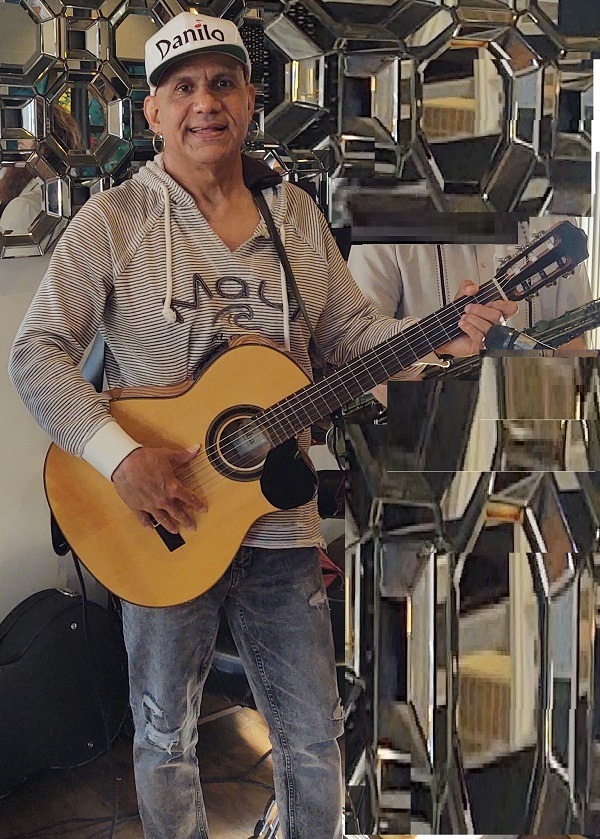
Danilo on guitar at one of his frequent restaurant performances

You are Francisco Pancho Perez’s grandson. Did your grandfather serve as inspiration for the path you would take in music?

Definitely he did. I remember being about four or five years old when I used to hear my grandfather play with his big band, which was composed of 15 or 14 musicians. I always listened to them practicing in our house and started dancing, so my grandfather used to call me cha cha chá. It was a great inspiration for me.

He played music similar to American jazz, and that’s where the inspiration for the music I play today comes from. The salsa that I write is inspired precisely by that kind of jazz.

Where does the name Danilo come from? Also, why is your orchestra called Danilo Y Su Orquesta Universal?

I have to make it clear that Danilo is my middle name since I was born. This is not a nickname as many believe. Some people even think that I have changed my name, but I didn’t. Roger Danilo Páiz Perez has always been my name.

Everyone called me Roger Páiz in the past, that is to say, people called me by my first and last name. In fact, when I played with Rubén Blades in 1989, the album we recorded has me in the credits as Roger Páiz. But when I founded my own orchestra in the 1990s, I thought Danilo was better suited to Latin music, so I started using my middle name to call my orchestra Danilo Y Su Orquesta Universal.

The word universal comes from the fact that I am a Buddhist. I practice the religion of Nichiren Daishonin (monk in Buddhism from Japan in the 13th century and founder of the branch of Nichiren Buddhism) for more than 30 years. That word is widely used in the Buddhist scriptures, and I am very involved in that.

Roger Páiz getting ready to hit with Josh Jones’ band

Your country of origin is Nicaragua. Is Nicaraguan salsa similar to Californian salsa? Are they different? Do you combine them?

Since I was very young, I listened to a lot of Cuban orchestras. I remember my dad tuning in to Celia Cruz, La Sonora Matanzera, among others. From that experience, I picked up all those things since childhood.

Here in the United States, the style was much more modernized. However, I grew up listening to El Gran Combo de Puerto Rico and many other orchestras in the ‘60s and ‘70s. My biggest inspirations were Héctor Lavoe, Oscar De León, Rafael de Jesús, Cheo Feliciano and many others from those years. I paid a lot of attention to how they sang and the melodies that they used.

What Danilo has learned from his musical references

You have made contact with Latin music stars such as Ray Barretto, Rubén Blades, Benny Velarde Y Su Super Combo, Andy Narell, Ray Obiedo, Cheo Feliciano, Oscar De León and many others. What did you learn from all these musical references?

For example, I shared a gig with Cheo Feliciano in Puerto Rico while I was with Rubén at a concert. (Luis Enrique was actually at that concert as well.) Cheo taught me how to phrase with the clave, since this is a very important detail in singing Salsa.

In the case of Héctor Lavoe, I learned a lot from the melodic part. When he sang, the melody was very interesting and appealed to me a lot.

Another singer I liked a lot was Rafael de Jesús, because his style tended to sound like jazz. Sometimes he sang some lines that sounded very jazzy, but he never lost his style as a Salsa singer. That’s one of the main things I liked about him.

Another singer I liked a lot was Rafael de Jesús because his style tended to sound like jazz. Sometimes he sang some lines that sounded very jazzy, but he never lost his condition as a salsa singer. That’s one of the main things I liked about him.

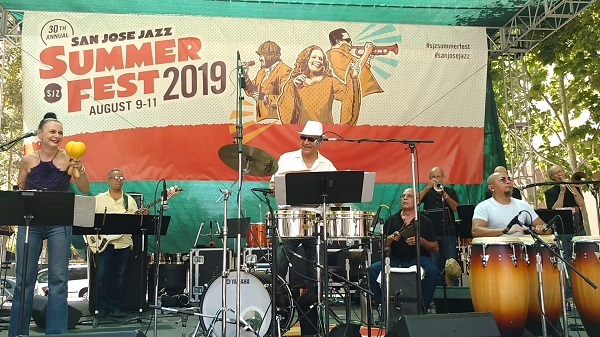
Danilo y Su Orquesta Universal at the San Jose Jazz Summer Fest 2019

Did he receive academic training in music?

I took classes  in Oakland, California, learning music theory, piano, singing, and much more. These studies helped me a lot to better prepare myself musically speaking.

Studying music is important because it enhances the way you perform, sing, and play on stage. That’s when people can tell whether you are a musician who has studied and analyzed music. I’ve met musicians who learned everything by ear and they never progress to the next level.

Of course, there were also things I learned on the stage, in the studio and in rehearsals. I’ve unified all this knowledge to do my job to the best of my ability.

I saw that you have some dates to perform in the Bay Area and other places, can you tell us a little bit about that?

In 1995, I got the opportunity to take a group to Singapore (to be the house band at the Hyatt Regency Hotel). What I did was to find the best six musicians who could play the music I was asked to play. We rehearsed, traveled to Singapore, and stayed there about three months, all expenses paid. It was an amazing experience and I was honored to present my music in that country.

Danilo with Tito Puente, Jr.

What about your current performances?

We just played at La Peña here in Berkeley. It was really good, a lot of people showed up there and they recorded the whole show. Fans sent me some videos as well, so I have to start editing them.

We also played at The Ramp, El Rio, The Turf Club, Kimbara, among others. Coming up, we will be playing at the Cigar Bar.

Let’s talk about your latest album Perseverando.

I decided to call this album Perseverando because of my experience of overcoming the difficulties of maintaining a music career.

Turning to Buddhism, the word perseverando is very important, because life puts barriers in your way and you have to persevere to overcome them. It was common for record labels to say that they were saturated and couldn’t sign me, but I kept writing and recording original music despite the difficulties. The first album is called Vivencias and the second one is called Avanzando. They are titles that have had a lot to do with my life experiences.

I made a video for one of the songs on this álbum, Rumberos de la Bahia, which is on YouTube: https://youtu.be/z3E7K_5SLJo

What other projects do you have pending?

I’m thinking about putting out an album that will be a combination of songs that have not been released yet with some remixes of songs on my albums. Although a dream of mine is to be nominated for a Grammy, that is not why I créate music. Music is my life and my passion.

Cover of the album Perseverando


Home

This is Josean Rivera and his incredible talent in salsa and other genres

How it all started

Today we are going to talk with Puerto Rican composer and vocalist José Manuel Rivera Rivera, better known as Josean Rivera (https://www.facebook.com/unsoneroparaelpueblo). Pleasure to meet you, Mr. Rivera, how are you doing? It is lovely to have you here.

Thank you so much for the invitation. Thank heaven I’m fine and I hope you’re too.

This is Josean Rivera, Puerto Rican composer and vocalist

Your name is José Manuel Rivera Rivera, but you are known artistically as Josean Rivera. Where does this name come from?

That’s a nickname my parents called me since very early childhood. I don’t know where it came from because my name is José Manuel. Instead, Josean is almost always used for people named José Antonio or José Ángel, but I’ve always been called that and ot still is (chuckles).

And you are still called that way to this day.

Yes, to this day. This is so.

I understand that you knew your calling as a vocalist when you were 15 years old. How did this happen?

More or less. I became interested in music long before that, but I liked percussion instruments such as the conga or the timpani. Through some friends, I met Miguel El Pollo Torres from El Gran Combo de Puerto Rico and used to go to the patron saint festivities. When I saw the dynamic Charlie, Papo and Jerry had when singing with El Gran Combo, I said I like that, let’s see what can be done.

In one of your most recent songs, you paid tribute to Raphy Leavitt. What did this pianist and La Selecta represent for the rest of your career?

A very important stage because it was my first participation in a renowned orchestra. I had many experiences and learned a lot from him, Sammy, Carlitos and the rest of the membership. They were like a family.

I understand that you were in medical school and, later, in the army. How did you combine these activities with your role as an artist?

I started studying medicine and then I understood it wasn’t my thing, so I joined the army. Everywhere I went, I always found local orchestras playing traditional salsa or covers. Also, working in the U.S. Army is not like that of other countries where soldiers are not allowed to go out and spend locked up. In our case, it was a normal job like any other, so we were able to engange in other activities with no problem.

However, when we had to travel to other places, we had to get some time off of work, take a vacation and stuff like that.

Raphy Leavitt and La Selecta were very important for his carrer

Music and the army

Many of your Puerto Rican-born colleagues also followed the military path when they go to the United States. Did you find any of your colleagues in the army? If so, did that help you or influence you in any way?

By sharing some time and being part of many shows with people from the armed forces or international singers who were going to perform where we were, I was able to sing with them and do the chorus for them. I think that helped me a lot.

I read that it was in the year 2016 when you decided to found your own orchestra. What led you to that? What made you then become a soloist?

What happened is that I belonged to the orchestra of Raphy Marrero, so I recorded two albums with him. The thing is that I was moved from one base to another, which made it very difficult for me to meet with the orchestra and do my activities with them, so I decided to try something by myself and see how it went.

Do you feel that you have achieved your goals or still have a long way to go?

We have achieved a great deal. As a soloist, I have made four musical productions and am working on the fifth one. We have already selected the songs and the arrangements, so we are going to start recording very soon.

The dream of every artist is to be able to play on stage and, owing to the whole issue of Covid and quarantine, all the activity decreased, but little by little things are getting back to normal.

You have experienced everything from classical to modern salsa, which is the style you enjoy singing best?

Since I grew up with El Gran Combo, La Sonora Ponceña, Willie Rosario and Bobby Valentín, of course that kind of salsa is my strongest point. I grew up in that environment where salsa is a little braver, but you have to sing anything because you have to try to please everyone.

Josean Rivera loves salsa brava, but sing anything

With what other musical genres have you experimented or would you like to experiment?

In the different orchestras in which I was, I got to sing merengue, bolero, cha cha chá and things like that. I can sing anything. In fact, I’ve come to sing some boleros in my albums as a soloist.

Which of these genres attrack most people?

Merengue and bachata are very popular.

What did you do during the pandemic?

We decided to make a new abum and used all that confinement time to select the songs for the album.

Have you returned to the stage?

I’ve already toured two or three times. I went to Washington, Seattle, Florida, among others. God Lord willing, we’re going to go to Colombia, Peru, Panama, and Mexico. We’re promoting the latest album Esto No Es Secreto.

What advice would you give to young artists who want to devote themselves to these genres?

My advice to those who want to start an artistic career is to dare to do so. The means to get ahead are there. You have to be active, let people get to know you and make promotions in different countries because that is how your music will reach the world. You have to keep moving forward and never giving up.

The biggest problem that these young artists will have to go through, based on your understanding.

I think the biggest problem is that there are no record labels anymore. One of the biggest obstacles is the budget for an album, whether it is a complete production or just one single at a time. It costs money.

Since there are no record labels to support you financially, it’s hard for the newer artists to record their albums.

Josean Rivera singing on stage

The latest news in the world of salsa in January

The latest news about the world of salsa

As usual, Johnny Cruz brings us the latest news about the world of salsa in New York. This month is very special, as there are currently many new musical productions made by some of the most famous Latin music groups of recent times. In addition, we talk a little about upcoming events at one of the most recognized venues in all of New York.  

New recording by El Gran Combo de Puerto Rico

It was recently announced that El Gran Combo de Puerto Rico has released its latest album entitled De Trulla Con El Combo, the first Christmas musical work in decades. The album contains a total of 10 songs with a focus on lighthearted and Christmas themes, which are very popular in the Island of Enchantment. This could make more than one boricua return to his roots and remember what this wonderful time of year was like at his birthplace. 

Let us recall that the orchestra had already released a Christmas album called La Fiesta de Pilito in 1985, so it is not the first time that the Puerto Rican group experiences this type of themes for some of its musical productions. 

Something that makes Rafael Ithier, director of the orchestra, very proud is that they managed to create the album in a very short time, thing that did not happen with their other Christmas works. Evidently, these times of pandemic were extremely productive for the Gran Combo, which is very near to celebrating its 60-year artistic career. Despite the prolonged time, this group of musicians has not yet lost what makes them unique in the public’s eyes.  

Cover of the album De trulla con el combo

New Christmas album by La Sonora Ponceña 

As well as the previous case, La Sonora Ponceña has done the same and released a new Christmas album entitled Christmas Star, which would be the fourth musical work of this kind that the group has done in its entire artistic career. 

What most characterizes this musical production is the use of themes that are largely related to the holiday season in Puerto Rico, something that will undoubtedly create a nostalgia feeling in many who listen to it.   

Enrique Pappo Lucca said they want to present a work which is as faithful as possible to the musical quality that has always characterized La Sonora Ponceña, but without losing the essence of what this season is and what it represents for Puerto Ricans. 

This album is available on digital platforms and physical stores for those who wish to purchase it and celebrate Christmas with this incredible group in the background.  

Cover of the album Christmas Star
Cover of the album Christmas Star by La Sonora Ponceña

Events at the Lehman Center for the Arts in the coming months 

The first big event at the Lehman for the Arts in January will be Manny Cruz’s first performance in the establishment. This talented Dominican will be delighting the audience on January 29 at 8 pm. It is worth mentioning that Cruz has been nominated for the Latin Grammy four times and the genres in which he specializes are ballad, pop, merengue and bachata. 

Almost a month later, Ballet Folklorico de Mexico de Amalia Hernández will perform at the Lehman Center to celebrate its 70th anniversary with a very special classical choreography for the occasion. The company’s last tour a few years ago was a resounding success and there is no doubt that this time will be no exception.   

Manny Cruz and his performance
Manny Cruz will perform at the Lehman Center for the Arts on January 29 2021

By: Johnny Cruz correspondent of International Salsa Magazine in New York City, New York

  • « Go to Previous Page
  • Page 1
  • Interim pages omitted …
  • Page 14
  • Page 15
  • Page 16
  • Page 17
  • Page 18
  • Interim pages omitted …
  • Page 24
  • Go to Next Page »

International Salsa Magazine (ISM) is a monthly publication about Salsa activities around the world, that has been publishing since 2007. It is a world network of volunteers coordinated by ISM Magazine. We are working to strengthen all the events by working together.