• Skip to primary navigation
  • Skip to main content

International Salsa Magazine

  • HOME
  • Previous editions
    • 2026
      • ISM / March 2026
      • ISM / February 2026
      • ISM / January 2026
    • 2025
      • ISM / December 2025
      • ISM / November 2025
      • ISM / October 2025
      • ISM / September 2025
      • ISM / August 2025
      • ISM / July 2025
      • ISM / June 2025
      • ISM / May2025
      • ISM / April 2025
      • ISM / March 2025
      • ISM / February 2025
      • ISM / January 2025
    • 2024
      • ISM / December 2024
      • ISM / November 2024
      • ISM / October 2024
      • ISM / September 2024
      • ISM / August 2024
      • ISM / July 2024
      • ISM / June 2024
      • ISM / May 2024
      • ISM / April 2024
      • ISM / March 2024
      • ISM / February 2024
      • ISM / January 2024
    • 2023
      • ISM / December 2023
      • ISM / November 2023
      • ISM / October 2023
      • ISM – September 2023
      • ISM – August 2023
      • ISM July 2023
      • ISM Edition June 2023
      • ISM – May 2023
      • ISM April 2023
      • ISM March 2023
      • ISM February 2023
      • ISM January 2023
    • 2022
      • ISM December 2022
      • ISM November 2022
      • ISM October 2022
      • ISM September 2022
      • ISM August 2022
      • ISM July 2022
      • ISM June 2022
      • ISM May 2022
      • ISM February 2022
      • ISM January 2022
    • 2021
      • ISM December 2021
      • ISM November 2021
      • ISM October – 2021
      • ISM September 2021
      • ISM August 2021
      • ISM July 2021
      • ISM May 2021
      • ISM April 2021
      • ISM June 2021
      • ISM March 2021
      • ISM February 2021
      • ISM January 2021
    • 2020
      • ISM December 2020
      • ISM November 2020
      • ISM October 2020
      • ISM September 2020
      • ISM August 2020
      • ISM July 2020
      • ISM June 2020
      • ISM May 2020
      • ISM April 2020
      • ISM March 2020
      • ISM February 2020
      • ISM January 2020
    • 2019
      • ISM December 2019
      • ISM November 2019
      • ISM October 2019
      • ISM Septembre 2019
      • ISM August 2019
      • ISM July 2019
      • ISM June 2019
  • Download Salsa App
    • Android
    • Apple
  • Spanish

Search Results for: El Gran Combo de Puerto Rico

Johnny Cruz – Let’s support the artists who continue working

North America / United States

The latin music from the Johnny Cruz view

We are about to end this 2020 so atypical and challenging for everyone. Especially for artists who make a living from shows and entertainment. I want to congratulate all those who keep up working despite adversity. I also take advantage of the season to thank those who accompany us to make each and every one of our projects possible, and of course, to God, for the health and recovery of those who have had relapses throughout this year. Thank you all!

Johnny Cruz from New York
Johnny Cruz is the president of Spanish Harlem Salsa Gallery

My recognition goes to Ismael Miranda.

This Puerto Rican artist became famous during the salsa explosion of the 70s in New York, his fans called him “El niño bonito de la salsa”. Miranda was still a teenager when he recorded with the Larry Harlow Orchestra and joined the Fania All Stars.

Then came a solo career of extraordinary quality. Known for his professionalism and healthy habits, Miranda continues to record and perform concerts with his voice as vital as ever.

He recorded his first album at 16 with the Joey Pastrana orchestra. Then he went to Larry Harlow and began to seek his own identity and have more respect for music. He confesses that at first he did not take his music career so seriously, and although there were women and drugs, he never disrespected his directors or the public.

“When fame falls on you and you are not prepared, you become a person who is not very nice, who thinks that he is more than anyone else. I was an inexperienced baby, but I was catching up little by little.

Friends like Cheo Feliciano and Pete “El Conde” Rodríguez watched over me. Adalberto Santiago was always by my side. Santitos Colón — Tito Puente’s singer — became my compadre. With all those people that surrounded me, I had to start doing things as God intended so as not to lose their support,” he said in an interview. Given the good impression his performances with Andy Harlow made, his brother, Larry Harlow, called the Judío Maravilloso, decided to recruit him to his orchestra.

Ismael Miranda began his recording cycle with the album El exigente. Convinced of the potential of the young singer, in 1968, Larry launched a new production entitled Harlow Orchestra presents Ismael Miranda.

The successes were repeated with the recordings Electric Harlow, Tribute to Arsenio Rodríguez, Abran paso and Oportunidad. With Larry Harlow, Ismael also ventured into the field of composition, sharing credits with him on the songs “La revolucion”, “Guasasa”, “Arsenio”, “El malecón” and “Lamento de un guajiro”, among others.

He has also stated that the most unpleasant thing about his career is that being so young in the beginning, he has had to see iconic characters and great friends like Héctor Lavoe, Celia Cruz, La Lupe pass away.

Find it difficult to be alone after having so many friends. “Today the world is each one by his side. La Fania was not just a record company. We were a big family in which we all loved each other very much. Every time I hear another musician leave, my soul breaks. ”

In the 1980s he recorded several productions with his independent record label. He recorded in 1984 with the prestigious Cuban group Sonora Matancera for his old record company Fania.

In 1986 his album Versos de Nuestra Cultura, together with singer-songwriter José Nogueras, was one of the great successes of the Christmas season of that year. In 1988 he announced his intention to retire from the artistic media. But that idea never came to fruition. Ismael has recorded with his own record label, IM Records, and with the RMM company.

He has a very close family. He has been with his second marriage for 25 years and has also been with his first wife for another 25 years. All of his children are married and have their own businesses. He has 13 grandchildren and two great-grandchildren. Recently Ismael Miranda and José Alberto “El Canario” joined Daniel Peña in “Hijo Del Cañaveral” Daniel Peña, Dominican based in the city of Miami.

He is recognized for his percussion skills and for being a music producer. Peña has worked with music greats such as Tito Puente Jr., pianist Marlow Rosado, Ismael Miranda, pianists Richie Ray and Larry Harlow, Celia Cruz and Giovanni Hidalgo. In 2014, he made his debut with the album “Eleven”, dedicated to his children; and three years later I have released “Sancocho”, a project with eleven songs.

The Dominican presents his new single “Hijo del Cañaveral”, a production that he made together with two great masters of salsa, Ismael Miranda and José Alberto “El Canario”.

Gerardo Rivas releases his first solo single.

Gerardo Rivas first solo single
New song for this talented artist

Puerto Rican Gerardo Rivas delights his followers with the launch of his first solo song. “A derretir el hielo” is a salsa, composed by Juan José Hernández and Victor Sanabria López, with musical production by Marcos Sánchez.

A few weeks after its premiere, the video clip has almost thirty thousand views on YouTube. The work leads to mysticism and contains a refreshing proposal. The direction was the work of Giova González and was filmed in San Juan, Puerto Rico. “Vamos a juntar los cuerpos bella, vamos a subir al cielo, vamos a prender la vela bella, vamos a derretir el hielo” the chorus quotes.

After more than a decade belonging to the group NG2, Puerto Rican salsa duo Rivas decided to try it on their own. “With great humility I present my first solo work. All my life I have been involved in music and daring to do a solo project feels very good “, declared Rivas. The singer is the son of Jerry Rivas, who belongs to “El Gran Combo”. From a very young age he has been immersed in the musical world. He was the vocalist of the group “Gerardito y los rockolos”.

In addition, it has around twenty-five years of experience. Rivas has always been a believer in salsa, bets on it and defends it in each presentation. A faithful representative of the genre!

The new success of Papo Rosario with Luisito Carrion and Isidro Infante!

This is the land where I was born. Papo Rosario is a world-class artist who has put the name of Puerto Rico high. Rosario, who withdrew in 2019 from the group considered the “Universidad de la salsa”, El Gran combo de Puerto Rico, after having an accident and presenting health problems, affirms that he already feels ready to resume his musical career with the Launch of his first solo production by producer Isidro Infante.

From this new album, we have their second single that cannot be missed. Without jumping on stage as before, but maintaining the grace of his movements, the singer Papo Rosario continues to work on his return to salsa with maestro Isidro Infante, who was the musical director of Fania All Stars. Rosario retired from El Gran Combo de Puerto Rico in 2019, after 38 years, as a result of a tumor in the spine, with which he battled since 2000, when he was operated on for the first time. This was followed by a second surgery in 2005, a third in 2017, and a fourth and fifth in 2018.

“They took out the whole tumor, which shot up as it pleased. In 2017 they removed 70% of the tumor on my right side, equivalent to a football. In 2018 they rebuilt my spine because the tumor ate a lot. I have a titanium spine, a scaffold on my back with rods that keep me on my feet. They removed 30% of the tumor on my left side in 2018,”, explained the singer. The medical prognosis indicated that he would not walk again.

“After so much therapy, I feel super good. After the operation, he said: let it be the will of Father God, it was not known if he was walking or not. I am up in the fight and grateful to God and to all the people for their prayers, which have contributed greatly to my health ”, the now soloist has stated in recent interviews. Rosario’s relationship with Infante dates back to adolescence, when they studied at Central High School in Santurce.

“I have always been an admirer of Isidro. We met around the world, he with the Fania and I with the Combo. People told me: ‘You have to do something’, I made up my mind and wanted Isidro to make a couple of arrangements for me”, he revealed. He has also stated that: “We come with traditional sauce, eventually something will be done with more mischief. The topics are everyday, nothing hurtful, but motivational in the middle of the quarantine. We do not want to come with bochinches, but to bring joy and give thanks ”. I wish you success today and always!

Gran Combo in concert
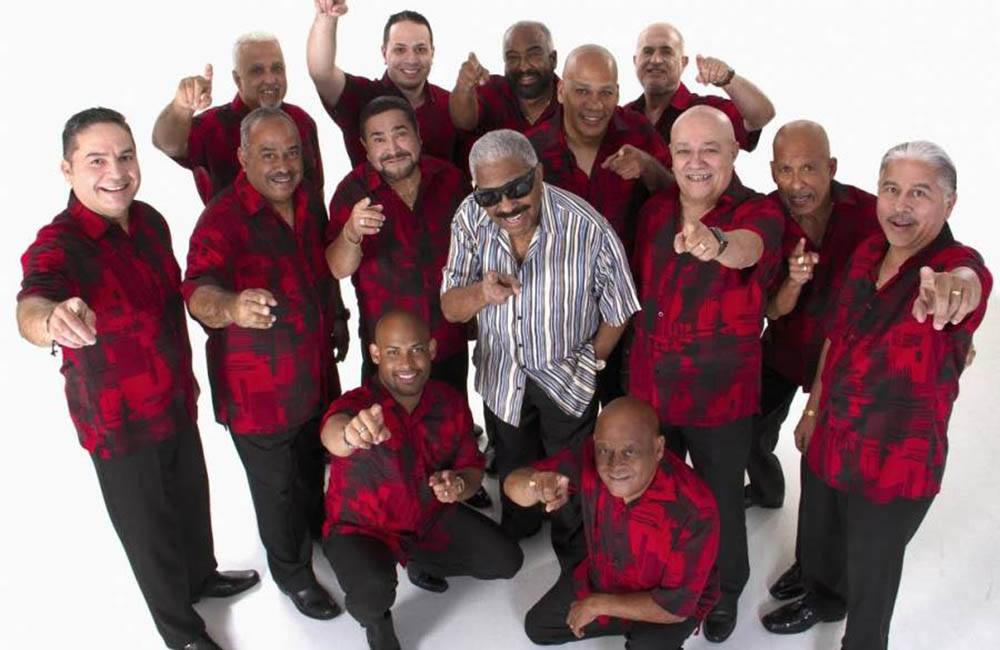
The Gran Combo de Puerto Rico announce concert (more artists)
The concert will be this November 14th ith more artists

El Gran Combo de Puerto Rico announced its first virtual concert for this November 14th from the Centro de Bellas Artes in Santurce. After almost eight months of inactivity due to the paralysis of the entertainment and events industry caused by the COVID-19 pandemic.

The “Mulatos del Sabor” have remained “bien guardados” during this period, but they understand that it is now “time to remove the mold and offer the sauce that we are asking for,” according to Jerry Rivas, vocalist of the veteran group. The so-called “Universidad de la Salsa” will offer on Saturday, November 14 at 9:00 p.m. the virtual show from the stage of the Centro de Bellas Artes (CBA), Luis A Ferré in Santurce. The mulatos have named the concert “El Gran Combo para el mundo”, since from the Spyntyx.com platform it can be enjoyed from any corner of the planet.

“The pandemic arrived and the whole world was paralyzed. But in the face of people’s requests and the messages that reached us about when they are going to do a show, we ventured into this format, which is new to us, but it is still an opportunity to reach more people anywhere in the world. In addition, we are going to present some of the themes of what will be our new record production “, mentioned Willie Sotelo, musical director of the group.

Sotelo and Rivas indicated that the founder of El Gran Combo, Rafael Ithier welcomed the virtual format, since like the rest of the members he is eager to return to the stage. Ithier turned 94 years old in August this year and has been very careful and cautious in preventing the spread of the coronavirus. So much so that for the birthday celebration the mulattoes surprised him with a sound bus at his house.

The musicians arrived at the front of Ithier’s residence and greeted him from the outside, and according to Rivas, days later the older mulato was tested for COVID-19 to verify that he is in good health. The virtual show will be prerecorded in some parts to avoid any mistakes. Tickets can be pre-purchased through spyntyx.com at a cost of $ 8.00.

The presentation will be a musical journey through hits such as: “Arroz con habichuelas”, “Sin salsa no hay paraíso”, “El problema está en el coco”, “Es la mujer”, “Achilipú”, “Colombia tierra querida”, “A mí me gusta mi pueblo”, “La espuma y la ola”, “El comején”, “La receta de amor”, “Alguien que me quite tu amor”,”Si la ves por ahí”, “Te veo, nena” y “No hay manera”, among others.

The group will integrate to the repertoire about three new songs as part of the musical production that they have worked in the months of the pandemic and that they hope to release before the end of 2020. “We had started the album before the pandemic, but these months have been perfect because by not traveling we have been able to dedicate ourselves to finishing the nine songs on the album. We are already in negotiations with record companies and the launch should be in December”, said Sotelo.

The group is invited every year to participate in the Feria de Cali at the end of December. This year, the invitation came to make the presentations in a small format capacity and in various tents that can maintain social distancing. The salsa orchestra has not confirmed its participation, so they are still evaluating the possibility of traveling to Colombia. Even so, in Puerto Rico they have six dates of Drive-In events and closed circuits confirmed for the holiday season. This never stops!

Adaberto Santiago 65th Anniversary

And if we are talking about incredible careers in this edition, I can’t stop talking about Adalberto Santiago and the new projects of the 65th anniversary with great artists of the genre. This time I can tell you about Cuco Peña’s string arrangements, the participation of Nelson Jaimes and, of course, the help of my friend Freddy Miranda. At 83 years old, he is still in the rumba. There is less and less to show the world this historical piece for the world of salsa.

Some invitations

The invitation to tune in to the new Fm / Internet radio station on Live365.com continues: Salsagallery. Good music, interviews with the artists and much more.

As always, remember that Spanish Harlem Salsa Gallery is in 1708 Lexington ave New York N.Y. 10029. Open free to the public all Thursdays & Fridays from 4 to 7 pm and Saturdays from 1 to 8 pm. Check the updates in our website: spahasalsagallery.com.

Also, The Johnny Cruz Show, the # 1 Salsa Show on television on all 5 Boroughs of New York on CH67. Saturdays from 3:30 to 4:30 pm.

Contact: Johnny Cruz. 917-747-8505. [email protected].
Home

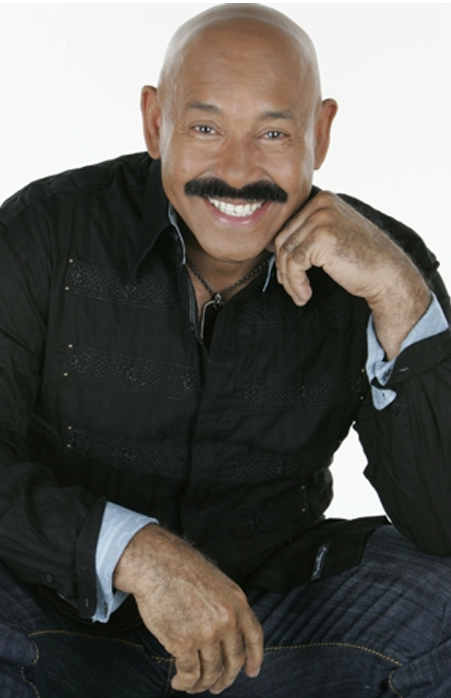
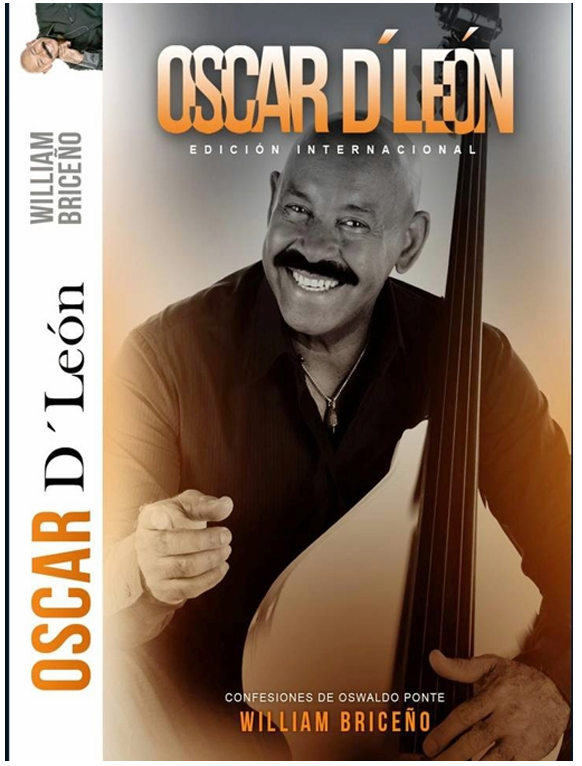
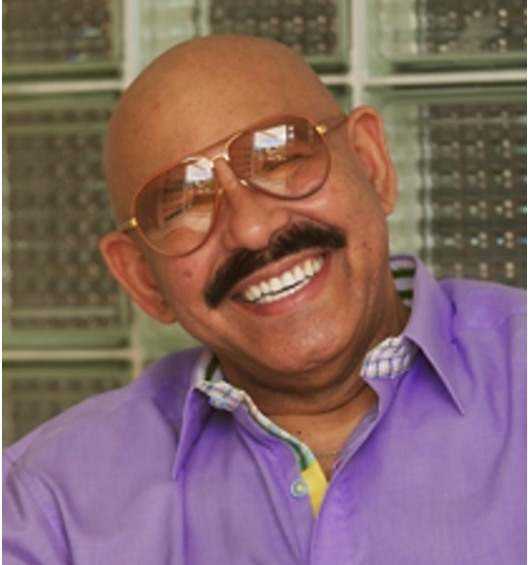
Oscar D’ León confessions of Oswaldo Ponte by William Briceño

Latinoamerica / Venezuela / Caracas
Oscar D' León
Oscar D’ León

Part 1

This book narrates the story of the famous singer Oscar D’ León from his birth and his life’s progress to who he is today; it also mentions how the era evolved, not only at a musical level but also regarding the situation of the country, both in Venezuela and other nations.

Before beginning to comment on the biography written by his manager, Oswaldo Ponte: biographies do not only try to remember great men who extend beyond their era. In this way, through this biography, the goal is to spread an idea about the work of the well-known artist “Oscar D’ León,” who has brought greatness to the country, crossing the line of his horizon and extending it toward other latitudes. One could say it is like a novel that not only speaks of successes or already known events, but also tells us about the reality of his life and not just what acquaintances or representatives of the artist think.

Photo1: Oscar D' León
Photo1: Oscar D’ León

The biography begins with the birth of Oscar Emilio León Simosa on July 11, 1943, in Caracas, Venezuela; where not only his family but other friends were present, one of whom ironically mentioned that in the future “he would be a great singer” since his crying was like a symphony. According to his mother, “Carmen Dionisia,” the midwife told her that he was born “enmantillado” (born with a caul), which meant the baby could have a multitude of gifts that he could take advantage of in the future.

It is worth mentioning that at an early age, he had more passion for music than for his studies, and he came to the conclusion that studies were not the best thing for his future; therefore, he dedicated himself to helping at his parents’ business to contribute to the household.

Since he was very young, he enjoyed listening to “Sonora Matancera” in a corner at night, which was the musical group of the era, and he would follow the percussion with his throat. He also listened to jazz orchestras, which led him to the conclusion that music would be his vocation; he was fascinated by listening to his mother hum the hits of 1953 by the Orquesta Aragón and Dámaso Pérez Prado.

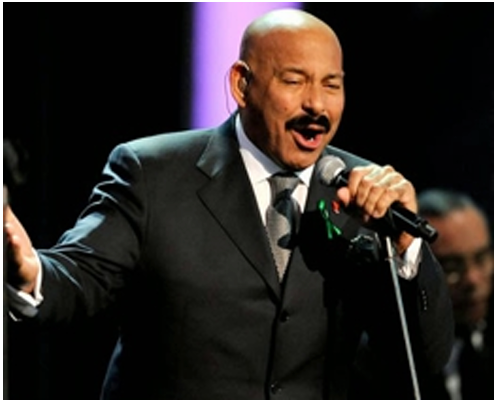
Oscar D' León - Photo 1
Oscar D’ León – Photo 1

Fortunately for the future singer, his family was passionate about music and had close relationships with musicians, singers, and players of all types of instruments even if they were not professionals. This warm, joyful, and above all, musical atmosphere embraced Oscar from the moment he was born. It was even shown that at an early age he had a certain interest in any object that emitted a musical sound, and he longed to learn how to use musical instruments. Despite having a humble family, Oscar himself managed to use various objects to create something that generated a musical sound and to discover his own rhythm, which he enjoyed at that time.

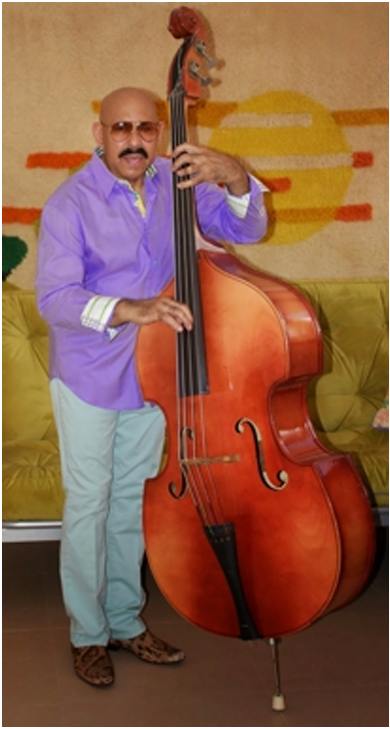
Oscar D' León - Photo 2
Oscar D’ León – Photo 2

Simosa, which was on July 11, 1943, in Caracas, Venezuela; where not only his family but other friends were present, and ironically one of them mentioned that in the future “he would be a great singer” because his crying was like a symphony. According to his mother, “Carmen Dionisia,” the midwife told her that at birth he was “born with a veil” (enmantillado), which meant the baby could have a multitude of gifts that he could take advantage of in the future.

During his adolescence in Venezuela, many significant political changes were occurring for the population; however, they did not stop celebrating festive seasons with his family even in difficult times. Many “parrandas” (parties) were held, something that Oscar enjoyed very much.

In 1958, he mentions that a phenomenon was occurring with the musical style of “Dámaso Pérez Prado’s Mambo”; also, at the Club Las Fuentes, the Sonora Matancera resonated with “Celia Cruz” alternating with the “Caracas Swing Boys”. A movement of orchestras influenced by foreign rhythms that thrilled Venezuelans began to be observed on a national level, such as Billo’s, which won the precious title of the most popular orchestra in Venezuela. Oscar was not interested in societal events, except for events in Cuba, since Cuban music was what fascinated him.

Photo: Oscar D' León confessions of Oswaldo Ponte by William Briceño
Photo: Oscar D’ León confessions of Oswaldo Ponte by William Briceño

Starting in 1962, he became a father, and marveled by his new life and his firstborn, he dedicated himself to his role as a father, keeping his family supported by working; this caused him to step away from music, and his maturity can be witnessed despite his age.

By the age of 23, he already knew how to sing and play the bass; over time, he met friends who would influence great changes in his future life. In 1966, he met Kiko Pacheco, who invited him to the group “Los Junior,” where he would begin his professional career. During that same year, salsa was taking off in Venezuela, as it was heard on all the country’s radio stations.

During that era, life was expensive, so he worked hard both in clubs and discotheques or as a taxi driver. On one occasion, Kiko Pacheco asked Oscar to sing in the “Quinteto Los Junior” because their vocalist had to leave; this allowed Oscar to demonstrate his talent, and from that moment on, everyone was enchanted upon hearing him, and his musical profession began. Later, “La Dimensión Latina” was created, which at that time was known as “Dimensión Seis,” founded by Oscar D’ León and Cesar Monge.

The members who formed “La Dimensión Latina” were Oscar de León, Cesar Monge “Albóndiga,” and José Rojas “Rojita” on trombones; José Rodríguez “Joseíto” and Elio Pacheco on percussion; and Enrique “Culebra” Iriarte on piano. A significant event for Oscar was that, during their first rehearsals, he had a premonition of his success when they found the rhythm he wanted to hear and share with the rest of the musical world. This was proven during their first performance, which was a total success, leaving everyone who heard them stunned.

Oscar D' León singing
Oscar D’ León singing

From that moment on, with the debut of La Dimensión Latina, a new concept emerged that would change the landscape of popular Venezuelan music and make history both nationally and internationally with the rise of the legend Oscar D’ León. They began playing for five months at “La Distinción” from Friday to Saturday. On Sundays, after finishing there, they would go to El Junquito to continue the party, gaining so much popularity that some felt they should launch an international career. During that time, singer-songwriter Mireya Delgado hired them after being impressed by seeing them perform on stage.

They played on a cruise ship during a one-week tour through different Caribbean islands and achieved great success despite the inconveniences they faced. They paid these no mind, as they dedicated themselves wholeheartedly to playing for their audience. This caused venues to become packed, captivating their fans who idolized them. From that point forward, many people began wanting to hire them for various events.

Here is the translation of the text into American English:

In that same year, 1972, a dizzying and unstoppable recording career began. This was based on the fact that executive representatives from the TH label heard two tracks: one was “Oye mi canto,” which was a hit for Gran Combo de Puerto Rico, and the other was “Te voy a cortar las patas” by Oscar D’ León. Because this made a great impact and created absolute conviction among the executives that they were witnessing a success, the promoter Mesone, upon hearing them, agreed to carry out a recording. This recording was shared with the Víctor Mendoza Orchestra, one of the TH producers in Venezuela: El Clan de Víctor.

2- Oscar D' León
2- Oscar D’ León

The album featured three tracks by Oscar; he recorded two of them with Dimensión Latina and the other with El Clan de Víctor. However, he does not appear as the author in the credits. The same thing happened with an album in 1991 when recording the album Auténtico. Among the 80 tracks that Oscar wrote, two of them are his immortal classics and of his authorship: “Llorarás” and “Detalles”.

For the first time in Venezuela, Salsa festivals were held that moved everyone. From that moment on, a true proliferation of salsa was witnessed in the country, all thanks to “Pensando en ti,” which had a major impact on the history of Venezuelan popular music.

After the success of his new discography—which contains “La comprita,” “Barranquilla,” and “Barranquilla y Quiéreme,” among others—three important international contracts were signed. Oscar and Dimensión Latina would go to Curaçao, Aruba, and Bonaire; that same year, they would also go to Colombia and Santo Domingo. However, it is worth noting that the period from “Pensando en ti” to “Que bailen to’s” covered the stage that catapulted him internationally.

Here is the translation of the text into American English:

The production of Dimensión Latina’s 1975 discography was the one that left an eternal mark, whose immortality was glimpsed from the very moment of its appearance. Its tracks focused on themes of romantic heartbreak. However, the rhythmic conception of “Llorarás” was the most important conception and structure of Oscar D’ León and Dimensión Latina; in fact, the song “Llorarás” marked the rupture of the old dance empire represented by Billo’s, and Dimensión came to be considered the “Billo’s of Salsa”.

An important subject in the world of music tells us in this book that: “salsa singers used phrases worn out by the use of previous generations who popularized them; in contrast, Oscar projected original modifications created by him”.

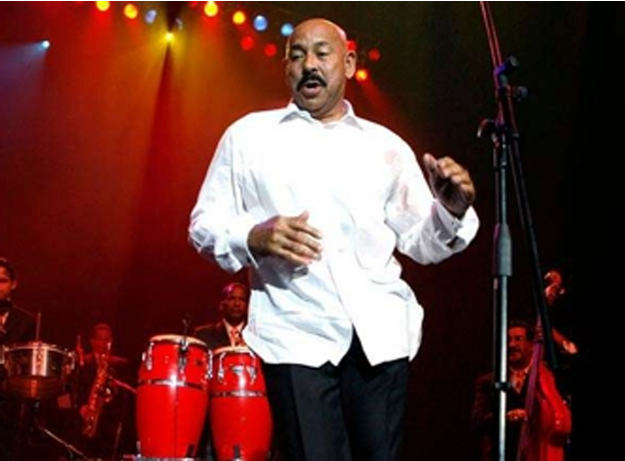
Oscar D' León in concert
Oscar D’ León in concert

When they traveled to New York, Oscar was very excited by the different stories he had experienced in the music world, and they were even happier to perform for the first time in the impressive metropolis. It was there where that musical genre that transformed them into idols, “Salsa,” was projected.

As time passes, Oscar manages to establish his own style and never changed it while climbing the steps of popularity and fame; the same happened with Dimensión Latina, though without achieving the countless triumphs Oscar D’ León obtained until his departure.

If you wish to know more about the history of Oscar D’ León, we recommend reading “Oscar D’ León: Confessions of Oswaldo Ponte by William Briceño, Editorial Fundación Simón Bolívar” to learn about the continuation, as it is a very broad topic to describe in this first part; likewise, in our next edition, we will conclude our final thoughts on this interesting and extensive biography.

Oscar D' León confessions of Oswaldo Ponte by William Briceño
Oscar D’ León confessions of Oswaldo Ponte by William Briceño


Manhattan Latin Music by Jon Horn

In the year after the big war ended, a terrific hurricane tore across the island, and in the town of Santa Barbara de la Loma the Catholic church was destroyed, but the modest compound of Senora– devotee of the seven powers and gifted daughter of Yemaya, spirit of the seas – went untouched by the storm. The people of Santa Barbara were not surprised. They called Senora “La Poderosa,” the powerful one, for she could heal the sick better than doctors, break and cast spells – but only for good – and see beyond the now and here. Believers in the natural religion came weekly to the walled yard behind her neat, two-room bohio to praise the mighty spirits who might possess them as they danced and chanted to the inspired drumming of the tumbadores.

On the next full moon, Senora called her gente to a special midnight ceremony. Dressed as always in immaculate white robe and turban, smoking a long cigar and swigging from a flask of rum, she told the assembly that Hate was hard at work everywhere, and worse things than hurricanes or even the war just fought were soon to come. Now they must all concentrate their prayerful energies and send goodness in the guise of music to an evil world. The native rhythms of their island, produced from the potent mix of slaves, colons, and indios, could bring people of all kinds and colors together. As dark hands beat out on taut skins a deep, steady roll like distant thunder, Senora called up into the moonlit sky: “May the babies born of Mambo be bringers of justice and peace where there is none! Go, my Mambo! Go now and work your musical magic at the center of the biggest city in the strongest nation on the earth!”

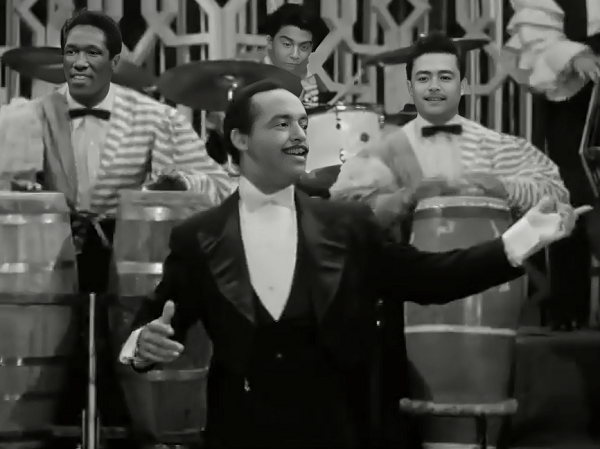
Damaso Pérez performing Latin music
The King of Mambo Damaso Pérez Pardo performing live

And the Mambo went and did all this, and much, much more…

Story goes that a certain midtown Manhattan dancehall was dying a slow death at the tag end of the Big Band era, just after the so-called “Good War.” The guy who was managing this musical venue (maybe for the Mob) was bemoaning the lack of customers to a canny Broadway promoter who poked a sallow finger at the bemoaner and said “Hey! If you don’t mind spics and
niggers in the joint, I can fill it six nights a week!” “At this point I don’t mind if it’s spics, niggers, or little green men!” “Done deal!”

Twas the season of Jackie Robinson “integrating” baseball’s major leagues. Smart money knew that American apartheid couldn’t last forever, at least not overtly. And where else would the winds of change blow first and hardest but in the Empire City, aka Nueva York? So the Palladium opened with a hot mambo policy, the best Afro-Cuban bands were hired, and lines formed around the block. Harlem and Spanish Harlem were now welcome in a big midtown venue. And not only “spics” and “niggers” showed up, but “wops” and yids” as well, the bridge-and-tunnel “mamboniks.” The word spread, and whitebread cafe-society mavericks came to check it out and stayed to shake a tail feather. For the next couple of decades it was the “place to be, thing to do” in NYC, if you wanted to move to and be sent by the best hot Latin sounds.

Around 1954/’55, the mambo crested in the Pop consciousness, with “Papa Loves Mambo,” “Mambo Italiano,” and “What The Heck is the Mambo?” on the mainstream Hit Parade. Perez Prado even took “Cherry Pink and Apple Blossom White” to Number One on the charts. But the real mambo, cha-cha- cha, guaracha, charanga, and son stayed underground, a niche thing, ethnic dance
music for Manhattan Latins and the cool cognoscenti. Raided and harassed by authorities who didn’t cotton to Mambo’s miscegenating powers, the Palladium lost its liquor license in the early ’60s and closed for good in ’66, just as the “new breed” wave of Latin Soul & Bugalu was making noise on the mean streets. And the beat goes on…

The Mamboniks were cool-looking Italian & Jewish guys & gals, out of high school but not in college, who hung out around Dubrow’s on the Hiway. If one of them had a dented sportscar or an old but flashy convertible, they’d congregate around the car at the curb, the dash radio loudly broadcasting Dick“Ricardo” Sugar’s mambo show of an evening, trying out hip-swinging cha-cha steps, casually dap guys and foxy girls in tight skirts; and tho the guys were not really hoods, they’d hang with future felons down the poolroom sometimes, and push a little weed to the hipper highschoolers, who whispered that these guys rolled queers in the Village for bucks and kicks…. but the big kick for the Mamboniks was the Latin Kick, hitting the Palladium at least once a week to hobnob with Ricans and Cubans and dap Harlem dudes and debs, all dressed up in continental suits and cocktail gowns, moving & grooving to the hot, blaring rhythms of Tito Puente and Tito Rodriguez, Eddie Palmieri, Joe Cuba, Orquesta Aragon, the La Playa Sextet, and many more smokin’ outfits who played en clave. Rest of the time they hung outside the cafeteria almost
under the BMT El, hanging on the Hiway but vibing they were too hip for the Hiway, still living at home in Brooklyn only ’cause it was free, but definitely on the way out and on up – or so it appeared to those a few years younger, hung up in mundane Midwood and Madison scenes. I didn’t really know the Mamboniks, but I knew who they were (the distance between 15 and 18 being even greater than between the Hiway and Broadway): one of them would fall with the felons and do time… another would marry his little sexpot cha-cha partner and go into the restaurant business downtown… yet another would become a musician/dope dealer, accent on the dope dealer. I only glimpsed these Mamboniks passing by Dubrow’s, but they called me (while ignoring me) to a more magical city than the one I knew as yet.

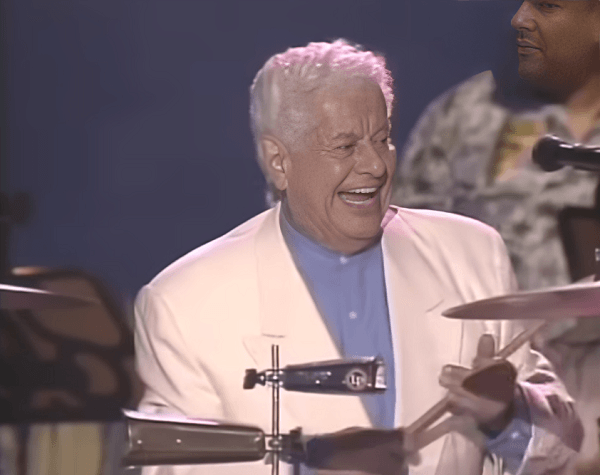
Tito Puente performing Latin music
Tito Puente performing ”Oye Como Va”

Jose de la Subway Speaks of Working the Mountains

There’s one or two agents book all the bands, and you best not get on their bad side! This guy I know from El Barrio, he plays timbales – he’s no Puente but he’s still young – he pulled me into this gig, subbing for the guy who was too fucked up on duji to make the job. We all meet at the bus terminal near the Dixie Hotel on the Deuce. Takes a couple hours to get up there and it’s real country, you can smell the trees! There’s these big Jewish hotels, they all book one Latin band to alternate with whatever square Pop band they got, and of course the biggest hotels get the big name bands and the smaller hotels get the cheaper bands who sometime hire kids just breaking in who look eighteen and can play some but don’t expect no union scale. You got this shack full of bunk beds to crash in, you eat leftover childrens’ meals – if there’s a hip Rican or Soul working in the kitchen you may get extras – and they don’t want to see your face around the place till showtime. Maybe they let you take a rowboat out on the lake, but you best stay away from the pool till you’re sent out there to play a cocktail set. They always call it an ‘Olympic-sized pool’ even if it’s four foot
deep! All these white chicks are out there in bikinis trying to get as dark as the people they don’t want in the pool with them. You play some cha-chas poolside late in the afternoon and you get to check out these chicks, some of them are hot, some give you the eye, but you wear shades and keep a stone face, and of course you’re high ’cause everybody be smokin’ weed in the band, that’s all you do, and you keep the job by keeping your distance from the hotel’s clientele. Some hustling bands be doubling, tearing around those mountain roads from one little hotel to another, making two jobs a night, wearing those ridiculous rhumba shirts with the big ruffled sleeves. After the last set everybody goes to eat and hang at Corey’s Chinese Restaurant in Liberty. When it’s Mambo Night at the Raleigh you sit in. And if you fuck up, or when the contract’s over, you’re back on the Hound to the Deuce, and you don’t have much loot to show for it. You’re paying your dues, you’re getting experience.

Musically, the late ’50s/early ’60s were dynamic times in NYC. Monk with Trane at the Five Spot, Ornette Coleman introducing “the new thing” aka “Free Jazz,” the hard-bop funk of “Moanin’” by Art Blakey’s Jazz Messengers, “Kind of Blue” by Miles, Trane’s classic quartet coming into its own with “Giant Steps” and “My Favorite Things.” And the Folk boomlet peaking in the Village
with Baez and Dylan, Paxton, Van Ronk, Ochs, and many more. R&B was in a slump and the Top 40 sucked bigtime… but over in Brooklyn and the Bronx, a new generation of Nuyoricans was coming of age, and tho they still dug the Afro-Cuban sounds, the mambo and the cha-cha-cha belonged to the (recent) past, so they were experimenting: Bronx Pachanga was revved-up charanga… trombones lent a harder edge to a conjunto like Eddie Palmieri’s La Perfecta… and “Latin Soul” was Doowop (a big influence en la calle) mated with the bolero feel and the bongo/congas beat. Joe Cuba knew he was onto something when his “To Be With You” (a bolero in English) became a street fave circa ’62/’63. Ace Cuban conguero Mongo Santamaria had a crossover hit of sorts with a jazzy horn chart on “Watermelon Man.” And Ray Barretto charted nationally with a speeded-up charanga featuring a streetwise Spanish rap superimposed: “El Watusi.” The times they were a-changin’ in the barrio. Joe Bataan was “Singin’ Some Soul.” Willie Colon was getting “Jazzy.” Eddie Palmieri’s hot, eight-minute jam on “Azucar Pa’ Ti” was a breakthru, played in its entirety on the radio by Symphony Sid and even by Dick Ricardo Sugar. Pete Rodriguez came on strong with the irresistible “I Like It Like That”… and the Latin Bugalu was a mid-’60s sub-genre (e.g. Johnny Colon’s “Boogaloo Blues”). But by the early ’70s, the newly branded “Salsa” hyped by Fania Records (the Latin Motown) prevailed, and Latin Soul’s swan songs were sung by Ralfi Pagan (“Make It With You”), and Paul Ortiz (“Tender Love & Sweet Caresses,” produced by “Subway Joe” Bataan). Musical artifacts remain, but as for the vibe, “You hadda be there, folks!”

That Latin Thing

The Afro-Cuban sounds, and the extensions and variations on those templates by their New York inheritors, were the hottest and coolest Latin sounds. Musicians have big ears, and there was always cross-fertilization between the seemingly segregated genres of Latin and Jazz (eventually producing – wait for it – Latin Jazz). So why aren’t more jazz buffs, and other musically savvy civilians, into the rich “Spanish Tinge” heritage? (They’ve always been into it in their own way down in Norlins.) Different languages as well as divergent styles, plus the commercial priorities of bottom-line execs who package musical product, perpetuate musically exclusive marketing niches, even unto today. But many stateside Jazz greats especially groovitated towards the Latin
thing. Dizzy Gillespie with Chano Pozo creating Cubop… Charlie Parker’s jams with Machito… Cal Tjader with Eddie Palmieri… Herbie Hancock’s “Watermelon Man” definitively rendered by Mongo Santamaria: these are some of the finest fruits of the Jazz + Latin marriages, and there have been many more in recent years. Yet the hardcore tipico and original classics are still all but unknown to generations of US Americans, and that’s a lowdown dirty shame.

Tio Jonny to the rescue! If you dig rhythms that won’t let you sit or stand still, or love to love a great love song, I’ve got two Latin strains to introduce into your musical bloodstream: superlative slow jams of yearning, ecstasy, betrayal, and loss in the best bittersweet boleros… and hip-shaking, toe-tapping dance classics of musica caliente. Maestro Cachao wasn’t just boasting when he titled one of his signature jam sessions in miniature “Como mi ritmo no hay dos.” There’s nothing quite like this Latin thing. But don’t take my word for it. Go check it out for yourselves, sis & bro!

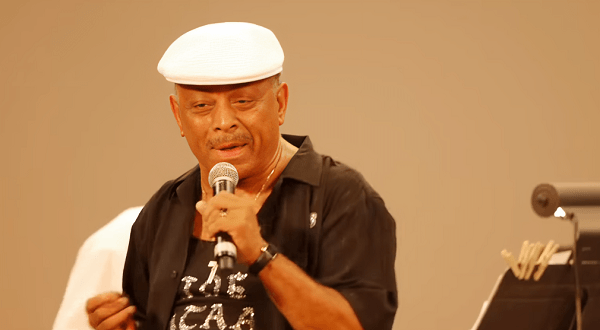
Joe Bataan singing Latin music
Joe Bataan singing ‘ ‘Gypsy Woman” some years ago

Musica Caliente 101

Salsa dura? Salsa Brava? Salsa romantica? Such consumer designations are so much caca de toro. To quote el rey Tito Puente, “Salsa is something you put on your food.” As a brand, “Salsa” moved a lot of units for Fania and other smaller labels in their heyday. But it was still music with Afro-Cuban roots, refined (or, purists might aver, debased) by Puerto Ricans and Nuyoricans, as insiders and aficionados well know. It was a music all about rhythm (we’ll consider the beautiful boleros shortly), pegged to the clave beat, where the Afro drums could sing melodiously while the Euro piano, violins, and horns remade themselves into rhythm instruments ( the repetitive, tension-building keyboard montunos, twin charanga fiddles, or twin trombones).

As the music morphed from Havana to New York, it got faster and louder (como no?), but the rhythms certainly didn’t cool down, tho they could sound hot and cool at the same time when vibes were featured, as in the ’50s party classic “Chop Suey Mambo” by Alfredito (Al Levy) or on many jams by T.P., Joe Cuba, or Latin-converso Cal Tjader. Anyone who felt this music in their bodies and souls (which are most definitely not separated in this art) would know this was musica caliente – and, as Ray Barretto titled one of his best workouts: “Que Viva la Musica.”

Say you’ve heard some of the great old school sounds and want to hear more? Tio Jonito is going to start you off with a sampler of the best (or at least some of my favorites) from the great days of this musica caliente, sometime in the late ’40s on into the ’70s. You go online and find these smokers on my list and you’ll not only get a little musical education but you’ll swing your butt off and have a ball. Vaya!

Orq. Casino de la Playa w/Miguelito Valdes: “Bruca Manigua”
Arsenio Rodriguez Orq.: “Dame un Cachito pa’ Huele”
Machito & his Afro-Cubans: “Tanga”
Chano Pozo: “El Pin-Pin” (nice later version by El Gran Combo)
Los Astros: “Que Lindo Yambu”
Arcano y sus Maravillas: “Rico Melao”
Sonora Matancera w/Celia Cruz: “Caramelos”
Sexteto La Playa: “Jamaiquino”
Randy Carlos: “Smoke” (“Humo”)
Fajardo y sus Estrellas: “Ay! Que Frio” (+ jazzy ’70s cover by Ocho)
Cortijo y su Combo w/Ismael Rivera: “El Negro Bembon”
Orquesta Aragon: “Caimitillo y Maranon”
Cachao y su Ritmo: “Malanga Amarillo”
Chappotin y sus Estrellas w/Miguelito Cuni: “Alto Songo”
Mongo Santamaria: “Afro Blue” “Para Ti”
Mongo Santamaria w/La Lupe: “Canta Bajo”
Tito Puente: “Oye Como Va” “Ran Kan Kan”
Eddie Palmieri & Cal Tjader: “Picadillo”
Tito Rodriguez & Orq.: “Mama Guela” “Ave Maria Morena”
Joe Cuba Sextet w/Cheo Feliciano: “El Raton”

Mon Rivera: “Lluvia con Nieve”
Orquesta Broadway: “Como Camino Maria”
Ray Barretto: “Cocinando”
Pete “Conde” Rodriguez w/Johnny Pacheco Orq.: “Azuquita Mami”
Willie Colon Orq. w/Hector LaVoe: “Abuelita”
Eddie Palmieri w/Charlie Palmieri: “Vamanos pa’l Monte”

Pete, Celiz, and Tito performing Latin music
Pete El Conde Rodríguez, Tito Puente, and Celiz Cruz performing ”Qué Bueno Baila Usted”

Boleros 101

Boleros are Latin love songs, and the best are equal to any operatic aria, Broadway show-stopper, or Pop ballad, especially those written and sung from the 1940s through the ’60s, the era of the bolero. Behind even the slowest bolero there’s a rhythmic roll (maintained by bongos, congas, or light timbales taps), analogous to the roll of “r” in spoken Spanish. Can’t abide musica romantica? The bolero, friend, is not for you. Latin America – notably Cuba, Mexico, and Puerto Rico – turned out great boleristas in the epica de oro, and the tunes they sang were world-class, true standards which sound just as strong today as ayer. But leave me not wax rapturous; rather let me share some of my fave boleros with you, and point you YouTubeward to hear them all.

Beny More: “Como Fue” “Hoy Como Ayer”
Olga Guillot: “Mienteme” “Tu Me Acostumbraste”
Trio Los Panchos: “Nosotros” “Sabor a Mi” “Los Dos”
Vicentico Valdes: “Tus Ojos” “La Montana”
Tito Rodriguez: “Inolvidable” “En La Soledad”
Los Tres Ases: “Delirio” “Estoy Perdido” “El Reloj”
Cheo Feliciano (w/Joe Cuba sextet): “Como Rien” “Incomparable”
La Lupe w/Tito Puente Orq.: “Que te Pedi”

Santos Colon w/Tito Puente Orq.: “Ay Carino”
Armando Manzanero: “Mia”
Los Tres Diamantes: “La Gloria eres Tu”
Javier Solis: “Si Te Olvides (La Mentira)”
Los Tres Caballeros: “La Barca” “Regalame Esta Noche”
Los Tres Reyes: “No Me Queda Mas”
Pedro Infante: “Contigo en la Distancia” “No Me Platiques Mas”
Jacaranda Castillon: “La Gata Bajo La Lluvia”

Read also: Dominican bandleader and singer Papo Ross is triumphing in Montreal

Albert Torres The Ambassador Of Salsa

North America / USA / New York
Albert Torres
Albert Torres

Albert Torres, a sympathetic boy with blushing cheeks who born in Brooklyn – New York – never suspected what his destiny had prepared him, to be the father of the Congresses of Salsa worldwide. His name would resound from North to South and from East to West, by the continents: American, European and Asian; in the different important scenes of the Latin music movement and would be the inspiration for many dancers of this branch.

His legacy would belong to the astonishment and shelter of the artists and the public that would applaud his talent, vigor and semblance to the rhythm of the phrase “Una Bulla”. This cheerful infant, without a doubt, was going to be a legend of Afro-Caribbean music. I’m talking about Albert Torres, The Ambassador of Salsa!

Photo by Albert Torres

Albert began to listen to the salsa genre from the age of 5, staring in astonishment at the whole scene, sitting, of his first dance lessons … At the famous Palladium in New York, where his mother danced and liked the music of Mongo Santamaría and Tito Puente.

This child, future congressman of Salsa, grew up when the history of Latin popular music (salsa) was being written in the South Bronx, where Puerto Rican communities were having a great explosion of creativity and musical activity.

At the age of 12 years old his family decides to move to Puerto Rico, “By that time I did not want to speak Spanish, I did not want to be Puerto Rican. I did not want to be part of that environment”, said Torres. He only danced disco and Hustle. However, at the age of 15 his life took a dizzying turn when he heard:

“Oye que lio que lio se va a formar

cuando mi gatito sepa

y es tan simple la razón

El que a su gata le cuenta que el que a

su gata le cuenta

no es nada más que un ratón

un ratón…

…Échale semilla a la maraca pa que

suenen

chacucha cuchu cucha cucha

échale semilla a las maracas pa que

suenen

échale semilla a esas maracas oye

chacucha cucha cucha cucha

y hace rato está sonando sonando

chacucha cucha cucha cucha…”


Albert Torres simply fell in love with the Salsa thanks to this theme: “El Ratón” of Cheo Feliciano together to Fania All Stars. “The legends of salsa changed my life. When I heard these legends, that August 26th of 1971, in the Cheetah, something happened inside me. The music entered by the feet and came to my heart”. Thus, declared his beginnings in the Salsa, Albert Torres.

In 1991 his passion for Salsa took him to impress the girls of the neighborhood by his incredible steps to a Hollywood celebrity when he, first time, participated in the movie Mambo Kings in which he was chosen as one of the main dancers.

Hollywood - Albert Torres
Hollywood – Albert Torres

There he not only helped Antonio Banderas with the dance steps, but also with the English by that time for Banderas was very hard. In addition, during the filming of the movie Albert had the opportunity to share with big of Salsa like Celia Cruz, José Alberto “El Canario” and his great idol Tito Puente.

That film was the hit that catapulted Torres to world fame being chosen by Debbie Allen as one of the 4 dancers (of more than 400 couples) to participate in the Academy Awards (1993) and to dance “My beautiful Maria” whose Singer was Plácido Domingo and where he stood out as the first Puerto Rican to dance in the history of the ceremony.

Then, he returns to the cinema being the choreographer and dancer of Salsa scenes in the romantic film “Dance with Me” with Vanessa Williams and Chayanne during 5 months.

Later he worked on the movie “Out to See” (1998) with Jack Lemmon and Walter Matteau and in the same year he also made a guest starring appearance on the Keenan Wayan’s Show where he performed with Jennifer Lopez. Everywhere there was Salsa, Torres seemed to be there. At the time and with all this like trajectory Albert Torres in 1991 also began his stage as a producer.

He started promoting Salsa clubs in Los Angeles, “I lost a lot of money. Nobody wanted to know about Salsa”, said Albert. Nonetheless, he began to handle Johnny Polanco y Su Conjunto Amistad, which were the best-known salsa group in the Western United States.

In 1992 he founded his own company, Albert Torres Productions Inc. (ATP) and began to organize salsa parties in several places in Los Angeles. The most important were the Boathouse in Santa Monica, St. Marks in Venice and Sportsmen’s Lodge in Studio City.

3- Albert Torres
3- Albert Torres

At that moment the genre of salsa was losing popularity. However, Albert Torres with his wit, insight and a lot of intelligence pulled him forward on his own. He revived it in such a way that he became the most influential salsa promoter in the United States. He was who brought to Los Angeles some of the most important names in the Latin music such as: Fania All-Stars, El Gran Combo, Oscar D ‘León, José Alberto “El Canario” and the Spanish Harlem Orchestra, among many others.

In the late 1990s, after the I administration of President Clinton relaxed the laws restricting presentations by Cuban artists in the USA, Albert Torres was the first promoter, who brought to the famous and the notorious Van Van group to Los Angeles in January, 1997.

The show, which took place in a night club in downtown LA, was a success. Since then, Los Van Van has received major media awareness with prestigious publications such as Los Angeles Times, New York Times, among others and including the most coveted music honor, a Grammy and Latin Grammy nomination. Torres’s passion and promotional skills have played a key role in the U.S.A Latin Entertainment explosion. Ricardo Lemvo, musician and singer living in Los Angeles, founder and leader of the salsa band Makina Loka said:

“Personally, I have a great deal of gratitude to Albert. In 1996 when I released my first album, Tata Masamba, he was the one who presented my music to the Latin audience in Los Angeles. He also placed my band at Sportsmen’s Lodge, Grand Park and many other venues. Albert was also who recommended me to film director Randa Haines and as a result, my band, Makina Loca came out in the movie “Dance with Me” with Chayanne and Vanessa Williams. I will be eternally grateful to Albert Torres for giving me a hand at the beginning of my career”.

4- Albert Torres
4- Albert Torres

1997 was crucial for Albert and the world of Salsa in Los Angeles because began the dream of Mr. Eli Irizarri of Puerto Rico, the concept of the Salsa Congresses in San Juan. “I was not the first year, but I heard a lot of nice things even though it was a financial failure. I attended the event in 1998 and was the master of ceremonies. Then, I started the same concept in Los Angeles beginning in 1999 and in the next 8 years following the Los Angeles Congress stood out as the largest in the world. There attend more than 6000 people daily arriving from more than 42 countries”, said Albert for an Argentine media.

In 1998, at the head of ATP, organized the first edition of Los Angeles Salsa Congress and in May 1999 was carried out, with the presentation of Tito Puente in the opening. In this first congress Albert transformed the event into an exciting music and dance venue that attracted 20,000 Latin Music enthusiasts from all over the world and USA and with such great success that he immediately became co-producer Salsa Congresses in over 32 countries.

“My most important desire to be a promoter of the Congresses would be that this can be used for dancers, can realize their dream of dancing on a stage and also find a way to respect the dancers as they deserve it. This is extremely important”. Albert Torres.

In LA Salsa Congress the stars are born, many of the world renowned dancers have their start at this event. The mission of LA Salsa Fest is to pass on to the next generation through educational seminars, dance workshops and being able to perform on stage.

Since then, Albert Torres Productions has created and produced the World’s Largest Salsa Music event. In addition to this, ATP is the co-producer of the World Salsa, broadcast from Las Vegas every year by the ESPN TV network being watched by more than 20 million homes worldwide, where more than 1000 competing dancers will be known on the planet. “On ESPN told me that if I wanted to see it on TV I had to do competitions.

I do not like it, but for the dancers to get to know each other worldwide, I decided to make the World Salsa Championship, the biggest and most important salsa tournament in the world. Now, since April (2012) I decided to do it alone, without partners, and now it’s called World Latin Dance Cup. I added other categories like cumbia, bachata, casino, children and people over 45 years. We have about 20 categories”. Torres Said in an interview with a Peruvian media.

5- Albert Torres
5- Albert Torres

In the World Latin Dance Cup No requirements. You have to take stock and follow the world rules. These are of time, originality of the dressing rooms, of musicality. If you drop the wig, the earring (while dancing), points are removed; if you do not wear stockings, too. A wig will not give points, but if it falls it will take the points. In this championship there is not a world champion, so there is a champion in each category.

According to his friends, Albert was a “workaholic”. He was always on the road promoting salsa music through all the congresses he organized around the world. Always in transit, he spent one night in Istanbul, the next in Paris and the following week in Tokyo. For example, at the beginning of 2007 he had 48 weeks of travel and in one year he could travel to 48 exotic countries such as Dubai, United Arab Emirates, Japan, Hong Kong, Brazil, Bulgaria, Romania, China, Colombia, Venezuela, Spain, Mexico, Peru, Holland, Hamburg, Italy, Switzerland, Sweden, France, Ecuador, New Zealand, Australia and Puerto Rico.

Therefore, it is not surprising to see on your Facebook wall, the immense and felt messages of thanks from dancers from all corners of the earth. His latest project called “The Legacy Project” is an initiative to combine our music culture with the latest technology tendencies in order to reach and unite more people so future generations can appreciate, preserve and be part of the history of Latin dance and music around the world.

In 2011 Albert Torres was honored to be accepted as a Member of the Council for Dance of UNESCO (United Nations Educational Scientific and Cultural Organization) and Elected Grand Marshall at the National New York Puerto Rican Day Parade in front of 2 million spectators lined up on 5th Ave that past June 12 of the same year. This past May, 25th the world of Salsa and entertainment received a huge impact, the news of the death of Albert Torres, victim of a Stroke.

Family, friends, national and international press as well as web portals lamented and reviewed this regrettable fact. Rudy Mangual, creator of the famous magazine Latin Beat Magazine commented to an international media that before this terrible fatal outcome, Albert was very delicate of health in the last months; he had diabetes and had an infection in the pancreas. He also said that he regretted his gone because he and his wife Yvette Mangual had a very special affection to Albert.

Albert Torres’s family wishes to thank all of our Salsa Family for your thoughts, prayers and well wishes during this difficult time. Albert passed away today May 25th, 2017, peacefully, surrounded by family and loved ones. We all find comfort knowing that he is now promoting and dancing alongside his Idols, Celia Cruz, Tito Puente, Cheo Feliciano, Tito Rodriguez and Ray Barreto. As well as his close friends Johnny Polanco, Rudy Regalado, Alicia Gomez and many others. We would love nothing more than for you to help us continue keeping his legacy and DREAM OF UNITY alive by supporting the great event that he started 19 years ago:

The LA SALSA FEST.

Thank you again and may you all be blessed. UNA BULLAAAA!

Rest In Peace ALBERT TORRES

6/14/1956 – 5/25/2017

On the other hand, different personalities of the artistic world expressed their deep pain:

“Salsa and I lost a good friend. Like everyone else in the music world, I was in shock: Albert was an exuberant, vibrant person. It seems unfair that he left the planet in the prime of his life at only 60 years old.

2- Albert Torres
2- Albert Torres

I remember in one of our many conversations, he expressed his great desire to bring the famous African salsa group Africando to the United States. Africando had a song, “Yay Boy,” that was all the rage not only in New York but also in Latin America, but not many people had seen the group live. It was a huge undertaking to organize a concert with Africando since the lead vocalists lived in Senegal, Togo, and other parts of Africa. When Albert finally managed to bring Africando to Los Angeles in 2004, he was over the moon. That was one of his greatest triumphs.

Albert, your passing is a huge blow to all of us in the salsa world. We will miss you terribly. Thank you for everything you’ve done to promote our music. Salsa. We will never forget you.

Rest in peace, brother.” Ricardo Lemvo

1- Albert Torres
1- Albert Torres

“Creating Unity through Salsa”, words from my brother Albert Torres. That’s exactly what we are trying to do, will keep this in my heart forever… Your legacy lives. Thank you Albert! Thank you Edwin and the #LASalsaFest team for this”. Tony Succa

Famed Salsa legend, dancer and Hollywood choreographer turned mega event planner Albert Torres is already part of our history. His continuous efforts to globalize Salsa have made a major impact on the preservation and accessibility of both Salsa Music and Salsa Dance around the world. To achieve this, he was constantly traveling around the world, encouraging conferences and festivals, discovering talents for dancing.

No doubt, Albert Torres brought the music it in the blood. He had his own vibration and constantly he was being a role model. He played that key role in the confluence of people and places that created an environment for the growth of Latin music in America and the world.

Photo1: Albert Torres

For that reason, on the Facebook wall of Albert thousands of emotions multiply. And the messages coincide in the gratefulness and the claim of “una bulla”, una bulla salsera para Albert. Today on some side of the Salsa´s Big, sure, you’re dancing and singing!

Albert Torres in solidarity with charitable causes

“Before I was an event producer, I handled 50 beds in a hospital helping people with drug, alcohol, and mental problems… I have been sober since December 14, 1985. For that, I can live and help others to live their Dreams”. Albert Torres

Great dancer and Champion fell ill last year after the WLDC. With the support of dancers worldwide he was able to beat leukimia and will be back this year. What an inspiration and great story. Let’s all appreciate each day that we are blessed with. Welcome back Jeremy.

ATP continues with the Albert’s legacy and offering top-notch quality events with world-class performers. His bands are legendary and his events feature some of the finest musicians and dancers the world has ever known.

“Para mí la salsa no es latina sino mundial. No tiene barreras de colores ni de país. Es increíble ver niños chiquitos bailar como los de los 80 que bailan… Para mí la salsa es como si fuera una paella, una comida increíble: tiene tantos condimentos y tantas cositas.

Albert Torres and his records

La salsa es así: con un poquito de rumba, jazz, tango, y si le pones swing, ballet y se mezclan todos con una bella canción de Óscar de León, algo sucede que nos afecta desde los tobillos hasta el corazón… Los problemas siempre van a estar esperándonos en casa, pero qué cosa bonita llegar a un lugar donde todo el mundo se lleva. Cuando empieza esa música todos tenemos algo en común. Ojalá el mundo aprendiera de eso”. Albert Torres (June 14, 1956 – May 25, 2017)

To learn more about Albert Torres and his events, please visit: www.worldlatindancecup.com, www.mysalsacongress.com and www.alberttorresproductions.com

To read more about Albert Torres’ work with Baile de Los Niños, providing cultural outreach programs to at-risk youth and low-income families, visit: www.alberttorresevents.com/bailedelo sninos/mission.asp

“Orquesta Zodiac” Its name came about due to the fact that in the early 70’s the ‘Walter Mercado’ program and the Zodiacal Signs were all the rage

In June 1971 what we know today as the Zodiac Orchestra was organized in the town of Loíza. Its name came about due to the fact that in the early 1970’s the Walter Mercado and the Zodiacal Signs program, which was broadcast on Channel 2 in Puerto Rico, was in vogue.

Tony Escobar’s uncle (the orchestra’s declamationist) suggested the name because it was an eye-catching and “new” name.

The Zodiac Orchestra was organized with members of a group called Loíza Power directed at that time by Paquito Pérez, who was 14 years old. In addition, it was nurtured with the best musicians of Loíza Sound of Javier Calcaño.

“Orquesta Zodíac” Su nombre surgió debido a que para principios de la década del '70 estaba de moda el programa de “Walter Mercado” y los Signos Zodiacales
“Orquesta Zodíac” Su nombre surgió debido a que para principios de la década del ’70 estaba de moda el programa de “Walter Mercado” y los Signos Zodiacales

The idea of recruiting these musicians was Paquito’s, since he grew up with José Luis Vizcarrondo and Tony Escobar.

Through Loiceño composers Carlos José Cirino (Tata) and Floren Ayala, the recording was achieved, as they approached Dario Gonzalez of Borinquen Record who contributed to make possible the release of the first 45 and LP. Tata’s “El Adiós” and José Feliciano’s “Las Costumbres” (1971) were part of this musical proposal that was very well received by the public.

This album became one of the best selling LPs. Other musical proposals of the group that would become hits were: “Panteón de Amor”  by Angel Laureano (1973), “Sinceridad” by Samuel Cirino, “Mi Guitarra” by Angel Laureano, among others. These great hits are frequently requested today on the Salsa Z-93 radio station.

After the initial success, many of the musicians dedicated themselves to work and to finish their studies, since they were married and were looking for security and economic stability for their respective families.

The Zodiac had the opportunity to travel to different cities in the United States such as: Boston, Connecticut, Philadelphia, New York, among others. They also traveled to other countries such as Colombia and others.

Orquesta Zodiac
Orquesta Zodiac

During these years, several orchestras were at their peak, such as: La Fania, La Selecta, Lebron Brother, La Corporación Latina, El Gran Combo, La Lupe, Chivirico Davila, Bobby Valentín, Tomy Olivencia, Ismael Miranda, Ricardo Rey, Roberto Rohena, Roberto Anglero, Justo Betancourt, among others.

In 1997 Paquito decided to retake and regroup the orchestra, and for some years he dedicated himself to reunite with the musicians and organize them again.

In 1999 he managed to restart La Orquesta Zodiac at the Z-95 festival in Mayagüez. Later they performed at the National Salsa Day dedicated to Cheo Feliciano in 1998.

These two presentations were made at the invitation of Pedro Arroyo (director of Z-93) to Paquito, and were a great success. El Gran Combo, Rubén Blades, Jimmy Zabater, La Solución, among others, also played in the tribute to Cheo.

The members of the current orchestra are young, and most of them were music students of Paquito Pérez, who worked as a music teacher for 30 years in the town of Loíza (before retiring).

José Luis Vizcarrondo, Tony Escobar and Paquito Pérez were schoolmates for years. The director of the orchestra in the beginning was José Luis, also collaborating with him were Tony Escobar (saxophonist and declamation player), Freddy Ayala (conguero) and Paquito Pérez (singer). All of them contributed ideas for the arrangements. Currently Víctor Pérez (Paquito’s brother) is the director of the wind section.

Orquesta Zodiac en el pueblo de Loíza

In 2010 the orchestra played in the National Salsa Day and in 2012 the orchestra played again in the same activity, but this time the activity was dedicated to La Orquesta Zodiac and La Corporación Latina. In which Z-93 gave them a well-deserved recognition and Paquito, José L, Tony, Tata, Laureano, and the rest of the new members of the orchestra were present.

Currently the orchestra meets periodically to practice, and are available for all kinds of activities.

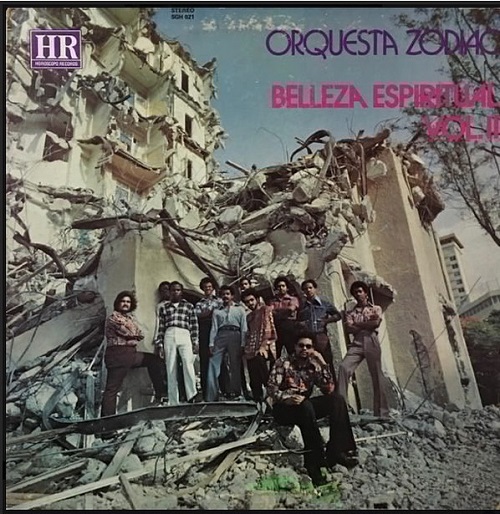
Did you know that…! In June 1971 what we know today as the “Zodiac Orchestra” was organized in the town of Loíza in Puerto Rico. Its name came about due to the fact that in the early 70’s the program “Walter Mercado” and the Zodiacal Signs, which was broadcasted on channel 2 in Puerto Rico, was in fashion. Tony Escobar’s uncle (declamationist of the orchestra) suggested the name because it was a striking and “new” name …Referring to the image of the post belongs to the second production of this Puerto Rican group entitled “Spiritual Beauty Vol. II” published in 1973 under the label “Horóscopo Récord” and directed by the founder, arranger, pianist and saxophonist Mr. José Luis Vizcarrondo. It is worth mentioning that this production includes the classics: Montuno de Oriente, Vicio de Amor and Belleza Espiritual”. Another important fact about the group is that it is still in force with musicians of the new generation, but with the same Swing and musical concept.

Segunda producción de dicha agrupación boricua titulada “Belleza Espiritual Vol. II” publicada para el año 1973

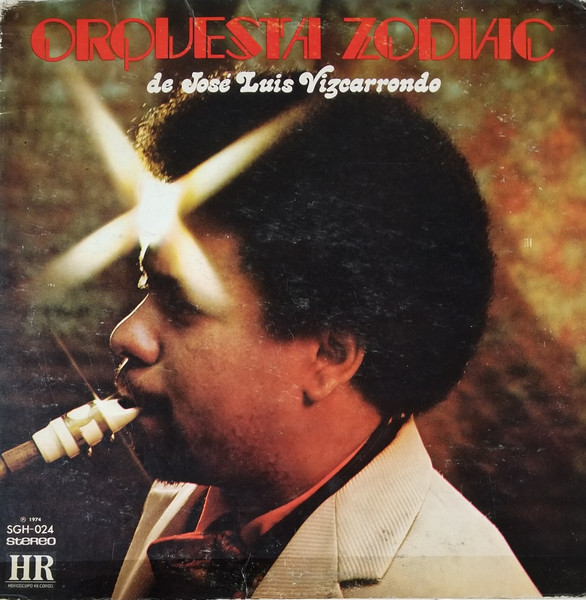
It is worth mentioning that the main responsible for making Orquesta Zodiac publicly known in Venezuela, Latin America and the Caribbean was Mr. Ali Delgado. Mr. Ali Delgado, for the year 1985 under the record label Performance Records, Delgado comments in detail that for the date of publication of this production the only popular sector (neighborhood) of Caracas where the Zodiac Orchestra was known was in Pinto Salinas.

Orquesta Zodiac De José Luis Vizcarrondo

Delgado is a music producer, music lover, collector, director and founder of the projects Salsa de La Mata and Jazz con Clave in Caracas.

Dj. Augusto Felibertt y Ali Delgado

Also Read: Sessions from La Loma brings together salsa fans from all over the world in Puerto Rico

  • « Go to Previous Page
  • Page 1
  • Interim pages omitted …
  • Page 16
  • Page 17
  • Page 18
  • Page 19
  • Page 20
  • Interim pages omitted …
  • Page 23
  • Go to Next Page »

International Salsa Magazine (ISM) is a monthly publication about Salsa activities around the world, that has been publishing since 2007. It is a world network of volunteers coordinated by ISM Magazine. We are working to strengthen all the events by working together.