• Skip to primary navigation
  • Skip to main content

International Salsa Magazine

  • Home
  • Previous editions
    • 2025
      • ISM / November 2025
      • ISM / October 2025
      • ISM / September 2025
      • ISM / August 2025
      • ISM / July 2025
      • ISM / June 2025
      • ISM / May2025
      • ISM / April 2025
      • ISM / March 2025
      • ISM / February 2025
      • ISM / January 2025
    • 2024
      • ISM / December 2024
      • ISM / November 2024
      • ISM / October 2024
      • ISM / September 2024
      • ISM / August 2024
      • ISM / July 2024
      • ISM / June 2024
      • ISM / May 2024
      • ISM / April 2024
      • ISM / March 2024
      • ISM / February 2024
      • ISM / January 2024
    • 2023
      • ISM / December 2023
      • ISM / November 2023
      • ISM / October 2023
      • ISM – September 2023
      • ISM – August 2023
      • ISM July 2023
      • ISM Edition June 2023
      • ISM – May 2023
      • ISM April 2023
      • ISM March 2023
      • ISM February 2023
      • ISM January 2023
    • 2022
      • ISM December 2022
      • ISM November 2022
      • ISM October 2022
      • ISM September 2022
      • ISM August 2022
      • ISM July 2022
      • ISM June 2022
      • ISM May 2022
      • ISM February 2022
      • ISM January 2022
    • 2021
      • ISM December 2021
      • ISM November 2021
      • ISM October – 2021
      • ISM September 2021
      • ISM August 2021
      • ISM July 2021
      • ISM May 2021
      • ISM April 2021
      • ISM June 2021
      • ISM March 2021
      • ISM February 2021
      • ISM January 2021
    • 2020
      • ISM December 2020
      • ISM November 2020
      • ISM October 2020
      • ISM September 2020
      • ISM August 2020
      • ISM July 2020
      • ISM June 2020
      • ISM May 2020
      • ISM April 2020
      • ISM March 2020
      • ISM February 2020
      • ISM January 2020
    • 2019
      • ISM December 2019
      • ISM November 2019
      • ISM October 2019
      • ISM Septembre 2019
      • ISM August 2019
      • ISM July 2019
      • ISM June 2019
      • ISM May 2019
      • ISM April 2019
      • ISM March 2019
      • ISM February 2019
      • ISM January 2019
    • 2018
      • ISM December 2018
      • ISM November 2018
      • ISM October 2018
      • ISM September 2018
      • ISM August 2018
      • ISM July 2018
      • ISM June 2018
      • ISM May 2018
      • ISM April 2018
      • ISM March 2018
      • ISM February 2018
      • ISM January 2018
    • 2017
      • ISM December 2017
      • ISM November 2017
      • ISM October 2017
      • ISM September 2017
      • ISM August 2017
      • ISM July 2017
      • ISM June 2017
      • ISM May 2017
      • ISM April 2017
  • Download Salsa App
    • Android
    • Apple
  • Spanish

Search Results for: Grammy nomination

Meet The Dates Of Havana D’ Primera – Europe Tour 2022

Alexander Abreu & Havana D’ Primera will begin their concert tour in Serbia celebrating their 15-year artistic career

cinco personas cantando
Alexander Abreu with the Van Van at Tempo Latino 2022

Alexander Abreu & Havana D’ Primera will visit Europe in September with their 2022 tour to celebrate their 15-year career with love and music, starting on Saturday, September 3rd in Belgrade (Serbia), and two days later they will step on the Bulgarian salsa stage (Monday, September 5th).

Subsequently, they will sing their repertoire in Spain (Seville, Madrid, Bilbao, and Barcelona) on September 8th, 9th, 23rd, and 30th, and will continue in France with two concerts: on Sunday 11th, they will be on stage on the Cabaret Sauvage (Paris), while the Sunday, September 25th, they will do so in the Patio de Camargue (Árles). In the same way, their tour of Germany (Hamburg) continues on Thursday, September 15th, and the 16th of this month, they will be in Finland, specifically in the capital city Helsinki.

The 2022 Tour continues in Italy (Florence and Naples) on September 17th and 21st. The latter will be in the Sweet Life concert hall located in the Somma Vesuviana municipality of the Neapolitan city.

On Thursday the 22nd, they will do the same at the Cuban Latin Festival in the Netherlands (Amsterdam) and will end their 2022 Tour 400 miles from Europe in Tunisia in the Yasmine Hammamet neighborhood located in the north of the African continent on Saturday, October 1st.
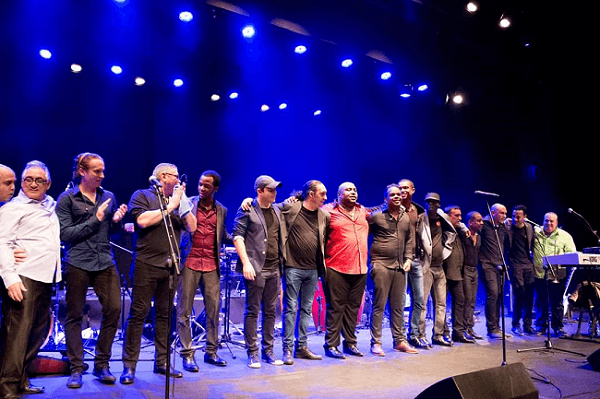
16 personas en un escenario
Ticket prices vary between £30 and £100.

Alexander Abreu spent his childhood in the city of Cienfuegos (Cuba) where he began playing the trumpet at the age of ten and has currently become one of the most versatile and acclaimed Cuban musicians of Afro-Cuban music. “I have always seen Havana D’Primera with 15 people on stage and everyone said that it was impossible, that it would be too expensive, too difficult to move… This is how we started: 14 or 15 of us and a lot of positive energy, now we are stronger than ever.” Abreu commente.

Havana D’ Primera (HDP) is a Cuban timba band founded by Alexander Abreu in 2007 and made up of 17 of the best Cuban musicians. The orchestra is led by the main composer Abreu, who has stood out for his melodic voice and ability to fuse genres through Salsa such as Jazz, Funk, and other Afro-Cuban rhythms.

“Since its inception, the band has released five studio albums and one live album. The debut album release was Making History with EGREM in 2009 and their first release for the Páfata Productions record label. 2012’s Pasaporte received favorable reviews from the international press and was voted one of the best Latin alternative albums of that year.

Since then, they have followed the success of “Pasaporte” with four more albums, released through Páfata Productions and the last one in co-production with the Cuban Producciones Abdala.

HDP released “La Vuelta al Mundo” in 2015 and “Haciendo Historia LIVE” arrived in 2016. “Cantor del Pueblo” in early 2018, earning the band a Latin Grammy nomination for Best Salsa album. We cannot forget “A Romper el Coco” with the participation of Mayito Rivera released in 2019, and the single Quiero Verte Otra Vez (2020) which won the Special Prize at the 2020 Lucas Awards gala and was also cataloged by the French newspaper “Le Monde” as one of the favorite songs of Latin music.

Finally, in 2021 the album “Será Que Se Acabó” was released, as a tribute to Cuban popular music of the 80s and 90s. Discography extracted from the Biography of Havana D’ Primera.

You can read: Where to go dancing Salsa in Paris?

Preparence is close to the Panama Jazz Festival 2022.

From January 10 to 15, the Panama Jazz Festival 2022 will be held, this being this 19th edition, which will take place both virtual and face-to-face activities, so that the Biosafety regulations of the Ministry of Health will be met (“No cloth” masks and gel), where they are informed that to enter all events they will be asked for the card and QR code 100% vaccinated with a minimum of 14 days and 12-year-olds must present a negative Covid test 24 hours before.

It will be held at the City of Knowledge Athenaeum, where every day except for Wednesday (12) from 7 pm at the National Theater there will be a Gala night with Danilo Pérez and Kurt Elling, however the other days will be presented:

  • Monday (10): Panamá Connections and Mayra Hurley.
  • Tuesday (11): Borderlands Trio e Idania Douman.
  • Thursday (13): Global Messengers and Pz533-Global Jazz Womxn.
  • Friday (14): Antonio Hart and Solinka.

This year the festival of this edition will be dedicated to Frank Anderson born in Panama, Bocas del Toro on January 24, 1929, in Panama he met and played with many Cuban musicians; In New York, he played piano and directed several recordings by Vicentico Valdés and worked with other artists such as Marcelino Guerra, Polito Galíndez, Arsenio Rodríguez, Andrés Andino and Yomo Toro, Israel López “Cachao”, Clark Terry, and in 1950 he founded his own big band, the musicians were members of the Duke Ellington and Count Basie orchestras. In the 1970s he became musical director and accompanist for many Broadway plays such as Purlie, Don’t Bother Me I Can’t Cope, A Raisin in the Sun, Eubie !, The Wiz, and Guys and Dolls. He also recorded on the discs of those works.

In 2009 he was recognized by the New York State Senate for his musical contributions, particularly his role as organist in various Brooklyn churches and his most recent recording is Ochosi Blues (2015) by Benjamin Lapidus and Kari-B3 where he is accompanying with the organ. in its unique style and unmatched flavor that combines Caribbean music, jazz and more in a very personal way. Anderson currently maintains his residence in Brooklyn.

The International Artists to participate are:

  1. Kurt Elling Dúo with Danilo Pérez “Secrets are the Best Stories”:
    Renowned for his unique combination of robust swing and poetic acumen, two-time GRAMMY winner Kurt Elling secures his place among the world’s leading jazz vocalists. The New York Times proclaimed him the “most prominent male vocalist of our time.” Over a 25-year touring and recording career, he has won 3 Prix du Jazz Vocal, 2 German Echo Awards, 2 Dutch Edison Awards and been nominated for a GRAMMY Award fifteen times. He has had a 14-year career at the top of DownBeat’s Critics and Readers polls, and has won twelve Jazz Journalist awards for “Male Vocalist of the Year.”Elling’s voice is instantly recognizable, embracing listeners with her warm, rich baritone and navigating the four-octave range as a virtuoso improviser and compelling storyteller. The Guardian has named him “some kind of superpowered Sinatra” and “one of the great jazz vocalists of all time.”
  2. Kris Davis and Bordeerlands Trio with Eric McPherson, Stephan Crump:In Borderlands Trio, the collective efforts of bassist Stephan Crump, pianist Kris Davis, and drummer Eric McPherson have luck on your side. In less than a year their chemistry is unusually deep. The title of their album Asteroidea is the Latin term for starfish, a creature capable of regenerating parts of itself, in turn related to the trio’s ability to constantly develop new landscapes. The word starfish evokes notions of both the ocean and outer space. “Gravity, magnetism, constellations, nature. With this band, we are always expanding and contracting, recontextualizing what surrounds us and heading towards the instantly inevitable. ” Crump comments.Asteroidea is a treatise on immediacy and a deep dive into the spectrum of responses to any gesture. Its rhythms are always transforming, its drama has wacky moments, and its creators are just getting started.
  3. Antonio Hart:He studied jazz at Berklee College of Music in Boston with Bill Pierce, Andy McGhee and Joe Viola. Of his friendships in Berklee, Roy Hargrove stands out, with whom he spends three years traveling the world and recording the first three Hargrove albums. During these years on the road, Hart completed a master’s degree at Queens College where he learned from teachers Donald Byrd and Jimmy Heath, who also produced the artist’s second recording ‘Don’t You Know I Care’.With his 1997 release, Impulse Records’ ‘Here I Stand’, he earned a Grammy nomination for ‘Best Jazz Instrumental Soloist’ and additionally participated in more than 100 guest recordings. Since its inception, Hart has recorded eight CDs as a leader. The latest JLP Jazz Legacy productions, ‘Blessings’.The artist balances his time as a full professor at Aaron Copland School of Music, Queens College, with touring with his bands, The Dave Holland Big Band and The Dizzy Gillespie Big Band.
  4. El Berklee Global Jazz Institute (BGJI):It is a musical performance program designed to foster creativity and musical mastery across various musical disciplines, with pianist and composer Danilo Pérez as its founder and artistic director.The BGJI provides a comprehensive contemporary music environment where students have the opportunity to explore their creativity to the highest level possible, advance the power of music as a tool for the betterment of society, and connect musical creative thinking with the environment. natural.
  5. Global Messengers:Directed by Panamanian pianist and composer Danilo Pérez, Global Messengers draws its unique spirit from the culture and experiences of its members, who come from Palestine, the United States, Greece, Jordan and Panama, with varied musical traditions and instrumentation to match. They are committed to the ancient practice of building community through rhythmically rich and melodically exciting music.* Danilo Pérez piano
    * Farayi Malek voice
    * Vasilis Kostas laouto
    * Layth Sidiq violin
    * Naseem Alatrash cello
    * Tareq Rantisi percussion
  6. The New England Conservatory (NEC):It was founded in 1867, being the oldest independent music school in the United States. Since its opening it has played an important role in the musical life of Boston and the world. Its mission is to provide a more rigorous education at the level of musicians of all ages and parts of the world. Additionally, we have teachers who encourage individual excellence in a welcoming community.NEC works for music to have an important place in people’s lives and for rigorous education and excellent recognition. Beyond the study of music, NEC teachers help explore the historical and social frameworks that support our musical traditions.
  7. PS-533:It is the number of a class called “Musical Performance and Social Activism” for the Berklee Global Jazz Institute Master’s Program at Berklee College of Music. The PS refers to the department of “Performance” and 533 refers to an upper level class open only to graduate students. Patricia Zarate, a teacher of this class, organized this group in 2022 to present the Global Jazz Womxn (women and dissidents) that stand out as alumni and of the program. The letter “S” was changed to “Z” to reflect the change from a school environment to a professional environment led by Zarate.

The National Artists to participate are:

  1. Solinka: better known as Solange Arias, she was a public servant in the 1950s, working as a secretary in the Ministry of Education of Panama, has a beautiful voice and is very attractive, so a Cuban agent convinced her to be a singer of professional sauce. In those years, men dominated the salsa genre, which is why Solange was not successful at first. It was in Peru that she became a sensation as a salsa presenter, so much so that one journalist wrote that her performance was as brilliant as an “Inca sun,” a nickname she adopted as her stage name, changing the c to a k. Later he found success in his native country and signed a contract with a record company, traveled a lot and won the first prize at the Valparaíso international song festival.
  2. Idania Dowman: She has a privileged and unmistakable voice that has transcended throughout her 27-year career. Daughter of the renowned Panamanian calypsonian Lord Byron. She publicly began in the Church where she was director of the Archdiocesan Choir of Panama and was part of Jazz Effects of Panama with Reginal Boyce. Today he has two groups of his own: The Emotions and Cache. He shared projects with Billy Herron, as he believes in the generational sharing of culture. He has represented Panama in Peru, Barbados, Trinidad and Tobago, Costa Rica, Colombia, the United States and Dubai. She was recognized by receiving a Doctorate in Art from the United Graduate College and Seminary International (United States) for her career in ART, MUSIC AND CULTURE; by the National University of Panama in 2012 and 2014, and awarded the Golden Star Awards of the distinguished VIP Diplomática magazine of Peru in 2019.She is recognized for her virtuosity in each of her presentations, for maintaining her Afro jazz essence and being a defender of Panamanian culture.

    She is recognized for her virtuosity in each of her presentations, for maintaining her Afro jazz essence and being a defender of Panamanian culture.

  3. Panama Connections: Group made up of professors and scholarship students from the Danilo Pérez Foundation, under the premise of “community and sharing”, Panama Connections explores the creative possibilities between Jazz and its links with Pan-African and Caribbean folklore, from its compositions originals, arrangements and adaptations are focused on this fusion.
  4. Mayra Hurley: Singer, film and television actress, and broadcaster. The Panamanian singer-songwriter is inspired by her multicultural roots that are expressed in all her artistic expressions, from funk, salsa, to rock n’roll, each show is a live experience with Caribbean flavor. In his more than 10 years of experience in musical theater, he has worked under the artistic direction of Bruce Quinn and Edwin Cedeño and has participated in works such as Jesus Christ Superstar (2005), Cabaret (2006), A Chorus Line (2008), Peras en el huerto (2006-2012), Little Shop of Horrors (2010), en la guerra y el amor todo se vale (2011) and Hairspray (2013).He made his film debut in the acclaimed film Historias del canal (2014), presented in the official IFF Panama selection and at international film festivals in Spain, the United States, Costa Rica, Mexico, Canada and Jamaica. In 2019 he participated in the Panamanian film Escribiendo el General by Oscar Faarup and in 2021 he won the Panama positive award in the category Positive Artist.

Buy your tickets through https://panamajazzfestival.com/ or if you want to have other information, follow the following accounts:

  • WebSite: https://panamajazzfestival.com/
  • Facebook: @PanamaJazzFesti
  • Instagram: @PanamaJazzFestival
  • Twitter: @PanamaJazzFesti
  • Correo: [email protected]
  • Telefono: +507 317-1466

Know everything about Oscar Hernádez and Spanish Harlem Orchestra

Spanish Harlem Orchestra and its beginnings

Spanish Harlem
Logotype of Spanish Harlem Orchestra

Spanish Harlem Orchestra is for many one of the best Latin jazz and salsa bands in the world due to its long career, impressive relevance and numerous awards throughout its 19 years of existence. This Latin music orchestra based in the United States was created by producer Aaron Levinson and producer, composer and arranger Oscar Hernandez, who gave birth to a legendary group, which was Grammy winning twice and whose style has differentiated it from many others of its kind. 

It all started with a call from Levinson to Hernandez to offer him the opportunity to join an ambitious project he had in mind, which consisted of the creation of a Latin jazz orchestra with a very peculiar sound and style. The producer could not resist such a proposal, so he agreed to lend his talent to the nascent initiative. This is how they debuted their first album Un Gran Día en el Barrio in 2002, thanks to which they received their first Grammy nomination for Best Salsa Album. After their first singles, the new group began to garner major success and to offer great performances all over the world. 

One of the main objectives of the members of the band is to set for themselves is to keep salsa dura alive in order to be lasting and to reach as many lovers of good music as possible. This is how the Spanish Harlem Orchestra, or SHO as its fans affectionately call it, has managed to preserve the best of traditional salsa, but from a fresh and innovative perspective.   

Its centerpiece Oscar Hernandez 

This is Oscar Hernández
Oscar Hernández playing the piano

Its most famous member Oscar Hernandez got his taste for music in the vicinity of Harlem’s Latin Quarter, where he spent his early childhood that would mark his professional future. As a young boy of 12, he became a trumpet player, but it would not be long before he decided to switch to the piano. He spent much of his adolescence playing with many Latin Jazz artists of the time. One of those great stars with whom Hernández had the opportunity to explore his talents was Rubén Blades, for whom he worked as a producer, arranger and pianist. 

In the 90’s, the musician produced the album Dance City, for which he received good reviews in the New York Times and was called by singer and composer Paul Simon for his Broadway show. 

Today, we are fortunate to have the pleasant presence of Oscar Hernádez to tell us about his beginnings and the path he had to take to join the project for which he is best known today by many of his fans, Spanish Harlem Orchestra   

Mr. Hernandez, reading your story, we noticed that Spanish Harlem started with a call from Aaron Levinson in 2000, could you tell us a little about that? 

Aaron Levinson is the producer. I did not know him. I have to make it clear that he is not a musician, but a DJ with a lot of connections and was called to make a record with the Warner Bross label with a specific concept. They thought he was the right person for that. He called me to help him with the musical part. Everything related Spanish Harlem Orchestra I owe to him because that is how I joined the project. That was what had to happen in terms of my fate. That is how God told me to wake up and understand that this was what I had to do. Until such time, I had only been a producer, arranger and pianist, so Levinson came to me and I accepted. We talked about the tracks and he picked some that I did not want to do. To make a long story short, we recorded the album, but Warnes Bross said they did not want to release it, so they gave it back to Aaron. A year and a half later, he sold it to a small company whose owners were friends of his and it was nominated for a Grammy. Since then, I started with the orchestra in 2002. The orchestra is almost 20 years and has been a great blessing for me. It was intended that he called me to put my personal stamp on that record with my brain and my heart, so I could create all the music that I have made these 20 years. Aside from that, we have gotten incredible reviews all over the world and won three Grammys. People know how good the orchestra is and how good the concepts we have recorded are because it is all documented. Listen to any of the albums and you will immediately note our quality, integrity, professionalism and musical concept. Obviously, I have very good musicians helping me, but final decisions start and end with me.  

After you decided to carry out the project, how did you combine what you already had with Spanish Harlem Orchestra? 

It was a moment in time that things were changing. I did not have anything stable at that time, as I had just finished working with Paul Simon in a stage play which was quite a large process. I was freelancing, so I was working for whoever called me. The perfect time came when I had the chance to create the orchestra and it was not easy because I had no ambitions for a career as a bandleader. It was not something I wanted to do, but I had to learn a lot of things after I became one like dealing with people, with musicians and with situations that were not easy. During that process, I had to get rid of a lot of people because I realized that I had good intentions, but that is not enough. You have to have willpower and be clear about the concept musically and in terms of business. I always try to deal with musicians in the best way because I was one before anything else. I try to be transparent and understand all situations, but there are also selfish people who want to enjoy all the advantages for themselves and I am not in that plan. My plan is to look for what is in the best interest of all of us as a group. At my age, I do not have time for anything but high quality and professionalism. I lasted seven years with Ray Barreto and recorded six albums. I lasted 12 years with Rubén Blades and we also recorded six or seven albums. What do I say? I have already worked with many people like Juan Luis Guerra, Paul Simon and many others who have left an important mark on me as a musician and as a director.

Oscar with his piano
Oscar Hernández next to his piano

What do you consider to be the most valuable thing you have learned from the artists you have worked with? 

I think all these people have love for music, which is the most important thing. I remember my times with Barreto, who listened to all the mixes we made and drove musicians crazy in search of perfection. Like Rubén Blades, who was a transparent person and always wanted to do his best as a musician. It is not just one thing I have learned, but several because they are all important. I believe that love, professionalism and willingness to work with musicians. I remember that Rubén was the bandleader, but he always considered our views as musicians. I was even the arranger and my musical value was respected from the beginning. I respect my musicians very much and I give them all the value they deserve. 

You told me earlier that you were on tour in New York. Could you tell us how it went? How did the audience respond? How did it feel to be back on stage after such a long time? 

It was incredible. Our first concert with the orchestra was in the very heart of of New York City on 42nd Street in Manhattan. There is a place called Brian Park and there were about 10,000 people there, as the event was free to the public. It filmed live and virtually streamed. I mentioned to the audience that this was the first time we played live and that we had only one rehearsal the day before. It was an amazing experience because I felt that musicians were in the best position to make a first-rate performance and they did. The audience warmly and gratefully applauded. When you do something all your life and suddenly it stops for a year and a half, you realize many things.   

What other events are you going to do? Are you planning on touring outside the United States? 

We are scheduled to have a tour in June in Europe, but it remains to be seen what will because COVID is still present and countries are evaluating how things are going to go in the next few months to specify dates and cities. In December, we will have four shows, two in Santa Fe, one in Albuquerque (California) and one in Costa Mesa (California). We are no longer touring as such, we are doing dates. It had been years since we have toured like we used to. The new album is done and sounds amazing. Last week, we were in New York finishing the vocals with the three singers, who are some of the best and it was a pleasure for me to share with them. They are clear that they have to do their part in what is going to be another great record.  

Oscar with his Grammy Award
Oscar Hernández with his Grammy Award

Questions from a lifelong admirer of Oscar Hernandez   

Augusto Felibertt, international director at International Salsa Magazine, professional DJ and collector, asked Oscar Hernandez some very interesting questions to learn more about his past as a musician.  

I want to know your feeling about your time with Grupo Libre de Manny Oquendo and Grupo Folklorico y Experimental Nuevayorquino. 

Associating with Andy and Jerry Gonzalez was an incredible experience for me as a young musician in New York. They were an important part of my development. They were a little older than me, but I remember Andy came up tome and presented himself when I was playing with Ismael Miranda in a club. He told me it was nice to meet me and that we sounded great. Since then, we became friends and he invited me to his house. When I arrived, it turned out he lived with Jerry in an apartment below his father’s and had an incredible record collection. We would spend many hours listening to music I had never heard and arguing about musicians. We would debate about who was the most important, who else we liked. It was a very nice time from which Conjunto Libre de Manny Oquendo emerged. I was the founding pianist of the group that recorded the first three albums. The image of Grupo Folklorico y Experimental Nuevayorquino also emerged. That group composed of of Andy, Jerry and René López became larger with other musicians who joined later such as Alfredo Chocolate Armenteros, Virgilio Martí, Heny Álvarez, Willie García, Milton Cardona, among others. There were so many musicians that the image of what a jam was (a spontaneous concert in which an artist or group performs before a small group of spectators) was expanded.  

Ray Barreto’s album Reconstrucción, a musical jewel for the salseros of the world. I want to know about your experience on that recording. 

Reconstrucción was one of the most important recordings of that time because the elements that Rey used to design the concept resulted in something incredible. I am very proud of that record with more than 40 years old. I was 25 years old when we made it and it went down in history. I am very grateful to Ray Barreto because he gave me the opportunity to work as a pianist and arranger on that recording. Even today, many musicians tell me that they listened to that album every day and were inspired by it.  

I would like to know about your time with Carabalí. 

Carabalí was the group of Raúl Primo Alomar, who was a conguero, and percussionist Rey Colón, who was a bongo player. They wanted to make a septet and called me to join as a producer. He was the producer of the two albums. I am very proud of that experience because I can be anywhere in the world and people still call me Carabalí wherever I go. Aris Martinez, the singer of the group, was about 20 years old at the time and I kept correcting him in the studio all the time. Nowadays I listen to him and he sings very well. However, it got to the point where we had a disagreement, so I left the group and wished them luck.   

You recorded an album entitled Como Nunca with Orlando Watussi, could you tell me a little about it? 

I do not remember much about the details, but Watussi has always been in the music business and has been considered one of the best singers. We don’t talk much, but he is a great person and a lifelong friend. That was a great opportunity for us and another example of how I have done my bit in the music scene with what I feel in my heart. 

Oscar Hernández with friends
Oscar Hernández, Rubén Blades, Eddie Montalvo, and Ralph Irizarry
Oscar Hernádez and his las recording
Oscar Hernández’s last recording entitled Visión

Link to Spanish Harlem Orchestra’s official website: https://www.spanishharlemorchestra.com/

Don’t Think About Not Attend The Alocubano Salsa Festival

It Starts On October 7th in Stockholm, Sweden

Dos hombres vestidos de blanco y un hombre con chaqueta y sombrero azul
Los asistentes deben guardar su entrada impresa o como recibo digital en su dispositivo móvil.

One of the most anticipated Afro-Caribbean events in Stockholm (Sweden) is the Alocubano Salsa Festival. This year, as usual, they will focus on the culture of the Cuban island and will once again do magic with the multiple Bootcamps led by Cuban instructors of trajectory that will focus on the technical development of each dancer that will make them feel comfortable and at home.

To maintain public health security, the Swedish government has drawn up a plan for the lifting of restrictions concerning the COVID-19 pandemic and a return to a more normal daily life. This derogation is based on the gradual elimination of limitations in the country with a maximum of five steps: The first step refers to the extension of restaurant openings until 10:30 PM and releases in the maximum amount of participation in activities at the open-air (Coming from June 1st, 2021). Steps two and three continue with the permission to give training and hold meetings in general without limits of square meters in open and closed spaces (It came into effect from July 1st, 2021). The fourth and fifth steps are estimated to be exposed in mid-September of this current year.

For this reason and in compliance with the measures adopted by the Swedish government, the Alocubano Salsa Festival will be held in 2021 with the main Latin genres of the moment Bachata, Cuban Salsa, Top Mambo, and urban music on four dance floors with eight Spanish-speaking DJs: DJ Javier La Rosa, DJ La’Fe, and DJ Flecha will mix the best Cuban Salsa, while DJ Soto-Mayor and DJ Raymon will make sure the attends do not leave the dance floor with the Reggeaton, moreover, DJ York and DJ DLux will do the same to the rhythm of Bachata, and similarly DJ Mauri will be mixing the best music for Top Mambo.

Venue: Royal Park Stockholm. Frösundaviks allé 15, 169 03 Solna, Sweden

Choose Your Bootcamp

Instructor de baile con camisa blanca y pantalón negro.
During the event, there will be filming and photographs that may include images of private participants

In the Bootcamps, participants will have the opportunity to be in small groups of 20 people, thus achieving a more personalized treatment during the four intensive hours of class, distributed as follows: two hours on Thursday night and the last two night hours will be finished on Friday. Additionally, you will learn a unique and exclusive choreography that you will perform with Cuban instructors on stage during the party on Saturday. (This participation is not mandatory).

Mambo Fusion: Designed for intermediate and advanced dancers. They will have a dress code that will be announced days before the event. The Cuban instructors are Rodrigo & Asya.

Bachata Traicionera: Four intensive hours of exclusive training. Instructors: Sergio and Ana. Level: Intermediate / Advanced. For the performance in the Sergio and Ana show, the participants will use a dress code that will be announced days before the event.

Cuban Salsa: It will last four hours divided into two hours of night practice on Thursday and the remaining two hours will be dictated on Friday. The choreography will be given by Cuban teachers: Seo Fernández and Bárbara Jiménez in individual Bootcamps. Level: Intermediate / Advanced. Essential dress code. The announcement will be on the eve of the event.

Date: Thursday, October 7th – Sunday, October 10th

Full Pass: 210 EUR

  • You Can Also Read: Enjoy Salsa In The New Zealand Winter

Extraordinary Concert with Havana D’ Primera & Alexander Abreu

Orquesta Havana D 'Primera despidiéndose en el escenario con luces azules
Before the concert, there will be two hours of the workshop, followed by Latin parties (before and after HDP) with DJ Soto Mayor and DJ La’Fe

Havana D’ Primera is a Cuban timba band founded by Alexander Abreu in 2007 and made up of 17 of the best Cuban musicians. The orchestra is led by the main composer Abreu, who has stood out for his melodic voice and ability to fuse genres through Salsa such as Jazz, Funk, and other Afro-Cuban rhythms.

“Since its inception, the band has released five studio albums and one live album. Following the release of the debut album Haciendo Historia with EGREM in 2009, its first release for the record label Páfata Productions, Pasaporte in 2012, received favorable reviews from the international press and was voted one of the best Latin alternative albums of the year.

Likewise, they have followed the success of “Pasaporte” with four more albums, released through Páfata Productions, and the last one in co-production with Cuban Producciones Abdala. “La Vuelta al Mundo” was released in 2015. A live album, “Haciendo Historia LIVE”, arrived in 2016, and then “Cantor del Pueblo” in early 2018, earning the orchestra a Latin Grammy nomination for Best Salsa Album.

Finalmente, en 2021 se edita el disco “Será Que Se Acabó”, como homenaje a la música popular cubana de los 80 y 90 ”. Fragmentos extraídos de la biografía de La Habana D ‘Primera

Fecha : Domingo 31 de de octubre de st

Hora : 6:30 PM – 10:20 PM

OMAR LEDEZMA JR.

From The Venezuelan Melody To The Caribbean Rhythm

Omar Ledezma Jr. with percussion plate
“I define myself as a Venezuelan.” Omar Ledezma Jr.

Portentous percussionist and surprising Venezuelan singer. Musician trained at the prestigious Berklee University in Boston (US). Winner of a Grammy Award. His lifestyle is characterized by national and international performances, collaborations, compositions, and tours. Familiar, fearless, personable, and cheerful. This is how Omar Ledezma Jr. presents us his life.

He was born in the mountainous valley of Caracas (Venezuela) west of the city in the La Candelaria parish in the summer of 1972 at the height of the Salsa. From seven years old he briefly began his musical studies on the Piano at the prominent Yamaha school.

At the age of thirteen, he returned to music again, but this time playing percussion instruments in a “war band” at Claret school, one of the most recognized educational institutions in the Venezuelan capital.

At 16 years old he already formed his first Merengue and Salsa group together with his first musical friends.

At this dizzying pace, Omar began to take an interest in the Gaitas (traditional holiday music from this Latin American country) and began his foray into this genre. In 1991 he obtained his first prize, third place in the Pupitres y Gaitas contest on behalf of the Claret school. “When I started to grow up I was interested in drums. I awoke an interest in the Gaitas festivals… In fact, the Venezuelan rhythm has marked my life as a musician”. Omar commented.

At the age of 17, this percussion player began his university studies in Law at the Faculty of Law of the Santa María University in the middle of a troubled city and in search of knowledge about how society worked. Omar Jr. adds: “Already in the first year of Law I knew that in Venezuela we had a great root in Roman Rights and modern laws, but those laws were not applied. And that worried me“.

At the same time, Omar continued his music studies but this time with his related instrument, the percussion. To achieve mastery, he obtained classes with the Venezuelan teachers Rubén García with whom he is currently collaborating on some projects in Uruguay. He also got instruction from the musical director from the popular area of ​​San Agustín in Sarria (Caracas), Jorge Orta “CroCro” who currently resides in the United States and the founder of the Orquesta CroCro y su Tumbaka.

Years later, and with experience acquired in presentations, and groups, Omar Jr. met his first mentor, Aquiles Baez, a famous Venezuelan artist, guitar virtuoso. Together with Aquiles, he made his first international tour of the United States. “With Aquiles, I had the pleasure of playing Venezuelan music. We play with many artists in the United States… Thanks to him I developed percussion (Non-autochthonous element) in Venezuelan music”. Ledezma Jr. commented.

In 1995 and with a law degree, he decided to dedicate himself to music professionally. He works hand in hand with consolidated national artists such as Daniel Somaroo, Carlos Puchi, Gerardo Rosales, just as his popularity begins and therefore his foray into studio album recordings.

Five years later, one of the most important phone calls arrived and the one that would turn his life upside down. Omar receives the call from Andy Vargas, the singer of the famous Mexican guitarist Carlos Santana. Vargas invited him to participate in his first residency at the Bellagio hotel in Las Vegas (Nevada), doing a show every half hour starting at six in the afternoon in the renowned bar of those facilities. This residency gave him many satisfactions and multiple experiences during his four years there.

Between these touches in Las Vegas, his second chance arises on the phone again, this time by the hand of the Venezuelan artist Jackeline Rago. Both worked for a season in a school program with the San Francisco Symphony.

All these experiences led him to be part of one of the most prominent local orchestras on the international rise of the San Francisco City (USA), the Pacific Mambo Orchestra for a decade.

In addition, Omar offers weekly personalized percussion training classes and works with various local organizations such as the San Francisco Ballet and the Community Music Center.

This cheerful and outstanding percussionist will soon surprise us with unpublished material in the dance genre. It will be two singles making his debut in the art world as a singer-songwriter, and you can enjoy it on his YouTube channel that he reactivated in December 2020.

OMAR LEDEZMA JR. & PACIFIC MAMBO ORCHESTRA

Omar Ledezma Jr. dancing with Sheila E.
Omar dancing with Sheila E. at the live concert at Stern Grove (San Francisco) in 2017

In 2011, the Grammy Award winner, Omar Ledezma Jr., is part of the most ambitious project of his life, the Pacific Mambo Orchestra (PMO), after moving to the fourth most populous city in the state of California (USA) and most receptive with Latino musicians, San Francisco.

It has been ten uninterrupted years in which Omar has gone from playing the conga to being the singer of the orchestra and is currently developing as the official timpanist of PMO, once that Karl Perazzo (Carlos Santana´s timpanist) left the big band. “Eventually he told me that is yours… I appreciate that opportunity because the Grammy has already come; many satisfactions and a lot of work have come as well”. Omar explained to us.

As time passed, they achieved a characteristic sound. And with it begin the recording of their self-titled album. Ledezma details us: “The band began to become popular on Monday nights, and we began to charge the entrance fee of 5, 10, 20, 30 dollars. Then we started on Saturdays with a lot of receptivity”.

In 2013 they won their first Grammy for Best Tropical Latin Album and embarked on their first national tour for 30 days accompanying Latin artists Marlon Rosado and Tito Puente Jr. They toured the stages of Indiana, Arizona, and Oregon ending in California. The first international tour was held in Mexico and the second at the Montreux Festival in Switzerland.

After the Grammy and his tour, the second Pacific Mambo Orchestra album was on its way but this time recorded live at Stern Grove (San Francisco) in 2017. Here, Omar had outstanding participation with the queen of percussion, Sheila E. During the song Ran kan kan Omar Jr. & Sheila E.  made a kettledrum war. He adds: “It was nice playing with her, watching her perform, and playing her music”.

This international orchestra made up of 20 musicians began rehearsals for the rhythm section on May 1 after a year and a half of not seeing each other. Before the end of 2021, they will make streaming where they will play original music such as PMO Intro, Muévete con Prisa, and Mr. B’s Mambo, among many others.

THE MUSIC RUNS THROUGH YOUR VEINS

Omar Ledezma Jr. Sitting
Omar and Cro Cro worked together in the band of José Alberto “El Canario” in performances in the United States before the pandemic.

His lineage confirms his musical streak. The Big Bands were always his great curiosity, and Glenn Miller’s orchestra his greatest ambition.

His father and his grandfather are musicians. His grandfather Rafael Isidro Ledezma “El Negro” was a renowned Orchestra conductor of the El Tigre city in Venezuela.

As an only child, he followed in the footsteps of his grandfather. He developed himself professionally in music.

In 1995 he belonged for a few months to the Venezuelan super band Guaco in the Salsa project directed by Gustavo Aguado at La Cantina located in Las Mercedes in the Venezuelan capital. “I learned as much as I learned at Berklee”. Omar commented.

Among so many things learned, the main and undoubtedly important were: being a music lover, having discipline, developing creativity, and cultivating friendship.

The last tour in Venezuela that Ledezma carried out with the Gonzalo Grau quintet (with whom he obtained his first Grammy nomination) was 20 years ago at the Teresa Carreño Theater as the opening act for Pablo Milanés.

 If I had children I would like them to follow their steps along with mine.” Omar Ledezma Jr.

YOUR WAY TO BERKLEE

 Omar Ledezma Jr. playing percussion
Omar first led a music trio and then established a Salsa band in a venue very close to the school.

During a trip to Boston, Ledezma visited Berklee University for the first time in the summer of 1998. Through brochures, he learned that he had the necessary conditions to apply for a scholarship at this important school, and immediately did so without distraction. “Many said you couldn’t and I’m the one who thinks you don’t lose anything by trying”. Omar said.

He got going and sent in a demo to schedule an audition. That presentation was a success and he was accepted right away as one of the graduates of this prestigious institution. It took him a year to move to Boston and began his studies in the fall of 1999. The first years were emotionally hard due to the death of his second mother.

But he knew how to recover and move on. He worked very hard for six years to finish paying for school in 2002.

He obtained a Diploma in Performance. During the five years of study, he learned the four harmonies, arrangements, and composition. Also, in percussion, he developed skills in drums, Latin percussion, and vibraphone.

I still feel like my career is just beginning.” Omar Ledezma Jr.

SalsaGoogle.com is International Salsa Magazine

Home

  • « Go to Previous Page
  • Page 1
  • Interim pages omitted …
  • Page 4
  • Page 5
  • Page 6
  • Page 7
  • Page 8
  • Interim pages omitted …
  • Page 14
  • Go to Next Page »

International Salsa Magazine (ISM) is a monthly publication about Salsa activities around the world, that has been publishing since 2007. It is a world network of volunteers coordinated by ISM Magazine. We are working to strengthen all the events by working together.