• Skip to primary navigation
  • Skip to main content

International Salsa Magazine

  • HOME
  • Previous editions
    • 2026
      • ISM / April 2026
      • ISM / March 2026
      • ISM / February 2026
      • ISM / January 2026
    • 2025
      • ISM / December 2025
      • ISM / November 2025
      • ISM / October 2025
      • ISM / September 2025
      • ISM / August 2025
      • ISM / July 2025
      • ISM / June 2025
      • ISM / May2025
      • ISM / April 2025
      • ISM / March 2025
      • ISM / February 2025
      • ISM / January 2025
    • 2024
      • ISM / December 2024
      • ISM / November 2024
      • ISM / October 2024
      • ISM / September 2024
      • ISM / August 2024
      • ISM / July 2024
      • ISM / June 2024
      • ISM / May 2024
      • ISM / April 2024
      • ISM / March 2024
      • ISM / February 2024
      • ISM / January 2024
    • 2023
      • ISM / December 2023
      • ISM / November 2023
      • ISM / October 2023
      • ISM – September 2023
      • ISM – August 2023
      • ISM July 2023
      • ISM Edition June 2023
      • ISM – May 2023
      • ISM April 2023
      • ISM March 2023
      • ISM February 2023
      • ISM January 2023
    • 2022
      • ISM December 2022
      • ISM November 2022
      • ISM October 2022
      • ISM September 2022
      • ISM August 2022
      • ISM July 2022
      • ISM June 2022
      • ISM May 2022
      • ISM February 2022
      • ISM January 2022
    • 2021
      • ISM December 2021
      • ISM November 2021
      • ISM October – 2021
      • ISM September 2021
      • ISM August 2021
      • ISM July 2021
      • ISM May 2021
      • ISM April 2021
      • ISM June 2021
      • ISM March 2021
      • ISM February 2021
      • ISM January 2021
    • 2020
      • ISM December 2020
      • ISM November 2020
      • ISM October 2020
      • ISM September 2020
      • ISM August 2020
      • ISM July 2020
      • ISM June 2020
      • ISM May 2020
      • ISM April 2020
      • ISM March 2020
      • ISM February 2020
      • ISM January 2020
    • 2019
      • ISM December 2019
      • ISM November 2019
      • ISM October 2019
      • ISM Septembre 2019
      • ISM August 2019
      • ISM July 2019
      • ISM June 2019
    • 2016
      • ISM December 2016
  • Spanish
  • Download Salsa App
    • Android
    • Apple

Search Results for: Gran Combo of Puerto Rico

Maelo y su Klan want to bring tropical rhythms to the whole world

Maelo y su Klan is the latest project, and one of the dreams, of the producer with more than twenty years of experience, Johnny Ysmael Salaverria Dicurú. The popular “Maelo” as his dearest friends call him, continues his career by working and pouring his heart into this project. With them the first genre fusion between Son and Kizomba is known. In the following lines we will talk about Maelo and his most beloved project.

Who is Maelo?

Johnny Ysmael Salaverria Dicurú was born in San Juan parish, in Caracas, capital city of Venezuela, where he spent his childhood surrounded by the joy of the Caribbean “soneros and salseros”. He was a child when he first expressed his interest in one of the most popular tropical Caribbean rhythms, salsa. Part of his influences came from his uncle, Héctor Bruno Dicurú.

Ysmael D´La O, is his artistic name on stage and producing, but his closest friends call him “El Tiburón de la Salsa”. He left with $80, and a luggage full of dreams, to look out for adventures abroad. His destiny was Tenerife, where he quickly earned the love and respect of the natives, and was embraced as an adopted son.

Maelo as a producer has worked with renowned soloists and groups, from all over the world. To name a few: Nicky Jam, El Binomio de Oro, Tito Rojas, Oscar D’León, Porfi Baloa, Tony Vega, La Dimensión Latina, Ray Sepúlveda, Guayacán, El Grupo Niche. As a promoter and producer of events, one of his greatest achievements was El Gran Combo De Puerto Rico who celebrated their 50th anniversary, and visited Europe hand in hand with him.

We can call Maelo, the cultural ambassador of Caribbean rhythms, making more than 30 countries listen and enjoy them. He was the first Latin American to have 100 continuous virtual conversations during the pandemic, a time when creativity was the escape of many artists.

Among his awards and recognitions is being nominated as International Producer of the Year in 2020, Producer and Promoter of the Virtual Euro Festival in the 20/21 edition. But soon more will come, since Maelo’s talent is infinite.

Defining Maelo and his Klan

The band stands out in danceable rhythms such as: Son, Charanga, Guaguancó, Salsa, Tropical, Latin Jazz and a lot of fusion with an original sound, which is inspired by African rhythms. Of course, with the influences of great masters of the old tropical school. In this way, a combination is created that generates a modern sound, worthy of the new generation. But what most characterizes this Klan is the creation of the fusion of the genres between Son and Kizomba.

The works of Maelo y su Klan have the collaboration of the renowned arranger and director of Billo’s Caracas Boys, the Venezuelan Julio Cesar Estrada. Also by Paquito Barón, ex-member of the Orquesta Bronco of Venezuela, in the musical production.

The Klan has all the merits and the support of the Anglo-Saxon and Asian public. One of his productions entitled ¡Cultura viva! Fusion is positioned as the new sound in Afro-Caribbean music. Maelo not only puts his talent for the band, but also puts all his knowledge of the tropical rhythms of Latin America, as well as its movements through Europe and Asia. Let’s hope that the journey of Maelo y su Klan will be a very long one, full of great successes, so that they can continue to please the public that loves these tropical rhythms.


Santa La Salsera and Diva of Mexico with her unique voice and style will continue to conquer us all

Originally from Boca Mar, in the beautiful port of Acapulco, Mexico.

From a musical family lineage, from the age of 3 she began her interest in the artistic medium; despite this her parents did not agree that she should dedicate herself to this career, but motivated by the musical taste of her mother she was inspired by great divas of the genre such as Mrs. Celia Cruz, La Lupe, Celeste Mendoza, Mercedita Valdes and Omara Portuondo.

Originaria de la Boca Mar, en el bello Puerto de Acapulco, Gro. México

She alternated with the Cuban actor and singer Zamorita, who invited her to sing solo in the well-known ECO Program and from there encouraged her to sing tropical music, since it was more in line with her image and voice; Later she got a job at the emblematic Blanquita Theater where she alternated with the legendary Sonora Santanera of Carlos Colorado, where she had the opportunity to compete against representatives of several Latin American countries in the international program “Sábado Gigante” with Don Francisco, in the section known as “Tropicalísimo” winning first place shared with Venezuela and thanks to her triumph she was discovered by the Director of Radio Tropical in Mexico, Mr. Manuel Durán, who recommended her to the Vice President of Musivisa, Mr. José Manuel Presa.

The Company was interested in her and from then on Santa signed a contract with Fonovisa Tropical. La Acapulqueña recorded her first production in Mexico City, titled “No me Provoques”, which was presented on August 15, 1994 at the Salón Verde y Oro of XEW Radio.

Verde y Oro of XEW Radio in Mexico City. “No me Provoques” reached the top of the charts with songs such as: “Corazón de Acero”, “Amor Pasión y Locura” and “Rey de mi Habitación”.

The second production “Lo Quiero a Morir” was recorded in Puerto Rico (in the then Gran Combo studio) for its internationalization, the song of the same name, was placed in the first place of popularity in the island itself, some countries of Central America and the United States of America.

The third production “Santa la Fiera” was recorded in the city of Miami, under the label On Top Records and produced by the renowned composer Victor Daniel, author of “La Vida es un Carnaval” with songs of more varied genre such as: “No vale la pena llorar”, “Tú eres hielo” and “Soy demasiado Mujer”.

After an absence, Santa resumed his career in 2012, with his fourth production “Yo soy santa para ti”, from which he managed to three singles “No tengas miedo”, “Sólo mírame” and “Como agua entre las manos”.

Santa has had the opportunity to participate in numerous television programs, as well as massive festivals, to mention a few: opening of the “Festival Boca del Río Veracruz, 1995” “Los Maestros de la Salsa 1996” (in Mexico City) “La Convención de Radio y Música 1996” (in Puerto Rico), “Festival 5 de Mayo 1997” (in Chicago), “Fiesta Mexicana de Raisin y Milwakee”, “Teletón Internacional de Chicago”, “Viva Chicago y Teletón de Honduras”.

Nino Segarra y Santa La Salsera y Diva de México

As well as international television programs such as “En Vivo”, “Hoy con Daniela, Zambombazo, Pácetelas”:, “Un Nuevo Día” and “Siempre en Domingo”, “Dr. Simi”, who dedicated a special to him, to mention a few”.

He has also had the opportunity to perform with great figures of his genre, such as: Tito Puente (who was his godfather), Celia Cruz, Jerry Rivera, Gilberto Santa Rosa, Grupo Niche, Eddie Santiago, Cheo Feliciano, Rey Ruiz, Los Hermanos Rosario, La Ponceña, El Gran Combo de Puerto Rico, Luis Enrique, among many others. In 2012 she resumes her career after an absence, she returns with her production “Yo soy santa para ti” placing herself in the taste of the genre lovers with songs like “Sólo mírame” “No tengas miedo” “Arrepentida”.

In 2013 she released the single “Llorarás” from her production “Yo soy como soy”, which includes unpublished songs, under the direction of the Veracruz producer and arranger Xavier Reyes.

Most of the songs were recorded in Mexico City, with the exception of “No quiero más mentiras” in New York, and “Mío primero” in Puerto Rico” with musicians of international stature. It includes two duets “Amiga” with Frakie Ruiz Jr. and “Cosas del amor” with Ariana Dao as well as the covers “Bidi, bidi, bom, bom” and “Si una vez” as a tribute to Selena Quintanilla.

After his tour he took a short break from music to participate in a short theater production dedicated to the “divo de Juárez” Juan Gabriel, called “Ya lo sé que tú te vas”, which he enjoyed very much in his acting career.

In addition, she received awards in her country such as the AMS AWARD for best female Salsera and the “Candilejas de oro” for her career.

She also participated as a host in the magazine show “Reventón musical”.

In 2018 she was invited to participate in the project “Divas de la salsa”, which took place in New York City representing Mexico and sharing the stage with various divas of the genre from other countries.

In May 2019, she toured Canada for 3 months, leaving her mark and in the last quarter of the same year, she travels to Colombia to continue expanding in the international market.

Her salsa version of “Si una vez” gives her the surprise to be placed naturally in the taste of the Colombian public and, as a result, the doors are opened to participate in events of the Feria de Cali alternating with the most important figures of the genre; she also participated as a special guest to sing in the tribute made to the master Gilberto Santa Rosa.

Once again Santa had the opportunity to leave her country high and show that Mexico also has and makes its good “molcajete salsa” as she calls it, inspired by these joyful Caribbean countries.

Back in Mexico, Santa started her online entertainment program “Santa con Ton y Son” with Raul Silva “El Titan de la Salsa” as her partner, which lasted only a short time on the air, due to some commitments she had to fulfill in the U.S. that were postponed because of the COVID pandemic; However, in the meantime Santa dedicated himself to write some songs that reflect feelings generated from that global chaos, such as “Chao Chao” which he recorded in Mexico City in December of 2021 as a duet with Ricardo Amador, accompanied by La Internacional Orquesta Controversia, of which a live video was recorded with great acceptance.

Santa Salsera y Diva de México con su voz y estilo único seguirá conquistándonos a todos

In addition to new duets and surprises that he is preparing in 2022 for the pleasure of the dancers.

Surely with his voice and unique style, coupled with his charisma and stage presence, Santa will continue to conquer us all.

Enlace Externo: Santa Salsera and Diva of Mexico

You can read: Irakere was a Cuban group that developed an important work in Cuban popular music and Latin Jazz under the direction of Chucho Valdés

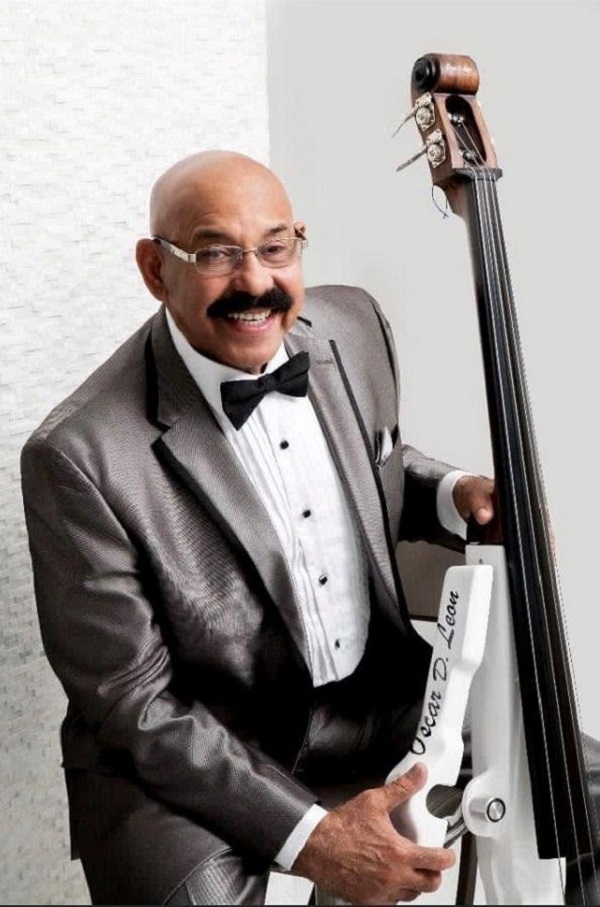
Oscar D’León celebrates 50 years of career in Caracas “International Salsa Magazine says present”

In September, the greatest exponent of Venezuelan salsa in the world will celebrate five decades of brilliant artistic career with an international tour that will have as its main event, an impressive and awaited symphonic gala at the Teresa Carreño Theater. And for september 22 at the Forum in Valencia.

Miami, May 19, 2022. Undisputed legend of Caribbean music, Oscar D’León, the Sonero of the World, celebrates 50 years of successful artistic career with an international tour that will take him to different locations in the Americas and Europe this summer.

This tour, which will begin on June 20 in Mexico City, will continue in July with the “50th Anniversary Europa Tour 2022”, culminating in a spectacular symphonic gala at the iconic Teresa Carreño Theater, which, during two performances on September 16 and 17, will give his audience the opportunity to sing and dance to the music that has made him the most recognized and admired Venezuelan artist in the world over the course of five decades.

Acapulco, Arequipa, Santiago de Chile, Miami, Frankfurt, Munich, Berlin, Paris, Amsterdam, Madrid, Tenerife, London, Istanbul are some of the cities that will live the energizing experience of seeing him on stage, a real party for music lovers.

Deserving of hundreds of awards and recognitions, including five Latin Grammys, D’León has been nominated nine times for the U.S. Grammy, being the first Venezuelan to obtain such a statuette. He did it in 2001 thanks to the song “Cielito Lindo, La Negra Mariachi Medley” Featuring-Oscar D’Leon, included in a collection album: “Masterpiece/Obra Maestra de Tito Puente y Eddie Palmieri”.

In 2013, he received the Award for Musical Excellence, a special recognition granted by vote of the Board of Trustees of the Latin Recording Academy to artists who have made creative contributions of exceptional artistic importance in the field of recording during their careers.

A true prophet in his own land, this global artist who began writing his formidable musical history in 1972, at the age of 28, when he formed the Dimensión Latina Orchestra, promises to celebrate his half-century of career with an unforgettable show at the Teresa Carreño Theater, the most important in Caracas, organized by the Venezuelan companies Imagen Producciones and Oz Show, in alliance with the National Orchestra System of that country.

Important Notes

Venezuelan musician who is among the most outstanding authors and performers of salsa and Caribbean music in general. Oscar D’León’s professional career began late: legend has it that one night, while visiting a nightclub in 1973, he heard that the band playing there had been fired. Oscar seized the opportunity and offered his own band to replace the one that had left.

The owner accepted and hired him to start playing a few days later. There was only one problem: the band at that time consisted only of D’León himself. He quickly got in touch with trombonist César Monge, told him what had happened and both got down to work to put together a line-up.

The band was finally formed by Oscar (vocals and bass, an instrument he had taught himself to play), César Monge (trombone), José Rodríguez (percussion), Enrique Iriarte (piano) and José Antonio Rojas (trombone).

Thus was formed La Dimensión Latina, Oscar D’León’s first orchestra. “Pensando en ti” was the first of the orchestra’s long list of hits. Four years later, Óscar left the band and was replaced by Puerto Rican Andy Montáñez, a vocalist who sang with the Gran Combo de Puerto Rico. Óscar returned with his own orchestra, La Salsa Mayor, with which he recorded his first album, titled after the group’s name: La Salsa Mayor (1977). The work was a great success in his country, and little by little his name began to be heard on an international scale. The following year he recorded the album El Más Grande, which contained the songs “El baile del suavecito” and “Mi bajo y yo”, and shortly afterwards he made his first visit to New York to offer live performances.

Aside from being a great sonero, Oscar D’León is also an extraordinary showman. Almost always accompanied by his bass, with which he plays and dances as if they were a couple, Óscar moves around the stage with great skill. In Venezuela, Óscar D’León is an idol, not only as a singer and musician, but also as a model of a self-made man who, from a very humble position, achieves fame and success on an international scale.

He is considered one of the best interpreters of Afro-Latin music of all times and is undoubtedly among the Venezuelan artists with more projection abroad.

Despite having gone through several stages in the development of Latin music, Oscar D’León’s style, always unmistakable, has maintained some constants that have allowed him to ensure the loyalty of his wide audience. D’León has recorded with the most outstanding salsa stars; among his collaborations, which can be traced in more than fifty albums, stands out his participation in The Mambo King, the hundredth full-length album by the legendary Tito Puente.

Corresponsal: Lida. María Fernanda León

www.Sanjuanproducciones24.blogspot.com

Papo Rosario with his “Salsa de La Buena” at the Spanish Harlem Salsa Gallery Museum

Papo Rosario and his “Salsa de La Buena”

We are incredibly pleased to talk about Luis Alberto Rosario, better known as Papo Rosario, who can be considered one of the most beloved salseros by people who have enjoyed his music for decades. In addition to being a very cloase and kind man to everyone around him, his musical and acting talent is undeniable.

Isidro Infante next to Papo Rosario

After having sung along with El Gran Combo de Puerto Rico for more than 40 years, Rosario makes his debut as a soloist with his first recording work “Salsa de La Buena”, in which he receives the full support of maestro Isidro Infante. Both Rosario and Infante are part of Salsaneo Records, which is close to becoming one of the most important music labels thanks to its contemporary salsa. Thanks to the counselling and advice received from Isidro, Papo has managed to create one of the most important and interesting albums in 2002.

One of the things that makes the album stand out is the great amount of danceable rhythms, positive lyrics, good vocals and fresh sonority. It is evident that the essence of the artist always stands out and he does not let himself be dragged along by what he learned during his time in El Gran Combo. While it is true that there are some traits learned from his friend and former colleague Jerry Vivas, Rosario seems pretty determined to distance hemself from the past and focus on a vastly different future.

Rosario and Infante recording in the studio

What “Salsa de La Buena” is 

“Salsa de La Buena” has many tracks that can perfectly mark a before and after in current Latin music. It starts with a beautiful hymn to optimism and perseverance called “Gracias”, which is one of the four songs composed by the pen of maestro Infante. In the case of “Salsa de La Buena”, the song that gives its name to the entire album, speaks of the connection the singer has with his people as an exponent of the salsa genre. The arrangements and piano melodies are reminiscent of what Richie Ray and Bobby Valentín did when they sang “Los Reyes de La Salsa”.

Isidro also shows his great talent with “Los refranes de Don Yeyo”, a beautiful piano solo where you can see how important the Caribbean collection of proverbs is for the culture at large.

Johnny Cruz with Papo Rosario

Promotion for Papo Rosario’s album 

In a conversation between Papo Rosario and Johnny Cruz, director of the Spanish Harlem Salsa Gallery Museum, the two talk about this recording work and the artist tells how did the whole process go.

Rosario has said that both he and Infante had studied together, but had built their careers separately until they met again recently. That’s when he proposed him to make some arrangements to his songs, but they ended up collaborating to make the album in full. The main objective of the record production was to bring a positive message to the peoples and do what God has put on their shoulders.

In the same way, he pointed out that the salsa museum was quite empty the last time he went, but he was surprised to see that all those spaces have been filling up with truly valuable objects for salsa and its fans.

From there, they gave their regards to Isidro Infante and invited him to the museum to join them and talk about “Salsa de La Buena” and other issues that arise.

Johnny Cruz, Papo Rosario and Rubio Boris

        By Johnny Cruz, ISM Correspondents, New York, New York City

This is Roger Danilo Páiz Pérez from Danilo Y Su Orquesta Universal

Why is he called Danilo?

We will start a conversation with bandleader, percussionist, and singer Roger Danilo Páiz Pérez. Pleased to meet you, how are you doing?

I’m fine thanks, Karina. Sitting here and ready to be interviewed by your magazine. I have a lot of information about what has happened in my life being a musician here in the Bay Area since the 70’s.

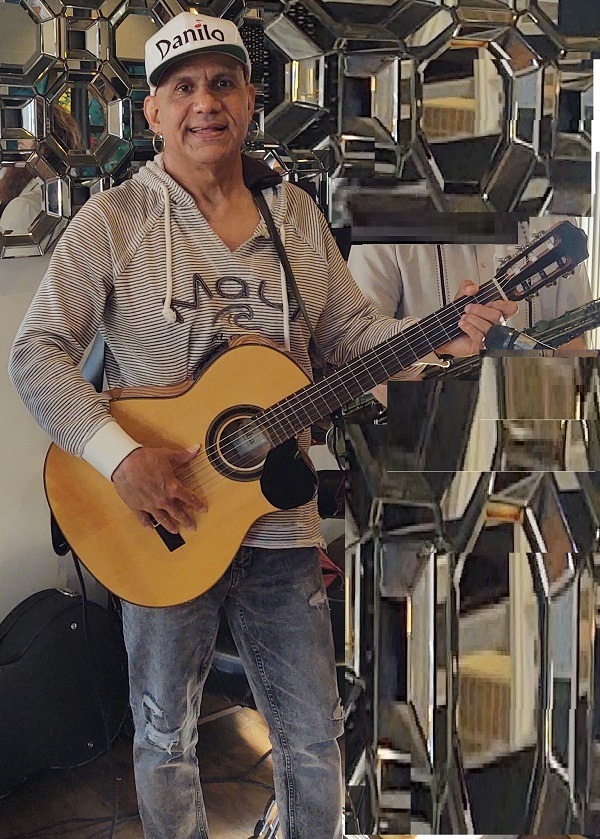
Danilo on guitar at one of his frequent restaurant performances

You are Francisco Pancho Perez’s grandson. Did your grandfather serve as inspiration for the path you would take in music?

Definitely he did. I remember being about four or five years old when I used to hear my grandfather play with his big band, which was composed of 15 or 14 musicians. I always listened to them practicing in our house and started dancing, so my grandfather used to call me cha cha chá. It was a great inspiration for me.

He played music similar to American jazz, and that’s where the inspiration for the music I play today comes from. The salsa that I write is inspired precisely by that kind of jazz.

Where does the name Danilo come from? Also, why is your orchestra called Danilo Y Su Orquesta Universal?

I have to make it clear that Danilo is my middle name since I was born. This is not a nickname as many believe. Some people even think that I have changed my name, but I didn’t. Roger Danilo Páiz Perez has always been my name.

Everyone called me Roger Páiz in the past, that is to say, people called me by my first and last name. In fact, when I played with Rubén Blades in 1989, the album we recorded has me in the credits as Roger Páiz. But when I founded my own orchestra in the 1990s, I thought Danilo was better suited to Latin music, so I started using my middle name to call my orchestra Danilo Y Su Orquesta Universal.

The word universal comes from the fact that I am a Buddhist. I practice the religion of Nichiren Daishonin (monk in Buddhism from Japan in the 13th century and founder of the branch of Nichiren Buddhism) for more than 30 years. That word is widely used in the Buddhist scriptures, and I am very involved in that.

Roger Páiz getting ready to hit with Josh Jones’ band

Your country of origin is Nicaragua. Is Nicaraguan salsa similar to Californian salsa? Are they different? Do you combine them?

Since I was very young, I listened to a lot of Cuban orchestras. I remember my dad tuning in to Celia Cruz, La Sonora Matanzera, among others. From that experience, I picked up all those things since childhood.

Here in the United States, the style was much more modernized. However, I grew up listening to El Gran Combo de Puerto Rico and many other orchestras in the ‘60s and ‘70s. My biggest inspirations were Héctor Lavoe, Oscar De León, Rafael de Jesús, Cheo Feliciano and many others from those years. I paid a lot of attention to how they sang and the melodies that they used.

What Danilo has learned from his musical references

You have made contact with Latin music stars such as Ray Barretto, Rubén Blades, Benny Velarde Y Su Super Combo, Andy Narell, Ray Obiedo, Cheo Feliciano, Oscar De León and many others. What did you learn from all these musical references?

For example, I shared a gig with Cheo Feliciano in Puerto Rico while I was with Rubén at a concert. (Luis Enrique was actually at that concert as well.) Cheo taught me how to phrase with the clave, since this is a very important detail in singing Salsa.

In the case of Héctor Lavoe, I learned a lot from the melodic part. When he sang, the melody was very interesting and appealed to me a lot.

Another singer I liked a lot was Rafael de Jesús, because his style tended to sound like jazz. Sometimes he sang some lines that sounded very jazzy, but he never lost his style as a Salsa singer. That’s one of the main things I liked about him.

Another singer I liked a lot was Rafael de Jesús because his style tended to sound like jazz. Sometimes he sang some lines that sounded very jazzy, but he never lost his condition as a salsa singer. That’s one of the main things I liked about him.

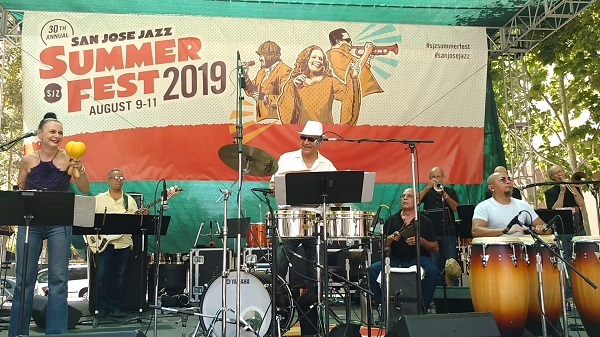
Danilo y Su Orquesta Universal at the San Jose Jazz Summer Fest 2019

Did he receive academic training in music?

I took classes  in Oakland, California, learning music theory, piano, singing, and much more. These studies helped me a lot to better prepare myself musically speaking.

Studying music is important because it enhances the way you perform, sing, and play on stage. That’s when people can tell whether you are a musician who has studied and analyzed music. I’ve met musicians who learned everything by ear and they never progress to the next level.

Of course, there were also things I learned on the stage, in the studio and in rehearsals. I’ve unified all this knowledge to do my job to the best of my ability.

I saw that you have some dates to perform in the Bay Area and other places, can you tell us a little bit about that?

In 1995, I got the opportunity to take a group to Singapore (to be the house band at the Hyatt Regency Hotel). What I did was to find the best six musicians who could play the music I was asked to play. We rehearsed, traveled to Singapore, and stayed there about three months, all expenses paid. It was an amazing experience and I was honored to present my music in that country.

Danilo with Tito Puente, Jr.

What about your current performances?

We just played at La Peña here in Berkeley. It was really good, a lot of people showed up there and they recorded the whole show. Fans sent me some videos as well, so I have to start editing them.

We also played at The Ramp, El Rio, The Turf Club, Kimbara, among others. Coming up, we will be playing at the Cigar Bar.

Let’s talk about your latest album Perseverando.

I decided to call this album Perseverando because of my experience of overcoming the difficulties of maintaining a music career.

Turning to Buddhism, the word perseverando is very important, because life puts barriers in your way and you have to persevere to overcome them. It was common for record labels to say that they were saturated and couldn’t sign me, but I kept writing and recording original music despite the difficulties. The first album is called Vivencias and the second one is called Avanzando. They are titles that have had a lot to do with my life experiences.

I made a video for one of the songs on this álbum, Rumberos de la Bahia, which is on YouTube: https://youtu.be/z3E7K_5SLJo

What other projects do you have pending?

I’m thinking about putting out an album that will be a combination of songs that have not been released yet with some remixes of songs on my albums. Although a dream of mine is to be nominated for a Grammy, that is not why I créate music. Music is my life and my passion.

Cover of the album Perseverando


Home

  • « Go to Previous Page
  • Page 1
  • Interim pages omitted …
  • Page 14
  • Page 15
  • Page 16
  • Page 17
  • Page 18
  • Interim pages omitted …
  • Page 24
  • Go to Next Page »

International Salsa Magazine (ISM) is a monthly publication about Salsa activities around the world, that has been publishing since 2007. It is a world network of volunteers coordinated by ISM Magazine. We are working to strengthen all the events by working together.