• Skip to primary navigation
  • Skip to main content

International Salsa Magazine

  • HOME
  • Previous editions
    • 2026
      • ISM / March 2026
      • ISM / February 2026
      • ISM / January 2026
    • 2025
      • ISM / December 2025
      • ISM / November 2025
      • ISM / October 2025
      • ISM / September 2025
      • ISM / August 2025
      • ISM / July 2025
      • ISM / June 2025
      • ISM / May2025
      • ISM / April 2025
      • ISM / March 2025
      • ISM / February 2025
      • ISM / January 2025
    • 2024
      • ISM / December 2024
      • ISM / November 2024
      • ISM / October 2024
      • ISM / September 2024
      • ISM / August 2024
      • ISM / July 2024
      • ISM / June 2024
      • ISM / May 2024
      • ISM / April 2024
      • ISM / March 2024
      • ISM / February 2024
      • ISM / January 2024
    • 2023
      • ISM / December 2023
      • ISM / November 2023
      • ISM / October 2023
      • ISM – September 2023
      • ISM – August 2023
      • ISM July 2023
      • ISM Edition June 2023
      • ISM – May 2023
      • ISM April 2023
      • ISM March 2023
      • ISM February 2023
      • ISM January 2023
    • 2022
      • ISM December 2022
      • ISM November 2022
      • ISM October 2022
      • ISM September 2022
      • ISM August 2022
      • ISM July 2022
      • ISM June 2022
      • ISM May 2022
      • ISM February 2022
      • ISM January 2022
    • 2021
      • ISM December 2021
      • ISM November 2021
      • ISM October – 2021
      • ISM September 2021
      • ISM August 2021
      • ISM July 2021
      • ISM May 2021
      • ISM April 2021
      • ISM June 2021
      • ISM March 2021
      • ISM February 2021
      • ISM January 2021
    • 2020
      • ISM December 2020
      • ISM November 2020
      • ISM October 2020
      • ISM September 2020
      • ISM August 2020
      • ISM July 2020
      • ISM June 2020
      • ISM May 2020
      • ISM April 2020
      • ISM March 2020
      • ISM February 2020
      • ISM January 2020
    • 2019
      • ISM December 2019
      • ISM November 2019
      • ISM October 2019
      • ISM Septembre 2019
      • ISM August 2019
      • ISM July 2019
      • ISM June 2019
  • Download Salsa App
    • Android
    • Apple
  • Spanish

Search Results for: Héctor Lavoe

Alberto Gonzalez talks about his book on Hector Lavoe and his experience with ‘‘El Jibarito de Ponce’’

As an artist, one of the most noble actions to be taken is to honor the great artists whose legacy inspired later generations, including those who pay homage to them today. Proof of this is the talented bandleader, composer, singer, and now author, Alberto González, whom we thank for sharing his story and various facets of his life with us, including his role as the author of a new book about “the singer of all singers,” Hector Lavoe. 
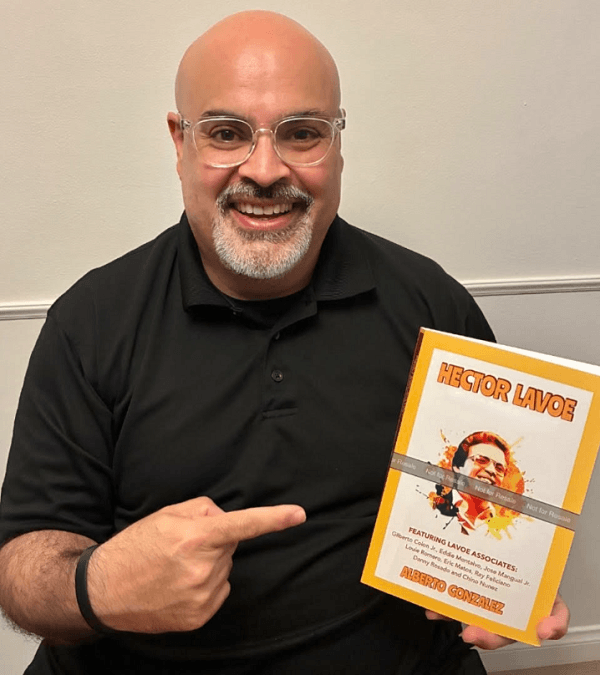
Alberto and his book on Hector
Author Alberto Gonzalez with a version of his book ”Hector Lavoe and Associates”

Alberto’s initial interest in music

Alberto’s initial interest in music began with an aunt from Puerto Rico who went to live with him and his parents in Chicago. She loved the music of Raphael and Sandro, so her nephew listened to them practically every day and ended up falling in love with their music and how they sang.

Little by little, Alberto began to learn their songs and was unknowingly taking his first steps toward becoming a professional singer. However, it did not stop there; he also listened to the trio music that his parents enjoyed and eventually to the salsa albums that his older brother began bringing to the house. Those salsa albums really caught Alberto’s attention.

Among the artists his brother listened to were Eddie Palmieri, La Sonora Ponceña, El Gran Combo de Puerto Rico, Willie Colón, and the one who would become his greatest inspiration, Héctor Lavoe.

Eventually, his brother became a professional trumpet player and played with various salsa orchestras in Chicago. Since he always heard Alberto singing songs at home, in 1979, he suggested that he audition for a new band of young salsa musicians his manager was putting together. For the audition, Alberto was tasked with learning and singing the popular Willie Colón and Héctor Lavoe song “Voso.”

Fortunately, his audition was a great success, and Alberto was asked to join La Típica Leal 79. The story behind the band’s name is interesting: Carlos Caribe Ruíz, the manager of the group, decided on the name Típica Leal because most of the members of his previous band, La Juventud Típica, decided one day to quit; they left him. For that reason, he decided to create a new band, and he made sure to add the word “Leal” (loyal in English) to the band’s name. His hope was that the new band, made up mostly of teenagers, would be loyal and not leave, just like the previous band did.

Sometime later, Alberto would go on to sing with a band called La Inspiración Latina, and he also worked briefly with Orquesta Yambo. In 2001, he moved to Los Angeles, where he began working with Johnny Polanco y Su Conjunto Amistad, becoming one of their main vocalists and traveling the world with them and the band.
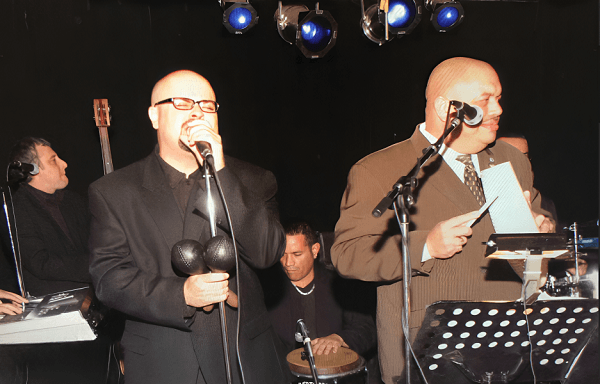
Alberto and Johnny Polanco
Alberto Gonzalez playing with Johnny Polanco Y Su Conjunto Amistad

Orquesta Salsa Caliente

When he left Johnny Polanco’s group, Alberto finally felt ready to form his own group, and that is how Orquesta Salsa Caliente was born. He has been leading the band for many years now and has even traveled with the band to Africa and Bermuda.

Over the past few years, Alberto has concentrated mainly on his work as an author. While he continues to perform, his primary focus has been on his debut book ‘‘Hector Lavoe and Associates.’’

Alberto’s Hector Lavoe Experience

In 1979, after auditioning and doing well with the song “Voso,” 15 year old Alberto officially became a member of La Tipica Leal 79.Caribe, the band’s manager, then asked him to learn a few more Hector Lavoe (and Willie Colon) songs. Since Hector was his favorite singer, he gladly learned the songs. Since his voice was somewhat similar to Hector’s, his bandmates began to affectionately call him “Baby Lavoe.”

In the fall of that same year, Alberto learned that Héctor and his orchestra were going to be performing in Chicago. Once he found that out, he asked Caribe to please take him to see Héctor, and, if at all possible, to introduce him to Héctor. Thankfully, he did get to go to that show, and he did meet Héctor. It was during that show, and during one of Héctor’s breaks, that he was able to take a photo with his favorite singer. Alberto still cherishes that photo to this very day. That night, he realized that Héctor was a “man of the people” due to his humility and how he treated others. The photo and his experience with Héctor were some of the main reasons why he decided to write a book about Lavoe. Over the years, many have criticized Héctor and have focused primarily on the negative aspects of his life. Sadly, many people are not familiar with the other side of Héctor, the humble, generous, and kind side of Lavoe. They will learn more about that side of Héctor in the new book.

Well, about a year and a half after first meeting Héctor, La Típica Leal 79 was booked to open for Celia Cruz and Héctor Lavoe. That show would take place at one of the most acclaimed dance halls in the city, where many of the greatest salsa artists performed over the years. That night, Alberto was able to share another conversation with Héctor, and he also took another photo with him. Héctor was generous with his time; he was kind and very accommodating. That’s something that Alberto never forgot.

This and other experiences are documented by the author in the book. Alberto actually interviewed about sixteen of Héctor’s former musicians, and eight of them are featured in the book. You’ll learn about their musical experiences, and you’ll be able to read about their experiences with “El Jibarito de Ponce,” Héctor Lavoe. These are the musicians that are featured: Gilberto Colon Jr., Eddie Montalvo, Jose Mangual Jr., Louie Romero, Eric Matos, Ray Feliciano, Danny Rosado, and Chino Núñez.

Alberto called the book “Héctor Lavoe and Associates,” and that title was somewhat inspired by Willie Colón’s 1978 compilation album “Willie Colón and Associates.”
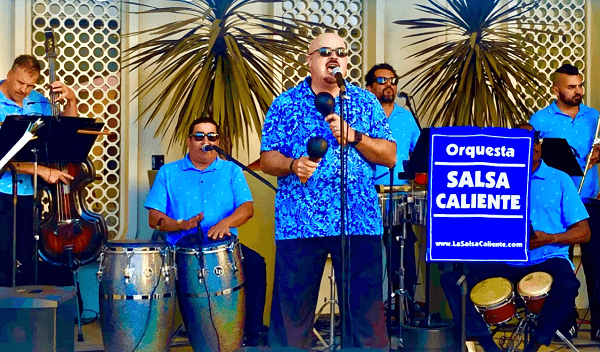
Alberto and Salsa Caliente
Alberto Gonzalez and his orchestra Salsa Caliente

A few Lavoe stories from the book

Among the many anecdotes that can be read in the book, Alberto told us one in which, on one occasion, a couple of Héctor Lavoe’s musicians had their vehicle broken into, and all of their instruments were stolen. When Héctor found out what had happened, he bought them new instruments and told them not to worry about paying him back. He did not charge them a penny.

Here’s another story. During a show, one of Héctor’s trumpet players accidentally dropped his trumpet on the floor and damaged it beyond repair; the instrument was unplayable. What did Héctor do? Héctor gave him $1,000 to go buy a new trumpet and, once again, didn’t charge him a penny.

These are just a few of the many stories regarding Héctor Lavoe that you’ll be able to read in the more than 400 pages of the book. The book will be officially launched in the coming months. For more information, please visit: www.hectorlavoebook.com.
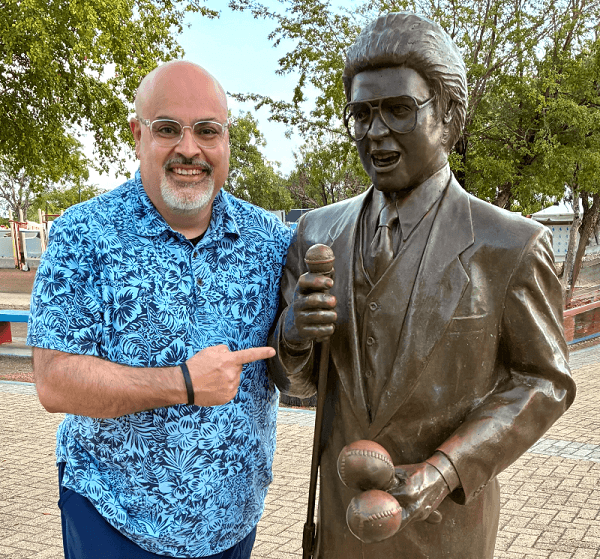
Alberto and Hector in Ponce
Alberto Gonzalez next to the statue of Hector Lavoe in Ponce, Puerto Rico

Read also: Puerto Rican American bandleader and singer Elle Jay is proud of her roots

The Night Hector Lavoe, “The Singer of Singers,” Refused to Please Pablo Escobar

January 1, 1981. The air was thick with the scent of a new year, but for Héctor Lavoe, it was anything but celebratory.

The Night Hector Lavoe, “The Singer of Singers,” Refused to Please Pablo Escobar

In Medellín, at a New Year’s Eve party hosted by none other than Pablo Escobar, the “El Cantante” himself found himself in a terrifying standoff.

This isn’t just a rumor; it’s a chilling anecdote that has cemented its place in music lore. It was a night when the King of Salsa faced down the King of Cocaine, and lived to tell the tale.

The Escape

The story begins with a frantic encounter recounted by a Colombian chronicler, Juan José Hoyos, who heard it directly from a taxi driver. It was well past midnight when a man, impeccably dressed in a suit but barefoot, suddenly appeared on the side of the road. He was clearly terrified, and the driver, unable to ignore his distress, pulled over.

The man, disheveled and without a dollar to his name, begged for a ride to his hotel. He explained he’d been singing at a “mafioso” party, and things had taken a dark turn. “My name is Héctor Lavoe,” he whispered.

Héctor Lavoe: “El Cantante de los Cantantes”

The taxi driver was skeptical. “You’ll have to sing ‘Yo Soy El Cantante’ if you want me to take you to the hotel,” he challenged.

Héctor, now inside the cab, bristled. “My friend, that’s exactly why I’m in this mess! One of those guys made me repeat that song like ten times, threatening me with a pistol! I got fed up and told the orchestra, ‘I’m not singing anymore, shut off the equipment!'”

The driver insisted, reminding the slight man in the suit that he was doing him a favor. Then, a voice, otherworldly and unmistakable, filled the cab:

“🎵 Yo soy el cantante / que hoy han venido a escuchar / lo mejor del repertorio a ustedes voy a brindar. / Y canto a la vida / de risas y penas / de momentos malos / y de cosas buenas. 🎵”

There was no doubt. It was Héctor Lavoe.

The Ordeal, Corroborated

What might have been dismissed as another tall tale from a taxi driver gained chilling veracity when members of Lavoe’s band corroborated the story.

Eddie Montalvo, the group’s conga player, vividly recalled the night. The gig with Pablo Escobar had been arranged by Larry Landa, a music promoter with deep ties to the drug world. The contract stipulated they’d play until 2 AM, but Escobar had other plans, demanding they continue until six in the morning.

Eddie Montalvo
Eddie Montalvo

“When it was two in the morning, Héctor told the band to stop,” Montalvo recounted. “The organizer threatened them at gunpoint to force them to keep singing. He wanted Héctor to repeat ‘Yo Soy El Cantante.'”

Amidst the chaos, the legendary salsa singer Ismael Rivera, who was also present, bravely stood up to the aggressors. Even the bodyguards got involved. Eventually, Lavoe and his musicians were herded into a small room and locked in for the rest of the night.

El Sonero Mayor Ismael Rivera

After an hour, in a desperate move, Héctor smashed a window. With the help of the other musicians, they slipped out one by one into the darkness, leaving their instruments behind, consumed by fear. “For thirty minutes they slipped and fell until they reached the highway,” Montalvo revealed.

And that’s how Héctor Lavoe ended up in that taxi, on a cold January morning in 1981.

A Strange Resolution

But the saga didn’t end there. The very next day, a mysterious individual visited Héctor and his band at their hotel. He presented them with a check, returned their confiscated passports and retained instruments, and offered a surprising apology.

Review of the Era (Flash)

This dramatic incident remains a stark reminder of the volatile world Héctor Lavoe navigated, and his unwavering spirit in the face of immense danger.

Also Read: International Salsa Magazine showcases important facts about Héctor Lavoe

By:

1) Los Mejores Salseros del Mundo

2) Dj, Augusto Feliberrtt

3) Hector Lavoe – Fans

International Salsa Magazine showcases important facts about Héctor Lavoe

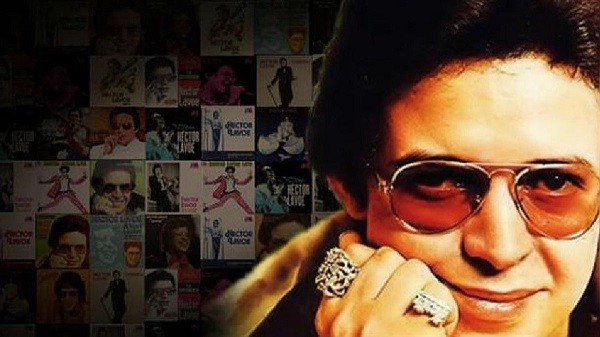
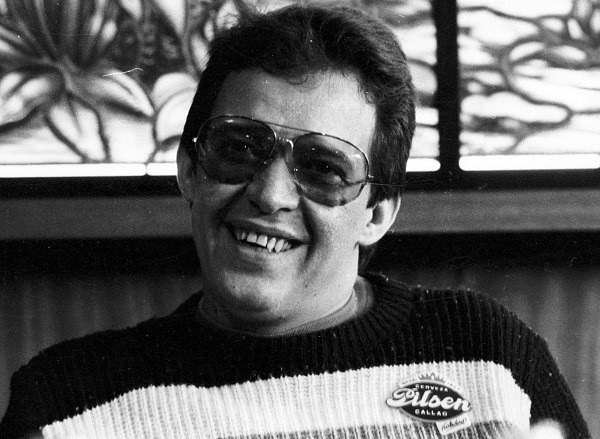
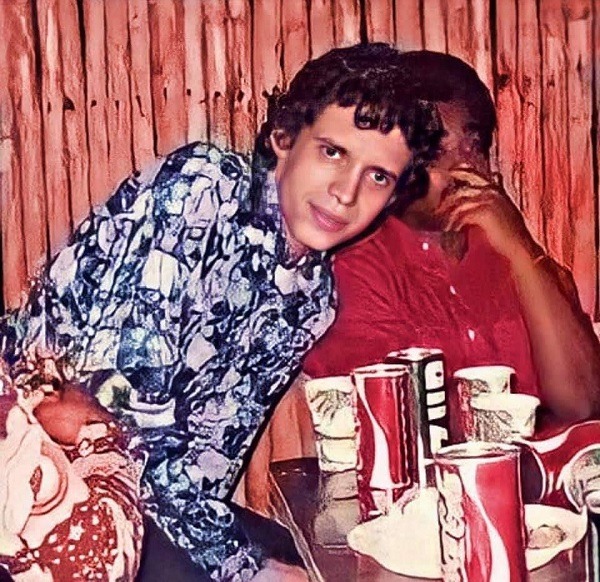
(Héctor Juan Pérez Martínez; Ponce, 1946 – New York, 1993) Puerto Rican singer and composer, considered one of the best interpreters of Caribbean music of all time and a pioneer in the introduction of New York salsa in the early 1970s.

He was part of the legendary orchestra of trombonist Willie Colón and was known by the nickname of El Cantante de los Cantantes.

-.Héctor Juan Pérez Martínez was born on September 30, 1946 in Ponce, Puerto Rico. His parents Luis and Francisca are musicians who, from song to song, manage to support a large family of several children.

-. In the year of Hector’s birth, the singers who would influence him are much older: Daniel Santos is 30 years old; Ismael Rivera, better known as “Maelo”, is 15; and Jose “Cheo” Feliciano is eleven.

-. At the age of three, he suffers his first loss: the death of Francisca Martínez, his mother.

-. Juan Morel Campos is a music academy where his father enrolls him. Héctor begins to learn classical music, but he quickly decides to learn what is played in the streets. Jesús Sánchez Erazo, better known as “Chuito el de Bayamón”, is his first idol.

-. Sings the song Campanitas de cristal, a bolero composed by Rafael Hernández Marín, at a school party.

-. In the early sixties, he forms with friends, including Papo Luca, a group that performs boleros and salsas. He earns 18 dollars a night and his talent seduces the people of Ponce. He is invited to sing on television programs. Musicians Felipe Rodríguez and Tito Lara give him a promising future.

-. At the age of 17, being recognized in his native Ponce, he travels to New York. His family does not agree with his departure. In the city he is greeted by the ghost of the death of a brother, who was supposedly a drug addict. He stays in the apartment of Priscila, one of his older sisters.

Héctor Juan Pérez Martínez

Before joining the Fania All Stars for the first time, a group directed by the Dominican Johnny Pacheco, he was part of bands such as Orquesta Nueva York and Alegre All Stars.

-. In 1966, at the age of 21, he sings alongside Pete Rodríguez, Adalberto Santiago, Tito Puente, Richie Ray, among other artists, in the incipient Fania All Stars. He meets Willie Colón, an American musician with Puerto Rican parents. “We both knew the world in the Bronx neighborhood. I learned to speak Spanish with Hector, although at first I understood what he was saying. I remember he had a brilliant sense of humor and was a great imitator of singers,” said Colón in an interview.

-. In 1967, he achieved fame with his first album with Willie Colón. It is a mixture of genres such as guaracha, plena and guaguancó, and is entitled El Malo. The album is a tribute to the slum culture of the United States and Latin America.

-. He tries to work as a painter, but his sister won’t allow it. After two weeks, he attends a musical rehearsal with his backing vocalist friend Roberto Garcia. Hector takes the microphone and makes the orchestra directors fall in love with him.

-. At the beginning of 1968 he meets Carmen, a follower he meets at a concert. On October 30 of that year Jose Alberto, his first son, is born.

-. After the birth of Jose Alberto, he has his second son with Nilda Román, another follower. With her, who is nicknamed “La Puchi”, he finally marries and stays in an apartment in Queens. Héctor Junior is the name of his second son.

-. At the end of the sixties he becomes addicted to drugs. In more than one stage he leaves the audience in a daze.

-. In 1971 he is called again to record, together with other stars, Fania All Stars at the Cheetah. This combo featured Cheo Feliciano, Richie Ray, Ismael Miranda, Celia Cruz and the young Rubén Blades. In 1973, the group filled the Yankee Stadium bleachers. Anacaona, Quítate tú and Ahora vengo yo are some of their hits.

-. With Willie Colón, he recorded more than 18 albums between 1967 and 1973. Thousands of reissues of Asalto navideño, El Juicio and Lo Mato were made. Che che colé, Ausencia, Calle luna calle sol, Todo tiene su final are the most requested songs by the Latin American public.

(H3) -. Willie Colón dissolves the duet in 1974. However, both continue to work. Lavoe’s talent continues despite his excesses and the author of Talento de televisión knows it well.

-. In 1975 he releases La voz, his first solo album. This incursion is interpreted as a second wind in his career. So much is his energy to continue that he releases eight more albums. De ti depende (1976) is a collection of boleros and Comedia (1978) breaks sales with the song El cantante, written by Rubén Blades. This work was also produced by Willie Colón, who that year teamed up with Blades to record Siembra, the best-selling salsa album.

-. His interpretation of El cantante helps to build the nickname “El cantante de los cantantes” (The singer of the singers).

-. He performs at the Coliseo Evangelista Mora in Cali in 1977. This concert was attended by the writer Andrés Caicedo, who managed to take a picture with Lavoe in the dressing room. Months later, the author of ¡Qué viva la música! committed suicide with an overdose of barbiturates.

-. As a result of a strong depression, Lavoe is interned in a mental sanatorium in the United States in 1977. His heroin addiction, which he had begun to suffer at the end of the sixties, is not only known by those close to him but also by his fans. “He paid a lot of attention to me and, when he was in trouble, he would call me”, confessed singer Ismael Miranda in an interview.

-. Lives in Cali between November 1982 and March 1983 at the Hotel Aristi. He is a regular singer at the Juan Pachanga discotheque, owned by Larry Landa, a concert organizer. In the capital of the Valley it is said that Lavoe takes drugs during the day and tries to sing at night.

Hector Lavoe el Cantante de los Cantantes

In February 1987, due to a fire, he jumps out of his apartment in Queens. At the same time, in Puerto Rico, his mother-in-law is stabbed to death.

-. On May 7, 1987, his son Hector is hit by a stray bullet. “That death broke his heart,” said Tito Nieves in an interview. “At that moment Héctor Lavoe’s soul dies”.

-. He is diagnosed with AIDS in 1988. Those who visit him in the hospital maintain that he does not lose his sense of humor nor his desire to return to the stage.

-. In Bayamón, Puerto Rico, he sings Mi Gente in a patron saint festival. But his presentation is sabotaged by one of the organizers who supposedly owes him money; in the middle of the song the lights are turned off and Lavoe is left without sound to continue.

-. In 1988, he throws himself from the ninth floor of a hotel in San Juan. He survives to continue fighting the battle. He sings on a Bronx street in 1989. His physical deterioration is a reflection of his state of mind. Lavoe is a ghost of his former self.

Héctor Lavoe
Héctor Lavoe

-. Tito Nieves is one of his friends who accompanies him in his difficult days. Lavoe depended on other people to live. A thrombosis paralyzes part of his body.

-. In March 1993, pushed by his record company, he makes his last presentation in New Jersey. He sings with Roberto Roena’s orchestra. Maestro Roena is not able to play in front of the “Singer of singers”. “It was too much to put him on stage”, he said indignantly.

-. At the age of 46 he dies of a cardiac arrest, on June 29, 1993, in New York. “He came into the world to enjoy it and suffer it. Although he was not happy, he made many people happy,” said his sister Priscila.

-. He is buried in Puerto Rico. He is accompanied by a horde of followers. The presence of his friend Ismael Miranda stands out, who bids him farewell saying: “He is not here with us, but his music continues”.

-. In 2007, El cantante, a movie inspired by his life, was released. It stars Marc Anthony and Jennifer Lopez.

-. Currently there are two monuments in his honor. One in his native Ponce, Puerto Rico, and another in Callao, Peru.

Héctor Lavoe

You can read: Génesis of Salsa, its essence, characteristics, rhythm, history and expansión

Hector Maisonave Manager of the Greatest Salseros in New York.

60 years in the business in the “Salsa” music industry, Héctor Maisonave says: “I have not seen anyone who surpasses the talent of Héctor Lavoe”.

You have managed the careers of so many salsa luminaries, how do you consider Héctor Lavoe’s talent?

I saw in Hector a supreme talent, to this day I have not seen anyone who can surpass him.

Not only as an artist selling tickets, selling records, but also as a human being.

There is no comparison of any kind, no matter who the artists are that are current today, to this day there has been no one that can replace Hector Lavoe.

He continues to this day as the most successful artist in all aspects.

He has managed and catapulted the careers of stars such as Héctor Lavoe, La Lupe, La India, Ismael Rivera, Tito Rodríguez, Gilberto Santa Rosa, among others.

Héctor Maisonave says: "I have not seen anyone who surpasses the talent of Héctor Lavoe".I saw in Hector a supreme talent, to this day I have not seen anyone who can surpass him. Not only as an artist selling tickets, selling records, but also as a human being.
Hector Maisonave Manager of the Greatest Salseros in New York.

“I continue to derive satisfaction from my work, my main addiction,” said the Puerto Rican producer.

With almost 60 years in the difficult and no less unpredictable music industry, today, on his 81st birthday, the artistic promoter Héctor Maisonave looks back to see that nothing remains the same in the business, but even so, his “musician soul” does not allow him to give up.

He has been a faithful witness and an important part of Latin American musical history, as a tireless promoter of the salsa rhythm in every corner of the planet.

His resume is impressive; he has produced more than 6,000 events; he has managed and catapulted the careers of some 80 artists, including stars such as his namesake Héctor Lavoe, Tito Rodríguez, La Lupe, India, Ismael Rivera, Raphy Leavitt, Gilberto Santa Rosa and La Sonora Ponceña.

And his experience has been recognized on more than one occasion by the artistic world.

He has been a faithful witness and an important part of Latin American musical history, as a tireless promoter of the salsa rhythm in every corner of the planet.
Héctor Maisonave 60 years in business in the “Salsa” music industry.

In 2010, this veteran businessman received the “Lifetime Achievement Award” from the Lincoln Center of New York, a distinction for his years in music production and management.

On that occasion, Diana Cortot, executive director of International Concert, the non-profit institution that presented Maisonave with the award, said that he was chosen because of the great help he has given to so many artists and his efforts to create a market for Latin music in the United States. “The Latin music industry, and salsa in particular, owes him a lot,” she said.

To this, the award-winning businessman, with the humility that has characterized him in each of his acts, simply said: “I don’t feel special, but privileged and honored”.

Born in Old San Juan, Puerto Rico, Maisonave was part of a great migratory stampede of Puerto Ricans who traveled to New York in the 1940s to escape poverty.

“It was here, in this city, where I took my first steps as a producer in the summer of 1950.”

Even at this age, memory remains one of his best attributes.

“I began to organize concerts in open spaces that attracted hundreds of people, who arrived in some buses that we arranged for the public, and they were like a kind of patron saint festivities in which transportation, food, dessert and dancing were offered… That was the beginning of everything,” he recalls while, suddenly, a special gleam begins to appear in his eyes.

That was the time when she discovered what her vocation was. But he also had to raise his voice, fight hard for his goals and defend his roots. He was even one of those who protested on New York’s iconic Fifth Avenue so that the New York City government would grant him permission to hold a Puerto Rican parade.

Born in Old San Juan, Puerto Rico, Maisonave was part of a large migratory stampede of Puerto Ricans who traveled to New York in the 1940s to escape poverty.
Rafael Ithier “Director del Gran Combo” y
Héctor Maisonave

“There were many inconveniences that got in the way, but there are more beautiful memories that light up my mind when I think of the dreams achieved,” confesses the man who had the idea of organizing Latino shows aboard boats that crossed the Hudson River to Bear Mountain.

And aware that, as he says, “turning 81 is not an everyday thing,” he says he is very happy to continue fighting the battle. “I continue to get enormous satisfaction from my work, my main addiction,” said this industrious Puerto Rican with his usual good humor.

Lately, his schedule has been as active as ever. From April to date, he has organized concerts for Grupo Mania and Tito Rojas (both in Philadelphia, Pennsylvania); José Alberto, “El Canario”, and Andy Andy at Six Flags New England, Springfield, Massachusetts, and next month he will be in charge of the presentation in Panama that salsa singer India has scheduled.

Source: Frank Manuel Orellana Rosas

Article of Interest: Richie Bonilla Management is a Latin Music booking and Managing Agency

Hector “Bomberito” Zarzuela Quality and Tuning in the Fania All-Star Machinery

Hector “Bomberito” Zarzuela, Instrumentalist, excellent sound, tuning and world-class reader.

 Héctor Zarzuela, known in the entertainment world as ‘Bomberito’, passed away last Thursday, January 7 at the age of 84 in New Jersey, USA.

Born June 3 in the city of Moca, Dominican Republic, where he began his musical studies, played with several local groups and then moved to the capital city in which he played with

different orchestras. Then in the early 60’s, he decided to emigrate to New York City.

Shortly after arriving in New York, he entered the world of salsa and began working with local orchestras, and later with those that made up the famous Fania All-Star in which he remained for many years.

Hector "Bomberito" Zarzuela Instrumentalist, excellent sound, tuning and world-class reader.
Hector “Bomberito” Zarzuela Quality and Tuning in the Fania All Stars Machine

The former member of the band Estrellas de la Fania, was one of the most important personalities of salsa thanks to his great talent and participation with renowned groups and artists of the salsa world, among them the Fania All-Stars (1971-1976 / 1979-1988 / 1994), Cheo Feliciano (1973 / 1977 / 1993), Ismael Rivera y sus Cachimbos (1975-1978), Héctor Lavoe (1975 / 1981) and Ray Barretto (1979 / 1987-1990).

He worked with fellow trumpeter Luis “Perico” Ortiz for many years, being an extraordinary quality and tuning session and responsible for innumerable hits of different singers.

The name Hector Zarzuela earned a lot of respect for his beautiful songs as an instrumentalist, excellent sound, tuning and world-class reader.

His list of artists with whom he recorded is enormous, here are some of them: Pete Conde, Johnny Pacheco, Héctor Lavoe, El Canario, Ismael Miranda, Ismael Rivera, Tony Vega, Celia Cruz, Grupo Niche, Victor Manuel, among others.

Traveling the world with all these artists, from Latin America to Africa, Japan, Australia, leaving legions of admirers in his wake and a great example to follow.
In 1980, he recorded with an orchestra formed by him, a production entitled “Merengues con Caché”. At that time, he was also with the group “Africando”.

In 1980, he recorded a production entitled “Merengues con Caché” with an orchestra which he has created. Around this time, he was also in the group “Africando“.

He traveled from Latin America to Africa, Japan, and Australia with all these artists, collected legions of fans, and set a great example to follow.

He also dabbled with some merengue groups, especially The New York Band, La Gran Manzana, etc. His career in merengue groups is not extensive, after all he has lived in New York City for many years, making him a living example of Constancy and Determination.

Lovingly called Bomberito, we know nothing about the reasons for this nickname, but he is highly known this way.

Zarzuela was a well-mannered, quiet temperament, respecful person when relating with others, and very responsible person in carrying out his work.

Man with a noteworthy trajectory in growing quality and respect by becoming one of the great figures abroad of our musicians.

Héctor Zarzuela deserves a predominant role in the pages of our history.

He was one of the greatest trumpeters of all time, always being the first trumpet in the ensembles.

He belongs to the highest elite group of musicians of the same instrument. The maestros Luis “Perico” Ortiz, Elias Lopes, Kito Velez, Orlando Pabellon, Rafael Labasta, Alfredo “Chocolate” Armenteros, Puchi Bulong and other great figures that make up the trumpet legends of the trumpet in salsa.

Trumpet

The trumpet is a wind instrument, which belongs to the family of brass instruments and is made of metal alloy.

The sound is produced by the vibration of lips on the part called mouthpiece from the air column (air flow).

Commonly, it is usually tuned in 9′ B ♭, that is to say, one tone below the tuning written on the staff, although there are also trumpets tuned in F, C, A and E, – flat-.

The musician who plays the trumpet is known as trumpet player or trumpeter.

Mechanism

The trumpet is made of brass tube doubled in a spiral of about 180 cm long, has several valves or pistons, and ends with a bellmouth weir, which receives the name of bell or pavilion.

The first two thirds of the tube are practically cylindrical, which gives it a loud and bright sound, whereas the cornet and the flugelhorn, which have a conical tube and produce a softer tone.

The remaining third is a conical tube, except in the last 30 cm, where the tube is widened to form the bellmouth weir.

The caliber is a complex series of turns that besome smaller in the mouthpiece receiver and larger just before the start of the bell. Careful design of these turns is critical to the intonation of the trumpet.

Hector "Bomberito" Zarzuela Instrumentalist, excellent sound, tuning and first class reader.
Hector “Bomberito” Zarzuela Quality and Tuning in the Fania All Stars Machine


Home

  • Page 1
  • Page 2
  • Page 3
  • Interim pages omitted …
  • Page 27
  • Go to Next Page »

International Salsa Magazine (ISM) is a monthly publication about Salsa activities around the world, that has been publishing since 2007. It is a world network of volunteers coordinated by ISM Magazine. We are working to strengthen all the events by working together.