• Skip to primary navigation
  • Skip to main content

International Salsa Magazine

  • HOME
  • Previous editions
    • 2026
      • ISM / March 2026
      • ISM / February 2026
      • ISM / January 2026
    • 2025
      • ISM / December 2025
      • ISM / November 2025
      • ISM / October 2025
      • ISM / September 2025
      • ISM / August 2025
      • ISM / July 2025
      • ISM / June 2025
      • ISM / May2025
      • ISM / April 2025
      • ISM / March 2025
      • ISM / February 2025
      • ISM / January 2025
    • 2024
      • ISM / December 2024
      • ISM / November 2024
      • ISM / October 2024
      • ISM / September 2024
      • ISM / August 2024
      • ISM / July 2024
      • ISM / June 2024
      • ISM / May 2024
      • ISM / April 2024
      • ISM / March 2024
      • ISM / February 2024
      • ISM / January 2024
    • 2023
      • ISM / December 2023
      • ISM / November 2023
      • ISM / October 2023
      • ISM – September 2023
      • ISM – August 2023
      • ISM July 2023
      • ISM Edition June 2023
      • ISM – May 2023
      • ISM April 2023
      • ISM March 2023
      • ISM February 2023
      • ISM January 2023
    • 2022
      • ISM December 2022
      • ISM November 2022
      • ISM October 2022
      • ISM September 2022
      • ISM August 2022
      • ISM July 2022
      • ISM June 2022
      • ISM May 2022
      • ISM February 2022
      • ISM January 2022
    • 2021
      • ISM December 2021
      • ISM November 2021
      • ISM October – 2021
      • ISM September 2021
      • ISM August 2021
      • ISM July 2021
      • ISM May 2021
      • ISM April 2021
      • ISM June 2021
      • ISM March 2021
      • ISM February 2021
      • ISM January 2021
    • 2020
      • ISM December 2020
      • ISM November 2020
      • ISM October 2020
      • ISM September 2020
      • ISM August 2020
      • ISM July 2020
      • ISM June 2020
      • ISM May 2020
      • ISM April 2020
      • ISM March 2020
      • ISM February 2020
      • ISM January 2020
    • 2019
      • ISM December 2019
      • ISM November 2019
      • ISM October 2019
      • ISM Septembre 2019
      • ISM August 2019
      • ISM July 2019
      • ISM June 2019
  • Download Salsa App
    • Android
    • Apple
  • Spanish

Search Results for: Johnny Cru

Our friend Tito Allen supports the Salsa Museum

From the Salsa Museum, we can boast of having a long list of important artists who have supported us since the project started or over the course of all these years. One of them is Roberto Romero Caballero, better known as Tito Allen, who is called ”El Elegante de La Salsa” by his most loyal fans as a result of the book ”Swing Latino” by Angel Mendez.

Tito singing
Tito Allen singing live

A little bit of Tito Allen’s biography

Tito Allen was born in the neighborhood of Santurce, municipality of San Juan, Puerto Rico, in 1946. He began his professional career in music as a 16-year-old teenager, when he was already part of groups in which he played the guitar and even performed on Puerto Rico’s Channel 4.

Although it is true that, initially, he was much more inclined to rock and roll and also used to play the bass, he changed his mind as time went by and decided to become a salsa singer, to the delight of all fans of the genre who gained forever one of their greatest Puerto Rican references. The best thing is that he turned out to have an incredible voice, so it was a very wise decision.

Obviously, Tito had his own inspirations to become what he is. In interviews with Tito, from his point of view, Cheo Feliciano is one of the best salseros of all and he has been listening to him since he was with Joe Cuba Sextet. As for the orchestras, he has also revealed that his favorite is that of Bobby Valentín and the song with which he identifies the most is ”Contento”. Another artist for whom he also expressed his admiration and desire to collaborate is the legendary pianist Eddie Palmieri.
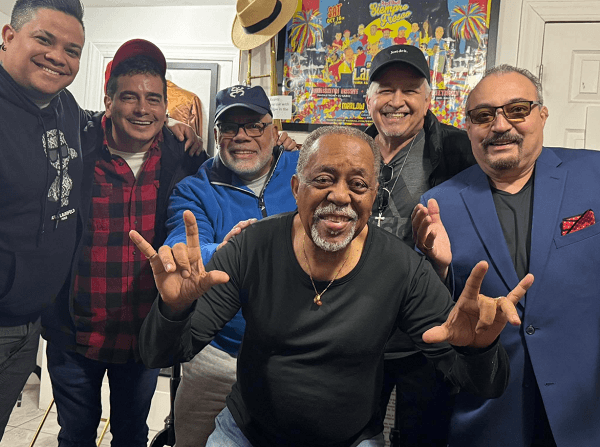
Tito and Johnny
Johnny Cruz, Tito Allen, Viti Ruiz, Jorge Leureyro, Christopher Rey and Ray Sepulveda

Tito Allen’s career

This talented man’s career is so wide that it is impossible to list everything he has done since he started in music, but it is possible to highlight that he has always tried to collaborate with as many groups and artists as possible and the list of recordings he has with other great names proves it. Tito Allen has sung along with Cheo Feliciano, Ray Barreto, La Típica 73, Adalberto Santiago, Papo Lucca, Willie Rosario, Fania All Stars, Pupi Legarreta, among many others.

It should also be noted that the singer traveled to New York in 1972 in order to attend Tito Puente’s shows and try to sing with him, but unfortunately he had no vacancies at that time. In view of this refusal, he decided to meet with pianist Edite Martínez, which resulted in a quintet that used to play in nightclubs.

He went back to Puerto Rico, but traveled again to New York very soon after, since he got a chance to play at ”El Corzo” with Ray Barretto’s orchestra, which was in need of a singer after the departure of Adalberto Santiago. After that, he finally managed to sing with Tito Puente for a few months and then went on to join La Típica 73 and La Puerto Rico All Stars.

All this without counting the large number of productions and recordings in which Tito sang and delivered backing vocals with many other big names in the industry.

Supporting the Salsa Museum 

Recently, Tito visited us at the Salsa Museum to give us his support and promote the institution as so many of his colleagues have done. In our social networks, you can see two pictures of the artist with our president Johnny Cruz, Viti Ruiz, Jorge Leureyro, Christopher Rey and Ray Sepulveda. 

Johnny Cru ISM corresponde in New York City

Read also: Puerto Rican singer Max Rosado and what he had achieved in Washington DC
Adalberto Santiago celebrates his 70th Anniversary next March

In this space, we have always worked to pay tribute to the greatest salsa legends and we consider it important that these luminaries feel the love of the public in life. That is why we want to pay homage to the man who has been a great pillar of Puerto Rican salsa as we know today. We are talking about the great singer from Ciales, Adalberto Santiago, who is celebrating the 70th anniversary of his artistic career. Here is a summary of his brilliant career.

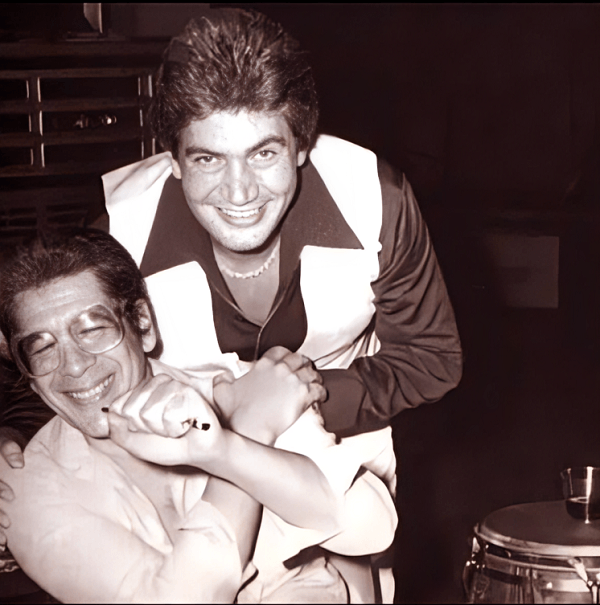
Adalberto and Ray
Adalberto Santiago and Ray Barretto in the 1960s

Adalberto’s beginnings in music

The sonero began his career by participating in trios, which he accompanied with his voice, guitar, bass and even his dance moves. This was something very few artists did at the time, which is why this young man drew a lot of attention at that time. 

He got to play with Chuíto Vélez and Willie Rosario, but his career really took off when he was given a chance to join the orchestra of Ray Barreto, which is when he managed to internationalize thanks to several albums that continue to be chanted by salsa fans until today such as ‘’Acid’’ or ‘’Rican Struction’’. Then, together with several members of this orchestra, he founded La Tipica 73, which revived Cuban son. 

Adalberto as an established artist

In the 1980s, he became part of the orchestra of Roberto Roena and got to perform famous songs such as ‘’Yo tenía una mujer’’. He is also known for co-producing the album ‘’Calidad’’ with his compatriot Papo Lucca, who arranged one of the tracks and was responsible for all the musical direction.

Some time later, he made a new version of the famous album ‘’Sex Symbol’’, becoming successful in countries such as Colombia, Peru and Venezuela. For this recording, the artist had the support of Isidro Infante in the area of production and arrangements. This is considered one of the most legendary musical works of the singer’s extensive career, to the point that many salseros around the world remember it fondly. 

Adalberto posing
Adalberto Santiago posing for the camera

During all these years, Adalberto has been the author of a great number of songs for many world-famous albums in which he has participated, either as a bandleader or lead singer. Despite the worldwide fame he has achieved, he always maintains loyalty for his Latin roots and, in his own words, the structure of Latin music is the most appropriate for his voice and singing style. 

In addition to that, the artist has always had the capability and experience to move through many Latin genres such as salsa, merengue, pachanga, cumbia, bomba, plena, boogaloo, guaracha, pachanga, among many others. 

He has always tried to maintain his physical and vocal discipline to continue giving the best of himself to his audience despite the years.

Celebrating his anniversary

As we said at the beginning, the great Adalberto Santiago is about to celebrate his 70th anniversary as an artist, an event that of course is to be celebrated big.

As a way of celebrating and thanking his public for all the support he has received, the singer has decided to hold a concert at the Lehman University of Performing Arts in New York City, more specifically in the Bronx, on Saturday, March 22 at 8PM. 

His fans have remained loyal all this time, so we have no doubt that he and his special guests will make everyone dance, making this event an unforgettable evening.

Read also: Milonga’s contribution to Latin music in general

Johnny Cru ISM corresponde in New York City

Willie González supports the Spanish Harlem Salsa Museum

The Salsa Museum always seeks to give exposure to the best of our Latin music and on that occasion, we want to talk about one of the most popular representatives of romantic salsa in recent years. We are talking about the amazingly talented Willie Gonzalez, who has recently been on the Johnny Cruz Show, so we think it is pertinent to do a review of his career and the most important details of his brilliant artistic background.   

Willie singing live
Willie González singing some of his biggest hits live

Willie’s beginnings in music   

Willie’s formal beginnings in music were when he was just a 15-year-old boy with the dream of becoming an acclaimed artist in the future. It was the Orquesta de Chamaco Rivera that gave him his first opportunity in the musical environment by playing the trombone, but this would not be the artistic area in which he would develop later on. What ended up catching his attention were singing and songwriting.   

During the 1980s, he was part of some important groups such as Orquesta Saraguey and Conjunto Chaney, in which Willie and Eddie Santiago were the main voices and began to gain great notoriety among the public.   

In 1988, he decided it was time for him to become a soloist in the company of the Orquesta Noche Sensual and the support of the Sanatone record label. Romantic salsa was in style at the time, so Willie followed that same line and named his first album ”Willie González, Original y Único”. Thanks to this material, the artist managed to sell more than 100,000 copies, receive Platinum and won other recognitions.   

In the coming years, he continued to release albums that was reaching greater success such as ”Willie González, Sin Comparación”, ”Para Ustedes, El Público” and ”Justo A Tiempo”. All of these have left great hits that are still considered romantic salsa classics to this day.   

Willie in a videoclip
Willie Gonzalez in his videoclip ”Aunque Lo Intente”

1990s and 2000s 

In 1994, the company Musical Productions published two compilation albums with Willie’s greatest hits which he called ”Éxitos de Willie González, Volumen 1” and ”Éxitos de Willie González, Volumen II”. The following year the singer demonstrated his talent as a composer with his album ”Willie González, Hacia Un Nuevo Camino” with songs like ”Quiero Recuperarte” or ”Dame Una Oportunidad”.   

Once the year 2000 arrived, he continued adding successes to his career with his next album ”Sensualmente A Mi Estilo” from the hand of a Venezuelan company called Trama Records and includes great songs like ”Sensualmente Loco”, ”Tatuaje Eterno”, ”Amor Audaz”, among others.   

About six years later, he released ”Reencuentro”. This musical work receives this name from a reunion between Willie and Eddie Santiago, who was his partner in the group Chaney many years ago. Together they recorded the songs ”Por Esta Mujer” and ”Solamente Ella”.   

Years later, Willie recorded live from Colombia, testing his skills as a producer along with talented Diego Galé. He also wrote some of the songs ”Juré” and ”Estoy Contigo”.   

In 2017, he continued to work in Colombia and released ”Willie González en vivo desde Manizales”. Such musical work contains songs like ”Pequeñas Cosas”, ”Quiero Morir En Tu Piel” and ”Si Tú Fueras mía”.   

In 2020, Willie released his album ”Esencia” and continued with the line of sensuality and romance with which he has become known over the past few years. In the case of ”Esencia”, he counted on the collaboration of talented composers such as Jorge Luis Piloto, Kiko Campos, Jandy Feliz, among others.   

Willie and Johnny Cruz
Johnny Cruz next to Willie Gonzalez talking about the Salsa Museum

Support to the Salsa Museum  

The Spanish Harlem Salsa Museum has been fortunate to be supported by Willie, who was kindly committed to donate some of his most precious objects to the institution so that salsa fans can appreciate them.    

In a video uploaded to the social networks of Johnny Cruz, president of the institution, they both talk about the role the museum has played in salsa and Willie said he was happy and proud to be able to support a place where there is a lot of history and items from such great Latin artists. 

Johnny Cru ISM corresponde in New York City


Read also: Ralph Rivera’s rol in the promotion of Latin Culture 

Ralph Rivera’s rol in the promotion of Latin Culture

Just as we have talked about musicians and singers who have left to the Puerto Rican culture in the highest in the rest of the world, it is also time to highlight the role of other figures who have contributed immensely to the way in which the Island of Enchantment is perceived by others: the cradle of several of the best artistic exponents from Latin America. One of them is Ralph Rivera.

From the Spaha Salsa Harlem Museum, we have always sought to promote Latin culture by giving space to figures who do their part in making sure we are respected on an artistic level. Such is the case of writer, producer and financial executive Rafael J. Rivera-Viruet, better known as Ralph Rivera, to whom we will dedicate the next lines of this article.   

Financial Executive Ralph Rivera
Puerto Rican financial executive and writer Ralph Rivera

Who is Ralph Rivera?   

Ralph Rivera was born in a coffee farm in the municipality of Utuado, the third largest municipality in Puerto Rico, which is located behind Ponce and Arecibo and is part of the mountainous region known as La Cordillera Central.   

Like many other Puerto Ricans of the time, his parents were seeking a better future for themselves and their child, so they made the decision to move to New York City, United States, thus becoming part of ”The Great Migration” in the 1940s, which consisted of a massive exodus of Puerto Ricans to Uncle Sam’s country as a result of its growing dominance over the island and the devastation caused by ”The Great Depression”, with which Puerto Rico was greatly affected.   

Once in the United States, the family settled in the South Bronx, where little Ralph spent his childhood and youth being part of New York’s public school system. It was full of children who wanted to get out of poverty through education and hard work. Ralph was certainly no exception, as he wanted the same thing and would do what he could to make it happen.   

Over the years, the young man acquired all the knowledge he could in the area he was most passionate about: business. Of course it was not an easy road, but Ralph managed to reach important positions in this field. When he worked for the auditing firm Price Waterhouse, he was hired by the talent agency Ashley Famous to handle the company’s financial affairs.  

Ralph’s beginnings were not easy
Ralph’s beginnings were not easy, but at the end he achieved all his goals

When he gained enough experience, he went for bigger challenges in his career. That was when he met his greatest mentor, fellow executive Marvin Josephson, with whom he created mergers and acquisitions in order to found International Creative Management (ICM) the Behemoth Talent Agency. 

Moving to Los Angeles 

At this point, Ralph had already fulfilled many of the dreams he had set out to achieve professionally, but he still has plenty to prove in the field. It turns out that, in the 1980s, he was given the opportunity to move to Los Angeles to work closely with Martin Starger, former president of ABC television, and Sir Lew Grade, who at the time was the head of Marble Arch Productions, a famous entertainment company in England. 

‘‘Sophie’s choice” and ”On Golden Pond” are among the projects the entrepreneur took on with the company, but his aspirations just kept growing and led him to work with Marvel Comics and Stan Lee himself on the television animation production side. Some of the Marvel titles Ralph worked on include ”Iron Man”, ”Spider Man”, ”The Fantastic Four” and many others.   

In the mid-1990s, he returned to his native island of Puerto Rico and settled in its capital, San Juan, to focus on producing documentaries about Hispanic American culture, including politics, cinema and, of course, music.   

Ralph’s book
Cover of the book ”HOLLYWOOD Se Habla Español

Ralph as a writer   

The multifaceted executive is not limited to the aforementioned facets, but is also a writer and author of the acclaimed book ”HOLLYWOOD: Se Habla Español”, which has won multiple awards since its release. 

In the text, Ralph describes some of the most important achievements of Hispanics in Hollywood films over the last century, stories that should make all of us Latinos who read them proud. They are proof that all the effort we have put into being recognized worldwide has finally paid off despite the obstacles.

Johnny Cru ISM corresponde in New York City


Read also: Pedro »Pacholo» Segundo apoya al Spaha Harlem Salsa Museum 

Pedro ”Pocholo” Segundo supports the Spaha Harlem Salsa Museum

At the Spanish Harlem Spaha Museum we always welcome the best of Latin music and, on this occasion, we could not stay behind, so we are glad to have had the opportunity to share with one of the best percussionists of the moment, Pedro Pocholo, who has a very interesting career that we will review below.   

Pocholo signing his album
Pedro ”Pocholo” Segundo signing a copy of his album ”A Guapetear” in 2022

Who is Pedro ”Pocholo” Segundo? How were his beginnings in music like?   

Pedro ”Pocholo” Segundo is an important producer and percussionist who has made a recognizable name in the Latin music industry thanks to his participation in some of the most critically acclaimed salsa and jazz orchestras.   

In music, it all started for him at the young age of 13, which is when he began playing with Ismael Miranda, representing the formal beginning of his professional career as a teenager. His efforts fortunately paid off, since a few years later, he was playing with Andy Montañez.   

In 1988, he joined Johnny and Ray’s group, causing him move to New York City, a place that gave him the greatest opportunities he would ever have in the artistic area. He became so well known for his skills as a percussionist that he was sought after by many artists to play with them such as Celia Cruz, Héctor Lavoe, Andy Montañez, Tito Rojas, Tito Nieves, José Alberto ”El Canario”, David Pabón, among many others.  

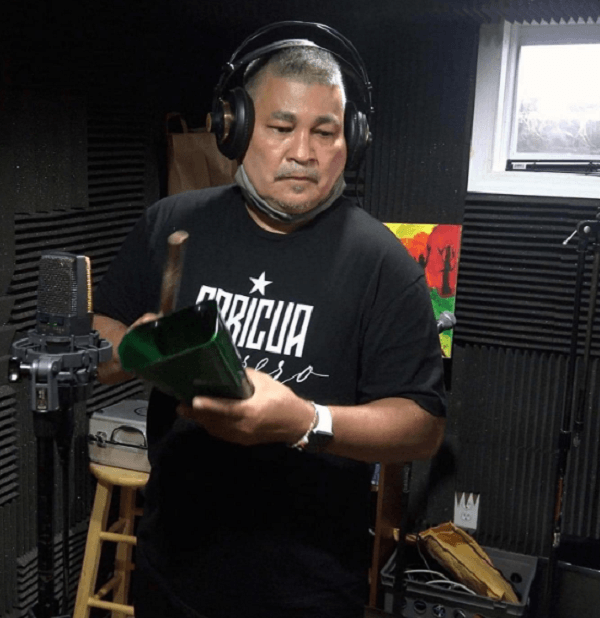
Pocholo playing the cowbell
Pedro ”Pocholo” Segundo playing the cowbell in his studio

Important things Pedro ”Pocholo” Segundo has done in his career 

Pedro ”Pocholo” lived many peak moments in the musical aspect, but without a doubt, the possibility to play to former presidents Bill Clinton and Al Gore with Celia Cruz and ”El Rey de Los Timbales” Tito Puente has been extremely important to his prestige as an artist, so he just went for more and more.    

This performance would not be the only collaboration he would have with Puente, as he also joined his talent to that of the timbalero in the DVD entitled ”Live at Manhattan Center” and traveled with him, The Big 3 Orchestra and Jimmy Bosch’s group to several countries in South America, Central America and Europe.   

Sometime later, in partnership with vocalists Carlos Santos and José Peña, Pocholo formed the group Madera Fina, with which he and his two fellow musicians managed to place some hits such as ”Guarimbo”, ”Palo de Son”, ”Desde Que Te Casaste”in very good places on the charts. They also went to Puerto Rico to promote the group and seek the support of local media such as La Mega 97.9 FM, being this radio station very important in the dissemination of these musicians’ work.   

Thanks to the experience gained from belonging to Madera Fina, Pocholo was more than ready to face bigger musical challenges, which led him to take on the creation, production and percussion of Boricua Legends, which has become one of the most popular New York orchestras of the moment.   

One of the best years of Boricua Legends was undoubtedly 2015, which was when it released its own version of ”Si Por Mi Llueve”, a song that was part of the world-renowned Cheo Feliciano’s repertory.  He also took second place in the GenGenSalsa Top 70 chart and eighth in the LatinosUnidosOnline chart.   

Pocholo performing live
Pedro ”Pocholo” Segundo during a live performance

Pocholo supports the Salsa Museum   

As many other Latin artists, Pocholo also supported the Spaha Harlem Salsa Museum and was a special guest on The Johnny Cruz Show to talk with the host and director of the museum, who was very pleased to welcome him on his show.   

In a video uploaded to Johnny Cruz’s social networks, the host can be seen introducing his guest and saying that they would talk about a number of very interesting topics, such as the beginning of his career, the founding of Boricua Legends and much more. Then, Cruz asks Pocholo to greet the audience and the musician, who was decked in a grayish suit and pink shirt, invites people to tune in to the show and assures them that they will talk about important things such as Latin music in New York and Puerto Rico.   

Finally, Johnny closes by saying that viewers can enjoy the show from 3:30pm to 4:30 every Saturday on channel 67 and says goodbye with the song ”La Fama” by Héctor Lavoe playing in the background. 

Johnny Cru ISM corresponde in New York City

Read also: Here we have Brazilian bandleader and composer Paula Maya 

  • « Go to Previous Page
  • Page 1
  • Interim pages omitted …
  • Page 7
  • Page 8
  • Page 9
  • Page 10
  • Page 11
  • Interim pages omitted …
  • Page 42
  • Go to Next Page »

International Salsa Magazine (ISM) is a monthly publication about Salsa activities around the world, that has been publishing since 2007. It is a world network of volunteers coordinated by ISM Magazine. We are working to strengthen all the events by working together.