• Skip to primary navigation
  • Skip to main content

International Salsa Magazine

  • HOME
  • Previous editions
    • 2026
      • ISM / March 2026
      • ISM / February 2026
      • ISM / January 2026
    • 2025
      • ISM / December 2025
      • ISM / November 2025
      • ISM / October 2025
      • ISM / September 2025
      • ISM / August 2025
      • ISM / July 2025
      • ISM / June 2025
      • ISM / May2025
      • ISM / April 2025
      • ISM / March 2025
      • ISM / February 2025
      • ISM / January 2025
    • 2024
      • ISM / December 2024
      • ISM / November 2024
      • ISM / October 2024
      • ISM / September 2024
      • ISM / August 2024
      • ISM / July 2024
      • ISM / June 2024
      • ISM / May 2024
      • ISM / April 2024
      • ISM / March 2024
      • ISM / February 2024
      • ISM / January 2024
    • 2023
      • ISM / December 2023
      • ISM / November 2023
      • ISM / October 2023
      • ISM – September 2023
      • ISM – August 2023
      • ISM July 2023
      • ISM Edition June 2023
      • ISM – May 2023
      • ISM April 2023
      • ISM March 2023
      • ISM February 2023
      • ISM January 2023
    • 2022
      • ISM December 2022
      • ISM November 2022
      • ISM October 2022
      • ISM September 2022
      • ISM August 2022
      • ISM July 2022
      • ISM June 2022
      • ISM May 2022
      • ISM February 2022
      • ISM January 2022
    • 2021
      • ISM December 2021
      • ISM November 2021
      • ISM October – 2021
      • ISM September 2021
      • ISM August 2021
      • ISM July 2021
      • ISM May 2021
      • ISM April 2021
      • ISM June 2021
      • ISM March 2021
      • ISM February 2021
      • ISM January 2021
    • 2020
      • ISM December 2020
      • ISM November 2020
      • ISM October 2020
      • ISM September 2020
      • ISM August 2020
      • ISM July 2020
      • ISM June 2020
      • ISM May 2020
      • ISM April 2020
      • ISM March 2020
      • ISM February 2020
      • ISM January 2020
    • 2019
      • ISM December 2019
      • ISM November 2019
      • ISM October 2019
      • ISM Septembre 2019
      • ISM August 2019
      • ISM July 2019
      • ISM June 2019
  • Download Salsa App
    • Android
    • Apple
  • Spanish

Search Results for: Johnny Cru

Remembering Domingo ”Tito” Gutiérrez’s career

Domingo ”Tito” Gutiérrez  

Domingo ”Tito” Gutiérrez is one of those names that can never be missing when talking about Latin music in the United States, since the contribution made by this musician has been invaluable. That is why we found this to be a good opportunity to look back on the trajectory of this great artist, who has demonstrated again and again that the language of music is universal and crosses borders.  
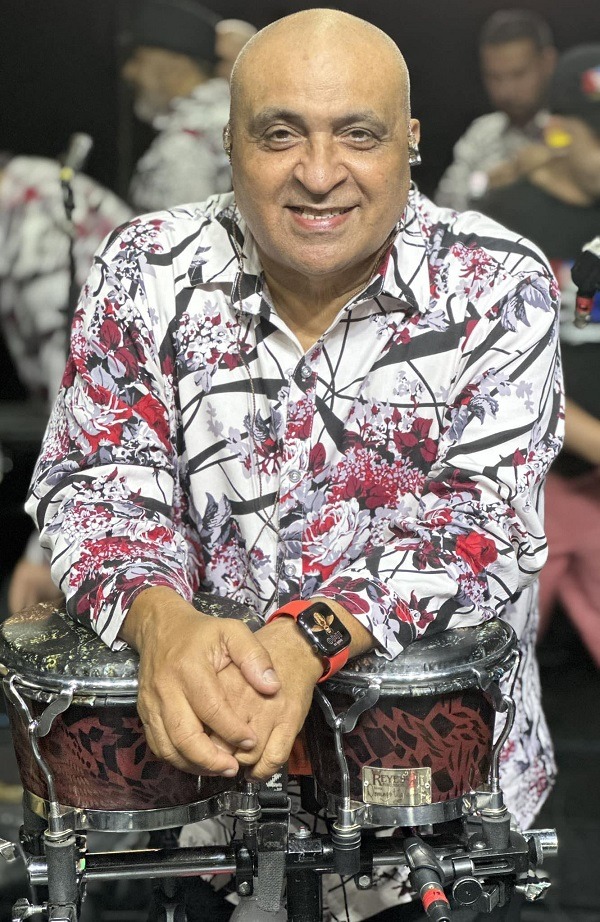
Domingo with bongos
Domingo ”Tito” Gutiérrez posing with his bongos

Childhood and musical beginnings 

Tito Gutiérrez was born in Guánica southwest of the ”island of Enchantment”, Puerto Rico on August 16, 1957 into the heart of a culturally Latin family, especially in the case of music. However, he moved with his parents to New York City when he was about 11 years old. 

Given that little Domingo had to start making friends again after the move, he took every opportunity to interact with other children of the same age, which led him to meet a group of kids enthusiastically playing instruments in a park.  

The boy had never played an instrument before in his life, so he felt a little intimidated at first, but that did not stop him from approaching them and saying he wanted to play with them. When asked him what instrument he played, he replied that he played the bongo, since he noticed that the improvised band did not have one.   

This is how Domingo joined them, started playing the bongo and continued playing it until he became a professional of this instrument.   

Domingo on stage
Domingo ”Tito” Gutiérrez performing on stage

Professional life in music 

In 1972, he finally ventured into music at a professional level with the same instrument with which he began in this world during his childhood and it was the group El Son De Hoy that gave him his first job opportunity. 

Not much time would pass before he became a musical director and founder of an orchestra when he created his own group called Orquesta Borinqueya. At the same time, he was also working with the Orquesta Alianza Boricua, with which he was recording a studio album.   

For a period of approximately five or six years, the artist has been recording with countless local orchestras with which he has continued to make a career and expand his musical curriculum, such as Orquesta La Crítica, Orquesta Nelson Feliciano, Orquesta Crisis, Orquesta Guainía, among others.  

In 1978, he went to live in New York and did his thing with the bongo along with some groups such as Grupo Melao, Conjunto Avicú and Peter Brown Jazz Cuartet.   

Domingo with a cowbell
Domingo ”Tito” Gutiérrez playing a Puerto Rican cowbell designed by his own line of instruments

In the late 90’s, his fame had grown so much that he has had the opportunity to work in orchestras of international stature such as Orquesta La Terrífica, Orquesta Costa Brava, Orquesta de Simón Pérez, Orquesta de Roberto Ortiz and more. He has also shared the stage with Ismael Miranda, José Alberto ”El Canario”, Andy Montañez, Cano Estremera, among others. 

Today, he plays for La Sonora Ponceña of Puerto Rico, ”45 Aniversario” being the first project he recorded with the group and has participated in a number of albums with this great team. 

While on tour with the different orchestras to which he has belonged, he was able to visit a large number of countries such as Venezuela, Ecuador, Mexico, Colombia, Costa Rica, Peru, Panama, Spain, France, Italy, among others. 

Parallel to all this, Domingo has his own line of bongos which he named ”Tito Gutierrez Bongo Series”. This line is part of an initiative of the Reyes Family, who are a group of Colombian artisans who are dedicated to designing bongos of different colors and sizes. 

Read also: Jerry Rivas, career, and support for the Spaha Salsa Gallery Museum 


Johnny Cruz Correspondent for ISM in New York City

North America – July 2023

This musician is Juan Carlos Formell

Thumbnail for Andrea Chaparro and Lulada Club

Jake Jacobs and VibraSÓN

Carlos Medrano from Sabor De Mi Cuba

Robert y Ricardo

Thumbnail for Johnny Cruz and all his articles


Jerry Rivas, career, and support for the Spaha Salsa Gallery Museum

The Spaha Salsa Gallery Museum has been the recipient of a good number of objects donated by artists and their families after they had died. This time, it is the turn of Jerry Louis Díaz Rivas, better known as Jerry Rivas in the music scene, who is one of the main singers of El Gran Combo de Puerto Rico.   

We want to use his pleasant visit to our museum and his forty-sixth anniversary with El Gran Combo to talk a little about his great career and everything achieved in his long musical career over the past decades.   

Jerry with Johnny
El Gran Combo De Puerto Rico singer Jerry Rivas and Johnny Cruz

Life and career of Jerry Rivas   

Jerry Diaz was born in the city of Tampa, United States, on August 25, 1955 and his parents were of Puerto Rican origin, so it is undeniable that Puerto Rican heritage greatly influenced the path he would take later on.   

About five years later, Jerry and his family moved to the city of Bayamón, Puerto Rico, where he began to take his first steps in the world of music with the guitar, the Puerto Rican cuatro and the Cuban tres, counting on the support of professor Carlos Seguí to learn to play the latter. However, shortly after, he would decide that singing was his thing. 

While still a young teenager, he was part of various groups such as Grupo Complicación, Conjunto Cojoba and Grupo Chaney, being in all cases a very important part of the body of musicians who were in these bands.   

His big great came in 1976 when Don Rafael Ithier, who was interested in the artist to be part of El Gran Combo De Puerto Rico, after he was recommended by Don Quique Lucca, who thought of this boy as replacement of the legendary Andy Montañez, singer of the group for more than 14 years.   

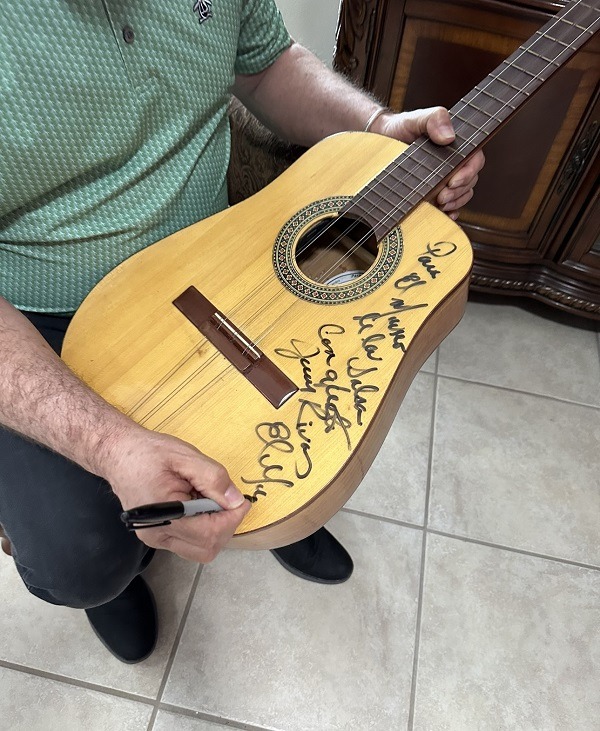
Jerry signing a tres
Jerry Rivas signing the Cuban tres he donated

Although it was not believed that Jerry could fill the shoes of his predecessor, his talent, effort and support from the music director of the orchestra, made him consolidate in the institution along with the rest of his colleagues and become one of the longest-serving members of El Gran Combo. 

International fame came with the album ”El Gran Combo En Las Vegas” thanks to the song ”La Clave”, in which he proved his vocal abilities to new levels. After that, he achieved his consecration as an international star with the album ”Happy Days” thanks to the song ”El Menú”.   

After that, everything that followed for Jerry was success with the orchestra, which resulted in approximately 30 recordings in a span of 45 years with El Gran Combo de Puerto Rico, his musicians and the extraordinary team behind the group.    

Other details of his life and support to the Salsa Museum  

In addition to being a vocalist for El Gran Combo de Puerto Rico, Jerry also participated in backing vocals with other great musicians for their respective musical works such as Willie Rosario, Bobby Valentín, Yuri Buenaventura, Gilberto Santa Rosa, La Sonora Ponceña, Adalberto Santiago and many others.   

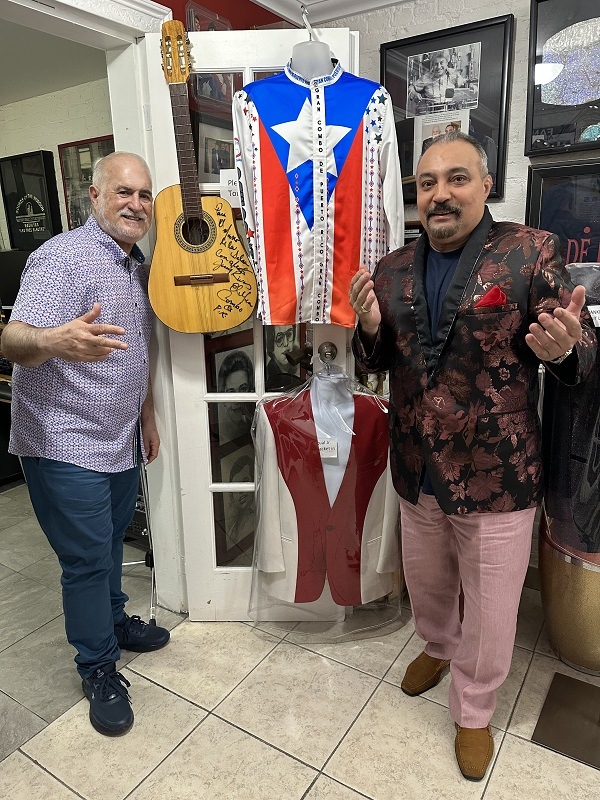
Jerry with Johnny and the tres
Jerry and Johnny with the tres and the jacket Jerry donated to the museum

In each of these projects, the Puerto Rican artist has always given his personal touch and his unmistakable vocal chords, so it is normal that he is considered a legendary voice within the salsa movement not only in his country, but also worldwide.   

Due to all of the above, it is a true honor for the Spaha Salsa Gallery Museum to receive this great musical luminary in its facilities, where he was welcomed by its president and founder, Mr. Johnny Cruz. 

Some photos on the Cruz’s official Facebook page, it is evident that both shared a very pleasant time remembering things from the past and talking about music. In addition, Jerry donated one of his shirts and a Cuban tres to the museum so that they can be exhibited to the public along with the rest of the objects in its collection.   

We thank Jerry for his kindness, generosity and great talent, which we hope will continue to accompany us in the years to come. 

Read also: Tommy Olivencia Jr’s career and support for the salsa museum 

Tommy Olivencia Jr’s career and support for the salsa museum

Inherited talent

The salsa museum has received several of the greatest artists and their families, who have donated valuable objects related to their careers. Today, it was the turn of Ángel Tomás Olivencia Rodríguez, who is artistically known as Tommy Olivencia Jr. 

Tommy Olivencia Jr. is a percussionist and timbalero born on March 19, 1969 and is the son of the famous Puerto Rican musical icon and director of the Primerísima Orchestra Tommy Olivencia, from whom he inherited his great talent and has left his family’s name very high.

Tommy Olivencia Jr., son of maestro Tommy Olivencia

Planté bandera de nuevo

Eager to find his own way and make his own name in the industry, the artist made his debut with the recording ”Planté bandera de nuevo”, which was carried out in his native country and presents a total of nine tracks, some of them created by composer and percussionist Jerry Ferrao.  

A very important fact during this period is that the timbalero made his official debut for AJ Records, Inc. in the framework of the 40th anniversary of Tommy Olivencia Y Su Orquesta at the beginning of this millennium, making this event even more special.

It is also important to highlight that this colorful musical work included the participation of figures such as Luis ”Perico” Ortiz. Máximo Torres, Tito Rivera, Pedro Bermúdez and many others. All these big talents made it possible for Tommy Olivencia Jr.’s first step as an artist to be on the right foot.

After Tommy Olivencia’s death

Once the incomparable Tommy Olivencia passed away, his son took the lead on the  Primerísima Orchestra, which represented a great professional challenge for his career considering that many of his father’s hits are already salsa classics worldwide.

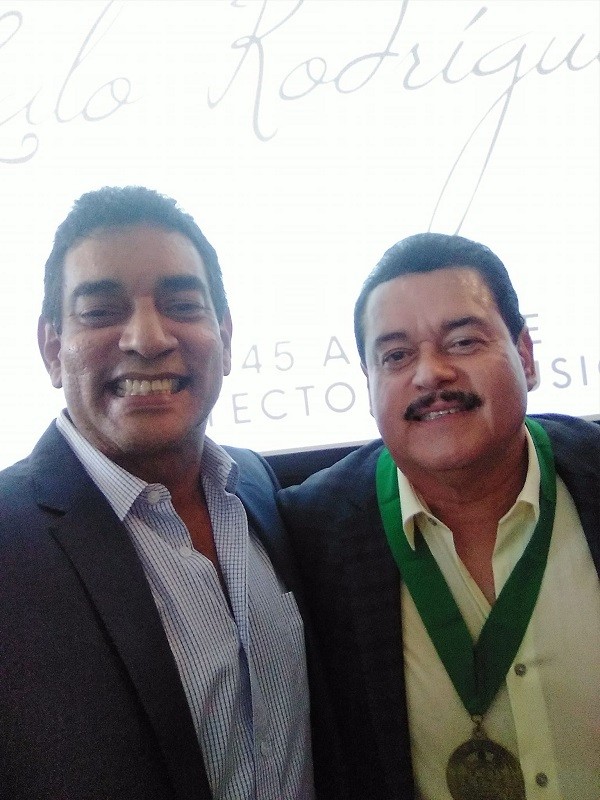
Tommy Olivencia Jr. next to Lalo Rodríguez

At the beginning, ”Tomito”, as he is also affectionately known, wanted to keep alive his father’s legacy with his most famous songs such as ”El Son Cubano”, ”Trucutú” or ”Doroteo”. However, there came a point where Olivencia and the rest of the members of La Primerísima had to get to work with new songs to join the previous hits.

When asked about these changes he had to make, he said that he has always worked on his father’s original repertoire, since the audience always asks for those songs in his performances. However, he says he is very happy to be able to contribute his grain of sand with the song ”Mi Querido Viejo”, which was dedicated to Tommy Olivencia senior and of which he is proud for the strng impact that it has had.

Something that made him very happy is that he was finally able to record his first video clip with the orchestra and other great artists such as Gilberto Santa Rosa, Lalo Rodriguez, Sammy Gonzalez, among others.

Although he feels quite pleased to be able to continue with the steps taken his father, he is very proud to offer completely new songs to join the already prolific repertoire of La Primerísima. Among the new songs are ”Un Legendario de Pueblo” and ”Evelio”.

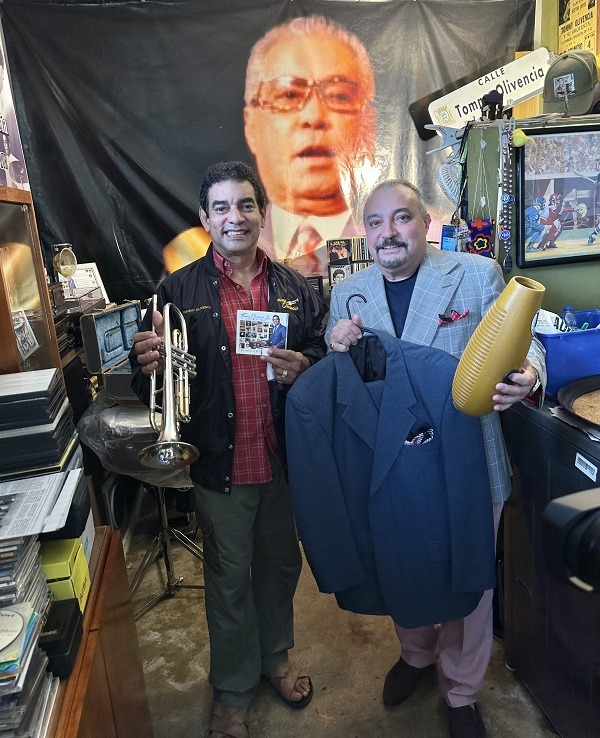
Tommy Olivencia Jr. with Johnny Cruz

Tommy Olivencia Jr. at the Spanish Harlem Salsa Museum

As well as a good number of other stars and their families, we were fortunate to enjoy the pleasant presence of Tommy Olivencia Jr. at the Spanish Harlem Salsa Museum, where he and the president of the institution, Johnny Cruz, had a nice chat and walk around the facilities of the place.

At these visits, it is very common for visitors to make donations to contribute to the extensive collection that the museum has to present and this was no exception. ”Tomito” donated a suit and the güiro of maestro Tommy Olivencia that whosoever visits the museum has the opportunity to appreciate some of the elements that his father used during his career.

From this space, we really thank his visit and his contributions and we wish him the greatest success in all the projects he undertakes both professionally and personally, especially what has to do with music.

Read also: Joe Bataan’s music remains in force


By Johnny Cruz, ISM Correspondent, New York, New York City


North America – June 2023

Thumbnail for Johnny Cruz and all his articles

  • « Go to Previous Page
  • Page 1
  • Interim pages omitted …
  • Page 9
  • Page 10
  • Page 11
  • Page 12
  • Page 13
  • Interim pages omitted …
  • Page 42
  • Go to Next Page »

International Salsa Magazine (ISM) is a monthly publication about Salsa activities around the world, that has been publishing since 2007. It is a world network of volunteers coordinated by ISM Magazine. We are working to strengthen all the events by working together.