• Skip to primary navigation
  • Skip to main content

International Salsa Magazine

  • HOME
  • Previous editions
    • 2026
      • ISM / March 2026
      • ISM / February 2026
      • ISM / January 2026
    • 2025
      • ISM / December 2025
      • ISM / November 2025
      • ISM / October 2025
      • ISM / September 2025
      • ISM / August 2025
      • ISM / July 2025
      • ISM / June 2025
      • ISM / May2025
      • ISM / April 2025
      • ISM / March 2025
      • ISM / February 2025
      • ISM / January 2025
    • 2024
      • ISM / December 2024
      • ISM / November 2024
      • ISM / October 2024
      • ISM / September 2024
      • ISM / August 2024
      • ISM / July 2024
      • ISM / June 2024
      • ISM / May 2024
      • ISM / April 2024
      • ISM / March 2024
      • ISM / February 2024
      • ISM / January 2024
    • 2023
      • ISM / December 2023
      • ISM / November 2023
      • ISM / October 2023
      • ISM – September 2023
      • ISM – August 2023
      • ISM July 2023
      • ISM Edition June 2023
      • ISM – May 2023
      • ISM April 2023
      • ISM March 2023
      • ISM February 2023
      • ISM January 2023
    • 2022
      • ISM December 2022
      • ISM November 2022
      • ISM October 2022
      • ISM September 2022
      • ISM August 2022
      • ISM July 2022
      • ISM June 2022
      • ISM May 2022
      • ISM February 2022
      • ISM January 2022
    • 2021
      • ISM December 2021
      • ISM November 2021
      • ISM October – 2021
      • ISM September 2021
      • ISM August 2021
      • ISM July 2021
      • ISM May 2021
      • ISM April 2021
      • ISM June 2021
      • ISM March 2021
      • ISM February 2021
      • ISM January 2021
    • 2020
      • ISM December 2020
      • ISM November 2020
      • ISM October 2020
      • ISM September 2020
      • ISM August 2020
      • ISM July 2020
      • ISM June 2020
      • ISM May 2020
      • ISM April 2020
      • ISM March 2020
      • ISM February 2020
      • ISM January 2020
    • 2019
      • ISM December 2019
      • ISM November 2019
      • ISM October 2019
      • ISM Septembre 2019
      • ISM August 2019
      • ISM July 2019
      • ISM June 2019
  • Download Salsa App
    • Android
    • Apple
  • Spanish

Search Results for: Johnny Cru

Enjoy Salsa in the East Coast

USA / New York / New York

Johnny Cruz: Everything will be very busy on the East Coast during the month of February. So be attentive Salseros!

Johnny Cruz, President of Spanish Harlem Salsa Gallery Museum invites us to follow all activities programmed in the place “Donde las leyendas nunca mueren”

Johnny Cruz from New York
Johnny Cruz is the president of Spanish Harlem Salsa Gallery

1708 Lexington ave New York N.Y. 10029 spahasalsagallery.com Open free to the public all Thursdays & Fridays from 4 to 7 pm and Saturdays from 1 to 8 pm.

Also, The Johnny Cruz Show, the #1 Salsa Show on television on all 5 Boroughs of New York on CH67.
Saturdays from 3:30 to 4:30 pm

Stay tuned:
Youtube, Facebook, Twitter, Instagram E-mail [email protected].

They are going to by talking on one of the best congueros of NY and the World: Eddie Montalvo.

Johnny Cruz will talk about Salsa from its capital: New York en El Barrio.

Cruz is owner of Cruz Music Inc with Recording Studios in N.Y. & featuring some of the Greatest Singer in the business and the best Musicians in the world.

Contact:
• Johnny Cruz: 917-747-8505 [email protected].

The Spanish Harlem Salsa Gallery

Is a cultural institution committed to providing residents of East Harlem and surrounding communities with structured, scholarly, cultural programming, information, resources, and learning initiatives. As inclusive and diverse as the salsa music represented within these walls, the Gallery provides a community-friendly, accessible, and arts education-centered space.

“Donde las leyendas nunca mueren”

As a strategic community partner, they provide a cultural resource for the surrounding museums and institutions on Museum Mile as well as the many community based organizations serving East Harlem, The Bronx, Brooklyn and Queens and other regions, as well as tourists visiting New York, that have expressed interest in knowing the roots of Salsa. Undeserved communities such as seniors, teens, homeless, mentally challenged, LGBTQ, and others will find the Gallery a sanctuary of cultural history and a repository for information on salsa music and its artists.


By Johnny Cruz, Correspondent, New York, New York

Salsa: From New York to the world!

North America – United States – New York

Last February we actively participated in different activities in New York, promoted by different instances and always supported from the Spanish Harlem Salsa Gallery Museum and The Johnny Cruz Show.

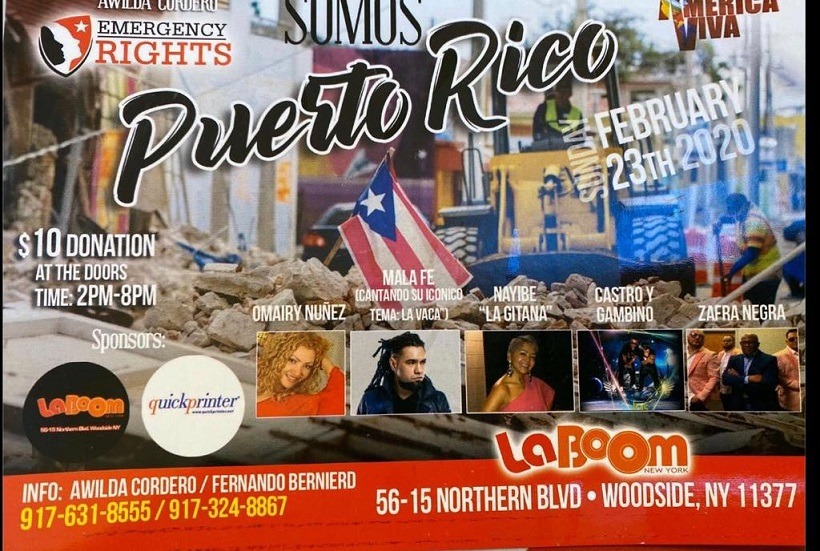
Johnny Cruz: We were part of the Somos Puerto Rico event, together with more than 25 artists and with the collaboration of La Boom, which allowed thousands of people to work for our island: Puerto Rico. There was a lot of music, and we were accompanied by artists such as Jova Rodríguez, Arlene, Roberto Vásquez, Anissa Gatners, Fernando Berniero, Alex Bautista, Jen Carrasco and Kevin Tapia, among others.

We also had typical food for sale and many initiatives aimed at saving so many lives in need. From this event we want to continue bringing families to the United States and they can be calm until they stop shaking in the south west of Puerto Rico. You are not alone!

In addition, we are working hard on a documentary about Frank Ferrer, always thinking of immortalizing figures that have consolidated Salsa in the world as a Latin genre of world projection.

Salsa, as you know, is a typically New York musical genre, the result of the influence of great Latin jazz musicians, and the existence of a youth of Latin origin born, or resident in New York, in slums where Salsa is the best expression, spiced up by the exile produced by the Cuban Revolution and the awareness of American racial minorities.

In 1964, Johnny Pacheco, a flutist of Dominican origin, and Jerry Masucci, a young businessman, founded the Fania label, which gave the old Latin labels, a more modern sense of Caribbean music. Musicians and singers of the previous generation were reinvented, but others were incorporated as a young Willie Colon, the Palmieri brothers, Eddy and Charlie; Papo Luca, Ray Barreto, Larry Harlow. And, there were also singers who put their voice to Salsa to tell stories of the street, daily or reflexive, that were the mirror of the life of the neighborhoods: Cheo Feliciano, Adalberto de Santiago, Andy Montáñez, the Ismaeles -Miranda and Ribera-, Justo Betancourt, Héctor Lavoe or Rubén Blades.

Johnny Cruz Salsa: From New York to the world!

The influence of the Cuban revolution had led composers and salsa musicians to become aware that it was necessary to compose songs that talked about what was happening in the streets from a critical perspective, giving way to a new salsa and foot reality for characters as Frank Ferrer started from folklore and protest to arrive at salsa mixing both concepts in an exemplary album: Yerbabuena. All this and much more can be enjoyed very soon.

For this month of March, Puerto Rico will organize the 1st World Salsa Collectors Meeting and of course we will be there representing New York with the Salsa Museum (SPAHA Salsa Gallery Museum). From March 7th, at least 15 organizations of this type of collector from seven countries will exhibit their collections of the Caribbean genre.

The collectors meeting will take place at the Sheraton Hotel, in Miramar, under the theme “La Salsa se baila así” and will be free admission. It will be attended by collectors from Puerto Rico, Colombia, Panama, Peru, Ecuador, Mexico and several cities in the United States.

That day will be the official release in LP format of the album “Mario Ortiz, 55 Aniversario”, nominated for the last edition of the Latin Grammys.

The event includes memorabilia exhibitors of legendary salsa artists such as Willie Rosario, Bobby Valentín, Roberto Roena o la Sonora Ponceña, as well as the Museo de la Salsa de Puerto Rico or the Fundación Nacional para la Cultura Popular.

Pieces from the Jairo Varela Museum, renowned deceased Colombian musician, whose orchestra Grupo Niche is still active and triumphing around the world will be presented. The writer Daniel Nina, will give a lecture about Salsa, and Puerto Rican dancer Tito Ortos will talk about the history of salsa dancing. We can enjoy live music with the group Cubaneo 54, and a great closing with the several times awarded Big Band of the Free School of Music of San Juan, directed by Professor Manuel García. See you there!

As always, remember that Spanish Harlem Salsa Gallery is in 1708 Lexington ave New York N.Y. 10029. Open free to the public all Thursdays & Fridays from 4 to 7 pm and Saturdays from 1 to 8 pm. Check the updates in our website: spahasalsagallery.com.

Johnny Cruz - Spaha Salsa Gallery
Johnny Cruz – Spaha Salsa Gallery

Also, The Johnny Cruz Show, the #1 Salsa Show on television on all 5 Boroughs of New York on CH67.  Saturdays from 3:30 to 4:30 pm.

Contact: Johnny Cruz. 917-747-8505.  [email protected].


By Johnny Cruz Correspondent, New York City, New York

North America May 2023

Thumbnail for Johnny Cruz and all his articles

Joe Bataan’s music remains in force

Joe Bataan in the Spaha Salsa Gallery

There are many artists of international stature have been in the Salsa Museum and left some valuable object in our facilities, and this month, it was the turn of American singer and musician Joe Bataan, who was kind enough to share with producer Johnny Cruz and his show partner Boris Calderón. 

Joe Bataan and Johnny Cruz in the Spaha Salsa Gallery

In one of the videos taken during the visit, the artist mentioned that the place was awesome and had expanded so much that another building would have to be made soon for so many valuable acquisitions. Let’s remember that both the artists and their families have been donating all kinds of garments, instruments and things related to their careers to be exhibited in the museum with the purpose of showing the public this valuable part of our culture.

After such an extraordinary exchange, we believe it believe to talk a little about the story of this talented man and how he has reaped all the success obtained at the time.

Story of Joe Battan

Bataan Nitollano is a New York singer of African-American and Filipino origin from his parents, but he grew up in the neighborhood of Harlem, where he got in trouble with the law and was trained in music.

Joe Bataan signing a jacket in the Spaha Salsa Gallery

While he spent a short time in prison, he studied music, and trained in playing the piano, something that would be extremely important for his artistic career. Once he was released, he formally began his career as a singer and formed his first group, which he named ”Joe Bataan and the Latin Swingers”. At that time, the young man was heavily influenced by two genres that were very fashionable at the time, which are boogaloo and Afro-American Doo-wop.

Although Bataan was not the first to enter the aforementioned genres, his very particular talent made him worthy of the attention of the newly created record label Fania Records, which signed the artist in 1966 and released his first single ”Gypsy Woman” the following year. The song ended up being a huge hit in the Latin community in New York City and laid the foundation for what would end up becoming what we know today as Latin Soul.

During the time Joe worked with Fania, he recorded about eight albums, which became a true sensation due to their mix of Doo-wop in Latin rhythms with English soul, which was quite new at the time. Everything was going well until he had some frictions with the label manager Jerry Masucci concerning the economic issue, so the singer ended up leaving the company to launch his own label Ghetto Records.

The artist's signature
The artist’s signature

In the 1980s, he spent a long time away from music to devote himself to teaching at the same center where he was held and experienced some health declines that kept him silent for quite some time until he ws back in play in 2005, when he released his album ”Call My Name” whose rhythms were based on Latin soul and got many positive reviews. This album proved that Bataan was still a talented artist even though his genres are no longer the most popular.

Today, he is a person with extensive experience in the world of music who is always willing to give his everything to any fan who wants to listen to him. The Spaha Salsa Gallery team is pleased to have had his presence in recent days, so we hope that meetings like this one can be repeated.

Read also: Life and career of Ernie Acevedo

Contact: Johnny Cruz. 917-747-8505. [email protected].


By Johnny Cruz, ISM Correspondent, New York, New York City


Good initiatives must be shared!

North America - United States - New York

We were taking the Salsa exhibition to Puerto Rico for the I Encuentro de Coleccionistas de Salsa, we made an exhibition of the clothing, records and instruments used by the Fania All Star orchestra, Tito Puente, Héctor Lavoe, Adalberto Santiago, the Gran Combo and others. For the first time, the last “tuxedo” that Tito Puente used in his participation with the Orquesta Sinfónica de Puerto Rico was exhibited.

Spanish Harlem Salsa Music Gallery, offered an exhibition and Master Class on the history of Salsa at the Escuela Especializada en Música Jesús T. Piñero in Cidra, Puerto Rico. We transported ourselves to Puerto Rico in search of an opportunity to publicize the Salsa Museum-Gallery in New York.

This is part of the efforts being made for the participation and dedication that is made to the people of Cidra in the Desfile Nacional Puertorriqueño 2020 and that is locally coordinated by the Patronato Cidreño along with other civic and professional organizations.

We were able to benefit hundreds of students at this school who are precisely focused on music. The knowledge offered in the three conferences and being able to closely observe the exhibition helped to foster the enthusiasm of the students who make up the campus, unique in the mountains of Puerto Rico, dedicated to the creation of good musicians and knowledgeable in musical art.

We are dedicated to enhancing Latin music and offering spaces focused on arts education, accessible and friendly to the community as a strategic partner.

I thank valuable people such as Laura Torres, Silkia Vázquez, Wilson Nazario and Wilfrido Torres “Puruco” for all the attention and teamwork that we were able to develop during our visit. I cannot stop also thanking my assistant in Puerto Rico, Carmen Cruz; and to Joseph Cruz for his magnificent and beautiful work with me during this pleasant experience.

I also take advantage of this space in International Salsa Magazine because I want to tell you about an artist and a great friend who is doing his best for music and Salsa. Without a doubt, Yova Rodríguez is a long-standing professional who has developed countless projects and initiatives to support those who need it most. With his music, his work and his human quality, he has reached many hearts from New York.


Geovanni “Yova” Rodríguez Ruiz, born in Puerto Rico, had a musical inspiration since he was a child, his uncle Antonio “Toño” Ruiz – his mother’s uncle who played the cuatro – was his first music teacher (melody) and his uncle José Antonio “Pipo” Ruiz Crespo -mama’s younger brother- taught him how to sing aguinaldos (lyrics); and with this they formed the solid foundations that encouraged little Yova to prepare himself accordingly for his foray into the musical world.

The celebration of the Promesa de Reyes, a celebration in which he participated with his mother at his short seven years, leads him to worry about creating and recreating aguinaldos to be interpreted each year, which in some way becomes the seed of composer that we know today.

At the age of 14, he attended the Escuela Libre de Música Ernesto Ramos Antonini in Mayagüez, hand in hand with piano teacher César Toro, rising as vocal leader of the Orchestra after a year.

Years later he gave himself the task of forming his own musical concept, and thus Sakao Aká was born. This orchestra was in charge of accompanying singers such as Camilo Azuquita, Ray de la Paz, Pupy Cantor and Herman Olivera in their presentations in Puerto Rico; and the cover letter for some of these singers to integrate Yova as a chorus girl in their presentations in various countries in Central and South America.


At the end of the 90s, on a trip to Cuba, he was impacted by the music of Fernando Borrego Linares, better known as Polo Montañez, to the point that, some years later upon learning of his death, he had the idea of ​​paying tribute to him, his musical reference, thus giving birth to the idea for her debut feature Homenaje a Polo Montañez (2005), a production of 10 songs by Montañez, and covered by Yova Rodríguez with the participation of renowned musicians from the patio such as Herman Olivera, Héctor “Pichie ”Pérez, Papo Lucca, Edwin“ Caneca ”Rosas, Edwin Colón Zayas, among others.

In 2008, like many of her compatriots, Yova prepares her luggage and heads to the southern United States, where she stays for two years and then moves to New York, a city that has become her center of operations and from where He has extended his working ties as a composer and where he records his next two productions.

The album Letras, canciones y sueños, musical work of 8 songs all written by Yova, comes to light after some years of having published his first production and of having worked silently composing and waiting for his opportunity. This possibility is materialized in 2013.

Already in 2015, the album Mi musa en las voces de mis amigos is released.

Salsa with Yova Rodriguez

Recently, Yova Rodríguez has created more than 420 songs, and many of them have been duly registered with the American Society of Composers, Authors and Editors (ASCAP) under the registry “El Negrito De Delia Music” . “Exceso de amor” is the first composition he has interpreted and recorded; like the song “No me odies”, it is the first recording of a song by him made by a third party.

Now they are going to hear more from Yova, as some productions that will include her compositions are in the process of recording / publishing. Attentive to the upcoming releases of the young Puerto Rican percussionist José Jomar Marcano, the master trumpeter Luis González, the young trombonist, arranger musician and also singer Leo Morales; the renowned DJ Andy Rodríguez, better known as DJ ANDY and the Venezuelan sonero Marcial Isturiz .

As always, remember that Spanish Harlem Salsa Gallery is in 1708 Lexington ave New York N.Y. 10029. Open free to the public all Thursdays & Fridays from 4 to 7 pm and Saturdays from 1 to 8 pm. Check the updates in our website: spahasalsagallery.com.

Also, The Johnny Cruz Show, the # 1 Salsa Show on television on all 5 Boroughs of New York on CH67. Saturdays from 3:30 to 4:30 pm.

Contact: Johnny Cruz. 917-747-8505. [email protected]

By Johnny Cruz, ISM Correspondent, New York, New York


  • « Go to Previous Page
  • Page 1
  • Interim pages omitted …
  • Page 10
  • Page 11
  • Page 12
  • Page 13
  • Page 14
  • Interim pages omitted …
  • Page 42
  • Go to Next Page »

International Salsa Magazine (ISM) is a monthly publication about Salsa activities around the world, that has been publishing since 2007. It is a world network of volunteers coordinated by ISM Magazine. We are working to strengthen all the events by working together.