• Skip to primary navigation
  • Skip to main content

International Salsa Magazine

  • HOME
  • Previous editions
    • 2026
      • ISM / March 2026
      • ISM / February 2026
      • ISM / January 2026
    • 2025
      • ISM / December 2025
      • ISM / November 2025
      • ISM / October 2025
      • ISM / September 2025
      • ISM / August 2025
      • ISM / July 2025
      • ISM / June 2025
      • ISM / May2025
      • ISM / April 2025
      • ISM / March 2025
      • ISM / February 2025
      • ISM / January 2025
    • 2024
      • ISM / December 2024
      • ISM / November 2024
      • ISM / October 2024
      • ISM / September 2024
      • ISM / August 2024
      • ISM / July 2024
      • ISM / June 2024
      • ISM / May 2024
      • ISM / April 2024
      • ISM / March 2024
      • ISM / February 2024
      • ISM / January 2024
    • 2023
      • ISM / December 2023
      • ISM / November 2023
      • ISM / October 2023
      • ISM – September 2023
      • ISM – August 2023
      • ISM July 2023
      • ISM Edition June 2023
      • ISM – May 2023
      • ISM April 2023
      • ISM March 2023
      • ISM February 2023
      • ISM January 2023
    • 2022
      • ISM December 2022
      • ISM November 2022
      • ISM October 2022
      • ISM September 2022
      • ISM August 2022
      • ISM July 2022
      • ISM June 2022
      • ISM May 2022
      • ISM February 2022
      • ISM January 2022
    • 2021
      • ISM December 2021
      • ISM November 2021
      • ISM October – 2021
      • ISM September 2021
      • ISM August 2021
      • ISM July 2021
      • ISM May 2021
      • ISM April 2021
      • ISM June 2021
      • ISM March 2021
      • ISM February 2021
      • ISM January 2021
    • 2020
      • ISM December 2020
      • ISM November 2020
      • ISM October 2020
      • ISM September 2020
      • ISM August 2020
      • ISM July 2020
      • ISM June 2020
      • ISM May 2020
      • ISM April 2020
      • ISM March 2020
      • ISM February 2020
      • ISM January 2020
    • 2019
      • ISM December 2019
      • ISM November 2019
      • ISM October 2019
      • ISM Septembre 2019
      • ISM August 2019
      • ISM July 2019
      • ISM June 2019
  • Download Salsa App
    • Android
    • Apple
  • Spanish

Search Results for: King of Mambo

Melina Almodóvar “La Muñeca de la Salsa”

North America / USA / New York

Melina Almodóvar

Melina Almodóvar
Melina Almodóvar

With an unwavering spirit, melodious voice, Caribbean cadence on her hips, friendly and cataloged by many as sexy, Melina Almodóvar has represented the Latin female son in the US. During her 20 years of artistic career, Melina Almodóvar has conquered audiences in the most imposing scenarios and has shared stages with the most recognized artists of the tropical genre

The nickname as many know she is “La Muñeca de la salsa” and which for a long period of time she sought to have because she had the same name that already identified another Salsa singer. Getting an ideal pseudonym to her was difficult, but not for a fan who, while delighting in her live presentation, cataloged her with this nickname with which they would later recognize her in the whole world.

“I wanted to give myself a nickname for Salsa … But I did not want to change my name … And then one day a gentleman says to me:” Hey, but you are a doll and look how you sing “, and then it was there that I stayed “La Muñeca de la Salsa”. It’s a name that stuck with me and it stayed there, so everyone knows who “La Muñeca de la Salsa” is and sometimes they do not know who Melina Almodóvar is, but I really like that name, I think it’s very beautiful”, she said.

At the age of 14, the interpreter born in San Juan de Puerto Rico lived an experience that marked her life since then. She moved with her mother to Memphis, Tennessee, leaving behind her culture and family, which caused an emotional shock and made her take full refuge in the music.

Melina Almodóvar - Photo
Melina Almodóvar – Photo

“Salsa saved my life.” The Salsa is my way of life. It’s my way of breathing, of doing things “.

“We moved to a very white place to an extremely American place. The south of the US is a very different place from New York or Florida. There are not many Latin people and for me it was very hard … I started studying music at the High School. I got into all the choirs that I could and all the bands in the school where I could be”, told me Melina.
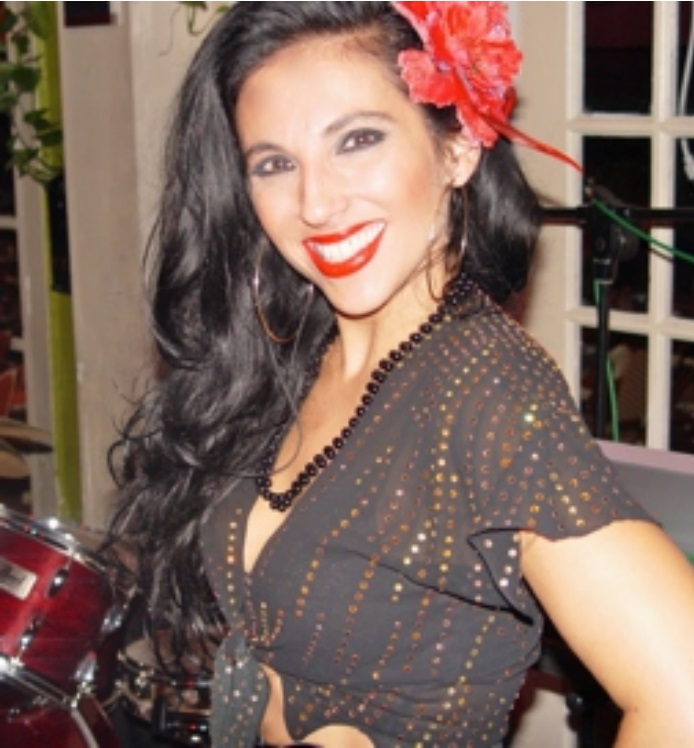
Melina Almodóvar - Photo 2
Melina Almodóvar – Photo 2

This Puerto Rican composer not only prepared in salsa, also studied different musical styles: Blues, Jazz and Gospel. What made her race for only 3 years at the University of Memphis the career of Musical Execution. Studies that she decided to abandon for working at the same time as a receptionist and translator for the City Council and also to continue pursuing her dream of singing Salsa professionally. “I decided to quit my university studies because I was really doing what I wanted to do: that was to be a singer… I thought it was better to leave school and nothing has gone wrong, I have continued doing everything at that moment, but on a slightly larger scale and for me it was the right decision”, commented Amodóvar.

During the 90s, Melina and other music professionals created the first salsa orchestra in Memphis called “La Orquesta Caliente”. With this band toured places like Alanna, Kentucky and Alabama. They played at such iconic venues as Beale Street, one of the most famous music streets in all the US for almost 4 years, just as they did at Young Ave Deli, a place that filled to its maximum capacity just to hear them sing and play Salsa every Monday. In this regard, Melina told me: “That’s when I started singing Salsa. That’s when I fell in love with salsa and I wanted to continue being a professional Salsa singer.”
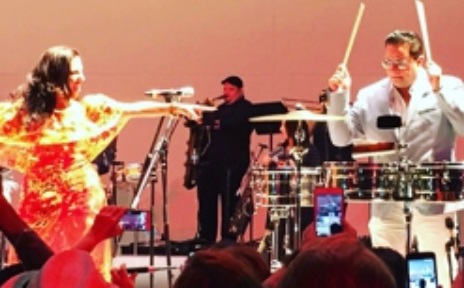
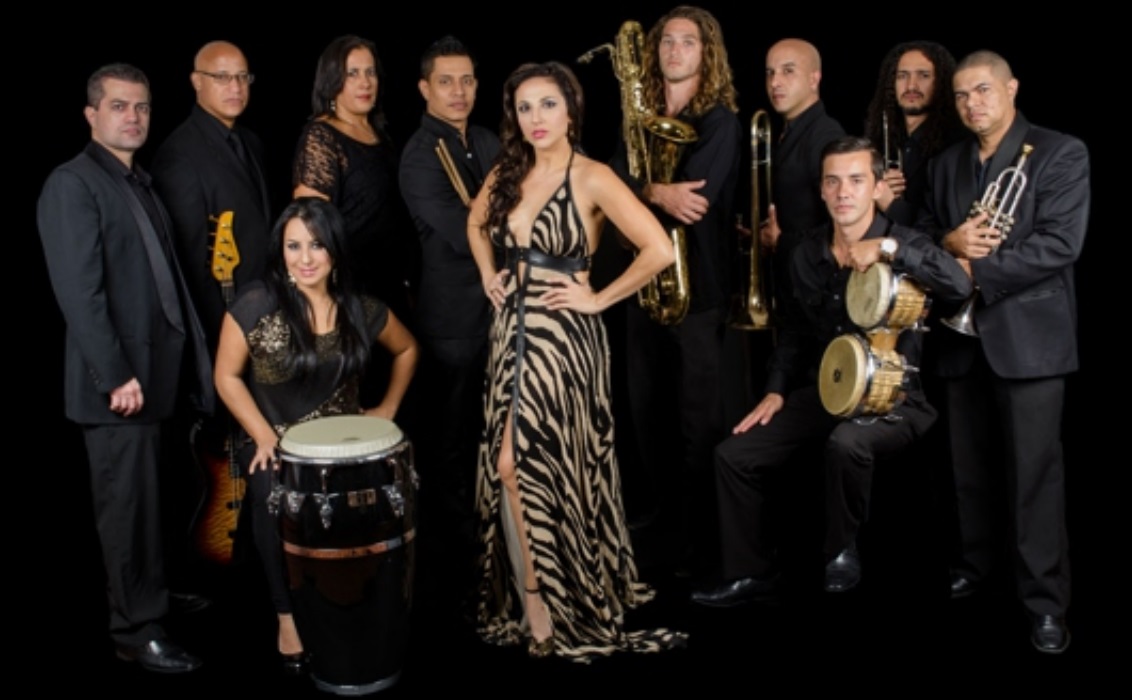
Melina Almodóvar “La Muñeca de la Salsa” in concert
Melina Almodóvar “La Muñeca de la Salsa” in concert photo

In 2003, she began her musical career as an independent soloist with her first album Rumba’s Salsa Soul Delight, where she exhibited her creative freedom to compose, work with other people in the music industry and create her own identity in this tropical genre. So, her second álbum was La Muñeca De La Salsa Y Más (2008) and Pasión y Salsa Live in 2013.

In all her productions this Puerto Rican singer based in Miami, likes to sing to the love in a very positive way. Each song is a tropical proposal of Latin culture, passion, celebration, dance and happiness that invites the dancer to enjoy. “I like to talk positively about things that make me happy. I do not like to shoot men … Because it’s not what happened to me. “She added: “I have a bolero that’s called Mi Nueva Página de Amor, but it’s very positive.

Melina Almodóvar “La Muñeca de la Salsa” - Cover
Melina Almodóvar “La Muñeca de la Salsa” – Cover

”Although the Salsa is a genre dominated by men, Melina has shown to take firm steps and open field solidly in the music industry, she has sung alongside major figures such as: The Great Combo of Puerto Rico, Andy Montanez, Bobby Cruz, Gilberto Santa Rosa, Marlo Rosa, Tito Puente Jr., el maestro Larry Harlow and Tromboranga.

She has developed a successful musical career of 20 uninterrupted years that has led her to perform at the biggest annual festivals and daily events in the country. For nine years “La Muñeca de la Salsa” performed live shows in South Florida at Tapas y Tintos club located in Miami’s South Beach with el maestro Ricky Torres, where thousands of dancers from all over the world gathered every Tuesday to dance and enjoy her music.

Melina Almodóvar “La Muñeca de la Salsa” - Singing
Melina Almodóvar “La Muñeca de la Salsa” – Singing

In 2010, Melina and approximately more than 600 dancers broke the Guinness Record for the largest number of people dancing Salsa at the same time a song. The idea got with her former manager Frank Nieves. The theme was “Lista pa’ Impresionar” of her authorship and doesn’t rule in the near future to do it again. “We were there seeing how we could do something different for an event that he was doing here for the Broward County Patron Festivities and we said why we did not try to break the Guinness Record. Establish a Guinness Record of the greatest number of dancers dancing a song and then we did it and it was spectacular”, said Melina.

In 2016, she released to the national and international market the salsa version single “Estoy aquí” of the popular Pop singer Shakira, whose arrangement was made by Seferino Cavan. The video of “Estoy Aquí” was shot on the famous beaches of Miami Beach and already has almost 1 million views.

Melina Almodóvar “La Muñeca de la Salsa” - Photo
Melina Almodóvar “La Muñeca de la Salsa” – Photo

Likewise, and in mid of 2017, Almodóvar recorded with Tito Puente Jr. a new version in Salsa Mambo of the song “Mi Socio” created by Tito Puente and Cuban singer La Lupe popularized in 1965. In the same way, she did with the singer and composer Bobby Cruz the song “La Chica del Bling”.

Currently, Melina does live performances every Friday to 6pm at Best Time Wine Shop located on 8th Street at 64th and 8th, a wine warehouse with a large dance floor. “Ándale! Pon a Sonar el Güiro” is her most recent single, it was released since last December and you can find it on all digital platforms. During this month of January, Melina will continue playing her music through the territory of Florida with the event Los Patrones de la Salsa and on April 7 she will produce along with her friend Kristina Moinelo the biggest salsa festival in Miami, the Hollywood Salsa Fest, in which she will also participate as a main star with great figures of salsa music.

la muneca de la salsa - flyers
la muneca de la salsa – flyers

Melina Almodóvar believes that the Salsa will never die because it is in the Latin idiosyncrasy and at some point this AfroCaribbean genre will return to be that people like most. She also commented that she does not rule out the possibility in the future to do a fusion with the new urban musical trends of the moment.

“For me to represent Latin music in the US is a very big honor because I love tropical music more than anything. It’s my life, it’s my way of breathing like all the SALSEROS … For me, it’s the whole world to be able to continue my long-standing career, to go ahead and bring good Salsa for the whole World.” Melina Almodóvar

The Salsa is the NUMBER ONE music genre that is danced around the world. I believe that we are keeping this genre alive with what we are doing every day. “Melina Almodóvar

Melina Almodóvar “La Muñeca de la Salsa”

To more information about La Muñeca de la Salsa, please visit www.melinaalmodovar.com or like her on Facebook: www.facebook.com/pg/MelinaSalsa


“DeBÍ Tirar Más Fotos” is not just an album; it is an invitation to reimagine music and the cultural impact it can have in an increasingly interconnected world

Bad Bunny was born as Benito Antonio Martínez Ocasio in San Juan, Puerto Rico, on March 10, 1994. He is a composer and singer of urban music, especially trap and reggaeton.

Bad Bonny DeBÍ TiRAR MáS FOToS

Although he never took formal music classes or studied any instrument, he is a singer, composer and creator of his own songs. The first samples of his art were seen on YouTube, where he slowly began to gain fans.

In mid-2016, Bad Bunny joined Hear This Music, a label created by DJ Luian and Los Mambo Kingz, presenting the hit “La Ocasión,” an anthem of trap music. There he also recorded singles such as “Diles,” “Soy Peor,” and “Tú No Vives Así.”

Bad Bunny has also participated in songs with numerous artists, such as Farruko, De La Ghetto, J Balvin, Maluma, Nicky Jam and Ozuna, among other urban music stars.

In 2017 he conquered Europe, touring with more than 20 concerts in 20 days. Upon his return he sang “Si Tu Novio Te Deja Sola” at the 2017 Billboard Latin Music Awards with J Balvin.

In addition, he sold out concerts at the Luna Park in Buenos Aires on September 8 and 9. In November he released “Sensualidad” with Prince Royce and J Balvin.

The year 2018 began with great success.

On January 12, he released “El Baño”, a collaboration he recorded with Enrique Iglesias.

On February 6, he released “Salimos A Buscarte”.

On the 9th, he presented “Fantasía”, with Alex Sensation.

On the 14th, she released a version of the hit “Báilame” by Nacho, together with Luis Fonsi, Yandel and Daddy Yankee.

On the 15th, she released “Amorfoda”, a new single in which she says “no” to love.

She didn’t wait and on the 22nd, she released “Dime Si Te Acuerdas”.

On March 16, she released a song with Khea, Düki and Cazzu, titled “Loca”.

On the 23rd of that month, “Dime” was released, recorded with Revol, J Balvin, Arcángel and De La Ghetto.

On April 1, she presented “Me Rolié”. In the same month, she released: “Te Boté”, with Ozuna, Nicky Jam, Nio García, Darell and Casper Mágico; and “Explícale”, with Yandel, Noriel Cosculluela and Brytiago.

On May 5, she recorded “Contigo”.

Bad Bunny nació como Benito Antonio Martínez Ocasio

On the 12th, 13th and 14th she presents her songs live, again at Luna Park. In between these concerts she releases “Sólo Avísame”. Then she releases “Quiere Verme”, together with Anuel Aa and “Diles”, with Ledy Medina.

On June 22nd she releases “I Like It”, recorded with Cardi B and J Balvin. On the 28th of the same month she releases the single “Estamos Bien”. She participates in Marc Anthony’s song “Está Rico”, together with Will Smith. On October 11th she releases “Mía”, in a spectacular collaboration with Drake singing in Spanish. On December 8th she releases the hit “Desde el Corazón” and on the 14th of the same month she presents “Sólo de Mí”, whose video reflects gender violence. On the 23rd her debut album goes on sale, under the name “X100Pre”.

On June 28, Bad Bunny & J Balvin present the eight-song album “Oasis” with the first single, “Qué Pretendes” (with special appearances by Mr. Eazi and Marciano Cantero of Enanitos Verdes)

Following the death of basketball player Kobe Bryant, Bad Bunny paid tribute to him with an emotional song titled “6 Rings.”

YHLQMDLG was released by the artist at midnight on February 29, 2020. The title means “I do what I want” and features collaborations with Daddy Yankee, Yaviah, Jowell & Randy, and Ñengo Flow. The album is a tribute to the marquesinas (garage parties) that Bad Bunny grew up attending, and features many nods to reggaeton from the early and mid-2000s

On May 10, 2020, he released his third studio album “Las que no iban a salir,” which features the participation of Don Omar, Zion & Lennox, Nicky Jam, Yandel, among others.

In July, after being the first Latin urban artist to be on the cover of Rolling Stones magazine, El Conejo Malo becomes the protagonist of the first digital cover of the legendary Playboy magazine.

On July 25, he releases the song and video: “Un día (One Day)” with Dua Lipa, J Balvin and Tainy.

On January 3, 2021, he releases the video for his song “Booker T”. That same year, he releases the single and video clip “Lo sentir BB” with Julieta Venegas and Tainy.

Bad Bonny
Bad Bonny

Throughout the year, he publishes several singles and video clips.

On May 5, 2022, he releases the album “Un verano sin ti”.

On June 2, he releases the video clip for the song “Tití mepregunta”.

On November 30, he releases the single “La Jumpa” with the video clip.

On December 22, he released the single “Gato de noche” with Ñengo Flow.

On February 15, 2023, he released the video for “Ojitos lindos” with Bomba Estéreo.

On May 18, he released the single “Where she goes” along with its video.

On July 21, he collaborated with Travis Scott on the single “K-Pop” with The Weeknd.

On September 25, he released the single and video “Un preview”.

On October 13, he released the album “Nadie sabe lo que va a pasará mañana” becoming a hit single.

Becoming the most listened to album of the year in a single day.

“What are we overlooking in Bad Bunny’s ‘DeBÍ TiRAR MáS FOToS’? Beyond reggaeton, a lesson in artistic evolution.”

While social media is boiling with divided opinions about Bad Bunny’s new album, it is worth moving away from the extremes and analyzing “DeBÍ TiRAR MáS FOToS” from a broader perspective.

Beyond being a reggaeton album, this work is an artistic, cultural and strategic manifesto that leaves valuable lessons for all musical genres, including salsa.

Bad Bunny has used his position as a global artist to fuse elements such as salsa with urban rhythms, achieving a musical dialogue that transcends generations and tastes. However, the impact of this project does not stop there.

I’d like to share five key aspects that other artists could learn from this release to innovate and connect more deeply with their audiences.

  1. The power of nostalgia: plastic chairs as a universal symbol

The album cover, with the humble plastic chairs, connects directly with the everyday life of Latin American neighborhoods. These common objects evoke memories of family gatherings, celebrations, and moments of community. The message is powerful: simplicity can be deeply meaningful and resonate globally.

  1. Exclusivity that generates value: “Residencia” concerts

Instead of a world tour, Bad Bunny is betting on “Residencia,” a series of exclusive concerts in Puerto Rico. With this strategy, he not only boosts tourism and the local economy, but creates a “FOMO” (fear of missing out) phenomenon in his fans. This generates massive advance reservations on hotels and flights.

  1. QR codes: intelligent digital interaction

Integrating technology with music is something that Bad Bunny has done masterfully. QR codes in Puerto Rico allow fans to interact with the album in innovative ways, unlocking exclusive content and creating a bridge between the physical and the digital.

  1. Incorporating traditional genres and sounds

Bad Bunny is not afraid to mix salsa with reggaeton, betting on musical arrangements that celebrate his cultural heritage. This shows that genres are not compartments or “silos”, but platforms for dialogue

  1. Expectation and release strategy

From the announcement of the title to the release date, passing through a short film full of cultural references, everything in this project has been designed to create a narrative that maintains the interest of the public. The lesson here is clear: music is not just released, it is experienced as a complete cultural event.

Final thoughts: innovation and evolution

In a world dominated by technology, staying traditional is not an option for artists who want to grow. Tools like Web 3.0, Blockchain, NFTs to offer immersive experiences and AI are revolutionizing the way musicians interact with their audiences and generate income.

While some lose themselves in criticism, others take advantage of these tools to redefine their art and project themselves globally. The lesson is clear: you have to look ahead and dare to evolve.

“DeBÍ TiRAR MáS FOToS” is not just an album; it is an invitation to reimagine music and the cultural impact it can have in an increasingly interconnected world.

Also Read: Sessions from La Loma brings together salsa fans from all over the world in Puerto Rico

Papo Vázquez the Pirate & Troubadour of Our Latin Music

Papo Vázquez Enjoying the Bell.

Angel Vásquez, “Papo Vásquez”, was born on February 24, 1958 in Philadelphia, Pennsylvania, USA.

Papo Vazquez
Papo Vazquez

By age 15, Papo Vázquez was playing with local American bands in Philadelphia and accompanying guest artists such as Eddie Palmieri.

At just 17, he moved to New York and was hired to play for trumpet player Chocolate Armenteros’ band, and soon began playing and recording with other top artists on the salsa scene such as The Fania All-Stars, Ray Barreto, Willie Colón, Grupo Folklórico Neoyorquino, Eddie Palmieri, Larry Harlow, and Hector Lavoe.

Vazquez also became a key player in the burgeoning New York Latin jazz scene of the late 1970s, performing with Jerry Gonzalez, Hilton Ruiz, and more.

He began his studies with Slide Hampton, eventually recording and performing Slide Hampton’s World Trombones.

Papo Vázquez Photo by Ernie Gregory (Gone but not forgotten) Thank you Ernie!PV

A Grammy-nominated trombonist, composer, arranger, NEA Master Artist, he has a 50-plus year career in jazz, Latin and Afro-Caribbean music.

Musical Director of the National Puerto Rican Day Parade Orchestra, (NYC/WABC) 2016, 2017, 2018, 2019.

Commissioned by Wynton Marsalis to compose music for Jazz and Art series, conducted and performed with the J@LC orchestra, CD release August 2019 New York Pops Education, Board of Education certified, 2018 and 2019

New music commissioned for Afro Latin Jazz Alliance for the “Nueva Música” concert series.

Nominated for Grammy for Papo Vázquez’s Mighty Pirates, Marooned/Isolated, 2008

Born in 1958 in Philadelphia, Pennsylvania, although his early formative years were in Puerto Rico.

He went on to play and/or record with jazz luminaries Tito Puente, Dizzy Gillespie’s United Nations Orchestra, Chico O’Farrill, Ray Charles, Slide Hampton’s World of Trombones, Jerry Gonzalez Fort Apache, among many others. By the age of 22, Vazquez had traveled the world.

Papo Vázquez Mighty Pirates Troubadours 2023

Vázquez was deeply moved by jazz from a young age. His appreciation and knowledge of indigenous Caribbean music provides him with a unique ability to fuse Afro-Caribbean rhythms with the freer melodic and harmonic elements of progressive jazz.

Beginnings

After spending his early years in Puerto Rico, he grew up in the heart of North Philadelphia’s Puerto Rican community. He purchased his first trombone from a friend for $5 and joined the elementary school band.

At the age of 14, an uncle recommended him to a local salsa band, where he met trumpeter Jimmy Purvis. Purvis inspired Papo’s lifelong passion for jazz by giving him two records: J.J. Johnson’s Blue Trombone and John Coltrane Live at the Village Vanguard. By 15, Vazquez was performing with local Latin bands in Philadelphia and accompanying visiting New York artists such as Eddie Palmieri.

He was a founding member of Jerry Gonzalez’s Fort Apache and Conjunto Libre, as well as the popular Puerto Rican Latin fusion band Batacumbele.

With Batacumbele he performed, composed, arranged and recorded several albums from 1981 to 1985. Upon his return to New York, he joined Tito Puente’s Latin Jazz Ensemble, traveling with them as principal trombonist and touring Europe with Dizzy Gillespie’s United Nations Orchestra.

Leader, Composer and Innovator.

Vázquez has always been deeply moved by jazz, and specifically cites the music of John Coltrane and J.J. Johnson as having influenced him most. In addition, his appreciation and knowledge of the indigenous music of Caribbean peoples gives him a unique ability to fuse Afro-Caribbean rhythms, specifically those of Puerto Rico, with the freer melodic and harmonic elements of progressive jazz.

During his time in Puerto Rico with Batacumbele in the 1980s, he began experimenting with “bomba jazz,” a fusion of jazz and traditional Puerto Rican bomba. In 1993 he recorded his first album as a leader, Breakout. He continued to collaborate with a variety of Latin Jazz artists, contributing Overtime Mambo to Hilton Ruiz’s Manhattan Mambo and Contra Viento y Mareo to Descarga Boricua, Vol. 1.

In 1999, he released a live recording with a number of leading New York Latin and jazz artists, including bassist Andy Gonzalez, saxophonist Michael Brecker, among others. The release of Pirates & Troubadours At the Point, Vol. 1 was followed the next year by At The Point, Vol. 2.

Mighty Pirates Troubadours Songs del Yucayekepor Papo Vazquez
Mighty Pirates Troubadours Songs del Yucayeke
por Papo Vazquez

This project evolved into the Pirates Troubadours, an “Afro-Puerto Rican jazz band” that includes musicians such as Roberto Cepeda of Puerto Rico’s Familia Cepeda folklore group, Milton Cardona and Anthony Carrillo on percussion, and John Benitez, among others. The group performed at festivals around the world and released Carnival in San Juan in 2003, followed by From The Badlands in 2007.

Interest grew as a composer.

He was the first artist to receive a composer commission (Iron Jungle) for the Afro-Latin Jazz Orchestra, then a resident orchestra at Jazz at Lincoln Center.

His first classical composition, Palomita Suite Afro-Caribeña which to date was the first time Bomba y Plena had been performed with a Chamber Orchestra, was commissioned by the Bronx Arts Ensemble and premiered at the Hostos Center for Arts and Culture in the Bronx in 2004.

In 2007, on a commission from the Bronx River Arts Center, he wrote Sube el Río (River Rising) for its Mighty Pirate Orchestra for its 20th anniversary concert “Bronx River Sounds.”

Discography

Papo Vázquez Mighty Pirates Troubadours – Capítulo 10: Breaking Cover, Picaro Records 2020
Cuarteto Papo Vázquez – GV J.S. Bach, Picaro Records 2017
Papo Vazquez Mighty Pirates Troubadours – Spirit Warrior, Picaro Records, 2015
Papo Vazquez Mighty Pirates Troubadours – Oasis, Picaro Records, 2012
Papo Vázquez The Mighty Pirates – Marooned / Aislado, Picaro Records, Nominación al Grammy 2008
Papo Vázquez Pirates Troubadours – From The Badlands, Picaro Records, 2007
El Niño Josele – 2011
Tego Calderon – The Underdog / El Subestimado, Jiggiri Records, 2006
Shakira & Wyclef Jean – Tema de la final mundial de fútbol (“Bamboo”), 2006
Ray Barretto – Normas rican-ditioned, Zoho Music, 2006
Los Pleneros de la 21 Para Todos Ustedes, Smithsonian Folkways, 2005 – Nominación al Grammy,
Bebo Valdes – Bebo de Cuba, Calle 54, 2005 – Grammy, Mejor Álbum de Jazz Latino
Papo Vázquez Pirates Trovadores – Carnaval en San Juan, Cu-Bop Records, 2003
Wayne Shorter – Alegria, Verve, 2003 – Grammy, Mejor álbum instrumental de jazz
Jack Bruce – Sombras en el aire, Sanctuary Records Group, 2001
Freddie Cole Rio de Janeiro Blues, Telarc
Chico O’Farrill “Carambola” Fantasía
Banda sonora de la película Mo ’Better Blues de Spike Lee
Papo Vázquez “Piratas y trovadores – En el punto Vol. I” Cubop
Papo Vázquez “Piratas y trovadores – At the Point Vol. 2” Cubop
Milton Cardona “Cambucha” Clave americana
Arturo O’Farrill “Bloodlines” Fantasy
Chucho Valdés “All Stars Bronx Lebanon New Directions Project” RMM
“Jammin ‘in the Bronx” Papo Vázquez Band, Chucho Valdes & The Machito Orq RMM
Chart Busters con el Dr. Lonnie Smith, Lenny White, Hiram Bullock, Craig Handy, Papo Vázquez, et.al. Chico O’Farrill Fantasía “Pure Emotion”
Steve Berrios Fantasía del “primer mundo”
Descarga Boricua “Descarga Boricua” Tierrazo
Dave Valentin “Tropic Heat” GRP
Juan Luis Guerra 440 “Fogarate” 440
Papo Vázquez “Breakout” Timeless
Ruben Blades “Amor y Control” “Antecedente” & “Caminando” Sony
Hilton Ruiz “Manhattan Mambo” Telarc y “Hands on Percussion”
RMM Tito Puente “Fuera de este mundo” Tito Puente “100” RMM
Jerry Gonzalez Fort Apache Band “Obatala” “Live in Berlin” Enja & “Ya Yo Me Cure” American Clave
New York Latin Jazz All Stars “Feliz Navidad”
Bobby Valentin “Presenta al Cano Estremera” – Bronco Records
Batacumbele “Con Un Poco de Songo” & “En Aquellos Tiempos” Tierrazo
Ray Barretto “Ricanstruction” Fania
Slide Hampton “Mundo de trombones” WEST54
Chico O’Farrill “Calle 54”
Fania All Stars “Habana Jam” Fania
Willie Colon & Ruben Blades “Siembra” Fania
Willie Colon y Celia Cruz Fania
Héctor La Voe “De Ti Depende” – Feliz Navidad, Fania
Mon Rivera “Vuelvo a Vivir” Fania

Sources:

© 2017 por Papo Vázquez. Creado con orgullo.

Textos www.jazzismomedellin.com

Also Read: Eddie Palmieri brought salsa for the first time and live from Sing Sing Penitentiary in New York

Europe / February 2025

Calibrated maracasMartinez attorney

Directory of European nightclubs

Czech Republic circular flag
CZECHIA

La Macumba 2024
La Macumba
Štefánikova 230/7 150 00
Prague, Czech Republic

fRANCE FLAG
FRANCE

Canela
Canela Club Latino Paris
77 Rue du Faubourg du temple 75010
Paris, France

Cuba Compagnie
Cuba Compagnie Café
48 BD Beaumarchais 75011
Paris, France

Cubana
Cubana Café
47 rue Vavin 75006
Paris, France

La Pachanga
La Pachanga Officiel
8, rue vandamme 75014
Paris, France

La Peña
La Peña Saint Germain
3 passage de la Petite Boucherie 75006
Paris, France

Balajo
Le Balajo
9 rue de Lappe 75011
Paris, France

Pachamama
Pachamama PARIS
46 rue du Faubourg Saint Antoine 75012
Paris, France

Selsero
Salseroparis
9 Rue du Petit Pont, 75005
Paris, France

Germany circular Flag
GERMANY

Cascadas
Cascadas
Ferdinandstr. 12
20095 Hamburg-Mitte, Germany

Havanna
Havanna Berlin
Hauptstr. 30
10827 Berlin-Schöneberg, Germany
La Macumba - The Real Latin Club in Hamburgs
La Macumba – The Real Latin Club in Hamburgs
Adenauerallee 3 20097
Hamburg, Germany

Latin Palace Changó
Latin Palace Changó
Münchener Strasse 57
60329 Frankfurt, Germany

SODA
Soda Club Berlin
Schönhauser Allee 36
10435 Berlin, Germany

Malta Circle flag
MALTA

Bario Latino Malta venue
Barrio Latino Malta
Ghar il Lembi Street SLM1562 Sliema
Central Region, Malta

Poland flag
POLAND

Teatro Cubano
Teatro Cubano Warsaw
ul. Aleksandra Fredry 6 00-097 /> Warsaw, Poland

Spain Flag
SPAIN

ACM City
ACM CitY
Carrer Can Pallarès 2, Cerdanyola del Vallès
08290 Barcelona, Spain

Antilla
Antilla Barcelona
C/ d’Aragó, 141
08015 Barcelona, Spain

Azucar
Azúcar SalsaDisco
Calle de Atocha, 107
28012 Madrid, Spain

Disco Bar Cuba Live
Cuba Live
Ramón y cajal número 2
07011 Palma de Mallorca, Spain

El Son
Discoteca El Son
C. de la Victoria, 6
28012 Madrid, Spain

Prisma Discoteca
Discoteca Prisma
C. de Alcalá, 192
28028 Madrid, Spain

Discoteca El Edén Boliviano
El Edén Boliviano
Carrer Gremi de Tintorers, 49A
07009 Palma, Illes Balears, Spain

Mojito
Mojito Club
Rosselló, 217
08008 Barcelona, Spain

Morena
Morena Barcelona
calle 11 num.29
08860 Castelldefels, Spain
Que Chimba
Qué Chimba
Av. del Vallès, 117
08223 Terrassa, Barcelona, Spain
Sala Olvido Madrid
Sala Olvido
C/ Olvido 15
28026 Madrid, Spain
Seven Dance
Seven Dance (Dio Club)
Carrer del Perill 10
08012 Barcelona, Spain

The Host Madrid
The Host
C/ Ferraz nº 38
28008 Madrid, Spain
+34 918 05 36 48

United Kingdom circular flag
UNITED KINGDOM

Salsa Soho

Bar Salsa Soho

96 Charing Cross Rd
WC2H 0JG London, UK

Salsa Temple

Bar Salsa Temple

Victoria Embankment, Temple

WC2R 2PH London, UK

Juju's
JUJU’s Bar & Stage
Ely’s Yard 15 Hanbury Street
E1 6QR London, UK

Revolucion de Cuba
Revolucion de Cuba Leeds
64-68 Call Lane
LS1 6DT Leeds, UK

LightHouse
The LightHouse Bar & Club
62 Rivington Street
EC2A 3AY London, UK


Karina Bernales present

FEBRUARY 2025

FESTIVALS

Austria circular flag
AUSTRIA
Salsa Congress B&W 2025

Black & White

Feb 20 / 24 2025

Stadthalle Wels
Pollheimerstraße 1
Wels, Austria 4600

From € 130

Vienna Bachata Paraíso 2025

Paraiso Festival

Feb 28 / Mar 02 2025

Apothekertrakt Im Schloss Schönbrunn
Meidlinger Tor, Grünbergstrase
Vienne, Austria 1130

From € 114.99

Bulgaria JPG
BULGARIA
National Salsa Congress 2025

National Salsa Congress

Feb 14 / 17 2025

Moscva Park Hotel
25 Nezabravka Str
Sofia, Bulgaria 1113

From € 49

France circle flag
FRANCE
Alegria Festival Bordeaux 2025

Alegria Festival

Feb 20 / 23 2025

Le Cube VO
30 Chemin de Cadaujac
Villenave-d’Ornon, France 33140

From € 60

Waranda Fest 2025

Wakanda

Feb 27 / Mar 02 2025

The Atrium Hotel & Conference Centre Paris CDG Airport
351 avenue du Bois de la Pie, CS 42048 Paris Nord 2
Paris, France 95912

From € 80

Germany circular Flag
GERMANY
Unidanza 2025

UNiDANZA

Feb 14 / 16 2025

Billies – das Tanzstudio
Stresemannstrase 374b
Hamburg, Germany,22761

From € 179

BachaaKizzz Sensation 2025

BachaaKizzz Sensation

Feb 14 / 16 2025

V8 Hotel the Original
Charles-Lindbergh-Platz 1
Boblingen, Germany 71034

From € 90

Bachatation 2025

Bachatation

Feb 20 / 23 2025

Son Latino Studio
Gablonzer Str. 9
Karlsruhe, Germany 76185

From € 99

Greece circular flag
GREECE
ensualonica Dance Fest 2025

Sensualonica Dance

Feb 21 / 23 2025

Block 33 Creative Space
26th Oktomvriou 67
Thessaloniki, Greece 54627

From € 89

Hungary circular flag
HUNGARY
BUDAPEST BACHATA FEST 2025

Budapest Bachata

Feb 14 / 17 2025

The Aquincum Hotel Budapest
Árpád fejedelem útja 94
Budapest, Hungary H-1036

From € 100

Italy circle flag
ITALY
Kizombafro Fest 2025

Kizombafro

Feb 14 / 16 2025

Hotel Touring Rimini
Viale Regina Margherita, 82,
Rimini, Italy 47924

From € 79

Bachata Day 2025

Bachata Day

Feb 28 / Mar 03 2025

Montresor Hotel Tower
Via A. Mantegna, 30
Bussolengo, Italy 37012

From € 110

Netherlands circular flag
NETHERLANDS
Amsterdam International Salsa 2025

Amsterdam International Salsa

Feb 06 / 10 2025

De Koning
Isolatorweg 29
Amsterdam, Netherlands 1014 AS

From € 125,99

Norway Circle Flag
NORWAY
Bailan2 Puro Cubano 2025

Bailan2 Puro Cubano

Feb 28 / Mar 02 2025

Drammens Theatre
Øvre Storgate 12
Drammen, Norway 3018

From € 180

Portugal Circular Flag
PORTUGAL
Zoukizomba Congress 2025

Zoukizomba Congress

Feb 27 / Mar 02 2025

Golden Tulip Porto Gaia
Hotel & Spa
Rua da Bélgica 86
Vila Nova de Gaia, Portugal 4400-050

From € 70

Workshop Iberico 2025

Workshop Iberico

Feb 28 / Mar 02 2025

Vidamar Resort Hotel
Estrada Monumental 175 177
Funchal, Portugal 9000-100

From € 80

Tá Fixe Kizomba Fest 2025

Ta Fixe Kizomba

Feb 28 / Mar 02 2025

Muxima Bar
Rua Maurício Lourenço de Oliveira, Nº 206
Vila Nova de Gaia, Portugal 4405-034

From € 80

Slovakia circle flag
SLOVAKIA
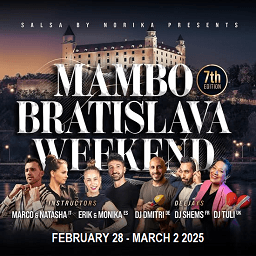
Mambo Bratislava Weekend 2025

Mambo Bratislava Weekend

Feb 28 / Mar 02 2025

Dance Club SALSA by Norika
Tomášikova 34
Bratislava, Slovakia 821 01

From € 110

Spain Flag
SPAIN
BSS SPAIN WORLD CONGRESS 2025

BSS World Congress

Feb 21 / 23 2025

Gran Hotel Bali Benidorm
C. del Actor Luis Prendes
Benidorm, Spain 03502

From € 90

Salsander Spain 2025

Salsander

Feb 21 / 23 2025

Hotel Chiqui Santander
Av de, Av. Manuel García Lago, 9
Santander, Spain 39005

From € 100

SoulDance Bachata & Salsa 2025

SoulDance Bachata & Salsa

Feb 21 / 23 2025

Hotel Don Angel
Carrer del Pla de la Torre, 14, Santa Susana
Barcelona, Spain 08398

From € 105

World Latin Congress 2025

World Latin Congress

Feb 27 / Mar 02 2025

Hotel Beatriz Toledo
Auditorium & Spa
C. de los Concilios
Toledo, Spain 45005

From € 150

Malaga Crazy Fest 2025

Malaga Crazy Festival

Feb 28 / Mar 03 2025

Hotel Alay
Avenida Alay, 5E
Benalmadena, Spain 29630

From € 70.77

United Kingdom circular flag
UNITED KINGDOM
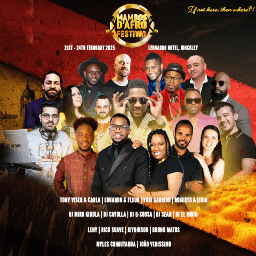
Mambos d'Afro 2025​

Mambos d’Afro Festival

Feb 21 / 23 2025

Hinckley Island Hotel & Spa
Watling St, Hinckley
United Kingdom LE10 3JA

From £ 100


Damian Ballester and the transformations of Cuban Folk Dance

Latin America / Cuba
Photo 3- Damian Ballester on stage

The relationship of Africa within the musical and dance culture in Latin America is notorious when we see the cultural expressions of the peoples of this continent, it is easy to see how similar they are, the use of percussion is one of the most relevant topics, in itself a mixture of cultural customs, religion, musicality, dance, in itself all the elements of the black race.

America, one of the main destinations of the ships with black slaves from many areas of Africa, caused our culture to be armed with a bit of each custom, therefore, we can say that in America there is a bit of each African people, this relationship of variety of slaves focused on dividing the forces of the race so as not to make it powerful, divided languages, customs, words and religions only left the marginalized population to communicate through percussion, an element that made the system improve at times of understanding within the fences where they lived.

Due to the above, African religions and customs are born in Cuba but, adopted by those already existing on the island, this combination gives us a rich variant of movements from three continents, Europe through Spain and Africa in all its splendor.

To clarify some topics of the folklore of the Caribbean island and its current dance transformations, we had to contact a great teacher, Damian Ballester, director of Iya Aye, one of the best folklore groups on the island of Cuba, to speak with this professional of the dance is necessary if we want to obtain real information about Cuban traditions, a great teacher who has left his teachings in many Spanish-speaking countries, among which Venezuela, Colombia, Ecuador, Mexico and now in the United States stand out…

we begin by greeting him and opening a pleasant conversation, to which we got an original response “Greetings acere, what was it”, calling him opens up a range of questions on the subject in question, here is an extract of the most common doubts generated around the relationship with salsa, its festivals and diffusion in the world.

Greetings Prof. Damian, grateful for your receptivity, we want to give information to our readers about the relationship of Cuban folklore within our world, Salsa, to begin with, what is defined as Cuban Folkloric dances?

Grateful for the opportunity and sure, that if we report on the case, folk dances are nothing more than the set of cultural goods or phenomena that constitute a cultural complex with manifestations of all aspects of popular life. It is the sum of the manifestations acquired by experience, by inheritance, by tradition, by the satisfaction of biological or sociological needs, among other things. This lasts through several generations and almost always undergoes transformations.

They will get compound terms in the word folklore, which speaks of people or people, popular knowledge, together with the popular knowledge of the people. It is a very long topic, because I should talk about so many things about my culture, better let’s leave the definition until here and thus add flavor to the interview.

Much better, we continue then, do African dances have any impact on Cuban folk dances?

Yes, of course, it is the root, the exercise of dance has always characterized my land and has suffered the same processes of contagion and transculturation between the ways of dancing of the colonizer and the styles introduced by African ethnic groups since the 16th century, in fact, the colonizers brought romance, active in the Cuban countryside for several centuries, with its couplets and their ways of singing and founding alegrías, while the black slaves included their ancestral rites, their drums, and their particular sense of rhythm and movement. bodily.

Given this brief explanation, we can say that not only dances of African origin contributed or influenced Cuban folklore, we can say that there is also an incidence from Spain, France and the Caribbean, but its main axis was born from the Spanish and the African.

We know the extent of Cuban folklore, for how long should a person prepare to be called a professor in this branch?

First of all, to carry the name, whether it is a teacher or instructor of Cuban folklore genres, there are two factors that are very important, the first is study, since Cuban folklore is made up of a very wide range of genres divided into different styles, I could mention some examples: Peasant, popular, Afro-Cuban and Franco-Haitian folklore.

Within the styles of peasant folklore, examples could be given of the Cuban zapateo, the ripiado parakeet, the chidonga, the hawk, the caringa, the son montuno, among others.

Within the styles of popular folklore, the Complex of the rumba, the mambo, the chachachá, the danzón, the dance, the pilón, the congas and the comparsas, the casino can be mentioned, within the Afro-Cuban folklore the Bantú cycle can be mentioned, the Yorubas, the Arara, the Abakua, within Franco-Haitian folklore we can mention the French tomb, the Haitian merengue, the gaga, the vodu among others, if I continue we will not finish today. (laughs to close)

Of the folkloric dances, which are the most outstanding or spread worldwide?

It could be said that there are several, examples are the popular folkloric ones, one could say the casino, the mambo, the chachachá, the son, the rumba complex, that the latter people tend to say are African or Afro-Cuban dances, that have African influence does not mean that they are classified within Afro-Cuban dances because this genre emerged in Cuba, was used as an object of protest against the government of that time and was eradicated in the essence of Cuban. In the same way, the one that has had the most impact and remained in the whole world are the Yoruba dances or dances of the orishas.

Should we open another interview to just talk about the many genres that the island embraces, what institutions correctly form the folkloric traditions in Cuba?

There are many institutions in Cuba, from the community point of view what is named in Cuba as amateur dancer are the community projects and actions that are nothing more than groups created in the communities, all of these supervised technically and methodologically by specialists from the houses of culture of each area by provincial and national methodologists governed by the Ministry of Culture.

From a professional point of view, there are art schools such as the ENA (NATIONAL SCHOOL OF ART) and the ISA (SUPERIOR INSTITUTE OF ART) all governed by a logical curriculum organized by specialists and connoisseurs of the genres.

Photo 2- Damian Ballester on stage

Other institutions that could be mentioned, is the little school of the national folkloric group of Cuba with 56 years of creation in charge of rescuing and safeguarding the traditional Cuban musical and dance traditions.

Wao, Enough, Do you know if there is any similar institution in the world?

In the world there are countless schools that are training dancers with the Cuban style and technique, whether they are Cuban or foreign teachers, but nothing like the preparation of art schools in Cuba that work with a logical and well-prepared program, in some schools around the world it could be said that they do not work under a logical methodological program for the teaching of these genres due to the commercial and monetary part, unfortunately there are many dedicated to commerce, to money and not to the necessary dedication.

This dissemination has been achieved while respecting the roots and traditions of the farmers? The root? The original essence?

Unfortunately, it could be said that a good diffusion of Cuban genres worldwide has not been respected or achieved, of 100% of the performers, it could be said that only 10% are protecting Cuban traditions, it is sad to say, but trade and populism it is destroying the folklore of an entire country.

Have these changes in traditions positively or negatively impacted Cuban culture?

First of all, traditions do not change if they are not passed down from generation to generation. In terms of their impact, I see it negatively because the dissemination that is taking place is incorrect and worst of all, there is no organization, which was of Cuba, can follow up on the program that is being given to Cuban genres, in itself, many see the commercial and hence they do not care about the poor distribution of what is taught.

What is the reason that so many dancers seek to perform Cuban dances? It is notorious to see it at festivals and congresses.

There are two very important factors: 1 Cuban music, which has been evolving in an incredible way, fusing Cuban rhythms within its repertoire, and the other factor is not because I am from Cuba, Cuban folklore could be said to be the most complete genre available. world level from the point of view of dance, is that it has a history, virtuosity is varied, it could be said that it is well complemented, due to its complexity and interpretive difficulty, it is what attracts attention, additionally, salsa comes from us, from these roots is born what now wants to be denied.

Teacher and the Cubans? Have Cubans spread their dance correctly?

It could be said that the vast majority of Cubans have disseminated the genres well, why do I say that the vast majority?

Because there is another small group that deforms it, money changes everything, foreigners think that all Cubans They dance, it has happened that they say Cuban and quickly you think he is a dancer, he knows everything, he is good, and no, that is not reality, one thing must be clear about being an opportunist, not a dancer, being a dancer by hobby and another is being one by profession or for being a teacher.

There are Cuban teachers who are hurt by the deformation that is happening with what has been studied so much, but there are others who only care about getting paid and do not care if their students do it well or badly.

How has the interpretation of Cuban roots impacted the so-called Salsa Casino in the world? Has the original and real spread of traditions been respected?

Look, since Cuban music began to evolve inside the casino, it began to undergo a series of transformations from movements to choreography due to the musical style that Cuban orchestras began to spread, known as TIMBA, which was well accepted by the public, If we talk about the impact from the traditional point of view, it could be said that there is no original interpretation of the Cuban roots because they are not executing a specific traditional genre, but rather what they are using different styles of the traditional folk dances that all this could be called Variety.

Have Cuban music and dance festivals or congresses devoted time and effort to improving these transformations? Have they worried about minimizing the damage?

In most cases, very few, first of all, if it is a competitive event, the organizers make the mistake of hiring unqualified personnel to evaluate genres of Cuban origin, and that is where the serious faults come from. There have been cases where there are groups , couples or soloists who perform a good technique within normal limits and the jury evaluates for a taste problem if they see it as beautiful and give it less points, or disqualify it, it is not about beauty, it is about correctness, the organizers should be more careful about these things.

What recommendations would you give to our dancer readers on this controversial topic?

The dancer must be clear about four aspects that are fundamental to his artistic life and entire career: dedication, love of dance and, most importantly, study.

Do only what you love and you will be happy, the one who does what he loves is blessedly condemned to success, which will come when it should come, because everything that should be, will be, and will come naturally.

Photo 1- Damian Ballester on stage

Let’s spend time respecting the roots and cultures of peoples, and above all, let’s take a good look at who we entrust our desire to learn, there are thousands of ways to learn correctly, everything is in the research, knowing who we contact and why There are hundreds of excellent instructors in the world, not to mention the many means of learning today.

I invite you to learn a little about this and other topics, I have a virtual classroom where I teach a lot of the theoretical and practical content online, I do it through the son rumbero academy and its virtual classroom format, follow the @sonrumbero accounts on Instagram and Facebook.

  • « Go to Previous Page
  • Page 1
  • Interim pages omitted …
  • Page 8
  • Page 9
  • Page 10
  • Page 11
  • Page 12
  • Interim pages omitted …
  • Page 32
  • Go to Next Page »

International Salsa Magazine (ISM) is a monthly publication about Salsa activities around the world, that has been publishing since 2007. It is a world network of volunteers coordinated by ISM Magazine. We are working to strengthen all the events by working together.