• Skip to primary navigation
  • Skip to main content

International Salsa Magazine

  • HOME
  • Previous editions
    • 2026
      • ISM / March 2026
      • ISM / February 2026
      • ISM / January 2026
    • 2025
      • ISM / December 2025
      • ISM / November 2025
      • ISM / October 2025
      • ISM / September 2025
      • ISM / August 2025
      • ISM / July 2025
      • ISM / June 2025
      • ISM / May2025
      • ISM / April 2025
      • ISM / March 2025
      • ISM / February 2025
      • ISM / January 2025
    • 2024
      • ISM / December 2024
      • ISM / November 2024
      • ISM / October 2024
      • ISM / September 2024
      • ISM / August 2024
      • ISM / July 2024
      • ISM / June 2024
      • ISM / May 2024
      • ISM / April 2024
      • ISM / March 2024
      • ISM / February 2024
      • ISM / January 2024
    • 2023
      • ISM / December 2023
      • ISM / November 2023
      • ISM / October 2023
      • ISM – September 2023
      • ISM – August 2023
      • ISM July 2023
      • ISM Edition June 2023
      • ISM – May 2023
      • ISM April 2023
      • ISM March 2023
      • ISM February 2023
      • ISM January 2023
    • 2022
      • ISM December 2022
      • ISM November 2022
      • ISM October 2022
      • ISM September 2022
      • ISM August 2022
      • ISM July 2022
      • ISM June 2022
      • ISM May 2022
      • ISM February 2022
      • ISM January 2022
    • 2021
      • ISM December 2021
      • ISM November 2021
      • ISM October – 2021
      • ISM September 2021
      • ISM August 2021
      • ISM July 2021
      • ISM May 2021
      • ISM April 2021
      • ISM June 2021
      • ISM March 2021
      • ISM February 2021
      • ISM January 2021
    • 2020
      • ISM December 2020
      • ISM November 2020
      • ISM October 2020
      • ISM September 2020
      • ISM August 2020
      • ISM July 2020
      • ISM June 2020
      • ISM May 2020
      • ISM April 2020
      • ISM March 2020
      • ISM February 2020
      • ISM January 2020
    • 2019
      • ISM December 2019
      • ISM November 2019
      • ISM October 2019
      • ISM Septembre 2019
      • ISM August 2019
      • ISM July 2019
      • ISM June 2019
  • Download Salsa App
    • Android
    • Apple
  • Spanish

Search Results for: Latin Dance

Tips for the Latin dances “Salsa”, “Bachata”, “Merengue” and “Lambada”

To be able to socialize and have fun, many people learn different activities that can attract others either in their daily routine or during a rest time they have; among those activities is music and dance, where the person can interact with their neighbor and / or partner (a) either by practicing it or simply talking about the subject.


Dancing is simply the act of performing a dance, where a person uses his or her body to perform movements to the beat or to the rhythm of a music or melody, in order to express a message, by tradition or with the aim of entertaining oneself; of course, in order to practice it, body communication is very important because the couple or group needs to know certain signals that indicate the “when” or “how”, in order to perform the steps and as a result the success of this performance will test the quality, maturity and growth of the dancers; and to perfect the technique the best thing they could do is to look for an academy where they can orient them and thus achieve their equilibrium either as a couple or as an individual.

However the dance is not something monotonous, it has different musical genres and on this occasion we will talk about La Salsa, La Bachata, El Merengue and a little known but at the same time very interesting rhythm called Lambada.

 The tenses in these 4 musical genres are different, for example:


  • The Lambada is a dance that comes from Brazil although you still have doubts about its exact origin.  Another influence of its development came from Caribbean music adding metal drums, electric guitars making this a unique musical experience.  It has a degree of popularity in Europe because it is exotic and uncommon due to certain characteristics la Lambada that there are traces of flamenco and other ancient Spanish dances.  The Lambada uses a three (3) beats, where the first 2 are fast and the third (3rd) is slow, with simple steps dancing either in the same place or on the side, showing momentum and interest where the dancer is looser, flexible and docile, whereas the woman is full bodily movement and should be guided by her partner, as if the woman were clay in the hands of the potter.
Lambada dance
Photo of a Lambada dance contest
  • La Salsa is an Afro-Caribbean rhythm and dance fused with jazz and other styles.  Its birth has been much debated, but it is known that it comes from a fusion carried out by the inhabitants of the Caribbean when they listened to European music and then mixed it with their drums, it is a rhythm with flavor, joy and the force of life, a very common characteristic when it comes to party, which one can associate through the salsa songs. The Salsa handles a four (4) beat beat beat, either side to side or back and forth, it can also be crossed (as if you draw a “V” with the 2 and 3 in the middle) and the turns in both dancers can be from simple to complex as you progress level in (a dance academy), citing the textual words of Glenis is a rhythm where the woman It’s man-guided, so if you want to blame her for a misstep, you know who to blame.
Salsa Pose
Photo of a couple dancing Salsa
  • The Merengue is a dance from the Dominican Republic, becoming a Caribbean and Latin rhythm, it is one of the easiest rhythms to learn to dance even without experience, since it is not as fast or strict as the “Salsa” is, its movement can be back and forth, or side to side, always adding very noticeable hip movement with the rest of the body although not as exaggerated as bachata or kizomba; giving it a touch of flavor and flavor.  It is required to do this a close dance with your partner that when salsa is danced, facilitating the fluency of the couple at the time of moving and so be more synchronized, of course it is that not all the time is like this, the trick is the synchronization of the couple’s steps; usually it resembles the turns of the salsa with the merengue.
Meringue Competition
Photo of dancers dancing Merengue

There are many types of dances in each country and in its academies and-or dance venues, which have their own rules, tips, names and steps to follow, what matters is that you achieve the ultimate goal which is to “dance” by holding classes regularly, following the advice of your teachers, practicing your technique outside your classes, dedicating time to improve your dance skills specific, improve your postures, exercise without abusing it getting your rest time and above all observe outstanding dancers of different styles, this way you will be able to achieve your goals without staying on the path of learning.
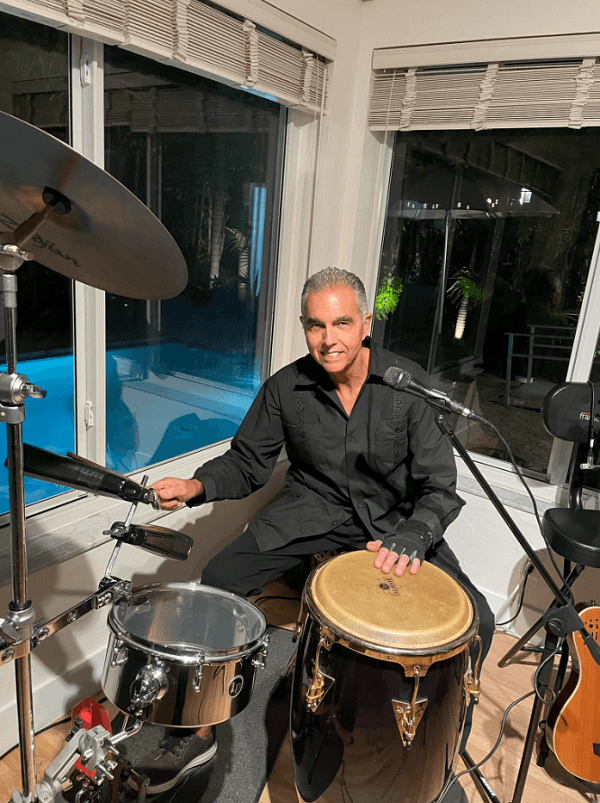
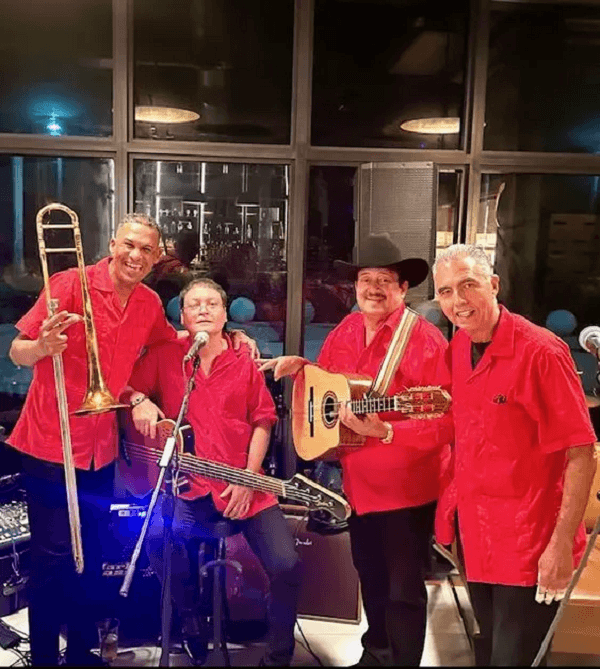
Cache Live Music puts Miami to dance to traditional Latin music

Roland Cache graced this edition with his presence to tell us about his beginnings, the subsequent creation of his band Cache Live Music, and his current career. The American of Cuban descent honors his roots with the music he and his collaborators play to delight their fans at any event they are hired, indicating the pride he feels in representing his parents’ country and how passionate he is about his craft.

Roland shared many interesting details about his musical life, and we are more than happy to share them with our readers in the following lines.

Roland Cache playing
Roland Cache playing drums live at an event

Roland’s musical beginnings as a teenager

As a child, Roland lived in Elizabeth, New Jersey, where some high school friends convinced him to play drums with them. Their favorite genre was the rock of the day, which was the 1960s. A few years later, specifically in 1973, another friend took him to a salsa concert at Madison Square Garden, and he liked what he heard so much that he became more involved in Latin music and left American music aside. 

Seeing great artists such as Tito Puente, Ray Barretto, and other artists of Puerto Rican descent, he learned to play timbales, tumbadora, and bongos, which allows him to play a combination of conga, timbales, and clave at the same time. 

Orchestras prior to Cache Live Music

Before creating his own band, Roland was part of other projects that were training him for what was to come in his career later. One of them was a band from New Jersey, whose members formed La Charanga Casino, which became very popular in that city.

Some time later, Roland could not play for a while, so he has been throwing himself into selling cars and other area businesses. Then, in 1998, he returned to music and created an American band that played rock and jazz with a touch of Latin music.

Roland Cache and the rest of the band
Roland Cache and the rest of Cache Live Music

Creation of Cache Live Music 

Eventually, he left the American band and founded a Latin band called Cache Live Music with a group of musicians, some of whom remain alongside Roland to this day. He met most of them through another musician friend who introduced them so he was knowing other artists who joined his project.

Cache Live Music was officially started in 1999, and according to its founder, the hardest thing about keeping a band like this together for so long was the search of opportunities in clubs and other kinds of places. However, Roland says that his experience as a salesman and negotiator has helped him a lot in winning contracts and the best conditions for him and his bandmates.

Current status of Cache Live Music

Today, the core of the band consists are three of its members: the guitarist, the bassist, and Roland, who is a multi-instrumentalist. More recently, Cache included a flutist, a trombonist, and sometimes a singer. This is how, depending on the requirements for a particular event, the group’s leader decides which members and instruments to include for every occasion in order to offer something different.

Cache at an Amazon event
Cache Live Music at an Amazon corporate event

Regarding the repertoire, they only perform covers, but they ensure that each and every song has their personal touch so that they resemble as little as possible to the original versions.

Anyone who wants to hire Cache Live Music can do so through its profile on The Bash by making a deposit and sending a contract to agree on the conditions of the event. However, it is important to note that they are already booked for December and January with corporate parties and weddings, for which we wish them every possible success because they already have the talent.

Tomas Pedro Regalado and Roland
Former Mayor of Miami Tomas Pedro Regalado and Roland Cache

Read also: The Williamsburg Salsa Orchestra: electrifying fusion and salsa flavored with indie rock

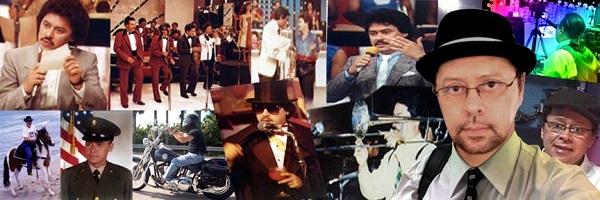
Rubby Haddock is one of the greatest exponents of our most danceable Latin Music in the Island of Enchantment

Our orchestra was born at the end of 1969, year in which we also began to record the 1st production “Presenting” which was released at the end of 1970.

Many talented musicians have passed through our orchestra such as Juancito Torres, Mario Ortiz, Rey Santos, Frank Morell, Hugo Dumont and many more that we will mention later.

Rubby Haddock is one of the greatest exponents of our most danceable Latin Music in the Island of Enchantment

Singers such as Sergio Cariño, Juan Acosta, Raul Carbonell Jr., Tony Rivas, Cucho Caro, Andres Reyes, Pedro Arroyo, Ricky Ramos, Tito Gomez, Yolanda Rivera, Eddie Rosario and Johnny Maldonado.

Rubby Haddock is one of the greatest exponents of good Latin music. His orchestra is known as one of the most danceable “Big Bands” on the Island.

He is called “El Maestro” by his followers and fellow artists. Because of his long artistic career, exposed to the world of show business, Rubby has become one of the best connoisseurs in the history of Latin music.

Born in Manhattan, New York on February 6th to Puerto Rican parents. His mother lived in Miami most of her life and in the late 60’s his father, Ruben Haddock who was a musician in New York, founded the most famous Dance Club in Puerto Rico, MIRAMAR CENTER when he owned El Club Coameño in Rio Piedras and El Club Caborrojeño in Bayamon.

A glorious time where his Producer Father brought to the Island of Puerto Rico the biggest stars of Latin music such as: TITO RODRIGUEZ, TITO PUENTE, LA LUPE, EDDIE PALMIERI, RICKY RAY, JOEY PASTRANA, JOE CUBA, WILLY COLON, HECTOR LAVOE, LARRY HARLOW, ISMAEL MIRANDA, CHIVIRICO DAVILA, TNT BAND among others, besides being manager and producer of ROBERTO Y SU NUEVO MONTUNO.

Rubby Haddock grew up with his father as a teenager in Puerto Rico within the entire business operation of Don Ruben, knowing these top stars of our music and hence the vein of musician and producer during his artistic career and experience in show business.

Celebrating the Rubi of Salsa Rubby Haddock. One of the greatest exponents of good Latin music

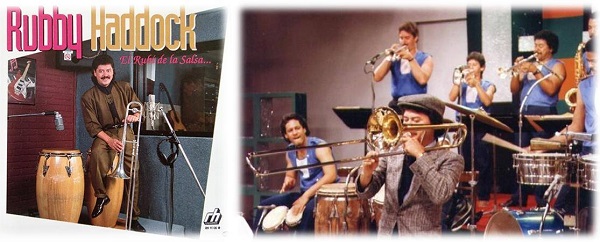
Rubby Haddock studied piano but showed that his passion was playing trombone.

For the years 1972 under the label UNIART, Rubby Haddock launches his first record production, “PRESENTING ORCH HADDOCK” becoming a powerful hit on the Island with the musical cut MONACILLO Y CORREA COTTO as some of the hits of this production.

In this first stage of Rubby’s musical career are among the different recordings: “PRESENTING”, “ASI ME LLAMAN”, “LA LEYENDA”, “DE REGRESO”, “UNLIMITED”, “2ND CONCIERTO FAMILIA TH”, “THE ENTERTAINER”, “THE ENTERTINER 2”, “OTRA VEZ”, “SALSA TROPICAL”, “EL RUBI DE LA SALSA”, “PASAPORTE MUSICAL”, “EL RUBI DE LA SALSA” and “PASAPORTE MUSICAL”.

In the second stage of his career, in 1978, when Rubby was the most popular in Puerto Rico with the song “Son Los Nervios”, one of the songs that propelled merengue on the island, Rubby surprised everyone by joining the U.S. Armed Forces in San Antonio Texas and Washington State, where in addition to completing medical courses, he also completed his Bachelor of Music Education at the Universities of Puget Sound and Pacific Lutheran.

In the 9th Infantry Div. Rubby became a member of the 9th Infantry Division Band where in addition to the Division Military Orchestra, Rubby most enjoyed the experience of being a member of the JAZZ ENSEMBLE BAND and the Big Band Jazz.

It didn’t take long for some of these great musicians to come and join Rubby’s Orchestra… At the request of a great Puerto Rican friend, and high ranking Army officer Eddie Velez, Rubby agreed to form his Orchestra back in Tacoma Washington State.

Remembering beautiful moments lived outside of his homeland until 1980, when he returned to Puerto Rico for a recording contract with the firm TH RECORDS, In this “come-back” in his return to Puerto Rico for the 80’s Rubby produces one of his most successful works: “De Regreso” with songs like: A Mi Jibarita, El Amor, Maria Teresa, Sra. Temptation with singers Raul Carbonell and Tony Rivas.

At the end of the 80’s Rubby Haddock ventured into Puerto Rican television, Wapa TV and Telemundo Channel 2, as producer of shows such as “Un puertorriqueño para la Historia (José Feliciano)”, New Year’s Eve Specials, etc.

Rubby Haddock y Sus Amigos, where the most prestigious artists such as: José José, José Feliciano, Mongo Santamaría, Barry Rogers, Eddie Palmieri, Julio Angel, and many more paraded in this section produced within the Midday Show. …. This show remained on the air for five and a half years.

Rubby Haddock
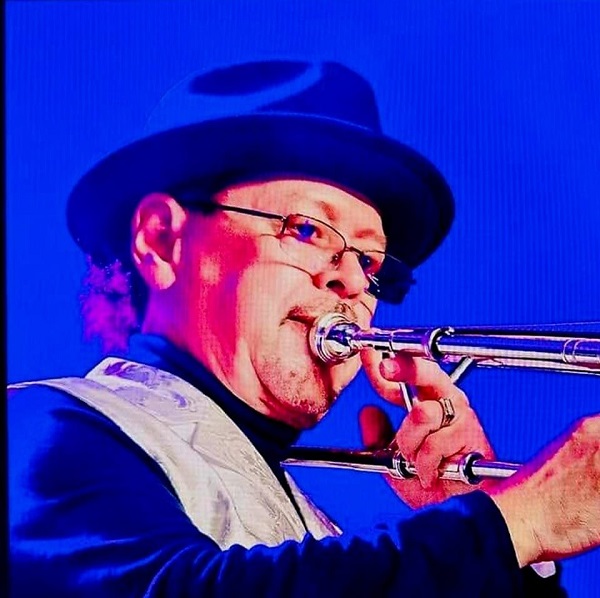
Rubby Haddock

By 1992 Rubby Haddock y su Orquesta represented Puerto Rico in the Puerto Rican Pavilion at Expo 1992 in Seville, Spain.

In the mid 90’s, although Rubby still continued as the Director of his Orchestra, he also ventured as an Entrepreneur with his own commercial Advertising Agency, where in addition to directing the entire operation of the agency Haddock & Haddock Adv, he was also the Creative, being in charge of all the production of Radio, Press and Television commercials for all the clients of the Agency.

By that time Rubby had already founded his own Recording Studio (Pentagrama Round), where he produced his three most recent productions of this decade in addition to sharing recordings for artist friends such as: Omar Alfano with Son By 4, it was from this studio that hits such as “A puro Dolor” were released.

His recording engineer was the outstanding engineer Sonny Hernandez. With him he shared works with artists such as: Danny Rivera, Andrés Jiménez, Ismael Miranda, Elvis Crespo, Melina León, Edwin Colon Sayas, Trió Borinquén, and others.

In 2000 Rubby moved to the United States where he currently lives. His fans constantly ask him to re-form his Orchestra because they miss his music and they also ask him for a compilation of his hits and a “Historia DVD” exposing the History of his Salsa, which seems to be Rubby Haddock’s next endeavor as an Artist.

Rubby has 3 sons, the first 2 Reuben Haddock and Rubby Haddock Jr, dedicated their careers to the business world and his youngest son Randy Haddock, who currently lives in New York, is a musician, singer and composer, already demonstrating great talent and the vein that comes from Don Ruben (grandfather) and Rubby (his father).

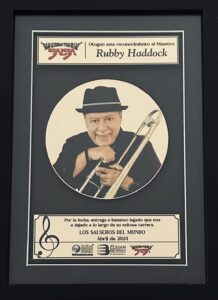
A very special thanks to Edgar Berrio and all the staff of Las Leyendas Vivas De La Salsa #8 for this great recognition, on behalf of Rubby Haddock and his family

Sources:

https://www.rubbyhaddock.com/news

pequi34 via Musica.com

Also Read: Jerry Ferrao says in salsa key: “My life is a drum”.

Discover The Alternative To Dance Latin Music In Israel

Havana Music Club: An exclusive Cuban atmosphere in Tel Aviv

Man dressed in black dancing with woman in white top
The owners of Havana Music Club are the same as the legendary Arena club.

The number one Latin rhythm club in Israel, Havana Music Club, since August 2010 opens its doors every night. It serves as a different entertainment venue for loyal Salsa and Bachata lovers from this country located on the Asian continent.

This club has set a new standard in the Middle East that resembles the best Latin music clubs in Europe and North America specifically New York and Los Angeles but with a Cuban atmosphere. Additionally, it has an underground parking lot for approximately 250 vehicles and nearby side streets with free parking spaces.

Ten years and a resounding success led Havana Music Club to create Hula La in July 2019. This “Little Brother” is located next to the main headquarters and also meets the requirements of high quality in sound, lighting, and atmosphere with a space clean that houses hundreds of dancers in 1500 square meters of parquet, which allows you to fully enjoy the continuous music of the various DJs.

This club complex is located next to Ayalon Lanes at the Hashalom Interchange (Azrieli Towers), a 2-minute walk from Hashalom Train Station.

The next event that Havana Music Club will bring to the Latin scene in Israel in 2021 will be the Caramelo festival. This event will have workshops with a couple of top-level national and international artists in the Salsa and Bachata styles. In addition, you will enjoy three nights of crazy parties, as well as accommodation with three meals, and hot/cold drink bars at the Hotel Leonardo Club.

Date: Thursday, September 2nd – Saturday, September 4th

Venue: Leonardo Club Hotel. Kampen St, Eilat, Israel

PARTIES IN HAVANA MUSIC CLUB

Couple dancing in the middle of the dance floor
The club has a food menu served by waitresses with an additional charge to the price of admission.

Havana Music Club offers Latin parties with Salsa and Bachata instructions three days a week (Tuesdays, Thursdays, and Saturdays) from 9:00 PM to late at night, and you can start from the basic level up to the professional level.

You will start with a small warm-up lesson to continue with the Latin rhythm class of the moment you prefer in any of its levels, and end with the great dance party in the Havana Music Club and Hula La. Likewise; you can also opt for classes for small groups.

Among the courses that will open soon are:

Woman dressed in lilac and man in black shirt
The club is handicap accessible

Salsa Lady Style: This course is aimed at Salsa dancers that have an intermediate level or higher. Women interested in developing body movement, gaining confidence in dancing, developing their style, and technique.

In the Salsa Lady Style course, you will work on proper posture, turns, leg and handwork, body movement, hip work, and upper body.

Chat for beginners: These Bachata classes are designed for all levels. The objective is to give you the bases so that you enter the world of “chat” and give you the tools to enjoy the dance that is conquering Israel.

Sabor de Cuba – Master’s Level: The course is taught by Lear Shoshani & Moti Sabag, one of the oldest and most prominent Afro-Cuban Salsa instructors in the country. In these lessons, they will teach the essentials of the music of this Caribbean island from its origins and emphasizing the Son, Rumba, and Afro-Cuban Mambo to dance more in tune with the music.

Salsa and Cha Instructor Training: Havana Music Club’s most prestigious course to attract future instructors from the Salsa and Bachata scene in this Middle Eastern country. This course includes general instruction, safety before a captive audience, dance basics, instructional experience, and various enrichment lessons in the field of rhythm, style, and musical history of these styles that mark the development of the night scene of this decade.

Maybe This Data Also Interests You

Dancers in the middle of a dance pass
Havana Music Club is an exclusive Cuban atmosphere in Tel Aviv
  1. There are 3 different rooms in the club: Central Room with capacity for 300 people seated or 850 people standing, Secondary room “Hula La”, and VIP Room with 90 square meters to accommodate from 20 to 50 guests.
  2. Smoking is prohibited within the club’s facilities.
  3. It is also strictly forbidden to bring any kind of drink. (Includes water)
  4. Havana Music Club offers live local bands’ performances.
  5. If you bought the ticket for a concert, I recommend you arrive at the opening of the doors to choose seats because the places are not separated.
  6. In general, the price online is cheaper than the one paid at the box office.
  7. Two other courses that will soon be offered are Mixed Style Lady Style and Salsa del Medio.
  8. Among the DJs that currently display their sets with the best mix of Latin music are DJ Charlie Pérez, DJ Nadav Shamgar (DJ NASH), DJ Moti, DJ Paco, and DJ Tzachi Bachar.
  9. According to the Israeli Ministry of Health guidelines, the number of people who spend time in the club should be limited. Attendees must present a vaccination or “in recovery” card plus an identification card.

SalsaGoogle.com is International Salsa Magazine


Home

Latin rhytms preferred by Europeans to learn to dance

A brief introduction about Latin music

In the last several years, Latin music has become a real phenomenon throughout much of the world, especially in Europe. Currently, Latin rhythms are heard in almost every corner of the Old Continent, which has been really beneficial for the great men of these musical styles, who have started their artistic careers in major cities of Europe.

After becoming an overwhelming success for this music in Latin America and the US, it gradually expanded throughout many European countries, in which Spanish and family languages ​​have a strong presence. In these countries, the Latino community has been growing steadily, which has made locals take an interest in its culture and traditions, including music. There are many Europeans who want to learn how to dance many Latin rhythms, but there are some that distinguish themselves from others.

Salsa

Europeans love Latin music
A drum for Latin music

Among the many Latin rhythms that many Europeans wanted to learn how to dance, salsa can never be lacking. This is because this world-renowned musical genre is very sociable and entertaining, which few Europeans were accustomed to see in ages past. Salsa is commonly danced in Los Angeles and very present at all kinds of parties and amateur competitions, especially in Continental Europe. In that part of the continent, it is quite common to find dance academies that teach this specific style.

There are many European nations that organize dance championships in which salsa occupies a very special place.

Bachata

Another genre preferred by Europeans in order to learn how to dance is bachata, which is from the Dominican Republic and characterized by very slow and sensual movements on the part of the members of the couple. After all the success achieved by bachata artists, this genre has become one of the rhythms with the largest presence in European music festivals.

There is no denying that a set of soloists and groups have offered an unimaginable contribution to the expansion of bachata throughout the world, such as Juan Luis Guerra, Romeo Santos, Prince Royce, among others.

Tango

Europeans dancing Latin music
A young couple dancing Latin music

If there is a genre that cannot be out of any list of options to learn how to dance, it is Argentine tango. One of the reasons why this elegant and distinguished dance has had this incredible success in Europe and elsewhere in the world has been the huge presence it has had in numerous Hollywood films and the great interest which ballroom dances have awakened in countries like England.

It is anticipated that its popularity will increase and have as much presence as salsa and bachata in dance events throughout the Old Continent. It is not long before it does.

Rumba

One of the most interesting details of a genre like rumba is that it has undergone a great number of changes in the mists of time. This is due to its Cuban origin and its many fusions with certain Spanish and African rhythms, so no wonder the sympathy that many Europeans have for this colorful musical genre.

The ones greatly responsible for the expansion of rumba in Europe have been the dance masters who have devoted much of their work to the promotion of this and other rhythms from Latin America.

Home

  • « Go to Previous Page
  • Page 1
  • Page 2
  • Page 3
  • Page 4
  • Interim pages omitted …
  • Page 137
  • Go to Next Page »

International Salsa Magazine (ISM) is a monthly publication about Salsa activities around the world, that has been publishing since 2007. It is a world network of volunteers coordinated by ISM Magazine. We are working to strengthen all the events by working together.