• Skip to primary navigation
  • Skip to main content

International Salsa Magazine

  • HOME
  • Previous editions
    • 2026
      • ISM / April 2026
      • ISM / March 2026
      • ISM / February 2026
      • ISM / January 2026
    • 2025
      • ISM / December 2025
      • ISM / November 2025
      • ISM / October 2025
      • ISM / September 2025
      • ISM / August 2025
      • ISM / July 2025
      • ISM / June 2025
      • ISM / May2025
      • ISM / April 2025
      • ISM / March 2025
      • ISM / February 2025
      • ISM / January 2025
    • 2024
      • ISM / December 2024
      • ISM / November 2024
      • ISM / October 2024
      • ISM / September 2024
      • ISM / August 2024
      • ISM / July 2024
      • ISM / June 2024
      • ISM / May 2024
      • ISM / April 2024
      • ISM / March 2024
      • ISM / February 2024
      • ISM / January 2024
    • 2023
      • ISM / December 2023
      • ISM / November 2023
      • ISM / October 2023
      • ISM – September 2023
      • ISM – August 2023
      • ISM July 2023
      • ISM Edition June 2023
      • ISM – May 2023
      • ISM April 2023
      • ISM March 2023
      • ISM February 2023
      • ISM January 2023
    • 2022
      • ISM December 2022
      • ISM November 2022
      • ISM October 2022
      • ISM September 2022
      • ISM August 2022
      • ISM July 2022
      • ISM June 2022
      • ISM May 2022
      • ISM February 2022
      • ISM January 2022
    • 2021
      • ISM December 2021
      • ISM November 2021
      • ISM October – 2021
      • ISM September 2021
      • ISM August 2021
      • ISM July 2021
      • ISM May 2021
      • ISM April 2021
      • ISM June 2021
      • ISM March 2021
      • ISM February 2021
      • ISM January 2021
    • 2020
      • ISM December 2020
      • ISM November 2020
      • ISM October 2020
      • ISM September 2020
      • ISM August 2020
      • ISM July 2020
      • ISM June 2020
      • ISM May 2020
      • ISM April 2020
      • ISM March 2020
      • ISM February 2020
      • ISM January 2020
    • 2019
      • ISM December 2019
      • ISM November 2019
      • ISM October 2019
      • ISM Septembre 2019
      • ISM August 2019
      • ISM July 2019
      • ISM June 2019
  • Spanish
  • Download Salsa App
    • Android
    • Apple

Search Results for: Latin Tribute

Directory of Salsa Clubs in Europe

Diobar

Av. del Marquès de l’Argentera, 27, 08003 +34 656 62 11 45 Barcelona, España

Havanna

Hauptstraße 30, 10827 Berlin, +49 30 78899655 Germany

La Bodeguita del Medio

Kaprova 19, 110 00 Staré Město, +420 224 813 922 Praha, Chequia

La Macumba Music Latino bar

Štefánikova 230, 150 00 Praha 5-Anděl, +420 776 795 166 Czechia

Ronnie Scott’s Jazz Club

47 Frith St, London W1D 4HT, +44 20 7439 0747 United Kingdom

Salsa Carlos

Yegi’a Kapayim St 10, +972 54-573-7173 Tel Aviv-Yafo, Israel

Baby’Oh Elche

Carrer Sabadell, 16, 03203 Elx, +34 633 77 80 90 Alicante, Spain

Havana Music Club

Yigal Alon St 126, +972 3-562-3456 Tel Aviv-Yafo, Israel

Hideaway

2 Empire Mews Stanthorpe Road, Streatham, Londres SW16 2BF +44 20 8835 7070 United Kingdom

Kona Kai

515 Fulham Rd., London SW6 1HD, +44 20 7385 9991 United Kingdom

Mi Barrio

Münzwardeingasse 2, 1060 Wien, +43 1 5876125 Austria

Mojito Club

Carrer del Rosselló, 217, 08008 +34 654 20 10 06 Barcelona, Spain

El Sabor Cubano

Carrer de Marià Cubí, 4, 08006 +34 674 98 88 63 Barcelona, Spain

Salsa! Soho

96 Charing Cross Rd, London WC2H 0JG, +44 20 7379 3277 United Kingdom

Salsa Temple

Victoria Embankment, Temple, London WC2R 2PH, +44 20 7395 3690 United Kingdom


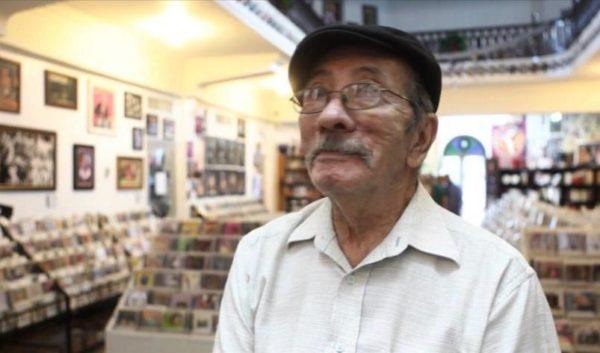
On March 19, 1928, in Guaynabo, Puerto Rico, Rafael Viera Figueroa was born.


Excellent Music Promoter. Remembered for promoting the LP Siembra by W Colón and R Blades. He founded Viera Discos, “Cathedral of Latin Music”.

He was considered one of the main disseminators of salsa in Puerto Rico, Rafael Viera, also creator of Viera Discos, one of the most important points of the movement until 2016, year in which it was closed.

Viera Figueroa was, from the late sixties to the eighties, Fania’s representative on the island. Why? He was the one who brought the music of the label founded by Pacheco and Masucci to the land of Ismael Rivera, when it was mainly distributed in the United States.

He was the promoter of the first Fania All Stars concert in Puerto Rico in 1973 and was in charge of bringing to Puerto Rico the films ‘Our Latin Thing’ and ‘Salsa’, which packed the local theaters in the seventies. According to Primera Hora, he was the one who inaugurated the Roberto Clemente Coliseum in San Juan.

In 2014 Viera suffered a stroke that kept him in intensive care. On that occasion his son, Richie Viera, gave these words to the aforementioned media: “I am a man of faith, and in God I trust that Dad will recover and will be able to continue with us for many more years, offering us his wisdom, his anecdotes and promoting and collaborating so that new talents will have a place in Latin music”.

Viera was known for the famous Casa del Coleccionista store, which he ran for more than 60 years in Santurce, for Viera Discos and for the Catedral de la Música.

He was also one of the driving forces behind the salsa boom at the time of Fania Records, where he worked as producer and promotion manager of the conglomerate of record labels; Fania Records, Vaya Records, Tico Records, Alegre Records, Cotique Records, Éxito Records, International Records and Música Latina, among others.

He was also involved in the success of the careers of artists such as Willie Colón, Larry Harlow, Cheo Feliciano, Richie Ray and Bobby Cruz, Celia Cruz, Ismael Miranda, Sandro, Sabú, Willie Rosario, Miki Vimari, Sonora Ponceña, Tommy Olivencia, La Lupe, Tito Puente, Eddie Palmieri, Ismael Quintana, Justo Betancourt, Héctor Lavoe, Tito Rojas, Frankie Ruiz, Corporación Latina, Junior Toledo, Viti Ruiz, Guillo Rivera, Ray Barreto, Willie Rosario, Orquesta La Terrífica, Roberto Roena y su Apollo Sound, Johnny Pacheco, Pete “El Conde” Rodríguez, Impacto Crea, Ismael Rivera, Raphael, Wilkins, Trio Los Condes, Joan Manuel Serrat and the most important conglomerate of musicians in the history of Latin music known as Fania All Stars, among others. In 1973, he was the promoter of the first Fania All Stars concert in Puerto Rico, which inaugurated the Roberto Clemente Coliseum in San Juan.

In the field of cinema, Viera brought to Puerto Rico the film “Our Latin Thing” and Salsa, films that crowded the local movie theaters.

He passed away on January 13, 2019 in Puerto Rico, may he rest in peace and eternal glory to Rafael Viera!


By Bella Martinez, ISM Correspondents, San Juan, Puerto Rico


On March 19, 1928, in Guaynabo, Puerto Rico, Rafael Viera Figueroa was born.

Excellent Music Promoter. Remembered for promoting the LP Siembra by W Colón and R Blades. He founded Viera Discos, “Cathedral of Latin Music”.

He was considered one of the main disseminators of salsa in Puerto Rico, Rafael Viera, also creator of Viera Discos, one of the most important points of the movement until 2016, year in which it was closed.

Viera Figueroa was, from the late sixties to the eighties, Fania’s representative on the island. Why? He was the one who brought the music of the label founded by Pacheco and Masucci to the land of Ismael Rivera, when it was mainly distributed in the United States.

He was the promoter of the first Fania All Stars concert in Puerto Rico in 1973 and was in charge of bringing to Puerto Rico the films ‘Our Latin Thing’ and ‘Salsa’, which packed the local theaters in the seventies. According to Primera Hora, he was the one who inaugurated the Roberto Clemente Coliseum in San Juan.

In 2014 Viera suffered a stroke that kept him in intensive care. On that occasion his son, Richie Viera, gave these words to the aforementioned media: “I am a man of faith, and in God I trust that Dad will recover and will be able to continue with us for many more years, offering us his wisdom, his anecdotes and promoting and collaborating so that new talents will have a place in Latin music”.

Viera was known for the famous Casa del Coleccionista store, which he ran for more than 60 years in Santurce, for Viera Discos and for the Catedral de la Música.

He was also one of the driving forces behind the salsa boom at the time of Fania Records, where he worked as producer and promotion manager of the conglomerate of record labels; Fania Records, Vaya Records, Tico Records, Alegre Records, Cotique Records, Éxito Records, International Records and Música Latina, among others.

He was also involved in the success of the careers of artists such as Willie Colón, Larry Harlow, Cheo Feliciano, Richie Ray and Bobby Cruz, Celia Cruz, Ismael Miranda, Sandro, Sabú, Willie Rosario, Miki Vimari, Sonora Ponceña, Tommy Olivencia, La Lupe, Tito Puente, Eddie Palmieri, Ismael Quintana, Justo Betancourt, Héctor Lavoe, Tito Rojas, Frankie Ruiz, Corporación Latina, Junior Toledo, Viti Ruiz, Guillo Rivera, Ray Barreto, Willie Rosario, Orquesta La Terrífica, Roberto Roena y su Apollo Sound, Johnny Pacheco, Pete “El Conde” Rodríguez, Impacto Crea, Ismael Rivera, Raphael, Wilkins, Trio Los Condes, Joan Manuel Serrat and the most important conglomerate of musicians in the history of Latin music known as Fania All Stars, among others. In 1973, he was the promoter of the first Fania All Stars concert in Puerto Rico, which inaugurated the Roberto Clemente Coliseum in San Juan.

In the field of cinema, Viera brought to Puerto Rico the film “Our Latin Thing” and Salsa, films that crowded the local movie theaters.

He passed away on January 13, 2019 in Puerto Rico, may he rest in peace and eternal glory to Rafael Viera!

All the talent Ochestra Fuego has to offer

This is our conversation with Marcus Hernández

We are here with the musical director of the Orchestra Fuego Marcus Hernandez. Nice to meet you, Mr. Hernandez. It’s a real pleasure to have you here.

Thank you. This is a real pleasure and a blessing to be here with you.

Marcus Hernández is the musical director of Orchestra Fuego

According to your website, there are many references to fire and colors red and yellow. Why hoose the name Fuego and use these tones?

Well, I had an orchestra in New York during the 1970’s whose name was Fuego 77. Fire and candela always had much to do with my style. When I moved to Florida, I launched an orchestra and decided to give it that name.

One of your latest singles is called Candela. Is it also to do with all this?

Yes, it is. I am always doing many things at the same time. When I was going to compose the song, I called my friend Carlos Infante, the guy from Miami who does all the arrangements for the orchestra. Since I grew up in New York, I grew up listening to that style of music in salsa.

Your website also reveals that your orchestra has a total of 12 members. Do you still have that number of people?

Most of the guys are still working with me. It is a blessing for me to have most of the guys who started the orchestra working with me. I want to stress that they are not only musicians, but active members of the orchestra. If you want to hire a musician, you call a guy and explain to him what he has to do, but my guys are members. We are always in touch and ask for feedback among ourserves. I think they are part of the orchestra, which is like a family.

Some of the guys leave and come back, but the vast majority of them have stayed in the group for seven years.

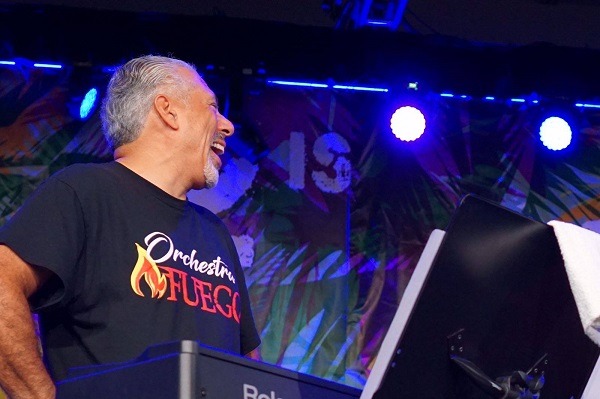
Marcus Hernández on stage

Of course, most of the musicians change groups a lot, but that’s not the case with you. Most of them are permanent members, right?

Of course! If my musicians get any job and we don’t have any performance for now, they can go work with other groups. However, when we have something to do, they know they have to play with us. The musicians know that I am always seeking the best for them. When we get contracts, we take care of them.

We have a team of managers that includes Tony de la Boga, Maria Caban, and my wife Silvia Hernandez. We always ensure that they have food, drink, water and everything they need to work. When we travel, they always come with us and we take care of the orchestra. That is a rare thing that almost no one does.

How have you kept such a large group together?

We always look for opportunities to play. We are the orchestra that plays the most throughout Florida. Our team of managers is always looking for places for us to play. I think that’s an example of the orchestra’s leadership, which I always take care of.

I am always looking for the best events for my musicians. They know I always have them on my mind and that’ss why they have stayed with me so long. They can play with other groups, but they know they must always be available for the Orchestra Fuego.

New projects (título 3)

I have understood that you are recording your next musical work and a new music video, could you tell us a little about that?

On April 18, our sixth album Candela was released along with its video. We have got a lot of attention these days because we have also released our second Christian song. We are not a Christian orchestra, but most of the guys are Christians. And then every once in a while, we do one or another Christian song, like one we did in a salsa version, that is to say, our style. Many churches have called us to do events with them because they have liked our work a lot.

Many artists prefer to release one song at a time because they say that releasing a full album is no longer profitable for them. In that sense, how are you working?

If you want to draw the attention of large companies like Sony, singles are good for artists who already have a career, but if you are a not so well known orchestra, they don’t take you seriously. So, these companies are looking for orchestras with full albums. We always make full albums containing 10 songs. In fact, our last album has 14.

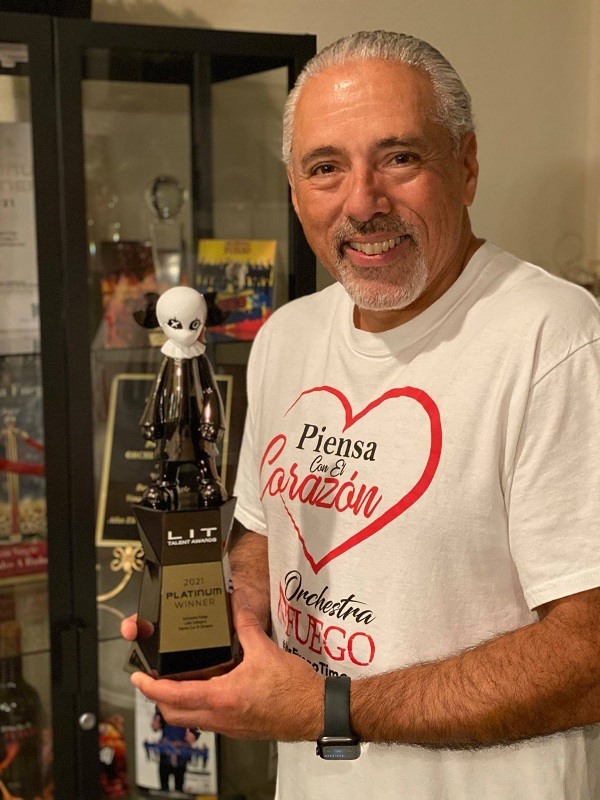
Marcus Hernández when Orchestra Fuego won its Platinum Award Trophy from the LIT Talent Awards

Among the many recordings you have made, I noticed that you did a tribute to Celia Cruz. What does this artist represent for you?

We have always liked her style, which included the costumes, the show on stage, among other things. I have seen her many times, in fact, I recorded my first album with Fania Records. So, I always saw her when it was her turn to get into the studio.

The orchestra Fiego’s vision was to be a show band, which means that we were not only musicians, we are also dancers. One thing people like a lot is that we use uniforms and are always well dressed. Another thing people also like is that the guys dance and have choreographies.

We played with Grupo Niche at the House of Blues before the pandemic, something that only those who have a long career in music can do. We have been able to play there thanks to our talent and characteristics.

On your website, you talk about old school salsa. From your point of view, what are the differences between old school salsa and modern salsa?

I think modern or romantic salsa is not part of my style. Our new album include several romantic songs, but my style will always be New York City Salsa, which was created for the dancer.

I saw that you already have dates to perform in the United States. Do you have any international tour planned?

Yes, we are going to tour with Grupo Niche. We are planning to go to Puerto Rico, Colombia, Peru, etc. Diego Galé is also going to play with us and we are also going to tour with him in Mexico and other countries.

What formula do you feel has not worked for you?

We tried to experiment with romantic music, but those songs did not have the results that we expected, which tells us that people want to hear us play salsa brava. We made the cessary changes in the fifth and sixth albums which are based on what works for us.

Lead singer Miguel Guerrero, and backup vocalists Kharina Rovira, and Betsy Lopez

Your website and social networks

Website: orchestrafuego.com

Facebook: Orchestra Fuego

Instagram: Orchestra Fuego

Frankie Vázquez “El Sonero de todos los Barrios and still going strong” Guatacando

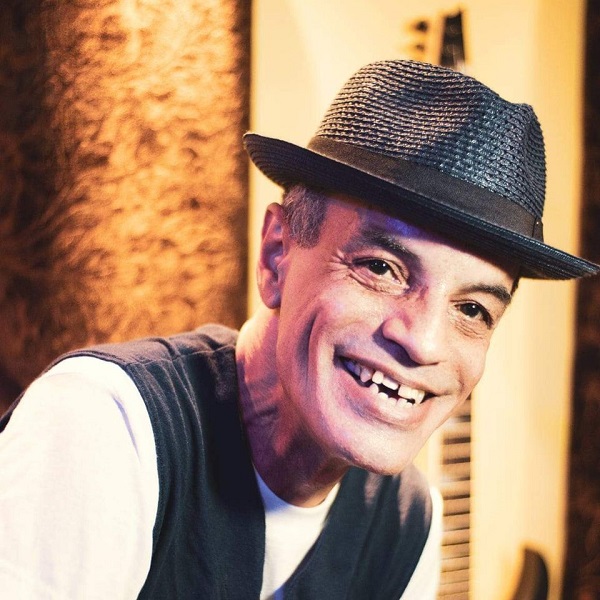
Efrain is a Puerto Rican Sonero Excélsior, he was born in Salinas in La Isla del Encanto.

His father gave him his first conga at the age of 10, and another one two years later, which allowed him to practice to the rhythm of his mother’s records: El Gran Combo, Cortijo and Eddie Palmieri.

His parents helped him to create his own band at the age of 16 “Los Generales” where he played congas; the band played concerts in his father’s restaurant. Suddenly replacing the singer of the orchestra, he becomes better and more popular. He then dedicated himself to singing, without giving up instruments such as congas, timbales, clave, maracas, güiro and bell.

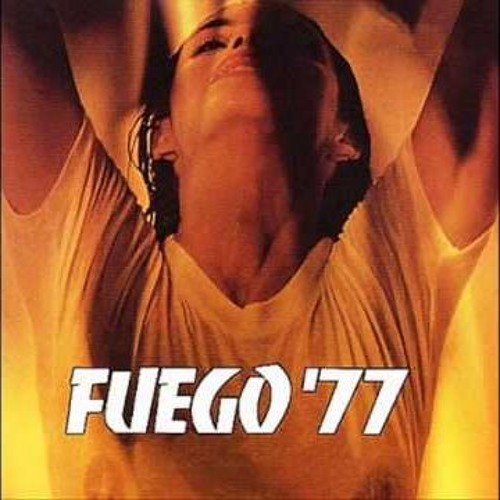
He moved to New York ’77, debuted recording on Al Santiago’s production Fuego ’77 to Alegre by the young band of the same name; Al liner note Frankie described as “enthusiastic, energetic and full of life”, he always chorused and sang lead vocals on the cut “Nueva York”, his cousin David Sanchez handled the remaining lead vocals. Fuego ’77 lasted two years.

Frankie performs: “New York”, where his very young voice is barely recognizable:

“New York site of opportunity

New York the city I love the most

I have a feeling that one day I would make it big”.


In the others, David Sanchez sings and Frankie is on backing vocals. Both are thanked in the credits for having contributed to the sounds.

This album is a wonderful little one, no song disappoints, on the contrary there is a communicative energy from the first to the last song.

“Fuego 77” was a band of young people in their early 20s.

He then spent two years with Sonido Taiborí (Sánchez sang in chorus with Johnny Ortiz and Taiborí ’79 in Fania with lead singer Tito Nieves, founder Ortiz, an outstanding Puerto Rican composer, later left), a year and a half with Orquesta Calidad and intermittently worked for three years with Orquesta Metropolitana.

He joined the “Conjunto Wayne Gorbea Salsa” for five years, providing lead vocals and güiro, accompanying one of the highlights of the Montuno sessions. He replaced Herman Olivera as singer with Manny Oquendo and his “Conjunto Libre” in December 1990, making his debut.

He partnered with pianist Martin Martin, bandleader of the magnificent “Los Soneros del Barrio” Orchestra in 1999.

He has sung with the Lebron Brothers for more than three years, as well as other spectacular company such as New swing Sextet, Leña Moncho, Tony Gonzalez, La Sonora Matancera, Frankie Morales, Delgado Jimmy, Joe Cuba, Jimmy Bosch, Spanish Harlem Orchestra and stop counting with his great success characterized.

He is currently one of the artists who has participated in countless recordings all over the world and even participated as a special guest in the group Dislocados de Ucrania.

His career is very rich and the list of his collaborations that we have just mentioned is not exhaustive.

We hope that the list will grow because we love his way of modulating his voice in each song, with a perfect diction, and his inspirations that enchant us in concert.

Facebook: Frankie Vázquez

  • « Go to Previous Page
  • Page 1
  • Interim pages omitted …
  • Page 47
  • Page 48
  • Page 49
  • Page 50
  • Page 51
  • Interim pages omitted …
  • Page 64
  • Go to Next Page »

International Salsa Magazine (ISM) is a monthly publication about Salsa activities around the world, that has been publishing since 2007. It is a world network of volunteers coordinated by ISM Magazine. We are working to strengthen all the events by working together.