• Skip to primary navigation
  • Skip to main content

International Salsa Magazine

  • HOME
  • Previous editions
    • 2026
      • ISM / April 2026
      • ISM / March 2026
      • ISM / February 2026
      • ISM / January 2026
    • 2025
      • ISM / December 2025
      • ISM / November 2025
      • ISM / October 2025
      • ISM / September 2025
      • ISM / August 2025
      • ISM / July 2025
      • ISM / June 2025
      • ISM / May2025
      • ISM / April 2025
      • ISM / March 2025
      • ISM / February 2025
      • ISM / January 2025
    • 2024
      • ISM / December 2024
      • ISM / November 2024
      • ISM / October 2024
      • ISM / September 2024
      • ISM / August 2024
      • ISM / July 2024
      • ISM / June 2024
      • ISM / May 2024
      • ISM / April 2024
      • ISM / March 2024
      • ISM / February 2024
      • ISM / January 2024
    • 2023
      • ISM / December 2023
      • ISM / November 2023
      • ISM / October 2023
      • ISM – September 2023
      • ISM – August 2023
      • ISM July 2023
      • ISM Edition June 2023
      • ISM – May 2023
      • ISM April 2023
      • ISM March 2023
      • ISM February 2023
      • ISM January 2023
    • 2022
      • ISM December 2022
      • ISM November 2022
      • ISM October 2022
      • ISM September 2022
      • ISM August 2022
      • ISM July 2022
      • ISM June 2022
      • ISM May 2022
      • ISM February 2022
      • ISM January 2022
    • 2021
      • ISM December 2021
      • ISM November 2021
      • ISM October – 2021
      • ISM September 2021
      • ISM August 2021
      • ISM July 2021
      • ISM May 2021
      • ISM April 2021
      • ISM June 2021
      • ISM March 2021
      • ISM February 2021
      • ISM January 2021
    • 2020
      • ISM December 2020
      • ISM November 2020
      • ISM October 2020
      • ISM September 2020
      • ISM August 2020
      • ISM July 2020
      • ISM June 2020
      • ISM May 2020
      • ISM April 2020
      • ISM March 2020
      • ISM February 2020
      • ISM January 2020
    • 2019
      • ISM December 2019
      • ISM November 2019
      • ISM October 2019
      • ISM Septembre 2019
      • ISM August 2019
      • ISM July 2019
      • ISM June 2019
    • 2016
      • ISM December 2016
  • Spanish
  • Download Salsa App
    • Android
    • Apple

Search Results for: Latin dance world

Omar Ledezma Jr talks about his experience at the Tempo Latino Festival

His reaction to the scholarship

We are here with Venezuelan percussionist and musician Omar Ledezma Jr. Good afternoon, Mr. Ledezma, how are you? Nice to meet you.

Same to you, Karina. It’s great to be participating again in the activities of International Salsa Magazine, a magazine that I have much appreciation and I’m find of it. Here we are always at your service.

man with glass
Venezuelan Grammy Award–winning singer and percussionist Omar Ledezma Jr

According to your website, you received a scholarship to study at Berkeley College of Music. How did you receive the news that you were selected?

That was interesting because when I arrived in the United States, I applied for the scholarship, so I had to extend my stay here in order to attend the audition in a December. In January, I got a letter that said I passed the audition and awarded the scholarship to study at the school. That was one of the most important news in my life.

So you were in the United States at the time you received the scholarship.

Yes, because there was no way I could have done that in Caracas, where I am from. So, I had the opportunity to travel to Boston to apply for the scholarship. Thank goodness, I had the opportunity to come and everything worked out fine.

Regarding technical and musical issues, what differences between your native country and the United States did you notice?

The first thing I noticed was that there were many opportunities. Really, I can say that I didn’t face the same constraints as in Caracas. When I started playing, I had many opportunities to go abroad to take my art. I already had the experience of having done it in my country with many other artists.

I think It would’ve been no different if I was in Caracas because I would have taken all the opportunities, played with many people and made my career there. However, I was able to go to Boston and took that opportunity. A few months later, I was already playing with school teachers, classmates, graduates and new people I met in a very interesting way. Despite my constraints related to the language, you can establish such interaction with all of them.
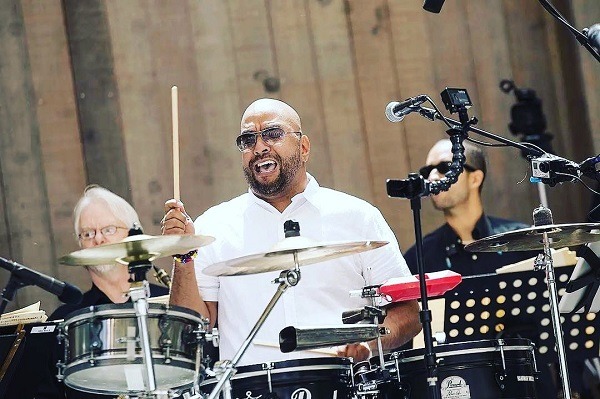
man playing the timbales
Omar Ledezma Jr playing the timbales

We understand that you are teaching at the SF Community Music Center and work hand in hand with other academic institutions, what made you dedicate yourself to teaching and training young talent?

I think it is important to lay the groundwork for the future. The present is lived now and the past provides us with experience, but we should always open the road forward for the future and new generations. I think that legacy for musicians is very important. We have to pass those teachings on to new generations.

Do you feel that the language shut doors on you at the beginning?

Not really. I have always thought that language should not be a limitation to fulfill your dreams. You have to respect the language of the country you are moving to, but without forgetting the mother tongue with which you were born, which is why I am a big supporter of bilingualism. You have to learn English, but without forgetting Spanish. It is a very important tool for young people whose parents were born outside the United States and moved here, but they should not forget their roots.

His experience at the Tempo Latino Festival

You have already told us that you have had the opportunity to tour the world. Could you tell us a little about your experience with Tempo Latino?

It was a very important experience for me and the group that I’m in, Pacific Mambo. It was an incredible experience with a massive attendance and it was surprising that we were able to meet that many people after the pandemic. We were playing in an arena full of people where we were warmly received.

It was very nice to feel the warmth of the live audience again and massively.
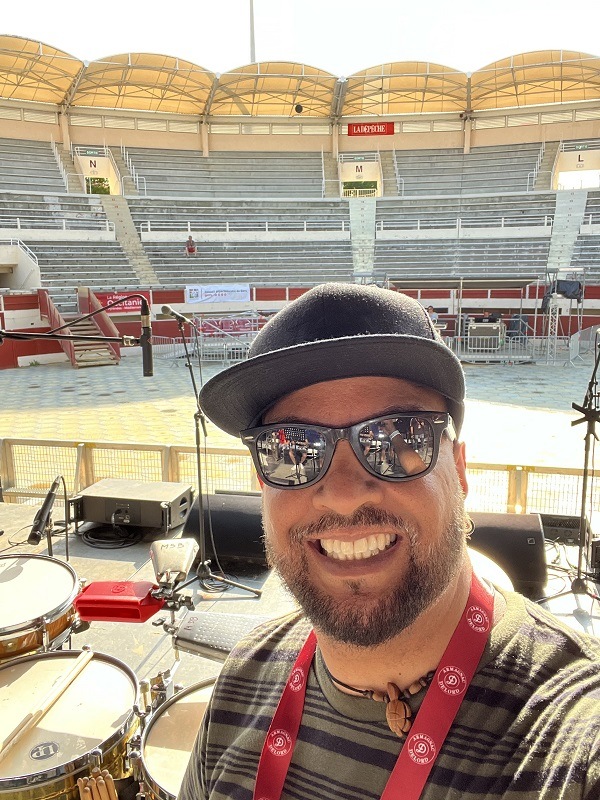
Omar Ledezma Jr in the arena at the Tempo Latino Festival

How was the flight, the arrival, the reception and everything that happened before the show?

It’s interesting because when I lived on the Northeast United States coastline, it was very easy for me to travel to Europe, Latin America, the Caribbean and other parts of the United States. Moving to California makes it more difficult because the trip is longer. It takes me about 11 hours to get to any port in Europe, and then being there, you have to make connection to get somewhere else. In our case, it was a full day of travel, as we arrived through Portugal. It was there that we waited for our connection to get to France. There were many people entering through the port of Lisbon, but there was no problem at all.

Already in France, the welcome the Tempo Latino staff was absolutely incredible. The audience was already waiting for our show. Then, we arrived to the village where the festival takes place and traveled a very beautiful route with spectacular scenery. Despite the fatigue, we fully enjoyed the trip.

When you played in the arena, how many people were there?

It is difficult to count the amount of people people there. I don’t have the exact numbers, but I can tell you that the arena was packed at the time of getting to the stage. We had the responsibility of opening for other well-known groups such as Los Van Van, so the arena was already full of people at the time of performing our show.

How was the audience reception towards you?

The audience reception was very warm and touching. People did not expect the band to have that contact and respect for the public like every time we perform. Many people enjoyed the hits we have had throughout our career such as OverJoyed by Stevie Wonder, Pink Panther Mambo, among other songs. When I did my solo with the timbales and the drums, I achieved a sound very much like We will rock you by Queen and I had to keep playing it because people were singing the song. An amazing thing that had never happened to me in my career.

Pacific Mambo performing at the Tempo Latino Festival

I heard that when you left France, you turned out to be infected with Covid-19, could you tell us what it went?

Yes, it came a surprise for me because I had not been infected since I went back to work on the street after the pandemic. I returned to my activities in the schools where I work and started providing shows again, but I had never tested positive for Covid-19 despite having been exposed. In fact, I have traveled to play in many places and even went on vacation to Venezuela, but I never contracted the virus.

When I return from my travel at the Tempo Latino festival, I was feeling a little sick and thought it was the fatigue of travel, but it turned out to be Covid-19. Fortunately, symptoms were very mild and I followed the treatment prescribed by the doctors. It took a little while for the virus to go away, but it all worked out. It was a period of forced vacation, as I had to wait about 20 days for the tests to be all negative.

Are you planning other international tours to Europe or Latin America?

We are negotiating to go to the East Coast and Canada in November. We are also making preparations for another small tour in the fall.

Today, the San Francisco Jazz Organization is going to broadcast our concert for subscribers, which makes us very happy.

What projects do you have on hand?

With regard to the band is concerned, we have talked about the possibility of making a new album and the way we want to do it. We are already looking for the music, the composers and the songs for the pre-production of this new musical work.

Pacific Mambo performing at the Tempo Latino Festival

Two Latin Events Will Blow Europe Away In August

A Salsero Festival and Tour will be the stars of the summer in the main cities of Europe

Europe welcomes Latin music events in the last month of summer this year with two impressive Salseras parties. During these events, the safety of the attendees will be guaranteed, will be an unbeatable festive atmosphere and lots of fun. So, don’t miss the opportunity to attend the Salsa Latina Istriana Festival in Croatia and the Cuban artist Maykel Blanco y Su Salsa Mayor’s European Tour, and enjoy the heat of August with your favorite Latin music.

Salsa Latina Istriana Festival 2022

DJ Sergio, DJ Marc “El Mágico” and DJ Julián Duke will be in charge of mixing the greatest Salsa hits during the Festival

Salsa Latina Istrian Festival began in 2004 as a free dance workshop with 100 dancers who love and dance enthusiasts to promote Salsa and other Caribbean dances.

This year the eighteenth edition of this festival with tradition and support for the community of European dancers arrives from August 26th to August 29th with four Bootcamps, workshops (Salsa, Bachata, Kizomba, Semba, and Urban Kiz), international instructors, Masterclasses, night parties, boat and beach parties (the farewell party on Monday will be free), 12 famous DJs, two free social dances on four floors, and much more.

Salsa Latina Istriana Festival 2022 http://www.salsalatinaistriana.com will be held under the precautionary measures agreed for events and dance academies.

The workshops, as well as the night parties, will take place over three days at Dom Hrvatskih Branitelja, Leharova 9, in the center of the coastal city of Pula, Croatia, and the cost of the gold pass is €150.

Maykel Blanco y su Salsa Mayor

The singles Qué Hace Que Te Mueve and Ya Tú No Coronas belong to the “Qué Hace Que Te Mueve” album released in 2019

Cuban artist Maykel Blanco and his orchestra will continue their tour of Europe (Part 2) on Saturday, August 27th, at London’s iconic auditorium Electric Brixton with a special six-hour Cuban Salsa show. Javier La Rosa and Dr. Jim will be the evening’s Cuban DJs, while Osbanis and Anneta (Cuban Salsa Dancers and UK and World Champions) will lead a Cuban Salsa class for all levels.

On Sunday, August 28th, they will visit Glasgow (United Kingdom) at The Garage (nightclub) and will end their tour on September 9th at the Transformatorhuis event venue located in Amsterdam (Netherlands).

Maykel Blanco y Su Salsa Mayor made their way into the Havanera capital’s music scene more than a decade ago. This popular band in Cuba combines catchy lyrics with irresistible arrangements that get dancers, fans, and onlookers moving on the dance floor.

They currently have two great hits playing on the popularity charts of the most important radio stations on the Afro-Caribbean Island, Ya Tú No Coronas (2019) and Qué Hace Que Te Mueve (2019).

“Maykel was born in San Leopoldo, a neighborhood of the Centro Habana municipality in the Cuban capital, on January 21st, 1981, the year that began a decade of splendor for Cuban popular music. With academic training at the Guillermo Tomás Music Schools and the Amadeo Roldán Conservatory, at the age of 17, he joined the orchestra “Abel y la Seducción” and a year later created, “Suprema Ley”, thus starting his outstanding career professional.

At this stage, he arouses the interest of the Spanish record label Envidia Record with which he signed his first international contract. With this record company, he managed to produce more than ten phonograms for his group and various other artists, including Tirso Duarte. He also participated in the recording of 40 albums as a percussionist in various productions and created music for various “Latin Jazz” groups, such as “Havana Express”.

Maykel decides on October 10th, 2004 to make his big debut with his new orchestra “Maykel Blanco y Su Salsa Mayor”, made up of talented musicians, who graduated from various art schools in the nation.

Since then and up to the present, he has devoted his energy, creation, and musical talent to this interesting project. Thus, allowing his professional career to continue on the rise, as a pianist, percussionist, composer, music producer, arranger, and cultural promoter reaching a high level of popularity and prestige, in Cuba and the world”. Fragments extracted from Maykel Blanco biography. http://www.maykelblanco.com/

Home

In Barrio Marianao in Havana, Cuba was born Armando Peraza was a Latin jazz percussionist

Peraza (May 30, 1924-April 14, 2014) was a Cuban Latin jazz percussionist.

Thanks to his collaborations with guitarist Carlos Santana, jazz pianist George Shearing and vibraphonist Cal Tjader between 1950 and 1990, he is internationally recognized as one of the most important figures in the field of Latin percussion.

Known primarily as a conguero and bongocero, Peraza is also a skilled dancer and composer. He has appeared on recordings by Pérez Prado, Machito, George Shearing, Charlie Parker, Tito Puente, Cal Tjader and Carlos Santana. Performances with Santana, Shearing and Tjader brought him international fame.

He was inducted into the Smithsonian Institute and had three “Armando Peraza Days” from the city of San Francisco.

One of the most important and respected figures in the world of percussion.

He is a legendary master on both congas and bongoes, whose unorthodox style and story are an inspiration to countless young musicians.

He began his artistic career in the early 1940s, played with singer Alberto Ruiz’s Kuvabana ensemble where he played the bongo and moved to San Francisco in 1949.

At the New York World’s Fair he played congas in an African pavilion with a Nigerian.

This African arrives and says to me: “Man, what part of Africa are you from? I told him, I am from Cuba. He said: “Don’t tell me” He later worked with the orchestras of Paulina Álvarez and Dámaso Pérez Prado, and the Bolero group.

In 1947 he moved to Mexico, where he joined with Mongo Santamaría the ensemble Clave de Oro, and in 1948 they both traveled to New York as percussionists accompanying the dance couple Pablito y Lilón.

At the end of that year, Peraza joined Slim Gaillard’s jazz combo with which he traveled throughout the United States. After arriving in New York in 1949, Armando became a sought-after musician, especially in the contemporary Bebop and Latin Jazz scenes.

Armando built a reputation for impressively fast and complex hand technique, experimental techniques and great talent for entertaining. He flourished in progressive atmospheres that combined jazz with Afro-Cuban styles and was at the center of a new expression called “Cubop”.

He has played on more than 100 albums and is the composer of more than 40 songs. Some of these works include collaborations with Mongo Santamaria, George Shearing, Cal Tjader and Carlos Santana.

Settled in San Francisco, California, in the early 1950s, Peraza began working with pianist George Shearing’s quintet, where he demonstrated his mastery as a player of the tumbadora and bongo; also in this period he recorded several albums of Cuban folk music with Mongo Santamaria.

In the 60’s he joined the quintet of vibraphonist Cal Tjader, with whom he remained for several years and with whom he popularized Chano Pozo’s Guachi guaro. In the 1970s, he joined Mongo Santamaría’s orchestra, with which he participated in the Montreaux Jazz Festival in Switzerland.

Later he worked with Carlos Santana’s rock band, in which he remained for 17 years, until his retirement from artistic life in the 90s.

He possessed a great capacity to obtain the most unusual sounds of the bongo and the tumbadora, and distinguished himself for his extraordinary solos on both instruments.

He died on April 14, 2014 in California, United States, as a result of pneumonia.


Fuente: https://kripkit.com/armando-peraza/

The Tambor, Tumbadora or Conga is a percussion instrument of great importance in Latin music

The drum, tumbadora or conga as a soloist instrument in Cuban music or jazz bands, had as its first figure Chano Pozo, who, upon receiving the invitation of Mario Bauza and Dizzy Gillespie to participate in his big band, turned the world of jazz upside down.

This explosive union resulted in compositions such as Manteca or Tin Tin Deo.

They also created the roots of what is known today as Latin Jazz, which was originally called Afro Cuban Jazz “Cubop”.

After the surprising death of Chano Pozo, figures such as Cándido Camero, Carlos “Patato” Valdés, Mongo Santamaría, Armando Peraza, Tata Guines and Ray Barretto emerged who gave development and personality to the conga drum as a solo instrument.

It should be noted that Ray Barretto was born in New York and is of Puerto Rican descent.

He would be the first important figure in the world of conga drumming not born in Cuba. As a teenager, Barretto took care of his siblings in the evenings while his mother worked and spent hours listening to the radio.

There he was influenced by jazz and, in addition, his mother listened to Cuban and Puerto Rican music at home. This is how he formed his taste and love for music.

Mario Bauzá

He was a saxophonist in Justo Azpiazu’s orchestra and trumpet player in the Machín Quartet. Later, he joined Chick Webb’s orchestra as principal trumpet. In 1933 he was named director of the orchestra, and remained as such until 1937. Between 1937 and 1939 he played with the orchestras of Don Redman and Fletcher Henderson. And in 1938 he joined Cab Calloway’s band.

We can also affirm that Mario Bauzá is the musical godfather of two great jazz legends: Ella Fitzgerald and Dizzy Gillespie. Because it was Bauzá who made Calloway meet the then young trumpeter John Birks Gillespie, and Chick Webb incorporated Ella Fitzgerald into his band.

Chano Pozo

Luciano Pozo González, better known as Chano Pozo was born in Havana Cuba on January 7, 1915 and died in New York, December 3, 1948, was a Cuban percussionist, half brother of trumpeter Félix Chapolín.

Percussion instruments are instruments that produce sound when struck, shaken or percussed in some way.

This percussion can be done with drumsticks, with metal bars, with the hands, with keyboards or by striking two bodies against each other. This wide variety of possibilities allows for a wide range of sounds and types of instruments.

He shined shoes and sold newspapers, played music in many places and even danced in the well-known Havana comparsa of “Los Dandy”.

He belonged to the Abakuá Secret Society, which explains the perfect mastery he had of the drums of the rite. He had the habit of playing sacred rhythms on his congas, as well as singing Abakuá and Yoruba songs.

He worked in the public transmissions of the radio station Cadena Azul, together with figures of the stature of Charlie Parker and Dizzy Gillespie, being with Dizzy when he popularized the well-known theme of “Manteca”.

Dizzy Gillespie

He was born on October 21, 1917 in Cheraw, South Carolina.

Son of a bricklayer and occasional musician who treated him very badly.

The young Gillespie hit on everyone: “I was a devil, a strong devil”.

At the age of fourteen, he began playing the trombone, but soon switched to the trumpet, which he was already playing proficiently when his family moved to Philadelphia in 1935. There he got his first important contract with Frank Fairfax’s orchestra.

His life changed as he transformed from a thug in his youth to a true citizen of the world, supporting social causes such as racial integration.

Ray Barretto

Of Puerto Rican parents from Aguadilla, Raymundo Barretto Pagan was born on April 29, 1929 in Brooklyn, New York. He spent his childhood and youth in the Bronx and Spanish Harlem.

He grew up with his mother Dolores Pagan and his siblings Cecilia and Ricardo.

As a child, when he was only 10 years old, he listened to Arsenio Rodríguez, Machito, Duke Ellington, Benny Goodman, Harry James, Los Panchos, Pedro Flores, Daniel Santos and Miguelito Valdez.

At the age of 17, in 1946, he joined the U.S. Army.

In Germany he discovered his taste for music represented in Bebop, listening to the songs “Shaw Nuff” by Charlie Parker with Dizzy Gillespie and “Manteca” by Dizzy Gillespie with the Cuban Chano Pozo, who became his source of inspiration. It was at that time that he became thoroughly acquainted with jazz.

“The word percussion comes from the Latin percussio, a variation of the word percussus, which refers to the action of striking, shaking or vibrating something repeatedly.”

Percussion instruments have a great importance in music because, within a group of instruments, their usual function is to mark the rhythm of the piece. This means that they are often seen as the heartbeat of a musical composition.

Because of their primary role in creating and maintaining the rhythm of a piece, percussion instruments often work in conjunction with bass instruments, including the double bass or electric bass.

There are a large number of percussion instruments that can be classified according to different criteria. In this article you can find the most important classifications used today.

Many of these instruments are simple and rudimentary. It is due to their simplicity that percussion instruments are the oldest in the history of mankind.

The evolution of technology and music gradually allowed the development of more complex instruments, among which are wind instruments and stringed instruments.

Sources:

https://www.instrumentosdepercusion.com/

http://clasica.latinastereo.com/Salsero-del-mes/Mario-Bauza

http://old.latinastereo.com/html/genteLatina/salseroMes/RayBarretto/cronologia.shtm

Cabaret Sauvage’s 25th Anniversary with Latin Essence

This atypical room located in the Parisian capital will offer Latin music for a month

Originally, Cabaret Sauvage was a Magic Mirror installed for only a few weeks in 1994.

A quarter of a century is the occasion for Cabaret Sauvage will celebrate its anniversary month with a Latin music festival. From July 1st to August 6th enjoy a colorful summer at Parc de la Villette – 59 boulevards Macdonald 75019 Paris, France.

This mythical place was created by Méziane Azaïche in December 1997. This first urban cultural park located in the heart of Parc de la Villette is surrounded by nature, has a terrace overlooking the Canal de l’Ourcq, has a circular dance floor, tables, benches, lights, and beveled mirrors. In the summer of 2019, they modernized this place with a new tent making it the first soundproof Magic Mirror in the world.

At Cabaret Sauvage you can eat, drink, dance, meet your neighbor from the next table, or even lounge on the terrace. Through its diversified program, you will be surprised by the quality of circus shows, dances, and night concerts with artists from all over the world.

During this anniversary month, Cabaret Sauvage https://www.cabaretsauvage.com/agenda welcomes attendees in a spirit of unity and acceptance with mixes of rhythmic genres for their knowledge and enjoyment, starting with Yuri Buenaventura on Saturday, July 9th. Doors open at 7:30 PM and the price is €35.

Yuri’s Salsa is marked by the lyricism of Europe and the drums of Africa. During his childhood, he listened to Gregorian chants, French songs, and classical music (melodies admired by his father) just as he enjoyed moving to the rhythm of percussion, marimba, and songs from the African continent that still sounds on the Buenaventura’s beaches (Colombia), his native island.

Máximo Francisco Repilado Muñoz “Compay Segundo” was the leader of the Compay Segundo y Sus Muchachos band.

The Latin music festival continues with Grupo Compay Segundo – Buena Vista Social Club on Friday, July 15th, and tickets are €25.99 (pre-sale price). Doors open from 8 PM on this day.

This group revives Cuban music before the revolution and expresses its distinguished stamp with a warm and unique sound.

This ecliptic music venue will bring Los Van Van in August, specifically on Friday, August 5th, and the doors open at 7:30 PM, and the ticket price is €35. On this occasion, César “Pupy” Pedroso will join this orchestra.

Los Van Van or better known by many in Latin America as “the Rolling Stones of Salsa” are a band created by Juan Formell in 1969 and has been a school for many current Salsa artists.

Cabaret Sauvage’s anniversary month ends with Chico Trujillo + Sidi Wacho on Saturday, August 6th. Doors open at 7:30 PM and the price of admission is €27.

Chico Trujillo began his musical career in Valparaíso (Colombia) in 1999. His project combines traditional Colombian Cumbia with Punk and has become today the standard-bearer of this new wave of traditional Colombian music accepted by many fans and exported for a long time to the European and American stages.

Likewise, the Sidi Wacho group is nomads born on the island of Valparaíso (Colombia), Roubaix (France), Lima (Peru), and Barbès (France). Their band is made up of two MCs (Rap vocalists), a trumpeter, an accordionist, and a percussionist who mix sounds and dialects accompanied by their war cry “La Lucha Sigue” (the fight continues) in an environment of Cumbia, Balkans, and Hip Hop.

  • « Go to Previous Page
  • Page 1
  • Interim pages omitted …
  • Page 13
  • Page 14
  • Page 15
  • Page 16
  • Page 17
  • Interim pages omitted …
  • Page 85
  • Go to Next Page »

International Salsa Magazine (ISM) is a monthly publication about Salsa activities around the world, that has been publishing since 2007. It is a world network of volunteers coordinated by ISM Magazine. We are working to strengthen all the events by working together.