• Skip to primary navigation
  • Skip to main content

International Salsa Magazine

  • HOME
  • Previous editions
    • 2026
      • ISM / April 2026
      • ISM / March 2026
      • ISM / February 2026
      • ISM / January 2026
    • 2025
      • ISM / December 2025
      • ISM / November 2025
      • ISM / October 2025
      • ISM / September 2025
      • ISM / August 2025
      • ISM / July 2025
      • ISM / June 2025
      • ISM / May2025
      • ISM / April 2025
      • ISM / March 2025
      • ISM / February 2025
      • ISM / January 2025
    • 2024
      • ISM / December 2024
      • ISM / November 2024
      • ISM / October 2024
      • ISM / September 2024
      • ISM / August 2024
      • ISM / July 2024
      • ISM / June 2024
      • ISM / May 2024
      • ISM / April 2024
      • ISM / March 2024
      • ISM / February 2024
      • ISM / January 2024
    • 2023
      • ISM / December 2023
      • ISM / November 2023
      • ISM / October 2023
      • ISM – September 2023
      • ISM – August 2023
      • ISM July 2023
      • ISM Edition June 2023
      • ISM – May 2023
      • ISM April 2023
      • ISM March 2023
      • ISM February 2023
      • ISM January 2023
    • 2022
      • ISM December 2022
      • ISM November 2022
      • ISM October 2022
      • ISM September 2022
      • ISM August 2022
      • ISM July 2022
      • ISM June 2022
      • ISM May 2022
      • ISM February 2022
      • ISM January 2022
    • 2021
      • ISM December 2021
      • ISM November 2021
      • ISM October – 2021
      • ISM September 2021
      • ISM August 2021
      • ISM July 2021
      • ISM May 2021
      • ISM April 2021
      • ISM June 2021
      • ISM March 2021
      • ISM February 2021
      • ISM January 2021
    • 2020
      • ISM December 2020
      • ISM November 2020
      • ISM October 2020
      • ISM September 2020
      • ISM August 2020
      • ISM July 2020
      • ISM June 2020
      • ISM May 2020
      • ISM April 2020
      • ISM March 2020
      • ISM February 2020
      • ISM January 2020
    • 2019
      • ISM December 2019
      • ISM November 2019
      • ISM October 2019
      • ISM Septembre 2019
      • ISM August 2019
      • ISM July 2019
      • ISM June 2019
  • Spanish
  • Download Salsa App
    • Android
    • Apple

Search Results for: Latin genres

Puerto Rican American bandleader and singer Elle Jay is proud of her roots

After so many years of coexistence between Latinos and Americans on US soil, there are many citizens who, as a result of this mix, carry in their DNA both identities and that is how they live their lives. Such is the case of Elle Jay, the founder and lead singer of Spanglish Latin American Band, with whom we talked about her life, career, and current orchestra.

Elle Jay recording
Bandleader and singer Elle Jay recording in the studio

Elle’s beginnings in music

Elle has been singing since she was very young. In fact, her mother says that when she was just six months old, she flounced excitedly whenever she heard Latin music. In addition, she comes from a family of musicians, firstly with her father, who played drums in an orchestra, and her mother, who was a singer. For this reason, music was always very present in each and every stage of her life, but she would not become a professional until many years later.

Moreover, once she grew up and became an adult, she felt she did not yet have the skills required to be a good singer, so she had to roll up her sleeves and start to gain experience if she wanted to reach the level she sought. That is how she met the members of a salsa orchestra that played in her area and asked them if they could give her the opportunity to join the group and get better over time. They said yes, and that is when she began to learn everything she could under the wing of various veteran musicians, who taught her to understand the rhythms and clave in the various genres of Latin music. 

She also joined other bands like the Orquesta Curaré and Pa’ Gozar Latin Band led by vocalist Laura Sosa, whom Elle considers one of her greatest mentors and teachers in the competitive and complex world of music.

Elle Jay and Jorge Rosario
Guitarist and bassist Jorge Rosario and Elle Jay presenting an evening serenade

How Spanglish Latin American Band got started

Several years later, she finally felt ready to start her own project according to her professional aspirations and therefore stop relying on what others were looking for in a group. In that regard, she took advantage of her half-Puerto Rican and half-American identity and her fluency in Spanish and English to develop an idea that she would share with other musicians she met in her neighborhood. These artists liked it and decided to join her on this road and see what the future held for them.

That was about six years ago, and the project has not done more to grow over time thanks to the tenacity of both Elle and the rest of the team who have made it all possible.

Current and former members of Spanglish Latin American Band

As many other groups of its type, Spanglish Latin American Band has undergone many changes since its founding. One of the few who has stayed in the band from day one is guitarist and bassist Jorge Rosario, who has accompanied Elle at all times and is by her side to this day. He also supports her greatly in everything related to sound and recordings.

The rest of the musicians have come and gone since the beginning. Among the current members of the band are Elle, Jorge, Italian trombonist Mike Matarrazo, and pianist Walter Ávalos. They are currently the most visible and stable faces of the group, while the others only play along with them occasionally.
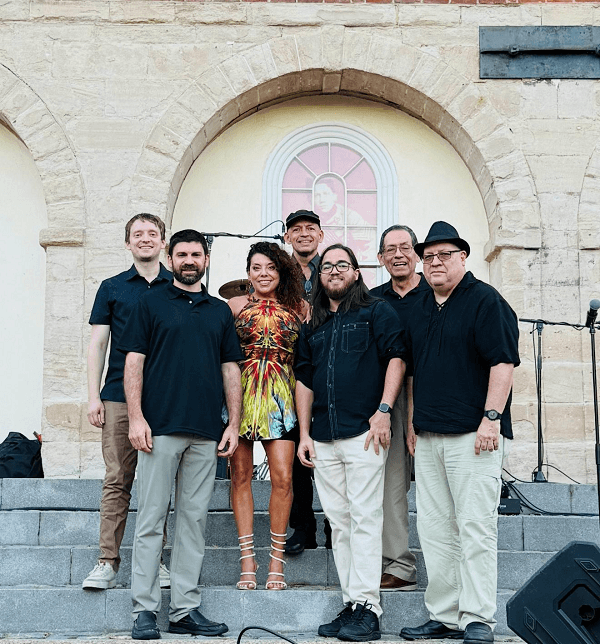
Elle Jay and the rest of the band
Conguero Mike McSweeney, trombonist Mike Matarrazo, bandleader and singer Elle Jay, drummer Hermidez, bassist and guitarist Jorge Rosario, pianist Walter Ávalos, and bongo player Jay Torres

Half Puerto Rican, half American

In other interviews, Elle has said that she identifies herself a lot with both the United States and Puerto Rico, which she has wanted to reflect in her music. That is why she has always felt a strong connection with artists like Selena, as “The Queen of Tex-Mex” was also very aware of her Latin culture despite being born in the United States. Quintanilla inspired her so much that she wanted to make a tribute to her by singing her famous song “Bidi Bidi Bom Bom” in reggae.

Another example of this is the group Sade with the song “The Sweetest Taboo,” which Elle translated into Spanish and covered in rumba and salsa to “latinize” it. She has done the same with many other well-known songs that have been covered in salsa and Spanish by her group. 

Although the majority of the public has shown great receptiveness to their work, Elle also points out that this has caused them some problems with producers and event promoters who think that the group is not American or Latin enough, which has negatively impacted them in some bookings. However, the artist assures that both she and her bandmates stand firm in their convictions and should not change the basis of their project just because a few people do not like it.

“This is who I am, and I can’t please everyone. There always will be people who say yes or no because that’s how this business works, so you have to be strong and move forward despite the obstacles you face,” Elle said on the subject.
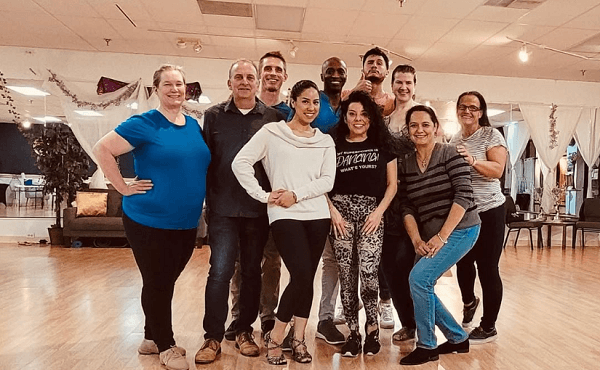
Elle Jay and her students
Elle Jay with her students during a salsa class. She is also a dance teacher

To communicate with Spanglish Latin American Band, you can do so via social media or email:

Facebook: Spanglish Latin American Band

Instagram: @spanglishlatinamericanband

Email: [email protected]

Read also: Trombone player Lindsey McMurray from the women’s orchestra Las Chikas

Venezuela violinist and former musician in El Sistema Ali Bello has many interesting things to say

Venezuelan musician Alí Bello has become one of the best Latin music violinists in New York, so we could not miss the opportunity to talk to him and learn as much as we could about his fascinating story. The young man has given his best to become a true icon of Latin Jazz in his current city of residence, so do not miss this great conversation.

Ali playing the violin
Venezuelan musician Ali Bello playing the violin live

Alí’s beginnings in the world of music thanks to El Sistema

From a young age, Alí became interested in music, which led him to join the National System of Youth and Children’s Orchestras and Choirs of Venezuela, where he studied classical music as an extracurricular activity. This in order for Alí and his classmates to be busy in any activity until their parents came to pick them up after work.

This was when an orchestra or school of music was formed clase to his father’s work, so Bello was enrolled in these classes from 2 to 5 p.m. after school. So it went for him since he was in kindergarten, and he learned to play the xylophone and the recorder. When the boy was seven years old, the school orchestra located in La Rinconada, Caracas, was officially created, but due to how small Ali was, the only instrument the school could assign him according to his size was the violin, which he keeps playing diligently to this day.

After many years of being part of the National Youth Orchestra, he got ahead with his musical career and decided to go to the United States to continue his university studies and train as a professional musician.

Other instruments besides the violin

In addition to the violin, Alí also plays a lot of percussion, since he considers it very important. He thinks every folk and Latin musician must handle percussion as efficient as possible and each of its rhythms in order to internalize the style they want to play on any instrument.

“Percussion and singing have always fascinated me, so I try to devote myself to both even a little bit, but it is undeniable that the violin has always been my main instrument. I’ve tried to focus all styles and everything I work on towards the violin to turn it into the main element,” the musician added on this subject.

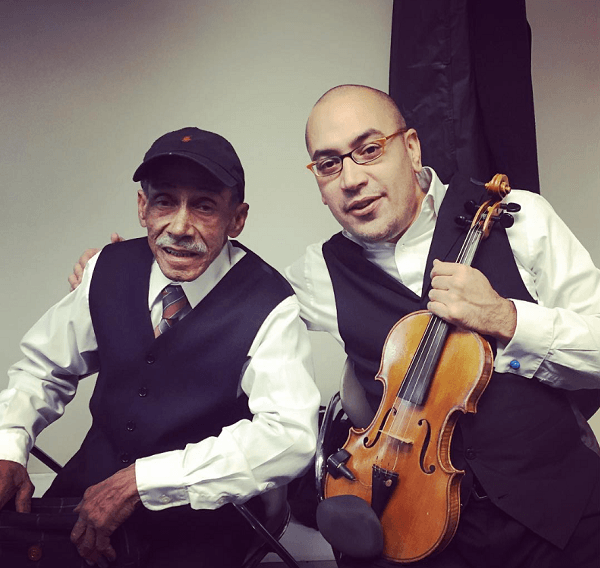
Ali and Gustavo
Ali Bello, his son and maestro Gustavo Dudamel

How the opportunity to study in the United States came about

Initially, Alí was supported by his violin teacher Margaret Pardee, who taught at the Juilliard School and went to Venezuela to give master classes. It was Pardee who encouraged Alí to continue his education in New York, which he finally achieved thanks to the Gran Mariscal de Ayacucho scholarship fund and the Simón Bolívar Musical Foundation.

This is how the Venezuelan artist obtained his bachelor’s degree, master’s degree, and PHD.

At college, he met Johnny Almendra, thanks to whom he discovered genres other than classical music, in which he was not only the performer of melodies but could also create his own music. He then discovered styles of Venezuelan and Latin music that inspired him to explore more varied rhythms different from what he had known before.

He played regularly with Johnny Almendra and his modern charanga group Los Jovenes del Barrio for a time and subsequently played for La Típica Novel and other orchestras. As Alí gained experience in the world of charanga and Latin music in general, he started having opportunities to learn and explore other genres such as Brazilian music, Afro-Cuban music, Latin jazz, and many more. 

Collaborations with major artists in the industry

All this hard-won ground gave Alí the opportunity and the honor to collaborate with great artists in the industry such as Tito Puente, Eddie Palmieri, Johnny Pacheco, Rudy Calzado, Pedro Cortés, José Fajardo senior, Pupi Legarreta, and many more. All these figures helped him not only to have a better understanding of the Afro-Cuban style and tradition, but also of the influence of New York on music.

Ali and Pupy
Maestro Pupy Legarreta and Ali Bello

Thanks to this knowledge base, he had the courage to release a record album, La Charanga Syndicate, in which, as the name suggests, he uses charanga and all the influences coming from the musicians he has known and continues to know. For this reason, he feels he now has something to say and bring to the style. 

Another important thing for his career was his participation in Jay-Z’s concert to celebrate the anniversary of the release of his first album. The rapper wanted to mark the occasion by playing with a symphony orchestra, so hired many musicians of all kinds to make a great show at Radio City Music Hall in New York. Fortunately for Ali, he was well-known in the music scene at the time, so he was contacted to participate in the event.

In that sense, the violinist is very happy to be in New York, as the world’s greatest artists always take this city into account for their concerts, which gives musicians like him the opportunity to have access to these great figures in the industry.

Ali as an arranger

In addition to being a percussionist and violinist, Ali has also ventured into musical arrangements quite successfully thanks to all the academic training he had received up until then. However, as he became a more experienced professional, he began to notice that his own ideas and thoughts came to life in his work. So, having the theory in his head, he could take those ideas he had had and develop them within the rhythmic and stylistic elements which are willing to use on each occasion.

In addition to that, the artist also works on production and mixing a bit to achieve the necessary sound. He even has his own studio where he plays for his own productions and other artists’ records as a freelancer.

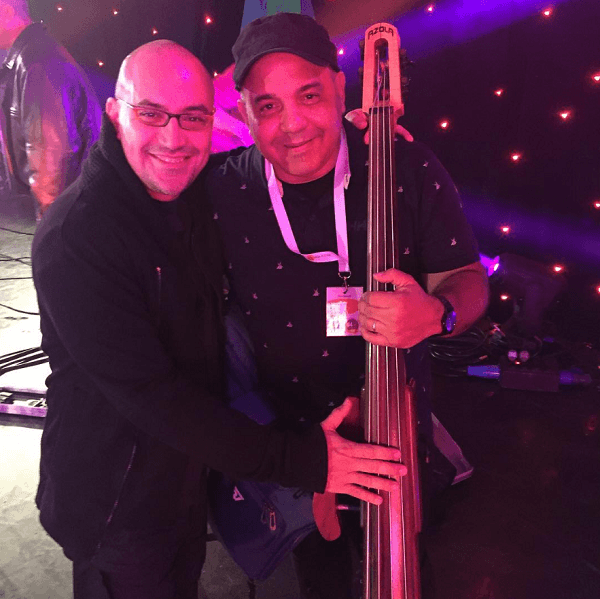
Ali and Juan
Ali Bello and Juan Carlos Formell from Los Van Van in Poland

Read also: Omar Ledezma Jr. shares with us the new from his project with Azesu

David Atanacio Percussionist, Composer and Singer Unveils a New Sound

David Atanacio, grounded in the values of honesty, integrity, loyalty, responsibility, and respect, appears to be an individual of strong moral and ethical character. He is someone who can be fully trusted, a faithful and committed friend and colleague who always tells the truth and acts with righteousness.

His sense of responsibility ensures he fulfills his commitments, while his respect makes him a considerate, open person capable of building harmonious relationships. Together, these values suggest a dependable, upright, and kind personality, making him a positive and admired presence.

Born in New York City and raised in Puerto Rico, specifically in the municipalities of Bayamón and Cataño, David Atanacio has cultivated a unique musical identity rooted in a powerful fusion of Cuban rumba, flamenco rumba, and Afro-Caribbean influences.

David Atanacio Percussionist, Composer and Singer

In 1993, he began his musical journey as a bongo player for his uncle’s “Grupo Típico,” later joining a local orchestra as a conguero in 1996. In 1997, he was presented with the opportunity to become a singer, marking a turning point in his musical destiny.

Recruited to co-found “Grupo Folclórico Yuba Iré,” it was with this group that he began to perfect his mastery of rhythms like La Bomba, La Plena, El Guaguancó, El Yambú, and more. During this same period, David Atanacio discovered his talent for composing and began writing his first songs, including one titled “Lo que dice el Tambor” (What the Drum Says).

He was recommended to work with the “Orquesta Abran Paso” from Puerto Rico, with whom he accompanied luminaries such as Ismael Miranda, Adalberto Santiago, Junior “Hommy” González (RIP), Larry Harlow (RIP), among others.

He then received a call from the Puerto Rican Maestro “Paoli Mejías,” percussionist for “Carlos Santana’s” group, who invited him to be part of his first musical project, “Mi Tambor.” On this album, David’s song “Lo Que Dice el Tambor” was recorded, appearing as Track No. 7. The album was nominated for “Best Latin Jazz Album” at the Latin Grammys in 2004.

David Atanacio: Percussionist, Composer, and Singer Unveils a New Sound

David Atanacio: Percussionist, Composer, and Singer Unveils a New Sound

In 2003, the King of Rhythm, Mr. Afinque “Don Willie Rosario,” invited David to join the front line of his orchestra, where he remained until 2005. After leaving Willie Rosario’s Orchestra, David decided to move with his family to Tampa, Florida.

Even in his new home, David never lost touch with his roots. One day, he received a call to contribute background vocals to the production “Sobrevolando” by the acclaimed Puerto Rican group “Cultura Profética” (2019). This production earned them the Latin Grammy for “Best Alternative Album” in 2020 and a nomination for “Best Latin Rock or Alternative Album” at the 2020 Grammy Awards.

David Atanacio is a “Sonero de Calle” (Street Sonero), with ample talent and ability to succeed. He is a percussionist, composer, and possesses the added artistry of the “Soneo del Guaguancó” (Guaguancó vocal improvisation).

Atanacio is now releasing his musical proposal, “David Atanacio & Champán D’ Barrio,” featuring aged salsa and plenty of flavor.

David Atanacio & Champán D' Barrio
David Atanacio & Champán D’ Barrio

The album contains ten tracks, eight of which are his original compositions. The production features special guest Herman Olivera, who performs a duet with David on a meticulously crafted song titled “De la Vieja Escuela” (From the Old School). The first single from this project, “Lo que dice el Tambor,” is hitting the airwaves, now presented under his orchestrated concept, “David Atanacio & Champán D’ Barrio.”

The Puerto Rican sonero recently released his latest single, “No Me Llores Más” (Don’t Cry For Me Anymore), a masterfully interwoven piece that pays homage to the musical genres that have shaped his artistic journey. The song perfectly fuses Cuban rumba, guaguancó, Spanish flamenco rumba, and son.

More than just a song, No Me Llores Más is a deeply personal sonic exploration that honors the genres that have influenced David Atanacio since his beginnings.

More than just a song, “No Me Llores Más” is a deeply personal sonic exploration that honors the genres that have influenced David Atanacio since his beginnings. Rhythms such as trova, décimas, aguinaldo, bomba, and plena have profoundly impacted his musical development, adding unique nuances to his artistic expression and reaffirming his commitment to the cultural heritage of his homeland and the Caribbean.

“No Me Llores Más” Credits:

  • Lyrics, Music, and Lead Vocals: David Atanacio
  • Background Vocals: Herman Olivera Jr. & Adriel González
  • Musical Arrangement: Carlos García
  • Piano: Yassel Puppo
  • Bass: Kevin Pagan
  • Trombone Solo: Carloscar Cepero
  • Percussion: Diego Centeno
  • Spanish Guitar: Alex García Potia

With an exquisite arrangement by Carlos García and impeccable execution by top-tier musicians, “No Me Llores Más” marks a new chapter in David Atanacio’s career. It’s where tradition and vanguard embrace to the rhythm of the drum, the guitar, and pure emotion.

This track will be available on all digital platforms starting June 14, 2025.

The rumba lives, the son renews, and David Atanacio’s voice celebrates it!

Press Contact: David Atanacio [email protected] 813-569-9581

Reference: Luis Rojas

Also Read: Herman Olivera the sonero of the 21st century

Multi-instrumentalist Ian Dobson talks about his trips and academic background

American artist Ian Dobson, like many of his compatriots, could not resist the charms of Latin music and its huge diversity of rhythms, so today he talked with us about the way he walked to become the talented multi-instrumentalist he is today.

Enjoy Ian’s incredible story in the following lines and learn everything he has to share.

Ian with his drum
Ian Dobson posing for the camera with his steel drum and ukulele

How Ian became interested in music

With just five years old, Ian already took a genuine interest in playing the drums and did not have any other family members who also liked music, except his aunt, who was a violinist. Although he does not have a very special motivation to love this instrument, he remembers that when he was 12, someone showed him a samba rhythm on his own drums, and he liked it so much that he continued playing it himself until perfectioning it. As a teenager, he was very involved in jazz, which also led him to Latin jazz and other genres derived from it. 

On reaching majority, he had already discovered a little more of Latin music, so he began studying Spanish in order to understand it better, which of course helped him a lot for the following years. His curiosity about this colorful culture was such that he embarked on a series of trips to many Latin American countries, one of which was Venezuela, more specifically Margarita Island, in 1988. Ian wanted to practice his Spanish and see what rhythms he could find in that country, the most popular being salsa and merengue.

Genres and countries that most influenced Ian

Among the Latin American countries we can name are Venezuela, Colombia, Guatemala, Honduras, Mexico, and Cuba. He also had the opportunity to play on several cruise ships and visit many Caribbean islands.

Each and every one of these countries had things that caught his attention musically. In the case of Venezuela, Ian was able to study the maracas during his master’s degree in percussion in Washington. One of his teachers was Euclides Aparicio, with whom he was able to learn much more about the music of this nation. 

Ian playing the marimba
Ian Dobson playing the marimba in Mexico

The artist points out that the country that most aroused his attention was Cuba, but he assures us that he liked all of them due to the musical and cultural diversity he found on all his trips, and he hopes to return to the same destinations someday. 

Mexico was the country where he spent more time, staying there for a total of six months. 

Academic background

Ian has a very interesting academic background that has provided him with a huge amount of knowledge applicable to his career. We can mention the University of Lisbon, where he was studying Portuguese and found it fascinating because there were many people from the African colonies, resulting in this music permeating Portugal and mixing with local music. One of its most renowned composers was Fernando Lopez-Graça, whom Ian had the opportunity to meet during his stay in the European country.

He became so interested in this subject that he wrote essays on how Brazilian music influenced Portuguese music and what role Africa played in all of this. Ian had already earned his bachelor’s degree from Pomona College, so he found all these topics very interesting and took them into account when it comes to studying music.

He also studied jazz at the Oberlin Conservatory, and although he did not complete his classes there, everything he learned obviously helped him a lot later on. At the University of Washington, he earned a bachelor’s degree in percussion and learned much more about music from a purely academic point of view.

Ian with a child
Ian giving classes to a little child some years ago

Ian the multi-instrumentalist

Ian studied timpani, marimba, vibraphone, piano, drums, percussion, and many other instruments throughout his career, so he can be considered a multi-instrumentalist who has sought to specialize in as many areas of music as possible.

During our conversation, Ian showed us through video call some of the instruments he was going to play that same day, such as steel drums, an electronic marimba, a drum set, a ukulele, DJ equipment, and so on.

He assures us that he is capable of playing these instruments and others during his performances, but he loves steel drums and the ukulele, which are a fundamental part of his repertoire.

Ian the teacher

While it is true that Ian has no private students right now, he previously offered music lessons for some time, gave workshops and created online spaces for his students and followers to learn from his experience.

Today, he only offers concerts, but he always tries to make them as educational as possible. In fact, he always has a few extra pairs of drumsticks that he offers to some of his concertgoers so they can play themselves while Ian explains what to do. This makes the performance much more interactive and dynamic thanks to audience participation.

The most satisfying aspect of being a teacher was to see his students gain much more self-confidence, which led them to pursue their goals with greater intensity. No matter how bad his mood may be at any given moment, he is always happy to see others learn and enjoy what they do.

Read also: Efrain ‘‘Junito’’ Davila, Victor Manuelle and Ricardo Arjona’s producer in International Salsa Magazine

French flamenco dancer Fanny Ara lets us know the most important details of her career

There are countless artists from all over the world who have fallen in love with Latin and Spanish-speaking rhythms due to their colors and richness, so we cannot fail to talk about cases like that of dancer, choreographer and dance teacher Fanny Ara, with whom we had the opportunity to talk for a few pleasant minutes about her beginnings in her native French Basque Country and her current career. 

This talented woman, who we met through her work with Javi Jiménez and his group Barrio Manouche, has a lot of interesting things to say, so we invite our readers to enjoy this story from start to finish.

Dancer Fanny Ara posing
The beautiful Fanny Ara posing for the camera. Photo taken by Tony Abello

Fanny Ara’s beginnings in dance

With respect to how Fanny first became interested in dancing, Fanny explained that her aunt was a Spanish classical dancer and convinced her parents to sign her up for dance classes when she was about six or seven years old, to which they agreed and so they did. The little girl was so pleased with this discipline that she knew at once that she wanted to be devoted to this for the rest of her life.

She studied piano, although nowadays he does not play it, and obtained a degree in music at the Bayonne School of Art and, once he had finished all her studies, she wanted to try his luck in Spain. Been there, she had the opportunity to work side by side with some of the best exponents of flamenco dancing such as Isabel Quintero and Antonio Najarro, sparking her curiosity for looking further into it and specializing in it. 

In the end, she stayed in Spain for a few more years and had no incentive to return to her country of origin. She had already started a new life in a completely different place and a profession that kept her there for the time being.

Moving to the United States

While still living in Spain, Fanny fell in love with an American and went to live with him in San Francisco, where her partner had always lived. She was fortunate enough to move to what was no other than the city with the largest flamenco music scene in the country, so it was not at all difficult for her to adapt to the new world that was opening up before her.

In fact, it did not take long for her to join dance companies, teach classes and perform just like she had been doing in Europe. The only difference is that San Francisco was a big city, while her hometown was very small and Seville, where she lived in Spain, was not a big village either, so this was a big change for her.

San Francisco opened her mind tremendously in many ways that she had not considered, so she decided that this would be her new home indefinitely.

Maria Elena and Fanny
Flamenco dancer Marina Elena Scannell and Fanny Ara. Photo taken by Timo Nuñez

Differences between the American and European market in terms of dance

Given that San Francisco had a much wider variety of cultures and music, Fanny was able to experiment with many other art forms like she had not done before, so she was able to dance different genres from flamenco such as jazz and even salsa, especially at social events.

The fact that her new home did not have the same traditional barriers the dancer encountered in Spain helped her to expand her horizons and try new genres and dances. In addition, being able to work in Canada and Latin America has also allowed her to expand her knowledge to unimaginable levels.

Awards and nominations 

This entire career has also led Fanny to be recognized for her talent. The artist received six Isadora Duncan Dance Award nominations for important categories such as Most Outstanding Individual Dancer and Most Outstanding Musical Performance. In addition, she earned a recognition from New York’s Vilcek Foundation as “Creative Promise in Dance.” 

She feels absolutely happy and lucky to be awarded and recognized for her achievements in several of her greatest works, including “Magia Flamenca,” “A Través de Tus Ojos,” “Tattooed,” “Lilith,” among others.

Biggest challenges of being a dancer and choreographer

According to Fanny, one of the biggest challenges facing an event producer and choreographer like her is the obtaining of economic resources needed to carry out her ideas, which makes it difficult to get financing for her projects, especially after the pandemic.

In addition, many venues and restaurants are not interested in paying what corresponds to a flamenco show, which greatly reduces the chances of making some labour agreements.

Another disadvantage encountered by the artist and her team is the refusal of some theaters to allow them to use their premises, as the flamenco tablao requires a certain footwear and tap, which can be a little damaging to the floor of these establishments. 

However, these problems have not been an impediment for her to continue her work, although she has had to adapt to certain conditions.

Fanny and Barrio Manouche
Fanny Ara dancing with the group Barrio Manouche

What motivates Fanny to create her choreographies

One of the things that move Fanny to create a choreography is to give a voice to those who cannot speak. In the last two productions the choreographer has made, she has sought to address the abuse suffered by human beings, especially women. The plot of the play is about three dancers who have suffered some form of abuse throughout their lives, showing how important it was for Fanny to show what many people suffer today with no one to listen.

What the artist wanted was to bring a message of hope to her audience and give a voice to those who have remained silent in the face of any form abuse to them. Best of all, words were not required to give the message, as the dancers expressed their emotions through their movements and gestures, which was more than enough.

In the case of “Lilith,” Fanny was the lead dancer together with two other musicians who accompanied her to offer a simple but powerful performance about the hard life’s way of a woman, something the artist wanted to illustrate through her work.

Ara sought to raise awareness among the audience during the hour or two her show lasted, so that attendees would go home with a different view of what they had believed until now. 

Read also: Javi Jiménez from Barrio Manouche talks about his career in Spain and then in San Francisco

  • « Go to Previous Page
  • Page 1
  • Interim pages omitted …
  • Page 20
  • Page 21
  • Page 22
  • Page 23
  • Page 24
  • Interim pages omitted …
  • Page 62
  • Go to Next Page »

International Salsa Magazine (ISM) is a monthly publication about Salsa activities around the world, that has been publishing since 2007. It is a world network of volunteers coordinated by ISM Magazine. We are working to strengthen all the events by working together.