• Skip to primary navigation
  • Skip to main content

International Salsa Magazine

  • HOME
  • Previous editions
    • 2026
      • ISM / April 2026
      • ISM / March 2026
      • ISM / February 2026
      • ISM / January 2026
    • 2025
      • ISM / December 2025
      • ISM / November 2025
      • ISM / October 2025
      • ISM / September 2025
      • ISM / August 2025
      • ISM / July 2025
      • ISM / June 2025
      • ISM / May2025
      • ISM / April 2025
      • ISM / March 2025
      • ISM / February 2025
      • ISM / January 2025
    • 2024
      • ISM / December 2024
      • ISM / November 2024
      • ISM / October 2024
      • ISM / September 2024
      • ISM / August 2024
      • ISM / July 2024
      • ISM / June 2024
      • ISM / May 2024
      • ISM / April 2024
      • ISM / March 2024
      • ISM / February 2024
      • ISM / January 2024
    • 2023
      • ISM / December 2023
      • ISM / November 2023
      • ISM / October 2023
      • ISM – September 2023
      • ISM – August 2023
      • ISM July 2023
      • ISM Edition June 2023
      • ISM – May 2023
      • ISM April 2023
      • ISM March 2023
      • ISM February 2023
      • ISM January 2023
    • 2022
      • ISM December 2022
      • ISM November 2022
      • ISM October 2022
      • ISM September 2022
      • ISM August 2022
      • ISM July 2022
      • ISM June 2022
      • ISM May 2022
      • ISM February 2022
      • ISM January 2022
    • 2021
      • ISM December 2021
      • ISM November 2021
      • ISM October – 2021
      • ISM September 2021
      • ISM August 2021
      • ISM July 2021
      • ISM May 2021
      • ISM April 2021
      • ISM June 2021
      • ISM March 2021
      • ISM February 2021
      • ISM January 2021
    • 2020
      • ISM December 2020
      • ISM November 2020
      • ISM October 2020
      • ISM September 2020
      • ISM August 2020
      • ISM July 2020
      • ISM June 2020
      • ISM May 2020
      • ISM April 2020
      • ISM March 2020
      • ISM February 2020
      • ISM January 2020
    • 2019
      • ISM December 2019
      • ISM November 2019
      • ISM October 2019
      • ISM Septembre 2019
      • ISM August 2019
      • ISM July 2019
      • ISM June 2019
  • Spanish
  • Download Salsa App
    • Android
    • Apple

Search Results for: Latin genres

Four nationalities united in Ladama

Talent can come from the most amazing and unexpected origins and more when we are talking about music, a branch of art from which always emerges people with a lot of potential who can completely break our schemes. This leads us to introduce the topic of a group of four young musicians and singers who joined their skills despite their apparent differences. They are the musical group Ladama.

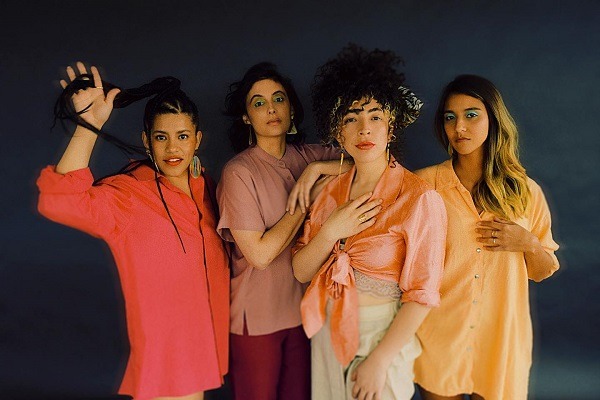
Ladama is an alternative Latin music band composed of four members of different nationalities: Venezuelan Maria Fernanda Gonzalez, Brazilian Lara Klaus, Colombian Daniela Serna and American Sara Lucas. 

Three of the four members of the group spoke exclusively with International Salsa Magazine and this report will show some of the topics covered during this pleasant conversation. 

Sara, María, Lara, and Daniela from Ladama
From right to left, Sara Lucas, María Fernanda González, Lara Klaus and Daniela Serna

Origins of Ladama as a group 

The conversation was started by Lara and Dani, who explained a bit about the rise and concept of the band. The group was created in 2014 while the girls were doing an artistic residency known as OneBeat, which was sponsored by the U.S. Department of State. They were selected to represent their respective countries, which led them to socialize with each other and discover the great chemistry between them because of the language and genres they played. 

Since OneBeat was an initiative towards cultural exchange between artists and offered the necessary technical equipment to record music, they took full advantage of this space to get to know each other’s styles and see what they could do together. 

Once the month-long residency was over, each went their way, but they kept in touch via Skype a year after having met. The motivation to create a project that would encompass a musical band and teaching classes to minority communities remains intact.

They wanted to create an initiative in which community, creativity, social impact and cultural exchange would be the fundamental pillars of Ladama. It was always clear that they not only wanted to make music, but also do something that would positively impact upon society and they think they have succeeded so far. 

As for the name Ladama, it is simply a combination of the first two letters of the names of each one: ”la” comes from Lara, ”da” comes from Dani and ”ma” comes from María Fernanda. At the same time, ”La dama” in Spanish means ”The lady”, which also refers to the fact that it is an all-women group.
Ladama in a residency called OneBeat
They first met in an artistic residency known as OneBeat

How did these different origins coexist in Ladama? 

We were very impressed by the fact that all Ladama members came from different countries, so we wanted to know how this impacted the group. Lara answered that the only thing they needed was the desire to play together and move this initiative forward, which means that the origin of each one was not a problem to found the group.  

Just like every other band, each one had her own ideas and they discussed them together to know which one to choose or not. 

Their major test was given during the Rec-Beat Festival in Brazil. They arrived only a few days before the event, so they could barely rehearse and set up the repertoire. Despite the haste, they feel that everything went very fluidly, as they spent time meeting with each other and writing some songs for an occasion like this.

Given that Lara, Dani and Maria Fernanda come from Latin and tropical countries, there are certain rhythms that sound so much alike, which they took advantage of to unify them and create completely new rhythms that sound good at the same time. Lara also pointed out that these mixes are in constant change and they always try not to get stuck in the same styles.  

In addition to that, Ladama has left traditional music behind a little bit and has focused on alternative music and other genres such as pop, soul and R&B. 

Dani addressed the topic of genres by saying that they do not follow a plan in which they have something specific to play or mix. Any of their songs can go from Dominican merengue and Colombian cumbia to trap and reggaeton without any problems. They do not like to limit themselves and always seek to reach all audiences.   
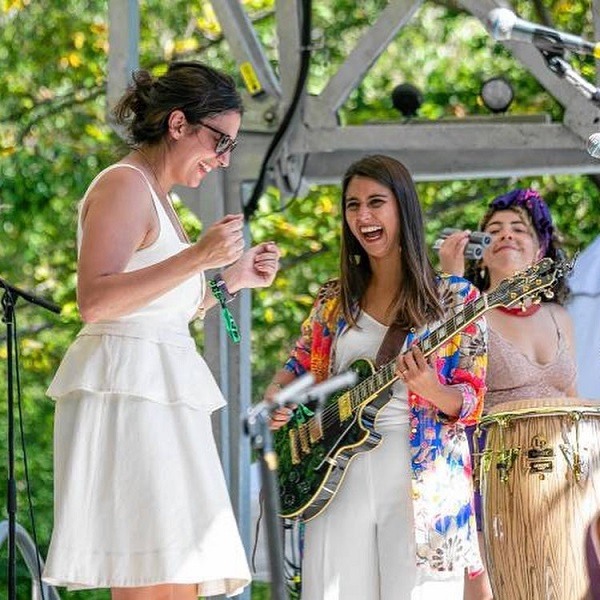
Ladama live
Ladama performing live

Ladama in a Tiny Desk concert series

Playing on Tiny Desk (a series of live concerts organized by the radio program All Songs Considered in the United States) is always a prestige for any artist or group that performs on that platform, which is inviting Latin singers more frequently every time.  

The girls were at a festival in Albuquerque, New Mexico, where they had the opportunity to meet the curator of Tiny Desk, who would invite Ladama to record their session in Washington D.C. shortly thereafter.

Lara considers that this was a great opportunity to spread their work due to the large number of people who always tune in to Tiny Desk, in addition to the many artists they knew after their appearance on the platform. 

For her part, María Fernanda commented that, on that same occasion, they took the opportunity to bring instruments from their own countries so that the Tiny Desk audience could get to know them. She also stressed that this session will be an important audiovisual document for history that will serve as an inspiration for other musicians in the future.

It was a great achievement after all that hard work.

Ladama on Tiny Desk
Ladama performing on Tiny Desk

Music classes for the community

The members of Ladama have also been focusing on music classes for the community at large, mostly in schools and universities. In their four countries, they have given workshops of all kinds related to music in the languages they speak, which are, English, Spanish and Portuguese. 

the artist emphasized that they always try to do this type of activities together in the very countries where they offer live performances. They have total freedom to do things separately, but they prefer to carry out these activities supporting each other.

Although they offer classes to anyone who is interested, Latino children are a very important group for Ladama, as many of them often have some problems of identity and adaptation to the United States. When they arrive at school in this country, they often disguise or even hide their Latino roots in order to fit in with their peers, so these classes are an opportunity for them to reconnect with that identity they begin to leave behind. 

These workshops and classes also serve as additional income for the group, as they can not only support themselves through tours and festivals. These educational activities are another way to diversify their earnings and have more stable inflows of money.


Read also: Juan Antón ”El Blanco” from La Clave Del Blanco

Roberto Quintero

North America / United Stated / New York

Roberto Quintero, The Master in the Congas, Bongo & Timbales NY

Roberto Quintero was born in Caracas, Venezuela, surrounded by Afro-Venezuelan and Afro-Cuban rhythms and music.

Roberto Quintero
Roberto Quintero – New York

His father, a respected composer, singer and percussionist, tutored and encouraged Roberto Quintero on percussion throughout his adolescent years.

Roberto Quintero comes from a long line of outstanding musicians, including his Uncle Carlos Nene Quintero and cousin Luisito Quintero.

Roberto Quintero and his congas

Roberto Quintero studied at the Conservatory of Music in Caracas, Venezuela and Sinfonica Orchestra Juvenil from Venezuela.

Besides his skillful Congas work, Roberto is also well known for his work on Bongos, Drum set, Djembe, Timbales and a wide variety of assorted percussion instruments.

He (Roberto Quintero) has played with Dave Samuels, Dave Weckl, Chicago, Gato Barbieri, David Sanchez, Roy Hargrove, David Sancious, Eddie Palmieri, Jack DeJohnette, Roy Haney, Marc Anthony, Timbalaye, Celia Cruz and countless other high-profile music acts in all genres, from symphonic to Jazz, Latin Jazz and Latin House.

Roberto Quintero
Roberto Quintero

Guantanamo music director, arranger and composer Julio Avila

Julio Avila Cuban Band 

The Latin music scene in Canada is growing every day thanks to the large number of artists who have decided to move to this beautiful country to try their luck with their talent. Such is the case of Cuban musical director, arranger, composer and singer Julio Avila and the members of his great band Julio Avila Cuban Band.   

Given that we thought his career was very interesting, we decided to contact him to learn more about his work and he was kind enough to accept the invitation. Here are the issues we touched on during this fascinating interview.  

Julio Avila Cuban Band
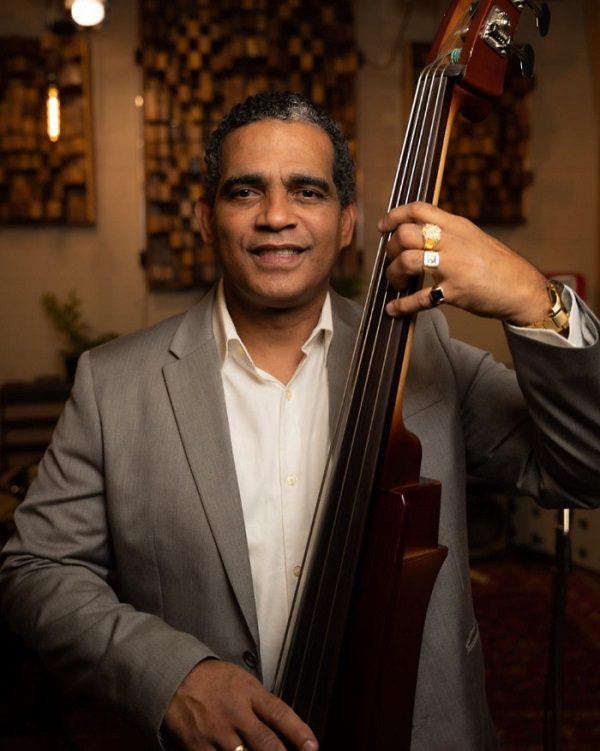
Julio Avila, musical director of Julio Avila Cuban Band

Life for Julio in Guantanamo, Cuba  

Contrary to the answer we might expect, Julio told us that making music in Cuba at that time was not difficult, as life was not so expensive and the economic crisis was not as severe as it is now.   

In his particular case, things were easier because his mother worked in a radio station and his father was a professional musician and the musical director of the popular music group Por Nuestros Campos for many years until he sadly passed away. It was undeniable that art ran through his veins. 

His sister Isabelita was also involved in popular music for many years and was even awarded on several occasions at the local Eduardo Saborit Festival. Today she is retired, but she was very successful locally at the time.   

Because all the brothers had a penchant for music, they decided to create a group called Los Hermanos Avila until they all went their separate ways and dedicated themselves to their own professions.   

Julio considers that today they would not have been able to devote to this branch of the arts due to the political and economic situation that the island is enduring, and he is thankful that it was not so. 

According to his words, the money was enough to buy the instruments in those times, but things become so complicated that developing an artistic career in the Caribbean country is much more difficult.  

All the members
All the band members with their instruments

Changüí 

Although he says he has played changüí because of his Guantanamo origins, he was never in a group that based its music on this traditional Cuban dance, as the artist has always liked popular music and salsa.   

”Changüí is a genre born in the province of Guantánamo that did not get much popularity, but today, it is impressive the large number of young people who play this dance, since they got a taste for it. In spite of all the years after it was created, there are guys who do not let it die, which makes me very happy” said Julio on this issue. 

When we wanted to know why he thinks that these young musicians have opted for this genre and not for other more modern ones such as trap or reggaeton, he replied that the latter two sound a lot in Cuba, but there have been music teachers and schools that have not let changüí die. They continue to teach it to their students and promote it whenever they can. 

In addition, there are always groups interested in preserving it in time and uniting it with son and other traditional Cuban genres. They even add flutes and violins, which were not present in the original changüí, in order to give it a unique and modern touch.  

Academic background 

Julio started playing the guitar being a child of five years old, as he had always seen his parents and older brothers involved in everything that had to do with music. Therefore, it all started in a very natural way and basically on instinct. It was later that both he and his siblings decided to educate themselves in order to become more complete professionals. 

In Guantánamo itself, he studied at a music school to become a bassist and began working fully on popular music, which had always been to his liking. 

With all that gained knowledge, he decided to move to the city of Havana, to get involved in other projects there and to compose his own material.   

Since he was 16, he earned a living as a bassist in a popular music group, which activity he alternated with his secondary education. It can be said that this is the formal beginning of Julio’s musical career. 

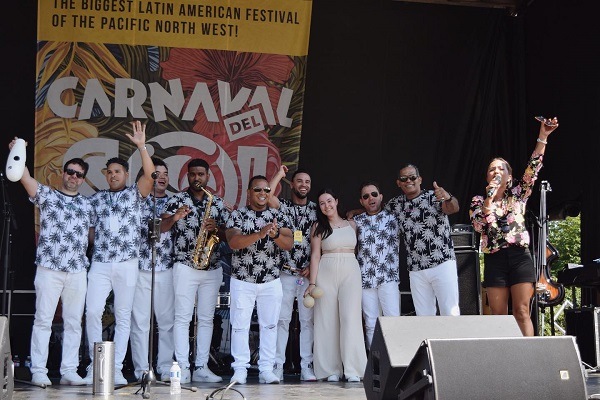
Julio Avila Cuban Band performing
Julio Avila Cuban Band performing at The Carnaval Del Sol in July 2023

Sonora Universal and Brisas Del Palmar 

Before forming his own orchestra, Julio worked with La Sonora Universal and Brisas Del Palmar, which were his first opportunities to shine in the music world.   

When the artist was working in a quintet, a trio from the city of Santiago (Brisas Del Palmar) went to a music festival in Guantanamo and thet had the opportunity to meet in a club in 1999. ‘’The musical director of the trio saw us playing and liked the way I played the bass. He told me about the possibility of playing with them, but it did not happen until 2001 when I went to Havana and we met by chance,” Julio said. 

After having some time worked with the trio, this musical director met the talented tresista Cesar Echevarría, director of Sonora Universal, who needed a bassist because his stayed in Germany. It was then that he told him about Julio and asked him to see him play, which led them to meet and start working together. 

Within a few weeks, Julio was already traveling to Europe with Cesar to tour Germany, Denmark, Holland, Austria and Czechoslovakia. This trip is the one that began to open new doors for him and make him develop as an artist. 

Definitive departure from Cuba 

When Julio had some time with La Sonora Universal, the director of Brisas Del Mar again asked him to join the group for a tour of Canada in 2005. When he was included, the group went from being a trio to a quartet.   

Receptivity from Canadian businessmen was so good that he decided to stay with Brisas Del Palmar permanently until he decided to move from Cuba in 2014 due to the situation which the island was going through. 

The latter coincided with the beginning of his love relationship with the Serbian citizen Natasha Marjanovic, who today is his wife, manager of his orchestra and a great life support. It was she who convinced him to stay in Vancouver, a decision he says it was the right one. 

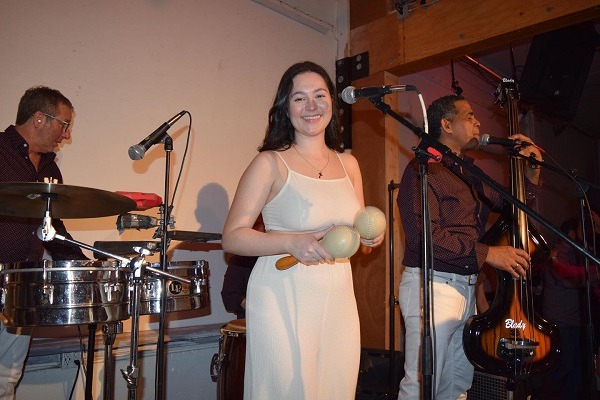
Singer of Julio Avila Cuban Band
Singer of Julio Avila Cuban Band Isidora Bosanovic

Beginnings of Julio Avila Cuban Band 

It all started when Julio needed a pianist for Brisas Del Mar and hired Ernesto Benitez, who, once in Canada, told him that he was not going back to Cuba. That is when he saw the opportunity to start creating his own orchestra from himself and this musician. 

The next to be included was percussionist Norman García, with whom Julio and Ernesto formed a trio and began performing at festivals until Isidora Bosanovic, singer and his wife Natasha’s niece, arrived. Her case is very particular because she did not speak Spanish, but she learned it so she could sing in the orchestra. Today, she speaks and sings in Spanish very well. 

Finally, the band included Denis Barzaga, another musician originating from Guantánamo, who currently lives in Spain, but when required, travels to Canada to play with the orchestra in Vancouver.   

Recently, kettle – drum player Julio Paredes was included to replace Barzaga, who was unable to travel for the time being.  

Read also: Puerto Rican singer and talented sonero Charlie Maldonado 

Eddie Ortiz & Son Caribe here in ISM

Eddie and his story 

Latin talent has expanded all over the world to the point that there is a significant presence of these groups in Hawaii. Today we have talked to Eddie Ortiz, one of its leaders, who tells us his interesting story. 

Eddie Ortiz, a New Yorker of Puerto Rican descent, began his journey through music when still a child, which led him to become the musical director of one of the main Latin orchestras in Honolulu.  

The following are the most salient aspects of his life and musical career.   

Eddie and his trumpet
Eddie Ortiz with his trumpet

The Armed Forces and moving to Hawaii   

Eddie’s first contact with music was in school, when he began taking trumpet lessons for a few years until he moved with his family to Tampa, Florida, where his life would change radically.   

While there, he joined the Navy and served for more than 20 years, time in which the artist took the opportunity to join the Marine band and hone his skills as a musician. 

It was in those years he served as a trumpet player and played for several military bands being in the armed forces.   

During his military career, he was forced to visit many countries and Hawaii was his last stop. About three years before retiring, he decided to create Eddie Ortiz & Son Caribe, a group he still plays with today.    

As for Hawaii, he liked the place, the weather and the people so much that he did not want to return to the United States. That was over 27 years in total. He still thinks it was the best decision he could have made personally and professionally.    

Eddie Ortiz & Son Caribe 

Something very interesting about Eddie Ortiz & Son Caribe is that they play Latin music, but most of the members are not Latino. The group has people from Japan, China, Portugal and Hawaii. In fact, some of them were with Eddie in the navy and, today, support him in this great project.   

A very particular case is that of Cynthia Romero, the band’s vocalist, who was born in Manila, Philippines, and speaks six languages, but Spanish is not one of them. However, she is perfectly capable of singing in that language without any problem, since she practices a lot the songs at the phonic level to avoid mistakes.   

Whenever there are original songs, Cynthia usually asks Eddie what a song is about and he explains it to her in detail so she can perform it and live out it properly. She also takes the trouble to translate all the content and learn it to avoid any failure in the studio or on stage.    

In the case of the genres, a different level of preparation for each one is always required, so Eddie and Cynthia always rehearse alone at first, while the musicians prepare themselves separately. It is then that they all join together to see how the band sounds as a whole.    

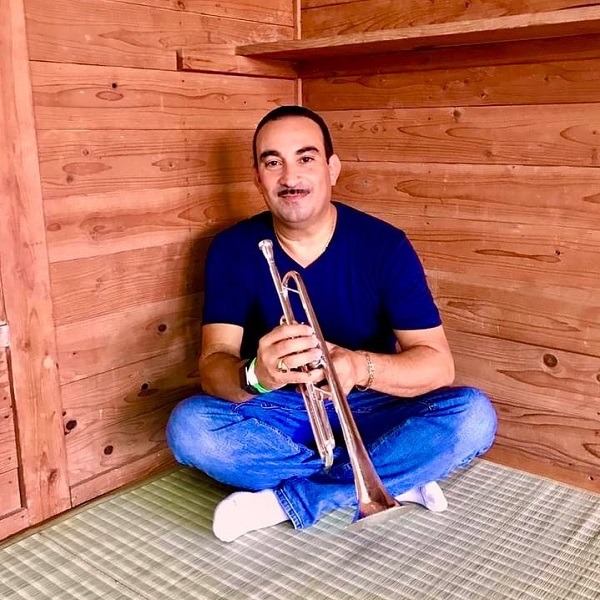
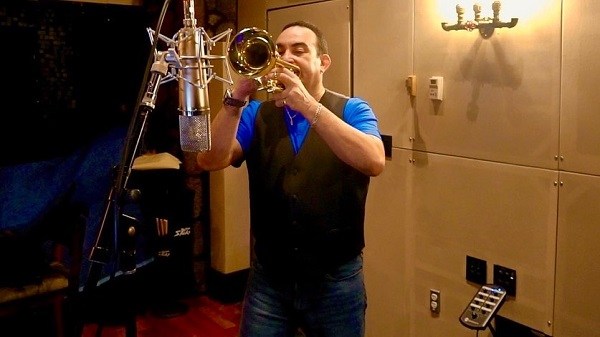
Eddie in a studio
Eddie Ortiz playing his trumpet in a studio

Learning from other artists on stage 

The members of Eddie Ortiz & Son Caribe have had the opportunity to share the stage with Ismael Miranda, Celia Cruz, Johnny Polanco, Tito Puente Jr, Luisito Rosario, and many more. When asked what he and his musicians have learned from these great artists, Eddie replied that the opportunity to accompany these personalities and open their shows have been a blessing and an immense honor.   

”Each one of these artists has a very unique style and, whenever we accompany one of them, there are always new things to learn in order to be able to interpret those styles in the future. All of these things that we see in others are incorporated into our own music as we see fit” said Eddie.   

The media’s role in his career   

With respect to the media, Eddie Ortiz & Son Caribe has had a presence in various magazines and channels such as Honolulu Magazine, KS TV, 88 Tee, University of Hawaii Sports Television, among others.    

Eddie said they did not expect this media exposure, but it has been very well received. They have been asked to make music for one or two radio stations or channels, which has given them the opportunity to demonstrate their talent and be known among a wider audience.   

The best thing is that this gave them the opportunity to explore other genres, as the aforementioned media have asked for pop, traditional Hawaiian music and other genres requested at that time.    

Original music and covers 

Eddie also told us that his band usually performs live on various entertainment places about four times a week, so they should try to have a repertoire as different as possible every night so as not to bore the audience. 

Regarding covers, there are always certain songs that people usually ask for, so the band always takes them into account to satisfy those attending. 

They also try to make a balance of all the genres they play such as salsa, bachata, merengue, cha cha chá, cumbia, Latin pop and many more.   

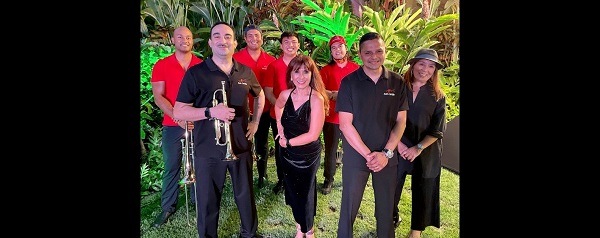
Eddie and his band
This is Eddie Ortiz & Son Caribe, the whole band

Tours 

Although the band’s strength is in Hawaii, their audience is not centred on the island and they have also managed to tour Asian countries such as Japan, Korea and the Philippines. In those places, the reception of the public towards Eddie Ortiz & Son Caribe has been phenomenal because there are many lovers of Latin music and culture in general there.   

Because of this, these countries usually have relatively large salsa events and festivals where they always take this band and other groups of this kind into account. Of course, they are also supported by dancers and DJs in order to liven up the atmosphere even more.   

Eddie remembers attending an event called ”Isla De Salsa”, which featured El Gran Combo De Puerto Rico, Juan Luis Guerra, Havana De Cuba and many others. This shows how much Latin music is valued in those places and the large number of followers it gathered. 

To end the conversation, Eddie pointed out that they have a large audience in Colombia, Ecuador and Mexico, so they also have plans and are making the appropriate arrangements to go there soon and meet their fans. They will also perform an anniversary concert to celebrate the 25th anniversary of the foundation of the orchestra and will have Luisito Rosario as a guest. 

Read also: Jimmy Rodríguez ”El Salsero Mexicano” talked to ISM about his career 

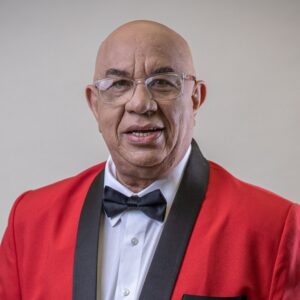
Argenis Carruyo is known in the music scene as “El Volcán de América” (The Volcano of America) due to the power of his voice

Carruyo He was born in Maracaibo on August 22, 1953 at the Chiquinquira Hospital in Maracaibo, located in the same sector where he grew up.

Argenis Carruyo he had the good fortune of being a neighbor of Los Blanco, who 12 years after his birth hired him as an instrument picker, an experience that served to awaken in him the love for music, a feeling that was nurtured when he discovered in him an unmistakable talent to make singing his life support.

“The Volcano of America” because the power of his voice makes the senses of those who have the opportunity to listen to him rumble; so sings Argenis Carruyo, from Zulia, who from a very young age began to demonstrate the vocal quality that characterizes him.

Argenis Carruyo is known in the music scene as "El Volcán de América" (The Volcano of America) due to the power of his voice
Argenis Carruyo is known in the music scene as “El Volcán de América” (The Volcano of America) due to the power of his voice

He has stood out as an interpreter of the gaita zuliana and during the 1970s and 1980s belonged to the Dimensión Latina.

The 80’s was a very busy decade for this multifaceted character; he sang with Orlando y su Combo, and did a duet with Ender Carruyo in the orchestra “Los Hermanos Carruyo” and then again with the Super Combo Los Tropicales, until 1985 when he decided to found his own group called “Argenis Carruyo y su Orquesta”.

He began his musical career with the youth group Los Larkings. Later, he was part of Los Juglares and Los Casinos.

In 1973, he joined the ranks of Súper Combo Los Tropicales and in 1977 he was recruited by Dimensión Latina, with whom he sang until 1981. Later he joined the group Los Melódicos.

During the 1980s he had an intense artistic activity in which he sang with Orlando y su Combo, duetted with Ender Carruyo in the orchestra Los Hermanos Carruyo, worked again with the Súper Combo Los Tropicales and, in 1985, formed his own group: Argenis Carruyo y su Orquesta.

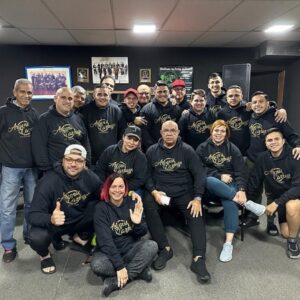
Argenis Carruyo and his Orchestra

Sabor a Gaita:

Apart from his work with rhythms such as guaracha and salsa, Carruyo has also performed the gaita zuliana.

The Volcano of America has not only stood out among the great interpreters of the Caribbean for playing rhythms such as the guaracha, he has also honored his land by making famous great gaita compositions.

During his time in the genre he worked with groups such as El Número Uno, Rincón Morales, Guaco, Los Morillo and Gaiteros de Pillopo.

He owes part of his fame to the gaita, because the Zulian melody accompanied him on stages and still accompanies him in his veins as it does to anyone who appreciates being a worthy Maracaibero.

During his artistic life he has received numerous recognitions, as well as the publication of a book with his biography.

In 1975 he won the Festival de Cantantes y Compositores Zulianos and has received the Mara de Oro (1993, 1994, 1995) and Gran Cacique de Oro awards as best singer, the Gran Aguila de Venezuela as best singer and dance orchestra (1995, 1996, 1997, 1998, 1999, 2001), and the Catatumbo de Oro as best popular singer (1993) among others.

"The Volcano of America"
“The Volcano of America”

His orchestra received the Orden Ciudad de Maracaibo in its first class as best dance group.

He has performed in the most important nightclubs in Maracaibo, the country and abroad, alternating with the most recognized figures of the song, which is why he is considered one of the most genuine interpreters of tropical Caribbean genres in the Zulian region, such as salsa, guaracha, cumbia, merengue and bolero.

With a prolific career of more than twenty-five years that has served to demonstrate his talents as a vocalist and his own characteristic style, which gives him his most authentic identity.

Argenis Carruyo, with pride from Maracaibo, proclaims that he owes to Zulia the success and fortune that always accompanied him since he discovered the enormous talent he carried in his blood, his homeland became his main fan, to Maracaibo he owes his life and to its inhabitants the affection and the memory that will always keep him alive through his songs.

For 2023 Argenis was specially invited to participate in the excellent group Quintero’s Salsa Project – Tributo A La Dimension Latina directed by New York based percussionists Luisito Quintero and Robert Quintero.

Luisito Quintero grew up in the Latin and African percussion tradition. His father is as percussive as his uncle Carlos Nene Quintero and cousin Roberto Quintero. He became a member of the Venezuelan Symphony Orchestra, but soon joined ensembles such as Grupo Guaco and El Trabuco Venezolano and toured with Oscar D’León.

He then moved to New York, where he met Latin jazz musicians like Willie Colon, Eddie Palmieri, Tito Puente and Celia Cruz worked. He then turned to the fusion of jazz, funk, salsa and African music and played with George Benson, Herbie Hancock, Ravi Coltrane and Toshiko Akiyoshi, but also with pop musicians such as Gloria Estefan and Marc Anthony. Louie Vega produced his first album with him.

Quintero’s Salsa Project – Tribute To The Latin Dimension

Tracks: Ya Tu Lo Véras; Sin Tu Cariño; Cara de Guabina; Sigue Tu Camino; Irimo; Dulce Cantar; De Quintero a Dimensión; Ahi Nama; Te Conocí; Parampampam; Arroz Con Manteca; Frutas del Caney.

Musicians: Argenis Carruyo; Jimmy Bosch; Marcial Istúriz; Roberto Quintero, Luisito Quintero.

Record labels in which Argenis Carruyo has participated.

Top-Hit (TH), Maracaibo Record’s, Argenis Carruyo, Discos VRZ, SonoVen Records, L. G. Record’s C. A; iMusician | EDGARSARMIENTO, Palacio, among others.

Argenis Carruyo y Dj. Augusto Felibertt

Sources:

La Buena Musica: Argenis Carruyo

La Salsa es mi vida: Quintero´s Salsa Project – Tributo A La Dimension Latina

Also Read: Víctor Porfirio Baloa Díaz, more commonly known as Porfi Baloa

  • « Go to Previous Page
  • Page 1
  • Interim pages omitted …
  • Page 33
  • Page 34
  • Page 35
  • Page 36
  • Page 37
  • Interim pages omitted …
  • Page 62
  • Go to Next Page »

International Salsa Magazine (ISM) is a monthly publication about Salsa activities around the world, that has been publishing since 2007. It is a world network of volunteers coordinated by ISM Magazine. We are working to strengthen all the events by working together.