• Skip to primary navigation
  • Skip to main content

International Salsa Magazine

  • HOME
  • Previous editions
    • 2026
      • ISM / April 2026
      • ISM / March 2026
      • ISM / February 2026
      • ISM / January 2026
    • 2025
      • ISM / December 2025
      • ISM / November 2025
      • ISM / October 2025
      • ISM / September 2025
      • ISM / August 2025
      • ISM / July 2025
      • ISM / June 2025
      • ISM / May2025
      • ISM / April 2025
      • ISM / March 2025
      • ISM / February 2025
      • ISM / January 2025
    • 2024
      • ISM / December 2024
      • ISM / November 2024
      • ISM / October 2024
      • ISM / September 2024
      • ISM / August 2024
      • ISM / July 2024
      • ISM / June 2024
      • ISM / May 2024
      • ISM / April 2024
      • ISM / March 2024
      • ISM / February 2024
      • ISM / January 2024
    • 2023
      • ISM / December 2023
      • ISM / November 2023
      • ISM / October 2023
      • ISM – September 2023
      • ISM – August 2023
      • ISM July 2023
      • ISM Edition June 2023
      • ISM – May 2023
      • ISM April 2023
      • ISM March 2023
      • ISM February 2023
      • ISM January 2023
    • 2022
      • ISM December 2022
      • ISM November 2022
      • ISM October 2022
      • ISM September 2022
      • ISM August 2022
      • ISM July 2022
      • ISM June 2022
      • ISM May 2022
      • ISM February 2022
      • ISM January 2022
    • 2021
      • ISM December 2021
      • ISM November 2021
      • ISM October – 2021
      • ISM September 2021
      • ISM August 2021
      • ISM July 2021
      • ISM May 2021
      • ISM April 2021
      • ISM June 2021
      • ISM March 2021
      • ISM February 2021
      • ISM January 2021
    • 2020
      • ISM December 2020
      • ISM November 2020
      • ISM October 2020
      • ISM September 2020
      • ISM August 2020
      • ISM July 2020
      • ISM June 2020
      • ISM May 2020
      • ISM April 2020
      • ISM March 2020
      • ISM February 2020
      • ISM January 2020
    • 2019
      • ISM December 2019
      • ISM November 2019
      • ISM October 2019
      • ISM Septembre 2019
      • ISM August 2019
      • ISM July 2019
      • ISM June 2019
  • Spanish
  • Download Salsa App
    • Android
    • Apple

Search Results for: Latin genres

Chantel Collado: a Canadian star of Latin descent

La Princesa de La Bachata

I am talking today with La Princesa de La Bachata Chantel Collado (https://www.facebook.com/chantelcolladoficial), who is an immensely talented artist. I understand she is a resident of Canada and is of Dominican descent. Thank you so much for accepting our invitation, Chantel. We learned that you are in Italy at the moment, what are you doing there?

First of all, thank you for the invitation. The pleasure is mine. Certainly, I grew up in Canada, but I’m on tour around Italy and pleased to bring my music to this beautiful country.

Chantel Collado was born in Canada, but her parents are Latino

Wonderful! How has reception towards your music in Italy?

It was amazing! Actually,I’m proud to see how both Italians and foreigners dance to bachata and enjoy it. Bringing this music to a country like Italy makes me very proud. It is a blessing to be able to travel, come, sing my lyrics and see how the audience loves them.

The nickname people you are given caught my attention. Where does La Princesa de La Bachata come from?

People give me that name when I went to London to give a concert. In view of the lack of women in the genre, I think it was easy for the public to call me that. For me, it’s a great honour for me to represent the genre, being a woman and a Dominican, since there aren’t many women who sing bachata.

Precisely because there weren’t a lot of women in the genre, did you feel a strong competition? Did you feel like you weren’t taken seriously?

Being a woman can complicate a few things. Thank goddness, men in the genre have also given me the opportunity and supported me, such as my musical godfather Frank Reyes, who is someone I admire. He is a bachata icon in the Dominican Republic and an example of a man who has supported me in my career. I had the opportunity to record a song and a music video with him.

I have received a lot of support from my colleagues and I am very happy to receive that support.

Who have been your musical references in and out of bachata?

I really like Romeo Santo, The King of Bachata. I grew up listening to exponents of Dominican bachata like Frank Reyes, Luis Vargas, Hector Acosta and Juan Luis Guerra. Outside of bachata, I have always liked Beyonce because of her stage presence. Regarding artists in this generation, I also really like Karol G.

Chantel Collado on stage

Have you experimented with urban or more modern rhythms?

Of course! I love to experiment and change from time to time. From a very early age, when I started singing in a competition in Los Angeles, I sang a cumbia by Selena titled Como La Flor. I have an urban song called Así. I’ve also sung salsa and I have merengues. What I like most is bachata, but for my generation, I listen to much urban music.

According to your biography, you decided to pursue a career in music after a talk you with your father, who also supported you very much in this regard. Can you describe that moment?

I grew up watching my father on stage as a director, musician and singer. From a very early age, I went on stage and sang with him. My brother is also a musician, so I think it just was natural for me. I didn’t know it’d like it or take it seriously as a career, but it was when I turned 15 that we decided to focus on music.

I was also performing and participating in musical theater, so I was singing, performing and dancing at the same time. When I turned 15, we decided as a family to focus on only one thing, which would be music. That’s how I started writing songs with my brother and we’ve been going at it for the last 14 years.

Latin descent

Your father is Dominican and your mother is Uruguayan. Do you think that coming from a Latin family has pigeonholed you or on the contrary?

Quite the opposite! It expanded my horizons. I grew up in Canada, speak English and, try to incorporate this language into my music. I’m of Uruguayan stock and even if people don’t listen to bachata in that country, I chose that genre because I listened to it all the time and I love it. I think that all this mix of countries expanded my horizons and I don’t feel that singing bachata is an obligation for me because I love doing it.

Her father and brother supported her a lot during her career

What did you do during the pandemic?

The pandemic was very difficult for me and all the artists in general, but I tried to focus on writing new music. I don’t know where I got the inspiration, but I recorded a music video with my mobile, which was made for my song Contigo o sin ti that you can find on YouTube. I did my own makeup and my own hairstyle for that day, put my IPhone on a tripod and got it all. I had to find thae encouragement to move regardless the situation.

Fortunately, I returned to the stage to sing for the public after two years.

In which countries are you touring now?

I am touring only in Italy. We’ve already been to two cities and we have two more to go to complete the tour. Then I will return to Canada, rest for a week and travel to the United States to continue touring.

Do you plan to tour Latin America?

I’ll be happy to do so. In fact, we already have some tentative dates in countries such as Colombia and Mexico. Let’s just hope that everything will happen because it would be the first time I brought my music to those corners.

How is urban bachata different from traditional bachata?

I think urban bachata is a movement that is starting to develop. My generation listens to a lot of urban music and an example of this is Bad Bunny, who is killin’ it right now. If we want bachata to evolve a little bit, we have to add a little urban touch and that’s what we’re doing. I think traditional music will never die because it is our main genre in the Dominican Republic, but it can also be made enjoyable for present generations, adding a little urban touch.

Speaking of urban artists, who do you want to collaborate with someday?

At the moment, I would love to collaborate with Bad Bunny. I love Bad Bunny and his new album. I had the great honor of opening for him in Toronto, Montreal, a few years ago. I also had the honor of meeting him, but I haven’t had the chance to collaborate with him yet, though I would love to.

As for traditional genres, I would like to collaborate with Anthony Santos on a more traditional song in my genre, bachata.

A message for young girls who want to dedicate themselves to the same as you.

I’d advise them to follow their dreams. I started in the music industry at a very young age I have achieved many things in the last 10 years. As a woman, I’d tell them to keep going because we are living in a time when women have more attention than ever before. We’re strong, independent and we can do anything we want.

Chantel at a photo shoot


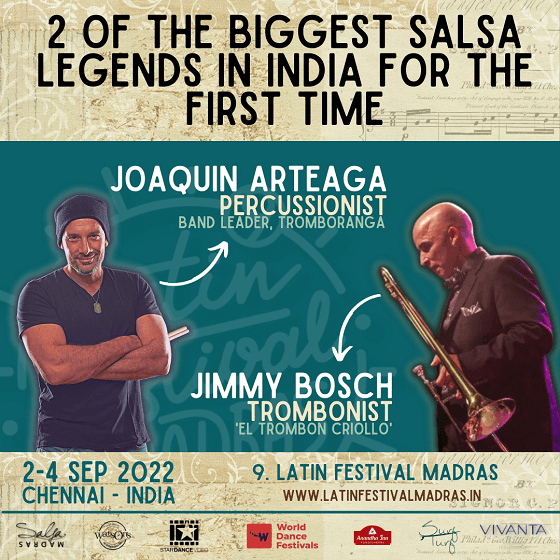
In September: Latin Festival Madras In Their Ninth Edition

The Oldest Latino Festival In India Returns With More Salsa Immersion

Latin Festival Madras started in 2014 and is the only one of its style in Chennai

The largest and oldest ten-day Latin gathering in Chennai (India) will bring the Maestro Jimmy Bosch “El Trombonista Criollo” and one of the best timbaleros in Europe today, Joaquín Arteaga live at the five-star hotel, Vivanta Chennai It Expressway located at 309, Old Mahabalipuram Road, Shollinganallur Chennai, Tamil Nadu, India 600119.

In this ninth edition of the festival, you will also find carefully designed Salsa, Bachata, and Kizomba workshops, special training camps with instructors with more than a decade of teaching experience at festivals around the world, performances by national and international dancers (Korea, Japan, Malaysia, Canada, Vietnam, China, and Russia) acclaimed worldwide, also social dancing in the company of the seven best DJs from Asia, pool party, theme parties, surfing, buffet lunches, and dinners with a luxury stay that characterizes this event as the only one of its kind in Madras, currently known as the Chennai city, capital of the Tamil Nadu state.

Friday, September 2nd will be the opening of the Latin Festival Madras https://www.latinfestivalmadras.in/ at Surf Turf beach, where you can dance all day long with delicious local food, and if you prefer a little more excitement you can surf in the Bay of Bengal with your fellow dancers. But, if you don’t know this sports discipline, don’t worry because there will be instructors on-site to perform this water sport with the correct technique.

7 DJs will participate in this Latin event from Malaysia, Japan, Canada, Thailand, and India.

On Saturday, September 3rd, and Sunday, September 4th, all the activities (workshops, camps, shows, and parties) will take place at the Taj Vivanta hotel, a five-star venue to have a luxurious, memorable, and family experience.

Two of the peculiarities of this Festival are the parties before to the Latin event (August 29th – September 1st) and the getaway after the closing of the festival (September 5th – September 6th). The event’s organizers have planned to visit Pondicherry through Mahabalipuram for two days, the latter place a UNESCO World Heritage Site.

In Pondicherry they will be able to taste the typical dishes, dance, and do a guided exploration of the ruins and historical sites of the town.

On the second day, you will explore the old Franco-Tamil city. During the day they will visit the old Auroville community located 10 km from Pondicherry and during the night they will dance at the pool party at Anandha Inn Convention Center and Suites. And on Wednesday, September 7th, will be the big farewell to Chennai.

But, before leaving the city of Chennai, we must talk about the live music that will be present at this Latin event in India. The greatest exponents of the Trombone and the Timbal will say here, the maestro Jimmy Bosch and the creator of the hard Salsa orchestra Tromboranga, Joaquín Arteaga.

The objective of this festival is to provide a memorable experience and exposure to the educational value for future talents, artists, and instructors.

Jimmy Bosch is an exceptional Latin Music Trombonist acclaimed in more than 70 countries and has 11 Grammy Awards and more than 100 recordings in the Salsa and Latin Jazz genres. “El Trombonista Criollo” has worked with the FANIA All-stars, Eddie Palmieri, Ruben Blades, Ray Barretto, Machito, Cachao, and more. He has participated in Salsa conventions and Latin and Jazz music festivals around the world, as well as performed in clubs in Asia, Europe, America, and Oceania.

On the other hand, the second artist to perform on this special evening is the Leader, Director, and Timbalero of the Tromboranga salsa orchestra, Joaquín Arteaga. This Venezuelan timbalero based in Barcelona (Spain) has been part of the Gerardo Rosales Orchestra (2004) and has toured Europe accompanying international artists such as Andy Montañez, Andrés Cepeda, Jhon Lozano, Venezuelan Masters Orchestra, and Bloque 53, among many others.

Since 2009 he has been a sponsor of the prestigious Latin Percussion LP brand. Joaquín has produced and recorded nine albums for Tromboranga and has toured extensively throughout Latin America, North America, Europe, Australia, and Asia. This Venezuelan composer has also organized and taught salsa percussion workshops in Spain, Japan, Australia, Colombia, the USA, France, the UK, Morocco, Lebanon, Thailand, and South Africa, among many other countries.

The Full Passes for the event are USD 140 (travel to Pondicherry and Mahabalipuram is not included). The online sale ends on August 31st, and the prices of the passes increase every two months.

Get Through March With Latin Atmosphere And Sound

France is ready to enjoy Latin events during the third month of the year

Covid-19 and its multiple variants have already ceased in France and that is why this European country is ready to start enjoying Latin events during this third month of the year. So don’t miss the details of each of the Latin parties that we bring this month dedicated especially to you.

Mulatason & Alfredo Buendía Y Los Picaflores

(Salsa / Mambo)

The 5 Mulatason singers dressed in white
This event will comply with current health measures.

Join and enjoy the end of this winter in the country with the Latin concert of the female group Mulatason and the band with the singular joy of Mambo Alfredo Buendía y Los Picaflores, this Saturday, March 5th at 9 PM at 3 Rue Ferdinand Buisson, 82000 Montauban, France Association Le Rio. Try to pre-sale tickets for € 20 because the price at the door will be € 24 per person.

And for those who still don’t know Mulatason, here I make a summary of their history. This orchestra formed in September 2013 by its director Yarelis Martínez Chávez is made up of five women with harmonious voices, and their music is a mixture of dance rhythms that range from Salsa through Timba and ending with the traditional melodies of the island of Cuba. Their popular and peculiar choreography called “Rikiti” has been their hallmark that they have managed to spread across large national and international stages.

The orchestra is made up of nine talented artists residing in Havana (Cuba) who graduated from higher art schools. Each member of the band is no older than 25 years old and they have a repertoire of original compositions.

Mulatason “Las Princesas de la Salsa” returns to Europe to present their new album No Vale Rendirse celebrating almost nine years in the art scene.

The 7 members of Alfredo Buendía and the Picaflores dressed in blue and black card
Seven musicians with a good dose of humor and passion for Afro-Latin music and Jazz make up the Mambo band, Alfredo Buendía y Los Picaflores

On the other hand, and for those who have not heard before about Alfredo Buendía y Los Picaflores, below I will tell you a little about them. This project of seven musicians was born on an afternoon in December 2016 in order to have fun on stage, make a type of music that injects energy into the audience, and transports joy and light madness to the spirit.

Alfredo Buendía (Lead Vocals – Trumpet 2) was returning from three years as a Jazz crooner in Rio de Janeiro (Brazil), he wanted to bring something new, interesting, and different to the artistic scene in France since he had become accustomed to the type of show that it’s made in America. Also, he wanted to play rhythmic and deliberately festive music like the one he had been listening to for a long time-El Mambo by Pérez Prado-with its history from Cuba in the 1950s to Mexico.

This bewitching goal materialized with Pierre Levy (Tenor Saxophone), Jonas Chirouze (Drums), Clément Lefèvre (Trumpet), Hugo Lebeau (Congas), Guillaume Pique (Trombone), Youssef Ghazzal (Double Bass), and Alfredo Buendía managing to create El Mambo a novel concept between Afro-Latin music and jazz little explored on the French scene.

Le Balajo

(Salsa / Bachata)

Le Balajo Salsa Class Flyer in France
Le Balajo is located at 9 Rue de Lappe, 75011 Paris, France

Le Balajo nightclub open since 1936 brings Salsa and Bachata classes every Tuesday from 7:30 PM to 2 AM for beginners and intermediate level dancers. Salsa lessons for amateurs start at 7:30 PM while intermediate level classes begin at 8:30 PM followed by a Latin party hosted by DJ Karim until 2 AM.

Remember that to access the club you must present a Vaccination Certificate (Required) and an identity document.

The fees to attend this weekly event of joy and good humor are €8 and include non-alcoholic drinks and €12 if the drink is alcoholic, but if you just want to enjoy the bar and its atmosphere, the admission is €5.

La Pachanga

(Salsa)

Colorful flyer of La Pachanga club in France
On the dance floor of La Pachanga, you can dance to the rhythm of Salsa, Bachata, Merengue, and Kizomba

The Bar/Restaurant/Club La Pachanga is a place of reference for Salsa lovers, it is located in Paris at 8, rue Vandamme 75014. This club is designed with a cozy and Caribbean style. At the bar, you can enjoy different types of cocktails, Mojitos, Caipirinha, or Cuba Libre, just as they offer only Latin American dishes at the restaurant.

At Pachanga, you can attend classes for beginner and intermediate levels from Tuesday to Saturday from 7:30 PM to 8:30 PM with different instructors who will make you live an hour of Salsa Cubana and Salsa Puertorriqueña dance.

Latin Music Bonus In France

Dancing couple dressed in black
The Latin Party at Bar Le 3 is back

On Friday, March 18th, you can enjoy the Soireé Mix Latino “La Calle” event from 4 PM to 9 PM at Bar Le 3 located at the French city and commune Valence at 4 rue André Lacroix. This bar has a tropical atmosphere with living rooms with sofas and armchairs as well as a cozy and warm decoration. It also has a selection of 30 cocktails and a permanent musical atmosphere with a selected playlist of Jazz and other genres.

And the last Latin Music Bonus in France that I bring you for this edition is the Fiesta Latina Metz to be held on Friday, March 26th. This festival will offer you two workshops (Salsa and Bachata), in addition to having fun with the rhythm of Cuban Salsa, Dominican Bachata, Sensual Bachata, Kizomba, and other Caribbean melodies. There will be big parties with DJ Will, DJ Papy Culio, and DJ Kylian starting at 9 PM and ending with seven shows from 11 PM to 3 AM. Fiesta Latina Metz will have three rooms (Salsa/ Bachata/ Kizomba) and the prices to attend vary by combo: one workshop + evening: €12, while two workshops + evening: €20, and if you just want to attend to enjoy the shows the ticket has a value of €7. Fiesta Latina Metz will take place at the Quai Sablon Social and Cultural Center at 1 bis rue Castelnau 57000 Metz.

You Can Also Read: Enjoy 4 Latin Events In Prague

Not-so-well-known Latin percussion instruments

Some lesser-known percussion instruments

After so many centuries of history, Latin music has undergone any number of transformations and mixes that have made it into the wonder that it is today. In the result, percussion instruments play a critical role and many of them are widely known by fans of Latin rhythms, including those who do not have a great deal of expertise on the issue. The thing is that many of these implements are not so well known to people, so let us mention a few of them with their main characteristics.  

Arará 

The Arará drums are named after a Cuban ethnic group that is mainly based in Havana and the province of Matanzas. In turn, they descend from other ethnic groups that had similar practices and today almost all their temples are located in Matanzas. 

At present, these drums are still used in the rituals of these cults. They are of various sizes and types, but a common characteristic they share is that they are all unimenbranophone and open without exception. One of the things that most identifies them is the presence of ritual marks made to differentiate them.  

This is an arará drum
One of the many types of arará drum

Rain stick 

This percussion instrument consists of a long tube inside which you can find seeds and bamboo sticks, which form a helicoid extended throughout the whole instrument. When this stick is moved, the seeds hit its walls and the sound produced is very similar to that of the falling rain, a characteristic of which it receives its name. 

It is believed that it originated during the age of indigenous peoples in South America such as the Panatahuas, the Quitos, the Mexicas, among many others. On the other hand, it is worth noting the appearance of evidence to suggest that they may have come from pre-Inca cultures originating in the Peruvian coast and the Andes Mountain Range. 

Although the tools used in its manufacture vary from one cultural tradition to another, the most common material is cactus, whose spines must be dried, ground and reintroduced.  

This is a rain stick
A wooden rain stick


Güira 

This is a Dominican percussion instrument that is part of the idiophones. Although it has come to be popular in other places, it is in the Dominican Republic where it originated and became so famous that it is even considered as a national heritage. For many, it has a strong resemblance to the bangaño, but it is very different from this one, since it has a manufacturing process in which metal predominates. 

In these times, it is very common to see it being used as an important part of musical genres such as bachata and merengue, although it is most likely fans have no idea about its existence.  

This is a güira
Here is a güira

Marimbula 

The marimbula consists of a set of metal plates that attach to a resonance box and whose main purpose is to produce sounds. It is an idiophone instrument that holds a striking resemblance to the sanza, which originated in Africa many centuries ago and arrived to the American continent from the hand of the slaves, who already brought their own traditions from their places of origin. 

As to its current use, it serves as an accompaniment to all kinds of musical groups in their shows, whether we are talking about rural or urban environments. However, it should be noted that its use has also spread to religious ceremonies and cults of various kinds. 

This is a marimbula
A marimbula

If you want more info about this topic: The seeds of capacho give the sound to maracas

A bit of history about Latin soul and its relationship with salsa

How Latin soul was born

There are certain musical genres that, despite their short duration on the public stage, marked history to such an extent that they continue to be named and taken into account when analyzing the process experienced by Latin music in the United States. One of them is Latin soul, which is defined as a musical genre born and developed in the 1960s in New York City, such as in the case of many of the rhythms we have today. 

Latin soul was born of the mixing of Cuban mambo and some elements coming from the American version of soul and Latin jazz. Even though it was a set of rhythms that became relevant only in the aforementioned decade, it played a particularly valuable role in the salsa movement that was starting to take shape at that time. 

One of its most striking characteristics is that it places a lot of emphasis on its Afro-Cuban rhythms, but at the same time, most of its songs are in English, which reveals an extremely interesting mix of Cuban and American cultures. After to have acquired a little more specific style, it started to become popular among New York-based Latin artists, who used the emerging genre to win over communities of their respective countries and local media at the same time. 

Among the greatest exponents of Latin soul is Joe Bataan, an American of Filipino descent who is regarded as the most famous vocalist of the genre. Something that made him really different from the rest of the artists of his kind was the merger between American soul and salsa that was already sounded at that time. For this and many other reasons, Bataan is still seen as one of the greatest idols of those golden years of music. 

This is Joe Bataan
Joe Bataan “The King of Latin Soul”

Bataan, Willie Colón, and other performers represented the emergence of a generation of musicians whose formation was the street itself and the harsh experiences occurring it. At the same time, there were others who had an academic background and studies that made them play and behave otherwise. When the union between both groups took place, the result was a display of talent that is still turning heads. All those who were trained in academies and on the street joined the new oncoming wave of rhythms. 

An important detail about this is that the Latin audience in general was eager to look for artistic role models through which to reflect their daily lives. We must remember that many of these people lived in poor conditions in some of the poorest neighborhoods in the country, so many did not really identify with educated music that came from the music academies and schools. All that changed greatly after the emergence of a group of artists who wanted to have their own place in the Anglo-Saxon entertainment business. In some cases, these young people came from an origin very similar to the one that has been described. 

This led to the creation of groups and orchestras in which formal and sophisticated music training had to coexist with other styles emerging from the humblest alleys in certain Latin neighborhoods. Music had ceased to be an elitist thing and would go on to become a mixture of different flavors and colors that were gradually brought together as the decades of the ’60s and ’70s went by. 

Around this time, the figure of Monguito Santamaría (Cuban percussionist and bandleader Mongo Santamaría’s son) emerged, who would be his biggest inspiration to take the path of music. The boy studied piano and proved a great talent for leading bands, but he needed something to push his career, since the mere fact of being a legend’s son was not going to guarantee the success he longed for. This led him to be carried away by the current of Boogaloo, another nascent genre that had gained overwhelming popularity at the time. 

Here you can see Monguito Santamaría
Monguito Santamaría

From there, Monguito created his own orchestra and invites some of his schoolmates to join him, which resulted in a quite complete group in which these guys designed their own American R&B versions and sounds and an accent that made them much closer to the African-American community that loved soul and funk. This made them put aside the Latin community for a while, but that would change sooner than expected.   

Long after Monguito completed his musical studies, he and his band decided to audition for Johnny Pacheco and Jerry Masucci. Let us not forget that Santamaria and the rest of his orchestra had a typically American vision of music, but they did not put aside the Cuban heritage behind them, so they always included songs in genres from the Caribbean island. This pleased the Fania All-Stars so much that they agreed to work with the orchestra, which adapted to the exigencies of the record label without losing sight of their goal: making music for Latinos in New York. 

This is how Monguito and Bataan became the Fania artists whose repertoires were more inclined to Latin soul. In view of the great success that Mongo’s son had with his projects on the label, he continued to immerse himself in the aforementioned rhythm and to enter Boogaloo, whose popularity was at its peak at that time. 

The bad news is that there were a set of factors that did not help the musician to make history as he wanted. One of them was the birth of salsa orchestras that perfectly read the social moment that lived by the poor Latin neighborhoods of the United States, a point on which Monguito stayed in the past. He and his musicians may have been better than many other bands of their generation, but they did not know how to read the historical moment when they were in. This and his little promotion in much of Latin America made much of his legacy be buried and forgotten. 

Monguito and his musicians
Monguito Santamaría, Rene McLean (saxophone), Harvey Hargraves (trumpet), Glenn Walker (trombone), Sam Turner (congas), Ronnie Hill (timbales), José Mangual Jr. (bongos), and Andy González (bass)

Eddie Palmieri’s role in this process 

American bandleader and pianist of Puerto Rican descent Eddie Palmieri played a very important role in the process carried out by Latin music during its evolution into what we know today. The artist radically changed the way Latin music was perceived thanks to his spectacular mix of Afro-Cuban rhythms and certain touches typically of Latin jazz. 

During the heyday of Boogaloo and Latin soul, Palmieri did his best to mix the best aspects of soul and funk with these Cuban rhythms, which would in turn be united with a typical revolutionary message of those years. Thanks to all these messages captured in his lyrics, the musician’s repertoire became more and more present in acts promoted by leftist movements and his music was brought to several prisons, giving it a nuance of denunciation that was very difficult to ignore.  

In contrast to other talents of those years, the New Yorker cannot be classified as a salsa, Boogaloo or soul musician. This is because he knew how to handle all genres and combine them in a novel way for that time.   

This is Eddie
Eddie Palmieri
  • « Go to Previous Page
  • Page 1
  • Interim pages omitted …
  • Page 6
  • Page 7
  • Page 8
  • Page 9
  • Page 10
  • Interim pages omitted …
  • Page 62
  • Go to Next Page »

International Salsa Magazine (ISM) is a monthly publication about Salsa activities around the world, that has been publishing since 2007. It is a world network of volunteers coordinated by ISM Magazine. We are working to strengthen all the events by working together.