• Skip to primary navigation
  • Skip to main content

International Salsa Magazine

  • HOME
  • Previous editions
    • 2026
      • ISM / April 2026
      • ISM / March 2026
      • ISM / February 2026
      • ISM / January 2026
    • 2025
      • ISM / December 2025
      • ISM / November 2025
      • ISM / October 2025
      • ISM / September 2025
      • ISM / August 2025
      • ISM / July 2025
      • ISM / June 2025
      • ISM / May2025
      • ISM / April 2025
      • ISM / March 2025
      • ISM / February 2025
      • ISM / January 2025
    • 2024
      • ISM / December 2024
      • ISM / November 2024
      • ISM / October 2024
      • ISM / September 2024
      • ISM / August 2024
      • ISM / July 2024
      • ISM / June 2024
      • ISM / May 2024
      • ISM / April 2024
      • ISM / March 2024
      • ISM / February 2024
      • ISM / January 2024
    • 2023
      • ISM / December 2023
      • ISM / November 2023
      • ISM / October 2023
      • ISM – September 2023
      • ISM – August 2023
      • ISM July 2023
      • ISM Edition June 2023
      • ISM – May 2023
      • ISM April 2023
      • ISM March 2023
      • ISM February 2023
      • ISM January 2023
    • 2022
      • ISM December 2022
      • ISM November 2022
      • ISM October 2022
      • ISM September 2022
      • ISM August 2022
      • ISM July 2022
      • ISM June 2022
      • ISM May 2022
      • ISM February 2022
      • ISM January 2022
    • 2021
      • ISM December 2021
      • ISM November 2021
      • ISM October – 2021
      • ISM September 2021
      • ISM August 2021
      • ISM July 2021
      • ISM May 2021
      • ISM April 2021
      • ISM June 2021
      • ISM March 2021
      • ISM February 2021
      • ISM January 2021
    • 2020
      • ISM December 2020
      • ISM November 2020
      • ISM October 2020
      • ISM September 2020
      • ISM August 2020
      • ISM July 2020
      • ISM June 2020
      • ISM May 2020
      • ISM April 2020
      • ISM March 2020
      • ISM February 2020
      • ISM January 2020
    • 2019
      • ISM December 2019
      • ISM November 2019
      • ISM October 2019
      • ISM Septembre 2019
      • ISM August 2019
      • ISM July 2019
      • ISM June 2019
  • Spanish
  • Download Salsa App
    • Android
    • Apple

Search Results for: Music Awards

The decade in which Eddie Palmieri faced the Erotic or Romantic Salsa

There are leaders in all the activities that man develops in his daily life: Sports, Labor, Student, Political, Musical, even in comic strips you can see these leaders all the time, showing the way to follow and saving humanity from its natural dangers.

El Zorro with his friend Bernardo, his father Alejandro and even with Sergeant Garcia and Corporal Reyes, saved California from the clutches of El Aguila, marking the way forward for the peace and freedom of his people.

In salsa, the same thing happens; there are musicians who set themselves up as leaders who dictate the path, the routes, the itinerary and the route where salsa should go, establishing through their musical performances where others should be guided on their way to certain triumph.

For salseros in general, Eddie Palmieri represents El Zorro of the comics, the leader to follow, the paladin of salsa, only that instead of looking like Diego de la Vega in physique, he looks more like Sergeant Garcia; backed by Ismael Quintana who would be El Cabo Reyes and Barry Rogers who would be Alejandro de la Vega.

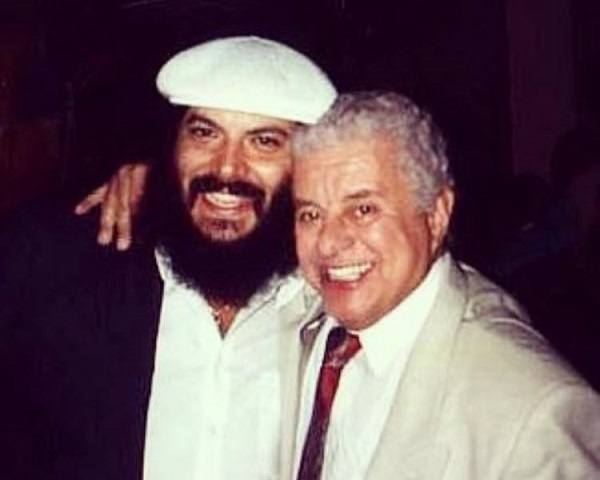
Eddie Palmieri y Dj. Augusto Felibertt

It is no secret that Eduardo Palmieri is one of the initiators of the salsa movement in New York; but more than that, this master of the piano has established the paths along which salsa has walked since the 1960s.

Eddie was one of the first musicians to use the trombone as a determining instrument in the conformation of an orchestra, giving it a preponderance never seen before and with a sharp and hurtful sound that forced a large number of musicians to follow this type of orchestration that ended up imposing itself in the so-called salsa boom.

La Perfecta determined the path to follow; they recorded anthological albums in the 60’s that were the delirium of the salsa movement lovers; many musicians began to see and hear how the tonality of this orchestra sounded different from those big bands of the 50’s; the people of the neighborhood immediately identified with this sound because, they thought, it sounded like a neighborhood, a slum, poverty, marginality, inequality, it sounded like spite, nonconformity, injustice; in short, with this sound they perceived the most expensive needs of a population marginalized from the great plans of the State that entailed advancement and progress.

The decade of the 70’s meant the explosion of a salsa boom that swept the entire Caribbean basin; orchestras came and went; they came and disappeared; they recorded and were immediately lost in anonymity, but most of these orchestras chose the musical patterns of a common denominator to carry out their musical proposals: A Crazy, Bearded and Barrigón Orate named Eddie Palmieri, as the Colombian writer José Arteaga called him.

Eddie, throughout this decade, was practically on the sidelines of the salsa boom and it could not be otherwise: Too much irreverence from a superior musician who, being clear where salsa should walk, refused to be part of all the outrages that were committed during that salsa explosion.

Too much rebelliousness from an artist who refused to be told what he should and had to record: “Nobody tells me what I have to record and how I have to record; I’m the one who knows how to make music, the label bosses can go to hell with their desks”, an angry Palmieri would say.

The record label Epic signed him in 1978, telling him that he had complete freedom to record the music he wanted: a lie. He recorded the Lp Lucumi, Macumba and Vodoo where he was practically forced to work on an album where rhythms and trends were mixed.

He took advantage of the only freedom he was given to record two legendary songs: Colombia Te Canto and Mi Congo Te Llama.

Bad management and ill-advised decisions put an end to the whole salsa movement that was born in the 70’s and the unthinkable happened for all the lovers of this tasty way of life: the whole musical scaffolding that represented the Fania label collapsed, leaving everyone with clear eyes and without sight.

Clouds of disbelief and uncertainty hung over the entire salsa movement, musicians, producers, artist managers, arrangers, record label owners and, those who were most hurt by all this, the lovers of this superb spectrum of hard and powerful salsa that was experienced in the 70s.

In the 80’s, faced with this dilemma and the perplexity of the moment, most of the orchestras took refuge in the so-called Salsa Erotica or Salsa Monga, which although it is true that it gave oxygen to salsa in general, it inflicted a death blow to salsa dura or gorda as it has been called since the 70’s.

As if that were not enough, the merengueros with: Fernandito Villalona, Jerry Legrand, Jossie Esteban y la Patrulla 15, Wilfrido Vargas, Rubby Perez, Las Chicas del Can and stop counting, colluded with salsa erotica (as El Aguila colluded with El Magistrado), to try to wipe salsa dura off the map and at any price.

At the beginning of the 80’s; under all this conglomerate of adverse circumstances; the merengueros and “salseros eroticos” making a killing and the hard salsa artists not knowing which direction to take, Líder Palmieri appeared with his stocky and ungainly figure, a huge cigar in his mouth, his madness (we are even madder) and his voice saying clearly, categorically and confidently: “Follow me, this is the road to follow”.

And so that there would be no doubt about this call against Salsa Erotica and Merengue, in 1981 he recorded the Lp “Eddie Palmieri” which, almost 30 years after its release, we are still studying and listening to it to digest what El Sapo did in these 5 memorable songs: El Día que me Quieras; Ritmo Alegre, Paginas de Mujer, No Me Hagas Sufrir and Ven Ven.

Poster salsa on all four sides, atrabiliary percussion, indescribable trombones and trumpets, legendary voices, in short, a priceless LP. By the way, a certain current of opinion maintains that salsa is nothing more than Cuban music.

Under this prism, then we would have to say that this Palmieri’s version of Carlos Gardel’s El Día que me Quieras, is a full-fledged Tango. 

Eddie Palieri 1981
Eddie Palieri 1981

In 1984 and when the “erotic” ones were widening their tentacles, Palmieri came with more fuel and that added to the bad experience lived in Venezuela with some businessmen who were determined to finish with him, musically speaking, allowed him to release the Lp “Palo Pa Rumba”, containing the pieces: 1983, Bomba de Corazón, Bajo con Tumbao, Pensando en Ti, Palo Pa Rumba and two songs dedicated to Venezuela because of the bitter and vexatious experience he had in our beloved homeland of names: Venezuela and Prohibición de Salida.

Eddie Palmieri Palo Pa' Rumba Ganador del Grammy's 1985
Eddie Palmieri Palo Pa’ Rumba Ganador del Grammy’s 1985

In 1985 the Lp “Solito” was released, a song that allowed Palmieri to tell the “eroticos” that there was a formula for arranging music that sounded strong and powerful, even if the content of the lyrics could suggest a certain shade of erotic salsa; that the trombones could sound energetic and strong without the sweetening and softness to which these hardened instruments were subjected in this decade; that it was not necessary to be bonitillo (as the Boricuas say) to succeed in this salsa environment and that, no matter what happened, he, Eddie Palmieri, was not going to be subjugated no matter how much salsa erotica the record companies demanded and played on the radio, emphasizing this statement with an abysmal piano solo.

To complete the LP: Justicia, Yo No Soy Guapo, Cada Vez que te Veo, Lindo Yambú and Pa Los Congos, round out his confrontation with “aquella” salsa.

Eddie Palmieri Solito Ganador del Grammy's 1986
Eddie Palmieri Solito Ganador del Grammy’s 1986

To top off the decade, in 1987 he recorded the Lp “La Verdad”, in which with the piece El Cuarto in the voice of Tony Vega ratified his point of view regarding “erotic” salsa; that it is not necessary to fall into pornography to say “nice things” and arrange the music with enough flavor and sandunga and that, finally, nothing would prevent him from continuing to crush his opinion based on hard and powerful salsa.

As if that were not enough, for this album he made use of a beastly orchestra made up of four trumpets, two trombones and a saxophone that left on the acetate: Conga Yambumba, La Verdad, Lisa, Noble Cruise and Buscándote.

The result of all this decade of salsa gorda music for Eddie Palmieri? Three Grammy awards and the recognition of a whole legion of hardcore salseros, who were not intimidated by the onslaught of the “erotic” and “merenguera” fashions of the moment and decided, in the face of so much sweet, effeminate and subtle trombone, to follow in the footsteps of the leader: El Zorro, sorry I made a mistake, by El Sapo Eduardo Palmieri.

Source: Larry Daniel Cabello Guzmán

Dj. Augusto Felibertt

Read Also: Bebo Valdés is considered one of the central figures of the golden age of Cuban music

Eddie Palmieri

Adrian Suarez Composer, arranger, trombonist and percussionist

Trombonist Adrian Suarez’s musical career began when he was very young at a music school.

“From the age of five they put us to study theory and solfège, and four years later I managed to get my hands on an instrument.”

However, once he was able to play an instrument, he took a break to dedicate himself to baseball. “It was at the age of 14 that an uncle took me to some Latin percussion lessons and soon after that I started with the trombone.”

On April 23, 1969, in Caracas, Venezuela, Adrian Suarez was born.

Excellent composer, arranger, trombonist, percussionist and researcher.

Bachelor of Arts (UCV-1994), he studied music, trombone and composition at the Escuela Superior José Ángel Lamas.

He also studied Afro-Caribbean percussion and Afro-Venezuelan percussion (1985-1990). He was a researcher and advisor for the foundation of ethnomusicology and folklore, fundef, between 1993 and 1995.

Adrian Suarez Composer, arranger, trombonist and percussionist

He studied composition at the Cátedra Latinoamericana de Composición Antonio Estévez, with maestro Juan Carlos Núñez from 1994 to 1996. In Germany he obtained a master’s degree in composition.

As a professional, he has collaborated with the Papel Musical Magazine (1992); he has been a researcher and advisor for the Foundation of Ethnomusicology and Folklore (FUNDEF) under the direction of Dr. Isabel Aretz; and he has worked as a documentary advisor for visual arts exhibitions.

He studied composition with Helmut Lachenmann and Marco Stroppa. In 2001 he received his master’s degree in composition from the Staatliche Hochschule für Musik und Darstellende Kunst in Stuttgart, Germany.

Since 1999 he has been a founding member of the international group of composers Aspect, based in Germany, and since 1991 of the Musikós Association in Caracas. He participated in the Latin American Composition Chair Antonio Estévez, under the direction of Juan Carlos Núñez (1994-1996).

He has received numerous awards, including the Unique Prize of the Manuel Enrique Pérez Díaz National Composition Competition (CONAC, Caracas, 1998) for his work “Soledades”, “Hommâge à Octavio Paz”, for two guitars and harp, the Municipal Music Prize (Caracas, 2002 and 2017), the National Culture Prize (2010) as well as the Prize of the Ibero-American Composition Competition for Symphonic Band Ibermúsicas-Oaxaca (2016).

El 23 de abril de 1969, en Caracas, Venezuela, nació Adrian Suarez

He has worked as author and director of musical-dramaturgical shows in Venezuela, including titles such as: “Lamas siempre” (1995), “Proyecto Música e Hipótesis Aleatorias” (1997), “Atavismos del Sol y de la luna” (2000), “Maithuna” (2009), “Watunna” (2010), “Meñé Ruwa, los dueños del canto” (2011) the first musical theater play in the continent for instrumental ensemble and two shamans and “La salsa es trombón” (2012, 2015, 2017).

He led a band integrated by a group of the best musicians of the salsa scene nationwide: Tuky Torres, on piano; Carlos Rodríguez, bass; Víctor Cardona, on timbal and bongo; Freddy Rivas, congas; Johan Muñoz, trombone; Eliel Rivero, trombone. Special guests included soneros Edgar Dolor Quijada, Reinaldo Torcat, as well as a group of batá drummers.

Creator of the Ensemble Lux Aeterna, dedicated to the interpretation of spiritual and sacred works of all times. He is also founder of the Akoustikos New Music Festival in 2009.

As a trombonist, he has cultivated popular music from all over the continent, with special emphasis on Venezuelan and Caribbean music. His work as a researcher, composer and performer has allowed him to take his work and music to several countries in the Americas, Europe, Africa and Asia.

La carrera musical de Suárez inició desde cuando era muy joven en una escuela de música

“It won’t be a master class in history,” says Venezuelan musician and composer Adrián Suárez with a chuckle; in reality it is a musical show, with hints of theater and dance, that will show the public the evolution of the trombone, and its relationship with the salsa genre from prehistoric times to contemporary times.

Adrián Suárez brings sacred sounds and turns them into music.

Suárez won the Second Iberoamerican Composition Contest for Symphonic Band Ibermúsicas, in the Mexican city of Oaxaca, with his work Aerofanía, retumbos místicos para banda sinfónica.

Salsa is trombone, Suárez assures, “It is a beautiful show that is not only educational, but also seeks to inspire the audience through the values and feelings it promotes”.

The artist and researcher’s expectation is that his audience will be completely involved with the sound and ambience: “To completely move the energy, since it is not only music to dance to, it is to sit down and listen to it carefully”.

Víctor Porfirio Baloa Díaz, more commonly known as Porfi Baloa

Adrián Suárez

Arturo “Chico” O’farrill

North America / United States / New York

Arturo “Chico” O’farrill  “The Afro-Cuban Jazz Architect” 

Arturo O'Farrill
Arturo O’Farrill

Arturo O’Farrill or better known as “Chico” O’Farrill was born in Havana (Cuba) on October 28, 1921. He was the son of a recognized Jewish family whose father was an eminent lawyer whom one day decided to immigrate to the United States. Arturo undertook his studies at the Riverside Military School in Gainesville, Georgia (interned by his father).

He began to love the jazz orchestras (big bands) and within that environment he fed musically, listening to recordings of Benny Goodman, Artie Shaw, Glenn Miller, and Tommy Dorsey, so much, that in a brief time he learned to plays the trumpet and became the trumpet player of the military band as well as the several dance groups.

Years later, Chico returned to Cuba. He studied law and at the same time developed his facet as a composer, receiving a composition and harmony study with the master, Félix Guerrero. Likewise, he was also Armando Romeu Bellamar Orchestra’s member and the Isidro Pérez Orchestra, when the Son and the Mambo prevailed in the Latin music.


TRAJECTORY

From 1943 to 1947 “The Afro-Cuban Jazz Architect” worked at the cabaret Montmartre. He was a member of Bellamar Orchestra, directed by Armando Romeu and integrated by Luis and Pucho Escalante, Gustavo Mas and Mario Romeu, among others. He traveled to Mexico and Europe as a trumpeter musician as well as he created the band, Los Raqueteros del Swing, being the director and trumpet.

Subsequently, he founded Los Beboppers (the first group of Cuban bop), which was presented at the Saratoga Hotel with Chico again as the director and the trumpet.

Arturo O'Farrill
Arturo O’Farrill

In the ‘50s decade began the successes for Chico as an arranger, working briefly for several orchestra directors, such as Gil Fuller, Noro Morales, Frank “Machito” Grillo, and Benny Goodman.

In the same way, he composed his first great masterpiece “Afro-Cuban Jazz Suite” in five movements: Song, Mambo, 6/8, Jazz and Rumba Open. This masterpiece was made and recorded for the businessman Norman Granz’s label, using the Machito’s Orchestra as an accompanist and rhythmic base.

“Afro-Cuban Jazz Suite”, according to Luc Delannoy: “begins and ends with a hypnotic flute and conga duo that reflects the essence of Cuban treatment; the union of musical universes: the European (the flute) and the African (the conga).

To these two instruments is joined the oboe, followed by the trumpets, saxophones and the “Tumbao” of the double bass… After a return to swing and bebop in the fourth movement, Chico takes us to the origins of Latin jazz with a melody of clear Arabic accents, before sinking back into the universe of Afro-Cuban percussions”. Likewise, for Benny Carter, this Suite was: “The reason for the coherence of the rhythmic parts and their relationships with the solos that have their own life and independence, Masterpiece of a genius.”

In New York and following the success of “Afro Cuban Jazz Suite”, O’Farrill writes “Cuban Fantasy” for Stan Kenton, who later changes its name to “Cuban Episode”.

In 1953 he traveled to California, where he founded his orchestra that included renowned musicians such as Mario Bauzá, Doug Mettome, Jimmy Nottingham, Eddie Bert, Fred Zito, Lenny Hambro, Flip Phillips, and saxophonist Eddie Wasserman. The orchestra used the rhythm section of the Machito’s Afro-Cuban, harp and oboe. With this concept he recorded for Norman Granz, performed in Birdland (New York), and the Hat Ballroom located in Los Angeles. In this period he composed three new movements: “La Jungla”, “Contraste”, and “Rhumba Finale”, baptized as “Manteca Suite” recorded with the Jazz player Dizzy Gillespie and orchestra of 21 excellent musicians in 1954.

Arturo O'Farrill
Arturo O’Farrill

He returns to Cuba again in 1956 to be inspired and immediately began working for the best record companies on the island such as Panart and RCA Víctor, recording “Chico’s Cha-Cha-Cha”, adapting the Charanga rhythm to the big band format. This album is released, one more time, on compact disc by BMG during the last decade of the twentieth century. Chico also made a recording for the popular D’Aida Quartet and arrangements for Bola de Nieve and the famous Orchestra Director, Aldemaro Romero.

In 1958 the restless O’Farrill moved for Mexico, an essential platform for all Latin American musicians at that time. There he returned to create another special sound and appears on television as musical director of the Andy Russell singer, and there his life changed radically. He started a semi-retirement period, but never stopped creating music. At that moment, he composed his famous “Azteca Suite” for trumpeter Art Farmer, and he made history again!

In the 60s he returned to New York and makes arrangements for such important figures as La Lupe (They Call Me La Lupe); Cal Tjader (Along Comes Cal); Clark Terry (Spanish Rice); Count Basie (High Voltage); Gato Barbieri (Chapter Three: Viva Emiliano Zapata); Ringo Starr (Night and Day) and dabbled in the Rock music with David Bowie (I Know It’s Gonna Happen, Looking for Lester), and finally he was director of the Aldemaro Romero´s Orchestra.

This stage extends until the end of the 20th century, although already in the 70s, the big bands go down in history for several genres that would be manifested due to their novelty and immense popularity in the United States and around the world. The architects of the new fashion used new techniques, styles, and sounds, especially in the field of harmonization. Suddenly popular music stopped being exclusively for the ballroom and -of course- “new sound” icons appeared in the Jazz Music. For this reason, Chico O’Farrill begins working in the lucrative field of music for television commercials.

Arturo O'Farrill
Arturo O’Farrill

In the mid-1990s, “The Afro-Cuban Jazz Architect” was contacted by American producer and Jazz director Todd Barkan with Pure Emotion, a compiled of his musical career with which he got a nomination for the 37th edition of the Grammy awards.

O’Farrill toured Europe with his orchestra in 1996 and recorded his latest album titled “Heart Of A Legend”, which contains 14 tracks, a formidable orchestra of 18 masters and a staff of international artists. The arrangements of “Heart Of A Legend”, considered for many as the best album of his career, took care by himself and the musical direction was entrusted to his son, Arturo O’Farrill Jr., a formidable pianist and heir of his legacy.

Arturo “Chico” O’farrill died on June 29, 2001, in New York City at 80 years.

Arturo O'Farrill
Arturo O’Farrill

Undeniably, Chico for more than half a century was a great musical creator. He was at the forefront of an innovative style that many know as Latin Jazz nowadays, which was called at the beginning with many names, such as Cuban bop, Mambo Jazz and Afro-Cuban Jazz.

Our dear “AFRO-CUBAN JAZZ ARCHITECT” Until forever!

In memory of 18 years of his passing!

Balazo de Norteamérica:

Arturo “Chico” O’Farrill

“The Afro-Cuban Jazz Architect”

In memory of 18 years of his passing!

Hansel & Raul celebrate the New Year in a concert in California

North America/ United States / California

Hansel & Raul celebrate the New Year with an awesome concert in California

The Charanga Ambassadors in the world will say goodbye to 2019 presenting the most select of their repertoire of the great hits

Hansel & Raul in concert

Date: Tuesday, December 31st

General Admission: 7:00PM

Cocktail Hour: 7:00PM – 8:00PM

Dinner: 8:00PM

Price: $120 (Adult) / $ 60 (Children under 12)

Venue: Crowne Plaza Los Angeles – Commerce Casino. 6121 East Telegraph Road, Commerce, CA 90040

The Charanga´s Legends will share all their talent with their fans for this last day of the year. This exceptional duo with 35 years of trajectory, time transgressor, continue to fill places to a full house in South America and the main cities of the United States, and this December 31, 2019, is the turn of Commerce city in Los Angeles County in California.

Hansel & Raul will be accompanied for the third time by Mr. Carlos Navarro orchestra, Son and Clave. This complicity of unique and singular talents has been joined in the different cities of the California State since the 90s, achieving the resounding success in each of their performances.

This duo formed in the Miami city in 1984 is still the Ambassadors of “La Charanga” with 330 recorded singles, six gold records and four platinum records for sales made, in addition to two Grammy awards with the album “Encore” in 1978.

Hansel & Raul
Hansel & Raul

Hansel & Raul, borne in Cuba, enjoy all their biggest hits summarized in their more than three decades of artistic career as a duo, and it’s for that the public will always have the last word when choosing the songs that they most prefer of these fantastic legends, but don’t worry, because Hansel assured us that their classics such as “Soy”, “María Teresa y Danilo”, “Ella”, “Ayer”, “Se me Nota”, and “Balancea mi Corazón” (songwriter  Venezuelan, Yordano) among many others, will be present in this show of one hour and forty-five minutes.

But wait, here’s still more! If you want to enjoy these Legends with the harmonic concept originating from the island “La Charanga” in advance and you aren’t here this month nor next in the United States, don’t perturb, because Hansel & Raul will be visiting Colombia, Peru, and Ecuador in a Small tour of South America, returning in December for the “New Year´s Eve 2020” event in the United States.

“LA CHARANGA IS MY FAVORITE MUSIC …

… IT’S VERY NICE AND LIGHT…

… AND IT IS THE TYPICAL MUSIC OF CUBA.”

Hansel E. Martínez

Event Details:

http://www.HANSELYRAUL.com

Social Channel:

https://www.facebook.com/pg/HANSELYRAUL/

https://www.facebook.com/events/crown-plaza-hotel-and-casino/new-years-eve-2020-the-great-gatsby-presents-hansel-raul/271515257093512/

Antonio Cartagena is an acclaimed artist, leaving the name of Peru on high all over the world

Antonio Cartagena is one of our best bastions who was born artistically in 1990 from a humble family with Afro-Peruvian roots.

Born in the Constitutional province of Callao (Bellavista) and having studied higher education in the National Police of Peru and half of career in the course of Psychology at the University San Martin.

Being able more the art is consecrated presenting his first success “Sin Ti” belonging in that instant to the Orchestra Peru Salsa All Star at the same time is invited to record songs like Niña and Tengo Todo Execto a Ti by the Orchestra of the Prestigious Oscar “Pitín” Sanchez La Sensual 990 achieving a greater acceptance the demands of work.

Antonio Cartagena
Antonio Cartagena is an acclaimed artist, leaving the name of Peru on high all over the world.

They were not made to wait in all the Peruvian literal for such reason is that Antonio Cartagena is traced important goals as the conquest of other countries reason others so that in 1991 produces his first album as a soloist with 10 songs where they highlighted songs like; Sedúceme and Necesito un Amor.

Becoming known in countries such as Colombia, Venezuela and part of the United States.

In 1992 he launches to the market a fresh and romantic Salsa where he highlights songs like Y que Tiene el and M Dueña; from there he reaffirms the internationalization being hired for a tour in the United States with all his group visiting places like New York, Los Angeles, Atlanta, Virginia, Dallas, Texas, San Diego, among others.

Then in 1993 he is hired by the prestigious international record company RMM of Mr. Ralph Mercado, one of the biggest salsa producers in the world; recording his first international album entitled Dime Que Si, where the most outstanding songs are Apaga La Luz and Perdone Querida.

Antonio Cartagena
Antonio Cartagena, is one of our best bastions.

To perform in dream stages such as Carnegie Hall, Madison Square Garden and Miami Arenas, alternating with many stars such as Oscar Leon, Van Lester, India, Marc Anthony, Tito Puente, Cheo Feliciano, Ismael Miranda, Celia Cruz, Domingo Quiñonez, Ray de la Paz, Tony Vega, Ray Sepulveda, Johnny Rivera, Tito Nieves, Jose Alberto el Canario, Luis “Perico” Ortiz, Giovanni Hidalgo, and an innumerable list of the greats of the firmament of the salsa market. The tour continued to include Canada, Panama, Venezuela, Colombia, Santo Domingo, Puerto Rico and Argentina.

These were events that marked a milestone in the vertiginous career of the artist; who arrives in his country after three years of coming and going; with a production titled Punto de Vista (1996), where he consecrates himself with the songs Si Tu No Estas and Pídele Perdón, successfully placing himself at the threshold of his career in his own country.

Already in 1997 he wants to impose the criollismo converting famous and traditional waltzes of our country in salsa; Disc that made him known all over the world even in Europe, presenting himself in stages of Germany, France, Holland, Italy, Switzerland, Spain among others.

In the year 2000 and without stopping touring nationally and internationally, Antonio Cartagena produced a new album which highlights the theme Nadie Quien te Quiera como Yo.

Then in 2001 he travels to New York to produce an album titled Volveré, with songs such as Ni Siquiera, giving much to talk about in that country and in Latin America, visiting countries such as the United States, Colombia, Venezuela, Ecuador, etc.

Antonio Cartegega
Cartagena y Baloa

In 2005 he presents a renewed and updated product imposing themes such as Salsa Regaee, titled No Me Digas Que No, placing himself in the first places of our musical environment.

Antonio Cartagena, is one of our best internationally recognized bastions, who is going through his best moment, considered in salsa as the best exponent of music in his genre and winner for this year of a number of awards such as: Nominated for Best Interpreter of the year in the salsa music genre.

Cartagena is an acclaimed artist, leaving the name of Peru on high all over the world.

Antonio Cartagena

Read Also: Fanny Almenara better known in the salsa environment as “La Sonera del Callao”

  • « Go to Previous Page
  • Page 1
  • Interim pages omitted …
  • Page 19
  • Page 20
  • Page 21
  • Page 22
  • Page 23
  • Interim pages omitted …
  • Page 37
  • Go to Next Page »

International Salsa Magazine (ISM) is a monthly publication about Salsa activities around the world, that has been publishing since 2007. It is a world network of volunteers coordinated by ISM Magazine. We are working to strengthen all the events by working together.