• Skip to primary navigation
  • Skip to main content

International Salsa Magazine

  • HOME
  • Previous editions
    • 2026
      • ISM / August 2026
      • ISM / July 2026
      • ISM / June 2026
      • ISM / May 2026
      • ISM / April 2026
      • ISM / March 2026
      • ISM / February 2026
      • ISM / January 2026
    • 2025
      • ISM / December 2025
      • ISM / November 2025
      • ISM / October 2025
      • ISM / September 2025
      • ISM / August 2025
      • ISM / July 2025
      • ISM / June 2025
      • ISM / May2025
      • ISM / April 2025
      • ISM / March 2025
      • ISM / February 2025
      • ISM / January 2025
    • 2024
      • ISM / December 2024
      • ISM / November 2024
      • ISM / October 2024
      • ISM / September 2024
      • ISM / August 2024
      • ISM / July 2024
      • ISM / June 2024
      • ISM / May 2024
      • ISM / April 2024
      • ISM / March 2024
      • ISM / February 2024
      • ISM / January 2024
    • 2023
      • ISM / December 2023
      • ISM / November 2023
      • ISM / October 2023
      • ISM – September 2023
      • ISM – August 2023
      • ISM July 2023
      • ISM Edition June 2023
      • ISM – May 2023
      • ISM April 2023
      • ISM March 2023
      • ISM February 2023
      • ISM January 2023
    • 2022
      • ISM December 2022
      • ISM November 2022
      • ISM October 2022
      • ISM September 2022
      • ISM August 2022
      • ISM July 2022
      • ISM June 2022
      • ISM May 2022
      • ISM February 2022
      • ISM January 2022
    • 2021
      • ISM December 2021
      • ISM November 2021
      • ISM October – 2021
      • ISM September 2021
      • ISM August 2021
      • ISM July 2021
      • ISM May 2021
      • ISM April 2021
      • ISM June 2021
      • ISM March 2021
      • ISM February 2021
      • ISM January 2021
    • 2020
      • ISM December 2020
      • ISM November 2020
      • ISM October 2020
      • ISM September 2020
      • ISM August 2020
      • ISM July 2020
      • ISM June 2020
      • ISM May 2020
      • ISM April 2020
      • ISM March 2020
      • ISM February 2020
      • ISM January 2020
    • 2019
      • ISM December 2019
      • ISM November 2019
      • ISM October 2019
      • ISM Septembre 2019
      • ISM August 2019
      • ISM July 2019
      • ISM June 2019
      • ISM May 2019
      • ISM April 2019
      • ISM March 2019
      • ISM February 2019
      • ISM January 2019
    • 2018
      • ISM December 2018
      • ISM November 2018
      • ISM October 2018
      • ISM September 2018
      • ISM August 2018
      • ISM July 2018
      • ISM June 2018
      • ISM May 2018
      • ISM April 2018
      • ISM March 2018
      • ISM February 2018
      • ISM January 2018
    • 2017
      • ISM December 2017
      • ISM November 2017
      • ISM October 2017
      • ISM September 2017
      • ISM August 2017
      • ISM July 2017
      • ISM June 2017
      • ISM May 2017
      • ISM April 2017
      • ISM March 2017
      • ISM February 2017
      • ISM January 2017
    • 2016
      • ISM December 2016
      • ISM November 2016
      • ISM October 2016
      • ISM September 2016
  • Spanish
  • Download Salsa App
    • Android
    • Apple

Search Results for: Music Awards

Earl Miranda and Ric Feliciano talk about the Latin Rhythm Boys and its history

Here we have Miranda and Feliciano

Good afternoon, we have here Earl Miranda, musical director of the Latin Rhythm Boys, and Ric Feliciano, writer and arranger for the group. Nice to meet you guys. It’s a pleasure to have you here.

Hi, Karina. It’s great to see you. We’re doing great.
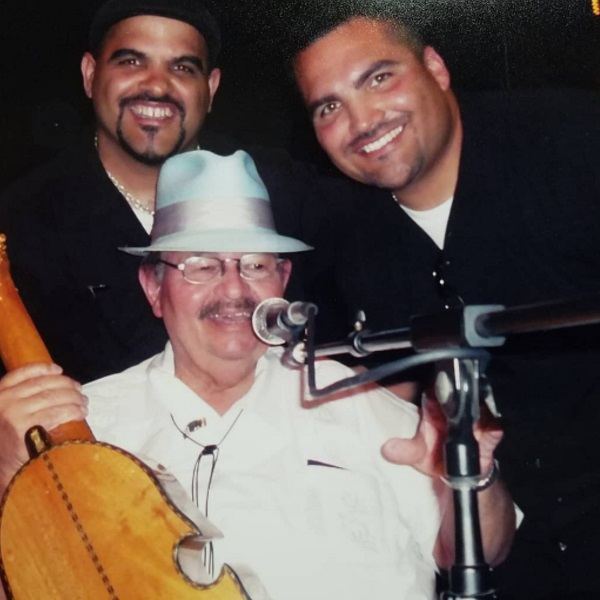
Earl Miranda, Henry Miranda, and Yomo Toro

Okay, wonderful. This project began with your father, Mr. Miranda, who was at the head of the group. What did you and your brother Henry learn the most from your father? How did you develop a love for music?

This all started when we were just kids. We had a lot of family celebrations like Christmas and my father’s band always came and play until three or four o’clock in the morning. My mother made food. Music was always very important to all of us from the beginning. When my father died in 1969, my brother started playing for some bands and I started working as a DJ until it got to the point where we got together and decided to start this whole project together.

Around 2003 or 2004, we contacted our cousin Ric Feliciano to ask him to join us. We started to develop a new salsa style. Ric came with the salsa flavor, while we had the jíbaro flavor, so we brought those two things together to start making music.

Mr. Feliciano, do you have anything to add?

Yes, I am a Boricua from New York, that is to say, a Nuyorican as people say here. Back in the 80’s and 90’s, I grew up listening to the music of Hector Lavoe, Mon Miranda, Willie Colón, among others. I am a trombonist and also like trombanga, which is the music of Mon Rivera and Willie Colón which involves placing trombones at the front of the group so that the sounds are very heavy. That is the style of the Latin Rhythm Boys, which seeks to look to the future, but honoring the stars of yesterday. Since we have three or four trombones and a very particular singing style, many people say we sound like La Fania, including Hector Lavoe’s timbalero, who tells us that our style reminds him a lot of the 70’s and 80’s.

When I listen to your music, it sounds a lot like old school salsa. Why choose that specific style?

For me, that style represents the story of which we come from. My family and his father come from Puerto Rico and moved to Hawaii. In 1963, my father made his life in the United States, California, but he actually started his band in 1957, which was called Junior Miranda and The Latin Rhythm Boys. Then, my brother called it The Latin Rhythm Boys Orchestra.

We have added certain elements to make our music more modern, but many of the arrangements are typical of old school salsa.

Earl Miranda, Henry Miranda and other members of the band

How Earl, Henry, and Ric work together

Mr. Miranda, you are the musical director of the Latin Rhythm Boys and your brother Henry is the music producer. How do you work together?

(Mr. Feliciano answers the question) Well, I’m the arranger, so what we do is Earl and I write all our lyrics together. My family comes from a long line of jíbaros, but we also love salsa. That’s why we are what we are today.

(Earl Miranda’s answer) We are a great team because I have a lot of ideas and Ric applies them in a phenomenal way. Things work out even better than when I thought of them.

We’ve been invited to awards shows and films to make soundtracks in Hollywood. We’ve done some jingles for certain Hollywood and Netflix films.

Mr. Miranda, you said in an interview that jibaro is more like heart and soul, what did you feel when you listened to jibaro music as a child? Why is jibaro music so important to you?

This taste for jibaro music started when I was a child. This reminds me of when I was with my family, my uncles, my aunts, my cousins and other members. It is in my soul. However, we knew we had to evolve into something more relevant. That’s how we created the group and decided to mix new with old. We look to the future, but honor the past.

There are many family members in the orchestra. Would you say this is a family project?

I would say that myself, Henry, Ric and Ricky Castillo are part of the same family. Certainly, there are many members of the family, but many things change over time and members get older, so they withdraw from group. There are also many members who are not family, but they become family and become very necessary for the band.
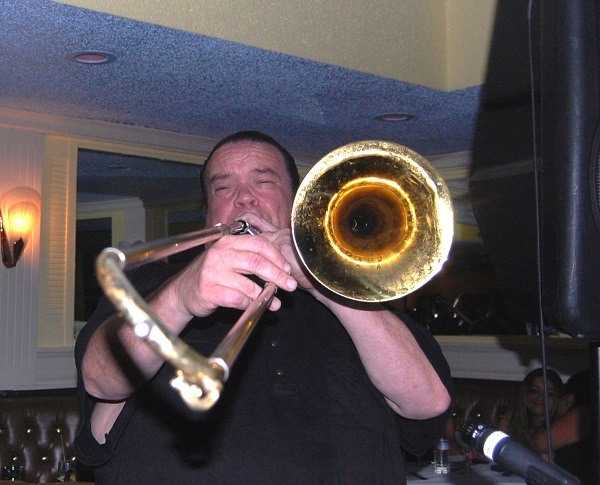
Ric Feliciano playing the trombone

This question is for Mr. Feliciano. I understand that you joined the orchestra in 2003. How did you join the Latin Rhythm Boys?

I came to California in the 90’s and was part of a few bands here, but I was looking for something that might take me back to my roots. That’s when I heard about the Latin Rhythm Boys (laughs) and decided it was a project I could work on. It brought me get back to my family roots, but we also achieved a new sound.

Music is very important to the family. You have always listened to Jíbara and Puerto Rican music. Would you say that education and training is important for musicians?

Yes and no. Musical training is important on the one hand, but on the other hand I think that music just flows. For example, I’m not very good at reading music, but it’s here in my heart. I could perceive it, even if I don’t have a lot of training around it. I think that’s part of the beauty of it all. Well, Ric is a teacher, so he can offer you another view on this subject.

(This is Mr. Ric Feliciano) Indeed, I am a teacher and I’ve been teaching music for over 30 years, but I must tell you something. Education is not enough to be a good musician because there is a connection that cannot be taught through a class. I’ve had many students who do everything right in technical terms, but they don’t have the necessary flavor. Not everybody has that. I think there needs to be a balance between feeling, flavor and education.
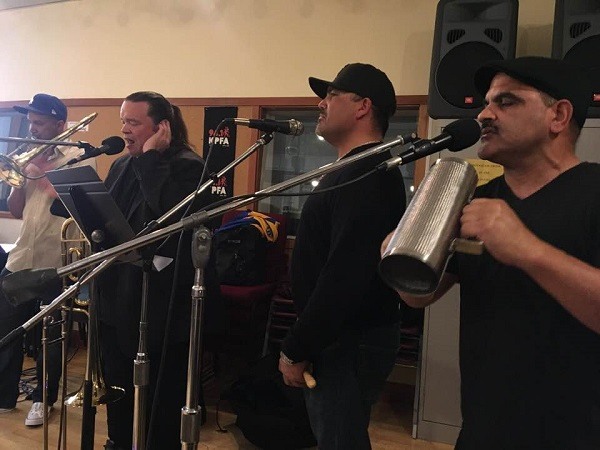
Ric, Earl, and Henry singing and playing

Do you have to be Latino to have that flavor?

We have some guys in the band who aren’t Latino, but they get the swing. We can work with anyone regardless of their ancestry, as we’ve had Americans and Europeans who have everything we’re looking for. We give them the sounds and they have no choice but to imitate them (laughs).

Do you consider it more important to make original music than to do covers?

Absolutely. If you have the talent and vision in your head, everything flows. I think if a person has a song in his/her head, he/she is going to want to translate into reality that idea and play it for an audience to see its reaction. If the reaction is good, you think you’ve done something right.

(This is Mr. Feliciano) What we usually do is to play our own songs at 90 per cent and covers at 10 per cent to please the audience. In fact, many people ask us for certain songs that they think they’re not ours, when, in reality, they are our hits from many years ago.
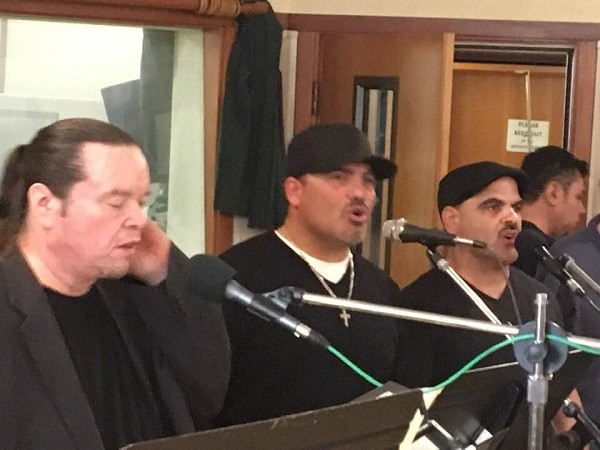
Ric, Earl, and Henry performing
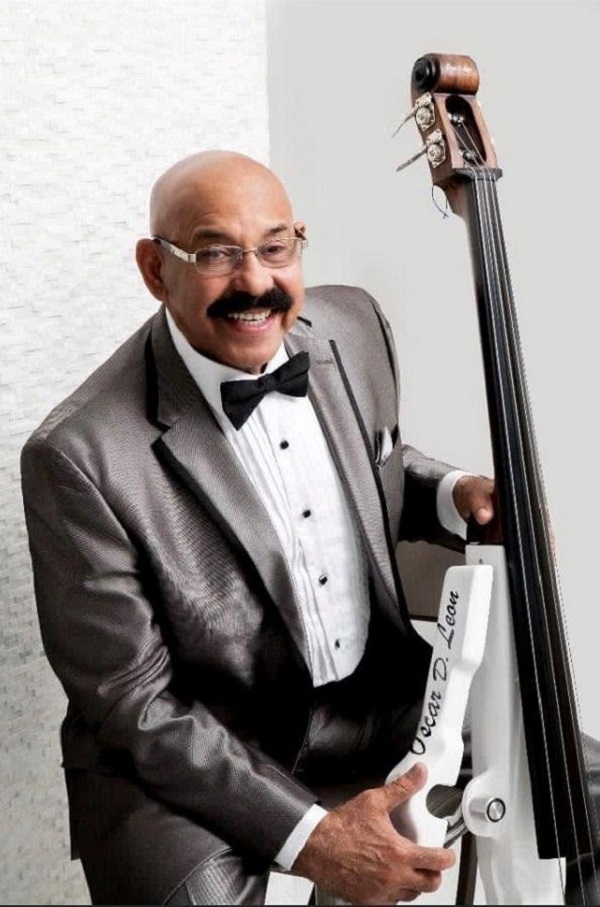
Oscar D’León celebrates 50 years of career in Caracas “International Salsa Magazine says present”

In September, the greatest exponent of Venezuelan salsa in the world will celebrate five decades of brilliant artistic career with an international tour that will have as its main event, an impressive and awaited symphonic gala at the Teresa Carreño Theater. And for september 22 at the Forum in Valencia.

Miami, May 19, 2022. Undisputed legend of Caribbean music, Oscar D’León, the Sonero of the World, celebrates 50 years of successful artistic career with an international tour that will take him to different locations in the Americas and Europe this summer.

This tour, which will begin on June 20 in Mexico City, will continue in July with the “50th Anniversary Europa Tour 2022”, culminating in a spectacular symphonic gala at the iconic Teresa Carreño Theater, which, during two performances on September 16 and 17, will give his audience the opportunity to sing and dance to the music that has made him the most recognized and admired Venezuelan artist in the world over the course of five decades.

Acapulco, Arequipa, Santiago de Chile, Miami, Frankfurt, Munich, Berlin, Paris, Amsterdam, Madrid, Tenerife, London, Istanbul are some of the cities that will live the energizing experience of seeing him on stage, a real party for music lovers.

Deserving of hundreds of awards and recognitions, including five Latin Grammys, D’León has been nominated nine times for the U.S. Grammy, being the first Venezuelan to obtain such a statuette. He did it in 2001 thanks to the song “Cielito Lindo, La Negra Mariachi Medley” Featuring-Oscar D’Leon, included in a collection album: “Masterpiece/Obra Maestra de Tito Puente y Eddie Palmieri”.

In 2013, he received the Award for Musical Excellence, a special recognition granted by vote of the Board of Trustees of the Latin Recording Academy to artists who have made creative contributions of exceptional artistic importance in the field of recording during their careers.

A true prophet in his own land, this global artist who began writing his formidable musical history in 1972, at the age of 28, when he formed the Dimensión Latina Orchestra, promises to celebrate his half-century of career with an unforgettable show at the Teresa Carreño Theater, the most important in Caracas, organized by the Venezuelan companies Imagen Producciones and Oz Show, in alliance with the National Orchestra System of that country.

Important Notes

Venezuelan musician who is among the most outstanding authors and performers of salsa and Caribbean music in general. Oscar D’León’s professional career began late: legend has it that one night, while visiting a nightclub in 1973, he heard that the band playing there had been fired. Oscar seized the opportunity and offered his own band to replace the one that had left.

The owner accepted and hired him to start playing a few days later. There was only one problem: the band at that time consisted only of D’León himself. He quickly got in touch with trombonist César Monge, told him what had happened and both got down to work to put together a line-up.

The band was finally formed by Oscar (vocals and bass, an instrument he had taught himself to play), César Monge (trombone), José Rodríguez (percussion), Enrique Iriarte (piano) and José Antonio Rojas (trombone).

Thus was formed La Dimensión Latina, Oscar D’León’s first orchestra. “Pensando en ti” was the first of the orchestra’s long list of hits. Four years later, Óscar left the band and was replaced by Puerto Rican Andy Montáñez, a vocalist who sang with the Gran Combo de Puerto Rico. Óscar returned with his own orchestra, La Salsa Mayor, with which he recorded his first album, titled after the group’s name: La Salsa Mayor (1977). The work was a great success in his country, and little by little his name began to be heard on an international scale. The following year he recorded the album El Más Grande, which contained the songs “El baile del suavecito” and “Mi bajo y yo”, and shortly afterwards he made his first visit to New York to offer live performances.

Aside from being a great sonero, Oscar D’León is also an extraordinary showman. Almost always accompanied by his bass, with which he plays and dances as if they were a couple, Óscar moves around the stage with great skill. In Venezuela, Óscar D’León is an idol, not only as a singer and musician, but also as a model of a self-made man who, from a very humble position, achieves fame and success on an international scale.

He is considered one of the best interpreters of Afro-Latin music of all times and is undoubtedly among the Venezuelan artists with more projection abroad.

Despite having gone through several stages in the development of Latin music, Oscar D’León’s style, always unmistakable, has maintained some constants that have allowed him to ensure the loyalty of his wide audience. D’León has recorded with the most outstanding salsa stars; among his collaborations, which can be traced in more than fifty albums, stands out his participation in The Mambo King, the hundredth full-length album by the legendary Tito Puente.

Corresponsal: Lida. María Fernanda León

www.Sanjuanproducciones24.blogspot.com

Meet The Dates Of Havana D’ Primera – Europe Tour 2022

Alexander Abreu & Havana D’ Primera will begin their concert tour in Serbia celebrating their 15-year artistic career

cinco personas cantando
Alexander Abreu with the Van Van at Tempo Latino 2022

Alexander Abreu & Havana D’ Primera will visit Europe in September with their 2022 tour to celebrate their 15-year career with love and music, starting on Saturday, September 3rd in Belgrade (Serbia), and two days later they will step on the Bulgarian salsa stage (Monday, September 5th).

Subsequently, they will sing their repertoire in Spain (Seville, Madrid, Bilbao, and Barcelona) on September 8th, 9th, 23rd, and 30th, and will continue in France with two concerts: on Sunday 11th, they will be on stage on the Cabaret Sauvage (Paris), while the Sunday, September 25th, they will do so in the Patio de Camargue (Árles). In the same way, their tour of Germany (Hamburg) continues on Thursday, September 15th, and the 16th of this month, they will be in Finland, specifically in the capital city Helsinki.

The 2022 Tour continues in Italy (Florence and Naples) on September 17th and 21st. The latter will be in the Sweet Life concert hall located in the Somma Vesuviana municipality of the Neapolitan city.

On Thursday the 22nd, they will do the same at the Cuban Latin Festival in the Netherlands (Amsterdam) and will end their 2022 Tour 400 miles from Europe in Tunisia in the Yasmine Hammamet neighborhood located in the north of the African continent on Saturday, October 1st.

16 personas en un escenario
Ticket prices vary between £30 and £100.

Alexander Abreu spent his childhood in the city of Cienfuegos (Cuba) where he began playing the trumpet at the age of ten and has currently become one of the most versatile and acclaimed Cuban musicians of Afro-Cuban music. “I have always seen Havana D’Primera with 15 people on stage and everyone said that it was impossible, that it would be too expensive, too difficult to move… This is how we started: 14 or 15 of us and a lot of positive energy, now we are stronger than ever.” Abreu commente.

Havana D’ Primera (HDP) is a Cuban timba band founded by Alexander Abreu in 2007 and made up of 17 of the best Cuban musicians. The orchestra is led by the main composer Abreu, who has stood out for his melodic voice and ability to fuse genres through Salsa such as Jazz, Funk, and other Afro-Cuban rhythms.

“Since its inception, the band has released five studio albums and one live album. The debut album release was Making History with EGREM in 2009 and their first release for the Páfata Productions record label. 2012’s Pasaporte received favorable reviews from the international press and was voted one of the best Latin alternative albums of that year.

Since then, they have followed the success of “Pasaporte” with four more albums, released through Páfata Productions and the last one in co-production with the Cuban Producciones Abdala.

HDP released “La Vuelta al Mundo” in 2015 and “Haciendo Historia LIVE” arrived in 2016. “Cantor del Pueblo” in early 2018, earning the band a Latin Grammy nomination for Best Salsa album. We cannot forget “A Romper el Coco” with the participation of Mayito Rivera released in 2019, and the single Quiero Verte Otra Vez (2020) which won the Special Prize at the 2020 Lucas Awards gala and was also cataloged by the French newspaper “Le Monde” as one of the favorite songs of Latin music.

Finally, in 2021 the album “Será Que Se Acabó” was released, as a tribute to Cuban popular music of the 80s and 90s. Discography extracted from the Biography of Havana D’ Primera.

You can read: Where to go dancing Salsa in Paris?

Joseíto Mateo “They call me the Negrito del Batey, because work for me is an enemy”

Joseito was a consecrated Dominican merenguero who began his career in the 1930’s, better known as “El rey del merengue, El diablo Mateo”.

As a child he learned to sing and dance. He sang at the “Fiestas de la cruz” and at wakes, since at that time the deceased were prayed to with songs.

Mateo began his career as a singer during the 30’s, a period in which he was gaining the public’s favor.

Some time later he was requested by the record label “SEECO” to join the cast that in Havana would record with the Sonora Matancera.

Those were the years of the Trujillo Era in which Dominicans required an exit permit to travel abroad.

At first, this document was denied to Joseito.

As a consequence, in Havana, once the record was contracted and the pieces that would be part of it had been selected, including “El negrito del batey”, Joseito’s place was taken by the Dominican singer Alberto Beltrán, who was known since then by the Cuban public as “El negrito del batey”, instead of his true inspirer.

He was born on April 6, 1920 in Santo Domingo (Dominican Republic).

In one of his later trips, he decided to stay in Cuba to sing in CMQ, together with Celia Cruz and La Sonora Matancera, a very popular group at that time.

After the assassination of Rafael Trujillo on May 30, 1961 and the end of his dictatorship, Joseito decided to try his luck in Puerto Rico.

In 1962, Joseíto participated as vocalist in the first tour of the “Gran Combo” to Panama, to promote the album ‘El Gran Combo con Joseíto Mateo’.

There he met the young singers Pellín Rodríguez and Andy Montañez, who ended up replacing him in the Puerto Rican group.

“El Gran Combo was very good to me, I adapted to sing plena, bomba, guaracha, boleros, but then I had to return to Santo Domingo to clear my name.

They were falling behind all those who were with Trujillo, and in the Republic they said I was a spy and was on the run”.


Mateo’s professional work has spanned more than 70 years and constitutes an important reference of the Dominican musical culture.

He was nourished by the roots of merengue and became a singular exponent of it. His innovative style was characterized by a stage participation enriched by his particular way of dancing and singing.

Some of his best known songs are Madame Chuchí, Dame la visa, La cotorra de Rosa and La patrulla, among others. Joseito is known as “El Rey del Merengue” (The King of Merengue).

On November 11, 2010, Mateo was recognized at the 11th Latin Grammy Awards with the Latin Recording Academy’s Musical Excellence Award for his contributions to Latin music.

He retired in 2001, close to his 82nd birthday and after recording 50 “elepes”.

Joseíto Mateo passed away on June 1, 2018 at the age of 98, due to leukemia. He spent his last days in the Hospital de las Fuerzas Armadas.

Source:

https://www.buscabiografias.com/biografia/verDetalle/8662/Joseito%20Mateo

Willy García releases a new album full of salsa named “Siendo Yo”


The Colombian salsa artist Willy García has surprised his fans with a new album full of salsa, of course the fast one, but where he also shows love songs hand in hand with nostalgia. Without neglecting touches of calculated risks and adventures to give all the listeners an album with a lot of great sounds, just like the one from Buenaventura has accustomed us to. Know a little more about this album with the following words.

“Mentiroso” is the title track that Willy García shows in “Siendo yo”

Mentiroso is a fast-tempo song that is exactly what Willy enjoys the most, but that doesn’t mean that the album isn’t a walk through different rhythms and tempos that offer us a glimpse into the thoughts of this great artist. There are songs in the style of “Como lo extraño” where each emigrant can feel identified with the nostalgia towards his homeland. But then we can find some risky tracks that go a bit far from his classic style.

For example, there is “Aquí le pago con esto” which is a collaboration with Cali Flow Latino where sounds of salsa, urban, tropical rhythms and holiday flavors are fused. In this way Willy wants to please his old fans but attract the new generations with modern sounds. The other songs are all romantic in style, but it is the last one on this list that Willy is most proud of,“Me enamoré de ella” is one of his favorites.

“Mujeres”, “Me Recuerda a Ti”, “Que Se Detenga el Tiempo” and “Si Eres Tu”, are all about love and romantic feelings that are precisely part of that essence that makes so many stick to the salsa genre. Another song that is worth talking about is “Cada día” which could be another hit for the radio and especially on the dance floors.

Arrangements of “Siendo Yo”

Starting with the song “Mentiroso”, it should be noted that it was mastered in New York City, recorded between Cali and Miami, with lyrics by Willy himself, in addition to the fact that he participated in the production together with the great Oscar Iván Lozano.

Among the musicians who participated in the recordings we can find many well-known names from the Colombian territory, such as Diego Galé who played the congas and the bongo, Diego Galindo, Johan Castro, Luis Araque and Christian Fernández did the choirs, while Luis Bravo and Carlos Latoche in the horn section, bassist Carlos Córdoba, timbalero Robert Vilera and Óscar Iván Lozano himself on piano.

A quick look at Willy Garcia’s career

Willy García’s career as a soloist is an incredible example that when there is talent, no matter how it is represented, it will always shine. We can name many recognitions and achievements, but the last few years have been one achievement after another that fill this son of the South American country with great pride.

First we must name achieving nominations for the Latin GRAMMY® 2021, in addition to the 2022 Heat Awards and 2022 Lo Nuestro Awards. Not counting the excellent positions it achieved on charts such as Billboard’s Tropical Airplay where it entered the top 10. It also managed to position himself at the number 1 of the USA Today’s chart, one of the most read publications in North America, with “Lo Veo y No Lo Creo” together with Gilberto SantaRosa “El Caballero de la Salsa”.

In addition to participating in the concert “Night of the Dominican Restoration” where he sang with Sergio Vargas. He also received from El Espectador the “Afro-Colombian Of The Year” award in the Arts and Music category. In general, 2022 only smiles at this great Colombian and more success are only expected from his fifth production as a soloist.

  • « Go to Previous Page
  • Page 1
  • Interim pages omitted …
  • Page 28
  • Page 29
  • Page 30
  • Page 31
  • Page 32
  • Interim pages omitted …
  • Page 39
  • Go to Next Page »

International Salsa Magazine (ISM) is a monthly publication covering salsa activities around the world and has been publishing since 2007. It is a worldwide network of volunteers coordinated by ISM Magazine. Together, we work to strengthen salsa events around the world.