• Skip to primary navigation
  • Skip to main content

International Salsa Magazine

  • HOME
  • Previous editions
    • 2026
      • ISM / March 2026
      • ISM / February 2026
      • ISM / January 2026
    • 2025
      • ISM / December 2025
      • ISM / November 2025
      • ISM / October 2025
      • ISM / September 2025
      • ISM / August 2025
      • ISM / July 2025
      • ISM / June 2025
      • ISM / May2025
      • ISM / April 2025
      • ISM / March 2025
      • ISM / February 2025
      • ISM / January 2025
    • 2024
      • ISM / December 2024
      • ISM / November 2024
      • ISM / October 2024
      • ISM / September 2024
      • ISM / August 2024
      • ISM / July 2024
      • ISM / June 2024
      • ISM / May 2024
      • ISM / April 2024
      • ISM / March 2024
      • ISM / February 2024
      • ISM / January 2024
    • 2023
      • ISM / December 2023
      • ISM / November 2023
      • ISM / October 2023
      • ISM – September 2023
      • ISM – August 2023
      • ISM July 2023
      • ISM Edition June 2023
      • ISM – May 2023
      • ISM April 2023
      • ISM March 2023
      • ISM February 2023
      • ISM January 2023
    • 2022
      • ISM December 2022
      • ISM November 2022
      • ISM October 2022
      • ISM September 2022
      • ISM August 2022
      • ISM July 2022
      • ISM June 2022
      • ISM May 2022
      • ISM February 2022
      • ISM January 2022
    • 2021
      • ISM December 2021
      • ISM November 2021
      • ISM October – 2021
      • ISM September 2021
      • ISM August 2021
      • ISM July 2021
      • ISM May 2021
      • ISM April 2021
      • ISM June 2021
      • ISM March 2021
      • ISM February 2021
      • ISM January 2021
    • 2020
      • ISM December 2020
      • ISM November 2020
      • ISM October 2020
      • ISM September 2020
      • ISM August 2020
      • ISM July 2020
      • ISM June 2020
      • ISM May 2020
      • ISM April 2020
      • ISM March 2020
      • ISM February 2020
      • ISM January 2020
    • 2019
      • ISM December 2019
      • ISM November 2019
      • ISM October 2019
      • ISM Septembre 2019
      • ISM August 2019
      • ISM July 2019
      • ISM June 2019
  • Spanish
  • Download Salsa App
    • Android
    • Apple

Search Results for: Orchestra

The interesting story of French percussionist Dominique Patrick Noel

How his career started

All right, so we are here with French percussionist, composer and musician Dominique Patrick Noel. How are you doing, Mr. Noel? A pleasure to have you here.

Well, thank you. First of all, I want to thank you for taking the time to interview me and to greet all those who is going to read it. Thank goodness, I am in good health and it is all good.

Dominique Patrick Noel tells us about his story and beginnings

You are a self-taught musician who started playing by age seven. Did you learn everything by yourself or did you receive some kind of training?

Since I come from a family of musicians such as my father and my two grandfathers, I can say that music has always been a part of my life. I started playing the drums by listening to a lot of jazz and fell in love with this genre. That’s how I started to develop the movements and patterns of jazz and the drums.

In school, I started playing and learned solfège, percussion, drumming, among other things. When I turned 15 years old, I started playing music at a pro level because I have always had the pleasure of learning by watching musicians, who had much more experience. Thank goodness, I had my mind fresh to grasp and remember what I had seen, which helped me a lot to continue developing in percussion, different instruments, rhythms, among other things.

When I started playing Latin music, my first instrument was the bongo. I had a mentor named Alfredo Mujica Jr.,m who knew my dad and learned by playing with him. When it was my turn, he was giving the task of helping me understand the patterns and other things. He told me that the best instrument I could choose to start with was the bongo because it would help me understand a little more about how salsa works and that helped me a lot. He showed me the basic pattern and how to imitate the sounds I heard until they were similar.

After that, I also learned to play the conga, the Dominican tambora, the güira, the batá, the cajon and the timbales.
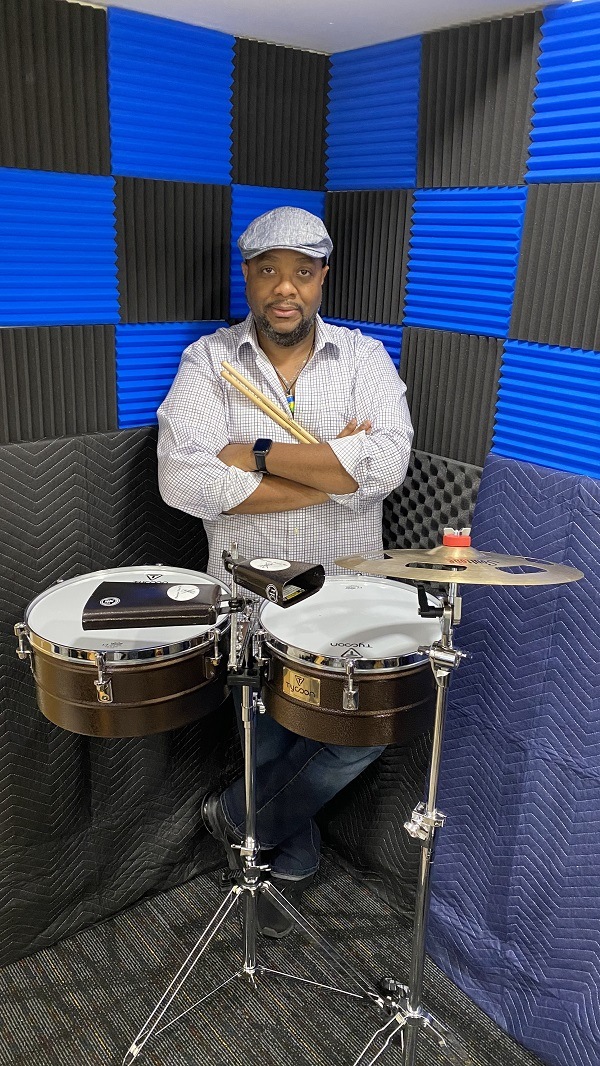
His career started at the age of 15 and his first instrument was the bongo

When you played the bongo for the first time, did you know you wanted to dedicate yourself to the Latin genres permanently?

When I was nine years old, I moved to Martinique and lived there for about four years. There I was fortunate to learn its folklore, its rhythms, its typical instruments and its dances. I also learned to perform all those genres with the drums and tried to absorb all I saw. Concurrently, the zouk era was beginning and I fell in love with the genre since I heard it for the first time.

Sometime later, my dad and I went to the United States to be with my dad, who was living in Washington at the time. It was there where I started to accompany him in several of his activities and shows with his orchestras. Then, I began listening more to salsa, cumbia and merengue, something I liked very much. Then, I told him that I would like to learn what he knew and play with him, to which he replied that it looked good, but that it was a profession that I had to take very seriously. Therefore, he advised me to listen to everything, even if it wasn’t Latin music because all genres nurture the musician in one way or another.

With whom he has worked?

You have worked with Tito Puente Jr, Tito Rojas, Izis La Enfermera de La Salsa, Frankie Vasquez, Lalo Rodriguez, among others. What have you learned from them?

I have had the opportunity to play with maestro Tito Rojas and his musical director, Celso Clemente, gave me some advice. When rehearsing, I approached him to thank him for allowing me to play the bongo with them and ask him for advice for my career, to which he replied that he liked my work very much and that I was very good for someone who was not born in this Latin music environment.

He also advised me that I had to move forward, never play down my goals, accept constructive criticism and always stay humble. I will never forget his words.
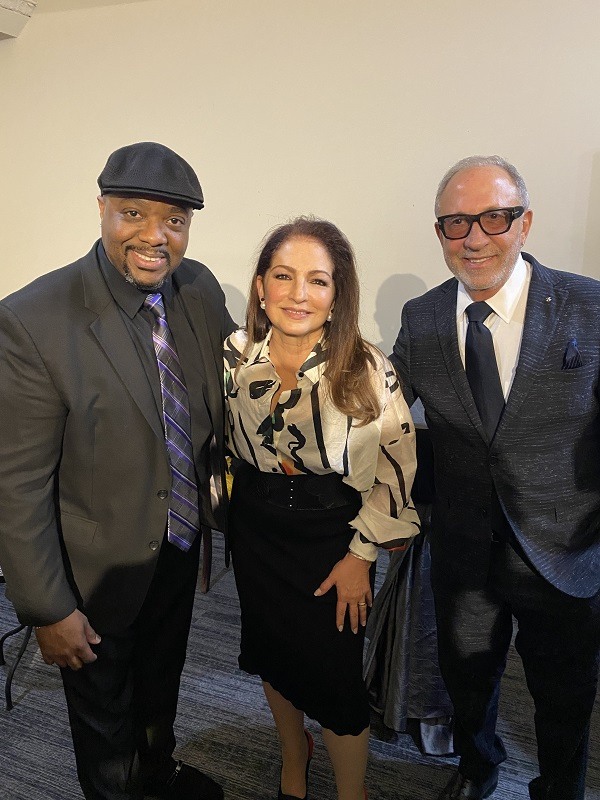
Dominique Patrick Noel next to Gloria Estefan and Emilio Estefan

We know that you are a voting member of the National Academy of Recording Arts and Sciences, which is well known for giving the Grammy Awards. What do you base to vote for a nominated candidate for an award?

There are several processes for artists to be nominated. For us the voters, it is a long process because we have the task of listening to much music and analyzing many details such as recording quality, lyrics, musicality and much more. There are many important elements to consider when choosing the person. I want to get to the point of saying that someone really deserves my vote for this or that category.

Voting takes time. It’s not something that you do in an hour or two, it takes a long time. The day of the awards ceremony, we already know who will the winners. At that point, we can say that all of them have managed to win via an arduous selection process.

Tell us about your song Mi Secreto with D’ William.

The skeleton of the song was my idea and I got together D’ William, to whom I offered to join the song. He wanted to collaborate with me in a merengue song for some time and I sent him the skeleton, which he liked and told me that something could be done with it. When he asked me if I already had the lyrics, I said no, but I wanted to base the song on an experience of mine, so I told him what it was about and the lyrics were written about that fact. Later, we made some additional arrangements and that’s how Mi Secreto was born.
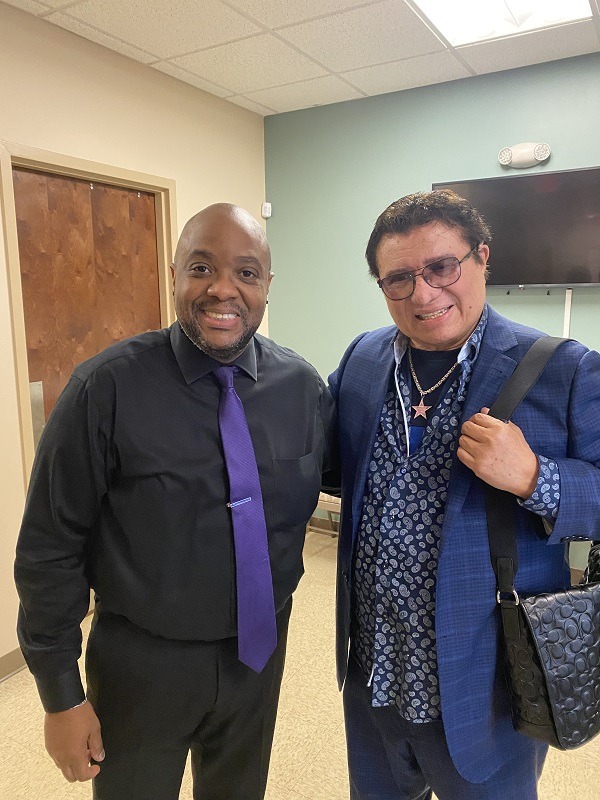
Dominique Patrick Noel next to Bobby Cruz

Read also: Earl Miranda and Ric Feliciano talk about the Latin Rhythm Boys and its history
Directory of Salsa Clubs in North America

Los Angeles
1.- The Mayan 

Salsa en el Mayan
FRI SEP 10 2021 AT 09:00 PM TO SAT SEP 11 2021 AT 02:00 AM
Los Angeles, California | Los Angeles

Tickets
USD 45

2.- VLounge Bar And Night Club

Details

Tony Vega
Vlounge Bar and Night Club, Los Angeles (LA), CA, US

Venue
Vlounge Bar and Night Club
6101 Reseda Boulevard
91335
Los Angeles (LA), CA, US

Additional details
Price: US $100.00
Doors open: 21:00

3.- La Clave Salsa Club

Salsa Bachata Group Classes Discounts
Group Classes at La Clave every Thursday, 11502 Ventura Blvd Studio City

Monthly Pass Discounted $50.00 per 8 classes, Includes the Dancing after. Classes: Salsa 8pm / Bachata or Chachacha 8:50pm

Available at The Club on Thursdays!

San Diego
4.- Sevilla Nightclub of San Diego

Bachata Tuesdays | Sevilla Nightclub San Diego

BACHATA NIGHTS

DJ HUSH IN THE MIX

DOORS OPEN 8 PM

BACHATA CLASS

PART ONE 8.15PM

PART TWO 9.15

NIGHT ENDS 2 AM

353 5TH AVE | GASLAMP QUARTER

INFO AND RESERVATIONS 619.245.1138

TAUGHT BY INDIGO ENTERPRISE

COVER CHARGE $15

GUEST LIST BEFORE 10 PM ENTRANCE DISCOUNTED $10

www.sdbachata.com // www.sevillanightclub.com

San Francisco

5.- The Cigar Bar & Grill

Bachata Sundays – at CIGAR BARMonthly Bachata Sunday at Cigar Bar – every 1st Sunday!
About this Event
Inessence presents Bachata Sundays: Bachata & salsa class, social dancing, food & drinks. This party will be once a month (1st Sunday), with the next one happening on September 4th.NEW LOCATION: the San Francisco famous Cigar Bar. It will be a night filled with bachata, salsa, y más. Come end your weekend dancing the night away! Smoke-free on Sundays.Indoor dancing & outdoor patio dancing.PLEASE SUPPORT THE BAR & KITCHEN so we can keep this beautiful venueTime:
*Doors open at 6:45pm* Salsa Class (beginner friendly): 7pm – 8pm

*Bachata Class (beginner friendly): 8pm – 9pm

*Social dancing: 9pm – 12:45am

Full bar / 2 Dance Floors / 21+

Tickets:
We highly encourage purchasing your tickets in advance!

$15 online presale (ends Sunday at 4:30pm 9/4)

$25 at the door

(NO refunds)

Location:
Cigar Bar & Grill, 850 Montgomery St. San Francisco, California

For more info:
www.inessencedance.com

@inessencedanceco

6.- El Valenciano

Latin ednesdays at El Valenciano

Latin Wednesdays at El Valenciano SF! Every Wednesday evening in the heart of SF’s Mission District we offer Bachata and Salsa Lessons at 8 PM followed by dancing at 9 PM! Full Kitchen and Bar serves delicious meals and cocktails… Pre-Sale Tickets only $12 via Venmo and $15 at the door.
Spring/Summer Special: $10 after 10 PM
Venmo ID: Gabriel-Romero-18
Code: 9190

Long Beach

7.-  PCH Club

Dance classes every Thursday

8PM BACHATA
8:45PM SALSA
9:30PM DANCING TILL CLOSE!

Oakland

8.-  Yoshi’s

JUAN ESCOVEDO ALL STARS

SEPTEMBER 8, 2022
DOORS: 7:30 PM / SHOW: 8:00 PM

BUY TICKETS
$26-$64

SEPTEMBER 8, 2022
DOORS: 9:45 PM / SHOW: 10:00 PM

BUY TICKETS
$26

Juan Escovedo has released his first solo CD, THE J, on November 8, 2021, at his official record release party with two sold-out shows in Oakland. This CD elevates your soul with a masterfully crafted sound and rhythm meticulously created with an orchestra of seasoned sound that promises to take your breath away. Angel, the first single, features singer-songwriter El DeBarge with Martin Kember from Color Me Badd. Raphael Saadiq plays bass on two songs, Eddie M plays saxophone on two songs, and Andy Fargas of Santana sings on another piece. The video Angel was released on December 1!

Juan has toured, performed, and recorded with many artists, including Prince, Tony Toni Tone, Miguel, El Chicano, Con Funk Shun, Patti LaBelle, Amerie, Chingy, Jody Watley, Lou Bega, MC Hammer, Lionel Richie, En Vogue, El DeBarge, Freddie Hubbard, Barry White, Herbie Hancock, Cyndi Lauper, Teri Lynn Carrington, Bobby McFerrin, Tito Puente, Cheryl Lynn, Raphael Saadiq, Bobby Womack, his sister Sheila E., and, still, his father, Pete Escovedo. Juan tours, writes, and records as a solo artist with his father’s Latin Jazz Orchestra and The E Family: his father, his brother, Peter Michael Escovedo, and his sister Sheila E. Produced and arranged by Peter Michael Escovedo, The E Family’s latest CD, Rhythm of the Night, is a collection of nine “Old School” Soul & R&B hits, re-arranged and transformed into an explosion of Latin Jazz articulated through a fourteen-piece Latin Jazz Orchestra. The album features guest vocalists Peter Michael, Simon Russel, Sy Smith, Sheila E., Peter Michael, and Debi, as well as Escovedo’s great grandchildren.

Costa Mesa
9.- Sevilla Nightclub of Costa Mesa

Bachata Sundays @Sevilla In Oc
Learn & Dance Bachata With The Best Dancers & Teachers In Orange County!

About this Event

We Invite You To Our New Venue For Bachata & A Sprinkle Of Salsa At Sevilla Night Club In OC.

Don’t Know How To Dance Bachata, Thats OK! We Offer An Amazing Paid Bachata Intro Class With Professional Dance Instructors.

Doors Open At 430pm With A Intro-2-Bachata Class. Then We Have A Fun Open Level Bachata Class At 5:30pm. No Partner Or Experience Needed! $10 For One Class or $15 For Both. (Pay At The Event)

Music Starts at 530pm Till 9pm With DJ Aragon & DJ Zonik

Free Cover For Dancing (Class Not Included)

Food & Bar All Day | Free Safe Parking. Dancing Till 9pm | 21 & Over Night

Sevilla | 1870 Harbor Blvd, Costa Mesa Ca 92627

Find Us On Instagram!

https://instagram.com/cielodanceevents?utm_medium=copy_link

Alhambra

10.- The Granada LA

FRIDAY SEPTEMBER 2ND
Salsa Room with DJ MORENO & DJ PICOSO
Bachata Room with DJ KENNY
Reggaeton/Hiphop on patio with DJ MIRO & DJ SMALZ
Group Dance Classes:
8:30pm Salsa 1 with Kayla & Rosanna
8:30pm Salsa 2 with Hector & Jade
9:30pm Bachata with Hector
(Prepaid $12 per class or $15 at door)

Mountain View

11.- Alberto’s Night Club

Hot Salsa Fridays With Pantea – Alberto’S Night Club

HOT SALSA FRIDAYS EVERY FRIDAY with Pantea Salsa Lessons All Levels Doors open 8:00 pm 8:30 pm Beginner 9:30 pm Intermediate 10:15 pm Social Dancing No Partner Necessary DJ SayNoMore 21 and Up. A cool bar lounge located in Mountain View with a great instructor and chill atmosphere. Plenty of seating, a full bar, and live bands of Friday nights. Music is a mix of salsa and bachata, with a sprinkling of cha cha and merrengue. Established in 1992, Alberto’s quickly became one of the best nightspots in the bay area. Lore has an unknown musician at the time, Marc Anthony, once played at the club. Alberto’s continues to be the goto place for Salsa, Bachata, dancing and Latin music. It caters to a diverse audience who come to hear and learn musical styles from salsa to tango.

INFO:
When:September 2 @ 7:15pm – 9pm
Where:Alberto’s Night Club, 736 W Dana St., Mountain View,
Price:$10

Richmond
12.- Allegro

Salsa Bachata Social every Sunday

Latin Saturdays at Allegro. See flyer for details.

DETAILS
Date: September 3
Time: 8:00 pm – 1:00 am
VENUE
Allegro Ballroom 12012 San Pablo Avenue Richmond, CA 94805 United States Montclair.

13.-  The Canyon

**SATURDAY @ THE CANYON**
9:30-2AM SALSA CUMBIA BACHATA Y MAS with SUPER DJ RUMBERO! Great Food & Full Bar! Air Conditioning! Huge Dance Floor! Great Sound & Lighting! Plenty of Seating and Lots of Free Parking! $10 B410PM & $15 After, cash only! 5060 E N Montclair Plaza, upper level next to Macy’s (enter from Moreno St) 21+
**************************
**SABADO @ THE CANYON**
9:30-2AM CUMBIA SALSA BACHATA Y MAS con SUPER DJ RUMBERO! $10 antes de las 10PM y $15 despues, solo efectivo! 5060 E N Montclair Plaza, 2do piso lado de Macy’s (entrada por Moreno St) 21+

Commerce

14.-  Steven’s Steak House

Live Salsa Friday at Stevens Steak House

Live Music with Sangria every Friday at Stevens Steak House.

DETAILS
Date: September 2
Time: 8:00 pm – 2:00 am
VENUE
Stevens Steak and Seafood House Restaurant, 5332 Stevens Pl Commerce, CA 90040 United States

Los Gatos

15.-  Charley’s LG

SALSA NIGHT with Salsa Lesson, Live Salsa Band & Salsa DJ

Charley’s Bar LG is excited to bring you SALSA/LATIN NIGHTS (Salsa, Bachata, Reggaeton) every Thursday! Super fun night of dancing at the beautiful Charley’s in downtown Los Gatos!

DJ Luis Medina (of KPFA Radio) will be spinning the top Latin songs to keep the dance floor packed! The live salsa band CARLOS XAVIER (Does Mark Anthony & Originals) will take the stage at 9pm!

Lessons – all levels welcome from 8-9pm
No partner needed (we rotate)
Full Bar
Newly remodeled
Large, Gorgeous, Smooth, Hardwood Dance Floor
High Quality Sound Equipment
Air Conditioning
On-Site, Free, Lighted Front & Back Parking
Elevator Access
Outdoor Patio with Heaters
Fun & Friendly Atmosphere
Live Latin/Salsa Band & DJ
Playing a mix of salsa and bachata, with a sprinkling of Reggaeton & Cha Cha.
Doors open at 6pm
Happy Hour 6-8pm
Dance Lessons 8-9pm
Social Dancing 9pm-1am
$20 Cover charge
https://salsagoogle.com/tickets/
21+

Tribute to Larry Harlow about a year after his departure

Tribute to my friend Larry

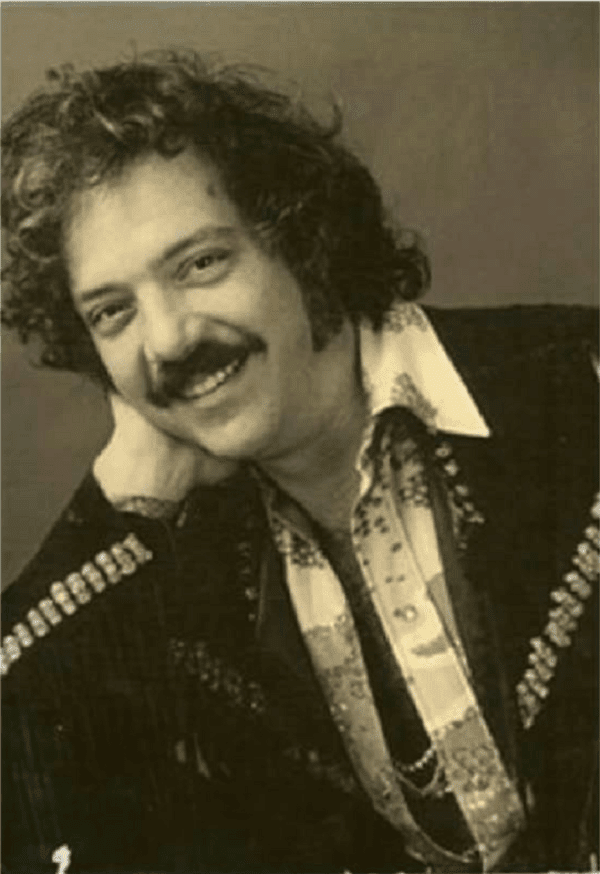
It is now a year since the unfortunate departure of one of the greatest icons of Latin music, who is none other than the one and only producer, composer and pianist Larry Harlow. Let’s remember that he passed away on August 20, 2021 in a health center located in the Bronx at the age of 82. His death was caused by heart failure due to a kidney condition from which he had been suffering from for some time.

“El Judio Maravilloso” passed away on August 20, 2021

A little of his history

The also known as “El Judio Maravilloso” has a great success story behind him in the field of music, which began with the occupations of his parents. Recall that his mother was an opera singer and his father was a musician in the orchestras of Barrio Latino, which could explain his interest in the industry when he was very little. From a very young age, little Harry already handled certain instruments in a skilled way, showing what he could dedicate himself to in the future.

His great interest in Cuban music and culture led him to travel to Cuba, where he began his musical studies related to Afro-Cuban music. Unfortunately, the arrival of the Cuban Revolution prevented him from fulfilling his task and he had to leave the island prematurely due to the political crisis that started to develop.

Since then, the Harlow Orchestra became one of the first groups to be formed with the label of Fania Records. At the same time, Harlow was producing an tremendous amount of albums, both his and other musical stars’, catapulting him to becoming one of the most respected producers of that time. Reportedly, there were approximately 270 records in total, which gave us a lot of hits that continue to be heard to this day.

One of his greatest achievements was to have brought the world famous Cuban singer Celia Cruz to New York, thus becoming the first artist of Latin origin to perform at the Carnegie Hall, a famous concert hall located in Manhattan that had only had room for Anglo-Saxon artists until that time. It was “El Judio Maravilloso” who managed to bring Latin America to the Carnegie Hall for the first time from the hand of “La Guarachera de Cuba”, something unthinkable in those years.

Larry Harlow and Johnny Cruz in the 80’s

He also had an important role in the film “Our Latin Thing”, along with several transcendental figures of the Fania All Stars.

Relationship with the Spanish Harlem Salsa Gallery Museum

It is of common knwoledge that Larry and this server had a close relationship, since we knew each other for many years and lived many incredible experiences related to this wonderful genre called salsa. That is why the famous pianist sent me some of his most precious costumes to be exhibited in our gallery so that all his fans could be as close as possible to their idol.  After his departure, seeing all those things donated by him leaves a deep emptiness in those who see them, but at the same time this reaffirms our commitment to offer our public the best salsa exhibittions they have ever seen.

Larry has left an indelible mark in the hearts of all of us who got to know him during his lifetime, but our duty is to move on with our heads held high.

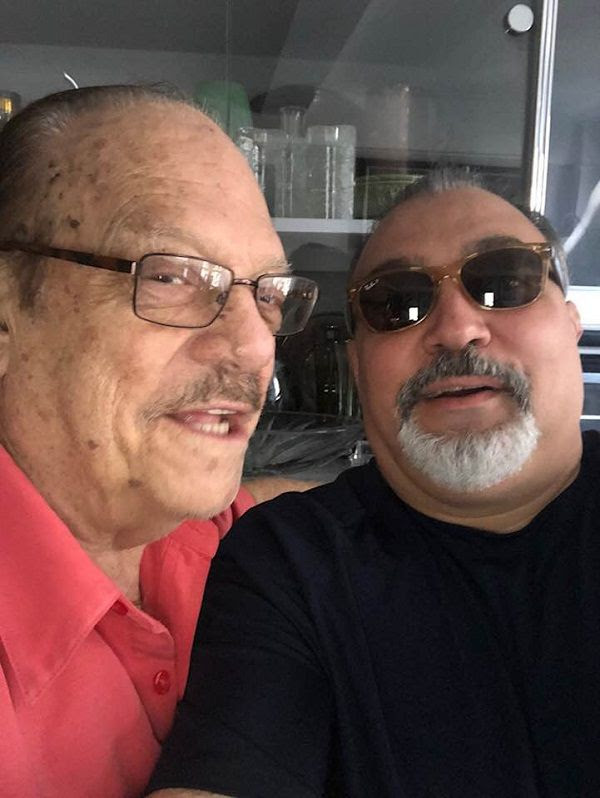
Harlow and Cruz in 2018


By Johnny Cruz, ISM Correspondents, New York, New York City

Earl Miranda and Ric Feliciano talk about the Latin Rhythm Boys and its history

Here we have Miranda and Feliciano

Good afternoon, we have here Earl Miranda, musical director of the Latin Rhythm Boys, and Ric Feliciano, writer and arranger for the group. Nice to meet you guys. It’s a pleasure to have you here.

Hi, Karina. It’s great to see you. We’re doing great.

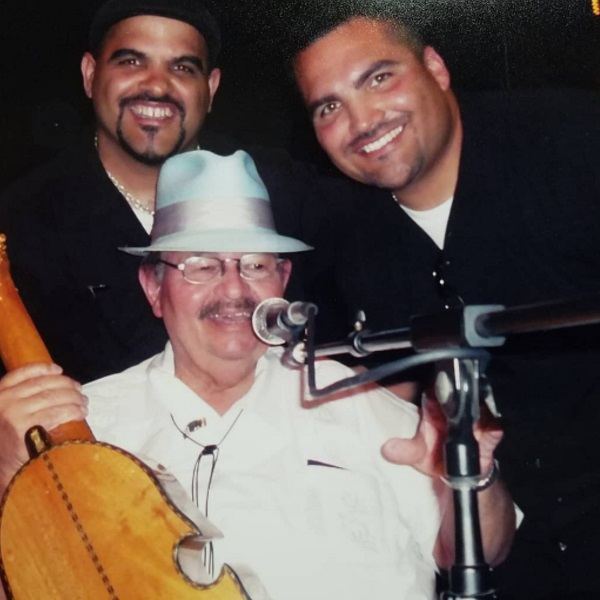
Earl Miranda, Henry Miranda, and Yomo Toro

Okay, wonderful. This project began with your father, Mr. Miranda, who was at the head of the group. What did you and your brother Henry learn the most from your father? How did you develop a love for music?

This all started when we were just kids. We had a lot of family celebrations like Christmas and my father’s band always came and play until three or four o’clock in the morning. My mother made food. Music was always very important to all of us from the beginning. When my father died in 1969, my brother started playing for some bands and I started working as a DJ until it got to the point where we got together and decided to start this whole project together.

Around 2003 or 2004, we contacted our cousin Ric Feliciano to ask him to join us. We started to develop a new salsa style. Ric came with the salsa flavor, while we had the jíbaro flavor, so we brought those two things together to start making music.

Mr. Feliciano, do you have anything to add?

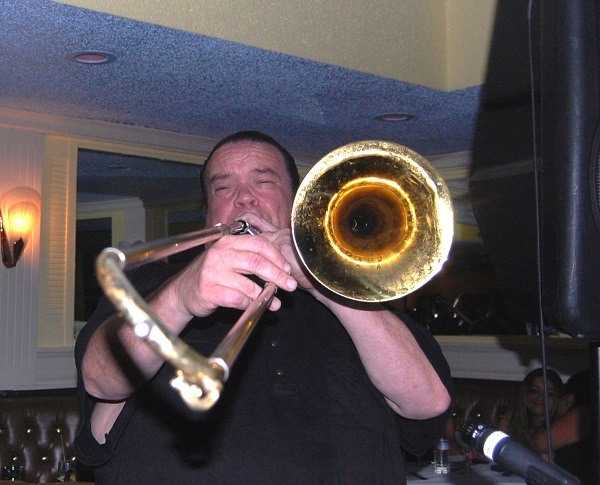
Yes, I am a Boricua from New York, that is to say, a Nuyorican as people say here. Back in the 80’s and 90’s, I grew up listening to the music of Hector Lavoe, Mon Miranda, Willie Colón, among others. I am a trombonist and also like trombanga, which is the music of Mon Rivera and Willie Colón which involves placing trombones at the front of the group so that the sounds are very heavy. That is the style of the Latin Rhythm Boys, which seeks to look to the future, but honoring the stars of yesterday. Since we have three or four trombones and a very particular singing style, many people say we sound like La Fania, including Hector Lavoe’s timbalero, who tells us that our style reminds him a lot of the 70’s and 80’s.

When I listen to your music, it sounds a lot like old school salsa. Why choose that specific style?

For me, that style represents the story of which we come from. My family and his father come from Puerto Rico and moved to Hawaii. In 1963, my father made his life in the United States, California, but he actually started his band in 1957, which was called Junior Miranda and The Latin Rhythm Boys. Then, my brother called it The Latin Rhythm Boys Orchestra.

We have added certain elements to make our music more modern, but many of the arrangements are typical of old school salsa.

Earl Miranda, Henry Miranda and other members of the band

How Earl, Henry, and Ric work together

Mr. Miranda, you are the musical director of the Latin Rhythm Boys and your brother Henry is the music producer. How do you work together?

(Mr. Feliciano answers the question) Well, I’m the arranger, so what we do is Earl and I write all our lyrics together. My family comes from a long line of jíbaros, but we also love salsa. That’s why we are what we are today.

(Earl Miranda’s answer) We are a great team because I have a lot of ideas and Ric applies them in a phenomenal way. Things work out even better than when I thought of them.

We’ve been invited to awards shows and films to make soundtracks in Hollywood. We’ve done some jingles for certain Hollywood and Netflix films.

Mr. Miranda, you said in an interview that jibaro is more like heart and soul, what did you feel when you listened to jibaro music as a child? Why is jibaro music so important to you?

This taste for jibaro music started when I was a child. This reminds me of when I was with my family, my uncles, my aunts, my cousins and other members. It is in my soul. However, we knew we had to evolve into something more relevant. That’s how we created the group and decided to mix new with old. We look to the future, but honor the past.

There are many family members in the orchestra. Would you say this is a family project?

I would say that myself, Henry, Ric and Ricky Castillo are part of the same family. Certainly, there are many members of the family, but many things change over time and members get older, so they withdraw from group. There are also many members who are not family, but they become family and become very necessary for the band.

Ric Feliciano playing the trombone

This question is for Mr. Feliciano. I understand that you joined the orchestra in 2003. How did you join the Latin Rhythm Boys?

I came to California in the 90’s and was part of a few bands here, but I was looking for something that might take me back to my roots. That’s when I heard about the Latin Rhythm Boys (laughs) and decided it was a project I could work on. It brought me get back to my family roots, but we also achieved a new sound.

Music is very important to the family. You have always listened to Jíbara and Puerto Rican music. Would you say that education and training is important for musicians?

Yes and no. Musical training is important on the one hand, but on the other hand I think that music just flows. For example, I’m not very good at reading music, but it’s here in my heart. I could perceive it, even if I don’t have a lot of training around it. I think that’s part of the beauty of it all. Well, Ric is a teacher, so he can offer you another view on this subject.

(This is Mr. Ric Feliciano) Indeed, I am a teacher and I’ve been teaching music for over 30 years, but I must tell you something. Education is not enough to be a good musician because there is a connection that cannot be taught through a class. I’ve had many students who do everything right in technical terms, but they don’t have the necessary flavor. Not everybody has that. I think there needs to be a balance between feeling, flavor and education.

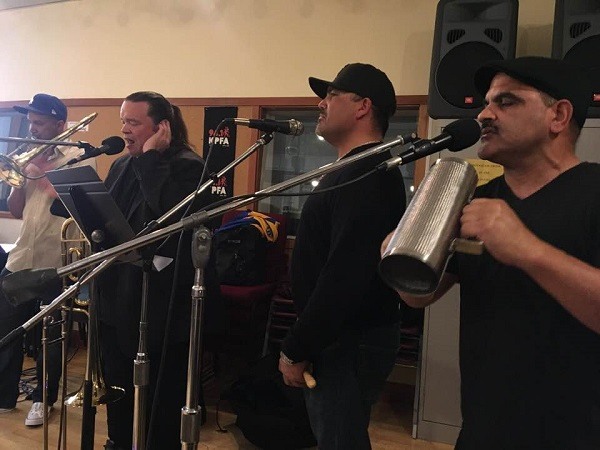
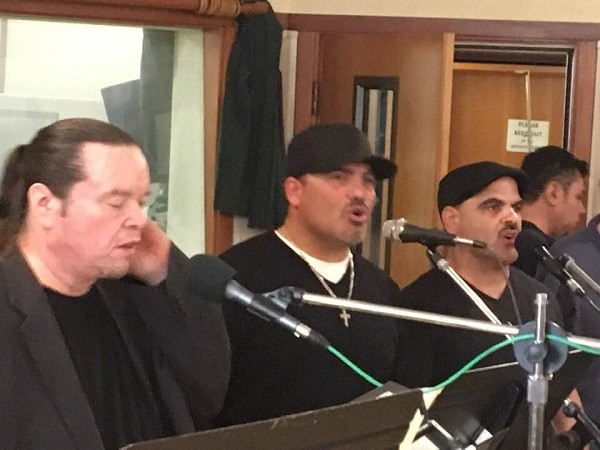
Ric, Earl, and Henry singing and playing

Do you have to be Latino to have that flavor?

We have some guys in the band who aren’t Latino, but they get the swing. We can work with anyone regardless of their ancestry, as we’ve had Americans and Europeans who have everything we’re looking for. We give them the sounds and they have no choice but to imitate them (laughs).

Do you consider it more important to make original music than to do covers?

Absolutely. If you have the talent and vision in your head, everything flows. I think if a person has a song in his/her head, he/she is going to want to translate into reality that idea and play it for an audience to see its reaction. If the reaction is good, you think you’ve done something right.

(This is Mr. Feliciano) What we usually do is to play our own songs at 90 per cent and covers at 10 per cent to please the audience. In fact, many people ask us for certain songs that they think they’re not ours, when, in reality, they are our hits from many years ago.

Ric, Earl, and Henry performing

Puerto Rican salsa singer Jai Ramos spoke to us of his life and projects

First years and military life

We are talking with Puerto Rican salsa singer Jai Ramos. How are you feeling? Glad to have you here.

I’m feeling fine. Thank you very much for the invitation. I feel blessed to be able to release my songs, but more important is the opportunity I have to be here talking to you and your audience.

person with clave in your hand
During his youth, Jai Ramos listened to ballads and popular music

Why did you choose salsa as your main genre? Was it to do with your environment or your roots?

It had much to do with my roots. When I started to lean towards music, I listened to ballads and various popular music singers that we had in Puerto Rico such as Chuco Avellanet, Lucecita, Lissette, among others. I also listened to other international artists such as Nino Bravo.

However, what made the switch was to go to the movies to see Our Latin Thing with the Fania stars. That’s when I made the change to salsa.

It’s very interesting because most of the artists you mentioned are boleristas or balladers, in other words, it was a huge change.

That’s correct.

You belonged to the United States Army, how did you combine your military career with your musical activities?

Interesting and very valid question. Even though I became interested in music, the places where I wanted to take music lessons would not accept me. After I finished school and became an adult, I joined the military and started to get exposure to different local music groups after arriving in the United States. That’s how I began to develop in my spare time. Admittedly, it was difficult, but where there’s a will, there’s a way.

I’ve talked to several Puerto Rican artists who were also in the U.S. Army at various ranks.

Did you get to coexist with other artists and salseros there? If so, do you think that helped you pursue your career in music?

Absolutely. Ar first, I met a lot of people who had a lot of musical experience in their spare time even though they were serving in the armed forces and they were the ones who provided me with the knowledge needed to improve this balance. With the passage of time, I also got to know people with musical experience who are very famous today such as Angel Santos. He and I served in the armed forces at the same time and retired at about the same time, so he chose composition, while I chose music performance.

I made a career in the army for 22 years of service. During all that time, I met many people and today I have communication with many of them even though we’re now civilians.

Jai Ramos
Jai Ramos shared with many other salsa artists during his time in the army

What Ramos learned from other artists

You got to share and sing along with artists such as Ray Barreto, Celia Cruz, Grupo Niche, Oscar D’ León, Nino Segarra, among many others. What did you learn from each of them?

Good question. They all taught me that they were still human beings and have a duty to the people in spite of being so famous. They were all very humble and that gave me to understand that they are flesh and blood people like us, but that they achieved success because of their talent.

When I was on a military base in Atlanta, I had an enormous exposure to many of them and it was Mr. Enrique Mercado who invited me to be part of his orchestra, which opened up for many great artists such as Celia Cruz, Ray Barreto, Grupo Niche, Eddie Palmieri, Conjunto Libre and the King of timbales Tito Puente. When I met them, I realized that they are devoted to people, prompted me to move forward in this career.

In musical and technical matters, what did these artists teach you?

Discipline and professionalism. Many people think that music is just entertainment, but those working on it see it as their profession. I also perceived the pride of providing entertainment for people, but always with quality. I understood that idea and started to apply this in my life.

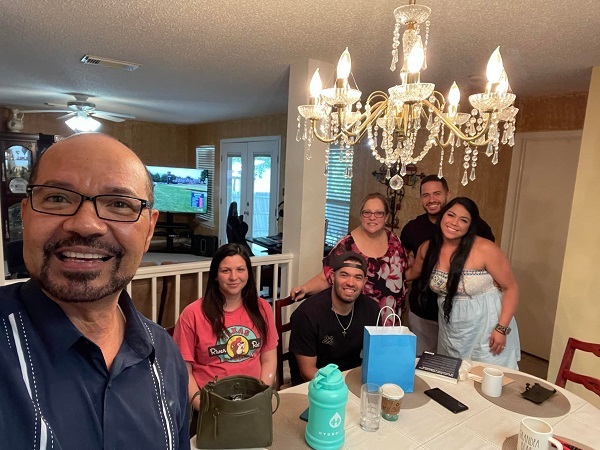
Jai Ramos and family
Jai Ramos with all his family

What did you learn not to do?

Some of the musicians who accompanied orchestras had certain habits that I was able to observe and I became convinced that I did not wanted to copy them. Sooner or later, I knew that such habits would eventually affect anyone.

I want to clarify that I did not see these things in any of the artists. That is why they are so professional, since they always behave well, both on and off stage. At the same time, they are humble enough to speak directly to a person like me who approached them to ask questions and get some advice.

What led you to have a solo career after having belonged to several orchestras?

I’ve always loved to be a lead singer, but I wasn’t the only one in the orchestra. However, something I noticed while being part of an orchestra is that I was always subjected to the music projects of our musical director, which stopped me from implementing my own ideas and my own music. That’s why I ventured to pursue a solo career and implement what God has put in my heart and mind.

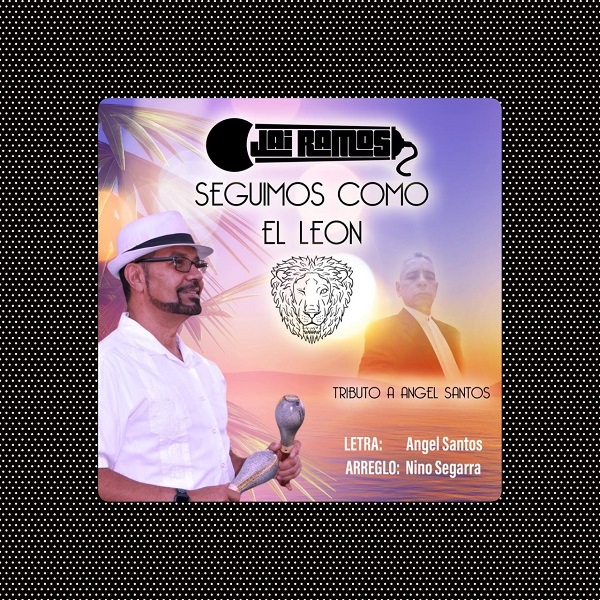
You had already told me about your most recent release “Seguimos Como El León”, a tribute to Angel Santos Junior. Why did it take you to embark on this project? Why pay tribute to Angel Santos Junior?

Thank you for that question. I want to keep giving credit where credit is due. Angel and I were very close friends and I’m using the past tense because unfortunately he passed away on 15 April 15 this year. When I came here to San Antonio, he was one of the first musicians I met and I shared with him in many performances. As I mentioned before, he and I were in the army at the same time.

One of the things Angel has achieved was to create many successful compositions. When I decide to launch my own project, one of the people that I had in mind to get an original song was Angel. When I called him and asked if he had something available, he told me that he only has one song, which was “Seguimos Como El León”. By that time, I knew he was having health problems, but I had no knowledge that he had already been evicted.

cover jai ramos
Cover of the song “Seguimos Como El León”

When I listened to the lyrics, I didn’t realize that he was giving a message about himself for when he left. Almost all of his compositions had a joking or small-town tone, but this one is a message of overcoming.

By the time we finished the song, maestro Nino Segarra and yours truly agreed to record the project, master it and record it. Then, I shared it with Angel so that he could listen to it and I told him that we gave him credit. Nino Segarra and I thought it was important that everyone who listened to the song always knew that it was one of his compositions.

When we were getting ready to do the release, we learned that he passed away. So, I proceeded to communicate with his family to ask permission from them to use his image and pay tribute to him with that song. They agreed, so I changed the cover and the title of the song to make it look like a posthumous tribute to Angel and thus to perpetuate his name.

What did you learn from Angel Santos artistically and musically?

He was my mentor in this release. I carried out the project, but he mentored me into most of the steps I followed. The biggest lesson I learned from him in the last years was how to be an independent producer and how to implement the ideas I had in mind.

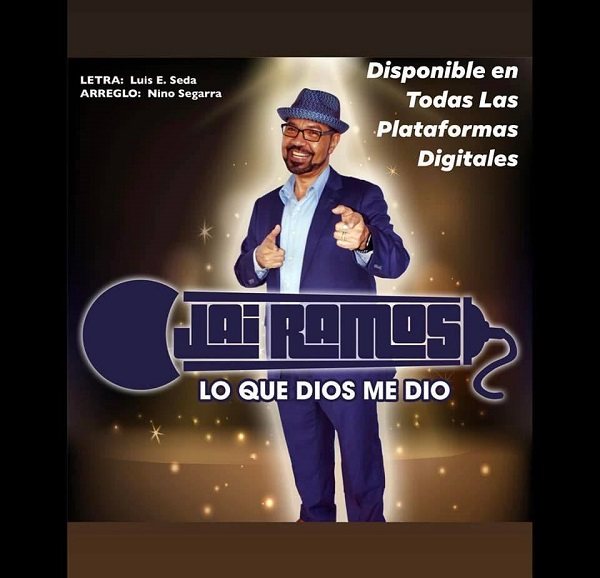
You have songs with titles such as “Seguimos Como El León” and “Lo Que Dios Me Dio”. We can note that these songs are focused on bringing positive messages and about personal growth. Why are these aspects so important to you? Why reflect them in your music?

I am a servant of the Lord. In my spare time, I am a minister at a church. With all the things happening today, I felt in my heart that I had to be part of the solution and bring a positive message in the midst of what is going on.

My musical proposal is based on messages about personal growth with the idea of getting people closer to the Creator.


cover jai ramos lo que dios me dio
Cover of the song “Lo Que Dios Me Dio”

You can read: This is Roger Danilo Páiz Pérez from Danilo Y Su Orquesta Universal

  • « Go to Previous Page
  • Page 1
  • Interim pages omitted …
  • Page 105
  • Page 106
  • Page 107
  • Page 108
  • Page 109
  • Interim pages omitted …
  • Page 155
  • Go to Next Page »

International Salsa Magazine (ISM) is a monthly publication about Salsa activities around the world, that has been publishing since 2007. It is a world network of volunteers coordinated by ISM Magazine. We are working to strengthen all the events by working together.