• Skip to primary navigation
  • Skip to main content

International Salsa Magazine

  • HOME
  • Previous editions
    • 2026
      • ISM / May 2026
      • ISM / April 2026
      • ISM / March 2026
      • ISM / February 2026
      • ISM / January 2026
    • 2025
      • ISM / December 2025
      • ISM / November 2025
      • ISM / October 2025
      • ISM / September 2025
      • ISM / August 2025
      • ISM / July 2025
      • ISM / June 2025
      • ISM / May2025
      • ISM / April 2025
      • ISM / March 2025
      • ISM / February 2025
      • ISM / January 2025
    • 2024
      • ISM / December 2024
      • ISM / November 2024
      • ISM / October 2024
      • ISM / September 2024
      • ISM / August 2024
      • ISM / July 2024
      • ISM / June 2024
      • ISM / May 2024
      • ISM / April 2024
      • ISM / March 2024
      • ISM / February 2024
      • ISM / January 2024
    • 2023
      • ISM / December 2023
      • ISM / November 2023
      • ISM / October 2023
      • ISM – September 2023
      • ISM – August 2023
      • ISM July 2023
      • ISM Edition June 2023
      • ISM – May 2023
      • ISM April 2023
      • ISM March 2023
      • ISM February 2023
      • ISM January 2023
    • 2022
      • ISM December 2022
      • ISM November 2022
      • ISM October 2022
      • ISM September 2022
      • ISM August 2022
      • ISM July 2022
      • ISM June 2022
      • ISM May 2022
      • ISM February 2022
      • ISM January 2022
    • 2021
      • ISM December 2021
      • ISM November 2021
      • ISM October – 2021
      • ISM September 2021
      • ISM August 2021
      • ISM July 2021
      • ISM May 2021
      • ISM April 2021
      • ISM June 2021
      • ISM March 2021
      • ISM February 2021
      • ISM January 2021
    • 2020
      • ISM December 2020
      • ISM November 2020
      • ISM October 2020
      • ISM September 2020
      • ISM August 2020
      • ISM July 2020
      • ISM June 2020
      • ISM May 2020
      • ISM April 2020
      • ISM March 2020
      • ISM February 2020
      • ISM January 2020
    • 2019
      • ISM December 2019
      • ISM November 2019
      • ISM October 2019
      • ISM Septembre 2019
      • ISM August 2019
      • ISM July 2019
      • ISM June 2019
    • 2016
      • ISM December 2016
  • Spanish
  • Download Salsa App
    • Android
    • Apple

Search Results for: Pianist

You will hallucinate with these 4 Salsa clubs in Spain

Barcelona is the second destination city with the major Salsero movement in the Iberian Peninsula

After the Spanish capital, Barcelona, ​​Galicia, and Alicante are the main cities with the greatest salsa identity.

During the 90s this tropical rhythm began to be adopted in the territory and the first cities to put aside the prejudice toward Latin music were Madrid, Murcia, Cádiz, and Galicia, although Salsa was always heard in the Canary Islands but that is a story that we will tell later.

Currently, Barcelona is the second city with the most salsa movement and there are many options where you can enjoy an amazing dance experience in combination with tropical music and amplified energy. So, we will give you a guide to four clubs that have left their mark in Spain with Latin rhythms and which we assure you that you will love a lot.

Mojito Club

Mojito Club is 100% Salsa & Bachata on Thursdays and Sundays

If there is a place where you can go dancing Salsa and enjoy an unforgettable night out, that place is Mojito Club. Indeed, this club is a reference for Salsa in one of the fascinating cities in Spain with architectural landmarks and where more people like this Caribbean rhythm, Barcelona. On its dance floor, you can have a great time until dawn. Thursdays are from 11 PM with the usual Salsa and the most current Latin sounds with local DJs. Does it surprise you? Wait, there is still more to celebrate. On Fridays and Saturdays, they play the most international Latin music and on Sundays, it’s student day from 8 PM.

Mojito Club also has a dance school where they teach classes of Salsa and Bachata to start or improve. These lessons are entertaining, educational, and fun. Each course is 10 hours long and the lessons are from Monday to Friday. It’s not necessary to attend as a couple. Registration is free and costs € 29 per month.

The charm of Mojito Club https://mojitobcn.com/ is located at Rosellón Street, 217. 08008 Barcelona.

Sabor Cubano Sarrià

Luis Alberto Díaz “El Negri” plays the big hits of traditional Cuban music on salsa nights

It’s true Barcelona is almost the cradle of Salsa in this European country. Sabor Cubano Sarrià is one of the town’s Salsa clubs. This Night Club offers live music with the virtuous Cuban pianist, Luis Alberto Díaz “El Negri” also you can dance to the melodies of Cuban Salsa, International Salsa, Bachata, and urban rhythms with DJs. Here, you will find Salsa and Bachata teachers who give free lessons for beginners at 8 PM every Sunday with minimum consumption. Sabor Cubano Sarrià https://www.facebook.com/saborcubanoclub is one of the clubs where you can have fun with the two most widespread Latin dances in the world. It opens its doors from 7 PM to 12:30 AM and you can find it at Calle Marià Cubí 4. 08006 Barcelona.

Baby’Oh

Baby’Oh is a meeting point for lovers of Salsa, Bachata, and Kizomba

Baby’Oh is another fantastic club to enjoy Salsa and is easy to locate in Alicante at Calle Sabadell, 16, 03203 Elx. It is characterized by having a large room to dance and slide with quick movements and turns. It has a terrace for smokers, V.I.P and Reserved areas, as well as Table Service. Additionally, Baby’Oh https://www.facebook.com/babyohelche/ offers monthly events, workshops (Saturdays), and live performances with stars and emerging Salsa and Bachata artists.

Salason
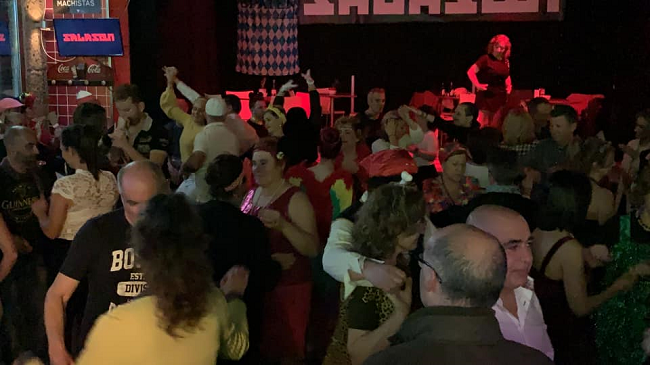
This cultural platform is designed with exceptional acoustics and cutting-edge technology.

The last stop in this guide with the four Salsa clubs in Spain with which we assure you that you will hallucinate is Salason. Of course, you will learn Cuban-style Salsa and Rueda Casino as well as traditional Bachata lessons with maximum fun, coordination of movements, and body language.

You can practice on Tuesdays in two groups: Students (intermediate level), the Salsa lessons start at 8 PM, and the Bachata group starts at 8:30 PM.

Thursdays are classes for beginners with two choice times: 8 PM and 9:30 PM.

Salason https://salason.es/ is a structured building with three independent rooms but complementary to each other and is located in the northwest of the country at Calle Lirio, 30 Cangas Do Morrazo, 36940, Galicia.

NOTICIAS CON SABOR MARCH 2022 by Luis Medina

Live music and other news in the SF Bay Area

I recently interviewed percussion phenom and timbalero for Santana, Karl Perazzo on my KPFA Radio program Con Sabor. He is quite a busy man…I caught up to him while he is in Las Vegas for rehearsals for Santana’s upcoming slew of shows at the House Of Blues. In addition to his busy schedule with Santana, Karl has other projects during his spare time that include the SF based all-star Salsa band Karabali as well as guest appearances with Salsa Caliente that kept him busy during the COVID. He also appears on occasion with fellow bongocero Jake Jacobs band VibraSON. On top of all of that, Perazzo also creates and manages his own line of jewelry.

Perazzo, a self taught musician who was drawn to the drum and Afro-Cuban music as a young child and started his musical studies at the age of 8. Karl is a phenomenal percussionist who plays masterful Timbales, Bongo, Congas, cowbell and an impressive array of percussion instruments. He has been a mainstay in the Santana band for the past 31 years inheriting the Timbales spot from the legendary Orestes Vilato. Perazzo is still going strong keeping the percussive fire burning on Santana’s latest recording Blessings and Miracles. The band will be launching a major tour with Pop legends Earth Wind and Fire later this year. He has his own signature line of Latin Percussion congas and bongos that he designed himself with a distinctive Dia De Los Muertos sugar skull theme to honor the ancestors.

Karl Perazzo and his instruments
Percussionist and timbalero for Santana Karl Perazzo

Perazzo has previously performed with the greats such as Tito Puente who mentored him when he was a young kid along with another fellow kid phenom Gibby Ross. I saw Karl and Gibby playing with Tito on stage-what a sight to see! Karl also played with Sheila E. (as a member of her band in her emergence as a huge star in the 1980’s), Prince, Pete Escovedo, Dizzy Gillespie, Malo, Pacific Mambo Orchestra, Ray Obiedo, Andy Narell, Jorge Santana, Raul Rekow and many others. Perazzo also formed the popular SF based salsa band Avance which had a long run starting in the early 1990’s. The group disbanded in 2020. Karl has kept himself connected to his roots which is Salsa and Afro-Cuban music but has always kept his hear open to all types of music since his childhood. He credits his father who always encouraged Perazzo to push himself to be a complete percussionist, to learn how to sing and be a versatile performer.

Perazzo is now launching his own YouTube show “The Backstage Show” on the TBS Music Channel in the next couple of months which will focus on fellow creatives such as musicians, artists, chefs, writers and other notable individuals involved in arts and culture. Perazzo who is the host of “The Backstage Show‘ told me that the program’s mission is “to turn music into inspiration“. I asked Karl Perazzo what keeps him going. He told me “you have to have passion in whatever you do in life…whether it’s sweeping the floor or playing the drum”. You can feel that burning passion, inspiration and enthusiasm along with those great playing chops whenever you see him play live! You can catch up with Karl Perazzo by following him on Instagram under karlpperc.

Music Notes

Music Notes: Salsa superstar Luis Enrique and Peruvian salsero Josimar Y Su Yambu are the new headliners replacing Victor Manuelle on Saturday, April 9th at the Hyatt Regency Hotel in Burlingame. Promoters JC Coral and Bosco Vega are presenting the show which originally was scheduled for early February but was postponed due to COVID restrictions. The new lineup was announced earlier in February. For tickets, visit eventbrite.com, tickeri.com, ticketsparati.com or call 415-424-8809 or 650-218-0861.

Luis Henrique performing
Luis Henrique on stage

Former El Gran Combo vocalist Charlie Aponte will be singing his original solo material as well as a slew of his great Gran Combo hits on Friday, April 6 at Roccapulco in San Francisco. Pepe Y Su Orquesta will be opening up the show brought to you by Jaffe Events. Roccapulco will also be presenting the red hot Combinacion De La Habana with a high energy six man vocal front line for their SF debut on Saturday, March 5th. CDLH is under the direction of Gerson Valdes, the nephew of iconic pianist Chucho Valdes and performs Timba mixed in with Reggaeton and Salsa Dura. This popular group is embraced by Cuba’s youthful fans and making fans everywhere.

Jaffe Events in association with MGD Productions will be presenting a dream Cuban music double bill featuring Los Van Van and Havana d’Primera with Alexander Abreu on Friday, May 6th at Berkeley’s UC Theatre, 2036 University Avenue. DJ Antonio will also play in-between sets. I have the honor of serving as the Master of Ceremonies of this special event. For Info and tickets visit www.jaffeevents.com.

Former Los Van Van vocalist Yeny Valdes and her band will be visiting the popular Fresquecito monthly party at La Furia Chalaca, 310 Broadway in Oakland on Saturday, March 12 at 10 pm. Yeny will be joined by resident DJ’s Walt Digz and Pepe Timba. For tickets, visit www.eventbrite.com

La Peña Cultural Center, 3105 Shattuck Avenue in Berkeley is featuring a special “Baila” community dance party on Friday, March 18th from 7 pm to 1 am with a multi-room environment featuring the explosive salsa of BrauLio Barrera’s Somos El Son with KPOO/KPFA DJ Jose Ruiz in the main auditorium. DJ Ron will be spinning Bachata in the lounge. Salsa and Bachata dance lessons by In Lak’ech Dance before the show begins at 7:30 pm. Tickets are already going fast. For tickets and information, visit lapena.org.

World Salsa Radio is presenting their second in a series of dance socials on Friday, March 25th at The Beat, 2560 Ninth Street in Berkeley. There will be dance performances by renowned Salsa dance troupes as well as Salsa lessons starting at 9 pm. The DJ music will be provided by WSR CEO Felipe “El De La Clave SF” Martinez and WSR co-founder Orlando DJ Boricua” Felix. Special guest DJ will be yours truly, Luis Medina of “Sabiduria Con Tumbao” starting my set at 10 pm.

Be sure to tune in on your laptop, phone or devices by visiting www.worldsalsaradio.com. It’s on 24 hours a day!

Some of the DJ's
Walt Digz, Felipe “El De La Clave”, Antonio and Luis Medina

The Seahorse in Sausalito continues to showcase a variety of fine bands on Saturday and Sunday evenings starting at 5 pm. This month, the Seahorse features Julio Bravo’s 50+ Birthday Party with Julio and Salsabor 3/6, Rumbache 3/12, Edgardo Cambon and Candela 3/13, Anthony Blea & Friends and DJ Jose Ruiz’ Birthday Party 3/19, Louie Romero & Mazacote 3/20, La Clave Del Blanco 3/26 and Orquesta Taino on 3/27. The featured DJ is KPOO/KPFA’s Jose Ruiz. Great food, Beer and Wine are offered at this popular venue located across the Golden Gate Bridge at 305 Harbor Drive.

The Ramp, 855 Terry Francois Blvd near the water in San Francisco continues their popular Salsa Saturdays with N’Rumba 3/5, Orquesta Borinquen 3/12, Karabali 3/19 and Manny Martinez y Orquesta La Rebeldia 3/26. The shows start at 5 pm and feature DJ Mendy in-between the sets.

San Francisco’s The Cigar Bar on 850 Montgomery Street is continuing their hot Friday and Saturday night live Latin music schedule in March. This month, they are presenting Manteca, 3/4, Pepe Y Su Orquesta 3/5, The Latin Rhythm Boys 3/11, Josh Jones Latin Jazz Ensemble 3/12, Julio Bravo y Salsabor 3/18, La Clave Del Blanco 3/19, Somos El Son 3/25 and Edgardo Cambon y Candela 3/26. Enjoy the classic surroundings, the patio, the fine food, cigars, drinks and the swinging music at the Cigar Bar.

Promoter/DJ Bosco Vega is also opening a new local night spot Gustoso at the Atlas Lounge, 637 San Mateo Avenue, San Bruno on Sat. March 12th featuring Salsa, Bachata and Timba by DJ’s Franklin, Antonio and Bosco himself!!

Remember you can catch my radio programs Con Sabor (in its 25 anniversary year) on KPFA 94.1 FM and kpfa.org Saturday nights 9 to 11 PM PST & Sabiduria Con Tumbao on Wednesday nights 5 to 7 PM PST on WorldSalsaRadio.com.

That’s it for this time! Ciao 4 now!!

This is Julio Bravo
Julio Bravo performing with his orchestra

BY LUIS MEDINA, PRODUCER AND HOST OF CON SABOR ON KPFA 94.1 FM AND SABIDURIA CON TUMBAO ON WORLD SALSA RADIO.COM

Memo Arroyave, entre las voces más importantes e impecables del Caribe

Considered as one of the faithful representatives of Venezuelan salsa, the young vocalist Guillermo José “Memo” Arroyave, born on July 22nd in the city of Caracas, arrives to “Salsa Escrita” for an exclusive interview.

Memo Arroyave, continues to project himself with more and more quality and professionalism, characteristics that define him in the Caribbean music genre at the national and international levels.

In a pleasant and enjoyable conversation with Memo, he told us about his career and his current and future projects.

Memo Arroyave, welcome to Barquisimeto’s salsa column “Salsa Escrita”; it is a great pleasure for us to have you as our special guest and we would like you to tell us about your beginnings in your artistic career.

-Thank you Carlos for the opportunity you are giving me to reach your readers in a direct and fraternal way.

Memo Arroyave

Memo Arroyave, among the most important and impeccable voices of the Caribbean

My beginnings in the world of music and show business date back approximately to 1996, when I was a student of the successful Venezuelan Rafa Galindo (R.I.P.D.), the musical legend of our country.

Then I ventured into the stages forming part of different groups in Caracas, such as Partitura Latina, Orquesta Gente Novel, Orquesta Ensueños, Galaxy Latin Band, El Código Salsero, among others.

-Memo, which artists have you shared the stage with, what can you tell us about them? Professor Carlos, I have had the opportunity to share the stage and accompany, on occasions, as a soloist and others as a backing vocalist, national and international artists of the stature of: Andy Montañez, Ismael Miranda, Viti Ruiz, Christian Fernandez, Adalberto Santiago, Pupy Santiago, Paquito Guzman, Roberto Blades, Jose Mangual Jr, Max Torres, Wichy Camacho, Willman Cano, Nino Segarra, Nelson Arrieta, Marcial Istúriz, Mandinga Star Band, Wílmer Lozano, Wiwi Buznego, Wílmer Cobos, Cheo Valenzuela, Miguel Araujo, Erick Franchesky, Irving Manuel, Ángel Flores, Samir Bazzi, Manuel Guerra y su Orquesta, and in December 2019, I shared the stage with Hermán Olivera, Luisito Carrión and Frankie Vásquez.

-Regarding current projects, what can you tell us about them? I am part of several projects simultaneously my friend Carlos, among which stand out: Orquesta Puma Band, Victor Cardona y la Máquina de la Salsa, La Rumba Sonora de New York, Afro Códigos and recently I was invited to participate in the 10th Anniversary album of “Los Rumberos del Callejón”.

Well Memo, for all that you have given us to know about your talent and dedication, you are an obligatory reference of the salsa show and we would like to know about your most recent and future projects.

-In fact, I recently recorded and released the song “Si falta el Aire”, a composition by the Spaniard David Santisteban, with arrangements by Enmanuel “Cerebro” Romero and under my production.

 Memo Arroyave
Memo Arroyave, continues to project himself with increasing quality and professionalism.

It was recorded in Caracas, Mexico, Miami, and New York, mixed and mastered in the Venezuelan capital, as part of my first musical production. Other of my hits are: “Y lloré”, “No Puedo estar sin ti”, which I did a duet with Rafael “El Pollo” Brito. And as a scoop for your salsa column “Salsa Escrita”, I already have the next promo ready and it is a duet with NG2 from Puerto Rico and last week was the release of the song with José Madera Niño “3º Mundo”, titled: “Me gustas pero…”, which is sounding strong and last year I recorded for a Colombian pianist, but he is based in Washington, United States, which made an album called “10” and among other singers participate: Rodrigo Mendoza, Mariana “La Sonora de Venezuela”, Marcial Istúriz, Gonzalo Díaz, Mike Barrios, which is a talentazo of Zulia state, who is currently in Mexico, my person and other people from other countries.

Soon I will be in the production that is in the process of mixing and where Argenis Carruyo, Oscar Arriaga, Wichi Camacho, and others also participate.

-Excellent Memo, I understand that in addition to your facet as a singer, you also dabble in the media?

That’s right professor, let me tell you that I am the nephew of Fernando Sosa Leal, I have done radio and television since 2002; I started with a radio program in the state of La Guaira, I was the director of the musicalization of Azul 95. 9 FM, then we did “Mundo Latino”, there I was as an animator with Fernando Sosa Leal and Luis Arturo in CMT, then in TVES, but I leave the project to devote myself more to my singing career and also went several times to Puerto Rico to the editions of the National Salsa Day, World Salsa Congress, to give coverage from there for all Venezuela and the Caribbean and recently as the producer of Strike 13 with Fernando Sosa Leal in his Bowling program for Meridiano TV.

Carlos, I wanted to thank you for the focus you give to the singer through your salsa column, if I may say individually and not so much as choristers, which of course is important, but in your work and interviews we have read the support and contribution you give to our musical productions and recordings with orchestras, since this way we make ourselves known to music lovers as well as to the public.

Finally, I want to thank you for your time and congratulate you for this work that you do with a lot of enthusiasm, with desire and that should be appreciated not only by me but by all musicians, artists who are giving it their all and that, if it were not for people like you, it would be even more difficult.

-Your social networks? Through @memomedicen, they are my accounts in R.R.S.S. Thanks, Memo for this connection we had and thank you for accepting the invitation to Salsa Escrita “La Columna Salsera de Barquisimeto”, through International Salsa Magazine, www.salsaGoogle.com, we would also like to have you performing in our twilight city and musical capital of Venezuela and remind all artists that we are to serve them in an unconditional way in favor of our Latin music and obviously the Venezuelan talent that is unquestionably superior every day.

See you next time and let’s keep salseando!

Article of Interest: Henry Valladares, a brilliant, versatile, and disciplined percussionist

Johnny Andreu “Almendra”. Bandleader, percussionist and founder of Los Jóvenes del Barrio

Growing up and listening to music, he played with various objects around the house. Taking things seriously at the age of 16, he started with bongos, then congas and then timbales, which is the instrument he is best known for.

Andreu y Los Jovenes Del Barrio, the band was led by his ex-wife, the American born singer JILLIAN (1962-2009) able to charm you in two languages, a great loss at a young age, another victim of the scourge of our time, cancer. Blending elements of Charanga, Jazz, Typical Latin, the group dominated radio stations for a decade.

Brooklyn-born composer Johnny Andreu, who from an early age was introduced to and kept in touch with Latin rhythm through family influences, received his musical training at U.C.L.A., the “University on the Corner of Lexington Avenue. When he was 18, Mario Lebran, a musician with Ricardo Ray and author of ‘Mambo Jazz’, helped him get into the music business. He has learned a lot by listening to his records and playing his instruments.

Lebran Andreu also encouraged him to audition for his first job as a percussionist working for “Mike y Su Rítmico”. From there he moved on to the Bobby Matos orchestra whose pianist Paquito Pastor said one day he named him Andrews after Andreu. You are Latin, you are an ‘Almendra'”. That’s how Johnny Andreu became Johnny Almendra.

In the late 1960s he teamed up with Johnny Colon, they performed at the Corso and the legendary Cheetah, and after a year, Almendra and Louie Bauzo left to form their own band, Tambo.

This group lasted about four years and later worked with Almendra Charanga ’76, Orquesta Broadway, and the Típica Novel. Playing with Típica Ideal, he met Milton Cardona, who became a lifelong friend.

Band director, percussionist and founder of Los Jóvenes del Barrio.
Johnny Andreu “Almendra”

One day Cardona invited Almendra to see Willie Colón at Casa Borinquén, and as it turned out, they were in need of a timbalero. They invited Almendra who stayed for eight years.

During 1977 and 1978, Willie Colón Rubén Blades recorded history-making albums. A large number of the best musicians of the time were brought together, including Héctor Lavoe, percussionist José Cándido Rodríguez, bassist Víctor Venegas and many others. This material was released in 1998 for the RMM label.

For International Salsa Magazine through www.SalsaGoogle.com it is a great pleasure to review an artist of the stature of Jhonny Almendra, catalogued as one of the greatest percussionists in the city of New York for his ability and skill still in the forefront of Latin Music.

Johnny Almendra, Los Jóvenes Del Barrio  Reconfirmando “1997”

Johnny Almendra, Los Jóvenes Del Barrio – Reconfirmando “1997”

Tracks

Todo el Mundo Necesita

Pasión Sin Freno

Hechicera

Everybody Plays the Fool

Borincuba

Zapato Apartao

Cumbiaranga

Compassion

Rent

Cold and Darkness, The

Hechicera Reprise/A-Files

Musicians

Regina Carter – trombone

Ozzie Meléndez – trombone

Ronnie Bar – backing vocals

David O’Quendo – flute

Karen Joseph – flute

Kimson Plaut – accordion, piano, synthesizer

Oriente Lopez – flute, synthesizer, backing vocals

Ray Sepulveda – vocals

Tito Nieves – vocal

Robert Thomas – violin

Sam Bardfeld – violin

Al Bello – percussion

Andreu Johnny Almendra – percussion

Frank Seguinot – vocal

Miles Peña – vocal

Sources: 

https://lasalsaesmivida.com/johnny-almendra-y-los-jovenes-del-barrio-reconfirmando/https://www.pinterest.com/bobbymartell/johnny-almendra/

Article of Interest: What Ángel Meléndez has to say about his brilliant musical career

Lino Roldán “Taino” and his amazing station Radio Brisa Tropical

How Radio Brisa Tropical Started

We meet today with Taino Roldan from the fabulous station Radio Brisa Tropical. Good morning Mr. Roldan, hope you are well.  

Quite well, thanks to God. Warm greetings to you from our radio station Radio Brisa Tropical.  

How did you start liking broadcasting and how did you know you wanted to get into this? 

Whilst resident in Italy, I began my career as a DJ there and in Germany. When I returned to the United States, I started going to all the local stations to have a salsa show. At first, they always replied that they were not interested and the doors were closed to me, but that never caused me a problem. I have always believed that if a door has closed, you have to find a way to enter that world, no matter what. At last, I started working at an AM station where I spent three years and then at a FM station for almost 10 years.

During this whole period, I was studying broadcasting at the local university and playing with the internet. It was by that time that streaming and webcasting, which was in 2005 if I got it right. A friend of mine who was a computer programmer told me that I could broadcast my shows in this manner. I asked him for help, given he was the expert, so we did this and connected. At that time, Facebook or any of those things did not yet exist, but MySpace did. Then we managed to webcast until the streaming service came out from the hand of YouTube and other platforms, and that’s when I opened my accounts in those social networks and created my website.

While I was on FM, we continued webcasting until 2012, which was when I officially left that station. I was on about four FM stations, but on different days in the area where I was. After I stopped working in those places, I decided to keep right here in my own studio and do my show solely and exclusively on the internet and it has been the case until today. It has been 31 years of happiness and here I am still standing.

Lino in his studio
Taino Roldán in his studio, where he webcasts his show Radio Brisa Tropical

We understand that this Radio Brisa Tropical project started in 1991. How was this idea conceived?  

While I was on AM, my show was not called Brisa Tropical, but rather “¿Qué pasa?” There we included all kinds of music and gave cultural news about all countries, since I am in an area represented by all Latin American countries, the Caribbean Centre, South America and Spain. Having such a diverse audience, I decided to talk about all countries and not just mine, which is Puerto Rico. I talk about the important days of all the countries such as independence days and other historical events. I want to make content to entertain and educate the audience.

When I switched to FM, the station where I did my show is called “The Brise” and it played contemporary music in English. So, I sat with a friend who was helping me and it was there when I called my own program “Brisa Tropical”, as it is during that time that we included salsa, merengue, bachata, vallenato and much more.

Thank the Lord and the audience we have, we are more dedicated to salsa, and when I say “salsa”, I am including Cuban son and all these Afro-Cuban rhythms that were called salsa since the 70’s till present. However, we like to include all tropical music, classic as well as contemporary. So, it is at the point now where we have created an international audience, and that’s why it is so important to identify and mention the names of the artists, the orchestras, the composers, the arrangers, the members of the groups. Let us remember that there is plenty of time on the Internet. This is nothing like an AM or FM station that are commercial and you only have to reduce the amount of time. Here, I am the programmer and the announcer.

Radio Brisa Tropical is streamed exclusively on the Internet

You have already told us about the role played by the internet and social networks in implementing your project. So much so that networks have become the main transmission channels of the station. Is the internet the main broadcasting channel or are you still on the radio?  

My show is streamed exclusively on the internet. Commercial broadcasters were my beginning, but I am absolutely sure that the future is the internet and I am not just talking about Facebook because this social network is not a music platform. I have my YouTube channel, my Facebook page and my Twitter account, but webcasting has opened the door to all musicians, performers and composers from anywhere in the world. The internet is the future of music. I am dedicated to salsa and Latin jazz, but I usually include other genres that listeners often ask me for, such as cumbia, tropical music, vallenato, etcetera.   

In addition to salsa, your station plays other genres such as Latin jazz, vallenato, cumbia and plena. Why did you start this project with salsa as a base?  

I grew up with salsa and developed myself as a DJ for many years both in Italy and Germany. Although I used to play everything, when I saw the love of Europeans for salsa on the dance floor, I always decided on it. Salsa has always been my life. I like all positive music, but I will always prefer to broadcast salsa and Latin jazz. Now, if a listener asks me to play a good song that does not have high-flown words or anything, I have no problem with it. Here I have been asked to play even rancheras because I have learned that you never say no to that loyal audience. 

You currently broadcast live on YouTube, Facebook and your website. Do you know which transmission channel has a bigger audience?   

Most of my audience listens to me through the link to my server and website. Remember that the website has the links to the channel and the other social networks. Through TuneIn, I receive a lot of audience around the world. I also use Live365 because the station pays royalties and I have the license to broadcast legally. The problem is that this platform is not heard in some places in South America or Europe, which is precisely why I also use TuneIn. When I check my content every day, I realize that we have a lot of audience coming from the Caribbean, South America, Central America, Europe and the United States.

Taino with a Wito Rodríguez album
Taino Roldán holding a Wito Rodríguez album

Age ranges of Radio Brisa Tropical

Many would say that the genres played on your station are to the taste of an older audience that enjoyed the salsa of the 70’s, 80’s and 90’s. What is the age range of your station?  

According to the demographic information and the comments I am getting, I have seen that we have people from 10 or 11 years old and up. Once, a lady sent me a comment saying that her 100-year-old dad stayed in bed listening to the station and even sent me a picture of him smiling. I’ve also received messages from young people. I would say my demographic ranges from 20 years old and up.

I include classic salsa because many of those performers and bands remain relevant with their legacy despite having passed away, but there are also many salseros from that golden era in the 70’s and 80’s who are still active like Willie Rosario or La Sonora Ponceña. I have a lot of Venezuelan and Colombian friends from Venezuela who always send me music.

 I like to balance my way to program. I like to take people back to the 70’s and even beyond, bring them back to the present and explain the ins and outs of a song or album. One of the most important things a broadcaster must do is to mention the artist, the composer, the arranger, the musicians, among others. You have to talk about the piece that is playing and what is behind it.

Tarino next to Willie Rosario
Taino Roldán and Willie Rosario

What you are saying is very important because many times people only focus on the vocalist or leader of a group, but they do not wonder about all the behind-the-scenes work or even talk about the rest of the members, such as the guitarists, the pianists, the arrangers or the musical directors. In that sense, what do you do to disseminate all this information? 

I like reading a lot. If I am going to talk about a specific artist, I will look for who he is, what his trajectory is, how his beginnings were, what he did, what he is doing now. Of course, I have never included any personal data. This is very important to me because this helps the artist to sell his stuff. When there were a lot of record sales, I had the habit of checking the back to read the liner notes of that artist. That information is very valuable to me because that is what I use to  inform the audience unequivocally.

From what you have told me, you have been working exclusively on the Internet for many years. Did you do it before or after the pandemic?  

I had already been webcasting my program on the Internet for many years. In fact, I have been doing it since 2012. Thank goodness, the pandemic has not affected me in any way. My wife and I have taken care of ourselves and followed the sanitary rules, but this situation has not affected our work. On the contrary, I am here before the microphone in my studio while I speak and play music every day in the morning. It may also happen that I bring my laptop to a remote location and air the show from there or through my cell phone. I have done a lot of interviews during all this time because I like it so much.    

What other projects or shows are you carrying out?  

I have discovered that I can do a show about music, but without playing music. Sometimes I do it, but this is not my usual due to the issue of copyright with Facebook. I have a show called “Hablando de Salsa” and I am proud of it because it has been very successful. I am doing this project with Eduardo Saya. The show is entirely about salsa and we broadcast it every Wednesday at 6 PM CST. There, we always choose a different subject to be tackled every day.

Lino and his wife
Taino Roldán and his wife Carmen Roldán

Link to the Facebook page of Taino Roldán: Taino Roldán

  • « Go to Previous Page
  • Page 1
  • Interim pages omitted …
  • Page 40
  • Page 41
  • Page 42
  • Page 43
  • Page 44
  • Interim pages omitted …
  • Page 55
  • Go to Next Page »

International Salsa Magazine (ISM) is a monthly publication about Salsa activities around the world, that has been publishing since 2007. It is a world network of volunteers coordinated by ISM Magazine. We are working to strengthen all the events by working together.