• Skip to primary navigation
  • Skip to main content

International Salsa Magazine

  • Home
  • Previous editions
    • 2026
      • ISM / January 2026
      • ISM / February 2026
    • 2025
      • ISM / December 2025
      • ISM / November 2025
      • ISM / October 2025
      • ISM / September 2025
      • ISM / August 2025
      • ISM / July 2025
      • ISM / June 2025
      • ISM / May2025
      • ISM / April 2025
      • ISM / March 2025
      • ISM / February 2025
      • ISM / January 2025
    • 2024
      • ISM / December 2024
      • ISM / November 2024
      • ISM / October 2024
      • ISM / September 2024
      • ISM / August 2024
      • ISM / July 2024
      • ISM / June 2024
      • ISM / May 2024
      • ISM / April 2024
      • ISM / March 2024
      • ISM / February 2024
      • ISM / January 2024
    • 2023
      • ISM / December 2023
      • ISM / November 2023
      • ISM / October 2023
      • ISM – September 2023
      • ISM – August 2023
      • ISM July 2023
      • ISM Edition June 2023
      • ISM – May 2023
      • ISM April 2023
      • ISM March 2023
      • ISM February 2023
      • ISM January 2023
    • 2022
      • ISM December 2022
      • ISM November 2022
      • ISM October 2022
      • ISM September 2022
      • ISM August 2022
      • ISM July 2022
      • ISM June 2022
      • ISM May 2022
      • ISM February 2022
      • ISM January 2022
    • 2021
      • ISM December 2021
      • ISM November 2021
      • ISM October – 2021
      • ISM September 2021
      • ISM August 2021
      • ISM July 2021
      • ISM May 2021
      • ISM April 2021
      • ISM June 2021
      • ISM March 2021
      • ISM February 2021
      • ISM January 2021
    • 2020
      • ISM December 2020
      • ISM November 2020
      • ISM October 2020
      • ISM September 2020
      • ISM August 2020
      • ISM July 2020
      • ISM June 2020
      • ISM May 2020
      • ISM April 2020
      • ISM March 2020
      • ISM February 2020
      • ISM January 2020
    • 2019
      • ISM December 2019
      • ISM November 2019
      • ISM October 2019
      • ISM Septembre 2019
      • ISM August 2019
      • ISM July 2019
      • ISM June 2019
      • ISM May 2019
      • ISM April 2019
      • ISM March 2019
      • ISM February 2019
      • ISM January 2019
    • 2018
      • ISM December 2018
      • ISM November 2018
      • ISM October 2018
      • ISM September 2018
      • ISM August 2018
      • ISM July 2018
      • ISM June 2018
      • ISM May 2018
      • ISM April 2018
      • ISM March 2018
      • ISM February 2018
      • ISM January 2018
    • 2017
      • ISM December 2017
      • ISM November 2017
      • ISM October 2017
      • ISM September 2017
      • ISM August 2017
      • ISM July 2017
      • ISM June 2017
      • ISM May 2017
      • ISM April 2017
      • ISM March 2017
      • ISM February 2017
  • Download Salsa App
    • Android
    • Apple
  • Spanish

Search Results for: Radio

Yani Borrell ”El Elegante de La Salsa”

How Yani became the artist he is now 

We were fortunate to speak with the Cuban singer based in Canada, Yani Borrell, who has been kind enough to spare us a few minutes of his busy schedule to reveal unpublished details of his beginnings in music, departure from Cuba, arrival in Canada, current projects, among other things.   

Then these were the most important issues that came up in the conversation we had with the artist for a little over half an hour.  

Cuban singer Yani
This is Yani Borrell, a famous Cuban singer based in Canada

Grupo Constitución 

Yani joined Grupo Constitución being just a 17-year-old. In his native city of Camagüey, there was a small square where concerts were held and Grupo Constitución used to rehearse there. One day, the young man was going through the place and was struck by what the musicians were doing at that moment.   

Suddenly, the musical director asked the vocalist to make a little more complex melody, but failed. However, Yani perceived the sound and reproduced it with his lips loudly. That got the music director’s attention so much that he asked the young man to come over and show the singer what he had done.   

When he repeated it, the musical director of the group was so fascinated that he asked her to join them. This is how Yani began to study music to a more professional level and to hold the necessary auditions to be able to belong to an orchestra in Cuba (this was a mandatory requirement in the country to belong to a musical group).  

 After attracting the attention of other groups due to his talent, Yani was contacted by a more renowned orchestra, Yani decided to leave Grupo Constitución and go with his new companions to seize this new opportunity that life had to offer.  

Making music in Cuba  

We know that the political and economic situation in Cuba has been complicated for some decades, so we wanted to know how Yani lived these years in his native country while devoting himself to music. 

That’s when he started telling us that he had to live through the terrible Special Period, one of the worst crises experienced by the island, so logically he did not have the necessary resources to devote himself fully to his passion and put aside any other job at that time. 

Yani on stage
Yani Borrell performing on stage

This is because Yani thought that being in a mildly famous orchestra would bring him the benefits he was looking for, but unfortunately, it was not so. Rather, he was really struck with the difficult reality that sometimes performances and concerts were paid several months later.   

Yani and many of his colleagues had to borrow in order to survive and wait for the pay day to settle the debts with those same people. This situation persisted for quite some time until he could work for an orchestra established for tourism, with which payments were a little more regular.   

However, she had to make a living doing other activities outside the world of the arts. In his case, Yani was self-employed and even had a small mobile coffee shop where he sold sandwiches. At the same time, he studied music and worked with some orchestras, since it was impossible to live only from music. 

The first level orchestras that toured internationally always pursued better financial compensation for their musicians, but salaries were still insufficient to alleviate the crisis experienced in Cuba.  

Moving to Canada, Toronto 

The process to live Cuba and move to Canada was extremely hard. Yani had already toured the North American country for some time, in fact, he was in about 25 Canadian cities during his tours, so he already knew the territory quite well.  

Before the second tour he would do in that country with his orchestra of the day, the artist was very clear that he was going to ”defect from Cuba” (that is how the act of leaving the country at the first opportunity is called in Cuba). 

While it is true that his standard of living had improved considerably with this international orchestra, this did not offer the stability he wanted, so he resigned from the group, decided to stay and live permanently in Canada and start a new life.   

Today, he is completely satisfied with the results of his decisions and knows very well that he has done the right things for his career and his life in general.  

Yani on radio
Yani Borrell during a radio interview

Adaptation to the Toronto music scene 

One of the hardest decisions was already made, but there were still some challenges to overcome. He had to face language and cultural barriers in order to stand ut and make a place in the city’s Latin music scene. 

At the same time, he worked in factories and even start his own business. He says there were times when he did not even sleep because he played with several local orchestras at the same time, so dividing his time between each of them was a titanic task. However, all the effort paid off. 

After being with one of the most renowned orchestras in the area, Yani realized it was time to create his own project, which he called Yani Borrell & The Clave Kings.   

After all this, he began to be prompted by a group of people who wanted to help him and pushed him to keep growing, thanks to which he released his first solo album in 2013.   

C.W. Entertainment  

The artist management company C.W. Entertainment was very important in Yoni’s growth as an artist, because at one point it joined forces with the artist and boosted his career to such an extent that this team made him one of the most important salsa artists of the time in Canada. So much was the support that it was this label that filmed his first two music videos. 

Although he no longer works with that company for a year and a half, Yani assures that he still has an excellent relationship with its team and thanks these people for everything they have done for him.   

Today, the Cuban already has his own record label and is entirely independent in this aspect.  

Yani Borrell receiving recognition
Yani Borrell receiving recognition at the Caribbean Music and Entertainment Awards

El Elegante de La Salsa (The Elegance of Salsa) 

One of the names by which Yani Borrell has been known throughout his career is ”El Elegante de La Salsa” due to his style when singing in this genre and the use of formal wear in concerts. 

Regarding the story of how the nickname came about, it was precisely a social communicator who was very well liked in the city of Toronto, constantly interviewed the Cuban singer and started refering to him as ”the heartthrob”. 

However, this journalist was the host of the concert in which Yani released his album and referred to him as ”El Galán de La Salsa” (The Salsa Heartthrob) at the moment of presenting him to the public.  

From there, the public started refering to him as ”el galán” and ”el elegante”, which led one of his managers to tell him to start calling himself ”El Elegante de La Salsa”. 

Future performances  

Recently the nominees for the Latino de Oro Music Award have been announced, among which Yoni Borrell appears as one of the nominees for the ”Impact Singer with International Projection” category. 

This was news that Yoni received with great pleasure due to so many years of effort to lift his artistic career. This and each one of the recognitions that the artist has received throughout his career has made him feel very proud and sure that he is on the right path. 

He also revealed for the first time that he will be one of the artists invited to perform on stage that day to animate the event in the city of León, Spain. 

To end the conversation, Yoni finished giving a message to Cuban musicians in which he said that they should always focus on discipline, which he defined as ”the mother of perfection”. He also invited these same young people not to despair and to be constant, since this career is an endurance race, not a marathon. 

Read also: Eddie Ortiz & Son Caribe here in ISM 

Carlos “Nene” Quintero comes from a family of musical prodigies

Carlos Vicente Quintero De Jesús, better known as Nene Quintero, was born on October 21, 1946 in the Caracas neighborhood of Marín (a neighborhood of percussionists par excellence), in San Agustín del Sur.

In a family that has produced several musicians, among them his brothers the former “Madera”, Ricardo and Jesús “Chu” Quintero, who died in the Orinoco tragedy; Rafael who lives in Marseille or his nephews Luisito (the “chamo Candela” of Daiquirí), Robert and Chuíto, who live in New York.

During his adolescence he was in several groups and then he played with Los Dementes, the Venezuelan group Pan suerte de Santana with César Monge (Dimensión Latina) and Alfredo Padilla (La Salsa Mayor), Porfi Jiménez, Frank Quintero and Los Balzehaguaos, Yordano and many others.

Carlos "Nene" Quintero comes from a family of musical prodigies
Carlos “Nene” Quintero comes from a family of musical prodigies

-What would be the five main moments of his career?

Nené lists them:

1- Having worked with people I went to see at a radio station and then I got to play with them. That was in the 70’s, in a place called Playboy in Altamira, with their bunnies and everything.

I worked with Lewis Vargas and Rafael “Gallo” Velásquez on trumpets; Moscatt was the saxophonist; Willy Pérez, pianist; Jorge Romero, bassist of Aldemaro Romero’s Onda Nueva; and Marcelo Planchart on drums.

2- When I heard on the radio a song I recorded with Los Dementes: “Rómpelo”, which was very popular. I saw myself as a very famous person, I was heard on the radio for the first time.

3- When Eumir Deodato came and proposed me to go with him to the United States.

I was not in conditions to go because I was working very well, I was doing a lot of jingles, I had two children who were starting to study.

I was sacrificing something that was taking shape: my family. I told him I could go, work and come back. The surprise was when a letter arrived for a tour of Mexico and the United States.

Deodato is a very kind person, he gives you freedom to work, we communicated in “Spanglish” and “portuñol” and he loved beer.

Carlos Nene Quintero

4- Seeing Celia Cruz when I was a kid in Marin, going to visit friends like Johnny Perez, from Sonora Caracas, and some time later working with her, even in her last shows, in Montreal.

Celia’s birthday was the same day as mine, and she looked older, but as soon as she started the music and said “sugar!” she was different, she was transformed.

5- Working lately with my nephews Robert and Luisito gave me a lot of emotion: The three of us on the same stage in New York with Celia Cruz.

But there are more experiences. Eros Ramazzotti, for example. “I chose to go to New York and Miami when things got tough here. I worked with Gato Barbieri and with salsa people.

I would go back and forth, two months out and back. I was recording with a saxophonist who worked with Eros and, the following year while I was in Miami he called me for a six-month tour.

I said yes, they called me the following year again and I spent three years with Ramazzotti touring all over Europe, Brazil, Puerto Rico, Central America, Mexico and Miami.

-Any anecdotes with Ramazzotti? –

Once on his birthday he rented a track where they raced cars. We were drinking, driving, talking, talking, listening to music and they brought a cream cake for Eros.

At one point when he was very close to me with the cake in his hand, I put it in his face. It was a mess with everyone throwing things and pieces of cake at each other.

But I got the impression that he was upset and I went over to apologize and explain to him that it was something that could happen on any South American birthday, especially with a cream cake. He told me not to worry, that it was fine.

Other jobs came through Ramazzotti, such as with Jovanotti and Lucio Dalla.

-And how was it with Little Louie Vega, one of the producers and DJs of the moment?

-I met him through Luisito. We have been touring Europe, the United States and Japan for the last three years, and we recorded with Pushim, a Japanese woman, a song that was in the Japanese top ten.

Meanwhile, “Nené’s” routine continues to be more international than ever between the United States, Europe and especially France, where he has been working with a group that bears his name: Nequin Group, with whom he recorded an upcoming album.

“Working abroad is like working here, but in another language”, he reflects on the matter and says that he is preparing a method for percussionists to work with their feet as well as with their hands.

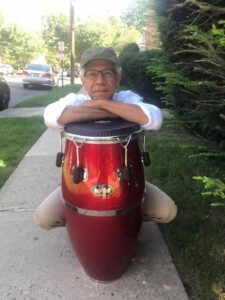
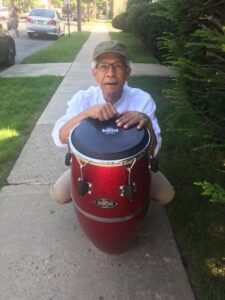
Carlos Nené Quintero con mi Signature congas (Roberto Quintero)

-What has seemed new to you lately in Europe or in these parts?

-Those jazz works in which there is no conventional group with drums or bass, like what I did with Gerry Weil and Pablo Gil at the Corp Group Cultural Center.

THE BATICONGA AND THE “MCGIVER SET”.

The baticonga is a hybrid: drums with conga. I use bass drum, hi-hat, cimbals, toms, snare and cymbals of various thicknesses.

It has a special redoblante with a rim that does not protrude from the leather so that it does not bother when hitting it like a tumbadora.

It is an idea that I have been maturing. It was born because of Yordano’s album that made him famous, Manantial de corazón, there I recorded all the percussion and when it was time to play it live we needed a drummer and two percussionists. We got the drummer, but things were missing and I started to add electronic pedals, electronic drums, octapads and to use feet and hands.

Then we did an unplugged set and it had to be acoustic with congas, bass drum, snare drum, hi-hat, cymbals.

The McGiver set is a djembe with brushes, cymbals with rivets, a conga that is just like a lid, like a tambourine, and I mount it on top of a snare drum stand and a cowbell. A set that does it all.

SIX INFLUENTIAL PERCUSSIONISTS

Alejandro Blanco Uribe and Airto Moreira: “I saw a lot of Gerry Weil with La Banda Municipal in the 70s and Alejandro as a multi-percussionist with effects and accessories.

That led me to look at Airto’s proposal and to fall in love with percussion at a time when I was playing guitar”.

Trilok Gurtu: “For his fusion of oriental music with rock and jazz. I’ve been hearing him since Oregon, and when I heard him with John McLaughlin on the live album in London my jaw dropped.”

Jack DeJohnette: “As a drummer he has a very floaty groove, he can do with the beats what he wants and the rhythm is always there.”

Tony Williams: “Another drummer. I saw a video that aroused my interest because his technique is like the one I use with the baticonga”.

Carlos Nené Quintero con mi Signature congas (Roberto Quintero).

Giovanni “Mañenguito” Hidalgo: “Since he came out the thing changed, he gave another level to the congas or tumbadoras, with him there has been a ‘before and after'”. – with Roberto Quintero and Luisito Quintero.

Also read: Argenis Carruyo is known in the music scene as “El Volcán de América” (The Volcano of America) due to the power of his voice

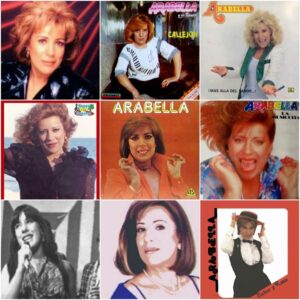
Arabella la Sonera Mayor de Colombia in her Callejón on a Sunday in Barrio with Chico Matanza

Born on June 5th, Arabella, “La Sonera Mayor”, is from Bogota, Colombia.

Arabella With her first name “María Margarita Pinillos”, she is an excellent Salsa singer and composer who shined in the 70’s and 80’s with her record productions, whose consecration and fame, however, was not in her native country but in Venezuela.

His Caribbean music song that made him famous was “Callejón” and he stayed in Venezuela for a while.

In 1972 he settled in Venezuela, it was in this country where he managed to strengthen his career and achieve the great success he had, he recorded several albums in the company of great artists of the time. In 78 and 79 he formed a group called “Los Maraqueros”, with which he could freely make the music he really wanted to make, Cuban music of Trio Matamoros and Puerto Rico.

She felt great interest in music from a very early age, however she did not contemplate from that time to make professional music, it was until she was 13 years old that a friend enrolled her without prior consultation in a radio contest of the time called “Orquídea de Plata Phillips”.

But because she was not prepared she was disqualified, however as a result she was recommended to participate in the television contest “Michel Talento” the first contest for amateurs of Colombian television. From that contest she went on to be hired at the Tequendama Hotel, the most important hotel of the time, as the first woman to sing vallenatos at the Salón Monserrate with the company of accordionist Ángel Martínez.

Arabella la Sonera Mayor de Colombia in her Callejón on a Sunday in Barrio with Chico Matanza

Arabella’s name was born from the fact that they used to tell her that she resembled a model that visited Colombia who unfortunately committed suicide, her pianist suggested her to adopt that name as her artistic name and she accepted.

Considered for many years as the natural successor of Celia Cruz, and Celia said that Arabella was her successor due to her extraordinary vocal quality.

She settled in Caracas-Venezuela since 1982, obtaining success in Salsa thanks to the advice of the great announcer Phidias Danilo Escalona.

In her beginnings she formed her own group called “Los Maraqueros”, she also recorded with Pacho Galán and with “Los Hijos del Rey” of the Dominican Wilfrido Vargas in which she recorded 4 merengues in a trip she made to the Dominican Republic, Wilfrido himself located her to record with him and they were hits the theme Corazón, Corazón de Julio Iglesia.

Los Armónicos de Manolo Monterrey, Chucho Sanoja y su orquesta, Willy Pérez and with the Megatones de Lucho.

With the groups that accompanied him as a salsa soloist.

It is worth mentioning that the song “Mi Vida es Cantar” immortalized by Ursula Hilaria de la Caridad Cruz, “La Guarachera del Mundo”, the queen of salsa, was composed by Arabella, who gave it to the eternal Cuban and salsa luminary.

For a while she lived in Puerto Rico where she decided to become a musical show businesswoman, with this company she traveled to several Latin American countries with first class singers: Marvin Santiago, Oscar de Leon, Ismael Miranda, among others.

Arabella Maria Margarita Pinillos

She finally announced her retirement from music after recording “La Musiquita” and “Yo te Vi”. After her retirement she moved to Miami, United States with her daughter, Margarita decided to dedicate herself to take care of her beloved daughter, her home and two cats and two dogs that are her favorites.


DISCOGRAPHY

– Más Allá Del Sabor (1990)

– Mi Son Es Un Misterio (1987)

– Puro Trópico (1987)

– La Musiquita (1987)

– Arabella (1985)

– Sabor Y Raza (1982)

– La Simpatiquisima (1980)

– Encontré Mi Amor (1979)

– Arabella (1978)

– Nelson Martinez y Arabella (1976)

– Nelson Martinez / Arabella Y Su Combo Tropical (1974)

Arabella la Sonera Sabor y Raza

SINGLES & EPs

– I Was Your Hunt (1990)

– Amiga La Vida / Sin Dejarte De Amar (1987)

– Mi Son Es Un Misterio / Mentiras (1986)

– Zape Pa’ Lla / Mentira (1986)

– Mentiras / Panamá (1985)

– Chico Matanza / Nu Sueño Mas (1982)

– Pal Campo/Mucho, Poquito, Nada (1978)

– Hija De Nadie (Flor Del Mal) / Arepas

– Domingo En El Barrio / Chico Matanza

– Mentiras / Espejismo

– Tómame Que Tómame / Con La Vara Que Midas (Take Me That Take Me / With The Rod That Midas)

Source:

William Aramburen Salsa Ephemeris

@arabellalasoneramayor 

Also Read: Betsy Colombian Salsa, Bolero and Son Cubano Singer

Brazil Directory 2023

Root Hookah Lounge
Root Hookah Lounge
Av. Professor Nilton Lins, 1591 – Flores, Manaus, Brazil, Manaus, AM, Brazil

Antonieta Bar and Lounge
Antonieta Bar & Lounge
Centro, Rio de Janeiro – State of Rio de Janeiro, 20230-150, Brazil

Bar Bip-bip Nightclub
Bar Bip-bip Rua
Almirante Gonçalves, 50 22060-040 Rio de Janeiro, RJ, Brazil

Club Mix Bar
R. do Mercado, 25, Rio de Janeiro, Brazil, 20010-120

Rio Scenarium
Rio Scenarium
Pavilhão da Cultura Rua Lavradio 20 – Centro, Rio de Janeiro, RJ, Brazil

L'apero Bar and Restaurant
L’apero
Avenida Litorânea, 4A , São Luís, MA, Brazil

Azucar Club Cubano Nightclub
Azucar Club Cubano
Rua Aspicuelta, 366, São Paulo, SP, Brazil

Bona Casa de Musicahttps://www.bona.art.br/
Bona Casa de Música
Rua Doutor Paulo Vieira, 101, São Paulo, SP, 0 01257-00, Brazil


Guantanamo music director, arranger and composer Julio Avila

Julio Avila Cuban Band 

The Latin music scene in Canada is growing every day thanks to the large number of artists who have decided to move to this beautiful country to try their luck with their talent. Such is the case of Cuban musical director, arranger, composer and singer Julio Avila and the members of his great band Julio Avila Cuban Band.   

Given that we thought his career was very interesting, we decided to contact him to learn more about his work and he was kind enough to accept the invitation. Here are the issues we touched on during this fascinating interview.  

Julio Avila Cuban Band
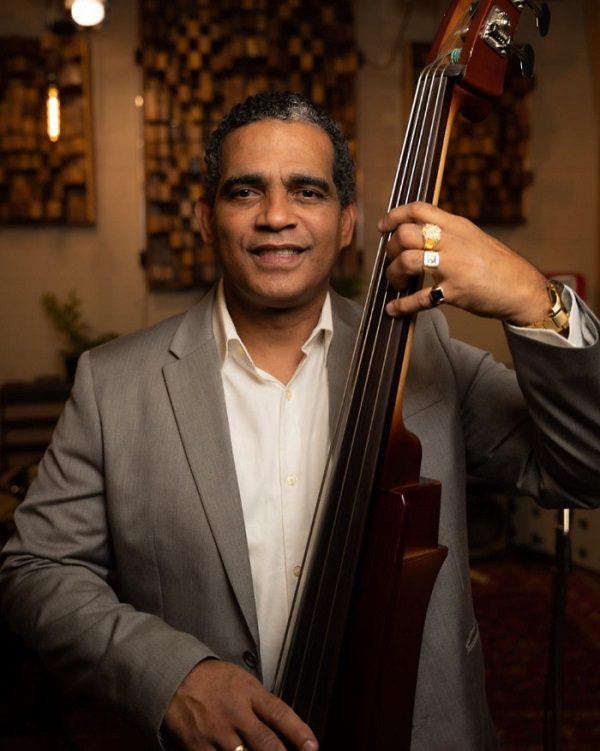
Julio Avila, musical director of Julio Avila Cuban Band

Life for Julio in Guantanamo, Cuba  

Contrary to the answer we might expect, Julio told us that making music in Cuba at that time was not difficult, as life was not so expensive and the economic crisis was not as severe as it is now.   

In his particular case, things were easier because his mother worked in a radio station and his father was a professional musician and the musical director of the popular music group Por Nuestros Campos for many years until he sadly passed away. It was undeniable that art ran through his veins. 

His sister Isabelita was also involved in popular music for many years and was even awarded on several occasions at the local Eduardo Saborit Festival. Today she is retired, but she was very successful locally at the time.   

Because all the brothers had a penchant for music, they decided to create a group called Los Hermanos Avila until they all went their separate ways and dedicated themselves to their own professions.   

Julio considers that today they would not have been able to devote to this branch of the arts due to the political and economic situation that the island is enduring, and he is thankful that it was not so. 

According to his words, the money was enough to buy the instruments in those times, but things become so complicated that developing an artistic career in the Caribbean country is much more difficult.  

All the members
All the band members with their instruments

Changüí 

Although he says he has played changüí because of his Guantanamo origins, he was never in a group that based its music on this traditional Cuban dance, as the artist has always liked popular music and salsa.   

”Changüí is a genre born in the province of Guantánamo that did not get much popularity, but today, it is impressive the large number of young people who play this dance, since they got a taste for it. In spite of all the years after it was created, there are guys who do not let it die, which makes me very happy” said Julio on this issue. 

When we wanted to know why he thinks that these young musicians have opted for this genre and not for other more modern ones such as trap or reggaeton, he replied that the latter two sound a lot in Cuba, but there have been music teachers and schools that have not let changüí die. They continue to teach it to their students and promote it whenever they can. 

In addition, there are always groups interested in preserving it in time and uniting it with son and other traditional Cuban genres. They even add flutes and violins, which were not present in the original changüí, in order to give it a unique and modern touch.  

Academic background 

Julio started playing the guitar being a child of five years old, as he had always seen his parents and older brothers involved in everything that had to do with music. Therefore, it all started in a very natural way and basically on instinct. It was later that both he and his siblings decided to educate themselves in order to become more complete professionals. 

In Guantánamo itself, he studied at a music school to become a bassist and began working fully on popular music, which had always been to his liking. 

With all that gained knowledge, he decided to move to the city of Havana, to get involved in other projects there and to compose his own material.   

Since he was 16, he earned a living as a bassist in a popular music group, which activity he alternated with his secondary education. It can be said that this is the formal beginning of Julio’s musical career. 

Julio Avila Cuban Band performing
Julio Avila Cuban Band performing at The Carnaval Del Sol in July 2023

Sonora Universal and Brisas Del Palmar 

Before forming his own orchestra, Julio worked with La Sonora Universal and Brisas Del Palmar, which were his first opportunities to shine in the music world.   

When the artist was working in a quintet, a trio from the city of Santiago (Brisas Del Palmar) went to a music festival in Guantanamo and thet had the opportunity to meet in a club in 1999. ‘’The musical director of the trio saw us playing and liked the way I played the bass. He told me about the possibility of playing with them, but it did not happen until 2001 when I went to Havana and we met by chance,” Julio said. 

After having some time worked with the trio, this musical director met the talented tresista Cesar Echevarría, director of Sonora Universal, who needed a bassist because his stayed in Germany. It was then that he told him about Julio and asked him to see him play, which led them to meet and start working together. 

Within a few weeks, Julio was already traveling to Europe with Cesar to tour Germany, Denmark, Holland, Austria and Czechoslovakia. This trip is the one that began to open new doors for him and make him develop as an artist. 

Definitive departure from Cuba 

When Julio had some time with La Sonora Universal, the director of Brisas Del Mar again asked him to join the group for a tour of Canada in 2005. When he was included, the group went from being a trio to a quartet.   

Receptivity from Canadian businessmen was so good that he decided to stay with Brisas Del Palmar permanently until he decided to move from Cuba in 2014 due to the situation which the island was going through. 

The latter coincided with the beginning of his love relationship with the Serbian citizen Natasha Marjanovic, who today is his wife, manager of his orchestra and a great life support. It was she who convinced him to stay in Vancouver, a decision he says it was the right one. 

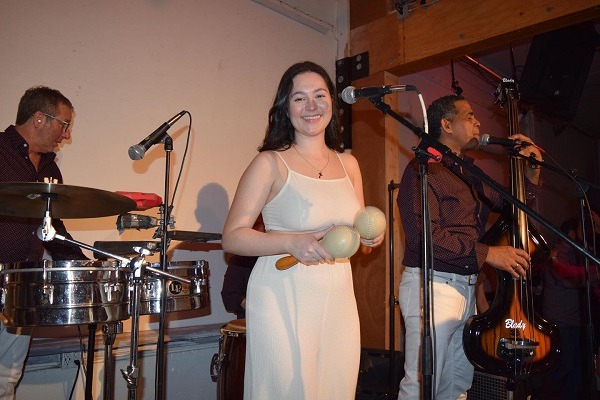
Singer of Julio Avila Cuban Band
Singer of Julio Avila Cuban Band Isidora Bosanovic

Beginnings of Julio Avila Cuban Band 

It all started when Julio needed a pianist for Brisas Del Mar and hired Ernesto Benitez, who, once in Canada, told him that he was not going back to Cuba. That is when he saw the opportunity to start creating his own orchestra from himself and this musician. 

The next to be included was percussionist Norman García, with whom Julio and Ernesto formed a trio and began performing at festivals until Isidora Bosanovic, singer and his wife Natasha’s niece, arrived. Her case is very particular because she did not speak Spanish, but she learned it so she could sing in the orchestra. Today, she speaks and sings in Spanish very well. 

Finally, the band included Denis Barzaga, another musician originating from Guantánamo, who currently lives in Spain, but when required, travels to Canada to play with the orchestra in Vancouver.   

Recently, kettle – drum player Julio Paredes was included to replace Barzaga, who was unable to travel for the time being.  

Read also: Puerto Rican singer and talented sonero Charlie Maldonado 

  • « Go to Previous Page
  • Page 1
  • Interim pages omitted …
  • Page 23
  • Page 24
  • Page 25
  • Page 26
  • Page 27
  • Interim pages omitted …
  • Page 63
  • Go to Next Page »

International Salsa Magazine (ISM) is a monthly publication about Salsa activities around the world, that has been publishing since 2007. It is a world network of volunteers coordinated by ISM Magazine. We are working to strengthen all the events by working together.