• Skip to primary navigation
  • Skip to main content

International Salsa Magazine

  • Home
  • Previous editions
    • 2026
      • ISM / January 2026
      • ISM / February 2026
    • 2025
      • ISM / December 2025
      • ISM / November 2025
      • ISM / October 2025
      • ISM / September 2025
      • ISM / August 2025
      • ISM / July 2025
      • ISM / June 2025
      • ISM / May2025
      • ISM / April 2025
      • ISM / March 2025
      • ISM / February 2025
      • ISM / January 2025
    • 2024
      • ISM / December 2024
      • ISM / November 2024
      • ISM / October 2024
      • ISM / September 2024
      • ISM / August 2024
      • ISM / July 2024
      • ISM / June 2024
      • ISM / May 2024
      • ISM / April 2024
      • ISM / March 2024
      • ISM / February 2024
      • ISM / January 2024
    • 2023
      • ISM / December 2023
      • ISM / November 2023
      • ISM / October 2023
      • ISM – September 2023
      • ISM – August 2023
      • ISM July 2023
      • ISM Edition June 2023
      • ISM – May 2023
      • ISM April 2023
      • ISM March 2023
      • ISM February 2023
      • ISM January 2023
    • 2022
      • ISM December 2022
      • ISM November 2022
      • ISM October 2022
      • ISM September 2022
      • ISM August 2022
      • ISM July 2022
      • ISM June 2022
      • ISM May 2022
      • ISM February 2022
      • ISM January 2022
    • 2021
      • ISM December 2021
      • ISM November 2021
      • ISM October – 2021
      • ISM September 2021
      • ISM August 2021
      • ISM July 2021
      • ISM May 2021
      • ISM April 2021
      • ISM June 2021
      • ISM March 2021
      • ISM February 2021
      • ISM January 2021
    • 2020
      • ISM December 2020
      • ISM November 2020
      • ISM October 2020
      • ISM September 2020
      • ISM August 2020
      • ISM July 2020
      • ISM June 2020
      • ISM May 2020
      • ISM April 2020
      • ISM March 2020
      • ISM February 2020
      • ISM January 2020
    • 2019
      • ISM December 2019
      • ISM November 2019
      • ISM October 2019
      • ISM Septembre 2019
      • ISM August 2019
      • ISM July 2019
      • ISM June 2019
      • ISM May 2019
      • ISM April 2019
      • ISM March 2019
      • ISM February 2019
      • ISM January 2019
    • 2018
      • ISM December 2018
      • ISM November 2018
      • ISM October 2018
      • ISM September 2018
      • ISM August 2018
      • ISM July 2018
      • ISM June 2018
      • ISM May 2018
      • ISM April 2018
      • ISM March 2018
      • ISM February 2018
      • ISM January 2018
    • 2017
      • ISM December 2017
      • ISM November 2017
      • ISM October 2017
      • ISM September 2017
      • ISM August 2017
      • ISM July 2017
      • ISM June 2017
      • ISM May 2017
      • ISM April 2017
      • ISM March 2017
      • ISM February 2017
  • Download Salsa App
    • Android
    • Apple
  • Spanish

Search Results for: Radio

The return of Ray Sepúlveda to Europe

The return of Ray Sepúlveda to Europe

Ray Sepúlveda loves his music ardently, and it is for this reason that, for two decades, he has been one of the most notable voices in salsa to date. This much loved singer takes every opportunity he gets to give us all of his soul through his music, and his most intimate feelings. One of his first steps this 2023 is to visit Europe, to celebrate Valentine’s Day with all his European fans. Learn more about the singer, and his dates for this Europe Tour with the following lines.

Ray Sepúlveda is a singer forged in Salsa’s golden years

Sepúlveda Jr. was born in Brooklyn, his parents are originally from Puerto Rico. Today he is a successful singer who has recorded five albums for his current label RMM, and has built up a reputation as a vocalist on all continents. However, his journey to his success was not an easy one.

Since his childhood, Ray Jr. learned everything from his father, Ray Sepúlveda Sr., who was a bolero singer, and a member of Trío Los Románticos. This experience allowed him to listen to the best artists from Puerto Rico and Latin America, which inspired him to follow his dreams of becoming a renowned singer.

At the end of the 70’s Ray managed to record his first album and two more under Fania. He also got to dabble in the cinema, and in the 80s he even worked with Hector Lavoe. But in those years there was a decline in the genre, which is why Sepúlveda came to work with the United States Postal Service.

The 90s were his return to the stages with the Johnny and Ray Orchestra, with which he came to record his greatest hits. As he himself has commented on several occasions: “At that stage of my career I had the opportunity to work with Sergio George, the music producer of Salsa Con Clase. Sergio greatly influenced, and in a way created the musical style of Ray Sepúlveda.”

A few years later he would sign with RMM which led him to further consolidate his solo career. In “Salsabor,” his fifth production with RMM, Ray Sepúlveda shows us his way of being and feeling. He uses the same energy that he had on his first album with them, and inspires us to enjoy his well-known romantic salsa sound.

Ray has made appearances at some of the world’s most famous venues. For example, he has played in New York’s Madison Square Garden several times, including a Valentine’s Day concert. He has also performed at Radio City Music Hall and at the Continental Airlines Arena in New Jersey to celebrate RMM’s 10th anniversary. In addition, Ray has traveled throughout Europe, receiving a great reception especially in Italy.

2023 marks his return to Europe

This new year marks the return of Ray Sepúlveda to the European stages with his Europe Tour, led by Luisito Eventos and Amber Productions. This tour consists of a total of 6 dates, starting on February 3 in Madrid, Spain. Two dates follow in Italy on the 4th and 5th, in Genoa and Firenze respectively. It closes with stops on 10, 11 and 12 passing through Milano, Italy; to then reach Valencia and Barcelona in Spain.

In these presentations Ray will captivate the audience with his best-known classics, in addition to showing his new songs from his latest production Salsabor, among which stand out: Como Tiembla El Alma, Eres, Lo Necesario, Sabes Que Soy Aquel, among other great works. To obtain tickets for these dates and enjoy a great night, you just have to contact the following numbers: +34627098111 / +34635417043.
Tribute to Eddie López for his career

How were his beginnings?

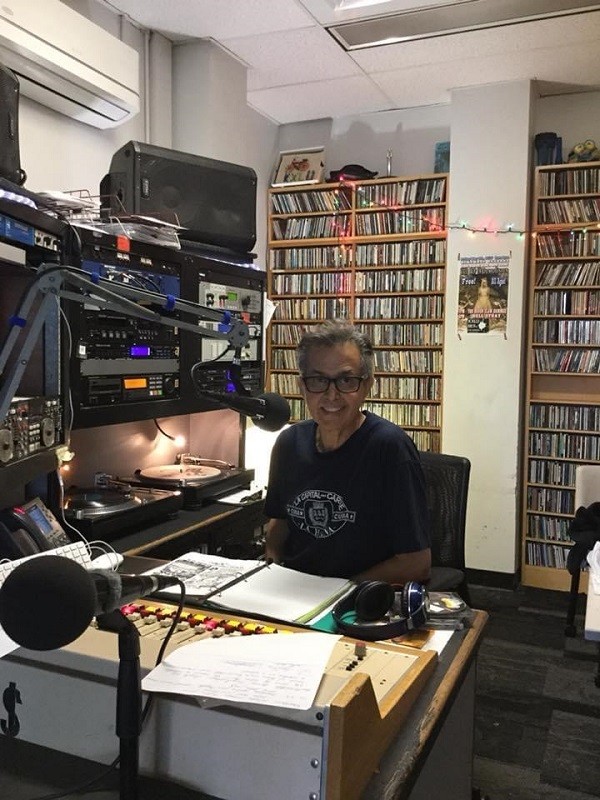
On January 10, 2023, the death of Eddie Lopez has been made known, who has been one of the greatest pillars of the radio station KXLU since 1976 when he started his career as a DJ. His arrival came during the third anniversary of the famous program ”Alma Del Barrio”, being a fundamental piece in the huge success the show had during several decades and making it remain part of the programming of the already mentioned radio station.

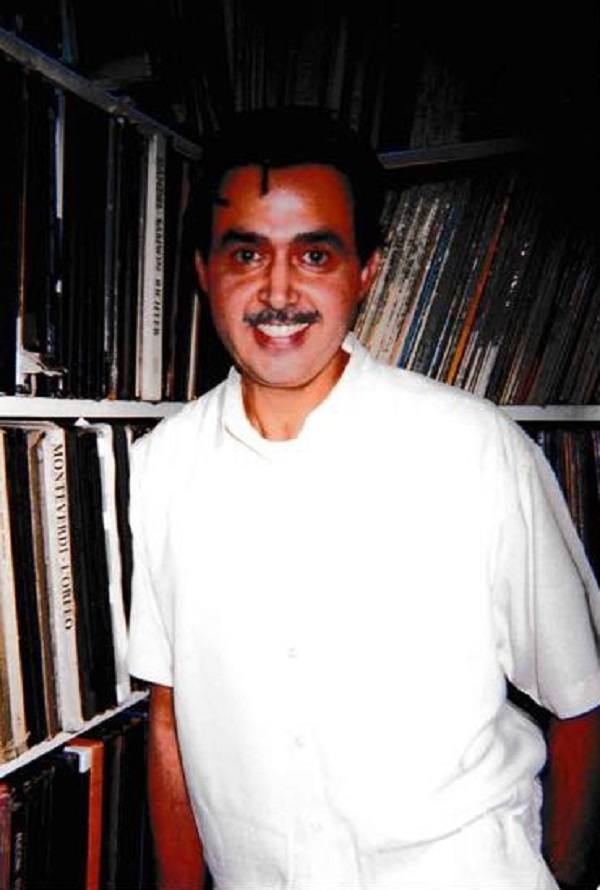
Host of the radio show ''Alma Del Barrio'' Eddie López
Host of the radio show ”Alma Del Barrio” Eddie López

A little bit of his life

Eddie Lopez was originally from Los Angeles and spent much of his childhood in his father’s photography studio, which may have been one of his greatest inspirations to dedicate his life to the arts in adulthood. After graduating from Cathedra High School, he was admitted to Pepperdine University, but switched to Loyola Marymount University, from where he finally graduated in 1978.

Although much of his professional career was spent at KVEA Channel 52 Telemundo, he spent 46 years working at ”Alma Del Barrio” and streaming the best Afro-Cuban music through the waves of KXLU from 2pm to 6pm. During all these years, Eddie always said that he wanted ”Alma Del Barrio” to be as professional as possible and encouraged all his colleagues to always be better every day to give their best to the audience. He also said that this show was not only a work team with common interests, but a family in which everyone supported each other to achieve their goals.

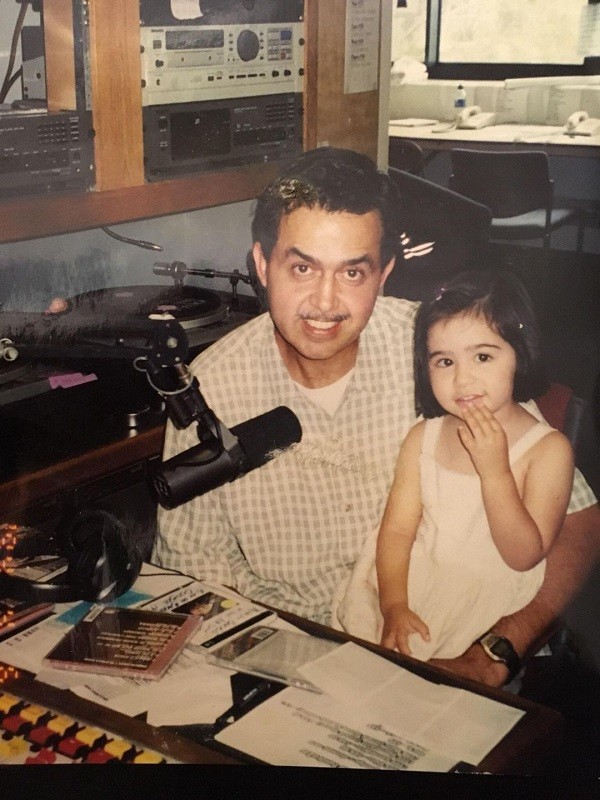
All those involved in his life who came to know him say that he was a man completely dedicated to his family who deeply loved his wife Vanessa and his daughter Nina, who were always his greatest motivation to get ahead day by day. He was loved by all his family and friends, who are very sorry for this sad loss in the Latino cultural world of Los Angeles and the United States in general.

Eddie López with his daughter Nina

Reactions to his passing

In the social networks of ”Alma Del Barrio”, the sorrow of the team over the physical disappearance of the host can be clearly seen. On the Facebook account of the show, there are several messages referring to all that Eddie achieved during his professional life and all that he contributed to the show ”Alma Del Barrio” and to the radio station KXLU. These comments are accompanied by photographs in which Lopez can be seen carrying out his work with the enthusiasm that characterized him in those periods when he practiced the profession he so loved, which was communication.

One of those who mourned the loss of the broadcaster was the host of the program ADB, Alan Geik, who had been his personal friend for decades thanks to the passion for the media they both shared. It all started when Eddie hired Alan to host a evening show called ”Latin Dimensions” at a station that works in a small classroom.

Geik did not have any plans to become a broadcaster at the time, but Lopez convinced him by telling him it could be a great adventure and a learning experience for himself. When he accepted, he never thought that the programme presented by him would multiply the number of audience several times over thanks to the popularity he was gradually acquiring. Not to mention that the station where the program was aired moved to better facilities and became a radio power.

The host ends his note of mourning by expressing that he is proud to have been such a good friend of Eddie and all that they achieved together thanks to the professional team they formed during such a long time.

Eddie López working at the radio station

Read also: ”Salsa Con Sabor’’ and its contribution to salsa music

La Sonora Matancera musical congregation of long trajectory and its sound quality, is one of the most popular in the Caribbean island “Cuba”

It was founded in Matanzas in 1924 under the name of La Tuna Liberal.

Its first members were: Valentín Cané, director and tres player, Manuel Valera, guitar and second voice, Manuel Sánchez (Jimagua), timbal, Ismael Governa, cornetín, Pablo Vázquez Govín (Bubú), double bass, Domingo Medina, guitar, Ismael Goberna, cornetín, Julio Govín, guitar, José Manuel Valera, guitar, Juan Bautista Llopis, guitar.

In 1926 Carlos Manuel Díaz Alfonso (Caíto), falsetto voice and maracas, and Rogelio Martínez Díaz (El Gallego), guitar, joined the group and it adopted the name Sexteto Soprano.

On January 12, 1927, under the name of Estudiantina Sonora Matancera, they moved to Havana. In November of that year they recorded their first two recordings for the Victor label: Fuera, fuera, chino, by José Manuel Valera, and El porqué de tus ojos, by Valentín Cané.

With the definitive name of Conjunto Sonora Matancera, it began its transmissions on the radio station El Progreso Cubano (later Radio Progreso). At that time it appeared on Radio Atwater Kent; in 1932, at the suggestion of Rogelio Martínez Díaz, it took the name of Sonora Matancera, and began its performances in the Havana Sport dance academies, and later in Marte and Belona, and later became part of the cast of CMQ Radio. In 1935, trumpeter Calixto Leicea joined the group; in 1939, composer, pianist and orchestrator Severino Ramos, who gave the Sonora its distinctive sound with his orchestrations.

La Sonora Matancera congregación musical de larga trayectoria y su calidad sonora, es una de las más populares en la isla caribeña “Cuba”

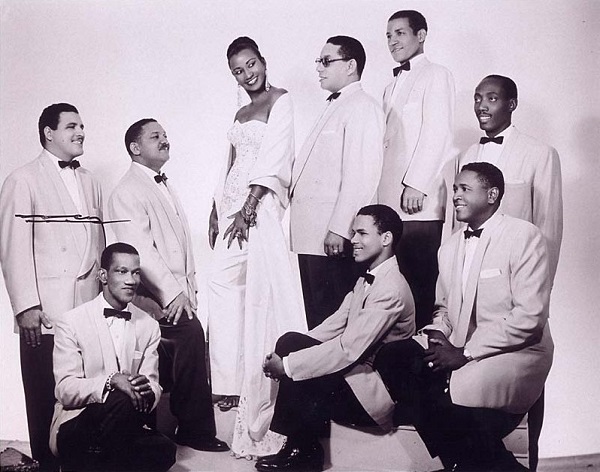
In 1944 pianist Lino Frias and trumpeter Pedro Knight Caraballo joined the group, who with Calixto Leicea formed the most interesting trumpet duo in the history of Cuban ensembles; in 1945 singer Bienvenido Granda Aguilera; in 1948, Angel Alfonso Furias (Yiyo), tumbadora. At this time the Sonora Matancera was formed by Rogelio Martínez Díaz, director, guitarist and chorus; Pablo Vázquez Govín (Bubú), double bass; José del Rosario Chávez (Manteca), timbal; Ángel Alfonso Furias (Yiyo), tumbadora, who replaced Valentín Cané; Calixto Leicea, first trumpet; Pedro Knight Caraballo, second trumpet; Lino Frías, pianist; Carlos Manuel Díaz Alfonso (Caíto), falsetto voice and maracas; Bienvenido Granda, singer and claves; and Celia Cruz, who soon became the stellar singer we knew and the mainstay of the Sonora Matancera hits. Thus began a period that critics have called the golden age of the Sonora.

In 1950, with the advent of television, the Sonora Matancera was one of the first musical groups to perform on this medium. It also signed a contract with the Seeco record company, with whose recordings it made a name for itself in the international market. In 1952, Raimundo Elpidio Vázquez replaced his father, Pablo Vázquez, on double bass (when Rogelio Martínez Díaz died in 2001, he took over the leadership of the group).

In 1926, it changed its name to “Septeto Soprano”. That same year, Carlos M. Díaz “Caíto” accompanied Eugenio Pérez in the choir.

Later in 1927, on Caíto’s recommendation, Rogelio Martínez joined the group and the name of the group was changed to Estudiantina Sonora Matancera.

Sonora Matancera
Sonora Matancera

With a great desire to improve the group travels to Havana where they get in touch with the record company “RCA Victor” and make their first recording on January 12, 1928.

At the beginning of the thirties, the group began to adapt to the new rhythms that were appearing at that time as well as adapting new instruments, such as the grand piano, which was played for the first time in the group by Dámaso Pérez Prado, who years later would become the “King of the Mambo”.

But it was in 1935 when the group took the name La Sonora Matancera, and with this change it introduced a new trumpet player: Calixto Leicea, who replaced Ismael Goberna, who died a few months later due to health problems.

The unforgettable José Rosario Chávez “Manteca”, who replaced the resigned “Jimagua”, also joined the band. Humberto Cané joined the group playing the tres and his father Valentín Cané began playing the tumbadora.

In 1938, Dámaso Pérez Prado retired and left the vacant piano position to Severino Ramos, who soon after became the musical arranger of the group.

During the first years of the forties they made presentations in dance academies, cabarets and in Radio Progreso Cubano, they also included in their repertoire: guarachas, montunos.

On January 6, 1944, two musicians from Arsenio Rodriguez’s group joined the group: Lino Frias (author of the popular song Mata Siguaraya) who began to play the piano and Pedro Knight who became the second trumpet player of the Sonora Matancera.

In the month of December, Bienvenido Granda enters the band recommended as vocalist, being his first recording “La Ola Marina” by Virgilio González, and with him they sign a contract with the nascent record label Panart Records. Valentín Cané, Israel del Pino, Caíto and Humberto Cané made recordings with this label.

In the middle of 1946 the founder Valentín Cané suffers asthmatic problems that force him to leave the group, dying two years later. Before the group joined Panart Records, it recorded other songs for the “Varsity” label, without the name of the Sonora Matancera appearing on the labels, here the first version of “Se Formó la Rumbantela” by Pablo Cairo, “Tumba Colorá”, “El Cinto De Mi Sombrero”, Bienvenido Granda and Humberto Cané participated in these numbers.

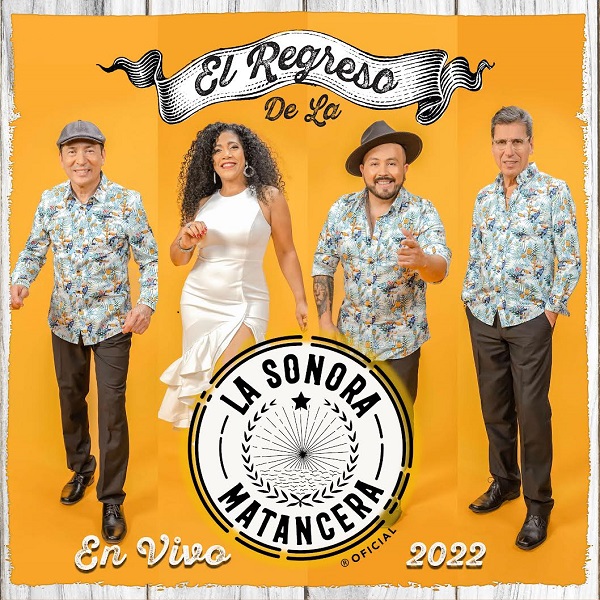
El Regreo de La Sonora Matancera 2022 2023

Members

Trumpets: Calixto Leicea and Pedro Knight

Double Bass: Elpidio Vázquez, replacing his father Pablo Vázquez, “Bubu”.

Piano: Lino Frías

Timbales, Bongó and Campana: José Rosario Chávez “Manteca” Chávez

Tumbadora: Ángel Alfonso Furias “Yiyo”.

Guitar and Choir: Rogelio Martínez

Maracas and Chorus: Carlos Díaz Alonso “Caíto”.

Claves and Choir: Bienvenido Granda.

Last January 13, 2023 they turned 99 years old and are still going strong from generation to generation.

Source:

Enrrique “Culebra” Iriarte, Venezuelan pianist, arranger and orchestra conductor.

Bibliography: Ecured Cuba

La Sonora Matancera 

You can read: Carlos “Patato” Valdés one of the best percussionists in the history of Latin Jazz

Santa La Salsera and Diva of Mexico with her unique voice and style will continue to conquer us all

Originally from Boca Mar, in the beautiful port of Acapulco, Mexico.

From a musical family lineage, from the age of 3 she began her interest in the artistic medium; despite this her parents did not agree that she should dedicate herself to this career, but motivated by the musical taste of her mother she was inspired by great divas of the genre such as Mrs. Celia Cruz, La Lupe, Celeste Mendoza, Mercedita Valdes and Omara Portuondo.

Originaria de la Boca Mar, en el bello Puerto de Acapulco, Gro. México

She alternated with the Cuban actor and singer Zamorita, who invited her to sing solo in the well-known ECO Program and from there encouraged her to sing tropical music, since it was more in line with her image and voice; Later she got a job at the emblematic Blanquita Theater where she alternated with the legendary Sonora Santanera of Carlos Colorado, where she had the opportunity to compete against representatives of several Latin American countries in the international program “Sábado Gigante” with Don Francisco, in the section known as “Tropicalísimo” winning first place shared with Venezuela and thanks to her triumph she was discovered by the Director of Radio Tropical in Mexico, Mr. Manuel Durán, who recommended her to the Vice President of Musivisa, Mr. José Manuel Presa.

The Company was interested in her and from then on Santa signed a contract with Fonovisa Tropical. La Acapulqueña recorded her first production in Mexico City, titled “No me Provoques”, which was presented on August 15, 1994 at the Salón Verde y Oro of XEW Radio.

Verde y Oro of XEW Radio in Mexico City. “No me Provoques” reached the top of the charts with songs such as: “Corazón de Acero”, “Amor Pasión y Locura” and “Rey de mi Habitación”.

The second production “Lo Quiero a Morir” was recorded in Puerto Rico (in the then Gran Combo studio) for its internationalization, the song of the same name, was placed in the first place of popularity in the island itself, some countries of Central America and the United States of America.

The third production “Santa la Fiera” was recorded in the city of Miami, under the label On Top Records and produced by the renowned composer Victor Daniel, author of “La Vida es un Carnaval” with songs of more varied genre such as: “No vale la pena llorar”, “Tú eres hielo” and “Soy demasiado Mujer”.

After an absence, Santa resumed his career in 2012, with his fourth production “Yo soy santa para ti”, from which he managed to three singles “No tengas miedo”, “Sólo mírame” and “Como agua entre las manos”.

Santa has had the opportunity to participate in numerous television programs, as well as massive festivals, to mention a few: opening of the “Festival Boca del Río Veracruz, 1995” “Los Maestros de la Salsa 1996” (in Mexico City) “La Convención de Radio y Música 1996” (in Puerto Rico), “Festival 5 de Mayo 1997” (in Chicago), “Fiesta Mexicana de Raisin y Milwakee”, “Teletón Internacional de Chicago”, “Viva Chicago y Teletón de Honduras”.

Nino Segarra y Santa La Salsera y Diva de México

As well as international television programs such as “En Vivo”, “Hoy con Daniela, Zambombazo, Pácetelas”:, “Un Nuevo Día” and “Siempre en Domingo”, “Dr. Simi”, who dedicated a special to him, to mention a few”.

He has also had the opportunity to perform with great figures of his genre, such as: Tito Puente (who was his godfather), Celia Cruz, Jerry Rivera, Gilberto Santa Rosa, Grupo Niche, Eddie Santiago, Cheo Feliciano, Rey Ruiz, Los Hermanos Rosario, La Ponceña, El Gran Combo de Puerto Rico, Luis Enrique, among many others. In 2012 she resumes her career after an absence, she returns with her production “Yo soy santa para ti” placing herself in the taste of the genre lovers with songs like “Sólo mírame” “No tengas miedo” “Arrepentida”.

In 2013 she released the single “Llorarás” from her production “Yo soy como soy”, which includes unpublished songs, under the direction of the Veracruz producer and arranger Xavier Reyes.

Most of the songs were recorded in Mexico City, with the exception of “No quiero más mentiras” in New York, and “Mío primero” in Puerto Rico” with musicians of international stature. It includes two duets “Amiga” with Frakie Ruiz Jr. and “Cosas del amor” with Ariana Dao as well as the covers “Bidi, bidi, bom, bom” and “Si una vez” as a tribute to Selena Quintanilla.

After his tour he took a short break from music to participate in a short theater production dedicated to the “divo de Juárez” Juan Gabriel, called “Ya lo sé que tú te vas”, which he enjoyed very much in his acting career.

In addition, she received awards in her country such as the AMS AWARD for best female Salsera and the “Candilejas de oro” for her career.

She also participated as a host in the magazine show “Reventón musical”.

In 2018 she was invited to participate in the project “Divas de la salsa”, which took place in New York City representing Mexico and sharing the stage with various divas of the genre from other countries.

In May 2019, she toured Canada for 3 months, leaving her mark and in the last quarter of the same year, she travels to Colombia to continue expanding in the international market.

Her salsa version of “Si una vez” gives her the surprise to be placed naturally in the taste of the Colombian public and, as a result, the doors are opened to participate in events of the Feria de Cali alternating with the most important figures of the genre; she also participated as a special guest to sing in the tribute made to the master Gilberto Santa Rosa.

Once again Santa had the opportunity to leave her country high and show that Mexico also has and makes its good “molcajete salsa” as she calls it, inspired by these joyful Caribbean countries.

Back in Mexico, Santa started her online entertainment program “Santa con Ton y Son” with Raul Silva “El Titan de la Salsa” as her partner, which lasted only a short time on the air, due to some commitments she had to fulfill in the U.S. that were postponed because of the COVID pandemic; However, in the meantime Santa dedicated himself to write some songs that reflect feelings generated from that global chaos, such as “Chao Chao” which he recorded in Mexico City in December of 2021 as a duet with Ricardo Amador, accompanied by La Internacional Orquesta Controversia, of which a live video was recorded with great acceptance.

Santa Salsera y Diva de México con su voz y estilo único seguirá conquistándonos a todos

In addition to new duets and surprises that he is preparing in 2022 for the pleasure of the dancers.

Surely with his voice and unique style, coupled with his charisma and stage presence, Santa will continue to conquer us all.

Enlace Externo: Santa Salsera and Diva of Mexico

You can read: Irakere was a Cuban group that developed an important work in Cuban popular music and Latin Jazz under the direction of Chucho Valdés

North America – February 2023

Thumbnail for Johnny Cruz and all his articles

  • « Go to Previous Page
  • Page 1
  • Interim pages omitted …
  • Page 36
  • Page 37
  • Page 38
  • Page 39
  • Page 40
  • Interim pages omitted …
  • Page 64
  • Go to Next Page »

International Salsa Magazine (ISM) is a monthly publication about Salsa activities around the world, that has been publishing since 2007. It is a world network of volunteers coordinated by ISM Magazine. We are working to strengthen all the events by working together.