• Skip to primary navigation
  • Skip to main content

International Salsa Magazine

  • HOME
  • Previous editions
    • 2026
      • ISM / May 2026
      • ISM / April 2026
      • ISM / March 2026
      • ISM / February 2026
      • ISM / January 2026
    • 2025
      • ISM / December 2025
      • ISM / November 2025
      • ISM / October 2025
      • ISM / September 2025
      • ISM / August 2025
      • ISM / July 2025
      • ISM / June 2025
      • ISM / May2025
      • ISM / April 2025
      • ISM / March 2025
      • ISM / February 2025
      • ISM / January 2025
    • 2024
      • ISM / December 2024
      • ISM / November 2024
      • ISM / October 2024
      • ISM / September 2024
      • ISM / August 2024
      • ISM / July 2024
      • ISM / June 2024
      • ISM / May 2024
      • ISM / April 2024
      • ISM / March 2024
      • ISM / February 2024
      • ISM / January 2024
    • 2023
      • ISM / December 2023
      • ISM / November 2023
      • ISM / October 2023
      • ISM – September 2023
      • ISM – August 2023
      • ISM July 2023
      • ISM Edition June 2023
      • ISM – May 2023
      • ISM April 2023
      • ISM March 2023
      • ISM February 2023
      • ISM January 2023
    • 2022
      • ISM December 2022
      • ISM November 2022
      • ISM October 2022
      • ISM September 2022
      • ISM August 2022
      • ISM July 2022
      • ISM June 2022
      • ISM May 2022
      • ISM February 2022
      • ISM January 2022
    • 2021
      • ISM December 2021
      • ISM November 2021
      • ISM October – 2021
      • ISM September 2021
      • ISM August 2021
      • ISM July 2021
      • ISM May 2021
      • ISM April 2021
      • ISM June 2021
      • ISM March 2021
      • ISM February 2021
      • ISM January 2021
    • 2020
      • ISM December 2020
      • ISM November 2020
      • ISM October 2020
      • ISM September 2020
      • ISM August 2020
      • ISM July 2020
      • ISM June 2020
      • ISM May 2020
      • ISM April 2020
      • ISM March 2020
      • ISM February 2020
      • ISM January 2020
    • 2019
      • ISM December 2019
      • ISM November 2019
      • ISM October 2019
      • ISM Septembre 2019
      • ISM August 2019
      • ISM July 2019
      • ISM June 2019
    • 2016
      • ISM December 2016
      • ISM November 2016
  • Spanish
  • Download Salsa App
    • Android
    • Apple

Search Results for: Salsa Fest

5th Rumba y Manana Afro-Cuban Festival in Cracow

Europe / Poland / Cracow

Rumba y Manana is a vibrant world of Afro-Cuban stories and legends coming alive in music and dance.
Rumba y Manana
Rumba y Manana

Rumba y Manana was born out of a pure passion for Cuban rumba and afro along with all they bring: roots, tradition, wealth of rhythms and movements, unlimited possibilities of interpretation, all the wide range of emotions and utility in the modern Cuban music and dance as well as all the amazing joy they bring.

  • We intend to create a place to develop and deepen your skills and knowledge of these dances, as we believe there is a true strength hidden in them.
  • We want them to become more and more popular, as they fully deserve it.
  • We want to share the joy and happiness of dancing them.
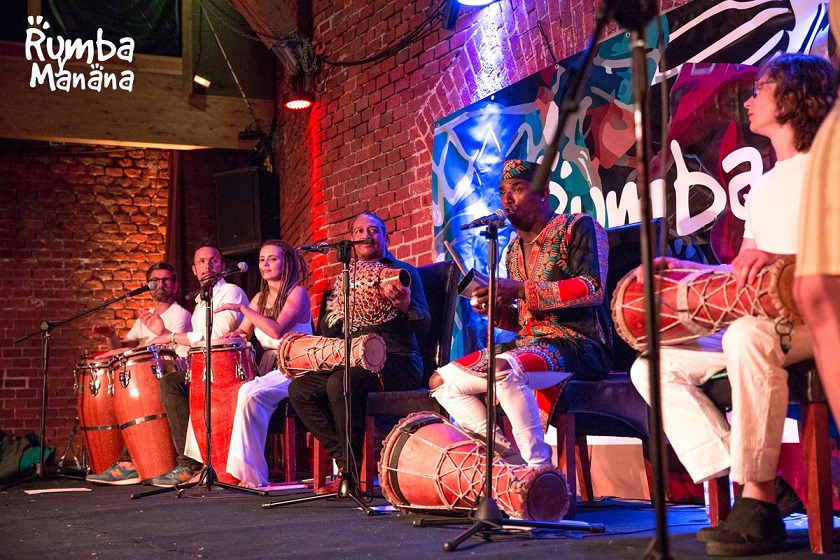
Rumba y Manana rumba in Cracow

We have also created another event to popularize rumba and Afro-Cuban dances: Sabado de la Rumba – a younger sister of Rumba y Manana. Sabado de la Rumba is a projector meetings with live music concerts and free-dancing accompanied by few workshops. We’ve hosted two editions of them in Cracow, where we always invite.

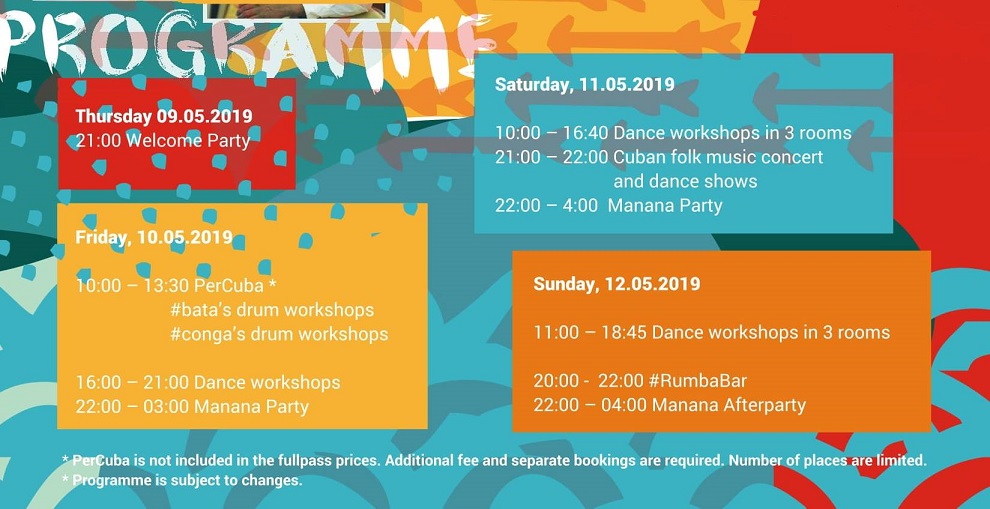
  • 3 workshop rooms , two of them with live music!
  • 4 levels of teaching : begginers, open, advanced, masterclass
  • One workshop room dedicated to Salsa
  • 3 salsa cubana parties with the best DJ!
  • Live Concert & Orisha show
Rumba y Manana Programm

Tickets & Programm: http://rumbaymanana.pl/
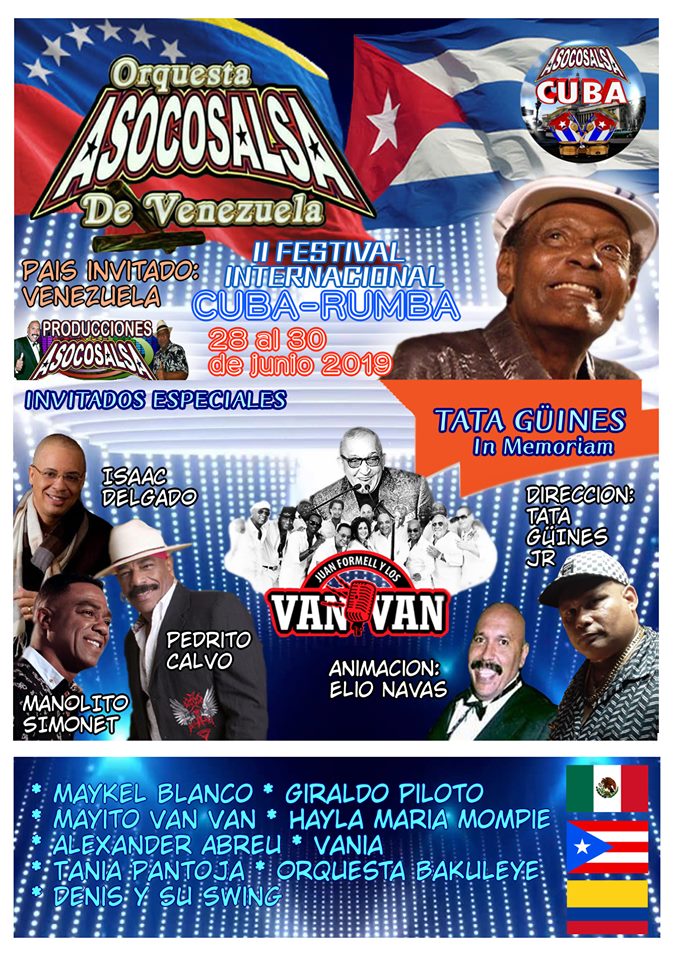
Cubarumba Tataguines in memoriam International Festival in its second edition.

Latin America / Cuba / La Habana

The National Center for Popular Music invites you to participate in the Cubarumba Tataguines in memoriam International Festival in its second edition.

It will be held in Havana from June 28-30, 2019. With the aim of Honoring the memory of Tata güines, Stimulating the artistic creation of rumba groups from the community, encouraging children’s projects based on the folkloric and musical genre, highlight the social value of the rumba as intangible heritage of humanity.

Asocosalsa Cuba
Asocosalsa Cuba

Likewise, to carry out a national and international workshop based on the pedagogical need to strengthen cultural nationality by art students in Cuba on the basis of the figure of tata güines, the fundamental foundation that promoted the proclamation of Rumba as Intangible Heritage of Humanity. . With this goal we urge all young people, students who wish to participate in the Festival through the following themes:

Themes:

  1. Cultural educational practices
  2. Potential value of transformation of the percussive theory of Tata güines.
  3. Main factors that slow down or facilitate the descending of the Rumba genre as a percussion modality.
  4. Ethical and aesthetic values ​​promoted by the practice of percussion
  5. Challenges to perfect percussive techniques
  6. Creation and promotion of Cuban art
  7. Young rumbero, possibility of cultural advancement. Harvested experiences and challenges for the present and immediate future.
  8. Others

The venue will take place at the Turf Night Club

General program:

Press conference

Thursday, June 13, 2019

Venue: El Turf Night Club

Address: F Street between Calzada and Quinta Vedado

Time: 2pm

Participation: Press-Radio-Television-Guests

Duration: 1h

toast to daddy

Place House Museum Tata güines

TIME: 3 PM

Event schedule:

Thursday, June 27

  • 8:00 Opening Gala Avellaneda Hall of the National Theater

Cast Subject to change

  • Tata guines Jr.
  • Makuta Flow
  • Rumbansoc
  • Ronald and his Rumbera explosion
  • Denis and his swing
  • Vania Borges
  • Iannna Wobble

Friday, June 28

Venue: Club Noturno El Turf

  • 9:00 Inaugural Conference
  • 10:00 Recess
  • 10:30 Percussion and dance workshops
  • 12:30 Demonstration group
  • 1:30 Visit Tata Guines House Museum
  • 2:00 Lunch

Cultural

Devil Tun Tun: 4pm to 6pm.

Show Woman in the rumba

Omini Bata-Rumba Morena

  • 6:30 a.m. to 8 p.m. Tataguines/Ochareo Group
  • 10-2am Venue: Club Norturno El Turf Shows with rumba groups

Explosion Rumbera/Rumbavila/Rumbansoc/

Saturday, June 29

Venue: Club Noturno El Turf

  • 9:00 Inaugural Conference
  • 10:00 Recess
  • 10:30 Percussion and dance workshops
  • 12:30 Demonstration group
  • 2:00 Lunch

Cultural

  • 3:00 Clave de Rumba folkloric ensemble / children’s project.
  • 8pm-2am Venue: El Turf Timbalaye Nightclub /Rumberos de Cuba/Rumbansoc/ Tata güines

Sunday, June 30

Venue: El Turf Night Club

  • 9:00 Report of the event. Delivery of Certificates.
  • 10:00 Recess
  • 10:30 Symposium Asocosalsa Cuba
  • 5:00 Cinema Avenue Closing Gala
  • 10:00 Final reception.

Festival Project

Event Organizing Committee:

Víctor Rodríguez García: Executive Director

Arturo Soto Martínez: Chairman of the Event

Suset Núñez Vázquez: CNMP Events Coordinator

Osorio García Rule: CNMP Events Department

Brigitte Oliva: General Producer

Principal Cubarumba
Principal Cubarumba

Company National Center for Popular Music

INTRODUCTION

The Cubarumba 2019 Tata güines in memoriam project is a previous interactive festival that consists of pedagogical, competitive, sociocultural moments that will transfer original Cuban music, through percussion and dance workshops, interaction with the community, as well as shows of this genre, intangible heritage of the humanity, the evident and permanent need to rescue Cuban roots, and the representation of the name Tata güines, a national and international figure. Following this trilogy as a cultural line, the president of the festival Arturo Soto Martínez advocates for this event.

Carrying out research, it is verified that this festival has a high tourist level, which causes a useful strategy to penetrate tourists about our idiosyncrasy and traditions, in addition to giving an unforgettable moment to all those who are present at that moment.

If we observe the social gaze, we realize the motivation of society in general since we encourage in the community a hope of cultural revival, a festival of inclusion in all senses since people of all ages and disabilities participate. Achieving a mutual interaction that achieves as a result an inclusion of this musical genre in daily life and in the tastes of all the people who enjoy it.

It is emphasized that times are changing, however it is important to take actions so that the celebrations of our origin are not forgotten, it is about looking for very frequent actions that work with everyday life, exclusivity, professionalism and good taste that keep this celebration alive. choice for youth not only in our country but around the world

For all the above, the need for this culturally artistic project becomes evident, specifically in these places where a large foreign crowd is concentrated, since it is unaware of Cuban culture. Relying on the battle of ideas that we have daily for the rejection of national identity, this project that settles the roots, that remembers the past, that discloses our present and that above all that is written increases love is evident, permanent and necessary. for Cuban culture.

DEVELOPING

  • Goals:
    • Honor the memory of Tata güines
    • Stimulate the artistic creation of rumba groups from the community
    • Encourage children’s projects based on the folkloric and musical genre.
    • Highlight the social value of the rumba as intangible heritage of humanity

Themes:

  1. Cultural educational practices
  2. Potential value of transformation of the percussive theory of Tata güines.
  3. Main factors that slow down or facilitate the descending of the Rumba genre as a form of percussion.
  4. Ethical and aesthetic values ​​promoted by the practice of percussion
  5. Challenges to perfect percussive techniques
  6. Creation and promotion of Cuban art
  7. Young rumbero, possibility of cultural advancement. Harvested experiences and challenges for the present and immediate future.
  8. Others

PARTICIPATION METHOD

  • Delegates
  • Student
  • Musicians
  • Guests

REGISTRATION FEES: DELEGATES

Foreigners………………50 cuc includes participation in the event, certificate and/or credits.

Cubans …………………….250 cup includes food, participation, certification and/or credits

Cuban students ……………..125 cup includes food, participation, certification and/or credits

PROJECT OBJECTIVES

GENERAL OBJECTIVE

Carry out an international rumba festival based on the artistic value of the figure of tata güines in the world on the basis of the Rumba proclamation as Intangible Heritage of Humanity

Goals:

  • Honor the memory of Tata güines
  • Stimulate the artistic creation of rumba groups from the community
  • Encourage children’s projects based on the folkloric and musical genre.
  • Highlight the social value of the rumba as intangible heritage of humanity
Specific Objectives Actions Indicators Participants Responsible
Honor the memory of Tata güines Hold the Cubarumba Tataguines Festival in memoriam Conciliation Company, Sponsors, Organizing Committee Event Leader
Stimulate the artistic creation of rumba groups from the community Theoretical-practical dance and percussion workshops, presentation of youth groups in event activities Conciliation with Artex, Egrem. Cuban and foreign population Org Committee
Encourage children’s projects based on the folkloric and musical genre.


Activity in the National Folkloric Ensemble of Cuba, headquarters for the socialization of children’s projects Address of Palenque, Production Org Committee Event Leader
Highlight the social value of the rumba as intangible heritage of humanity Activity the woman in the rumba, the longest rumba, the rumba and its youth, the rumba does include you Group Directors Production Event Leader


Tata Guines No 1
Tata Guines No 1

Beneficiary population:

Directly, the population that benefits is Cuban and foreign, since in some way the project is aimed at educating, including, transforming the culture of these times that affects this population.

For this, their full participation is needed, in the first order the attention that is very important, then the interest in dance and percussion and the decline that forms the taste for this musical genre.

Also highlighting the importance of the social inclusion of people with disabilities, we can mention that the festival has the honor of promoting groups with different disabilities. Example of the incursion of culture in Cuba.


Orquesta la Identidad is one of the most nationally and internationally recognized groups in the salsa genre

Winner Identidad Orchestra on several occasions of the Cali fair disc with songs such as MUJERES in 1987, QUIÉREME in 1991 and COMO YO TE AME, the most played song at a historical level in the different Latin FM stereo stations in 2003.

ORQUESTA LA IDENTIDAD

Among other works of recognition such as: LAS COSAS SON COMO SON, TU DESDÉN, GOLPE DE GRACIA, SI ELLA VOLVIERA, DESENGAÑOS, among others.

This group was founded by the Colombian composer and musician Carlos Enrique Navia in 1981 in the capital of salsa in the city of Cali – Colombia, which came to fame in 1987.

Following the release of his first album entitled LA IDENTIDAD, under the Codiscos label, musical production that includes the works, LAS COSAS SON COMO SON, Y ME QUIERES, PARA QUERERTE, CADA CUAL, POR SU LADO, LA FUMA, GENTE CORRIENTE, BRABAJE and MUJERES.

Work that was awarded as the official album of the Cali Fair and gave him the opportunity to make his first international tour of the United States, visiting the states of Florida, New York, California, Texas, Illinois, among others.

This group had a very important boom in Colombia and the whole world for being elected revelation orchestra of the year and gave him the participation in the most important events and fairs throughout the Colombian territory.

Thanks to the success and recognition, the orchestra recorded its second album called LA MÚSICA in 1989, album that expanded its audience in other countries such as: Mexico, Venezuela and Ecuador with the works TU DESDÉN, AMOR ETERNO, TE QUIERO TANTO, LA MÚSICA, SON SABORIONDO, SENTIMIENTOS POR TI and BOMBA NAVIDEÑA, work that occupied the first places in the FM radio stations, preselected as Cali’s fair disc and elected the second most important song of the fair.

Orquesta la Identidad is one of the most nationally and internationally recognized groups in the salsa genre

Identidad Orchestra in 1990 the orchestra recorded its third album entitled UN TOQUE DE MISTERIO, album produced by the renowned Venezuelan musician Cesar Monges “Albondiga” who has participated in countless productions of artists and orchestras of international recognition in the salsa genre.

After a long tour in the United States, the orchestra arrives in Colombia to record their fourth album entitled SALSA CON ENERGÍA, a product produced in the studios of Grupo Niche.

This production included songs such as: LA RETIRADA, ESE SOY YO, BOROJO, AGITACIÓN, SI ELLA VOLVIERA, LLEGASTE A MI VIDA, DESENGAÑOS and COMO YO TE AMÉ, one of the hits of preference of our listeners, occupying the first places and beating the record of the most played song in all salsa genre stations in Colombia, United States, Mexico, Venezuela, Ecuador, Peru, Spain, Italy and many more countries.

ORQUESTA LA IDENTIDAD is an orchestra that has been characterized by its perseverance.

Identidad Orchestra in 1992 they recorded their fifth album titled PROFESIÓN SALSA and ended their relationship with the record label Codiscos to start their independence as a brand under the direction of composer, singer and founder Carlos Enrique Navia to produce their works as an independent record label.

Orquesta la Identidad is one of the most nationally

This album included songs such as: GOLPE DE GRACIA, PECADORA, COCTEL DE AMOR, SI YO PUDIERA, SEÑORA CALI, MUJER AMADA, TE PILLÉ, NO IMPORTA, among others. This product was widely distributed in countries such as Ecuador, Venezuela, Mexico, Peru, United States, among others.

As a record label Identidad Producciones, ORQUESTA LA IDENTIDAD has recorded albums such as A TIEMPO, a production that has captivated the salsa public with songs like: CUANDO EL AMOR SE ACABA, MI NIÑA, LA ESQUINA DEL MOVIMIENTO, LE CANTO AL PACÍFICO, TE QUIERO Y TE AMO, TU DESDÉN, LA FUMA and singles such as: POR SIEMPRE ELLA, FRACASO, DICIEMBRE EN CALI, SON PA EL BAILADOR, COLOMBIA REAL, A MI PADRE, BENDICIÓN DE MADRE, MI GUAGUANCÓ, HOMENAJE A LA SONORA MATANCERA, GUAYAQUIL among others.

Works that are played on Latin radio stations and massively on digital platforms. Orquesta LA IDENTIDAD is a group that has participated in important Latin music events such as: SEBASTIÁN DE BELALCÁZAR awards on two occasions and nominated for best salsa genre orchestra, event organized by FALCON MANAGEMENT BOOKING & ENTERTAINMENT, INDEPENDENCE FESTIVAL OF GUAYAQUIL – ECUADOR, INDEPENDENCE FESTIVALS OF COLOMBIA IN THE UNITED STATES, WORLD SALSA FESTIVAL, BILLBOARD LATIN MUSIC, FESTIVAL OF ORCHESTRAS IN COLOMBIA AND FAIRS THROUGHOUT THE COLOMBIAN TERRITORY.

ORQUESTA LA IDENTIDAD is currently preparing the celebration of 40 years of artistic career, an album that will include the greatest hits such as MUJERES, QUIÉREME, GOLPE DE GRACIA, MUJER AMADA, LAS COSAS SON COMO COMO SON, TU DESDÉN, UN TOQUE DE MISTERIO, COMO YO TE AMÉ and DESENGAÑOS, which will have collaborations with national and international artists of recognition in the salsa genre and is preparing to make its next international tour of the United States year 2024.

CONTACT Carlos Enrique Navia General Manager Contact: 310 822 8068 – 317 642 1031 Email: [email protected]

ORQUESTA LA IDENTIDAD

Also Read: Colombia’s legendary Grupo Niche and its founder Jairo Varela

Lengaïa Salsa Brava is killing it in Montréal

Latin talent can be found where you might least expect it and, this time we found it in the city of Montreal, Canada, a place that is cultivating an increasingly large and vigorous Latin music scene. On this occasion, we were thrilled to be able to talk to Giany-Frantz Huyghues-Despointes, who is the leader and founder of the orchestra Lengaïa Salsa Brava.

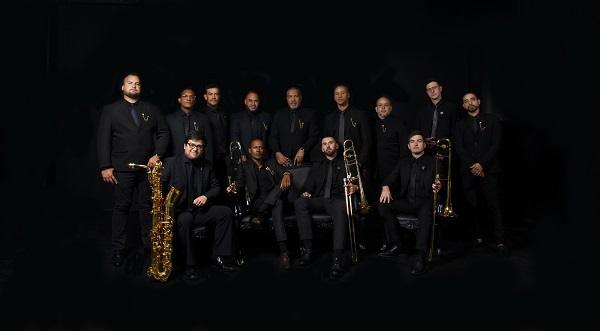
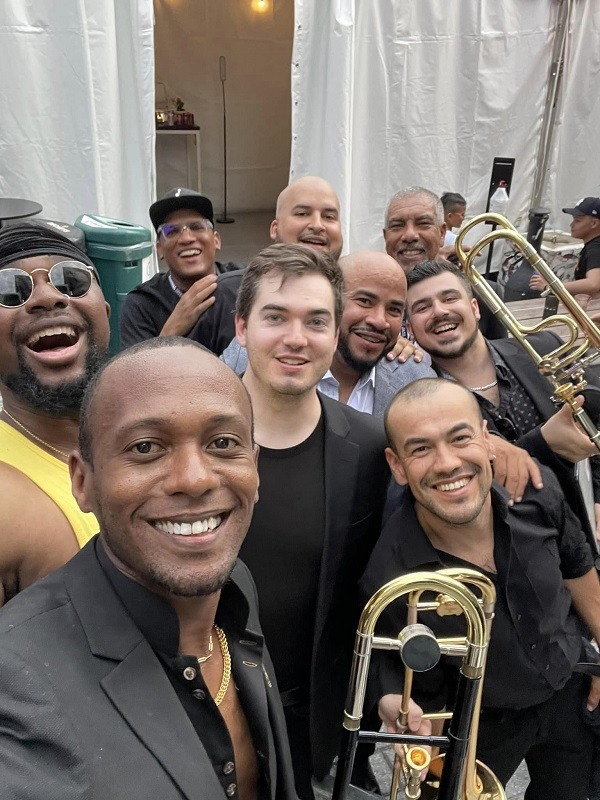
Lengaïa Salsa Brava is a 12-member salsa orchestra that was created in 2012 by Giany, who was also a trombonist and had some experience in the world of music before daring to create his own group. 

The effort of all its members has enabled them to collaborate with great performers of the genre and win important awards such as the Canada Latin Awards in the category of ”Salsa Group of the Year” in a row in 2017 and 2018 respectively. 

Lengaïa Salsa Brava has also performed approximately 30 concerts a year since its foundation and has participated in important festivals such as Toronto Salsa Festival, Festival Nuit Blanche de Montreal, Nuits d’Afrique, among others. The group was greatly helped by the fact that its members come from different countries such as French Guyana, Cuba, Colombia, Peru, Quebec, Spain and Venezuela. 

This interesting journey shows us how hard this group has worked to achieve a place within the industry and all the potential they have to achieve much more than what was obtained. Today, Giany, its founder, shares a little more about himself and his orchestra Lengaïa Salsa Brava.

Giany, founder of Lengaïa Salsa Brava
Giany Huyghues Despointes, director and founder of Lengaïa Salsa Brava

Giany’s beginnings as a musician

Although the trombone is the instrument for which Giany is known, he started playing the trumpet from 10 years of age, which is when he began his interest in this branch of the art.

An important point is that in French Guyana, the country where Giany was born, salsa is not a predominant genre, since the most played by the French Guyanese is the mazurka, which is very similar to the Haitian compas. In the case of Giany’s family, they listened to a bit of everything, including salsa.

A turning point for the artist was watching Celia Cruz singing on tv one day. The musician had never heard the Cuban singer before and it was an incredible experience for him, as her deep voice, colorful outfit and wig caught his attention at the time. 

Because of her deep voice, he thought she was a man, but his mother explained to him who Celia was and, months later, took him to a concert to see her live. That performance of ”La Guarachera de Cuba” marked him so much that he would begin to lean towards music in the future. Today, he says that Celia is a spiritual mother to him, as she was his great inspiration. 

Along with being a fan of the Cuban singer, he wanted to learn to play instruments and initially opted for the piano and the guitar, but that changed when his Spanish teacher at school gave him a trumpet and he discovered that he really liked to play it.

Some time later, he graduated from the national school of music in his country and, by the time he turned 18, Giany noticed that his musical skills excelled more with the trombone than the trumpet. This is how he decided to choose the trombone as his main instrument and so it has been to the present time.

He started playing classical music with that instrument but soon discovered that he wanted to return to the genre that captivated him when he was just a child, so he dared to create a group in France, where he studied aviation. The thing is that he went to live in Canada six months later and had to abandon the plans he had at that time.

Lengaïa Salsa Brava
The whole orchestra Lengaïa Salsa Brava

Founding of Lengaïa Salsa Brava

Giany arrived in Canada with the vision to create another group in his new country of residence, but he did not know any musicians yet, so he moved into action and started placing ads on social networks and other virtual means to communicate with artists who were interested in joining his project. 

The results were amazing and there were many musicians who contacted Giany because of their interest in the concept proposed by him. With this group, he started assembling the orchestra in order to give form to what Lengaïa Salsa Brava is today. The orchestra has six years with the same staff and format it presents to the public today.

Huge number of nationalities in Lengaïa Salsa Brava 

As for the large number of nationalities living in the orchestra, Giany has said that all ”are part of a big family” hinting that national origins have not been a problem for the smooth development of the group. In addition to that, the salsa brava is a genre widely known worldwide, so the members of the orchestra knew in advance what they were getting into.

To what we must add that these guys work or have worked in other salsa brava orchestras, so they were pretty much steeped in everything related to this beautiful music. 

Giany says it is very easy to work with his musicians because they always know how to perfectly interpret what he wants.

Lengaïa at one of its concerts
Lengaïa Salsa Brava at one of its concerts

Origin of the name Lengaïa Salsa Brava

When Giany was looking for a name for the group, he wanted something different and not very Latin sounding. He also wanted people to ask what the name meant, so we have fallen into the trap. 

The musician explained that he wanted something that refers to how explosive, energetic and aggressive his music is, so he chose the name inspired by a Tanzanian volcano called Ol Doinyo Lengaï that spews black lava. ”When you see a volcano exploding, you imagine something explosive and aggressive at the time. That’s what we want to reflect with our music”. Also, the fact that its lava is black is something different from other volcanoes, as is the group’s orchestration and technique,

Activities outside Lengaïa Salsa Brava

Giany wanted to emphasize that all the members of Lengaïa Salsa Brava have other jobs and work activities outside the orchestra. In his particular case, he works as a commercial pilot, but in his spare time, he devotes himself as much as he can to his great passion which is music. 

So far, Giany and the other members of the orchestra are unable to live solely on music, but they do their best to keep the group together and are there to fulfill Lengaïa Salsa Brava whenever necessary.

Although the orchestra has been a second employment option, it is undeniable that this is their great vocation and the engine that moves his life, so there will always be space for it.

Read also: John Narváez and Elizabeth Rojas from Salsamania

John Narváez and Elizabeth Rojas from Salsamania

John and Liz from Salsamania  

Between days 23 and 25 March, 2023, the San Francisco Salsa Festival took place, which brought together some of the cream of The Bay Area Latin music scene. One of those attending this great event was the main editor of International Salsa Magazine, Mr. Eduardo Guilarte.   

On site, he had the opportunity to share with other guests and some of the organizers such as Elizabeth Rojas, affectionately known as Liz, and John Narváez. We had the chance to talk with both dance professionals to know more about their beginnings, festivals and projects. Do not miss it!  

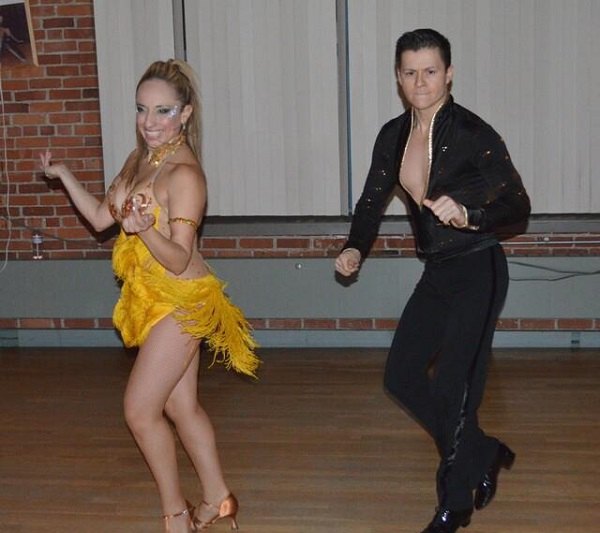
John and Elizabeth
Colombian dancers John Narváez and Elizabeth Rojas

Beginnings   

After several attempts to schedule a meeting with John and Liz, we finally managed to talk with these Colombian dancers and entrepreneurs, who began by thanking us for the contact and the opportunity to promote their passion for salsa and the community they represent.   

This love they have for the aforementioned musical genre has much to do with their roots. Both were born in Colombia and left the country when they were 12 years old (they are the same age) because of the violent situation caused by the guerrilla that existed in those years.   

Although those were hard times, John says these were very nice years from which he has fond memories. He remembers almost all his family members singing or playing an instrument, while he was the only dancer. All this influenced him in such a way that Latin music remains his north after so many years.  

Moving to the United States 

Since the social situation did not allow them to live in their country, they decided to move to the United States and apply for political asylum. At the beginning, it was not easy and the focus was on working hard to get ahead in this new country and to learn English. However, all that changed over time. 

With the arrival of economic and family stability, priorities changed. John comments that his interest in music and dance perked back up due to the family gatherings that his relatives celebrated such as birthdays, quinceañeras, weddings, among others. 

Although at the time dancing was not considered a serious profession, both John and Liz began to practice it at amateur level. Once they turned 21, they started going to the most popular salsa clubs, but it was all for recreational purposes. It was years later before they began to analyze all the technical and historical part of dancing to understand it better and take it more seriously.  

John, Liz, and Barbara
John and Liz with Barbara on Despierta América

Dancing as a profession 

John and Liz started to take dancing seriously in 1999. They both attended a three-day salsa event in Los Angeles, but what they did not know is that this was the first world salsa congress in America.   

This gave them the opportunity to share with the best salsa dancers in the world and they saw such impressive things that they were inspired to return next year with a well-established dance team with which they could participate fully in these activities. 

Being full of motivation, they decided to create Salsamania Dance Company and performed with their team at the festival. They started doing the same thing every year, which helped them gain experience and evolve their styles. 

After earning the trust of the festival organizers thanks to their talent and professionalism, they were given the opportunity to start teaching salsa workshops at the aforementioned congress. This is how little by little John and Liz began to build the reputation and credibility they have today.   

 In 2004, it got to a point where John took the important decision to quit his job to devote himself to dancing and Liz was quick to do the same. His resignation came with the opportunity to take a three-month trip to Hong Kong to teach salsa in a community where people did not dance it. 

They managed to build a community from nothing, since at that time, Hong Kong was not a place where people listened to salsa. However, everything went well and the dancers managed to seamlessly connect with the local audience. As John rightly said, ”salsa is a universal language and you don’t have to speak that language to feel the music”. 

On returning to the Bay Area, they began to practice dancing as a profession in the United States. 

On this point, Liz commented that her parents became very upset with her when she quit her job because of dancing, but today, they admit that it was the right decision and support her totally.  

Liz and John dancing
Liz and John during a social dance in Boston

Salsamania Dance Company 

Liz told us that it was difficult to create Salsamania Dance Company because it requires a lot of discipline and healthy coexistance between different types of personalities to create a group like this and keep it together. Fortunately, John is an industrial psychologist, so he helped to prevent these aspects to be a problem. 

Basically, Liz is responsible for the company’s management and John is the one who takes care of the human part of all the staff. 

They started the whole process like any regular company and drew up the contracts for all those who were going to work with them, making Salsamania a much more established, structured and serious project in the eyes of everyone else. Today, it is one of the largest companies in the Bay Area.   

They also took it a step further and built a salsa academic program with a thoroughness and detail that has not been seen in other projects of this kind.   

San Francisco Salsa Festival  

San Francisco Salsa Festival is one of the biggest salsa events in California and the United States in general and we were fortunate to have representation there with our editor Eduardo Guilarte.  

It began to be celebrated in 2008 with the support of international salsa promoter Albert Torres, who was a fundamental piece in the development of the festival and talent recruitment for an event of this size, as there were many things John and Liz had to learn. That is why they are both incredibly grateful for what the congress organizer did for them back then.  

To recruit artists, the dancers only require candidates to be good teachers, to share with the salsa community and to put on a good show for the audience. 

They also often invite colleagues they have known for years and some recommended to whom they give them the opportunity to shine and make themselves known during those days. 

Every year, they look for dancers, dance instructors, DJs and live orchestras. For Liz and John, the thing about live bands is very important, as they are concerned that there are so many clubs and venues that no longer hire these talents. This year, they focused on local bands that play on Thursdays and Fridays in San Francisco and were very happy with the results.  

It is expected that the next San Francisco Salsa Festival is scheduled between days 22 and 24 March, 2024 at the same venue, which is the Marriott Waterfront Hotel.   

The orchestras hired to perform for next year are Cabanijazz, The Latin Rhythm Boys and Orquesta Boyacán. The dancing couples are Alex and Judy from Colombia, Colombians Felipe from Colombia and Kathe and Mauricio and Danny from Mexico.   

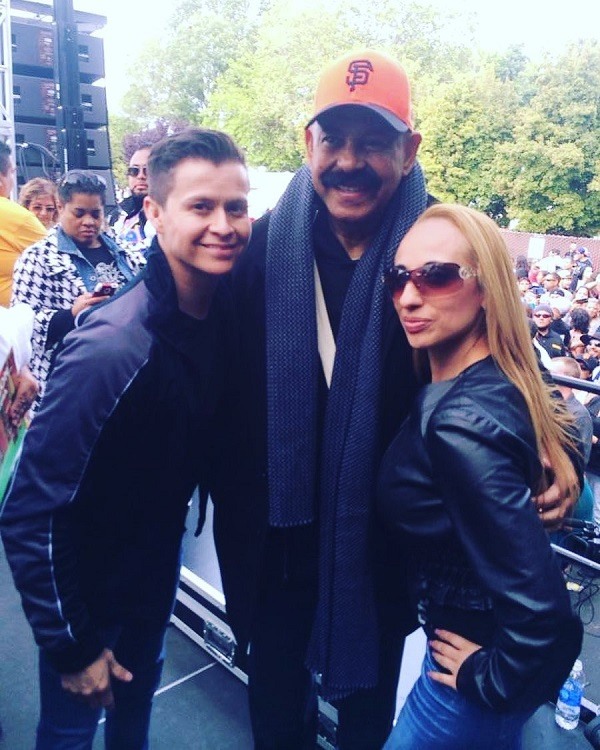
John, Liz, and Oscar D’ León
John and Liz with Venezuelan singer Oscar D’ León

Difficulties in the pandemic 

As dancing is an activity with a lot of physical contact and closeness, we were curious to know how they lived the pandemic and what they did to keep their project afloat in this situation. 

Though they admit that those months were not easy, they have always been very disciplined with their money and had enough to resist as long as possible without working.   

They tried to make up for lost time by teaching classes via Zoom as did most of their colleagues and designing new choreographies to apply when they went back to their usual activities. 

In addition to this, both had not spent time with their respective families in a long time, so they also took advantage of the absence of work to reunite with their loved ones and take up those important contacts that were lost due to stress and routine. 

Read also: Here we have Salseros With Attitude 

  • « Go to Previous Page
  • Page 1
  • Interim pages omitted …
  • Page 10
  • Page 11
  • Page 12
  • Page 13
  • Page 14
  • Interim pages omitted …
  • Page 135
  • Go to Next Page »

International Salsa Magazine (ISM) is a monthly publication about Salsa activities around the world, that has been publishing since 2007. It is a world network of volunteers coordinated by ISM Magazine. We are working to strengthen all the events by working together.