• Skip to primary navigation
  • Skip to main content

International Salsa Magazine

  • HOME
  • Previous editions
    • 2026
      • ISM / April 2026
      • ISM / March 2026
      • ISM / February 2026
      • ISM / January 2026
    • 2025
      • ISM / December 2025
      • ISM / November 2025
      • ISM / October 2025
      • ISM / September 2025
      • ISM / August 2025
      • ISM / July 2025
      • ISM / June 2025
      • ISM / May2025
      • ISM / April 2025
      • ISM / March 2025
      • ISM / February 2025
      • ISM / January 2025
    • 2024
      • ISM / December 2024
      • ISM / November 2024
      • ISM / October 2024
      • ISM / September 2024
      • ISM / August 2024
      • ISM / July 2024
      • ISM / June 2024
      • ISM / May 2024
      • ISM / April 2024
      • ISM / March 2024
      • ISM / February 2024
      • ISM / January 2024
    • 2023
      • ISM / December 2023
      • ISM / November 2023
      • ISM / October 2023
      • ISM – September 2023
      • ISM – August 2023
      • ISM July 2023
      • ISM Edition June 2023
      • ISM – May 2023
      • ISM April 2023
      • ISM March 2023
      • ISM February 2023
      • ISM January 2023
    • 2022
      • ISM December 2022
      • ISM November 2022
      • ISM October 2022
      • ISM September 2022
      • ISM August 2022
      • ISM July 2022
      • ISM June 2022
      • ISM May 2022
      • ISM February 2022
      • ISM January 2022
    • 2021
      • ISM December 2021
      • ISM November 2021
      • ISM October – 2021
      • ISM September 2021
      • ISM August 2021
      • ISM July 2021
      • ISM May 2021
      • ISM April 2021
      • ISM June 2021
      • ISM March 2021
      • ISM February 2021
      • ISM January 2021
    • 2020
      • ISM December 2020
      • ISM November 2020
      • ISM October 2020
      • ISM September 2020
      • ISM August 2020
      • ISM July 2020
      • ISM June 2020
      • ISM May 2020
      • ISM April 2020
      • ISM March 2020
      • ISM February 2020
      • ISM January 2020
    • 2019
      • ISM December 2019
      • ISM November 2019
      • ISM October 2019
      • ISM Septembre 2019
      • ISM August 2019
      • ISM July 2019
      • ISM June 2019
  • Spanish
  • Download Salsa App
    • Android
    • Apple

Search Results for: Salsa en Venezuela

Efrain ‘’Junito’’ Davila, Victor Manuelle and Ricardo Arjona’s producer in International Salsa Magazine

Efrain ”Junito” Davila is one of those faces behind the scenes that makes many things the public enjoys possible, which has led him to work with big names in the industry who respect his work and know that having him on their teams is a guarantee of success and quality. The arranger, music producer, composer, orchestrator and pianist has honoured us by talking a little about his life and career, something he himself admits that he does not do very often, so we thank him for his trust in International Salsa Magazine to tell his story.

Efrain Junito Davila working
Producer, arranger, and pianist Efrain ”Junito” Davila doing his work. Photo by Gisselle

Efrain’s interest in music from an early age

Efrain begins his story by telling us that his house always had tropical music, in fact, his father Efrain Davila was a musician and his mother was a singer, so they took their young son to their respective orchestras’ rehearsals and constantly exposed him to everything about music. However, he did not show much interest in music until he was about 11 or 11 years old, when he started playing with a little piano he had at home. He found the instrument fascinating and very easy to understand, to the point that his father noticed how easy it was for him to play and bought him a bigger piano, music books and several cassettes so that he could learn about that whole world.

It can be said that at the age of 12, Efrain was already a musician and played in the same orchestra as his father, but it was the following year, at the age of 13, that he made his first tour to Panama, which was the first country he visited for work.

An interesting fact we want to mention about the group in which his father was trombonist, Orquesta Xariz, is that it was one of the first Christian salsa orchestras of the time, because back then, this genre was still seen as something mundane and ordinary, something similar to what we see with urban music today. Therefore, it was not easy for people to identify Christianity with salsa, but Orquesta Xariz did it and Efrain learned a lot from it.

Professional start in music

Although Efrain made his first tour at the age of 12, for him the beginning of his career as such was at the age of 15, age in which he was no longer playing with his father, but with other artists in nightclubs. Although he was still a minor, the fact that he was tall and had a little beard helped him to be allowed to perform in those places. By that time, the artist was already being paid for his work and was performing much more often.

Victor, Efrain, and Jerry
Victor Manuelle, Efrain ”Junito” Davila, and Jerry Rivera

Around the same time, he began to make musical arrangements, first for the Orquesta Xariz and then later for other independent artists in New York City. Efrain himself got involved in this area in a completely self-taught way, since he did not want to be dedicated solely to play piano for the rest of his life, but sought to explore what other areas music could offer him.

Already at 20 or 21 years old, he also became interested in music production, to which he has devoted himself ever since.

Efrain as a producer, arranger and orchestrator

Efrain comments that he began to be recognised for his work for the first time thanks to the group DLG (Dark Latin Groove), which was looking for young musicians to join their ranks at that time. It was then that he met Sergio George, the owner of the group, who was the first to offer him his first major opportunity to arrange music for artists signed to great labels such as Sony. It could be said that this was the moment the young man knew he wanted to remain dedicated to this field and, over the years, he grabbed much more experience to the point of dealing with multinationals and artists of great name.

Grammy and Premios Lo Nuestro nominations

Throughout his career, Efrain has been nominated for a Grammy, a Latin Grammy, and a Premios Lo Nuestro award once in every case, he was nominated due to a work made for Prince Royce because he was doing much bachata at the time and, on another occasion, it was together with his friend and partner Guianko Gomez. In that same year, a couple of projects with the Venezuelan group Guaco were also nominated, indicating that the musical elite had him on its radar and acknowledged his efforts over time. 

Victor, Efrain, and Tito
Victor Manuelle, Efrain ”Junito” Davila, and Tito Nieves

Although the artist greatly appreciated that his work is taken into account in this way, he is very clear that obtaining prizes should not be his main goal, so he has to keep working hard and not settle for what he has achieved so far. He comes down to “you must not only look into the past, but also into the future”.

Collaborations with great artists 

In the case of Maluma, Efrain clarifies that he did not work directly with him, but covered some of his best-known songs in salsa. However, there have been other great artists whom he does know directly, such as Ricardo Arjona, who coincidentally called him on the day of our conversation to discuss some pending issues.

He has also met and worked directly with Victor Manuelle, with whom he has been friends and worked on his last nine record productions. Efrain says that it is nice working with the Puerto Rican artist because he really knows what he wants. “Many artists today don’t know what they want. They know what they don’t want, but they don’t know what they do want, which makes things a little difficult for me. Artists with long-spanning careers like Victor, Ricardo himself, Servando, and Florentino Primera know exactly what they want, so they are able to tell me what they are looking for in their work,” Efrain said about the topic. 

He also mentioned that he usually has trouble with new artists for the same reason, since being inexperienced, he is the one who has to create a sound or wave from where starting. However, he continues to work with them, but he has to use much more creativity in constantly inventing and creating song demos so that they can see what they like. 

It should also be mentioned that other important artists he is working with such as La India, Olga Tañón, and Tito Nieves.

Florentino, Efrain, and Servando
Florentino Primera, Efrain ”Junito” Davila, and Servando Primera

Behind-the-scenes work

Owing to the nature of his work, Efrain’s face is not as well known to the public as is the case of the great singers and musicians who work with him. When questioned about this, he says that he has never liked drawing attention and prefers to stay behind the cameras as a producer. He acknowledges that there are colleagues who do like media attention, but this is not his case. In fact, he does not participate much in interviews like this or podcasts. He believes that being very famous brings problems and prefers to live in peace and retain his privacy. 

Read also: The composer and singer Carlos Xavier reveals unpublished details of his career

Lawyer in the USA talk about Visas and entering the country

Interview: Bill Martinez and Eduardo Guilarte


The term “vet”  was originally used in horse-racing, referring to the requirement that a horse be checked for health and soundness by a veterinarian before being allowed to race. Thus, it has taken the general meaning “to check”. It is a figurative contraction of “veterinarian,” which originated in the mid-17th century.

The colloquial abbreviation dates to the 1860s; the verb form of the word, meaning “to treat an animal,” came a few decades later—according to the Oxford English Dictionary, the earliest known usage is 1891—and was applied primarily in a horse-racing context (“He vetted the stallion before the race,” “You should vet that horse before he races,” etc.). By the early 1900s, “vet” had begun to be used as a synonym for “evaluate,” especially when searching for flaws.

“Vetting” in reference to immigration in the United States of America involves investigations by the State Department’s security units, which include various branches of security. This process is used to assess individuals applying for visas or those who already have visas or residency status. The purpose of vetting is to ensure that individuals entering or remaining in the country are not a security risk and that they maintain their lawful status.

Eduardo Guilarte

Okay, so I’m talking with immigration attorney Bill Martinez about the current immigration situation here in the United States and the impact that the executive order is having. Bill, tell us what’s going on?

Bill Martinez

Well, since the elections, there’s been a chilling effect on the artists, presenters, promoters, everyone involved in bringing international artists over to the United States, particularly from certain country-designated countries. The executive order that Trump announced divided countries into different categories: red, yellow, and green. If you’re coming from a “red” country like Cuba or Venezuela, the vetting process is tougher.

The vetting process, which involves investigations by the State Department’s security units (which are multi, the various “ramas,” various branches of security), can delay the processing of visas for a long, long time, in some cases years. I had somebody vetted for a couple of years; he was always supposed to be here for two months. This was just last year. A famous Cuban artist was going to be honored as the best of his instrument, just to get an award.

Eduardo Guilarte

Who was that?

Bill Martinez

I can’t tell you. I don’t want to…I feel like I can’t give you that information. But it was someone very well known. Okay, and he ended up missing that opportunity. We’re going to try to bring him in again, but for right now, it’s very unsure and uncertain whether an artist will get a Visa or not.

It’s not just Cubans, but it’s across the board. The process under the executive order continues throughout, even if you have residency, even if you seem to have a Visa and you’re okay. At any point, if there’s some red flag of uncertainty, you are subject to having a Visa revoked and being returned to your home country, or in the majority of the cases for Cubans, you suffer really long delays for administrative processing, which means security clearances.

We just lost out on getting 15 young artists from the jazz school “Diana,” who were going to be in Berkeley on April 10th (or I think it was October). They were invited to go to Berkeley for about 10 days, and their visas were denied under the executive order because they come from a country whose ideology is contrary to the United States.

These are kids, and they’ve been practicing since July to come and do this wonderful exchange with their colleagues at Berkeley High School. The Berkeley High School people, the kids and supporters, were really excited for this to happen, and there was sadness for them after they got interviewed in December. They were told, “Why are you getting the administration involved? We need to vet, we need to investigate more and more.”

Finally, about three weeks ago, we found out, “Well, we made a decision because they come from a country whose etiology is going for the United States.” These are young kids, and their hearts were broken equally.

The Berkeley students wanted to reciprocate; Berkeley students to go to Cuba every year for the past eight years. They wanted to reciprocate, but they couldn’t. Similarly, a project we had with a famous Broadway producer…

Our licensed activity was essentially to send (this happened) the day after we got the denials of these kids, three days (or two days) later, I could not get visas for two of the three original members of the Buena Vista Social Club and Ibrahim Ferrer Jr., the son of Ibrahim Ferrer from the original Buena Vista Social Club. I could not get their visas to attend.

Did one of these Social Club members play on Broadway? We were only asking for one day, so the 30 kids from “Diana,” that’s nice, and the Broadway play…

Eduardo Guilarte

So, let me ask you about artists like Isaac Delgado. What’s his status right now?

Bill Martinez

I’m not sure because I know he does a yearly tour over here, I believe, and I could be wrong, but he now has dual citizenship. I’m not talking about citizenship and people who have become residents or permanent residents with permanent residence. The vetting process isn’t just to get the visa originally; it continues throughout. I mean, it is subject to review at all times. It’s an exhaustive review of the entire vetting process, and that continues even if you have residency. So, they will continue to investigate to assure that you maintain your lawful status, even when you think everything is okay.

Eduardo Guilarte

So, let me ask you this question: Let’s say that I am a permanent resident, and have been here for 20 years. Are you saying that if I am against Trump, they could potentially cancel my residency?

Bill Martinez

You can see what happened to the medical doctor, at Rutgers University. She’s a Lebanese doctor who went home to visit her family for a couple of weeks, and they wouldn’t let her back in. She had an H-1B visa. (referring to MD Rasha Alawieh, which while some initial reports mentioned Rutgers, also affiliated with Brown Medicine and had a clinical appointment at Brown University).

There was a…I forget which country this gentleman was from; I think he was a journalist, and he tweeted something against Donald Trump, and he had residency and was not allowed back yet. So, it’s a risky proposition to leave the country, even if it’s lawful and everything’s cool. You think it’s not a time to be taking risks.

Eduardo Guilarte

Thank you, Bill.

Bill Martinez

It’s a dark place right now.Bill Martinez 2025

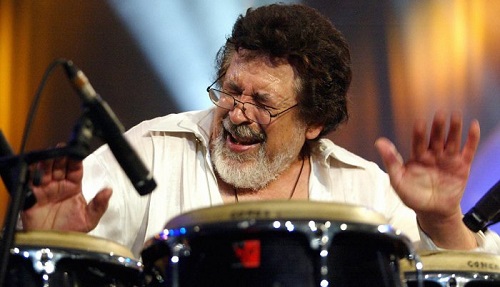
Eddie Montalvo Iron Hands: “I’m in love with Venezuela”

We felt an unforgivable duty to publish this interview with Eddie Montalvo “Iron Hands,” as it is Swing Latino update on the biography of a musician who is more than just a friend, a godfather; he’s family, the kind that gives you friendship, that fills you with conflicting feelings and leads you to relive wonderful and unforgettable moments.

Giogerling Mendez y Eddie Montalvo

He is a living legend of our Afro-Caribbean music.

We hadn’t seen each other for many years, so I wanted to share the time with him before he left Venezuela (he was playing on Saturday, so we met on Friday and shared some time with longtime friends starting at noon), before the show. The next day he would say goodbye to Venezuelan soil. This interview will be published in two installments, and here is the first one.

– How long has it been since Eddie Montalvo last came to Venezuela?

– Let me put it this way. The last time I came to Venezuela was with Rubén Blades and Son del Solar. I’ll call it Seis, because Son was with another keyboardist, Arturo Ortiz, Robby Ameen on drums, and two trombones, Reinaldo (Jorge) and Jimmy Bosch. That was the last time, many years ago.

I’ve always loved Venezuela, it’s the honest truth. I’m in love with Venezuela, no matter what happens. I’m always grateful for it. I’ve always had many friends here.

The School of the Street

– What was your first experience in music? Why conga?

– Well, when I was very young, my parents and I would go every weekend to a party at an aunt’s house. At that time, my goddaughter, I’m not going to lie to you. The gentlemen were always well-dressed, with ties, the ladies with their eyebrows done, their hair combed, a real formality despite their humility.

Everyone was dancing at that party, and Eddie Montalvo was banging on the tables until he could say no more. That’s how they got me two metal cookie tins, and it became my first instrument.

When I was five, I asked my parents if it was possible for Santa Claus to bring me a bongo. My parents were poor, and yet, on December 25th, a bongo appeared under the Christmas tree.

A bongo that didn’t have a key, a bongo that you had to put a fire under to get the sound out.

At ten, without lying to you, I asked them if it was possible for them to buy me a conga, and my parents bought me a conga that cost 50 US dollars.

As I grew older, I started crossing the street where there was always a party of rumba players. I went down with the conga, and they asked me, “Do you know how to play?” And I said, “No,” then they said, “Well, if you don’t know how to play, you can’t sit here with us and rumba.”

I went home frustrated with the conga line because they wouldn’t let me sit in and play at the party.

Héctor «Bucky» Andrade

It just so happened that there was a conga player who played with Héctor Lavoe, with Willie Colón, on an album called The Hustler.

His name was Héctor Andrade and he had a nickname: Bucky. He saw me every day when I came down with the conga line, and it seems he felt sorry for me and said, “Come here.” I said, “Are you talking to me?” He said, “Yes, yourself, come here!” Bucky said, “I see you here every day, and I feel sorry for you because I know you love the conga line, because you spend hours sitting on the bench watching us; I’m going to teach you the first tumbao like it’s played in rumba, street rumba.”

Because remember, my first music school was the street. My parents didn’t have the money. After Bucky taught me, he said, “Go home and practice.

When you think you’re ready, come, but I warn you, there will be about five rumberos playing the quinto. If you get tired, you’ll never play here again.”

I went to my room and practiced. When I felt God tell me to come down, that you’re ready, I went down.

Bucky looked at me and said, “How are you feeling?” And I sat down to play the tumba’o. About seven or eight rumberos played by, and I was still playing the tumba’o, tired, but I couldn’t stop playing, and that was my first experience. I learned a lot by watching the rumberos on the street. That way, I prepared myself and was able to sit with all of them, play the first part, play the second part, play the third part, and then quintate. That way, I played the grade they wanted and went down every day to sit with them.

Formal Studies

As I grew older, in my last year of school, I saw they had a Latin orchestra at a music school, but honestly, all they played was a Latin segment, but it was all American music.

The teacher was Italian. I knocked on the door of that school, and the teacher in charge looked at me and said, “Can I help you?” And I said, “I’m here because I’d like to know if it’s possible for you to let me play conga here with the Latin group.” He said, “Oh, no, no, no, look, son, I have tons of conga players here. Everyone comes here because they want to play conga. Excuse me, come see me next year.” And so I wasted all that time frustrated because I wanted to play.

Time came and school started in September. I tried again, and the teacher refused again. So I said, “No, no, no, no, wait, you promised me I could play conga here.” And seeing my insistence, the teacher asked me, “Do you really play conga?” “I think so.” Then he said, “Bring me a conga that’s in that room. I want it to play me a merengue, a cha-cha-cha, and a mambo.” I played it for him, and he said, “Wow, you have good hands, you’re starting with the Latin orchestra here,” and that’s how I graduated from hig  h school at 17.

From School to Work

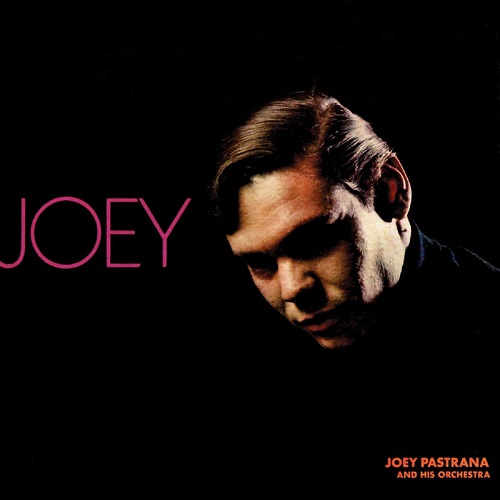
At that time, I went to work at the stock exchange in New York, and I didn’t like it, so I left. One day, I went into a New York club, and Joey Pastrana’s orchestra was playing.

It just so happened that someone said to Joey Pastrana, “Look, you see that skinny kid over there on the corner, that kid plays conga,” and he said to the kid, “Tell him to come over here.”

The kid came up to me and said, “Look, Joey wants you to go over there on stage.” I replied, “I don’t know Joey. And you’re telling me Joey wants me to go over there when I don’t even know him?” “Well, look, go, he’s calling you.”

Joe Psatrana
Joe Psatrana

I went over there, and he said, “Look, and Joey said, “Do you want to play a number with me?” And I said, “I don’t know who told you I play conga. I don’t play conga.” And he answers, “But the kids here are saying you play conga.”

And because of his insistence, I played a number. When I played the number, he said, “Do you want to play here? Because my brother, Willie Pastrana, is leaving the group.”

And when I came to see you, at 17, I was playing with Joey Pastrana. So, from then on, I went with Tony Pabón in the protest. I was with Ernie Agosto and La Conspiración, with Adalberto Santiago, Los Kimbos, even with La Diferente for a little while, just for a while; with the great Héctor Lavoe, with Pacheco, with Pete el Conde, very quickly. Then with the Estrellas Fania, and those from Puerto Rico.

– You replaced Ray Barreto in Fania, hence the nickname Manos de Hierro? Tell us a little about your experience with Fania.

– Oh, because I always had heavy hands when I played. And they called me that name: Ray Barretto, “Hard Hands,” and I, “Iron Hands.” They were the musicians, and your dad (Ángel Méndez) gave me that nickname. I’ll never forget this. I forgot to mention someone, Willie Colón, who I also played with and recorded the album “Siembra.”

Ray Barretto’s Replacement

I can’t explain how I was able to make my career in music, because, blissfully, I was in the audience at Madison Square Garden watching Fania, and I never in my life thought I’d play with the Fania Stars!

Regarding the question about whether I reviewed Barretto: before joining the Fania stars, there was Johnny Rodriguez, El Dandy.

He left, and I joined. So when I saw Barreto wanting to return, I said these words to Ray Barreto: “With all due respect to you, because you’re an icon I’ve always respected, this chair, I was just warming it up, this chair is yours.” And he said to me in English: “Eddie, we’re going to split the show. You play half the show, and I’ll play half.” And I said to him, “Ray, this seat is yours. I respect it,” and he said, “No, half and half.”

Ray Barretto
Ray Barretto

We always had a tremendous relationship. I remember when my father passed away, and Ray came and stayed with me at the funeral home for two hours. I’ll never forget it.

And I’m telling you from the bottom of my heart, one of the things I hold dear is that when Ray got sick, honestly, I wanted to go see him, and they always told me, Eddie, you can’t go because they have him in intensive care and they won’t let you in.

I was always calling mutual friends who knew if he was coming out of intensive care or not. They would tell me, “Eddie, no, hey man, don’t come because you’ll waste your time.” That’s how I couldn’t see him in his final days. It was only when he passed away that I went to the funeral home.

The same thing with your father, you know, your father for me is the friendship, and I’m not saying this because you’re interviewing me, but the relationship, the respect I have for your father, and you know, I thank your father because he was the one who made us, and I say this, of course, God made us, and with all due respect, but when it comes to the entertainment side of things, your father was the magazine that everyone bought.

When I started out in 1977, coming to Venezuela, I met your father, Ángel Méndez, Swing Latino, with Fernando, the photographer, and the truth is that the friendship was never lost.

Eddie Montalvo y Ángel Méndez

We’ll be releasing the second part of this interview soon.

Pónle Saborrrr!

By:

cafeatlantico

Swing Latino

Giogerling Mendez

Dj. Augusto Felibertt

Also Read: The legacy of Leopoldo Pineda, the ambassador of the trombone in La Maquinaria Fania All Stars

Eduardo Ron and his Fondo Blanco Band liven up great events in Miami

Once again, the Venezuelan talent in the United States is a source of inspiration for the subject of these lines and it is the turn of Venezuelan musician, sound engineer and DJ Eduardo Ron. The artist has kindly taken a few minutes of his time to answer our questions about his career and group, so here are the most important topics of our conversation.

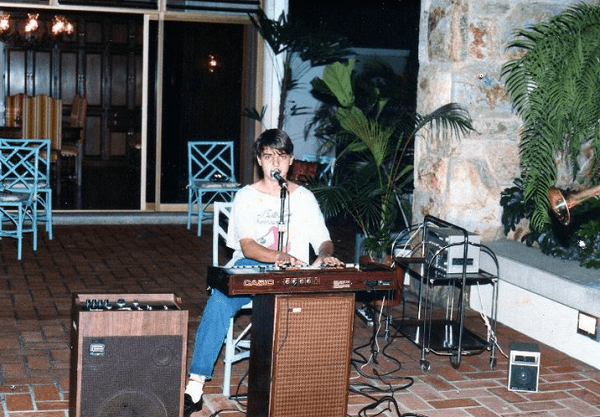
Eduardo playing the keyboard
Eduardo Ron playing the keyboard during an event

How Eduardo started in music in his native country

Since Eduardo was just a five-year-old boy, he proved to have a very capable hearing at home and already liked music very much, so his parents decided to enroll him in piano lessons, although he confessed that the instrument was not his thing. At school, he became part of bands with which he gradually found his preferred style and genres.

With these groups, he even competed in school band contests in Caracas, which are very common in the city. Over time, the only one of his close friends who ended up devoting himself to music was him, to the point that he became a ‘’one-man band’’ who took care of almost everything in his own musical project.

It was until 20 years ago where he began to include singers, percussionists and other musicians to be part of his group. That is when he changed the name to ‘’Fondo Blanco’‘, taking Eduardo’s last name, which is Ron (rum in Spanish), as inspiration.

What things Eduardo learned besides the piano

From a very young, Eduardo always liked to have contact with the part of the audio and equipment, which led him to study sound engineering at the Taller de Arte Sonoro. In addition to that, although he loves percussion and masters it to some extent, he was a keyboardist and singer for many years. He is no longer doing either at the moment, as he has decided to devote himself entirely to music production, mixing and mastering.

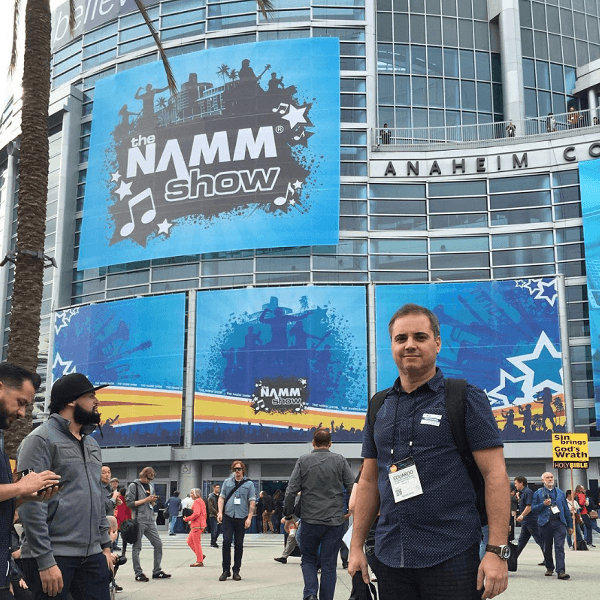
Eduardo at The NAMM Show
Eduardo Ron at The NAMM Show in 2016

When Eduardo decided to move to the United States

About 14 or 15 years ago, Eduardo decided to move to the city of Miami due to the political and economic situation in Venezuela at that time. For the same reason, he had no choice but to start from scratch with the project in these new lands and return to play, something he had not done for years, but the situation warranted.

The artist describes the Miami music market as complicated, since the competition is fierce. A huge advantage he had was that he studied English since he was very young, so the language issue was not a problem for him, but that did not make the other drawbacks easier to solve. 

One of the first surprises Eduardo got was that, in Miami, he has done no more than 50 events a year, while in Venezuela he had as many as 140 in a year. This is because the market is gigantic and it is difficult to make a big name in it, not to mention that live orchestras do not have as many bookings as before due to cost reductions.

Two years later, he had already got new artists working with him and his situation had stabilized successfully, although the process was not easy. Moreover, even today, he cannot demand exclusivity from those who work with him because he does not have the economic muscle for that, so he has a long list of musicians whom he calls for certain events. One of the first ones he always calls is Army Zerpa, whom he described as one of the best bassists and arrangers he knows, which is why he has become a key person for his project. 

Artists with whom Fondo Blanco has shared the stage 

Fondo Blanco has been fortunate to share the stage with great artists such as Oscar D’ León, Ricky Martin, Gilberto Santa Rosa, Marc Anthony, among others. Of course, the contact with these luminaries taught Eduardo many things and he assures that one of the best shows he offered was during a Santa Rosa concert, where there were more than 12,000 people. He assures that this is one of those days he will never forget.

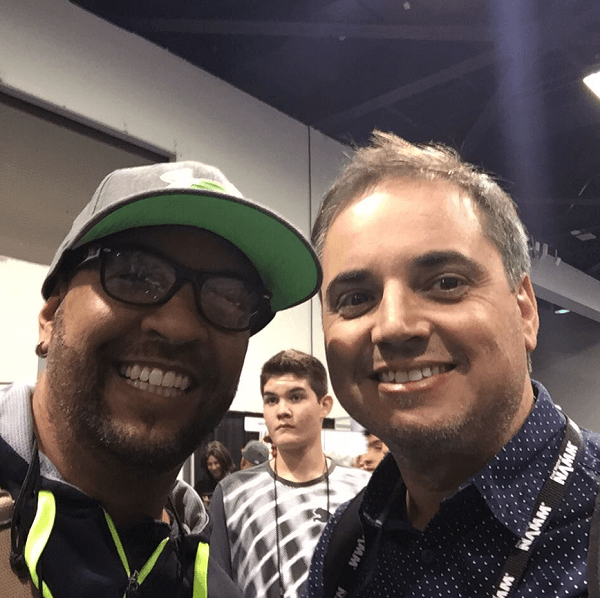
Eduardo and Omar
Eduardo Ron next to Omar Ledezma Jr. at The NAMM Show in 2016

However, just as he has had very positive experiences as the previous one, obviously not everything is rosy. The Venezuelan told us that one of those not so good days was during a Ricky Martin concert, an event he had to open that day. It turns out that his equipment was damaged two hours before his turn and he had to try to fix it in front of the crowd of 30,000 people who came to see the Puerto Rican superstar, but nothing he did worked and the audience began to hiss.

That same day, Ricky Martin’s keyboardist asked him to borrow his keyboard because his was damaged and, when returning it, it was totally messed up and what Eduardo had there had been deleted.

Today, although he remembers this with humor, the experience was so unpleasant that it led him not to accept other proposals due to fear that the same thing could happen again. However, once these fears were overcome, he continued to play with his band and has managed to adapt to what the Miami market required both locally and internationally, which shows that the goals and targets should not be disregarded no matter however difficult the circumstances become and Eduardo Ron is a great example of that.

Eduardo rehearsing
Eduardo rehearsing for the gaitas contest at Claret School, Caracas

Read also: What a pleasure to talk to Pablo Pérez ‘‘El Alcalde de La Salsa’’

Oscar Dudamel continues to achieve dreams and presents “La Rumba Me Llama”

Legendary Venezuelan trombonist Oscar Dudamel expands his musical vision with a new single that fuses the essence of classic salsa with his unmistakable style, which is why he does not hesitate to express “La Rumba Me Llama”.

This song is part of his upcoming album “Sueño Alcanzado”, a production that will be released on May 30 and represents the culmination of years of musical research, fusing the classic salsa sound with jazz influences and the romantic tradition of boleros.

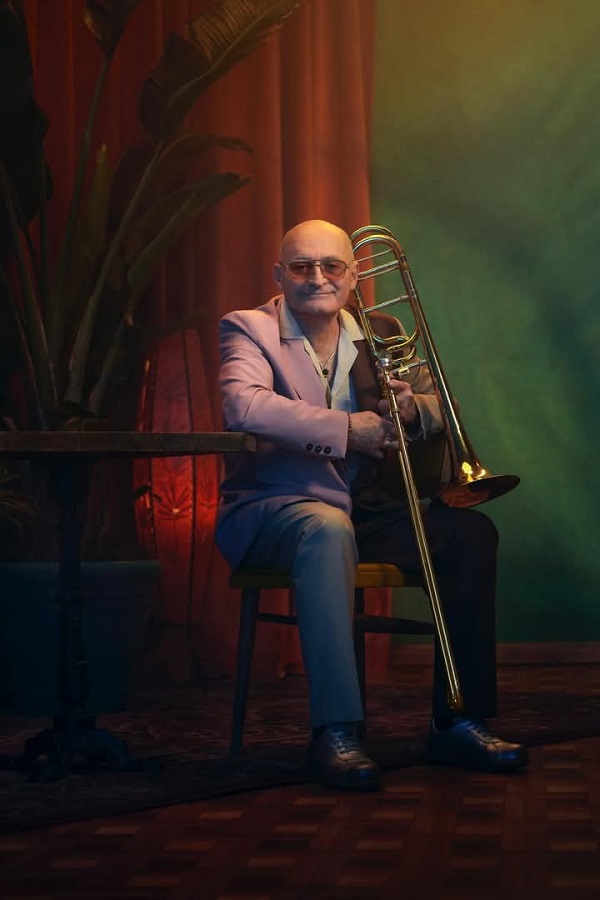
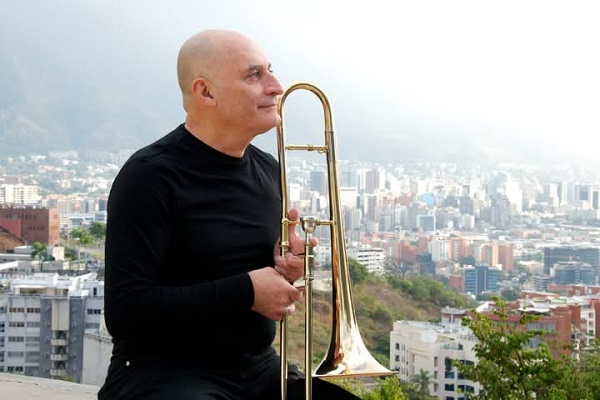
El legendario trombonista venezolano Oscar Dudamel

In “La Rumba Me Llama”, Dudamel brings his trombone to the forefront of a vibrant composition that captures the essence of the rumba as an inescapable call. With a musical structure that evokes the great salsa orchestras and an impeccable instrumentation.

The piece stands out for its meticulous arrangements, powerful brass and an irresistible cadence, faithful to the spirit with which Dudamel has approached his music. The track is an invitation to the dance floor and a testament to the rhythmic power that has defined his career.

The album Sueño Alcanzado not only takes its name from a personal concept of triumph, but also from one of his most significant pieces.

The title track was born in an intimate creative encounter in Caracas, Venezuela, with Maestro Alberto Crespo, composer Eliel Rivero and Solange Ramírez, mother of his son Gustavo Dudamel.

Oscar y Gustavo Dudamel

Dedicated to her son and with her special participation on violin, this piece encapsulates the spirit of a project that transcends the musical to become a testimony of life.

More than a nostalgic production, “Sueño Alcanzado”, of which the song “La Rumba Me Llama” is part, is the reflection of an evolution. The music that accompanied him since his childhood now takes a new form under his direction, in a creative process that has brought together talented musicians with whom he shares the same vision.

His orchestra, based in Madrid, has become the vehicle to continue taking his proposal to international stages, demonstrating that salsa is still alive in every note and every drum beat.

“La Rumba Me Llama” is now available on all digital platforms and is just a preview of ‘Sueño Alcanzado’, Oscar Dudamel’s new album, consolidating his legacy with authenticity and mastery.

Oscar Dudamel Virtuoso Musician, Trombonist and Orchestra Conductor.

Oscar Dudamel, a Venezuelan trombonist, discovered his passion for salsa as a child when he first heard “La Murga” by Willie Colón. Although his formal musical training began with Maestro Pablo Canela and later continued within El Sistema as a classical musician, that early experience left a profound mark on him, inspiring his dream of playing the trombone and solidifying his love for salsa as his ultimate passion.

Dudamel was born on January 14, 1961, in Barquisimeto, Venezuela. He grew up in a musical family where every gathering was celebrated with music, fostering his passion for the art from a young age. His parents purchased him a trombone, and he began his studies at the Yamaha Music Academy.

Oscar Dudamel sigue alcanzando sueños

At the age of 7, he was enrolled in a music academy under the guidance of Maestro Pablo Canela, a composer and prominent figure in the music of the Lara State region of Venezuela.It was there that he started his training with the Cuatro, the traditional Venezuelan instrument, and the guitar, which became his first instruments.

In addition to his Cuatro training, Dudamel began studying and playing various percussion instruments, further broadening his musical repertoire.

His academic training took place at the Lara State Conservatory in Barquisimeto, and at the National System of Youth and Children’s Orchestras and Choirs of Venezuela, also known as El Sistema.

During his teenage years, he became a member of the Youth Orchestra of Lara State (El Sistema Lara) and the Liceo Mario Briceño Iragorry Band, where he had the opportunity to expand his musical knowledge and explore various genres.

Dudamel entered a new phase of his life when he enrolled at the Vicente Emilio Sojo Music Conservatory to study theory and solfège, continuing his trombone studies under the guidance of his maestro, Óscar Vivenes.

Over the years, he became a member of the Lara Youth Symphony Orchestra of Lara, part of the national network of Venezuela’s El Sistema orchestras, actively participating in classical music.

However, his fascination with the Caribbean rhythms of salsa never disappeared. Thus, he combined his classical training with his passion for salsa, performing with renowned artist and sharing the stage with legends of the genre, such as Héctor Lavoe, Ismael Rivera, Ismael Miranda, Celia Cruz, Justo Betancourt, Marvin Santiago, and other great artists.

In Caracas, Venezuela, he founded his own orchestra, with which he had the opportunity to share the stage with notable figures such as Rubén Blades, Gilbert Santa Rosa, Luis Enrique, Guaco, Oscar D’ León, and many others.

Dudamel’s surname is synonymous with music. He is the father of Gustavo Dudamel, one of the most acclaimed classical music conductors in the world. Gustavo’s well-known fondness for salsa stems from his father, who recently fulfilled his lifelong dream of releasing a solo album titled Sueño Alcanzado, dedicated to his son.

Dudamel currently resides in Madrid, Spain, where he leads his ensemble, Oscar Dudamel y su Orquesta, performing salsa alongside his Venezuelan musician friends and colleagues at Café Berlín Madrid.

Oscar Dudamel y Dj, Augusto Felibertt

‍Research Sources:

Contact: Katie Baloian of Radio Notas (Compartiendo Ideas)

Alberto Crespo (Pianist and Arranger)

Dj. Augusto Felibertt

Café Berlin in Madrid

Also Read: Mariana “The Sonera of Venezuela and for the world”

  • « Go to Previous Page
  • Page 1
  • Interim pages omitted …
  • Page 7
  • Page 8
  • Page 9
  • Page 10
  • Page 11
  • Interim pages omitted …
  • Page 95
  • Go to Next Page »

International Salsa Magazine (ISM) is a monthly publication about Salsa activities around the world, that has been publishing since 2007. It is a world network of volunteers coordinated by ISM Magazine. We are working to strengthen all the events by working together.