• Skip to primary navigation
  • Skip to main content

International Salsa Magazine

  • HOME
  • Previous editions
    • 2026
      • ISM / March 2026
      • ISM / February 2026
      • ISM / January 2026
    • 2025
      • ISM / December 2025
      • ISM / November 2025
      • ISM / October 2025
      • ISM / September 2025
      • ISM / August 2025
      • ISM / July 2025
      • ISM / June 2025
      • ISM / May2025
      • ISM / April 2025
      • ISM / March 2025
      • ISM / February 2025
      • ISM / January 2025
    • 2024
      • ISM / December 2024
      • ISM / November 2024
      • ISM / October 2024
      • ISM / September 2024
      • ISM / August 2024
      • ISM / July 2024
      • ISM / June 2024
      • ISM / May 2024
      • ISM / April 2024
      • ISM / March 2024
      • ISM / February 2024
      • ISM / January 2024
    • 2023
      • ISM / December 2023
      • ISM / November 2023
      • ISM / October 2023
      • ISM – September 2023
      • ISM – August 2023
      • ISM July 2023
      • ISM Edition June 2023
      • ISM – May 2023
      • ISM April 2023
      • ISM March 2023
      • ISM February 2023
      • ISM January 2023
    • 2022
      • ISM December 2022
      • ISM November 2022
      • ISM October 2022
      • ISM September 2022
      • ISM August 2022
      • ISM July 2022
      • ISM June 2022
      • ISM May 2022
      • ISM February 2022
      • ISM January 2022
    • 2021
      • ISM December 2021
      • ISM November 2021
      • ISM October – 2021
      • ISM September 2021
      • ISM August 2021
      • ISM July 2021
      • ISM May 2021
      • ISM April 2021
      • ISM June 2021
      • ISM March 2021
      • ISM February 2021
      • ISM January 2021
    • 2020
      • ISM December 2020
      • ISM November 2020
      • ISM October 2020
      • ISM September 2020
      • ISM August 2020
      • ISM July 2020
      • ISM June 2020
      • ISM May 2020
      • ISM April 2020
      • ISM March 2020
      • ISM February 2020
      • ISM January 2020
    • 2019
      • ISM December 2019
      • ISM November 2019
      • ISM October 2019
      • ISM Septembre 2019
      • ISM August 2019
      • ISM July 2019
      • ISM June 2019
  • Spanish
  • Download Salsa App
    • Android
    • Apple

Search Results for: Salsa orchestra

Rey Ruiz’s ‘Contigo’ concert at the Coca Cola Music Hall in Puerto Rico was Phenomenal.

As part of his Contigo tour, Rey Ruiz returned to what he considers his musical homeland: Puerto Rico. Since August 1992, when his first album (Rey Ruiz) was released, he has not stopped singing. He affirms that from the beginning he longed for a concert on Puerto Rican soil like the one he finally achieved on March 23, 2024 at the Coca Cola Music Hall.

Rey Ruiz's 'Contigo' concert at Coca Cola Music Hall in Puerto Rico phenomenal
Rey Ruiz’s ‘Contigo’ concert at Coca Cola Music Hall in Puerto Rico phenomenal

Before the concert, we were counting on hearing the songs that the salsero’s fans turned into hits. Certainly, the Coca Cola Music Hall witnessed how the euphoria with which Rey Ruiz catapulted in the early 90’s was revived. We knew we would hear the usual hits, such as ‘No me acostumbro’, ‘Si me das un beso’, ‘Amiga’, ‘Si te preguntan’, ‘Mi media mitad’, ‘Luna negra’ and ‘Creo en el amor’. To these were added ‘El Rey del mundo’, ‘Mal momento’, ‘El hombre de tu vida’, ‘Así se compone un son’, ‘Es difícil de explicar’ and a medley that included ‘Miénteme’, ‘Estamos solos’ and ‘Eso digo yo’.

An emotional Rey Ruiz sang ‘Cuba y Puerto Rico’, a song of his own authorship, arranged by Papo Lucca, which was included in his 4th album (Destino, 1996). For this special performance he was accompanied by the Puerto Rican cuatro player Prodigio Claudio. The concert was brought to a close with a tasty rendition of ‘Mañana por la mañana’.

Rey Ruiz, whose battle cry also gave the title to one of his musical productions: Fenomenal (2000), clarifies that he is a composer by muse, and that he does not consider himself a composer by trade. However, he is a singer-songwriter by definition, and the composition that best defines him is ‘Si me das un beso’, a song that highlights the Caribbean spark that characterizes his lyrics and interpretations.

Rey Ruiz was one of the soloists who firmly established himself in the salsa scene when salsa romántica was taking over the changing spaces of Latin music. Salsa dura was evolving to give way to the new trend we know today as salsa romántica.  With the repertoire with which Tommy Villariny’s production and Jorge Luis Piloto’s pen were shaping the salsa artist’s career, the success was epic. That great takeoff in the career of the icon of salsa romántica was given with the impulse of the person Rey Ruiz calls “the daddy of the chicks”, his promoter: Edgardo Barreras.  During the concert, Rey Ruiz made a stop to thank Edgardo and the late Tommy Villariny, who was represented by his son Oscar, for the success of his career.

Rey Ruiz
Rey Ruiz

The performance at the Coca Cola Music Hall of the production by Rosalis Torres exceeded all expectations.  It had been anticipated that there would be “a unique experience, a magical night with Rey Ruiz as part of his Contigo tour.  The promise of an evening with the incomparable energy of Rey Ruiz on stage was fulfilled.  Indeed, Rey Ruiz is a legend.  His voice is unique, soft and romantic. However, that “softness” does not detract from his vocal strength, which he managed to show off accompanied by a large orchestra and symphonic sound.

The super orchestra that accompanied Rey Ruiz included Erick Castañeda on congas and musical direction, Elías Lopés, Jr. on timbales, Idelfonso Correa on bongo, Sergio Munera on bass, Héctor Ortiz on piano; Iván Odio, Mario Ortiz and Alfredo Pérez on trumpets; Alexander Zapata and Ramón Benítez on trombones; as well as Alain García, Laura Ruiz and Juan Carlos Gonzales on backing vocals. For the symphonic sound, the chamber orchestra featured Sarli Delgado on double bass and conducting the string ensemble; Leticia Medina, Olga Juliá, Stephanie Berríos Carla Berríos, Mariel Pagán and Emily Reyes on violins; Chrystal Villalongo and Gina Flaz on violas; and Keren Torres and Ruth Brin on cellos.

Rey Ruiz’s more than 30-year musical career confirms that Cuba and Puerto Rico are one bird with two wings. Rey Ruiz is the pride of Cuba and is also the pride of Puerto Rico, his home of always.


Rey Ruiz y Bella Martinez

Bella Martinez Puerto Rico


Also Read: Jerry Ferrao says in salsa key: “My life is a drum”.

ISM / April 2024

​

April-2024 (left) April-2024 (right)
SalsaApp-L SalsaApp-R
NA April 2024 humbnail
LA March 2024 humbnial
EU March 2024 Thumbnail
Asia March 2024 thumbnail
Africa March 2024 Thumbnail
Oceania April 2024
Backcover April 2024
Do you enjoy Latin music? Would you like to get more involved in this genre and share your passion for Salsa, Bachata, Kizomba, Merengue and more. Why not joint our Global Team of volunteers as a correspondent?
You can ask for more details with no obligation and we’ll be happy to talk to you about the benefits that come with the role

[Read more…] about ISM / April 2024

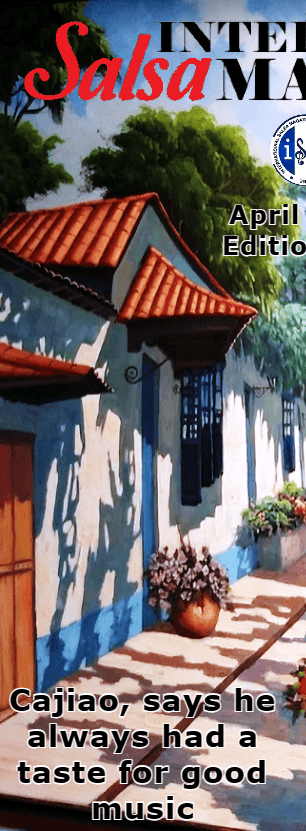
Cajiao, says he always had a taste for good music: the tangos and ballads of the 50s and 60s

Danilo Cajiao was born on February 9, 1969 in Cali Colombia son of Marina Munevar and Antonio Cajiao family with three siblings Walter, Patricia and Raul.

From my father I inherited the musical taste for Afro Antillean rhythms, we listened at home to the Sonora Matancera, Benny More, Arsenio, Daniel Santos and many more.

Danilo Cajiao was born on February 9, 1969 in Cali, Colombia.

There was always a taste for good music: the tangos and ballads of the 50s and 60s.

When I was a student I participated in several music festivals at school and I was part of several dance and Andean music groups.

I always liked salsa and my favorite artist of the genre will always be Angel Canales.

After the appearance of the program “YO ME LLAMO” in Colombia I was motivated to start the process to achieve the perfect imitation of Angel Canales.

I began my presentations in small salsa bars with a dance floor and I did about 4 songs of Diferente, as I went along the character was being perfected and the public and the owners of the bars were asking for something more.

I then created “the Orchestra SON DE LA 8″ in 2013 with the purpose of making the accompaniment and mount all the music of the different Angel Canales.

Orquesta SON DE LA 8

The market was opening and the support of the salseros was very large, We have had much acceptance in the salsero environment in Colombia.

Participating in major events locally, nationally and internationally:

Leyendas Vivas De la Salsa in Medellin Colombia,

Salsa al Parque Cali, Salsa al Parque Bogotá, Homenaje a la Salsa, Tributo a los salseros and Noche Blanca.

I have alternated and shared stages with several national and international artists and orchestras.

Orquesta Brodway, Orquesta Colon, Nelson y sus Estrellas, Gran Combo de Puerto Rico, Henry Fiol, Adalberto Santiago, Luisito Carrión, Papo Cocote, Cano Estremera, Moncho Santana, Orquesta Zodiac, Luigui Texidor, Frankie Vásquez, Tony Molina, Orlando Marín, Orquesta la Inmensidad and Orquesta la 33.

Danilo Cajiao, says there has always been a taste for good music, the tangos and ballads of the 50s and 60s.

International presentations:  

Guayaquil Ecuador and Caracas Venezuela.

Endorsed and supported by the family of ANGEL CANALES and by him I have taken my tribute to the most recognized places and salsa clubs in Colombia.

Apart from accompanying the Diferente Angel Canales with the orchestra Son de la 8 we have made our own music always keeping the line of heavy salsa and with good taste.

Angel Luis Canales “El Diferente”.

There were nine record productions by Angel Canales between 1975 and 1987, twelve productive years.

By 1970 Angel Luis Canales had put his voice on an album by African-American pianist Mark Dimond, and five years later Dimond’s orchestra was renamed “Angel Canales y Sabor”.

The immense musical freedom of Ángel Luis Canales Canales has much to do with the determining influence exerted on him by Rafael Cortijo, Ismael Rivera and the irreverence of the Combo de Cortijo as a whole.

The difference was that those two masons did not have enough money to support their ideas economically (discographically speaking) while Canales had enough because of the money he earned from his profession as a jeweler and diamond cutter.

That’s why he didn’t lower his head to anyone, that’s why he didn’t give in to any advantageous record contracts and made his own record label, that’s why he never paid or bribed radio producers, and he dressed the way he wanted.

That’s why the conservative salseros kept a CIA-like eye on him. And Canales revolutionized everything in his path: from his clothing to his vocal and orchestral arrangements, his presentations and his choice of repertoire.

By 1970 Angel Luis Canales had put his voice on a record by the Afro-American pianist Mark Dimond, and five years later Dimond’s orchestra was renamed “Angel Canales y Sabor”, and with it he would make a mark like few others in the world of salsa, from his total independence, to the freedom for the musicians, his revolutionary shaved head, and a wardrobe that had nothing to do with the salseros, in addition to his voice, repertoire and arrangements. Ángel Canales recorded in 1979 the album “El sentimiento del latino en Nueva York”, and an exquisite version of “Dos Gardenias”, by Cuban composer Isolina Carrillo.

“El sentimiento del latino en Nueva York” was a clarinada similar to “Imágenes Latinas”, the song by Argentine Bernardo Palombo presented a year earlier by Conjunto Libre, in terms of its contents of denunciation and clamor for justice. “Es el sonido que el americano oye/ y no entiende” (It’s the sound that the American hears/ and doesn’t understand).

Musical childhood

Ángel Luis Canales was born on June 29, 1950 in Santurce, Puerto Rico, son of Ángel Luis Canales and Ana Ilda Canales.

At the age of 8 he was already in New York with his parents, who liked to listen to romantic music and also to Cortijo y su Combo.

The Puerto Rican country song was also among his favorites; it was the jíbara song of his people. In time Canales would indicate that Cortijo and Ismael were determining influences in his musical and social journey.

Much has been said that his current retirement is due to Parkinson’s disease, but Ángel Luis Canales is there, he attends private invitations of his friends and remains in the battle line of salsa and life. He is currently 73 years old.

In those years and in school he was more inclined to practical workshops than books and that is why he went to work, recommended by one of his teachers in a jewelry store where from being a messenger he would learn all the secrets of the art of cutting, polishing and mounting diamonds. He became a professional, solvent, and with an extraordinary clinical eye that would serve him a lot later.

Vista larga, his new friends did not speak Spanish, his native language, but fortunately Angel Luis had peers of his generation, and Latinos like the Lebron brothers and Willie Colon himself.

He also took a long view of his internship in the U.S. Army and later assimilated the new trends that emerged in the music being made in New York.

He started out firmly, as we have already mentioned, with pianist Mark Dimond (Markolino), who had been linked to Willie Colón. With Mark he added his voice to some of the songs on the album “Brujería” and later, with the departure of the pianist, the orchestra was renamed “Ángel Canales y Sabor”.

With this band he would record “Sabor” in 1975 and other albums until “El Sentimiento del latino en Nueva York” in 1979.

Two years before the recording of this album, in 1977 Angel Canales made his first visit to a Latin American country, Panama, and the reception he received was such that he would later write a song dedicated to that country.

The same happened during his visit to Venezuela on November 13 and 14, 1981, which became a musical commotion of great proportions at the Poliedro de Caracas.

Likewise in Colombia and Peru he felt the devotion of the public of those nations. Perhaps he did not know the scope of his work and the projection he already had.

Angel Canales "El Diferente" receiving Danilo Cajiao's production "Mi Perdicion" year 2020.
Angel Canales “El Diferente” receiving Danilo Cajiao’s production “Mi Perdicion” year 2020.

Much has been said that his current retirement is due to Parkinson’s disease, but Angel Luis Canales is there, he attends private invitations of his friends and remains in the battle line of salsa and life. He is currently 73 years old.

Source: TeleSurTv

Also Read: Orquesta la Identidad is one of the most nationally and internationally recognized groups in the salsa genre

Wilmer Lozano from a very young age his mother saw in him the desire to be a musician

Wilmer Lozano is a Venezuelan singer and composer. He was born in Caracas, Venezuela, on October 7.

Wilmer Lozano Yenyere

When talking about successful Latin singers and good salsa, one has to talk about Wilmer Lozano, one of the greatest exponents of Latin music in the world, who has made millions of people around the world dance.

Among his musical hits are: “Me marcharé”, “Aún estoy de pie”, “Si acaba bien”, “Descarga pa ti”, “Se me pasó la mano” and “Igual que yo”.

Childhood, Youth and Family Life.

Wilmar Lozano’s mother saw in him the desire to be a musician since he was a child.

Every night before going to sleep and saying his prayers, he would dedicate himself with his grandfather Lino Lozano to practicing décimas, which would be very useful in his career as a sonero.

Wilmer Lozano’s Beginnings in Music.

Wilmer Lozano’s career began when he was in school, participating in all the events that took place there.

He got his first singing lessons at the Casa de la Cultura Germán Lira and that’s how he arrived at a very popular radio program for the time, rumbos, coplas y canciones directed by the great Venezuelan Simón Díaz.

Jose Hidalgo y Wilmer Lozano

Wilmer Lozano and his union with different groups.

Soon after, he belonged to an orchestra in the block where he lived and shared his studies with music. Little by little he belonged to orchestras based in Caracas, such as: Grupo Autana, Grupo Rayta, La Quinta Galaxia, Quinteto Visa, Conjunto Sensación, Sonora Habanera, Hildemaro y su Orquesta, Orquesta Selecto, Marianela y su Orquesta, Orquesta Vía de Escape and Orquesta La Júnior.

He later joined the ranks of the Dimensión Latina Orchestra. With this orchestra he has the privilege of sharing with the excellent bolerista Wladimir Lozano and the sonero Rodrigo Mendoza, both recognized nationally and internationally, with whom he further nurtured his knowledge as an interpreter and sonero.

He also formed part of the youth orchestra called Los Adolescentes, where he is a key piece of it, standing out as a leading artist.

With this project he recorded two productions where he performed several hits, with which he became known worldwide.

Musical genre.

Wilmer Lozano is a performer who is considered one of the best salsa singers due to his graceful voice register.

Career and Legacy

Wilmer Lozano has managed to place eleven songs in the first place of the Hit Parade. According to information provided by the company Record Report, besides being the only Venezuelan singer, who in two opportunities being in the first place, is incorporated again to the same place of honor with the same interpretations.

Wilmer Lozano, Tuky Torres, Dj. Augusto Felibertt y Rey Torcatt

Then his artistic life assumes another challenge, which he achieves with great professionalism, since his talent exceeds many expectations. Proof of this was his record production “Wilmer Lozano Original”, where he took the opportunity to launch himself as a soloist.

In this work he shows all the experience he has acquired during his artistic career, with the help of producer Thomas Bernal.

He achieves an excellent production, with very varied Latin rhythms and social themes. This album has the participation of the composers: Thomas Bernal, Ruby Pérez, José Luis Perales, Amaury Gutiérrez, Ángel Flores and Pedro Vargas, among others.

Among the hits of his debut are: “Me han contando que existe un paraíso”, “Me marcharé”, “Se me pasó la mano”, “Completamente” and “Sueño guaireño”, this last one was dedicated to the people who had something to do with the tragedy of La Guaira, Vargas, Venezuela.

In many of his songs he also talks about the social content, as well as the concern of many people to move forward beyond their borders.

He has also collaborated with renowned interpreters of the salsa genre, such as: Tito Puente, Tito Rojas, Rey Ruiz, Victor Manuel, Cheo Feliciano, Gilberto Santa Rosa, Tony Vega, Celia Cruz and Oscar D’León.

Wilmer Lozano is a salsa performer who has achieved musical success. His career has excelled nationally and internationally, with his arduous talent that has characterized him.

His tours have taken him to Latin America, the United States, Asia and Europe.

Theme: Se me paso la mano

Album: Wilmer Lozano “Original”.

Composition and Arrangement: Tomas “Monchy” Bernal (RIP)

Year: 2001

Label: Plátano Record

“I don’t know what I’m going to do with me, today I’m destroying myself little by little, I was wrong I lost my way because of her my destiny is transformed, because I don’t know what to do with this love that makes me run amok, she makes me see everything differently”.

Sources: Buena Música

Also Read: If you want to listen to Tasty Salsa tune in to Ritmo Sabor y Salsa with Nesmary J. Gómez

North America / April 2024

Joanna Torres from Arepas Latin CuisineDon Perignon

The NAMM Show

Julio Vilchez

Paula MayaPBS

Thumbnail about the salsa museum

Las Maracas promo

Martinez attorney


Canada flag

CANADA

DIRECTORY OF NIGHTCLUBS

Dirty Martini
Dirty Martini Oakville
2075 Winston Park Dr
Oakville, OntarioN, Canada L6H 6P5
+1 905 829-8400

El Rancho
El Rancho
430 College St
Toronto, Ontario, Canada M5T 1T3
+1 416 921-2752

LULA LOUNGE
Lula
1585 Dundas West
Toronto, Ontario, Canada M6K1T9
+1 416 588-0307

Marlowe Restaurant & Bar
55 York Blvd
Richmond Hill, Ontario, Canada L4B 3B4
+1 905-771-8645

Sahara
Sahara
1855 Dundas St E
Mississauga Ontario L4X 1M1
+1 905 282-0316

Smokeshow BBQ & Brew
744 Mt Pleasant Rd
Toronto, Ontario, Canada M4S 2N6
+1 416 901-7469

Mangos Kitchen Bar
Mangos Kitchen Bar
1180 Howe Street
Vancouver, BC, Canada V6Z 1R2
+1 604 559-5533

Baza
Baza Dance Studios
1304 Seymour Street
Vancouver, BC, Canada V6Z 1R2
+1 778-379-2292

Studio Nightclub
Studio Nightclub
919 Granville street
Vancouver, BC, Canada V6Z 1L3
+1 604 620-6604


United States flag

UNITED STATES

DIRECTORY OF NIGHTCLUBS

CALIFORNIA FLORIDA  ILLINOIS
MICHIGAN NEW JERSEY NEW YORK
OHIO PENNSYLVANIA TEXAS
VIRGINIA WASHINGTON
APRIL 2024 FESTIVALS
Colorado circle flag
COLORADO


Colorado CC 224

Colorado State Dance Championship

Apr 20 / 21, 2024

7000 Church Ranch Blvd, Denver, CO, United States,80021

  • « Go to Previous Page
  • Page 1
  • Interim pages omitted …
  • Page 82
  • Page 83
  • Page 84
  • Page 85
  • Page 86
  • Interim pages omitted …
  • Page 155
  • Go to Next Page »

International Salsa Magazine (ISM) is a monthly publication about Salsa activities around the world, that has been publishing since 2007. It is a world network of volunteers coordinated by ISM Magazine. We are working to strengthen all the events by working together.