• Skip to primary navigation
  • Skip to main content

International Salsa Magazine

  • Home
  • Previous editions
    • 2025
      • ISM / November 2025
      • ISM / October 2025
      • ISM / September 2025
      • ISM / August 2025
      • ISM / July 2025
      • ISM / June 2025
      • ISM / May2025
      • ISM / April 2025
      • ISM / March 2025
      • ISM / February 2025
      • ISM / January 2025
    • 2024
      • ISM / December 2024
      • ISM / November 2024
      • ISM / October 2024
      • ISM / September 2024
      • ISM / August 2024
      • ISM / July 2024
      • ISM / June 2024
      • ISM / May 2024
      • ISM / April 2024
      • ISM / March 2024
      • ISM / February 2024
      • ISM / January 2024
    • 2023
      • ISM / December 2023
      • ISM / November 2023
      • ISM / October 2023
      • ISM – September 2023
      • ISM – August 2023
      • ISM July 2023
      • ISM Edition June 2023
      • ISM – May 2023
      • ISM April 2023
      • ISM March 2023
      • ISM February 2023
      • ISM January 2023
    • 2022
      • ISM December 2022
      • ISM November 2022
      • ISM October 2022
      • ISM September 2022
      • ISM August 2022
      • ISM July 2022
      • ISM June 2022
      • ISM May 2022
      • ISM February 2022
      • ISM January 2022
    • 2021
      • ISM December 2021
      • ISM November 2021
      • ISM October – 2021
      • ISM September 2021
      • ISM August 2021
      • ISM July 2021
      • ISM May 2021
      • ISM April 2021
      • ISM June 2021
      • ISM March 2021
      • ISM February 2021
      • ISM January 2021
    • 2020
      • ISM December 2020
      • ISM November 2020
      • ISM October 2020
      • ISM September 2020
      • ISM August 2020
      • ISM July 2020
      • ISM June 2020
      • ISM May 2020
      • ISM April 2020
      • ISM March 2020
      • ISM February 2020
      • ISM January 2020
    • 2019
      • ISM December 2019
      • ISM November 2019
      • ISM October 2019
      • ISM Septembre 2019
      • ISM August 2019
      • ISM July 2019
      • ISM June 2019
      • ISM May 2019
      • ISM April 2019
      • ISM March 2019
      • ISM February 2019
      • ISM January 2019
    • 2018
      • ISM December 2018
      • ISM November 2018
      • ISM October 2018
      • ISM September 2018
      • ISM August 2018
      • ISM July 2018
      • ISM June 2018
      • ISM May 2018
      • ISM April 2018
      • ISM March 2018
      • ISM February 2018
      • ISM January 2018
    • 2017
      • ISM December 2017
      • ISM November 2017
      • ISM October 2017
      • ISM September 2017
      • ISM August 2017
      • ISM July 2017
      • ISM June 2017
      • ISM May 2017
      • ISM April 2017
  • Download Salsa App
    • Android
    • Apple
  • Spanish

Search Results for: Son

Son Rumbero, Colombia Offers You Authentic Salsero Tourism

Norte America / Colombia / Bogota

Son Rumbero, Colombia Offers You Authentic Salsero Tourism

“Come and enjoy classes, dance and local tourism”

Jose Perez - Son Rumbero, Colombia
Jose Perez – Son Rumbero, Colombia

The Son Rumbero Academy continues to focus on salsa tourism in Colombia. This prestigious academy offers us the opportunity to unite the tourism of this beautiful country with the best classes of Latin rhythms that you are looking for, all nested in a single package, an opportunity to schedule 24 hours a day in activities willing to know, enjoy and above all. all dance.

The offer is made to enjoy the service in the main cities of the country since they have qualified personnel who provide classes from the capital Bogotá, passing through Cali, Barranquilla, Cartagena, Medellín, Pereira, Popayán among other cities.

The cycle of classes ranges from 2, 4, 6, 8 or more hours of personalized instruction, with qualified and highly experienced professionals, this leads to an almost guaranteed successful result, live the experience of learning salsa in any of its styles, Merengue, bachata, urban rhythms, a little bit of everything, only you have the power to determine the line you want to take, all these dance activities taught in ideal spaces, from discos, classrooms to hotels in the cities.

This cycle of classes is nested in the visit to the best nightclubs in the city where you are, this to take the classes to the practical cycle, an idea that allows you to learn much more effectively by sharing with the same teachers who instruct you.

Class in Son Rumbero, Colombia

We have a unique salsa tourism program in the country, the academy offers you the opportunity to get to know the most emblematic tourist sites in the area where you are, whether historical, cultural, social, recreational or other that interests the client.

The classes are scheduled weeks in advance where the academy sends you the itinerary of classes and walks in a tourist guide that organizes the days of your visit, always leaving a space for those interested to also determine the activities you want to do, it is like have a tourist assistant who additionally dances.

For more information on plans and costs, be sure to contact them at the numbers +573022582306 and +573196432329, through their social networks @sonrumbero on Instagram and Facebook, email [email protected] or [email protected] and through their website www.sonrumbero.com

Eddie Ortiz & Son Caribe here in ISM

Eddie and his story 

Latin talent has expanded all over the world to the point that there is a significant presence of these groups in Hawaii. Today we have talked to Eddie Ortiz, one of its leaders, who tells us his interesting story. 

Eddie Ortiz, a New Yorker of Puerto Rican descent, began his journey through music when still a child, which led him to become the musical director of one of the main Latin orchestras in Honolulu.  

The following are the most salient aspects of his life and musical career.   

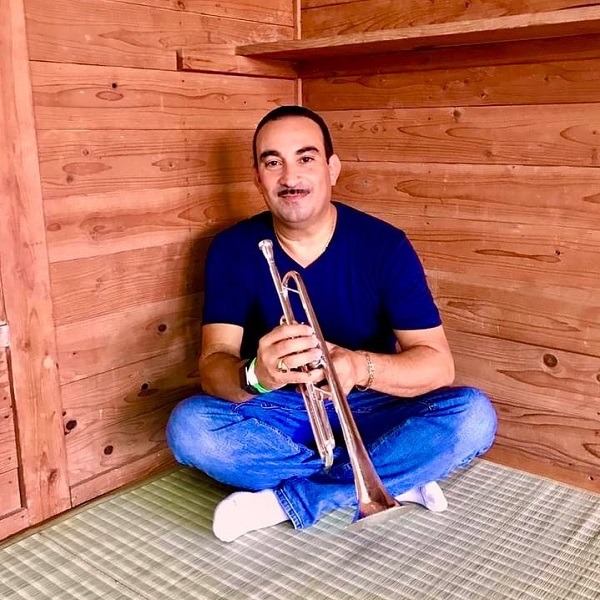
Eddie and his trumpet
Eddie Ortiz with his trumpet

The Armed Forces and moving to Hawaii   

Eddie’s first contact with music was in school, when he began taking trumpet lessons for a few years until he moved with his family to Tampa, Florida, where his life would change radically.   

While there, he joined the Navy and served for more than 20 years, time in which the artist took the opportunity to join the Marine band and hone his skills as a musician. 

It was in those years he served as a trumpet player and played for several military bands being in the armed forces.   

During his military career, he was forced to visit many countries and Hawaii was his last stop. About three years before retiring, he decided to create Eddie Ortiz & Son Caribe, a group he still plays with today.    

As for Hawaii, he liked the place, the weather and the people so much that he did not want to return to the United States. That was over 27 years in total. He still thinks it was the best decision he could have made personally and professionally.    

Eddie Ortiz & Son Caribe 

Something very interesting about Eddie Ortiz & Son Caribe is that they play Latin music, but most of the members are not Latino. The group has people from Japan, China, Portugal and Hawaii. In fact, some of them were with Eddie in the navy and, today, support him in this great project.   

A very particular case is that of Cynthia Romero, the band’s vocalist, who was born in Manila, Philippines, and speaks six languages, but Spanish is not one of them. However, she is perfectly capable of singing in that language without any problem, since she practices a lot the songs at the phonic level to avoid mistakes.   

Whenever there are original songs, Cynthia usually asks Eddie what a song is about and he explains it to her in detail so she can perform it and live out it properly. She also takes the trouble to translate all the content and learn it to avoid any failure in the studio or on stage.    

In the case of the genres, a different level of preparation for each one is always required, so Eddie and Cynthia always rehearse alone at first, while the musicians prepare themselves separately. It is then that they all join together to see how the band sounds as a whole.    

Eddie in a studio
Eddie Ortiz playing his trumpet in a studio

Learning from other artists on stage 

The members of Eddie Ortiz & Son Caribe have had the opportunity to share the stage with Ismael Miranda, Celia Cruz, Johnny Polanco, Tito Puente Jr, Luisito Rosario, and many more. When asked what he and his musicians have learned from these great artists, Eddie replied that the opportunity to accompany these personalities and open their shows have been a blessing and an immense honor.   

”Each one of these artists has a very unique style and, whenever we accompany one of them, there are always new things to learn in order to be able to interpret those styles in the future. All of these things that we see in others are incorporated into our own music as we see fit” said Eddie.   

The media’s role in his career   

With respect to the media, Eddie Ortiz & Son Caribe has had a presence in various magazines and channels such as Honolulu Magazine, KS TV, 88 Tee, University of Hawaii Sports Television, among others.    

Eddie said they did not expect this media exposure, but it has been very well received. They have been asked to make music for one or two radio stations or channels, which has given them the opportunity to demonstrate their talent and be known among a wider audience.   

The best thing is that this gave them the opportunity to explore other genres, as the aforementioned media have asked for pop, traditional Hawaiian music and other genres requested at that time.    

Original music and covers 

Eddie also told us that his band usually performs live on various entertainment places about four times a week, so they should try to have a repertoire as different as possible every night so as not to bore the audience. 

Regarding covers, there are always certain songs that people usually ask for, so the band always takes them into account to satisfy those attending. 

They also try to make a balance of all the genres they play such as salsa, bachata, merengue, cha cha chá, cumbia, Latin pop and many more.   

Eddie and his band
This is Eddie Ortiz & Son Caribe, the whole band

Tours 

Although the band’s strength is in Hawaii, their audience is not centred on the island and they have also managed to tour Asian countries such as Japan, Korea and the Philippines. In those places, the reception of the public towards Eddie Ortiz & Son Caribe has been phenomenal because there are many lovers of Latin music and culture in general there.   

Because of this, these countries usually have relatively large salsa events and festivals where they always take this band and other groups of this kind into account. Of course, they are also supported by dancers and DJs in order to liven up the atmosphere even more.   

Eddie remembers attending an event called ”Isla De Salsa”, which featured El Gran Combo De Puerto Rico, Juan Luis Guerra, Havana De Cuba and many others. This shows how much Latin music is valued in those places and the large number of followers it gathered. 

To end the conversation, Eddie pointed out that they have a large audience in Colombia, Ecuador and Mexico, so they also have plans and are making the appropriate arrangements to go there soon and meet their fans. They will also perform an anniversary concert to celebrate the 25th anniversary of the foundation of the orchestra and will have Luisito Rosario as a guest. 

Read also: Jimmy Rodríguez ”El Salsero Mexicano” talked to ISM about his career 

Betsy Colombian Salsa, Bolero and Son Cubano Singer

Betsy, Colombian singer who began her career at the age of 17, in Bucaramanga in the tropical genre.

She is part of the most recognized orchestras of her region, standing out as one of the most powerful voices of the genre.

Betsy Colombian Salsa, Bolero and Son Cubano singer

She recorded with local orchestras, tropical productions and at the same time consolidated as a commercial voice.

Her love for salsa, bolero and son has led her to belong to important orchestras such as RUMBATA directed by maestro Edwin Rey and LA JOHND BAND directed by JOHN DENNIS ESCOBAR from Cali.

Betsy records with the maestro Edwin Rey, the album “SINCERIDAD”, interpreting in the single PROMESAS, she a song called MI CUMBIA, composed by MARIO ENCALADA, CHILENO and Colombian folklor is heard again with a young and modern oxygen.

In 2020, she recorded the single “SENTIR”, original arrangements of You Salsa de Perú, generating a very positive result to the ear of the public lover of romantic salsa.


In 2021, with the help of producer ALBERTO RUEDA and MS PRODUCCIONES, he releases the album “Una vida de Son”, composed of 10 salsa hits, among which stand out: (Los olores del amor, Siempre Seré, Si te Preguntan, Caretas), in a new, fresh version with that wonderful Cuban touch.

Betsy, Colombian singer who began her career at the age of 17 in Bucaramanga in the tropical genre.
Betsy Colombian singer who began her career at the age of 17 in Bucaramanga in the tropical genre.

With this album, she was nominated as best female singer SALSA, in the last edition of the CRISTO REY Awards, in the city of CALI, which took place on October 21, 2021.

In 2022, she released the album esencia, sabor y son, which contains 10 tracks of emblematic salsa songs, in Cuban son version, such as DIME POR QUÉ, CASI TE ENVIDIO and with an interesting bet on the songs YA LO SE and UN SUEÑO y NADA MÁS, by Calle Real and Polo Montañez respectively.

At the end of 2022, she won the PANORAMA DE PLATA AWARD, as PERSON OF THE YEAR IN SANTANDER, for her outstanding musical performance during the year and for taking the Department to other regions of the country.

Betsy At the end of 2022, she was awarded the SILVER PANORAMA AWARD.

For 2023, the album “YO SOY” is released, which contains the title “Si ya no estás”, written by maestro Jorge del Valle, Cuban composer, with arrangements by maestro Alberto Ardila Rueda and recorded in the studios of MS PRODUCCIONES in Bucaramanga.

In addition, this musical cut is part of the new record production entitled “Yo Soy Betsy”, which has several songs such as: “Caballo Viejo”, “Cuando”, “El Me Mintió”, “Manantial de Corazón”, “Mentira”, “No Sabes Como Duele”, “Que Suene Mi Campana”, “Que Vas Hacer”, “Yo Quisiera” and “Si Ya no Estas”.

Betsy, Colombian singer of SALSA, BOLERO Y SON CUBANO presents her album “YO SOY BETSY”.

By 2023, the album "YO SOY" is released, which contains the title "Si ya no estás".
By 2023, the album “YO SOY” is released, which contains the title “Si ya no estás”.

Betsy Moreno, Colombian singer, specialist in Bolero, Salsa and Son Cubano, launches her album: “YO SOY”, which contains the title: “Si ya no estas”, written by maestro Jorge del Valle, Cuban composer, with arrangements by maestro Alberto Ardila Rueda and recorded in the studios of MS PRODUCCIONES Bucaramanga – Santander – Colombia.

“Si Ya No Estas” is a romantic song arranged by Alberto Ardila Rueda, a song for lovers of romantic son.

In addition, this song is part of the new record production called “Yo Soy Betsy”, which has several songs such as: “Caballo Viejo, “Cuando”, “El Me Mintió”, “Manantial de corazones”, “Mentira”, “No Sabes Como Duele”, “Que Suene Mi Campana”, “Que Vas Hacer”, “Yo Quisiera” and “Si Ya No Estás”. This is a highly recommended production for lovers of good music and is already available on all streaming platforms.

Follow BETSY MORENO’s career on her social networks and all digital platforms.

Instagram: @betsycantanteoficial

Facebook: betsycantantebucaramanga

Youtube: Betsy Cantante Oficial

Tik Tok:   @betsycantanteoficial

Twitter:  @betsycantanteoficial

E-mail:  [email protected]

Contacts and Bookings: + 57 316 6348316

Also Read: Henry Benavides surprises with “Por Cuenta Propia,” his new project

Leo Pacheco Sonero del barrio and beloved example of father and friend was lead vocalist of the Orquesta Renovación under the direction of the tumbador Nico Monterola.

On May 17, 1948, Alejo Veliz Pacheco was born in Las González, Miranda State.

Under the musical influence of his father, an outstanding Afro-Venezuelan drummer, his debut as a professional took place in 1973, when he became the lead vocalist of the Renovación, after the departure of Orlando Castillo “Watussi” to the orchestra of Porfi Jiménez.

Leo Pacheco Sonero del barrio and beloved example of a father and friend

An advanced group, which emerged on February 6, 1973, under the musical influence of Harlow y la Perfecta, became the ideal competition to the “Galician” Dimensión Latina.

Under the direction of tumbador Nico Monterola, La Renovación, despite not having much luck, presented in its ranks timbalero Alfredo Cutuflá, (great Venezuelan timbalero, with a brilliant career in France), then Cheo Navarro (Director of Bailatino), the future trombonists of Oscar D’ León, the Piñango brothers: Nené and Taito.

This is the first recording for the album of La Renovación, one of the best Venezuelan salsa groups of the 70s. La Renovación since its foundation had in its ranks a select group of musicians that in the future would make a brilliant career in our salsa, needless to say that this group in its different stages has always tried to maintain a very fat and hard sound in the style of the good bands of New York”.

Orquesta Renovación under the direction of the tumbador Nico Monterola

This LP gathers many good songs but there is one in particular that I like very much and it is “Guaguancó a Barlovento”, authored by Orlando Watussi, who was also founder of this group, but he left before the recording of this first album.

Rafael García on bass, Félix Suárez “Shakaito” (future director of the Bronko), Hungria Rojas (later Oscar D’ León’s bongos player) and the vocalization of Leo Pacheco, who recorded with them, (5) Cinco Producciones: Echa Pa’ lante (1974); Llegó la Renovación (1975); Pare Cochero (1975); Lo máximo es Renovación (1976) and A todo el mundo le gusta (1976).

Due to some problems he left La Renovación and went on tour to Colombia with Nelson Henríquez, commitments that prevented him from joining the newly formed orchestra of Oscar D’ León, who observed in Leo his great conditions to do the chorus and second voice, (as a substitute for the work done by Wladimir Lozano in Dimensión Latina), and in a nightclub, Oscar told him: “Leo was looking for you, because the two of us, for whatever comes out …”, “here there is nothing else…”, “here we are going to bust everybody…”.

In fact, after Rodrigo Mendoza’s departure in March 1977, the band replaced him thanks to Leo Pacheco’s very special timbre to do the chorus and second voice, with some songs that served as witnesses, such as the unforgettable: Juramento, Fuego de Amor, Capullito de Azucena, Cruel Desilusión (Con la Crítica de Oscar), among others.

Oscar D'Leon Y Su Salsa Mayor El Oscar De La Salsa
Oscar D’Leon Y Su Salsa Mayor El Oscar De La Salsa

The last days of May 1977, the breakup of Oscar D’ León’s Salsa Mayor is announced, where the bassist-singer in record time reassembles his orchestra dismantling the Renovación itself, while Leo Pacheco, together with the timbalero Alfredo Padilla, Henry Camba, William Puchi, Miguel Pacheco, José “Pipo” Pérez form: “Nuestra Orquesta La Salsa Mayor”, with whom he recorded three anthological albums: De frente y luchando (1978); Strong & Hots (1979); Sello de garantía (1979).

He continued his musical activity in the following years with La Crítica, Combo Venezuela and other groups.

“There was a lot of history left to tell, impossible to tell in this opportunity for reasons of space, although we hope it will be the beginning of a series of works on Venezuelan Salsa, which unfortunately we begin with the sad news of the death of Leo Pacheco, who left us with the fullness of his vocal cords and strength, which impressed the doctors on the day of his death when he resisted 8 hours with a heart attack while driving home in Ocumare del Tuy in his native Miranda state”.

For July 2023 the Lutier, Percussionist and friend Maestro Nico Monterola made a well-deserved tribute with a single titled:

“Tribute to Leo Pacheco”.

Sonero of the neighborhood and beloved example of father and friend.

Leo Pacheco Sonero del barrio and beloved example of a father and friend


Source: Jose “Cheo” Guevara of Asocosalsa 74

Also Read: “Canelita Medina” Caribbean popular music loses one of its best exponents

Puerto Rican singer and talented sonero Charlie Maldonado

Interview with Charlie Maldonado 

José Charlie Maldonado Rodríguez, artistically known only as Charlie Maldonado, is a Puerto Rican singer who has a great talent as a backup singer and sonero, which he has been developing throughout a prominent and very successful career in the world of music.    

After having read his biography and being interested in the journey he has been on in salsa, we decided to contact him and arrange a conversation in which we could learn more about him and everything he has done to get here. Next, is a little bit of Charlie’s beginnings and, later on, everything he told us.   

Charlie talked to us
Talented Puerto Rican singer Charlie Maldonado, who kindly accepted to talk to us

Beginnings                                                                                          

Charlie was born on October 4, 1964 in the city of San Juan, Puerto Rico. At a very young age, he was always exposed to boleros and salsa music, as his father belonged to a musical trio that was very popular at the time.    

For those years, he listened to Ismael Rivera, Cheo Feliciano, Gilberto Monroig, Danny Rivera, Marco Antonio Muñiz, among others. Charlie said that, with such references at that time, it was impossible not to be enchanted by the music, so his interest in this branch of the arts grew and grew over time.  

His interest got to the point where he wanted to learn to play percussion instruments such as the tambourines, the maracas, the drums and, most especially, the bongo (it was the first instrument Charlie learned to play).    

Although he does not consider himself as the best bongo player of the world, he is believed to be very capable of playing it efficiently and delighting the listening audience. Most interestingly, he did not achieve this level through formal academic training at an institute, but through constant practice at ”rumbones de esquina” (congregation of people who play music, dance and drink alcohol on a street corner), school activities, family gatherings and Christmas parties. 

These informal activities in which he was able to participate gave him the opportunity to develop as an artist from a very young age. In addition, his father and other musicians in the family helped him a lot in this process. The magic you feel when you play music, the family warmth and interaction with the public are not learned in any academy,” said Charlie.   

Charlie at rumbones
Charlie Maldonado practiced his skills at ”rumbones de esquina”, school activities, family gatherings and Christmas parties

 The Saljaztet 

The first opportunity for Charlie to play in a professional group came with The Saljaztet in 1990 thanks to its founder Bobby Concepción, who saw him singing in one of those street parties and believed in his talent and what could be done with it. 

Bobby is an industry veteran who has worked with many orchestras such as Orquesta Panamericana and La Orquesta del Maestro Willie Rosario. Being around him taught him a lot and he gained a lot of experience by seeing him in action on stage.    

He even taught him some vocal and instrumental techniques to apply in his performances.   

Charlie keeps the best memories of this group, its director and his colleagues. He is extremely grateful for everything he learned from them and continues to apply many of these things today.   

Osvaldo Núñez, Sammy Marrero, La Selecta and more   

”Every human being who comes into our lives has a lot to contribute and teach us. Lord made is different, so all the musicians I’ve worked with have taught me different things” said the artist. 

Osvaldo ”Cuchón” Núñez is a brilliant musician who was very dynamic on stage. He was able to play the trumpet, do chorus and lead at the same time. He performed all of these functions excellently, which is why Charlie paid too much attention to what he was doing and copied him.   

Raphy Levitt from La Selecta de Puerto Rico was an extremely regimented person who ran the orchestra very well and was excellent for business. He had an almost military discipline and was extremely picky about his musicians and vocalists, to the point that he made them rehearse separately depending on their roles on stage.    

Levitt, Marreno, ,Núñez, and Charlie
Levitt, Marrero, and Núñez were very important in his career

In the case of Sammy Marrero, he was always at the height of Levitt’s demands and sometimes exceeded them. In addition to being extremely disciplined, he always lived up to what was required of him on each project and even a little more. He even worked with him when he had his own orchestra, a period in which Charlie learned even more from him.   

On this subject, the singer concludes that ”The personalities mentioned have taught me three fundamental things: discipline, perseverance and respect for the public”.   

Solo career 

The idea of becoming a soloist was always on his mind, but it was not until 2016 that he was able to carry it forward. The previous year, in 2015, the maestro Raphy Levitt unfortunately passed away, at which time Charlie had some songs recorded.   

He was already thinking about becoming independent and creating his own musical project, but had not decided to leave the orchestra until the death of Levitt. That is when he got hands on work and finished the record production he had already started. 

In 2016, he launched his first solo project entitled ”Dueño de Nada”, whose songs are mostly written by Charlie Ramos. The only cover in the album is precisely ”Dueño de Nada”, which was written by Manuel Alejandro and masterfully played by José Luis Rodríguez ”El Puma” in the 1980’s. 

His most recent album is entitled ”Vida Artificial”, which was released in September last year and addresses very interesting and current issues. The single that gives its name to the whole album, ”Vida Artificial”, ”is perfect for today. Phones, tablets and computers are damaging everyone’s mind. There are families who sit at the table, but don’t even talk to each other focus their attention to electronic devices. Technology is important, but we can’t be connected to it all the time. That was the message we wanted to bring with Artificial Life” said Charlie.  

Charlie on stage
Charlie Maldonado singing on stage

Future projects 

Charlie is about to release a song titled ”Señora Rumba” written by Eduardo Saya. The material has already been recorded and Charlie and his team are working on the video clip, which has a few shots filmed. It is expected to be released this August. 

Likewise, he is working on his concerts and private presentations in Puerto Rico, but some opportunities are opening up in Colombia in the future. 

También lee: We spoke with Andrea Chaparro from Lulada Club 

  • « Go to Previous Page
  • Page 1
  • Interim pages omitted …
  • Page 10
  • Page 11
  • Page 12
  • Page 13
  • Page 14
  • Interim pages omitted …
  • Page 247
  • Go to Next Page »

International Salsa Magazine (ISM) is a monthly publication about Salsa activities around the world, that has been publishing since 2007. It is a world network of volunteers coordinated by ISM Magazine. We are working to strengthen all the events by working together.