• Skip to primary navigation
  • Skip to main content

International Salsa Magazine

  • HOME
  • Previous editions
    • 2026
      • ISM / April 2026
      • ISM / March 2026
      • ISM / February 2026
      • ISM / January 2026
    • 2025
      • ISM / December 2025
      • ISM / November 2025
      • ISM / October 2025
      • ISM / September 2025
      • ISM / August 2025
      • ISM / July 2025
      • ISM / June 2025
      • ISM / May2025
      • ISM / April 2025
      • ISM / March 2025
      • ISM / February 2025
      • ISM / January 2025
    • 2024
      • ISM / December 2024
      • ISM / November 2024
      • ISM / October 2024
      • ISM / September 2024
      • ISM / August 2024
      • ISM / July 2024
      • ISM / June 2024
      • ISM / May 2024
      • ISM / April 2024
      • ISM / March 2024
      • ISM / February 2024
      • ISM / January 2024
    • 2023
      • ISM / December 2023
      • ISM / November 2023
      • ISM / October 2023
      • ISM – September 2023
      • ISM – August 2023
      • ISM July 2023
      • ISM Edition June 2023
      • ISM – May 2023
      • ISM April 2023
      • ISM March 2023
      • ISM February 2023
      • ISM January 2023
    • 2022
      • ISM December 2022
      • ISM November 2022
      • ISM October 2022
      • ISM September 2022
      • ISM August 2022
      • ISM July 2022
      • ISM June 2022
      • ISM May 2022
      • ISM February 2022
      • ISM January 2022
    • 2021
      • ISM December 2021
      • ISM November 2021
      • ISM October – 2021
      • ISM September 2021
      • ISM August 2021
      • ISM July 2021
      • ISM May 2021
      • ISM April 2021
      • ISM June 2021
      • ISM March 2021
      • ISM February 2021
      • ISM January 2021
    • 2020
      • ISM December 2020
      • ISM November 2020
      • ISM October 2020
      • ISM September 2020
      • ISM August 2020
      • ISM July 2020
      • ISM June 2020
      • ISM May 2020
      • ISM April 2020
      • ISM March 2020
      • ISM February 2020
      • ISM January 2020
    • 2019
      • ISM December 2019
      • ISM November 2019
      • ISM October 2019
      • ISM Septembre 2019
      • ISM August 2019
      • ISM July 2019
      • ISM June 2019
    • 2016
      • ISM December 2016
  • Spanish
  • Download Salsa App
    • Android
    • Apple

Search Results for: Trumpet

From Cali, Colombia, “La Crítica Orquesta” by Harold Estrada

With a unique, impacting, dynamic sound and with an explosion of musical energy, “La Crítica Orquesta” of Harold Estrada comes to us in this delivery, directly from the city of Cali, Colombia; who presents to the world, a different proposal with a clear and forceful message of much social sense in his interpretations. In a brief conversation we had with its director Harold Estrada, a young musician of great experience with Colombian Orchestras, he shared with us aspects of this successful group from Caleña.

Welcome Harold to International Salsa Magazine “The Only Salsa Magazine in the World”. First of all, tell us: since what date does “La Crítica Orquesta” come out? Thank you Professor Carlos Colmenárez, for the wonderful invitation that you make us from your city Barquisimeto, in our sister Venezuela, with a fraternal greeting and thus let us know a little more through you and this prestigious media; because let me tell you friend, that the Orchestra begins to sound since 2012, with an enterprising, constructive, quality and very professional work, in search of an authentic sound that identifies it and allows it to take its rightful place in the salsa environment here in Colombia and internationally.

De Cali, Colombia, “La Crítica Orquesta” de Harold Estrada

And in these 10 years of trajectory, have you had important participations in events and festivals? Indeed Professor Carlos, we had the honor of being present at the World Salsa Festival 2012 and also in the fairs of Cali, likewise several departments of the country have witnessed this magnificent evolution, seeking to remember the essence and expression of salsa Caleña with that characteristic sound and Orchestras that left their mark on the Afro-Caribbean and Colombian music.

Harold friend I understand that you develop a social and musical work in the city of Cali, tell us… Yes, our orchestra is developing and forming a “Collective of salsa to the street”, which is a program that is ready to rescue the Caleña culture, with the purpose of safeguarding the salsa in the city.

Which international artists have been accompanied so far by “La Crítica Orquesta”. Carlos, we have had the privilege of accompanying here in Colombia salsa artists of the stature of: Rafu Warner, Luigi Texidor, Chamaco Rivera, Ruben Sierra, Julio Lopez, Manny Fuentes, and more, demonstrating the musical support of the group.

What is the mission of “La Crítica Orquesta”? We are convinced that our mission is to make quality music for the enjoyment of the people, for the delight of the dancer and the ear of the music lover, but especially, music to free the spirit and cheer the soul.

Who are the members of the Orchestra? “La Crítica Orquesta”, is conformed by: Harold Estrada (conductor and conguero), Oscar Eduardo González (Trumpeter), Cruz Ramón Mayora (Bongos player), Andrés Holguín (Trumpeter), Ramiro Lennis (Singer), Leo Bonilla (Trombonist), Andrés Felipe Silva (Bassist), Marco Felipe Ramírez (Timbalero), Carlos Alberto Cruz and Harrison Muñoz (Singers), Mauricio Bastidas (Saxophonist), Jerry Alejandro Figueroa (Pianist), Gregorio Gómez (Singer), by the way our bongos player, is Venezuelan, born in the city of Naiguatá, but since he was a child he lives in the city of Barquisimeto, to which soon will be back, the experienced and excellent musician Cruz Ramón Mayora Medina.

La Critica Orquesta de Harold Silva
La Critica Orquesta de Harold Estrada

As for productions, have you already recorded some? Yes Professor Carlos, we already have several songs and even videos on Youtube for the knowledge of all. And these are the titles, composers, arrangers and performers: “Cannabis”, this is the most recent single recorded just a month ago, with lyrics by: Einar Flores and in the arrangements Andrés Silva, both Colombians. “Canallón”, lyrics by Einar Flores (Colombia) and arrangements by Pedro Cruz, (Dominican Republic). “Dale Duro”, composer and arranger Luis Cabezas (Venezuelan), the interpreters are: Carlos Cruz, Harold Aguirre and Adrián Barragán, respectively.

Excellent friend Harold and the social networks of the Orchestra. On Youtube you can reach us as: Orquesta la Crítica de Harold Estrada, Instagram: lacriticadeharoldestrada and Facebook: lacriticaorquestacali; for bookings you can contact us at: +573147800543.

Upcoming concerts or events? We will be present God willing at the “Concierto Circulación”, on November 26 and also at the Cali Fair.

Thank you for accepting the invitation, brother and friend Harold Estrada and the whole Orchestra, for us it was an honor to have you in International Salsa Magazine salsagoogle.com, and from here we wish the greatest success to “La Crítica” of Colombia, a group that undoubtedly, is putting well in high the Salsa made in Cali.

The privilege is ours, Professor Carlos Colmenárez, and from Colombia, we will transmit you the best wishes of the Orchestra and the whole country, so that you continue to make known the salsa talent of your beloved Venezuela as well as of all the Salseros in the world. Thank you a thousand times for the support you give to “La Crítica Orquesta”, and on behalf of all its members, we send you blessings and wish you many successes and long life. You, the social communicators are a key factor to promote and publicize the musical work for Salsa made with quality and international flavor for the dancers and connoisseurs of the genre.

Until next time and we continue salseando…!

Carlos Colmenarez

You can read: Henry Valladares, a brilliant, versatile, and disciplined percussionist

Christmas songs in salsa format from Puerto Rico to the world

International Salsa Magaine presents by Bella Martinez the Irreverent writer of La Salsa.

Julito Alvarado compone, arregla, produce “La marquesina”

Julito Alvarado composes, arranges, produces, complements on backing vocals and plays his trumpet on the recently released Christmas single entitled La marquesina.  For this, he invites Luisito Carrión and Prodigio Claudio to be part of the song conceptualized in a traditional septet format.  Before looking at the credits, I thought I heard Henry Santiago in the chorus singing: “Tú pones la marquesina y te traigo lo que te gusta” (You put up the marquee and I’ll bring you what you like) between pregón and pregón.   Indeed, I located his name in the credits.

In the first minute, Julito harmonizes with his characteristic trumpet solo.  At the second minute, we are treated to the Puerto Rican cuatro solo by Prodigio, shortly after Luisito Carrión brings out his commercial announcer’s voice, announcing the solo.

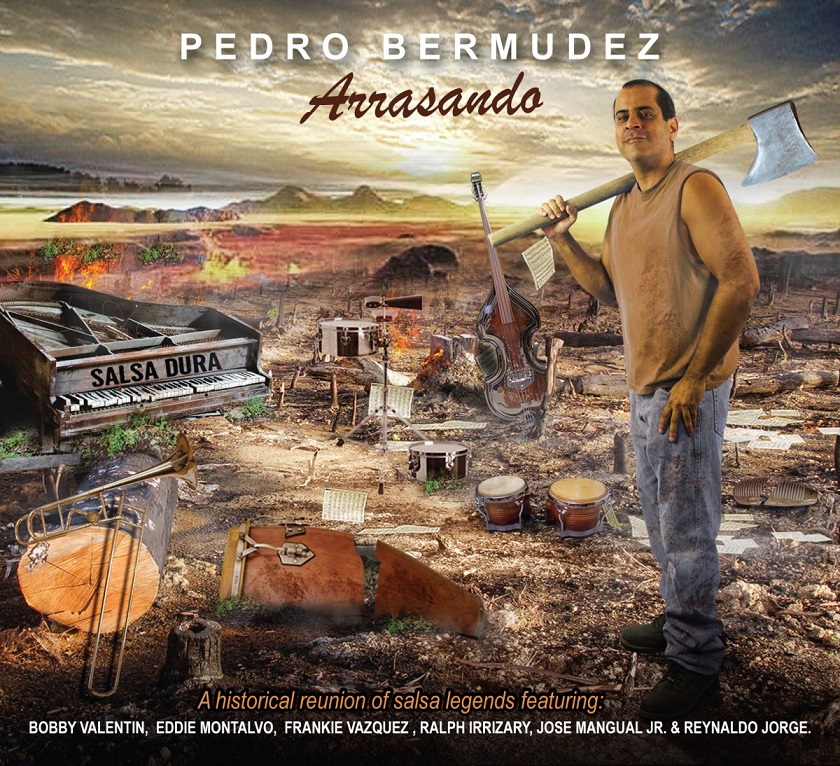
In addition to the above mentioned, the musicians responsible for such sonority are: Jerry Rivas and Julito Alvarado, along with Henry Santiago on backing vocals; Efraín Hernández on bass; Pedro Bermúdez on piano; Omar Hernández on timbales and bongo set; Tommy Lee Ramos on tumbadoras and Neftalí Ortiz on güiro.

Melina Almodóvar “Estamos en Navidad”

Melina Almodóvar brings us Estamos en Navidad, written by Luigi Flores, who also made the musical arrangement and played the piano.

The song starts in Melina’s voice, announcing that we are in Christmas and that a new year is coming.  “Oh, what an emotion and blessing that we are in Christmas…” she announces the good wishes chanting, between soneos: “have a lot of prosperity and that your dreams come true”.

Before the first minute, Fabiola Muñoz Ortiz’s Puerto Rican cuatro takes center stage.  During the second minute, the guest of honor adds Puerto Rican spice to the longest Christmas in the world with her Puerto Rican cuatro solo, after Melina gives way with a resounding: “Tell Fabiola, how Christmas is heard in Puerto Rico”.

Melina also sings about the coquito, the Christmas menu and everything else that might suggest a Puerto Rican Christmas in full swing.  I love the positive message, whose lyric assures us that the best is yet to come.  It is one of the few contemporary Christmas songs -if not the only one- in that line of positive and motivational inspiration, without being a religious or sacred lyric.  Anyway, the Christmas salsa song is great. It is very tasty.

The musicians responsible for accompanying Melina on this recording are as follows:  Alex Zapata on trombones, Daniel Silva on bass, Caliche Sabogal on all percussion, our beloved musical genius -Luis Aquino- on trumpets. Henry García, Melina Almodóvar and Ángel Vallenilla complement from the choirs.

Ángel “Papote” Alvarado y su Grupo Esencia “Yo vengo”

Angel “Papote” Alvarado and his Grupo Esencia bring us the single entitled Yo vengo.  The song takes off and “takes a trip” from the first bars, affirming with forcefulness between trombones and tambourines: “I come from a truly powerful race, very deep roots and unparalleled culture”.  The pen and accordion of Ricky Martinez affirm in the voice of Papote: “My homeland is a jewel and in the world is unique, my people and my flag, are national treasure …” declaring patriotic pride and cultural responsibility, between soneos that embrace the chorus: “I come, I come, I come …”.

Motivating to move forward with the well known “pa’ lante boricua”, an honorable mention is given by saying a musical farewell to the late plenero Tito Matos, shortly before José Eduardo embellishes the theme with his Puerto Rican cuatro, so present during the Christmas season.  This is the song that awakens Puerto Rican patriotism and motivates it to flourish.

Statements like: “how happy I feel with my flag held high” and “Puerto Rico my homeland, the queen of my loves, for its people and my people, the most beautiful of flowers” while listening to the brothers Toñito and Victor Vazquez guapear with their trombones; synchronize our hearts to the rhythm of patriotic pride that only the Puerto Rican Afro-Caribbean essence understands.

Choco Orta  “Asi es mi Tierra”

In keeping with the Puerto Rican concept of celebrating Christmas as early as September, as soon as the gentle breezes of our tropical Christmas season begin to be felt, Choco Orta released this Christmas classic. From the pen of our own Gloria Gonzalez, Choco Orta produced, directed and released this all-time hit.

It is worth mentioning that this song has already consolidated as a classic, originally popularized by the quartet Los Hispanos. In this way, Choco celebrates with Los Hispanos the 70th anniversary of the longest running quartet in existence, in addition to his 35 years of artistic career.

Choco Orta considers the Los Hispanos quartet “one of the great pearls and treasures of our Puerto Rican soil.  Currently, the members of the Los Hispanos quartet are Wisón Torres, Tato Díaz, Rafy Torres and Nino Segara.

For the production of this single, Choco had the collaboration of Nino Segarra in the arrangement, musical direction and keyboards. Musicians of the stature of Julio Loyola on trumpets; Moisés Cancel on trombones; Hilton Mercado on baritone saxophone; Ceferino Cabán on piano; Alexis Pérez on bass; Manny Trinidad on cuatro and guitar and Javier Tito Álvarez on tumbadoras, bongo and timbales delivered such perfection.

La Orquesta del Rey de Puerto Rico “El lechón vacunao”

The Orquesta del Rey de Puerto Rico brings us El lechón vacunao, from the pen of Miguel García. The composer manages to inject jocularity into the return of the Puerto Rican Christmas celebration with all the trappings of the law, after having been inhibited from celebrating Christmas in person because of COVID-19.

Néstor Ramos Zavala interprets the nice song.  He is accompanied by: Michael Colón and David Irurita on trombones; Harel Orengo, José Claudio and Eduardo Alvelo on trumpets; Juan Ramos on bongo; Gary Rodríguez on tumbadoras; Javier González on timbal; Benjamín Vázquez on bass; Sebastián Alicea on piano; Israel Santana on Puerto Rican cuatro; Cándido Reyes on güiro; Millie Smith, Luis Martínez and Jorge Agosto on backing vocals; Ezequiel Colón is the voice of Don Seco.


By Bella Martinez, ISM Correspondents, San Juan, Puerto Rico

Irakere was a Cuban group that developed an important work in Cuban popular music and Latin Jazz under the direction of Chucho Valdés

Irakere was formed as such in 1967 but had begun to work much earlier; in that year precisely they went to a selection called in Havana to organize with the best musicians of that time the Cuban Orchestra of Modern Music; already in 1972 they were approaching to what they currently produce deciding in 1973 to call it Irakere, which in Yoruba language means Vegetation and that is how, starting from its name, they work based on the Afro-Cuban musical roots.

In this way, through the combination, mixture and interrelation of classical, impressionism, jazz, rock and various compositional techniques they managed to walk through all styles such as dance music, concert, traditional and popular Cuban music.

Thanks to the impulse of pianist Chucho Valdés, the Cuban group Irakere took off in 1973, nourished by Thelonious Monk’s bop.

Founders

Grupo Irakere: It was founded in Havana in 1973, by:

Jesús Valdés(Chucho) composer, director and pianist;

Paquito D’Rivera (Paquito), alto and tenor saxophone, flute and clarinet;

Carlos Averhoff, tenor saxophone, soprano, flute and bass clarinet;

Jorge Varona, trumpet, trombone and percussion;

Carlos del Puerto, bass, bass guitar and tuba;

Carlos Emilio Morales, guitar;

Bernardo García, drums and batá drums;

Jorge Alfonso, batá drums;

Enrique Plá, drums;

Carlos Barbón, güiro, chekeré and tambourine; and

Oscar Valdés, singer, tumbadora (conga), batá drums and bongo.

Irakere, fue un grupo cubano que desarrolló un importante trabajo en la música popular cubana y el Jazz Latino

On the founding of Irakere, Chucho Valdés expressed:

“For us the group always existed, it was present at all times; it was like something pending. At the beginning it had no name, it was just an idea we were working on: to use Cuban folkloric percussion in dance music, and to look for different timbres with a common characteristic: “ours”.

Then Oscar Valdés came up with the idea of combining the not easy and little known batá drum with the tumbadora, güiro and cowbell and so, step by step we arrived at the current group…”.

About Irakere’s first stage, the musicologist Leonardo Acosta points out: “one of the successes of Irakere had been not to try to invent and identify itself with a “new rhythm”, according to the old guidelines of advertising so much used from the forties to the sixties.

The slogan about the “new rhythm” was until recently the “open sesame” on which the musicians counted to become famous overnight, and by that way sometimes quite commercial results were achieved.

Apart from the fact that no “new rhythm” is so new, they all come from the alteration or amalgamation of pre-existing rhythms.

Irakere’s only alchemy comes from the spontaneous creativity of its members. Since there is no commercial endeavor, laboratory practices are unnecessary, and the group can perform a contradanza, a danzón, a son montuno or a cha cha chá without fear of seeming “old-fashioned”, since they are in fact playing something else at the same time. And without setting themselves the goal, nor having to invent a “pega” name, almost by an imperative of the material they are working on, new rhythmic combinations are emerging, to the point that Irakere’s rhythm is unmistakable among Cuban listeners or dancers.

Grupo cubano Irakere

Certainly, and in spite of their triumphs in international jazz festivals, Irakere is not a jazz group. But these successes are not gratuitous either, because as we have seen, they have formidable musicians with great experience in the jazz field, especially in the aspect of improvisation, the great discovery of jazz and perhaps its greatest contribution to the music of the 20th century.

“Paquito D’Rivera: Irakere was born against the will of the Cuban authorities”.

When talking about Cuban music, the name of one of the most emblematic groups in the country’s musical history comes to mind, Irakere, which in Yoruba language means vegetation, jungle.

Irakere became the seed that would germinate a lush forest of rhythms and sounds, a school through which many of the great stars of Cuban music have paraded.

Founded more than four decades ago, this legendary band has been a pioneer of Afro-Cuban jazz and the initiator of the musical revolution in the seventies.

Gracias al impulso del pianista Chucho Valdés, el grupo cubano Irakere levantó vuelo en 1973

Irakere emerged at a time when, due to political demands on the island, music and culture were treated as an instrument of revolutionary identification and jazz was branded as imperialist music.

It was at this time, in the late sixties and early seventies, that a group of great musicians founded a band whose main goal was to enrich Cuban popular dance music with Latin jazz as essential elements.

Under the direction of the outstanding pianist Jesús “Chucho” Valdés, excellent musicians came together in search of a different sonority, based on the use of Afro-Cuban folkloric percussion together with the renewed timbres of the popular rhythms of the time that fused jazz, rock, funk and popular Cuban rhythms such as son, mambo or cha cha chá, together with classical or concert music.

“Irakere was the Musical Generation of change”.

Sources:

https://www.ecured.cu/Irakere

Leonardo Acosta

Radio Televisión Marti

Mirna Guerra

Irakere

You can read: Israel Kantor was an excellent bassist, arranger and composer who achieved great popularity in Cuba for his vocal technique and original “Sonear” style

“Mambo Fiesta” the new of Maelo y su Klan from Oslo Noriega

As of Thursday, November 4, 2022 it will be available for sale on all digital platforms worldwide.

A musical production of Café Records.

Miami, FL, November 4th, 2022. (Café Records) It already smells like the holidays, both the World Cup Qatar 2022 and Christmas and the native of Caracas, the Venezuelan Ysmael D’La O (Maelo), producer, composer and director of the European group “Maelo y su Klan”, brings us this new and catchy single from the album “Cultura Viva”, titled Mambo Fiesta.

Mambo Fiesta lo nuevo de Maelo y su Klan desde Oslo Noriega

In his musical biography, Maelo has the album “Ritmo y Sabor” 2018 and singles from his new production; “Son Kizomba”, “La reina de la Campana”, “Que Extraño es Eso”, which was his first Feat with the Venezuelan cultural heritage group “El Sondeo Clásico del Caribe” and last summer’s hit “Son Onomatopeya”.

It has been a spectacular year, full of nominations, recordings and successes of the mulatto from Carapita, in which we highlight the following: winner as the best Antillean Group of 2022 of the Cristo Rey Awards, which is awarded in Cali, Colombia, known for being the world capital of salsa.

He also received the “Honorable Mention” as producer of the year 2022, at the Golden Latin Awards in Tenerife, Spain, after more than 20 years in music production in the old continent.

Referring to the Mambo, today few groups are recording this type of rhythms, but Maelo, as a good visionary and knowledgeable of the emerging market, breaks with that scheme and presents us with a work of musical art for the dancer.

With the invitation of excellent and first class musicians as collaborators:

Composer: Ysmael D’La O (Maelo), Trumpets: Luis Ruiz, Trombone: Michael Palma, Voice: Luis González, Alto and Baritone Saxophones: Julio Estrada, Tumbadoras, Bongo, Campana, Maracas and Guiro: Yomar “Caballo” Méndez, Timbal: Hungría Rojas Jr, Bass: José “Mortadelo” Soto, Piano: Julio Estrada, Backing Vocals: Luis González, Alexis “El Chivo” Aguilar and Ysmael D’La O (Maelo). Arrangement and musical production: Julio Estrada, recorded at Estudio Requena and JE studio, mixing: Francisco Requena and Julio Estrada.

Mastering: Estudio Requena: Francisco Requena, all under the general and executive production of: Ysmael D’La O (Maelo).

“Mambo Fiesta” is here to stay in the public’s taste, and is already available on all digital platforms distributed by Café Records.

Maelo y su Klan

You can read: Live The Salsero Rhythm In Asia

September 22, 2022 marked the 48th anniversary of the Fania All-Stars concert in Zaire, Africa

Last Sunday, September 22, 1974 (On a day like today, Fania All-Stars made history by performing for the first time in Africa in front of 80 thousand spectators.

A magical night that included wonderful moments. This is their story.

In mid-1974, American boxing promoter Don King organized a fight in Kinshasa, Congo, for Muhammad Ali to regain the crown against the then heavyweight champion of the world, George Foreman, a bout that was called ‘The Rumble in the Jungle’.

Fania All-Stars en Zaire, África

Parallel to the boxing match, musician Hugh Masekela and renowned producer Stewart Levine scheduled a series of concerts at the 20 du Maipara stadium in Kinshasa (Zaire) as part of a 3-day festival (September 22-24, 1974) that would later become one of the most important musical events of the century in Africa, which the organizers called ‘Zaire 74’Unfortunately, an injury suffered by George Foreman while training forced the fight to be postponed for almost six weeks, but the music festival did take place.

La Pelea del Siglo
La Pelea del Siglo

The event was attended by 31 groups (17 local and 14 foreign) and featured artists such as James Brown, BB King, Bill Withers, Manu Dibango, Miriam Makeba, Fania All-Stars, among others.

The Fania musicians who traveled to Africa and performed at the festival were: Johnny Pacheco (flute), Larry Harlow (piano), Bass: Bobby Valentin (bass), Nicky Marrero (timbales), Ray Barretto (congas), Roberto Roena (bongos), Yomo Toro (Cuatro), Pupi Legarreta (Violin) Jorge Santana (Electric Guitar), Victor Paz, Kurt Ranno, Luis ‘Perico’ Ortiz (Trumpets), Lewis Kahn (Violin and Trombone), Ed Byrne (Trombone), and 6 singers: Celia Cruz, Ismael Miranda, Jose ‘Cheo’ Feliciano, Hector Lavoe, Santitos Colon, Ismael ‘Pat’ Quintana (vocals and backing vocals).

Concierto de la Fania All-Stars en Zaire, África

Everything was ready to return to the Big Apple, New York but a major misfortune forced Johnny Pacheco and company to stay.

Although it may seem incredible, musicians and singers had to stay 11 additional days due to a political and social problem in that country, unable to leave the hotel where they were staying. This is how Bobby Valentín tells it in an exclusive interview to Rafael Vega Curry, journalist of elnuevodia.com

“We couldn’t get out. (Jerry) Massucci had to pay an extra $18,000 because we would gather in the rooms to order food and empty the coolers (laughs). There was always someone who said “tomorrow we’ll play in my room”, says the well-known ‘King of Bass‘.

With the concert in Zaire, Fania All Stars had become the first tropical orchestra to set foot on African soil. The show, held at the Statu Hai stadium in Kinshasa, was attended by more than 80 thousand spectators.

Estadio Statu Hai de Kinshasa

It was part of the “Zaire 74” event held from September 22 to 24 of that year, and also featured R&B and Soul artists such as James Brown, Bill Withers and BB King.

In 1974, salsa was at its peak in New York. However, its top representatives were confined within four walls.

Celia y Jhonny en África

Among the musical geniuses were Johnny Pacheco, Ray Barretto and many others who made this orchestra the most important salsa orchestra in its history. Héctor Lavoe could not be missing in that directory.

Important Note:

The Democratic Republic of the Congo, also popularly known as D. R. Congo, Democratic Congo, Congo-Kinshasa or Eastern Congo, and called Zaire between the years 1971 and 1997, is one of the fifty-four countries that make up the African continent. Its capital and most populated city is Kinshasa.

Between October 27, 1971 and May 17, 1997, the African country currently known as the Democratic Republic of the Congo was known as the Republic of Zaire (in French, République du Zaïre).

The name Zaire was given to it during the rule of Mobutu Sese Seko, who ruled it with an iron fist during a long dictatorship, and from whom emanated the political system and the characteristic ideology of the State.

The instability and rebellions that plagued the Congo until 1965 culminated in the seizure of power by Lieutenant General Mobutu Sese Seko, then Commander-in-Chief of the Congolese Army.

Mobutu proclaimed himself president for five years and in 1970 consolidated his power by being elected president without opposition.

In 1971 the new name of the State was adopted, with the official proclamation of the denomination: Republic of Zaire. This name and the new national symbols would remain until 1997, when at the end of the First Congo War Mobutu was overthrown and fled the country.

Upon assuming the presidency of the country the guerrilla leader Laurent-Désiré Kabila proclaimed the Democratic Republic of Congo, recovering its own name.

Sources:

Bobby Valentín

Salserisimo Peru

https://es.wikipedia.org/wiki/Zaire

You can read: Fania All Stars

  • « Go to Previous Page
  • Page 1
  • Interim pages omitted …
  • Page 36
  • Page 37
  • Page 38
  • Page 39
  • Page 40
  • Interim pages omitted …
  • Page 59
  • Go to Next Page »

International Salsa Magazine (ISM) is a monthly publication about Salsa activities around the world, that has been publishing since 2007. It is a world network of volunteers coordinated by ISM Magazine. We are working to strengthen all the events by working together.