| DIRECTORY OF NIGHTCLUBS | ||
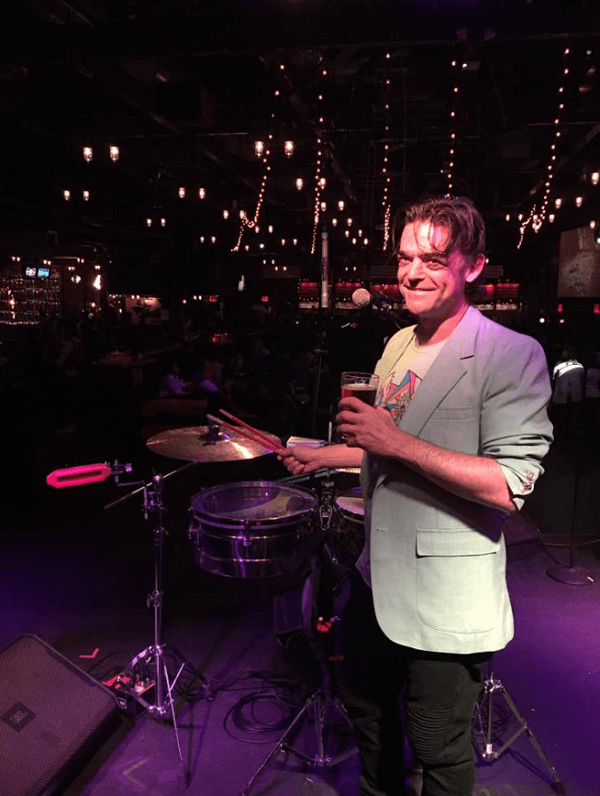
After a few months of absence, we’re finally back with the batteries recharged to put a magnifying glass on the current projects of the best soneros right now. Today it is the turn of percussionist Julio Albino, who, as usual, delights us with every project he releases.
But before that, we are going with a bit of the artist’s story so that everyone can know him better.

Julio Albino, also known artistically as Junito, became interested in music in his homecity of New York, and after his subsequent return to Puerto Rico, this curiosity did nothing but grow as time went by. It was then that he started listening to the music of legendary names in the industry such as “El Rey de Los Timbales” Tito Puente and Oreste Vilato, who inspired him to join the San German’s school band to some extent. He would later pursue an artistic career through collaborations with more experienced artists.
He ventured into this world professionally in the 1960s, when he began to be taken into account by several of the greatest salseros of the time, such as Frankie Ruiz, Hector Tricoche, Marvin Santiago, Paquito Guzman, Junior Gonzalez, Los Hermanos Colon, Joe Quijano, among others.
There is no denying that each of these collaborations contributed to Julio making known his great talent as a percussionist, but he would not rest until he was able to form his own project, which he eventually achieved. That was how he founded his own orchestra, Julio Albino Y Su Orquesta Secreto A Voces.
Thanks to all the effort invested in his career, Julio has managed to secure a place for his orchestra in the salsa scene, and his best-known musical works are proof of this. His big debut came in 2005 with the album ‘‘Bailalo’’, which ranked high on the charts in countries such as Italy.
Ten years later, he also released the album “Haciendo Ruido” and, the following year, he came with his single “Chachara Con Cua” and the promise of a new album. In 2018, he released “Edén Borinqueño” as his second promotional single, and shortly after, Julio released the full album, which he named “El Secreto Ya No Es Secreto”.

In 2025, Julio once again showed why he deserves the place he has earned and released his new single “Pasaporte de Rumbero”, with which he looks to consecrate himself as a worthy heir to the soneros who previously gave him the opportunity to join their ranks. Similarly, he shows absolute respect for Afro-Caribbean culture and its deepest roots.
This joyful and energetic piece is not only a reflection of the Puerto Rican artist’s talent, but also of the strength and modernity of his orchestra, which is deeply connected to the Cuban musical tradition. From the very first seconds of the song, listeners can appreciate a festive street atmosphere, but at the same time with sophisticated percussion led by Julio himself, who boasts incredible technique that serves as a guide for the rest of the musicians accompanying him.
Among the members of the orchestra, we can mention trombonist Juan Colón, trumpeter Juan “Junito” León, saxophonist Ricardo Dávila, pianist Gabriel Rodríguez, and bassist Luis Rodríguez. Likewise, the lead vocalist is the charismatic singer Ángel Ríos, who contributes his exquisite phrasing and an enviable dominance of the clave at all times.

He became a legend in Cuban music with his masterful handling of the double bass and was renowned for his performances in mambo and Latin jazz.
His talent earned him two Grammy Awards (in 1995 and 2005), a Latin Grammy in 2003, an honorary doctorate from Berklee College of Music, and a star on the Hollywood Walk of Fame.
He has been described as “the inventor of mambo” and is considered a master of descarga (live improvisations).
He began by playing various instruments until he settled on the double bass, which allowed him, as a teenager, to join the Havana Philharmonic Orchestra, where his father and older brother also played.

His first stop was Madrid, where he stayed for a year before emigrating to the United States. In the U.S., he resided in New York City, Las Vegas, and Miami.
López also played acoustic bass with his brother, the multi-instrumentalist Orestes López. They literally composed over 3,000 songs together and were highly influential in Cuban music from the 1930s to the 1950s.
They created the “nuevo ritmo” (new rhythm) in the late 1930s, which transformed the danzón by introducing African rhythms into Cuban music, ultimately leading to mambo.
He won several Grammy Awards for both his own work and his contributions to albums by Latin music stars, including Gloria Estefan. In 1995, he won a Grammy for Master Sessions Volume 1.
In 2003, he won a Latin Grammy for Best Traditional Tropical Latin Album alongside Bebo Valdés and Patato for El Arte Del Sabor. He won another Grammy in 2005 for his work ¡Ahora Sí!
His nephew, Orlando “Cachaíto” López, became one of the pillars of the famous Buena Vista Social Club.
Cachao performed with artists such as Tito Puente, and his music has been featured in films like The Birdcage and the soundtrack of the video game Grand Theft Auto: Vice City.

His last musical collaboration was with Gloria and Emilio Estefan on the singer’s album titled 90 Millas.
López passed away on the morning of March 22, 2008, in Coral Gables, Florida, at the age of 89, due to complications following kidney failure.
Cachao y Su Ritmo Caliente – Monte Adentro (2000)
Tracks:
Musicians:
Recorded in Havana, 1957-1958

The tradition of being musicians comes from grandparents and great-grandparents, all the Cachaos are musicians.
By:

Musical Style: His music fuses a wide variety of Afro-Latin rhythms (such as Uruguayan candombe, Brazilian samba, Cuban son, Peruvian landó, and Venezuelan joropo) with the harmonies and melodies of modern jazz.
Accolades: He has recorded several CDs with his own compositions and has received awards for his outstanding performance in the Latin jazz scene. His album “Ongoing Dreams” was chosen as the best album in its category in 2002 by “The Boston Globe.”
Teaching Experience: During his time in the United States, he was a piano and harmony professor at Berklee College of Music. Since 2003, he has resided in Barcelona and teaches at ESMUC (Escola Superior de Música de Catalunya).
Collaborations: He has collaborated with numerous musical groups as a pianist and is a significant figure in the jazz scene in Spain.
Eduardo Tancredi is a prominent figure in Latin Jazz, known for his ability to integrate diverse Latin American rhythmic influences with the harmonic sophistication of modern jazz.
Latin accents took some time to establish themselves in jazz music. Very few composers ventured into that genre in the early decades of the last century, to the point that their timid attempts were considered exotic and trivial.

It was in the 1940s that the Latin touch gained relevance. Cuban Mario Bauzá, who had played trumpet in Chick Webb’s and Cab Calloway’s orchestras, propelled the success of Machito’s band and convinced Dizzy Gillespie to hire conga player Chano Pozo.

Latin jazz today has a strong presence in popular music, and Uruguayan Eduardo “Edú” Tancredi is a brilliant exponent of that style. He was an outstanding student at Berklee College of Music in Boston, where he won awards such as the Quincy Jones Award and the Outstanding Latin Act Award.
After his acclaimed “Ongoing Dreams” from 2002, this CD, “Venimos Tumbando,” recorded in 2007, now arrives with ten formidable compositions and his own arrangements. His background in Latin American folklore plus his jazz studies have achieved a splendid confluence that is enjoyed from beginning to end on this album.
The arrangements contrast the different orchestral sections, highlighting their diverse sound textures, suggestive harmonizations, and enhancing the dynamics and fiery percussion instruments. Three saxophones, piano, guitar, bass, and drums alternate with ten other guest musicians (vocals, sax, harmonica, two basses, two drum sets, and three percussionists), generating a sonic turbine that captivates the listener from the first note.
This doesn’t mean that all tracks propose an overwhelming rhythm. There are passages of beautiful lyricism, as in the two versions sung by Ana Finger, or the pleasant harmonica of Antonio Serrano, or the director’s piano in “Como un blues.”
The soloists perform at a high level, with special mention of Miguel Zenón’s alto sax, an improviser of fresh ideas, clean musicality, and great inspiration and fervor. The interventions of guitarist Alejandro Luzardo, trumpeter Matthew Simon, tenor saxophonist Eladio Reinón, and baritone saxophonist Xavi Figuerola are also noteworthy.
“Venimos Tumbando” confirms Tancredi’s talent as a composer and pianist and his skill as an orchestra conductor. Abilities he generously demonstrated during his acclaimed performance at the Teatro Solís last December. Thomas Werner
Tracks:
Musicians: Edu Tancredi (Piano) Ana Finger (Vocals) Antonio Serrano (Harmonica) Mathew Simón (Trumpet) Pere Grau (Soprano sax, alto sax) Miguel Zenón (Alto sax) Eladio Reinón (Tenor sax) Juajo Arrom (Trombone) Xavi Figuerola (Baritone sax) Alejandro Luzardo (Guitar) Matías Migues, Paco Weht, Javier Gómez (Double Bass) Santiago Blanco, Salvador Toscano (Drums) Carlos Reyes “Compota”, Alejandro Luzardo, Santiago Blanco, Alexis Liden, Sandro Lustosa, Salvador Toscano (Percussion)

Information By:
Also Read: Arturo “Chico” O’Farrill. “The Architect of Afro-Cuban Jazz”
Lindsey McMurray, bandleader of the group Las Chikas, has graciously accepted our invitation to talk about the women’s orchestra she is leading, which makes us very happy and pleased, so we invite our readers to enjoy this interview from beginning to end and learn about the musical journey of this young artist.

Lindsey’s journey to become an artist began very soon at school, when she was just 10 years old and started learning to play the trombone. Prior to this, she had already studied other instruments such as the keyboard and the recorder, but she ended up trying the trombone.
Soon after, at the age of 11, she joined the school jazz band, but it was not until college that she began experimenting with salsa in orchestras that played this genre. Until then, Lindsey had had virtually no contact with Latin music, as she had only listened to typical U.S. rhythms. However, once she discovered Latin American music, she could not escape her love for it and continues to play it to this very day.
It should be noted that the musician does not have any family member who is too. So she would be the first one to make music her profession and, of course, one of the most important areas of her life.
Before even getting to know of the existence of Las Chikas, Lindsey was on a TV show called ‘’Noches Con Platanito’’ in the musical side, but she did not really lead anything until the bandleaders of the groups who were there left. Her big break came in 2017, when she finally managed to become a bandleader herself and, in turn, started two groups at the same time.
This is because Lindsey did not want to depend on anyone be called whenever she was required, but, on the contrary, she wanted to go on developing her autonomy to the point of being the one to create jobs for others instead of looking for them somewhere else.

It is important to clarify that Lindsey is not the founder of Las Chikas, but that the group already existed before she joined during the pandemic. The idea of Las Chikas was born during “Noches Con Platanito” as part of the show, but Lindsey and the other members wanted to have activities outside of the show and what the production asked them to do. At that time, the leader and founder of the group was Eliana Rose who during the pandemic wanted to settle in Southern California, so she asked the artist to take her place, which she accepted.
This posed a significant challenge for her, as she had never led a Latin music orchestra in her life. However, the novelty did not make him get cold feet, but on the contrary, it was an experience she wanted to live in order to learn from it.
The current members joined the group thanks to recommendations from friends and other people in the industry. Already at this point, it can be said that they all are her friends, to the extent that they have shared all kinds of special occasions such as birthdays, trips, and much more.
What catches the attention about Las Chikas is that, as its name suggests, it is only composed of women. One of the reasons is that the industry, despite of the recent social changes, continues to be dominated by men, so these young female talents find support between themselves.
What the original founder wanted was to promote the idea that a group of girls could play Latin music without it being perceived as strange. Lindsey shares this vision with hundred percent and hopes new generations of women never think for a moment that their gender is a limitation to achieve what they want in music.

While acknowledging that there have been positive changes in recent decades, she thinks there are areas that do not have enough female representation such as percussion, bass, production, arranging, among others. It is very common for women to be vocalists in a band, but it is still unusual to see them in other areas of the project.
On the band’s website, it can be read that the group is a mix of diverse cultures and ethnicities. In this regard, Lindsey pointed out that, while it is true that she is not a Latina, she has always sought to create something as authentic as possible that is rooted in Latin culture, of course with great respect. “Latin music is so joyful, intelligent, and capable of being beautiful to the eyes of any human being who hears it. I also want in a certain way to make non-Latinos enjoy this beautiful music as much as I do,” Lindsey added on the subject.
She also said that diversity plays a very important role, as non-Latino audiences tend to feel that they have permission to be part of the joy emanating from this music. In addition to that, the fact that the members have diverse backgrounds helps the band have different perspectives on what they want to do.
Today, Las Chikas is composed of Cuban singer Mayelin Vázquez, Cuban singer Whitney Hernández, American pianist Dolores Duran-Cefalu, bassist María Vega, Mexican timbalera Anita Garay, Mexican conga player Diana Teixeira, American trumpet player Anne King, Mexican saxophonist Marina Panzetta, and Lindsay herself on trombone.
Read also: The best of Cuban music in Tampa with Cuband Son Band