

Directory of North American nightclubs |
||
|
|
||
|
|
|
|
|
|
||

CALIFORNIA |
|

ILLINOIS |

MICHIGAN |

NEW JERSEY |

NEW YORK |
|
|
|
|
|
|
|
|


Directory of North American nightclubs |
||
|
|
||
|
|
|
|
|
|
||
|
CALIFORNIA |
|
ILLINOIS |
|
MICHIGAN |
NEW JERSEY |
NEW YORK |
|
|
|
|
|
|
|
|
The United States is and will remain the land of opportunities for artists from all over Latin America, and Dominican producer, composer, and guitarist Oscar Almonte is one more of those examples of what effort and discipline can achieve on fertile ground. We could talk exclusively with Mr. Almonte about the most important aspects of his prolific career, and we want to make them known to our readers, who always honor us by visiting to our content each month.

Oscar began telling us that music as such has drawn his attention since he was very little, more specifically, the ones he was listening to at home and that some relatives played, as several of them are professional and amateur musicians. That mix of rhythms and melodies always intrigued him, especially those from Cuban music, which was very popular at that time.
Family parties were the perfect occasion for the young man to show his strong interest in music, as it was not uncommon for one of his uncles to bring out his guitar, play, and sing to lighten the mood. This was one of the things that led Oscar to learn to play as he saw adults do it.
Not to mention that Caleo López, his grandfather, was a guitar maker and played them as well.
Oscar’s primary education in music was given in a self-taught way, In fact, their parents bought him his first guitar at just nine years of age, and he took some classes with this instrument. He stopped for a while and resumed his interest in the guitar at age 14, which is when he learned his first chords and memorized some rock songs he liked to play them.
When he had the right age, he began studying music at the Culture and Art Institute in his hometown, Santiago de Los Caballeros, where he completed a bachelor’s degree in classical guitar.
Today, Oscar is based in New Jersey City, where he moved for the purpose of seeking new horizons personally and professionally. He wanted to soak up the musical culture that exists in the New York area, which is very close to where he is now.
When asked about the job opportunities he had upon arrival, he told us that he had the fortune of having contacts and friends with whom he had already traveled to the country, which allowed him to play with some bands he knew. However, he does admit that it took him a while to find a balance in his economy, so he had to work in family automotive businesses while his situation stabilized. He was working in that until he could devote himself exclusively to music, just as he did in his country.

The main difference he noticed between the music scene in New Jersey and the Dominican Republic is that, in his home country, it is easier to live exclusively from music as a simple artist. There are things that are easier to do because the budget allows it, and certain places where musicians play cover some elements such as sound engineers and show producers. When he arrived to his new destination, he had to learn many of these things to be able to do them himself and not have to spend what he did not have.
Just as Oscar has taken great pains to make his own project, he has also been involved in others belonging to artists such as Pavel Nuñez, Felle Vega and La Orquesta de Las Danzas Mezcladas, Xiomara Fortuna, Irka Mateo, El Prodigio, and many others.
He has managed to make contact with several of them because they live in the same city as him. It also happens that he played with several jazz musicians through whom he got to know others, something which took advantage to develop contacts and friendships with whom he could work in the future.
Among the most important things he learned from them, one is audience management, repertoire management, certain vocal techniques that he did not know and, mainly, everything that has to do with the responsibilities an artist who is already the head of his own project should have.
The artist has also been nominated for the famous Soberano Awards in the category of Merengue of the year in 2012 thanks to the song ”Levántate”, which was recorded by Héctor Acosta ”El Torito”. An interesting aspect of this piece is that Oscar wrote it with the purpose of showing it to Ricky Martin so that he would finally record it, but unfortunately it was not possible to make contact with the Puerto Rican.

Over time, he learned that Héctor was looking for songs to add to his new album ”Corazón Abierto”, so Oscar got down to business and contacted his musical director to see if Acosta would be interested. Fortunately, he was and the song enjoyed very acceptance among the public, so he managed to get the nomination at that time.
Finally, in the year 2020, Oscar was ready for his debut as a singer-songwriter and, at finally, to do things other than what a simple musician does. Although he was writing since he was 14 years old, always thinking for other artists, he decided to change his approach and focus on himself and his career.
It is then when he made his debut in this facet with the song ”Mi Tierra”, in which he describes his hometown Santiago de Los Caballeros as the title indicates. Something interesting about ”Mi Tierra” is that it fuses rhythms from many parts of the world with Dominican pambiche.
Oscar defines pambiche as one of the sounds of merengue, but softer and calmer when compared with the more lively merengue.
As for the rest of the colors it has, the artist used elements of African music and very different tempos to those often used in merengue.
He is also promoting the song ”Bermudas” with the young singer Carolyn Rodriguez. A mutual friend introduced them and thought that their voices would work well together, so they gathered and made a romantic song based on urban bachata with hints of reggae and some electronic touches.

Read also: Joshua Levine and his quartet have a lot of Guataca


Directory of European nightclubs |
||
|
|
||
|
|
||
|
|
||
|
|
|
|
|
|
|
|
|
|
|
|
|
|
||
|
|
|
 Adenauerallee 3 20097 Hamburg, Germany |
|
|
|
|
|
|
||
|
|
||
|
|
||
|
|
||
|
|
||
|
|
|
|
|
|
|
|
|
|
|
|
 Av. del Vallès, 117 08223 Terrassa, Barcelona, Spain |
 C/ Olvido 15 28026 Madrid, Spain |
 Carrer del Perill 10 08012 Barcelona, Spain |
|
|
||
|
|
||
|
|
|
|
|
|
|
|
| Karina Bernales present |
APRIL 2025 |
FESTIVALS |
|
|
 |
¡Meneate! Viena Cuban DanceApr 10 / 13 2025 Fanialive From €159 |
|
|
 |
Kizz Me BachAmore CongressApr 11 / 14 2025 Palais des Congrès Mons From € 70 |
|
|
 |
World Stars Salsa FestivalApr 24 / 28 2025 Maritim Hotel Paradise From € 79 |
|
|
 |
Bachata Magic FestivalApr 05 / 06 2025 OX Club Prague From $79 |
|
|
 |
Baila Baila Salsa FestivalApr 17 / 20 2025 Tanssikoulu-Dance School Baila Baila From € 150 |
|
|
 |
Paris International Salsa CongressApr 11 / 13 2025 La Palmeraie Hotel From € 164 |
 |
Lyon BachataApr 18 / 20 2025 Espace Ecully Bar From € 97 |
|
|
|
 |
Bachata Festival StuttgartApr 09 / 14 2025 Sängerhalle From € 99 |
|
|
 |
AloCubano Salsa FestivalApr 24 / 27 2025 Golden Coast Hotel From € 140 |
|
|
 |
SPRING WeekendApr 11 / 13 2025 Hotel Annabella From € 110 |
 |
Diamond KizombaApr 03 / 07 2025 Hotel D50 From € 92.31 |
|
|
|
 |
Zeno Latin FestivalApr 11 / 13 2025 Zeno Complex From € 55 |
|
|
 |
Nordic Salsa & BachataApr 25 / 27 2025 Samfunnssalen Event & Konferanse From KR 390 |
 |
Oslo Kizomba FestivalApr 10 / 12 2025 Dancecity From KR 850 |
|
|
|
 |
El Sol Bachata FestivalApr 11 / 13 2025 Sound Garden Hotel |
|
|
 |
Bachata Takes Over BucharestApr 04 / 07 2025 NORD Events Center by Globalworth From € 100 |
|
|
 |
Corazon y MezclaApr 11 / 18 2025 Don Angel Hotels From € 100 |
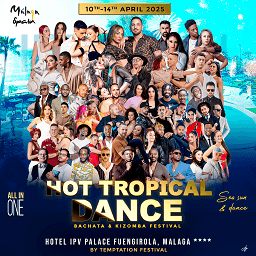 |
Hot Tropical Dance MálagaApr 10 / 14 2025 Hotel IPV Palace & Spa From € 79 |
|
 |
Kizomba Barcelona CongressApr 11 / 13 2025 Hotel Evenia Olympic Park From € 75 |
|
 |
KizCon
|
|
 |
Fever Bachata World CongressApr 24 / 28 2025 Hotel Gandia Palace From € 105 |

This caused commotion and controversy among salseros and made them doubt without a doubt what is the reality that salsa lives and more with the progressive physical departure of emblematic legends who made history in the world, coupled with the proliferation of the so-called “DJ” who multiply many times the nostalgia of the public for living the times of said legends and who became a trend due to this fact. In 2024 we saw how important salsa concerts were held in our country Venezuela where foreigners who had not visited us for a long time did so and so we enjoyed what some call “the last of the Mohicans”, as well as Venezuelans who took to various stages making it clear that, if they continue creating, either by adjusting the sound of the old and modernizing with quality staging or simply delighting with their career and style what they have already established.

After this necessary reflection we want to talk about Marcial Isturiz who was born in the sandunguera town of Capaya, Barlovento in the Miranda State of VENEZUELA, and we put it in capital letters because this “extraordinary sonero who wandered through the streets of Petareña hitting any pot he found in his path, finding out where and at what time the “arayé” was lit, always on the “hunt” for a good opportunity”, a quote was written by Ángel Méndez in his book “Entren que Caben Cien” describing how clear this man has been since childhood in pursuing and having the firm certainty of where he had to go to achieve his dream. He understood, from my point of view, that he who perseveres succeeds and we have seen his professional growth during all these years, thirty years recently completed, being a musician performing several instruments, going on to be also a composer and arranger, accompanying with his voice in duos of consecrated stars and groups, renowned orchestras as well as others not so well known, his voice being a characteristic seal that draws the attention of his followers, a sonero that we can say “gets lost from sight”.
A man who has earned the respect and affection of the public wherever he goes and to name one of the presentations in which he has demonstrated his “people skills”, we had the opportunity to travel and share with him closely accompanying him Sonero Clásico del Caribe in that free event that the Barquisimetanos salseros put on at the end of January 2024 to Ramón Méndez, where by the way Marcial took advantage of the invitation to perform the National Anthem the day before at the Cardenales – La Guaira Game, impeccably. Undoubtedly, that presentation was an omen of good fortune for what would be a year full of success.

We saw him singing choruses with these greats, specifically next to Herman Olivera and Rico Walker waiting for his turn like each of those called to this meeting until Peter Perignon introduced him for the first time with his Orchestra La Puertorriqueña and said that the person responsible for that invitation and presence of our sonero there was his friend Gilberto Santa Rosa.
Briefly, Perignon told the audience that he knew Marcial since he was part of Bailatino and he fell in love with that group, since then he had been following him and now recently in his participation with the Latin Dimension he knew that Marcial with this performance made his dream of being in that country come true.
Joy is not enough for what we salseros in Venezuela feel for this representation that should not be overlooked because if there are soneros from Venezuela and with class: Marcial Isturiz is one of them; with his own style and professionalism, this is how our “Mayor of Capaya” was seen next to these greats, comfortable, safe and proudly waving our tricolor wherever he goes.
At Swing Latino we say congratulations to Marcial, keep doing your thing without resting like until now, because later it will be too late:
AGUA PA’ LOS GALLOS y
¡Ponle Sabor!
Source: Giorgenling Méndez from Swing Latino
Also Read: Salsa at its best, led by the leader of La Puertorriqueña: Don Perignon

Although he never took formal music classes or studied any instrument, he is a singer, composer and creator of his own songs. The first samples of his art were seen on YouTube, where he slowly began to gain fans.
In mid-2016, Bad Bunny joined Hear This Music, a label created by DJ Luian and Los Mambo Kingz, presenting the hit “La Ocasión,” an anthem of trap music. There he also recorded singles such as “Diles,” “Soy Peor,” and “Tú No Vives Así.”
Bad Bunny has also participated in songs with numerous artists, such as Farruko, De La Ghetto, J Balvin, Maluma, Nicky Jam and Ozuna, among other urban music stars.
In addition, he sold out concerts at the Luna Park in Buenos Aires on September 8 and 9. In November he released “Sensualidad” with Prince Royce and J Balvin.
The year 2018 began with great success.
On January 12, he released “El Baño”, a collaboration he recorded with Enrique Iglesias.
On February 6, he released “Salimos A Buscarte”.
On the 9th, he presented “Fantasía”, with Alex Sensation.
On the 14th, she released a version of the hit “Báilame” by Nacho, together with Luis Fonsi, Yandel and Daddy Yankee.
On the 15th, she released “Amorfoda”, a new single in which she says “no” to love.
She didn’t wait and on the 22nd, she released “Dime Si Te Acuerdas”.
On March 16, she released a song with Khea, Düki and Cazzu, titled “Loca”.
On the 23rd of that month, “Dime” was released, recorded with Revol, J Balvin, Arcángel and De La Ghetto.
On April 1, she presented “Me Rolié”. In the same month, she released: “Te Boté”, with Ozuna, Nicky Jam, Nio García, Darell and Casper Mágico; and “Explícale”, with Yandel, Noriel Cosculluela and Brytiago.
On May 5, she recorded “Contigo”.

On June 22nd she releases “I Like It”, recorded with Cardi B and J Balvin. On the 28th of the same month she releases the single “Estamos Bien”. She participates in Marc Anthony’s song “Está Rico”, together with Will Smith. On October 11th she releases “Mía”, in a spectacular collaboration with Drake singing in Spanish. On December 8th she releases the hit “Desde el Corazón” and on the 14th of the same month she presents “Sólo de Mí”, whose video reflects gender violence. On the 23rd her debut album goes on sale, under the name “X100Pre”.
On June 28, Bad Bunny & J Balvin present the eight-song album “Oasis” with the first single, “Qué Pretendes” (with special appearances by Mr. Eazi and Marciano Cantero of Enanitos Verdes)
Following the death of basketball player Kobe Bryant, Bad Bunny paid tribute to him with an emotional song titled “6 Rings.”
YHLQMDLG was released by the artist at midnight on February 29, 2020. The title means “I do what I want” and features collaborations with Daddy Yankee, Yaviah, Jowell & Randy, and Ñengo Flow. The album is a tribute to the marquesinas (garage parties) that Bad Bunny grew up attending, and features many nods to reggaeton from the early and mid-2000s
On May 10, 2020, he released his third studio album “Las que no iban a salir,” which features the participation of Don Omar, Zion & Lennox, Nicky Jam, Yandel, among others.
In July, after being the first Latin urban artist to be on the cover of Rolling Stones magazine, El Conejo Malo becomes the protagonist of the first digital cover of the legendary Playboy magazine.
On July 25, he releases the song and video: “Un día (One Day)” with Dua Lipa, J Balvin and Tainy.

Throughout the year, he publishes several singles and video clips.
On May 5, 2022, he releases the album “Un verano sin ti”.
On June 2, he releases the video clip for the song “Tití mepregunta”.
On November 30, he releases the single “La Jumpa” with the video clip.
On December 22, he released the single “Gato de noche” with Ñengo Flow.
On February 15, 2023, he released the video for “Ojitos lindos” with Bomba Estéreo.
On May 18, he released the single “Where she goes” along with its video.
On July 21, he collaborated with Travis Scott on the single “K-Pop” with The Weeknd.
On September 25, he released the single and video “Un preview”.
On October 13, he released the album “Nadie sabe lo que va a pasará mañana” becoming a hit single.
Becoming the most listened to album of the year in a single day.
While social media is boiling with divided opinions about Bad Bunny’s new album, it is worth moving away from the extremes and analyzing “DeBÍ TiRAR MáS FOToS” from a broader perspective.
Beyond being a reggaeton album, this work is an artistic, cultural and strategic manifesto that leaves valuable lessons for all musical genres, including salsa.
I’d like to share five key aspects that other artists could learn from this release to innovate and connect more deeply with their audiences.
The album cover, with the humble plastic chairs, connects directly with the everyday life of Latin American neighborhoods. These common objects evoke memories of family gatherings, celebrations, and moments of community. The message is powerful: simplicity can be deeply meaningful and resonate globally.
Instead of a world tour, Bad Bunny is betting on “Residencia,” a series of exclusive concerts in Puerto Rico. With this strategy, he not only boosts tourism and the local economy, but creates a “FOMO” (fear of missing out) phenomenon in his fans. This generates massive advance reservations on hotels and flights.
Integrating technology with music is something that Bad Bunny has done masterfully. QR codes in Puerto Rico allow fans to interact with the album in innovative ways, unlocking exclusive content and creating a bridge between the physical and the digital.
Bad Bunny is not afraid to mix salsa with reggaeton, betting on musical arrangements that celebrate his cultural heritage. This shows that genres are not compartments or “silos”, but platforms for dialogue
From the announcement of the title to the release date, passing through a short film full of cultural references, everything in this project has been designed to create a narrative that maintains the interest of the public. The lesson here is clear: music is not just released, it is experienced as a complete cultural event.
Final thoughts: innovation and evolution
In a world dominated by technology, staying traditional is not an option for artists who want to grow. Tools like Web 3.0, Blockchain, NFTs to offer immersive experiences and AI are revolutionizing the way musicians interact with their audiences and generate income.
While some lose themselves in criticism, others take advantage of these tools to redefine their art and project themselves globally. The lesson is clear: you have to look ahead and dare to evolve.
“DeBÍ TiRAR MáS FOToS” is not just an album; it is an invitation to reimagine music and the cultural impact it can have in an increasingly interconnected world.
Also Read: Sessions from La Loma brings together salsa fans from all over the world in Puerto Rico