• Skip to primary navigation
  • Skip to main content

International Salsa Magazine

  • HOME
  • Previous editions
    • 2026
      • ISM / March 2026
      • ISM / February 2026
      • ISM / January 2026
    • 2025
      • ISM / December 2025
      • ISM / November 2025
      • ISM / October 2025
      • ISM / September 2025
      • ISM / August 2025
      • ISM / July 2025
      • ISM / June 2025
      • ISM / May2025
      • ISM / April 2025
      • ISM / March 2025
      • ISM / February 2025
      • ISM / January 2025
    • 2024
      • ISM / December 2024
      • ISM / November 2024
      • ISM / October 2024
      • ISM / September 2024
      • ISM / August 2024
      • ISM / July 2024
      • ISM / June 2024
      • ISM / May 2024
      • ISM / April 2024
      • ISM / March 2024
      • ISM / February 2024
      • ISM / January 2024
    • 2023
      • ISM / December 2023
      • ISM / November 2023
      • ISM / October 2023
      • ISM – September 2023
      • ISM – August 2023
      • ISM July 2023
      • ISM Edition June 2023
      • ISM – May 2023
      • ISM April 2023
      • ISM March 2023
      • ISM February 2023
      • ISM January 2023
    • 2022
      • ISM December 2022
      • ISM November 2022
      • ISM October 2022
      • ISM September 2022
      • ISM August 2022
      • ISM July 2022
      • ISM June 2022
      • ISM May 2022
      • ISM February 2022
      • ISM January 2022
    • 2021
      • ISM December 2021
      • ISM November 2021
      • ISM October – 2021
      • ISM September 2021
      • ISM August 2021
      • ISM July 2021
      • ISM May 2021
      • ISM April 2021
      • ISM June 2021
      • ISM March 2021
      • ISM February 2021
      • ISM January 2021
    • 2020
      • ISM December 2020
      • ISM November 2020
      • ISM October 2020
      • ISM September 2020
      • ISM August 2020
      • ISM July 2020
      • ISM June 2020
      • ISM May 2020
      • ISM April 2020
      • ISM March 2020
      • ISM February 2020
      • ISM January 2020
    • 2019
      • ISM December 2019
      • ISM November 2019
      • ISM October 2019
      • ISM Septembre 2019
      • ISM August 2019
      • ISM July 2019
      • ISM June 2019
  • Download Salsa App
    • Android
    • Apple
  • Spanish

Search Results for: Van+Van

Angel Bonne He was part of Juan Formell’s Los Van Van Orchestra, and collaborated with the impressive Irakere band of maestro Chucho Valdés

Latin America /Dominican Republic

Angel Bonne born in Santiago in 1961

Angel Bonne began his musical studies at an early age, developing his skills on the clarinet.

The artist confesses that genetically his father, Enrique Bonne, “has a lot to do with his musical taste”; he grew up watching him play the piano, and the drums played in the patio of his house, where musical meetings were held with greats such as Pacho Alonso and Omara Portuondo among others.

Born in Santiago in 1961, Angel Bonne began his musical studies at an early age, developing his skills on the clarinet
Angel Bonne
He was part of Juan Formell’s Los Van Van Orchestra

After graduating from the National School of Art, he worked as a saxophonist in groups such as: Galaxia, Santiago Feliú, Beatriz Márquez (where he also acted as director), Granma (Santiago de Cuba) and Cuban Orchestra of Modern Music (Santiago de Cuba).

He also participated as a saxophonist, in albums of renowned singer-songwriters such as Amaury Pérez Vidal and Evelyn García Márquez.

He also collaborated with other groups such as the Grupo Síntesis and the Irakere by maestro Chucho Valdés.

His interpretative quality and musical talent led him to form part of one of the most important orchestras of Cuban music, Juan Formell’s Orchestra, Los Van Van, where, in addition to playing the saxophone, he performed as an arranger and singer.

During this period, he interpreted everlasting successes in the history of Cuban popular dance music, as is the case of the song Azúcar, still very much in demand despite having been recorded for more than 25 years.

After graduating from the National School of Art, he worked as a saxophonist in groups
Angel Bonne He also participated as a saxophonist, in albums of renowned singer-songwriters such as Amaury Pérez Vidal and Evelyn García Márquez

His passage by this musical group, is qualified by the own Angel Bonne, like one of the most important moments of his artistic career, in fact has continued collaborating with this transcendental orchestra in the record productions due to the mark left by its vocal timbre in the chorus.

At the age of 33, he decided to make his career as a soloist without abandoning his role as an instrumentalist and his qualities as a composer, and he formed several groups.

His versatility allows him to venture into several musical genres, among which jazz, Nueva Trova and popular music stand out.
Angel Bonne He also shows his skills as a composer, arranger, performer, conductor and record producer.

Since then, he has starred in several record productions: “Pa’ decir lo que yo siento”, “Circunstancias”, “Esta es mi música”, “Por favor escuchame” and “Bonne and Bonne Co. He has also made three albums in which his facet as a singer-songwriter is evident; these are these are: “De otra manera”, “Buscándome”, and “El guardián”. He has participated in more than 60 albums recorded with well-known Cuban figures.

He made the original music and soundtrack of the Cuban soap opera EN FIN EL MAR, from which hits like ESE soy yo, Sueños en la inmensidad and Cada uno por su lado were released.

His versatility allows him to venture into several musical genres, among which jazz, Nueva Trova and popular music stand out.

From Bonne’s discography, you will always remember songs like: ¨Usted will return to passer¨, ¨No I know why he wants me to mi¨, ¨Pura vestment¨, ¨Ya I went from the 20¨, Amigos, which was also nominated in the category of best video of the year at the PREMIOS LUCAS, (an important Cuban audiovisual competition) to others, which also showcase his skills as a composer, arranger, performer, bandleader and record producer.


By: Diana Marie

Home

From Italy Albert Giorgio Giovanni DJ. Lindo Salsa and Bachata

Albert Giorgio Giovanni Fiorentu Dj Lindo is an Italian and Latin music producer (Salsa and Bachata).

Albert Giorgio Giovanni Fiorentu aka Albert Lindo or DJ. Lindo is an Italian DJ. and producer of Latin music (Salsa and Bachata).

Born in Udine, Italy in 1989, he started his career as a dancer in 1997.

In 2008 he graduated as a dance teacher.  In 2011 he moved to Austria (until today) and in 2014 he started working as a dance teacher at the school Conny & Dado in Graz.

In the same year he started his career as a DJ and in 2017 as a producer.

Dj Lindo is an Italian DJ and producer of Latin music (Salsa and Bachata).
Albert Giorgio Giovanni Fiorentu to Dj Lindo producer of Latin music (Salsa and Bachata).

In 2019 (after the first 2 unfortunate productions) the first world production “The Phantom” is released, helped by the pianist and composer Marco Ronca.

In 2020 he obtained his second diploma as a dance teacher and also launched his new single “No Te Detengas” always with Marco and in collaboration with several recognized artists.

Between the end of 2020 and the beginning of 2021, 4 new productions will be ready, a bachata and three salsas (a romantic salsa, a hard salsa and a Cuban salsa) with the collaboration of many recognized artists.

Currently Dj Lindo is part of the record label located in Milan (Italy) Alosibla Music Group and Downbridge Publishing, which each year presents the famous compilation.

Albert Giorgio Giovanni Fiorentu aka Albert Lindo or Dj Lindo is an Italian DJ and producer of Latin music (Salsa and Bachata)
Italian DJ and Latin music producer (Salsa and Bachata)

“SALSA IT”

Did you know the origin of the DJ…

The 9th of March is World DJ Day, thanks to the initiative of the ‘Worl DJ Fund’ and the NGO ‘Nordoff Robbins Music Therapy’. But, do you really know the history of these music mixing artists?

For 16 years this day has been celebrated as a tribute to this sector of music that is so in vogue in our time, which take advantage of his ‘birthday’ to donate what they charge these days to charitable causes.

The initiative was carried out in 2002 by the ‘Worl DJ Fund’ and the NGO ‘Nordoff Robbins Music Therapy’, and has been active for over a decade. But the history of the DJs has a few more years.

For those who still do not know what is behind the acronym DJ, a ‘disc jockey’ is a musician who creates, selects and plays before an audience music of his own or composed by other artists. There are several types, including radio and club DJs.

The first DJ in history

It was Ron Diggins, a British radio engineer who in 1947 built the famous Diggola
Ron Diggins first ever DJ

It was Ron Diggins, a British radio engineer who in 1947 built the famous Diggola, considered the first “mixing table” in the history of music. This home-made portable table included two turntables, lights, microphones, an amplifier and a dozen speakers. And it was made on a coffin wood base.

If we mention Ron Diggins, many of us won’t know who I’m talking about, because this British and radio engineer is considered the first DJ in history.

Many others before Diggins moved in with their records and equipment to cheer on the soldiers but he was the creator of “La Digolla”.

He himself built the first mixer in 1945, although it wasn’t until 1947 that the invention became official.

It was a portable table made of wood, worthy of any party room, it included two plates, lights, microphones, an amplifier and a dozen speakers.

As a curiosity, the wood with which Diggins made the first mixing table in history was casket wood.

Six weeks was the time it took the engineer to build the famous portable table.

Ron Diggins’ dream was to travel all over the UK with his van and “La Digolla”, so he could play his favorite songs.

This pioneer during his professional career was severely criticized by countless musicians who did not approve that the DJ would mix songs without their consent.

Diggins retired in 1995 after playing at 20,000 parties.

In his hard beginnings, traveling kilometers and full of criticism, he would never imagine what he had done, he had invented a profession. A job that would be paid for, more than he could have thought.

The first Disc Jockey in history, died at the age of 90 and in his long life he made 6 “Diggiolas” Some of them were auctioned off at more than $40,000.

“I haven’t invented anything, I just put the same things to a different use, that’s all.

On his 90th birthday, the first disc jockey confessed that, when he started to tour cities and towns with his invention, he received hundreds of criticisms from musicians who did not approve of him mixing their songs without their consent. Diggins retired in 1995 after playing at 20,000 parties.

The big DJ explosion

In the 60s and 70s, with the expansion of the discotheques in Europe and the USA, the creation of a specific technology for this figure of the music began, like the mixer ‘CMA-10-2DL mixer’. It was also the time of the birth of ‘hip-hop’ and ‘disco’ music.

In the 80’s we get the first big names, considered cult DJs, as Larry Levan who played in the ‘Paradise Garage’ in New York, or Frankie Knuckles, with its mixtures of ‘disco’ and ‘synth pop’ led to music ‘house’ in the ‘Warehouse Club’ in Chicago. At the same time, in Detroit, techno was born.

They were years of great impact for the DJs, who saw the birth of their first magazine specifically for professionals, the ‘DJ Times’ in 1988 and held for the first time an exclusive event for DJs of electronic music dance, the ‘Winter Music Conference’ in 85 in Florida.

The DJs of the digital era

The arrival of the ‘rave’ movement in the 90s radically changed the image of DJs and these artists began to project themselves as superstars or ‘Diva DJs’ who establish particular sounds and brands.

These new ‘DJs’ have arrived to our days, taking advantage of the technological innovations of the digital era, and there we have famous names such as the French David Guetta, Armin Van Buuren, Tiesto or Bob Sinclar, who travel the world with their mixes.

Source: https://culturizando.com/


Home

Be frightened at the Transilvania Salsa Fest!

Afterlight 10 very successful editions, the Transilvania Salsa Fest is back with great force to scare anyone who dares to live this experience from beyond the grave.

Living in this beautiful city (Transilvania) is not supposed to be synonymous with coldness and seriousness, quite the contrary. These are the events that make you remember the beauty of Latin music!

This great festival offers you a big selection of attractions and advantages that you cannot miss, such as the meeting of instructors and dance teachers specialized in all types of salsa to live an amazing weekend full of scary things.

Transilvania Salsa Fest and Latin music
This is the logo of the Transilvania Salsa fest

The Transilvania Salsa Fest includes 4 days of an absolutely extraordinary salsa experience, which brings you a series of ghostly parties animated by the best DJs, interesting dance workshops and the best classes taught by a large group of local and foreign instructors and shows that will leave you breathless.

The event offers various genres of music, but the main rhythms will be salsa, bachata and kizomba, which will satisfy your desire to dance and entertain you in the cold month of November.

Having fun at the Transilvania Salsa Fest
Attendees having fun at the Transilvania Salsa Fest

Salsa instructors

Magna Gopal

Super Mario

Panagiotis & Myrto

Alafia Group

Farid Ferchach

Kat & Eddie

BACHATA

Marco & Sara

Arnold & Wandaisha

Sorush & Nora

KIZOMBA

Ricardo & Paula – Afrolatin Connection

Richard & Manon

Location: Grand Hotel Napoca. Strada Octavian Goga

Cluj-Napoca, Judetul Cluj

Date: November 19-22

Facebook: www.facebook.com/transilvaniasalsafest

WhatsApp: 0040747171850

Home

Pupy Pedroso An Ambassador of Cuban Music in the World

Latin America / Cuba / La Habana

When we talk about the beautiful island of Cuba, it is impossible not to automatically think of its rich and ancient musical culture. We are talking about a small piece of land in the world, of that long Caribbean, but it is full of the most successful musicians of Cuba. the history of Latin rhythms.

It all lies in the Spanish and African influences that came to the Island hundreds of years ago, that race that was created from the strings and the drum, from the white and the black, from singing and dancing.

On this occasion I feel very proud to be able to speak directly with a cultural ambassador, recently appointed by the Latin Institute of Music, the leader of those who are are and one of the founders of the very famous Van Van orchestra, the great Cesar Pupy Pedroso, teacher of teachers, as we have called him for this occasion.

Good morning maestro, thank you in advance for the time you give us to all the readers of the International Salsa Magazzine and the portal www. salsamundi.com.

“Well, here I am very happy to be able to talk a little with you and grateful that you want to talk about this server”

Maestro with 19 years of foundation with Pupy and those who are maestro, tell us how the idea of ​​founding this great orchestra was born after making the whole world dance with the Van Van.

“The idea for the project ‘’Los que Son Son’’ arose from a recording I made (while in Los Van Van) with songs of my authorship performed by an internationally renowned performer. (Omara Portuondo, Rolo Martínez, Xiomara Laugart, Raúl Planas, Caridad Cuervo, Pedro Calvo, Raúl Planas etc…etc..) From that moment on I got the idea of ​​making another album with other performers, with a German publisher, and The album was called César Pedroso y Los que Son.

There came a time when I was on tour with Van Van and the dancers came with the records, so I could sign them, and it was then that the idea came to me of forming an orchestra and leaving Van Van and calling it ‘Los que Son Son’. . ”

Why Pianist?

“In my house when I was born there was already a piano, my father was a pianist, and children always want to be like their parents, and I was not going to be the exception, regardless of the fact that I liked the piano since I was little.”

What theme do you consider the flag of Pupy Pedroso’s new journey? When your orchestra opens

“Themes of the new transit: themes like ”What are the things in life” ””A crazy man with a motorcycle” ”Mommy behave well”, ”They’re calling me” and of course ”Six weeks “”

Pupy Pedroso
Pupy Pedroso

Tell us the story of the musical piece “De la timba a Pogolotti” does it tell us about a change in your life?

“From Timba to Pogolotti: It arises from a piano solo that I did in ”Sandunguera” and Pedrito Calvo identified me, as ”Pupy the sandunguero of Pogolotti” and the neighbors of La Timba (neighborhood where I I was born) they asked my older relatives why they said about Pogolotti, if I was born in La Timba, then I wanted to be okay with the two neighborhoods, when I made ”Los que Son…”

Well, I made that song in honor of the two neighborhoods, because I was born in La Timba, but I grew up in Pogolotti, and all my childhood friends are from Pogolotti, I don’t have friends in La Timba, and I consider that one is from where one is from. upbringing, not where he was born, because all the customs, friendships, first ”girlfriend” were Pogolotti’s.”

Which song is your favorite from Van Van’s golden era?

“If you talk to me about the songs from Van Van’s golden age, there are several, of mine the authorship of Maestro Formell and others of mine, for example of the maestro, there are several, “My doubts” ”Marilu”” The Painful” ”There are women” ”I’m everything” and one of mine: ”Six weeks “Sugar” ”The Negro is cooking” ”It must be over” ”That’s good ”, among many others, we live in a wonderful time”

Since August 2018, he was named Cultural Ambassador by the Latin Music Institute. Do you consider it an achievement or a new commitment?

“I consider both things, an achievement because it is not easy in a country with so much talent and so many performers to take me into account for said recognition, and at the same time a commitment, because I am obliged not to let my musical guard down in any way.” sense.”

Maestro comes from a family of great musicians, his grandfather a director, his father a pianist, both from great Cuban orchestras. Can we say that being a musician in your family comes in your blood? Is it inherited in the genes?

“Yes, sir, I am grateful for having been born in this family where there was so much musical talent, where only music was breathed, my autistic grandfather, director of an orchestra called ”Cuba”, my uncle a percussionist in an orchestra very famous for that ”Arcaño y sus Maravillas” era, and I believe a lot in the musical heritage because I consider myself a product of it.

As a pianist, it is because my fundamental patron was my father, from whom I copied and learned a lot from what I could discreetly practice and as a conductor, because I had the joy of having worked with different directors, Rolando Valdés, Enrrique Pérez, I assisted in substituting for my father and the ones I spent the longest time with, Elio Revé and Juan Formell, I spent 6 years with Revé and 32 with Formell and I learned a lot with both directors, I was lucky.”

To what do you owe your great success as a pianist and conductor?

“I think that to be good at any career, the fundamental thing is that you like it and have the aptitude for it, I think that music does not escape from that rule, because you can like it, but if you don’t have the aptitude, don’t waste your time, and Maybe if you have aptitude and you don’t like it, over time you may like it and fall in love with it, so aptitude is the fundamental thing.”

What is your greatest reference or influence in music?

“My greatest influence is Son, I love Son, rumba, guaguancó, Cuban music and Brazilian music, jazz, but my greatest influence is Son.”

Currently, how do you see timba within the island of Cuba? Minimized by Cubaton or leader of local rhythms?

“I believe that at all times, there have been different musical genres, which have been in the preference of the dancer, in the era of Rock and Roll they danced with Elvis Presly, with Bill Halle and his comets, with Little Richard, but also they danced with Aragón, Benny Moré, Sonora Matancera, among others,…

but today the balance leans more towards these foreign movements, good and bad, and that is happening all over the world, in the dance area, but I do not consider our dance music critical or dead, because there is taste for everything and every time “A convening orchestra performs on an open-air stage, it overflows with audiences, that means we are in battle, and the country that has the most musicians making a living from music is Cuba.”

Tell us about the 2019 projects? New CD? Tours?

“Fundamentally starting the next album, the release of a documentary of a tour we are doing in Cuba and some presentations abroad, to reappear again at the end of the year in Europe, with one of the dance hits from France:

”Having a good time”, I make a parenthesis, clarify that there are countries where our music prevails (El Son, La Timba, La Salsa) like Peru and Colombia, Cuban rhythms are still in fashion, thanks to many musicians and orchestras that make a great job for the dissemination, to the printed media and now the digital wave that quite develops our work, look, you are an example of this, we hope to continue giving our audience reasons to dance.

In August we return to South America, it is the tour we are most looking forward to, the Latin public is one of the best, we think about stopping in August in Colombia, Ecuador and Peru, in the same way we are now planning to organize the calendar, for businessmen or producers who wish to have us in their cities, must contact our direct representatives, talking to them is like talking to Pupy”

What should a producer do to have them in their Latin American projects?

“No compadre, very simple, contact them at these numbers +573022582306 and +51992630351, they are the only ones authorized to market our tour, we want to be in all the cities of Latin America.”

Grateful teacher for your time and for letting us get to know you a little, may the successes continue for what they are.

“Grateful to you, thank you for the dissemination you make of the popular dance music of my island.

It remains to leave you the social media links of such an important orchestra so that you can follow in its footsteps and find out about the development of the successes of this great band, on Facebook:

@pupypedroso and the numbers

+573022582306 and +51992630351.

Puerto Rican bandleader and musician Diana Sosa talks about her many projects in Nashville, Tennessee

We had a wonderful and very nice conversation with Puerto Rican percussionist, timbalera, conga player, and cuatro player Diana Sosa, who kindly told us about all the projects she has in the pipeline. Her husband and bandmate, guitarist and vocalist Chuck Nelson, put us in touch with her so we could learn more about both the project they share and the one she has undertaken on her own.

Then these are the things the talented Puerto Rican shared with us on this warm Sunday before Easter.

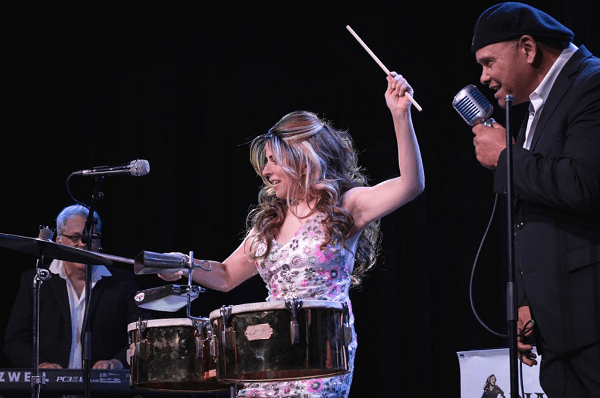
Diana Sosa is playing
Diana Sosa is posing for the camera while playing the timbales

How Diana got into the world of music

Diana was born and raised in Puerto Rico, where she began to love music and play, but not professionally yet. She was just experimenting with some traditional instruments of her homeland, such as the Puerto Rican cuatro, which she even studied with a private teacher. 

At the age of 39, she moved to Nashville, Tennessee, where she finally got her first big opportunities in music, and the background she brought for years helped her a lot. It all started with a short rehearsal she was invited to, and from there, she has done nothing but prove what she is really made of. 

Of course, she keeps studying and preparing to improve every day. When she is not learning to play with fellow musicians like John Santos, she is taking online courses to solve any doubts she may have.

Diana’s first opportunity with The Bicho Brothers

The first serious group that gave Diana the opportunity to develop professionally—and with which she keeps to playing to this day is The Bicho Brothers, a classic rock band whose members really appreciated the contribution provided by Diana. For this reason, it is she who brings that Latin flavor, the product of her heritage and years of training in these genres.

Something that really attracted the audience was that she was the only woman in the group and, incidentally, she played the timbales, which was uncommon back then. In addition, she added atypical sounds to certain well-known songs, which was also remarkable.

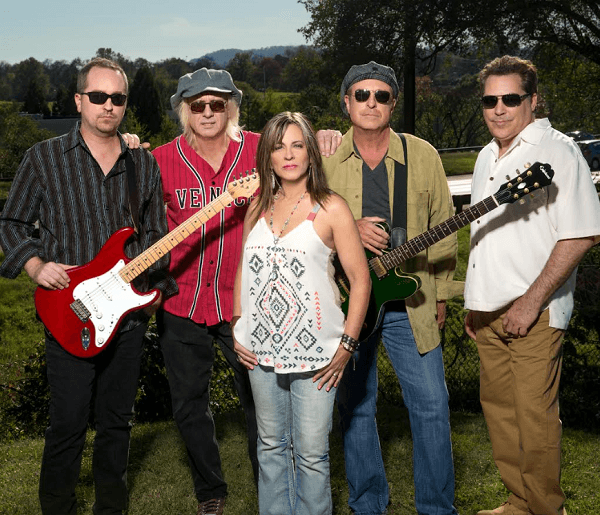
Diana Sosa and the rest of the Bicho Brothers
The Bicho Brothers from left to right: Jeff Krinks (guitar and vocals), Ron Krasinski (drums), Diana Sosa (timbales, congas, percussion, and Puerto Rican cuatro), Chuck Nelson (guitar and vocals), and Kenny Zarider (keyboards and vocals)

Another important personality who encouraged her to follow this route was the great producer Bill Cuomo, who told her she was very good at playing but needed to improve her technique. Twenty years later, it can be said that she took him at his Word seeing all she has achieved since then. From that point on, there have been many other projects and opportunities that make her very happy and keep her fulfilled.

Soul Sacrifice

Soul Sacrifice is a Santana tribute band founded in 1969 that has won a high reputation in Nashville by becoming one of the best tributes to Santana to date. The mix of familiar melodies and infectious rhythms they play at every show transports audiences to the biggest classics of the legendary Latin rock group created by Carlos Santana.

The band also includes some of the same members of The Bicho Brothers, such as the cases of Diana and Chuck due to all the years they have spent playing together, but including Cuban musician John Santos. He plays a fundamental role in making people feel they are listening to the original Santana rather than an imitation, which is why both he and Diana are key to the band’s performance.

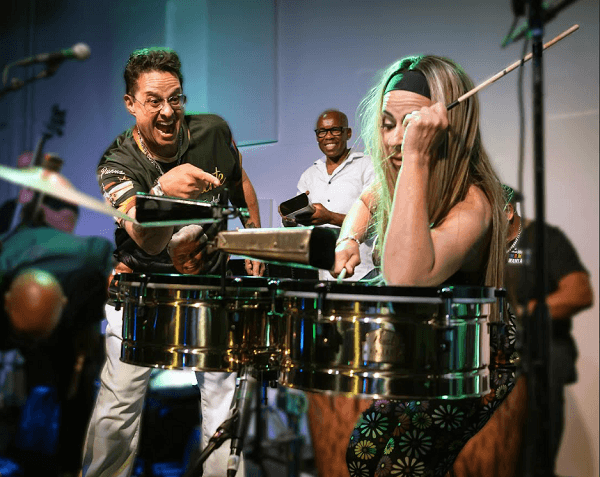
Diana Sosa with Diana's Mambo Maniacs
Diana Sosa playing with Diana’s Mambo Maniacs

Diana’s Mambo Maniacs

Diana also has her own project, which she decided to call Diana’s Mambo Manics. This Latin music group was founded in the early summer of 2025 as part of Hispanic Heritage Month. In that time of year, there are always many festivals dedicated to Hispanic and Latin music in the United States and around the world, so Diana and a group of musicians she had been in contact with for some time took the opportunity to play wherever they were able to make themselves known.

Among some of the musicians in the band we can mention John Santos as singer and timbalero, whose presence is essential at every show. The group also includes conga player Josvany Cordero, bassist Isoel Villareal, pianist Kenny Zarider, trumpeter Joe Mercado, and trombonist Huge Lindsay.

The main difference between this band, The Bicho Brothers and Soul Sacrifice is that it plays exclusively Latin music, but of the great artists in the 1950s and 1960s who performed at the Palladium Ballroom, the Copacabana, El Corso, Chez José & 3 and 1, among many others. Diana feels that, to a certain extent, she pays tribute to her parents, who used to go dancing and enjoying these rhythms to some of these places in their youth.

However, not all are covers. She is about to release an original song featuring Puerto Rican cuatro player Prodigio Claudio, but she did not have the details to share with us yet.

Diana and Tito Puente Jr.
Diana Sosa Playing with Tito Puente Jr.

Read also: Bandleader and bongosero Ray Degaldo is here to talk about his life and career

  • « Go to Previous Page
  • Page 1
  • Interim pages omitted …
  • Page 3
  • Page 4
  • Page 5
  • Page 6
  • Page 7
  • Interim pages omitted …
  • Page 135
  • Go to Next Page »

International Salsa Magazine (ISM) is a monthly publication about Salsa activities around the world, that has been publishing since 2007. It is a world network of volunteers coordinated by ISM Magazine. We are working to strengthen all the events by working together.