• Skip to primary navigation
  • Skip to main content

International Salsa Magazine

  • HOME
  • Previous editions
    • 2026
      • ISM / March 2026
      • ISM / February 2026
      • ISM / January 2026
    • 2025
      • ISM / December 2025
      • ISM / November 2025
      • ISM / October 2025
      • ISM / September 2025
      • ISM / August 2025
      • ISM / July 2025
      • ISM / June 2025
      • ISM / May2025
      • ISM / April 2025
      • ISM / March 2025
      • ISM / February 2025
      • ISM / January 2025
    • 2024
      • ISM / December 2024
      • ISM / November 2024
      • ISM / October 2024
      • ISM / September 2024
      • ISM / August 2024
      • ISM / July 2024
      • ISM / June 2024
      • ISM / May 2024
      • ISM / April 2024
      • ISM / March 2024
      • ISM / February 2024
      • ISM / January 2024
    • 2023
      • ISM / December 2023
      • ISM / November 2023
      • ISM / October 2023
      • ISM – September 2023
      • ISM – August 2023
      • ISM July 2023
      • ISM Edition June 2023
      • ISM – May 2023
      • ISM April 2023
      • ISM March 2023
      • ISM February 2023
      • ISM January 2023
    • 2022
      • ISM December 2022
      • ISM November 2022
      • ISM October 2022
      • ISM September 2022
      • ISM August 2022
      • ISM July 2022
      • ISM June 2022
      • ISM May 2022
      • ISM February 2022
      • ISM January 2022
    • 2021
      • ISM December 2021
      • ISM November 2021
      • ISM October – 2021
      • ISM September 2021
      • ISM August 2021
      • ISM July 2021
      • ISM May 2021
      • ISM April 2021
      • ISM June 2021
      • ISM March 2021
      • ISM February 2021
      • ISM January 2021
    • 2020
      • ISM December 2020
      • ISM November 2020
      • ISM October 2020
      • ISM September 2020
      • ISM August 2020
      • ISM July 2020
      • ISM June 2020
      • ISM May 2020
      • ISM April 2020
      • ISM March 2020
      • ISM February 2020
      • ISM January 2020
    • 2019
      • ISM December 2019
      • ISM November 2019
      • ISM October 2019
      • ISM Septembre 2019
      • ISM August 2019
      • ISM July 2019
      • ISM June 2019
  • Download Salsa App
    • Android
    • Apple
  • Spanish

Search Results for: Van Van

Los Van Van Orchestra

European Union

Los Van Van Orchestra. The Flavor in Zurich

1960-1969

Vital to the success and peculiar sound of Van Van, was the career of its director Juan Formell. Before founding it on December 4, 1969, ventures as bassist in several groups, from the Orchestra of the Cuban Institute of Radio and Television, to several groups are and jazz, these multiple experiences conditioned their future.

Its passage by the Orquesta Reve marked a turning point in the search for the style I wanted to achieve. He tested his innovative spirit giving it some sound and format solutions.

It incorporates bass, organeta, electric guitar, violins and flute replaced the five by the system. The vocal work was replaced by mounting quartets own voices. This experiment served as a starting point for, once created the VAN VAN, their contagious rhythm patterns sit in popular dance music.

Los Van Van Orchestra

1970-1979

Earlier this decade important critics and connoisseurs of the subject could notice the successful future of the Van Van. Juan Formell maintaining the contributions made to the previous group (The Revé), enriched the set with other instruments such as percussion, that an exceptional and unique way, were weaving what would define as the SONGO.

This mode of address are elements taken from jazz and rock, it consists of a rhythmic design combined with a figurative percussion piano and bass. Then creating harmonic and melodic different timbres.

José Luis Quintana (Changuito), Raul Cardenas (the Yulo), Cesar Pedroso (Pupi), Fernando Leyva, Jesus Linares, Orlando Canto, José Luis Cortés (The rough), Julio Noronha, Gerardo Miró, William Sanchez, Jose Luis Martinez Miguel angel Rasalps (Lele), together with its director, explored all possible ways and then came to this rhythm that becomes the basis of its sound.

It is for these years that begin recording their first five albums and debuted on several international stages.

1980-1989

This represents an important period for the orchestra. They break their own style incorporating the bronco and cracking of the trombones sound. Turn introduced synthesizers, keyboards with multiple sound possibilities. The use of synthesized saxophone and electric violins draw much attention at the time. In addition to his recording material have new triumphs as: Báilalo eh! Ah! (1982), Come, see and move (1984), Havana itself (1985), Eso que anda (1986), We the Caribbean (1987), wanting (1988) is over, and finally Songo gives way to a new stage.

Van Van Orchestra collash 1980-1989

A hallmark of the group is the use of the picaresque, irony, manners in their songs. Becoming a sort of chronicle of the Cuban reality, his writings offer a social circumstance, themes that recreate the jocular of everyday life.

In these years his music transcends borders and Latin American venues like the Empire in London, England, Austria, Switzerland and Germany are witnessing a pace capable of passing the most skeptical of the dancers.

1990-1999

90 start with a tour around the country celebrating its 20 years, evolving into the contemporary timbre and go in search of more complex and preciosistas as the father expressions.

Their latest results leave no doubt that reach maturity. Pieces like “Give him cadela” and “That’s my problem” Disco Sugar (1993), “I am normal, natural” and “What a surprise” the latest in vivo (1994), “Let anger” and “De equals “Ay ampárame god (1995) and” This puts you bad head “and” Take her to your vacilón “Te puts the bad head (1997) are some of the records that predate came VAN VAN ( 1999) containing “Van Van arrived Permit”, “the black is cooking” and “Temba tomb timba”, works that have ravaged mercilessly in the context of salsa, for their contagious rhythm, joy and good taste. All retain the seal of the group even when using other orchestral resources.

Los Van Van Orchestra collash 1990-1999

2000

Thanks a work of more than thirty years with the Grammy award with Disco Van Van is here or Llego Van Van. Award for best salsa album recorded by soloists, duos and vocal and Instrumentalist groups. (It’s worth noting that the award received is not the Anglophone Grammy Latino) Such award is the result of its continued making magic for over thirty years.

Los Van Van Orchestra in concierto

Los Van Van in Europe

Europe

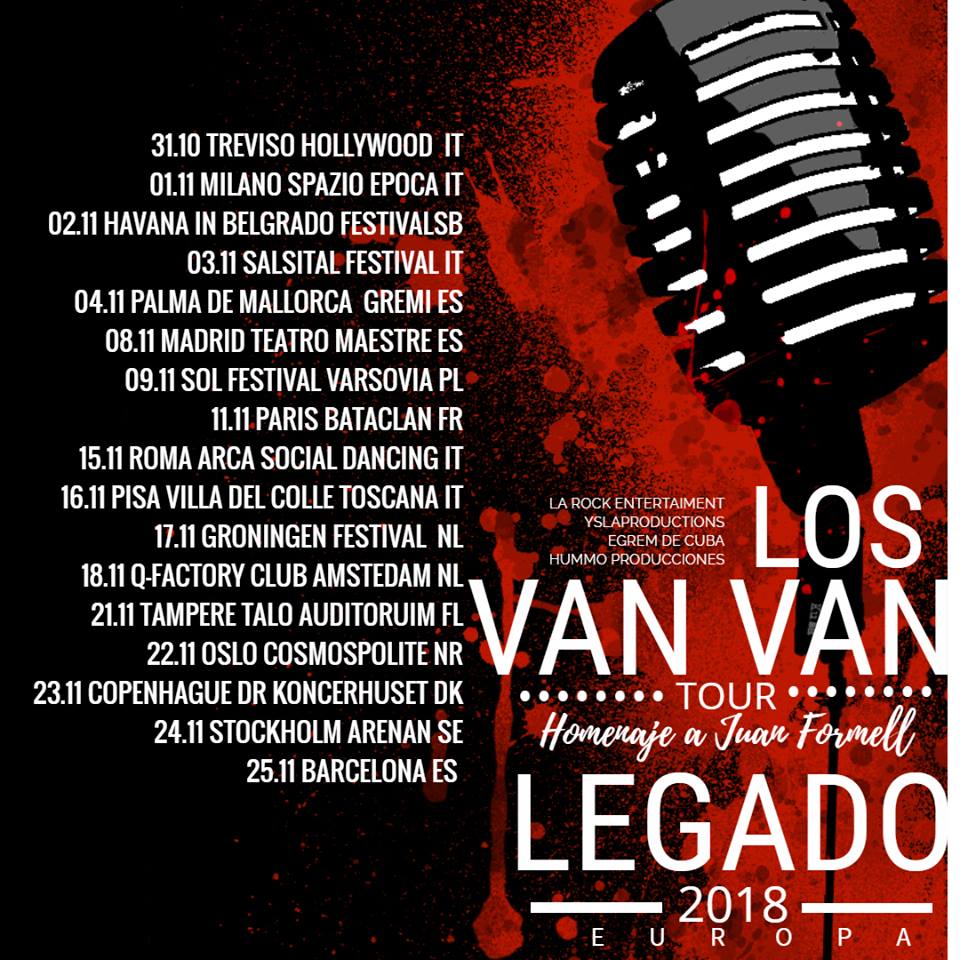
Los Van Van in Europe 2018

For decades, Los Van Van has been a world-class salsa orchestra that no one can keep silent about. The sixteen-strong formation continues to connect with this time through irresistible Cuban rhythms and Caribbean passion.

Los Van Van
Los Van Van

The band has been one of the first Cuban groups to use synthesizers and drum machines and has even created a completely new style: a superswing mix of a traditional charanga set-up (flute and violin combination), wind instruments and modern electronics, called ‘Songo’ by the Cubans.

In addition to Changui and Son Montuno, two traditional Cuban styles, Los Van uses different kinds of music such as rock, funk, disco and hip hop. Today Los Van Van consists of a selection of the best musicians of the first generation and new Cuban talents and vocalists. , led by Samuel Formell, son of the legendary founder of the band, Juan Formell.

In November you can enjoy to seventeen unmissable concerts for lovers of latin and salsa all around Europe!

Los Van Van and their 50th Anniversary

North America / USA / New York

Los Van Van returns to Lehman Center Performing Arts to celebrate their 50th Anniversary

For this special concert the Cuban legendary orchestra will join with the most popular lead Los Van Van vocalists: Mario “Mayito” Rivera and Pedro Calvo

Date: Saturday, June 1st

Show: 8:00PM

Cost: $50 – $100

Venue: 250 Bedford Park Boulevard West Bronx, New York 10468

Low cost onsite parking available for $5!

Los Van Van in concert

Lehman Center for the Performing Arts presents the return of Grammy-winning dance orchestra, Formell y Los Van Van, who bring direct from Cuba their blend of Afro-Cuban, disco and funk back to Lehman Center to celebrate their 50th Anniversary on Saturday, June 1st at 8PM.

Heralded as Cuba’s greatest dance orchestra known worldwide for their iconic live performances, Formell y Los Van Van features three of the late founder Juan Formell‘s children: Samuel Formell (Leader and Drummer/Timbalero) , Juan-Carlos Formell  (Bassist)  and the family’s youngest daughter, Vanessa Formell (lead vocalist).

BIO: Formell y Los Van Van, nicknamed the “Cuban Music Train,” is regarded as one of the most influential bands in the history of 20th century Cuban popular music. Founded in 1969 by Juan Formell when he was 27 years old, the band pioneered Songo, a hybrid rhythm that blended Cuba’s native folkloric son music with the go-go of the 1970s and has electrified dance floors in Havana for over forty-five years.

The band’s original members were: Juan Formell (bandleader, bass player, and songwriter), Cesar “Pupy” Pedroso (piano, songwriter), and Jose Luis “Changuito” Quintana (drums and timbales). Each one were music conservatory trained from a young age and were fascinated with the soul, go-go and disco music that dominated U.S. radio.

They named their dance band “Los Van Van” (which literally means “they go-go”) after the go-go fad, and pioneered the hybrid of son and go-go music – Songo – which can now be found throughout Latin jazz, pop, and world fusion.

And if the genius of Songo wasn’t enough, they also developed the complex rhythmic style that became known as Timba that was adapted by other bands in the ‘90s. Los Van Van soon became one of the best-known Cuban groups in the world, maintaining a loyal fan base throughout Latin America, Europe and Japan propelled by hits such as: “La Sandunguera,” “Anda, Ven y Muévete,” “Te Traigo” and “Yuya Martinez.”

Pedrito Calvo
Pedrito Calvo

In 1993, Changuito left the band and was replaced by Formell’s son Samuel who also proved to be an outstanding composer as evidenced by the song: “Te Pone La Cabeza Mala”, the title track of one of their best albums.  Although American politics hindered their ability to break into the U.S. market, their popularity in the U.S. grew throughout the ’90s, and the band toured the U.S. for the first time in 1997, including a memorable concert at Lehman Center.

Two years later, Los Van Van was honored with the GRAMMY® Award for Best Salsa Performance for their fifteenth album, Llegó…Van Van — Van Van is Here and in 2013, the Latin Recording Academy awarded Juan Formell with a special Grammy for a Lifetime Achievement of Artistic Excellence.

With over 40 albums to their credit, Formell y Los Van Van’s 2015 album Homenaje A Juan Formell: La Fantasia, was 80% completed at the time of Juan Formell’s death in 2014 and was finished under the direction of his son Samuel with another son, Juan-Carlos Formell.

The album’s release on Reyes Records in December, 2014 was on the 45th anniversary of the band’s founding and it features several of the band’s hit dance tracks refreshed with contemporary arrangements as well as many new songs including the widely popular: “Somos Diferentes”, “Todo se Acabó” and “La Moda”. Sony Music released it worldwide in 2016 and it earned a 2017 Grammy nomination for the Best Tropical Latin Album.

The group’s most recent album “Los Van Van son La Patria” is scheduled to be released on Cuba’s Engrem label later this summer.

Mario Mayito Rivera
Mario Mayito Rivera

BIO: Mario “Mayito” Rivera is nicknamed “El Poeta de La Rumba” for his ability to vocally interpret all forms of Cuban music in both modern and traditional styles with a colorful range that can be powerfully dynamic or tender and soft.

He was born in Pinar del Rio, Cuba, and has degrees from both the Escuela Nacional de Arte and the Instituto Superior de Arte. After college, he joined the band of Cuban singer Albita Rodríguez and played bass in Grupo Moncada.

From 1992 to 2011, Mayito was the characteristic voice and face of the extremely successful Cuban band, Los Van Van. He sang many of the band’s salsa hits, for which he was rewarded with a Latin GRAMMY® and two nominations.

Bio: Pedro “Pedrito” Calvo is a popular Cuban-born vocalist known for his charismatic and unique singing style which often includes clever word play and expressive rhythmic vocal sounds. Pedrito started his professional career singing with his father’s orchestra and years after with several Cuban orchestras including:

La Riviera, La Orquesta de Julio Valdés, and La Ritmo Oriental with hits such as: “Mi Socio Manolo” and “Aquí el que Manda es Mulé”. He was the most famous for his time (1974-2001) with Los Van Van, where he was part of the infamous lead singing trio of Los Van Van along with Mayito Rivera and Roberto Hernández.

Event Details:
www.LEHMANCENTER.org

Mayito Rivera “El Poeta de la Rumba” was the distinctive voice of Los Van Van de Cuba

Mario ‘Mayito’ Rivera is, without a doubt, one of Cuba’s most outstanding contemporary singers.

For more than 20 years he was the distinctive voice and recognizable face of Cuba’s most famous musical group, Los Van Van.

Regardless of the musical genre he performs -rumba, son, salsa, bolero or timba, modern or traditional style, with strength and dynamism or with delicacy and tenderness, Mayito Rivera’s performances, with passages adorned with tremors and coloraturas, are always stellar.

Mayito Rivera “El Poeta de la Rumba”

Mario Enrique Rivera Godínez was born on January 19, 1966 in Pinar del Río, a province located in the westernmost part of Cuba and famous for its handmade Havana cigars.

It was there that ‘Mayito’ began his musical training as a child. Later, he moved to Havana, where he studied percussion at the renowned National School of Art (ENA), which he later extended with advanced studies at the Higher Institute of Art (ISA).

After completing his training, which lasted a total of 15 years, Mayito Rivera joined the musical ensemble of the well-known Cuban singer Albita Rodríguez.

Later, he played bass in the Moncada Group, a formation belonging to the Nueva Trova Cubana movement, whose renovating spirit is firmly rooted in traditional Cuban rhythms.

At the age of 26, Mayito was discovered by Juan Formell, the director of Los Van Van, an orchestra that by then had already become a legend. Initially hired to play bass and sing backing vocals, he soon established himself as the group’s lead vocalist.

Over the next 20 years, Mayito Rivera, more than any other musician, put his stamp on Los Van Van.

He burst onto the scene as the representative of a new generation of musicians, and his fresh style contributed to the group’s endurin Singer of the group’s countless salsa hits that were played in the discotheques, he has been nominated twice for a Grammy and won it once.

Mario ‘Mayito’ Rivera es, sin duda, uno de los cantantes contemporáneos más destacados de Cuba

At the same time, he was also working on other projects: in 1999 he released his first solo album, Pa’ bachatear.

Chappotín, in which he transports the past to our days with a brilliant interpretation of traditional Conjunto Chappotín songs.

But Mayito Rivera is not only a singer and percussionist. In 2005, he released Negrito Bailador, his second solo album, produced by the Timba label of the German music publisher Termidor, in which he performs only songs of his own composition.

The music, with a rumbero tinge, is fresh, lively and of timeless quality. Subsequently, Negrito bailador was marketed in the United States under the title Llegó la hora and was immediately nominated for a Grammy in the Best Salsa Album of the Year category.

Mayito Rivera is probably the most requested special guest by other Cuban orchestras; so much so, that in recent years he has sung with almost all of Cuba’s star casts.

Nor has his career suffered any interruptions since he left Los Van Van in 2011: currently, Mayito Rivera tours the whole world relentlessly, giving concerts in countries as diverse as the United States, Canada, Venezuela, Colombia, Mexico, Peru, Argentina, France, Germany, Denmark, Spain and Italy.

The great popularity and multiple talents of this ‘poet of rumba’ are reflected in his performances as guest singer for salsa greats such as Oscar D’Leon, Gilberto Santa Rosa, Issac Delgado, Adalberto Alvarez, Mayimbe, Son Como Son, Timba Live, Pupy y Los que Son Son, Charanga Latina, Havana D’Primera, Tumbao Habana and Elio Reve Jr, to name just a few.

In 2012, Mayito Rivera established himself as a permanent member of Los Soneros de Verdad, the most successful orchestra of the moment dedicated to son and its related rhythms, led by singer Luis Frank Arias.

Two sold-out world tours of three months each in Europe, Asia, Russia and the United States attest to the high quality and great interest in this amalgam of traditional son and the vocal artistry of Cuba’s most dynamic rumbero.

Mayito Durante más de 20 años fue la voz distintiva y el rostro reconocible del más famoso grupo musical cubano, Los Van Van

In 2014, the superstar will be touring with his own orchestra. But before that, from June to September 2013, he will give a series of concerts with Los Soneros de Verdad performing songs from his as yet unreleased album Alma de Sonero.

During this project he will return to his musical roots: son and rumba, bolero and guaguancó, both in their traditional interpretation and in their more modern variants.

The album Alma de sonero includes 11 tracks and will be released in September 2013 worldwide success.

The musicians include Alexander Abreu (Havana D’Primera) on trumpet, San Miguel Pérez on tres and Luis A. Chacón ‘Aspirina’ Bruzón on bongos and cajón.

Website: Mayito Rivera

Read Also:   Carlos “Patato” Valdés one of the best percussionists in the history of Latin Jazz.

Concerts: Servando & Florentino and Los Van Van in London

The two Salsa bands will perform at the Electric Brixton´s stage in the English capital

Servando & Florentino are descendants of Alí ​​Primera (singer-songwriter of social themes)

The duo Servando & Florentino will visit London with their “En Tu Ciudad” tour on Sunday, July 17th at the Electric Brixton https://www.electricbrixton.uk.com/ located at 1 Town Hall Parade SW2 1RJ London, United Kingdom. Ticket prices are £41.25 and those under 14 must be accompanied by a representative. In Your City Tour 2022, it will also arrive during this month of July in four cities in Spain (Valencia, Tenerife, Barcelona, and Vigo) and will step on the stage of The Button Factory in Dublin (Ireland) on July 18th.

“Europe, we will also see you in Your City! We are very excited to meet all of you and that you can enjoy the Primera Experience that we have prepared.” The publication was made by the duet on April 20th on their Facebook page. Online tickets have been available since April 22nd, and you can get them on their Los Primera website. www.losprimera.com

The Servando & Florentino brothers were born in the early 1980s in the popular area of ​​Valle in Caracas (Venezuela) and began their careers at a very early age as main members of the Salserín orchestra in the mid-1990s.

The Primera brothers with this orchestra led by the singer and composer, Manuel Guerra, had great hits such as “De Sol a Sol” and “Yo sin ti” from the studio album Salserín con mucho swing released in 1996. With this success, they became a youth phenomenon equaled to the Pop group, Menudo. Salserín crossed the Venezuelan borders achieving the same fury in countries like Peru, Ecuador, Colombia, Mongolia, Italy, Spain, and Mexico, managing to gather up to 500,000 people in some concerts.

Years later, they continue their careers abandoning this youthful salsa phenomenon, and began their internationalization as a Salsa/Pop duo signing with the record label Hecho a Mano belonging to the artist Ricardo Montaner. With him, they made the albums: Los Primera (1997) and Muchacho Solitario (1999) then followed by Paso a Paso (2000), for a total of seven record productions with different record labels.

After twelve years, the Primera brothers meet again with their salsa audience in Europe, and you can’t miss it.

“London! We are waiting for you VanVaneros. The Train is Normal but a little Accelerated.” Text published by the orchestra on their Facebook account

On the other hand, Los Van Van will also be performing on this same stage located in south London on Sunday, July 31st with their Havana To London concert. Tickets cost £35.50 and an ID is required to access the show. The doors will be open to welcome you from 8 PM.

Los Van Van has been called by many the “Rolling Stones of Salsa”. This band was founded in 1969 by bassist and composer Juan Formell, a legend of Cuban music, accompanied by José Luis Quintana known as “Changuito”, and César “Pupy” Pedroso invented the “Songo”, a Cuban rhythm predecessor of “Timba” or “Salsa Cubana”, which would generate “Salsa – Son” with a Cuban sound that has made generations dance.

In 2018, they recorded their first record production “Legado” since the physical departure of Juan Formell in 2014. This tribute album has 14 songs with 3 new versions of the international singles Te extraño, Por qué lo haces y Amiga mía.

  • Page 1
  • Page 2
  • Page 3
  • Interim pages omitted …
  • Page 135
  • Go to Next Page »

International Salsa Magazine (ISM) is a monthly publication about Salsa activities around the world, that has been publishing since 2007. It is a world network of volunteers coordinated by ISM Magazine. We are working to strengthen all the events by working together.