• Skip to primary navigation
  • Skip to main content

International Salsa Magazine

  • HOME
  • Previous editions
    • 2026
      • ISM / April 2026
      • ISM / March 2026
      • ISM / February 2026
      • ISM / January 2026
    • 2025
      • ISM / December 2025
      • ISM / November 2025
      • ISM / October 2025
      • ISM / September 2025
      • ISM / August 2025
      • ISM / July 2025
      • ISM / June 2025
      • ISM / May2025
      • ISM / April 2025
      • ISM / March 2025
      • ISM / February 2025
      • ISM / January 2025
    • 2024
      • ISM / December 2024
      • ISM / November 2024
      • ISM / October 2024
      • ISM / September 2024
      • ISM / August 2024
      • ISM / July 2024
      • ISM / June 2024
      • ISM / May 2024
      • ISM / April 2024
      • ISM / March 2024
      • ISM / February 2024
      • ISM / January 2024
    • 2023
      • ISM / December 2023
      • ISM / November 2023
      • ISM / October 2023
      • ISM – September 2023
      • ISM – August 2023
      • ISM July 2023
      • ISM Edition June 2023
      • ISM – May 2023
      • ISM April 2023
      • ISM March 2023
      • ISM February 2023
      • ISM January 2023
    • 2022
      • ISM December 2022
      • ISM November 2022
      • ISM October 2022
      • ISM September 2022
      • ISM August 2022
      • ISM July 2022
      • ISM June 2022
      • ISM May 2022
      • ISM February 2022
      • ISM January 2022
    • 2021
      • ISM December 2021
      • ISM November 2021
      • ISM October – 2021
      • ISM September 2021
      • ISM August 2021
      • ISM July 2021
      • ISM May 2021
      • ISM April 2021
      • ISM June 2021
      • ISM March 2021
      • ISM February 2021
      • ISM January 2021
    • 2020
      • ISM December 2020
      • ISM November 2020
      • ISM October 2020
      • ISM September 2020
      • ISM August 2020
      • ISM July 2020
      • ISM June 2020
      • ISM May 2020
      • ISM April 2020
      • ISM March 2020
      • ISM February 2020
      • ISM January 2020
    • 2019
      • ISM December 2019
      • ISM November 2019
      • ISM October 2019
      • ISM Septembre 2019
      • ISM August 2019
      • ISM July 2019
      • ISM June 2019
    • 2016
      • ISM December 2016
  • Spanish
  • Download Salsa App
    • Android
    • Apple

Search Results for: World Salsa

Ramón “Mongo” Santamaría “I wanted to do something that sounded like home”.

April 7, 1917, Mongo Santamaría was born in the Jesús María neighborhood of Havana, Cuba.

Exceptional percussionist of Latin Jazz and related rhythms, whose first name was Ramón Santamaría.

Mongo left to continue playing his Congas hard in the sky on February 1st, 2003.

“I wanted to do something that sounded like home”. With these simple words, Ramón Santamaría Rodríguez “Mongo Santamaría” spoke of his essence.

The purpose of his music pursued a sonority and a memory, possibly located in Cuba, in Jesús María, a marginal neighborhood where he grew up and enjoyed a tradition attached to the drum, to religion, to the street and from where this great Cuban percussionist drank infinitely.

But surely those drums also came to him from far away, from the Congo, where his grandfather came from to be a slave on the island and who also filled his head with sounds full of meanings and colors, which he later masterfully spread around the world.

The name of Mongo Santamaría (Havana, April 7/1917 – Miami, Feb. 1/2003) is, for the glory of all music, an inevitable reference of Cuban percussion.

Since he was a child he knew that his thing was to play the drum and he was lucky enough to belong to a family of empirical musicians, singers and drummers who supported him in the learning and mastery of these instruments.

During his time in Cuba, already a professional musician, he participated in numerous groups that little by little gave him a place among the most outstanding percussionists of the time. Some names of these groups are El Conjunto Boloña, Lecuona Cuban Boys, with whom he was able to participate in the recording of his first album, Conjunto Matamoros, Segundo Grupo de Arsenio Rodríguez, among others.

Each group had its own style and stamp, but in each of them Santamaría put his personal “touch”.

At the prestigious Tropicana cabaret he played with Chano Pozo as a member of Armando Romeu’s orchestra.

From that moment on, his career would not stop. Conjuntos, Septetos de Son were the perfect selection to complete the sap from which he would draw all his style and technique.

Later, from carnival to carnival, he would gather with other percussionists to play in the comparsas and experience the festive musical atmosphere par excellence of those years.

Alongside him played other friends who soon became a Cuban reference in the United States: Patato Valdés and Armando Peraza.

As part of the Tropicana orchestra and located in a show in Mexico, he decided to settle there as did many musicians of his time and came to play with Pérez Prado and Benny Moré.

It was precisely in the latter orchestra where he met Clemente Piquero “Chicho”, another Cuban percussionist whose style made him rethink the role of percussion in Cuban popular orchestras.

Mongo Santamaría belongs to the second wave of Cuban percussionists who arrived in New York in 1950.

His new idea of restructuring and designing his own style in the use of Cuban percussion was perfectly in tune with the reality that a few years earlier was being experienced in the music produced and sold in New York, after the arrival of the Cuban rumbero Chano Pozo.

“The rhythm produced by the conga organizes all the percussion of a band, from which melodies and counter-melodies can be experimented with.”

“I think percussion is the base from which things come out.”

Already in the United States, Mongo plays with Gilberto Valdés, again he is part of Pérez Prado’s orchestra and finally with Tito Puente’s, where he stayed for 7 years. Once in the line of Afro-Cuban jazz, so popular at the time, he joined George Shearing’s group and later the vibraphonist Cal Tjader.

With his own orchestra, he accompanied La Lupe, one of his favorite singers, and undertook projects of novel formats for the time, such as small formations of brass trio, piano, bass, percussion and drums, at a time when jazz bands predominated.

Mongo Santamaría, perhaps without the theatricality to which Chano had accustomed the New York public, focused all his strength on achieving his own sonority, with a fusion of Cuban styles and genres, perfected and deepened in the introduction of Afro-Cuban rhythms with a naturalness and using colorful timbre elements by using several tumbadoras in his set.

His creativity is highly demonstrated in the great amount of music that is part of his catalog of works and the quality becomes indisputable when seeing the amount of outstanding jazz interpreters that version and recreate his work.

In 1959 he recorded Tambores y cantos, which contains the song Afro blue, which over the years became “a jazz anthem of all times”, according to Nat Chediak, author of the Latin Jazz Dictionary.
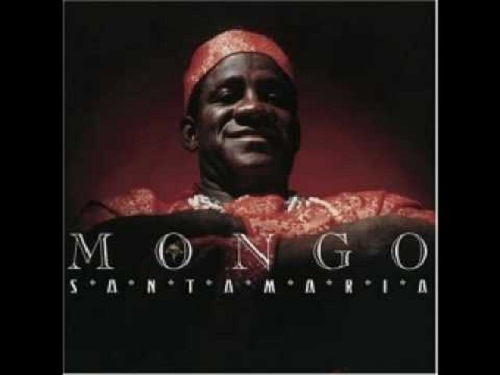
His long recording career (50 albums), testifies to the musical activity that this great percussionist carried out throughout his professional career. He worked with American jazz legends such as Chick Corea, Herbie Hancock, flutist Hubert Maws, Dizzy Gillespie, trumpeter Marty Seller, among other musicians who today still pay tribute to this Cuban conguero who was the architect of the fusion of rhythm & blues rhythms and Afro-Cuban music, recognized the connection of Cuban music to African roots and placed the congas in an indispensable instrument for the determination of Latin jazz.

In 1977 Mongo Santamaría received the American Grammy Award for “Best Latin Recording” for the work Dawn.

In 1999, Rhyno Record Company, based in Los Angeles, California, recognizing his contribution to Latin Jazz, released the “box set” (CD) Skin On Skin: The Mongo Santamaría Anthology (1958-1995), which includes 34 of his most successful pieces (from his rumba albums, his LP with La Lupe and his projects in the fusion of Jazz and Latin) and an extraordinary literature about his career written by actor Andy García, musician Poncho Sánchez and other connoisseurs of the Latin Jazz genre such as José Rizo, Luis Tamargo, Joel Dorn and Miles Pelich.

The legendary musician was extremely honored and grateful for the distinction Rhyno gave him by introducing this historic anthology to the world. As stated in the conversation with Jaime Torres, Mongo said:

“This is the fruit of many years of work, music made with taste and love.”

May he rest in peace and eternal glory to him.

From Peru and based in France we have Wálter Antonio Rebatta Hinostroza is a brand new and spectacular percussionist.

We are honored to present in this new release, one of the most outstanding figures of Latin music, representing the brother country of Peru, who has put the name of the musicians born in Inca lands very high in the world.

With you, directly from France, we have as a special guest Wálter Antonio Rebatta Hinostroza, a brand new and spectacular percussionist, who was born on September 14, 1973, in Bella Vista, Callao, Peru, being artistically known as “El Chato”.

Welcome Wálter to Salsa Escrita “La Columna Salsera de Barquisimeto, Venezuela”. It is a great pleasure to have you as a special guest in International Salsa Magazine, www.SalsaGoogle.com.

Thank you very much to you, my friend, Professor Carlos, for the invitation to your well read and recognized column and I take this opportunity to give a sincere greeting to all Venezuelans who are like my brothers.

How did you start in music? Well, teacher in my neighborhood called Ventanilla, in Peru, I grew up and since I was a child I breathed musical air, where at the age of 6 years old I was already playing “El Cajon”, traditional Peruvian Creole instrument, under the tutelage of my older brother Kike Rebatta, who took me later to learn other percussion instruments and prepare me with music theory, and then enter the music school of the renowned teacher Edelmi Chavez, and thus join the ranks of the most renowned orchestras in my country, such as: La Iniciativa, Orquesta la Grande, Banana Latin Jazz, among others.

Wálter, which international orchestras and artists have you accompanied? I have accompanied and worked with “Los Hermanos Colón” from Puerto Rico and among many groups, I have had the honor of being on stage with my Venezuelan brothers, Hildemaro “El Sonero del Amor”, with whom I have a great friendship, as well as with the master timbalero Alfredo Villamizar, from whom I have learned a lot and from whom I must thank through his column Salsa Escrita. “Chato”, you are currently based in the French city of Grenoble and we would like to know how is the salsa movement, especially in Europe. In fact, professor, in 1995, I came to Europe with the “Orquesta Salsa Perú” and I met Mr. Rodolfo Guerra, with whom a great friendship was born and I became part of the “Orquesta Sincopa Latina”, directed by him, being present in his productions: Salsa que te pasa, Demasiado corazón, Mi bachata, Puerto Rico, Todo, Escándalo, Mi silencio, Mi toque, Habla conmigo and Azafata. Wálter, I have heard that you have accompanied great salsa artists in their presentations, tell me who? I have had the honor of accompanying the late Tito Gómez, Willie González, Luisito Carrión and the great Venezuelan sonero Orlando José Castillo “Watussi”.

Also, let me tell you professor, that I have worked in the Italian television Media Set, in the very popular program “Notte Vola”, also in 2002, I participated in the Tour of the Queen of Salsa, Celia Cruz, along with the orchestra of the prestigious world famous violinist Alfredo de La Fe.

Likewise, my friend Carlos, in 2004, I performed in numerous events with Latin jazz groups, among them “El Royal Cuba”, of the Cuban musician and singer Eduardo Céspedes.

In 2007, I participated in the prestigious and famous festival of San Remo with the singer Daniele Silvestri, with whom I have recorded in his productions. In 2009, I participated in the Italian tour “Terromotati Dil Abruzzo”, conducted by the famous singer Laura Pausini and later that same year I participated again in a tour in the United States for charity with Pausini again.

Excellent Wálter, and what can you tell us about the orchestra you are currently working with and what are your future projects? Professor Carlos, at present I am an official musician of the renowned orchestra “Mercadonegro” and in relation to my projects, is to form my own group and perhaps dabble in bachata, but without leaving aside the salsa, since living in Europe I have met many bachateros. And something very important, my friend Colmenárez, I am also working on the project of my Venezuelan compadre, the musician Edwin Sanz, whom I would like you to interview at some point.

Very good Wálter, congratulations for your career, what are your contacts on digital platforms?  My Facebook is: Wálter Antonio Rebatta Hinostroza and my whatsapp: +41 77 5122633.

We want to wish you the best on behalf of Salsa Escrita “La Columna Salsera de Barquisimeto” and that you continue to put the name of Peru on high in all the stages of the world.

Thank you a thousand times, Professor Carlos Colmenárez, for taking me into account and thus make my career known and offer my greetings, thanks and respect to all the salseros of the world through International Salsa Magazine, www.SalsaGoogle.com and long live salsa, Peru and Venezuela, united forever…!

Chucho Valdes and Paquito D’ Rivera Will Tour for Europe

Jazz virtuous will offer a series of concerts from June to November 

Paquito D’ Rivera and Chucho Valdés

The pianist, composer, and conductor Jesús “Chucho” Valdes and the saxophonist, clarinetist, and composer Paquito D’ Rivera come together again to offer a tour called Reunión Sextet.

This tour of 2022 begins at the Mastercard Jazz Festival (Puerto Rico) and will pass through Poland (Bielsko-Biala), Spain (Pamplona, Marbella, Madrid, and Girona), and Germany (Essen) in June and July, and will end on November 30th in Zurich, Switzerland. Tickets range from €25 – €65 and you can get them in advance on Chucho Valdés’s website. www.chucho-valdes.com

The history of this long friendship dates back to the 1960s when they began their musical partnership as partners in the Havana Musical Theater Orchestra and the Cuban Modern Music Orchestra. With the founding of the Irakere orchestra by Maestro Valdés in 1973, Chucho and Paquito worked together again promoting the fusion of elements of Jazz, Classical music, Rock, and Afro-Cuban music that meant a transcendental development in Latin Jazz, and where Paquito and Chucho were the key figures. “Paquito was the heart of Irakere,” Chucho said.

Eight years later, Paquito went into exile in Madrid and later moved to New York. He developed a successful career as a leader & composer and won recognition as a Jazz Master from the National Endowment for the Arts of the United States in 2005. At the same time, Paquito also maintained his passion for classical music, receiving a Guggenheim Scholarship and commissions for quartets of strings, chamber groups, and symphony orchestras.

Meanwhile, Chuco remained in Irakere until 2005. He led trios and quartets, and established himself as a solo pianist. He produced his most recent production La Creación, a three-movement suite for small ensemble, voices, and Big Band. The masterpiece had its world premiere on November 5th, 2021, at the Adrienne Arsht Center for the Performing Arts in Miami and after was presented in Lyon, Paris, and Barcelona.

Now, after four decades, they come together to present Reunión Sextet accompanied by an extraordinary ensemble that includes Diego Urcola (Trumpet), Dafnis Prieto (Drums), Armando Gola (Bass), and Roberto Vizcaino Jr. (Conga). The repertoire will include old Latin Jazz hits, Latin American classics, and new compositions from the I Missed You Too album.

The two Cuban virtuosos have accumulated more than 25 Grammys and Latin Grammys. “I’ve always had the hope of being close to Paquito again and playing with him again,” he said. “I’ve always had that hope. Well, this is our moment.” The Maestro Chucho expressed.

His first tour in Spain was in 1981

Chucho Valdés, an icon of modern Afro-Cuban Jazz, told for a digital medium that practices the piano from six to eight hours a day. During the confinement, he was in Florida and composed La Creación (a tribute to Olodumare, the god of the Yoruba religion). This instrumental musical gem is sung, composed, directed, and performed by Valdés, and tells the story of the meeting of Afro-Cuban music in the Caribbean and the United States and how this has influenced globally. He also composed minor works and dedicated part of his time to teaching and virtual concerts.

Likewise, he added that the country that he would contemplate for a possible retirement would be Malaga (Spain) because his great pleasures come together: the Mediterranean, the diet, and many friends in the city.

Enriching conversation with Afrocuban music group Okan

Here is the interview

We are here with the Cuban Group Okan whose members, Elizabeth Rodriguez and Magbelis Savigne, are based in Canada. How are you, girls?

All right, thank you very much!

It’s a real pleasure for me to have you here. How’s it going?

We’re doing great and trying to start over after this big break. We are ready to be on tour very soon and do more things.

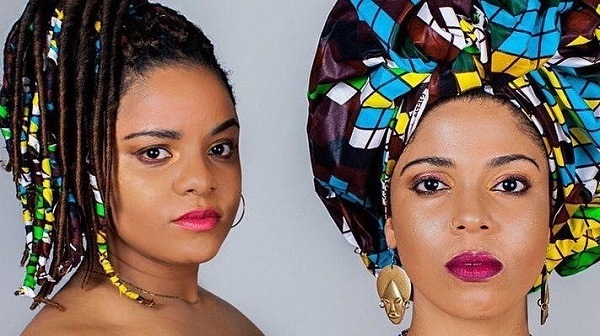
Elizabeth Rodriguez and Magdelys Savigne, members of the group Okan

Where is the name Okan coming from?

We wanted a name that had something to do with our Afro-Cuban roots, so we were doing some research on the closest thing to what we wanted. So, Okan comes from the Afro-Cuban dialect meaning heart. Elizabeth’s saint’s name is Okantomi which means Heart of Oshún, so we thought that sounded perfect for the kind of music we make that comes from our heart. We wanted to pay homage with that and have a name that Canadians could easily use. There have always been problems with the band’s name because they didn’t know how to say it, so Okan seemed to us the most appropriate.

In your music, the essence of Cuba stands out over everything else, but I imagine that your songs are also a mix of what you have learned since you left your country.

Yes, definitely. We have understood and learned that Cuban music is very good, but there are also many other things in the world. Living in Toronto has helped us to see how diverse music is and how similar it is to Brazilian or Turkish music, so you can say that we are influenced by different cultures and try to make music from the heart, from what we learned and from what surrounds us. In that sense, Toronto has many things to take advantage of

Which foreign rhythms have you been including in your work?

In addition to Cuban rhythms, we have also included Brazilian rhythms. We love Brazilian music and have a great love for Brazil – we include classical music genres as well because the two studied classical music in Cuba, so we are also influenced by that. Our next album is going to have a bit of Afrobeat, so it will be a bit more commercial than what we’ve done at the moment.

Living in Toronto helped Elizabeth and Magdelys to see how diverse music is

What did Jane Bunnet mean to you and other artists of your kind?

For us, she represented the opportunity to be able to go to festivals and learn more about the business. Of course, we learned by ourselves, since she taught us nothing. However, those tours gave us a lot of experience. The most important thing about playing with Jane Bunnet was to have gained experience and participated in important events we would’t have attended on our own. I think the most important thing was being able to achieve so much on our own and to play Afro-Cuban music representing the Afro-Cuban race and culture

Future genres

Are there any rhythms or genres that you don’t like or haven’t tried?

One of the songs on our next album is influenced by the rock of the 60’s because we like it a lot. Right now, there is some kind of Cuban reggaeton that has become very popular, but we haven’t done anything with that urban genre. We don’t really listen to the latest kind of reggaeton, so we prefer Afrobeat. We don’t say we’ll never do it, but we have to find some exponent of the genre who knows more about it to inform us. We have done some collaborations with Lido Pimiento and Bomba Estéreo.

We want to recover old Cuban genres that many people don’t know, which is why we have sung mozambique, pilón, changüI, among others. Cuban music is very broad and we got a long way to go in that regard.

I have noticed that the coloring is very important for you and this can be seen in your album covers and outfits, which are very colorful. What do you want to reflect with that?

What happens here is that clothes are super boring (chuckles) because many people dress in black or gray. In contrast, in Cuba and Latin America in general, people have always worn much more colorful clothes and we took that. Also, we met a Nigerian designer, who is the one who makes our clothes and outfits; besides, our Afro-Cuban roots also come from Nigeria, so we wear those clothes in honor of our ancestors. At first, we were doing this because it looked nice, but then people started asking why we did it, so it’s part of us now.

The coloring is very important for Okan

What reaction does the Canadian public to your outfits and music?

For the most part, the reaction is very positive. Many people say they came back to life when they hear us sing. We met a Cuban woman who had many years without going to Cuba and was very excited to hear us and that made us very happy because that’s the reason why we make music. Even though Canadians don’t understand the language, they like it because they see the chemistry between us and the musicians. People can see that and connect to us, even if they don’t understand the lyrics.

What have been the biggest obstacles you have had to face as immigrant artists?

The first problem is that people in this part of the world don’t respect the music done by professional musicians as much as they should although everyone consumes this product. In fact, payments do not correspond to the work done because people think that having a concert is very simple, but that implies a lot of prior preparation, songs written, sound tests, rehearsals, among other things. After all that, they want to pay 100 pesos for a concert. Music is not appreciated as a career and we consider that to be one of the main challenges we have had to face.

The other issue is that we come from a system in which we are not taught how the music business works. Behind it, there is a huge industry and a huge business, so you have to suffer so much to learn it.

Language is another barrier that closes many doors. Our advice to those who hear us is to know that it is possible make a living from music, but you have to speak the language of the country where you are living. You also have to find a good manager who believes in you and in your music; if it is someone born in the country, so much the better.

These girls have to face some obstacles as immigrant artists, but it was all worth it

How do you see the role of the internet in music?

We believe that excess is bad. It’s not fair what Spotify and other digital platforms pay, but you also have to understand that your music gains access to a larger audience. We’ve heard of people listening to us from Russia, Poland, Brazil, Colombia, Puerto Rico, Australia and many more countries. You have to see the positive part and understand that you can reach audiences from anywhere in the world. We can’t view the internet as an enemy, but as a tool and an advantage; it has its negative aspects, but many positive things.

What will be the name of your new album?

The name of our new album will be Okantomi, Elizabeth’s saint’s name and each track will be very different from the other one in terms of rhythms. We will have many guest artists and a super special song dedicated to Cuba in relation to the current situation, but seen from the point of view of Cubans in exiles. It will be called No volví. 

Occupations when you are away from the stage

We give music, violin, singing and piano lessons.

Cuban singer Daymé Arocena and her pride of being Afrocuban

This is our conversation

Here we are with Cuban artist Daymé Arocena who lives now in Canada. How are you, Daymé? Nice to meet you and great to have you here today.

Hello, nice to meet you. Thank you very much for the invitation. It is my pleasure to be here talking to you.

I understand that your musical career started at the age of eight. What made you start walking this path? What was the experience that made you make that decision?

I never made the decision to become a musician. I think it was part of the package. I never said that this is what I wanted to do because I’ve always done it. From the age of eight, my parents began taking me to music lessons and preparing me to came to the art and music school and the conservatory of music. I started singing with the choir in the community of 10 de octubre, where I came from. That’s how I started performing and getting up on stage as a soloist of a choir.

Daymé Arocena was born in Havana, Cuba

Considering that you come from a musical family and that music was always present at home, I imagine that also influenced your interest in making a career of it.

My family is profoundly musical, but they are not professional musicians. My dad is a music lover, but he is not a musician. My mother is a health care worker, qualified as a child cardiovascular surgeon. Actually, these are people who have a very nice sensibility for music, but they are not professionally dedicated to it.

I grew up in an intense environment. My house had many people; when I was born, there were already 22 people living at home, but some of them found more comfortable spaces to move and we became a family of 14. I was born in the 90’s, which was when the big crisis occurred and big power cuts were more frequent. There were electricitiy for very few moments during the day, so we couldn’t listen to the radio or TV. Then, my uncles and cousins kept singing, so I grew up watching the family sing and dance. In fact, several of my cousins today are folk musicians who went on to play in various traditional musical groups. It was a deeply spontaneous issue. I saw people enjoying and trying to alleviate the sufferings and shortages they were experiencing.

I imagine that musical and artistical growth in this context was very difficult. What challenges did you face in Cuba in becoming the artist you are today?

The mere fact of being born in Cuba is a challenge, but I had to face things beyond the fact that I was born on an island ruled by a dictatorial regime and all that that means. There was a lot of deep racism and a way to slyly to deal with social classes. For all these years, I have tried to purge my energy of resentment and pain caused by the situation and turn all these feelings into light and creativity. In my case, A lot of things happened like feeling uncomfortable in my own skin and not knowing how to deal with my skin color, my hair and my race. Today, I am deeply proud of my blackness and defend it to the death, but I went through a very hard and aggressive process before that.

The young and not so young prople have to know that you can make art and music through your own essence without having to please the eyes of a few.

So you would say that those things that were an obstacle are now part of your cover letter.

Totally. And proudly, too.

Daymé is deeply proud of her blackness

After leaving Cuba

When you left Cuba, what kind of support did you receive? What was the hardest moment?

Although I’ve spent years touring and working for years, I made the decision to leave Cuba a couple of years ago. I received a lot of international support that made my music visible, but it started playing long before I left my country. In Cuba, there is a control mechanism for artists consisting on a permit issued by the minister of culture to be able to practice that profession.

You can graduate from art school with full honors in the world, but that’s irrelevant because you graduate to be a music teacher, not a musician as such. In order to go on stage and get paid for your work, you need a permit issued by the Minister of Culture himself. To get it, you have to go through a lot of bureaucratic barriers such as commissions, auditions, among others. I didn’t have that permit to sing and profit from my singing when I met the record label that launched me as an artist. One day, I was singing in a deeply underground space without anyone’s permission. When I started to sneak into those spaces, my mom always told me to sing with energy because I never knew who was going to listen to me.

One day of those, a person named François Renié was watching me from the audience. This man was the creative director of the Havana Cultura platform. At that moment, they asked me to make a record with international DJs and singers. They invited me to do a casting, I showed up there, was selected and recorded the album despite not having permission to sing. When I was invited to the realease of the record in England, I showed them the music I Wrote and they offered me to sign with them officially.

You have been compared to Celia Cruz, Nina Simone and other artists of this stature because of your style, what do you have to say?

I had no idea who Celia Cruz was and it’s something I’m ashamed of. When I was compared with Celia Cruz, I wondered who she was. I think I really knew her following those comparisons.

Daymé thinks new generations have to know who Celia Cruz was

I think it has to do with that idea of homogenizing Cuban music into one thing. It was when I was compared with Celia that I started to find out about her and knew that she was the most universal of Cuban artists. She had a phenomenal way of petforming, transmitting, impacting and being as authentic. Musicians who do have access to Celia must do their utmost to let the new generations know who she was. If they can’t listen to her on the radio or TV, they can go online to listen to her and find out who La Guarachera de Cuba was.

How do you think Canadians perceive your music? 

I have done very few concerts in Canada as a soloist. In fact, I’m not even there at the moment, but in Puerto Rico. I can’t provide an overview of how Canadians perceive me, but I do think that they are super friendly, docile and open to all kinds of music. They appreciate, dance and enjoy whatever you play. I must thank my ancestors for the expansion of my music beyond the Canadian framework, so I don’t rely on that market for a living.

Do you plan to stay in Puerto Rico permanently?

I came to Puerto Rico to record my next album. I’m super happy and honored to be able to do it on this island so similar to mine because it has so much culture and colorful art. Here, I found the industrialization and visibility that Cuba doesn’t have. I still don’t know if I’m going to stay here for the rest of my life, since Canada enters into my plans in some way, but this is the stage I must live now.

Daymé Arocena is now living in Puerto Rico and recording her new album

  • « Go to Previous Page
  • Page 1
  • Interim pages omitted …
  • Page 144
  • Page 145
  • Page 146
  • Page 147
  • Page 148
  • Interim pages omitted …
  • Page 189
  • Go to Next Page »

International Salsa Magazine (ISM) is a monthly publication about Salsa activities around the world, that has been publishing since 2007. It is a world network of volunteers coordinated by ISM Magazine. We are working to strengthen all the events by working together.