• Skip to primary navigation
  • Skip to main content

International Salsa Magazine

  • HOME
  • Previous editions
    • 2026
      • ISM / April 2026
      • ISM / March 2026
      • ISM / February 2026
      • ISM / January 2026
    • 2025
      • ISM / December 2025
      • ISM / November 2025
      • ISM / October 2025
      • ISM / September 2025
      • ISM / August 2025
      • ISM / July 2025
      • ISM / June 2025
      • ISM / May2025
      • ISM / April 2025
      • ISM / March 2025
      • ISM / February 2025
      • ISM / January 2025
    • 2024
      • ISM / December 2024
      • ISM / November 2024
      • ISM / October 2024
      • ISM / September 2024
      • ISM / August 2024
      • ISM / July 2024
      • ISM / June 2024
      • ISM / May 2024
      • ISM / April 2024
      • ISM / March 2024
      • ISM / February 2024
      • ISM / January 2024
    • 2023
      • ISM / December 2023
      • ISM / November 2023
      • ISM / October 2023
      • ISM – September 2023
      • ISM – August 2023
      • ISM July 2023
      • ISM Edition June 2023
      • ISM – May 2023
      • ISM April 2023
      • ISM March 2023
      • ISM February 2023
      • ISM January 2023
    • 2022
      • ISM December 2022
      • ISM November 2022
      • ISM October 2022
      • ISM September 2022
      • ISM August 2022
      • ISM July 2022
      • ISM June 2022
      • ISM May 2022
      • ISM February 2022
      • ISM January 2022
    • 2021
      • ISM December 2021
      • ISM November 2021
      • ISM October – 2021
      • ISM September 2021
      • ISM August 2021
      • ISM July 2021
      • ISM May 2021
      • ISM April 2021
      • ISM June 2021
      • ISM March 2021
      • ISM February 2021
      • ISM January 2021
    • 2020
      • ISM December 2020
      • ISM November 2020
      • ISM October 2020
      • ISM September 2020
      • ISM August 2020
      • ISM July 2020
      • ISM June 2020
      • ISM May 2020
      • ISM April 2020
      • ISM March 2020
      • ISM February 2020
      • ISM January 2020
    • 2019
      • ISM December 2019
      • ISM November 2019
      • ISM October 2019
      • ISM Septembre 2019
      • ISM August 2019
      • ISM July 2019
      • ISM June 2019
    • 2016
      • ISM December 2016
  • Spanish
  • Download Salsa App
    • Android
    • Apple

Search Results for: dance

Johnny Pacheco, presents “Orquesta Primera Clase” from Maracay-Venezuela

The title of this album speaks for itself; the hand of the transcendental Dominican musician is introduced in this album.

El Zorro de Plata Pacheco appears as executive producer of the album, although we do not discard that he also participated in part of the musical production, due to the way the orchestra was structured and the style in which the arrangements were given; it is something that we can hardly notice when listening to the album, it is evident the great similarity to “Pacheco y su Tumbao”; four excellent trumpets with sonorous arrangements.

Johnny Pacheco, presents "Orquesta Primera Clase" of Maracay-Venezuela
Johnny Pacheco, presents “Orquesta Primera Clase” of Maracay-Venezuela

The predominance of Teo Hernandez (R.I.P)’s vocal style and register in the nasal coros, fits perfectly with the “Tumbao Añejo” that we have always been accustomed to from maestro Johnny Pacheco (R.I.P).

Although the album was backed by the Fania label and is loaded with a cheerful and swinging flavor, we think that it went somewhat unnoticed by the music-loving public.

The reasons could be several, we must remember that in those times in the 80’s the merengue rhythm was beginning to penetrate with a lot of strength.
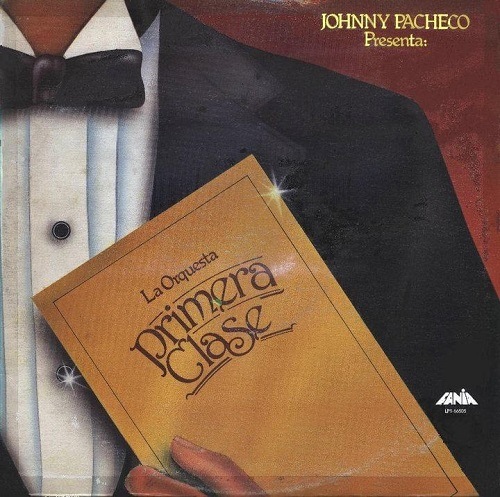
Johnny Pacheco, presenta la Orquesta Primera Clase

Although we could also add the little interest that the public of the capital (Caracas) had for the groups of the regions or interior of the country, and although it seems ironic to say it.
Another possible reason could be linked to the inclusion of only unpublished songs (it is well known that in those times, they supported copies more than creativity); these are only conjectures of this server, however, they do not escape the reality of that time.

Teo Hernández (R.I.P)

As for the musical themes, we have already pointed out that all of them are original and very well compensated with their arrangement; In particular there are two songs that I like very much, one of them is “Negro Nací”, written and sung by Orlando Sanoja, is a very happy song dedicated to our black race of the danceable in his music, “Si negro nací nací nací, blanco no puedo ser”, The other song of my predilection is “El Sabio”, composition and lyrics by Jorge Compres and vocalized by Teo Hernández, with great diction, good phrasing and those tasty choruses that accompany him.

Orlando Sanoja
Orlando Sanoja

It is worth mentioning that the excellent La Orquesta Primera Clase is still in force with a musical staff of the new generation maintaining its original sound with its lead vocalist Orlando Sanoja.

It is another good Venezuelan album that you should have in your personal CD library.
Johnny Pacheco presents “La Orquesta Primera Clase” (1982) Fania LPS-66506

SIDE A

1.- NEGRO NACÍ (Orlado Sanoja) Sings: Orlando Sanoja/ Arrangements: Nicomedes López
2.- ME SIENTO MUY FELIZ (Al mMaro Ríos) Sings: Orlando Sanoja/Arrangements: Bolívar Javier
EL ANIMAL (Jorge Compres) Sings: Teo Hernández/Arrangements: Jorge Compres
4.- TODO TIENE SU FINAL (Bolívar Javier) Sings: Teo Hernández/Arrangements: Bolívar Javier
5.- LLEVAME CONTIGO (Almaro Ríos) Sings: Teo Hernández/Arrangements: Bolívar Javier

SIDE B

1.- EL SABIO (Jorge Compres) Sings: Teo Hernández/Arrangements: Jorge Compres
2.- A MARACAY (Orlando Sanoja) Sings: Orlando Sanoja/Arrangements: Jorge Compres
3.- EXTRANJERA (Phorto Jacquez) Sings: Teo Hernández/Arrangements: Jorge Compres
4.- VIVA MI GUAGUANCO (Jorge Compres) Sings: Teo Hernández/Arrangements: Gilberto Riera
AY QUE HUMANIDAD (Orlando Sanoja) Sings: Orlando Sanoja/Arrangements: Jorge Compres

Personnel:

Pastor Rodríguez (1st Trumpet)
Henry Kamba (2nd Trumpet)
Gustavo Nieves (3rd Trumpet)
William Fermín (4th Trumpet)
Armin Kail (Piano)
Carlos Fagúndez (Bass)
Harold Josef (Congas)
Edgar Aponte (Timbal)
Félix Benítez (Bongo)
Teo Hernández/Orlando Sanoja (Singers)
Bolívar Javier/ Nicomedes López/ Jorge Compres/ Gilberto Riera (Arrangements)
Teo Hernández/Orlando Sanoja/Edgar Aponte (Chorus)
Johnny Pacheco (Executive Producer)
Carlos Guerrero (Recording Technician)
Luis Arismendi (General Recording Supervision)
Recorded at Fidelis Studios
Alejandro Pérez (Art and Design)
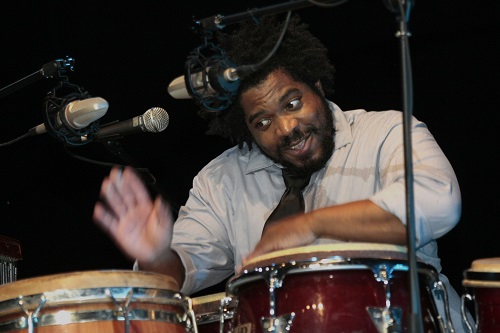
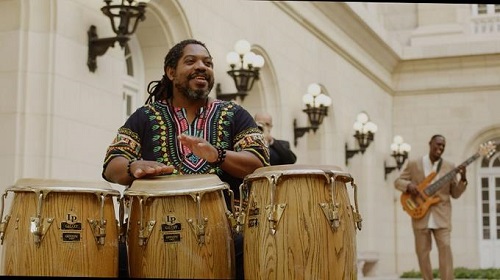
Yaroldy Abreu Robles is one of the talents of the new generation present in Cuba

Yaroldy Abreu Robles was born on February 22, 1977 in Sagua de Tánamo, Holguín, Cuba.

Excellent percussionist and arranger. Among the many talents of the new generation of Cuban experts in Cuban rhythms of French-Haitian origin and knowledge of Afro-Cuban folklore, Yaroldy is an imaginative and expressive percussionist, with great technique and virtuosity, with an original style.

Yaroldy Abreu Robles es uno de los talentos de la nueva generación presentes en Cuba

A member of a new batch of Cuban percussionists, he stands out for his genius and mastery, to hear him play is an enjoyment for the senses.
He radiates vitality and joy, his hands seem to fly and at the same time caress the drums causing a magical and contagious effect on those who listen to him. He is currently one of the members of the Maestro Chucho Valdés Quintet.

He grew up in an environment rich in traditions and with his grandmother he learned about the activities of Tumba Francesa de Bejuco.

Yaroldy Abreu Robles

This is an association of solidarity that preserves and enhances the folklore of French-African-Caribbean origin through cultural recreational meetings, and especially the celebrations organized by the slaves of Haiti.
He is not a great connoisseur of the Yoruba culture, he is not a believer, but he feels attracted by the symbolism and the music of the magic Afro-Cuban religious cults.

He began studying guitar as his first instrument at the Casa de la Cultura. Then at the age of nine he began classical percussion at the Escuela Vocacional de Arte de Holguín and in 1996 he entered the ISA (Instituto Superior de Arte) in Havana, where he graduated in 2001. Sound in the whole range of percussion of academic character and those of the Afro-Cuban tradition.

Yaroldy Abreu Robles Pintura por la Artista Inés Garridos

The first band where he played was called Son de Sagua, in which he played guitar with a mixed repertoire. His debut was with percussion, bongo in several groups and then with a wider range of instruments.

He began working with the group Piapá, doing experimental percussion, and a classical percussion quintet.

Also with dance music groups such as Pupy and Los Que Son Son and others. In 1997 he became a professional with Maraca and Otra Visión internacional, in 2000 he joined Irakere and in 2001 he joined the quartet of Chucho Valdés, the great protagonist of Cuban music in the last forty years as composer, director and discoverer of talents.
Among the young Cuban percussionists who continue to renew the grammar and pronunciation of the Afrolatino tumbadora in jazz, one of the most influential names is the thirty-one Yaroldy Abreu, whose point of reference is the work of the great immortal masters such as Chano Pozo, Tata Güines, Mongo Santamaría, Jorge “El Niño” Alfonso and Miguel “Angá” Díaz.

Discography in which he has participated
Yaroldy Abreu Robles

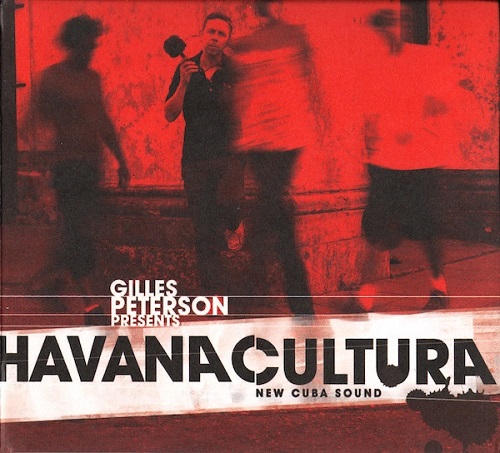
Gilles Peterson Presents Havana Cultura – New Cuba Sound Año 2009
Gilles Peterson Presents Havana Cultura 2010
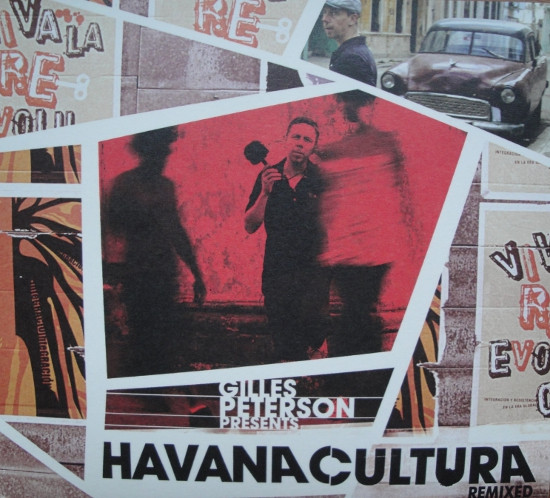
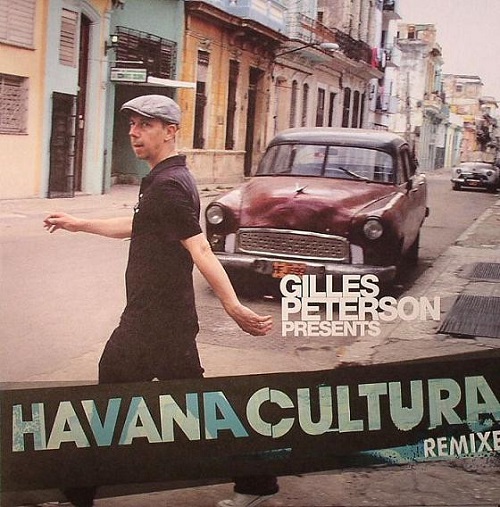
Gilles Peterson Presents Havana Cultura Remixed 2010
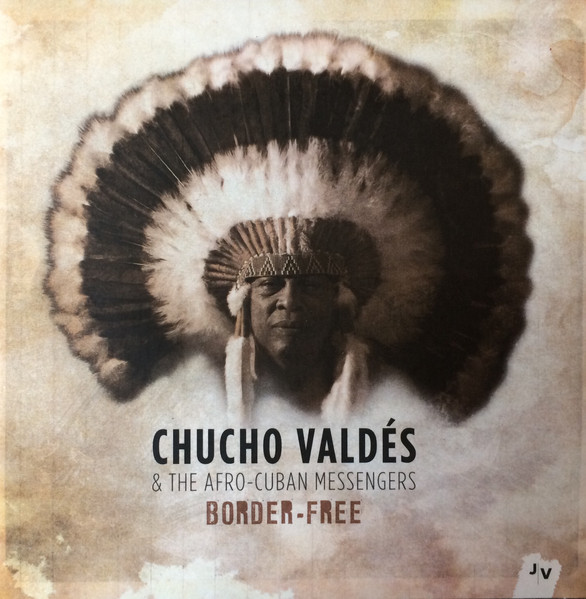
Chucho Valdés & The Afro-Cuban Messengers 2013

How Jacira Castro and Salsa Power changed the Latin music scene

How did Salsa Power start?

Latin culture, specifically the musical part, has had a large group of unconditional allies who have promoted it worldwide through their work and platforms, being Chilean-American Jacira Castro one of the best known. Jacira is a salsa casino-style salsa teacher and web designer who had the dream of spreading the typical rhythms of our countries, but she did not figure out how until she came up with a revolutionary idea: Salsa Power. 

Salsa Power was born in 1999 as part of an initiative created by Castro and graphic designer Julian Mejia, who practically became her partner until the moment when the page stopped working. From that year on that the dance instructor began to generate contacts and develop human networks with people inside and outside the world of music, especially from the salsa genre. A particularity of this system devised by Jacira was that it was fed by the information received from people from anyqhere in the world about everything related to concerts, festivals, press conferences, autograph signings and much more.

Jacira Castro - Salsa Power
Dance instructor and web designer Jacira Castro – Salsa Power

How did this project work?

Thanks to the technology that was advancing little by little in all this time, there were many more contact ways and social media came along to facilitate these activities. The website grew to such an extent that it came to have more than 300 correspondents in over 60 countries, many of whom did not even have professions or occupations related to music, but wanted to strive to make the initiative successful and Latin artists and orchestras have a dependable space to promote their work.

Contrary to what many readers may have thought, everyone involved in this project never received a single cent or publicity in return for all the work being done. In fact, it was Jacira herself who had to pay for all the expenses related to Salsa Power such as plane tickets, travel, lodging, food, wardrobe, among other things. Not to mention the website maintenance and other hosting costs for the domain to work properly.

Fortunately, all that effort and money were worth it because Salsa Power rose to become the largest salsa website on the internet and a true reference for any independent media planning to do anything remotely like that. Much of the fruits harvested by this beautiful project can still be found on the internet and consist of articles, interviews, event coverage, videos and many other things.

The name Salsa Power was so respected that you could not talk about the Latin salsa scene in the United States without mentioning it, especially in South Florida, a place where competition for the first places was at its higuest. This competition was not only between artists and musical groups, but also between media, associations and academies, triggering some inconvenience and regrettable situations like the one experienced by Jacira and Julián a few years ago.

Jacira paid for all the expenses related to Salsa Power

Controversies

Jacira has had run-ins with some important personalities of the Latin music community in Florida because of her political positions, which went against the current of a large number of Latin artists and dancers at that time, especially those who are part of the Cuban exile. Her attitudes towards the political situation in Cuba have been highly controversial, mainly those related to the U.S. economic embargo on the Caribbean country and the limitations on free cultural exchange between both nations. Both Castro and other leaders of the entertainment industry were opposed to the decades-old blockade, which has been maintained until today.

This caused the dance teacher to make some enemies in the Miami music scene, which led to the hacking of Salsa Power with the caption ”This is a communist website” in big red letters along with a message whose author calls Jacira ”communist” and ”pro-Fidel Castro”. Obviously, she got worried and immediately called Julian to bring down the page.

As they began to diagnose the issue and its possible causes, they concluded that those responsible were part of an association composed of a dozen dance schools in Miami and its sorroundings called Salsa United. Around the same time, this organization had just created its own website, which published content very similar to that of Salsa Power, so much so that its principal spokesperson Jolexy Hurtado and Jacira came to have some arguments and run-ins due to how much alike the interviews were in both websites. The conflict reached at such a level that Jacira states that Hurtado told her she was messing with the wrong guy.

Undoubtedly, this whole situation was a big headache for the web designer, but has never let any of this daunt her or make her feel inadequate. On the contrary, she has grown before adversities and has faced them with the gallantry that has always characterized her, since she knows what her work is worth in terms of quality and globality.

However, there comes a point when the effort and time invested are not enough, so it is time to be realistic and assume that everything has its end, as the great Héctor Lavoe would say.

Jacira and Larry
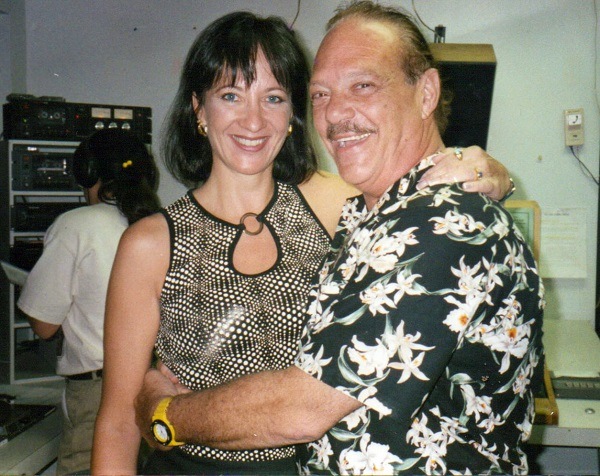
Jacira Castro with producer, composer, and pianist Larry Harlow

Farewell to Salsa Power and Jacira’s current life

After 22 years of operation of the Salsa Power project, many of the correspondents who provided information for the page got married, had children, studied, moved and pursued other professional opportunities that did not allow them to continue their work. For the same reason, Jacira had no choice but to terminate the project that was her life for more than two decades and publish a farewell message thanking all her readers for their support over the years and assuring that she will continue to travel and enjoy salsa and dance.

In spite of abandoning her duties as administrator of Salsa Power, the great impact of the Chilean-American’s work on those who have come to know her and collaborate with her cannot be denied. On her LinkedIn profile, there plenty of favorable reviews about her professionalism and commitment in every activity she makes.

From International Salsa Magazine, we wish her the greatest success in every project she undertakes and that she enjoys all the stages that are to come.

Read also. Pacifica Radio, history, shows and controversy

Kizomba as a result of war and colonization

The fight for Angola’s independence was a long and difficult struggle that endured for several decades. The country was colonized by Portugal in the 16th century, and for centuries the Portuguese imposed their culture, language, and political system on the Angolan people. However, the Portuguese colonization also led to the exploitation of the country’s resources, the forced labor of its people, and the suppression of its cultural identity.

In the mid-20th century, there came a wave of anti-colonial movements across Africa and Angola was no exception. The Angolan people began to demand their right to self-determination and freedom from colonial rule. In 1961, the National Front for the Liberation of Angola (FNLA) conducted a guerrilla war against the Portuguese, followed by the People’s Movement for the Liberation of Angola (MPLA) and the National Union for the Total Independence of Angola (UNITA) in the following years. The struggle for independence was marked by heavy fighting, political instability, and international intervention, but in 1975, Angola finally got its independence, ending over four centuries of Portuguese colonial rule.

Kizomba Dancer

Angola, officially known as the Republic of Angola, is a country located in southwestern Africa. It is known for its rich culture, vibrant music, and stunning natural beauty. One of Angola’s most famous cultural exports is kizomba, a popular dance and music genre that originated in the country and has spread to other parts of the world.

Angola has a long and complex history, marked by centuries of colonization, slavery, and war. The country was colonized by Portugal in the 16th century and remained under Portuguese rule until 1975, when it got its independence. The legacy of colonialism and the struggle for independence have had a profound impact on Angola’s cultural identity, including its music and dance traditions.

Kizomba, which means “party” or “celebration” in Kimbundu, one of the Bantu languages spoken in Angola, emerged in the 1980s and 1990s as a fusion of Angolan semba music, Caribbean zouk, and other African rhythms. Semba is a traditional dance and music genre that originated in Angola and is characterized by its joyful tempo, complex rhythms, and energetic movements. Zouk is a popular dance and music genre that originated in the French Caribbean and is characterized by its slow and sensual tempo, soft melodies, and romantic lyrics.

Young woman dancing kizomba

Young woman dancing kizomba

Kizomba music, in contrast to semba, is characterized by its slow and sensual tempo, soft melodies, and rich harmonies. The lyrics of kizomba songs are often sang in Portuguese, the official language of Angola, and deal with themes of love, romance, and social issues. Kizomba dancing is characterized by its close embrace and smooth, flowing movements. It is often danced in pairs, with the leader guiding the follower in gentle steps and turns.

Kizomba became popular in Angola in the 1990s, especially in Luanda, the country’s capital. The dance quickly spread to other parts of the country and became an important part of Angola’s cultural heritage. Kizomba dance parties, known as “kizombadas,” were held in clubs, bars, and community centers, attracting people of all ages and backgrounds.

In recent years, kizomba has gained popularity in other parts of the world, particularly in Europe, where it has become a popular social dance. Kizomba festivals and workshops have been held in many countries around the world, attracting dancers and music lovers from different cultural backgrounds.

Kizomba is not only a dance and music genre but also a cultural expression that reflects the history and identity of Angola and its people. It is an important part of the country’s cultural heritage and a source of pride for Angolans around the world.

45 years of salsa career of ‘el más que canta’ was in style

On Sunday, February 5, 2023, at about 5:00 p.m. Puerto Rican time, the curtain of the Coca Cola Music Hall rose to give way to a radiant Domingo Quiñones.

El más que canta’ arrived ready to share his voice and his usual nostalgic smile with the audience.

The 45th anniversary party began, the melodic style of the saxophone in charge of Jorge Baez. A minute after the orchestra played the first notes, Domingo let out a loud war cry that sounded like: “Puerto Rico”. Immediately, the first two songs were played: Chica romántica & Poeta y guerrero.

Domingo Quiñones  ‘el más que canta’

After a brief greeting in which Domingo thanked his fans for their support, the most emblematic songs of his career were heard, such as: Tú cómo estás, Soy, Enséñame, El progreso, Busco un amor, Falco de valor, Salsumba, Cuando se necesitan más, Fuera de control, Río abajo, Deseo salvaje y Devórame otra vez, A que no te atreves, Se necesita un milagro, Pasarás al libro del recuerdo, Lo reconozco y No voy a dejarte ir.

Keeping the rhythmic base going, Charlie Padilla was in charge of the tumbadoras, in perfect sync with Javier Oquendo on the bongos and Pablo Padín on the timbales. It was clear that Domingo was backed by a luxurious orchestra, under the musical direction of pianist, music producer, arranger, composer, singer and dancer: Carlos García.  Ricardo Lugo accompanied with his impeccable bass playing. Ramón Sánchez complemented the perfection of the stage behind the keyboard.

The wind section was formed by Ángel Hernández and Jesús Alonso on trumpets, and Eliut Cintrón and Víctor Vázquez on trombones. In the choirs, the vocal forcefulness and precision of Jorge Yadiel, Nahyra Pérez and David Carrero was heard.

Domingo Quiñones
Domingo Quiñones

About an hour into the celebration, Domingo decided to do a conga solo, what a surprise we were in for! The conga solo was very well done.

An hour and a half into the concert, Gilberto Santa Rosa, Luisito Carrión and Carlos García sang with Domingo Quiñones the song En el mismo barco, composed by Domingo in the midst of the COVID-19 pandemic.

Domingo Quiñones Tributo a Lalo Rodriguez

The arrangement of the song allowed the wind instrumentalists to have their way with the big spoon before giving way to a very heavy rumba in the percussive corner.

A moment of great emotion was the one that gave way to the song Río abajo, with the accompaniment of Luis ‘Perico’ Ortiz in his impeccable trumpet solos, in addition to accompanying Domingo in the chorus.

Por todo lo alto  fueron 45 años de trayectoria salsera de ‘el más que canta’

This intervention made clear the affection that Domingo and Perico have for each other.  It must be because when Domingo decided to pursue his dream as a soloist, he was part of ‘Perico’s’ orchestra.

For this celebration, our Domingo Quiñones gave way to a repertoire that summarized very well those 45 years of career.  More than singing, Domingo interpreted with that emotionality of his best times.  The audience vibrated with his performance. His histrionic ability, his interpretative quality and the charisma with which he captures the audience’s attention, kept them captive for hours.

Domingo Quiñones  y sus Amigos

Photo credits: Félix Guayciba

Bella Martínez

Read Also: “Mambo Night in Miami Beach” celebrates the 100th anniversary of the birth of “El Inolvidable”, our own Tito Rodriguez

Bella Martínez Writer, researcher of Afro-Caribbean music and author of Un conguero para la historia, Las memorias de Jimmie Morales.

787-424-8868

  • « Go to Previous Page
  • Page 1
  • Interim pages omitted …
  • Page 104
  • Page 105
  • Page 106
  • Page 107
  • Page 108
  • Interim pages omitted …
  • Page 168
  • Go to Next Page »

International Salsa Magazine (ISM) is a monthly publication about Salsa activities around the world, that has been publishing since 2007. It is a world network of volunteers coordinated by ISM Magazine. We are working to strengthen all the events by working together.