• Skip to primary navigation
  • Skip to main content

International Salsa Magazine

  • HOME
  • Previous editions
    • 2026
      • ISM / March 2026
      • ISM / February 2026
      • ISM / January 2026
    • 2025
      • ISM / December 2025
      • ISM / November 2025
      • ISM / October 2025
      • ISM / September 2025
      • ISM / August 2025
      • ISM / July 2025
      • ISM / June 2025
      • ISM / May2025
      • ISM / April 2025
      • ISM / March 2025
      • ISM / February 2025
      • ISM / January 2025
    • 2024
      • ISM / December 2024
      • ISM / November 2024
      • ISM / October 2024
      • ISM / September 2024
      • ISM / August 2024
      • ISM / July 2024
      • ISM / June 2024
      • ISM / May 2024
      • ISM / April 2024
      • ISM / March 2024
      • ISM / February 2024
      • ISM / January 2024
    • 2023
      • ISM / December 2023
      • ISM / November 2023
      • ISM / October 2023
      • ISM – September 2023
      • ISM – August 2023
      • ISM July 2023
      • ISM Edition June 2023
      • ISM – May 2023
      • ISM April 2023
      • ISM March 2023
      • ISM February 2023
      • ISM January 2023
    • 2022
      • ISM December 2022
      • ISM November 2022
      • ISM October 2022
      • ISM September 2022
      • ISM August 2022
      • ISM July 2022
      • ISM June 2022
      • ISM May 2022
      • ISM February 2022
      • ISM January 2022
    • 2021
      • ISM December 2021
      • ISM November 2021
      • ISM October – 2021
      • ISM September 2021
      • ISM August 2021
      • ISM July 2021
      • ISM May 2021
      • ISM April 2021
      • ISM June 2021
      • ISM March 2021
      • ISM February 2021
      • ISM January 2021
    • 2020
      • ISM December 2020
      • ISM November 2020
      • ISM October 2020
      • ISM September 2020
      • ISM August 2020
      • ISM July 2020
      • ISM June 2020
      • ISM May 2020
      • ISM April 2020
      • ISM March 2020
      • ISM February 2020
      • ISM January 2020
    • 2019
      • ISM December 2019
      • ISM November 2019
      • ISM October 2019
      • ISM Septembre 2019
      • ISM August 2019
      • ISM July 2019
      • ISM June 2019
  • Spanish
  • Download Salsa App
    • Android
    • Apple

Search Results for: dance

“Mambo Fiesta” the new of Maelo y su Klan from Oslo Noriega

As of Thursday, November 4, 2022 it will be available for sale on all digital platforms worldwide.

A musical production of Café Records.

Miami, FL, November 4th, 2022. (Café Records) It already smells like the holidays, both the World Cup Qatar 2022 and Christmas and the native of Caracas, the Venezuelan Ysmael D’La O (Maelo), producer, composer and director of the European group “Maelo y su Klan”, brings us this new and catchy single from the album “Cultura Viva”, titled Mambo Fiesta.

Mambo Fiesta lo nuevo de Maelo y su Klan desde Oslo Noriega

In his musical biography, Maelo has the album “Ritmo y Sabor” 2018 and singles from his new production; “Son Kizomba”, “La reina de la Campana”, “Que Extraño es Eso”, which was his first Feat with the Venezuelan cultural heritage group “El Sondeo Clásico del Caribe” and last summer’s hit “Son Onomatopeya”.

It has been a spectacular year, full of nominations, recordings and successes of the mulatto from Carapita, in which we highlight the following: winner as the best Antillean Group of 2022 of the Cristo Rey Awards, which is awarded in Cali, Colombia, known for being the world capital of salsa.

He also received the “Honorable Mention” as producer of the year 2022, at the Golden Latin Awards in Tenerife, Spain, after more than 20 years in music production in the old continent.

Referring to the Mambo, today few groups are recording this type of rhythms, but Maelo, as a good visionary and knowledgeable of the emerging market, breaks with that scheme and presents us with a work of musical art for the dancer.

With the invitation of excellent and first class musicians as collaborators:

Composer: Ysmael D’La O (Maelo), Trumpets: Luis Ruiz, Trombone: Michael Palma, Voice: Luis González, Alto and Baritone Saxophones: Julio Estrada, Tumbadoras, Bongo, Campana, Maracas and Guiro: Yomar “Caballo” Méndez, Timbal: Hungría Rojas Jr, Bass: José “Mortadelo” Soto, Piano: Julio Estrada, Backing Vocals: Luis González, Alexis “El Chivo” Aguilar and Ysmael D’La O (Maelo). Arrangement and musical production: Julio Estrada, recorded at Estudio Requena and JE studio, mixing: Francisco Requena and Julio Estrada.

Mastering: Estudio Requena: Francisco Requena, all under the general and executive production of: Ysmael D’La O (Maelo).

“Mambo Fiesta” is here to stay in the public’s taste, and is already available on all digital platforms distributed by Café Records.

Maelo y su Klan

You can read: Live The Salsero Rhythm In Asia

Latin America – November 2022

Isaac and Esteban Hernández, two brothers making history

How they got their start in the world of the arts

There have been many artists of Latin origin who have become known in much of the world thanks to their talent and dedication to what they do. A perfect example of this are the Mexican siblings Isaac and Esteban Hernandez, who have given much to talk about in major media outlets both in Spanish and English.

Isaac and Esteban Hernández in an event together

These boys, originally from Guadalajara, Mexico, are two of 11 siblings in a very large family. They are children of two dancers and one of them is Héctor Hernández, who taught the youths to dance from an early age thanks to the wide experience he gained in this profession. Isaac and Esteban have commented in some interviews that their father built a barre and both used thin pieces of wood as a ballet floor, which they used to practice their moves.

In addition to that, they were home-schooled by their mother, Laura, which helped a lot to train them in dance and allow them to devote more time to these activities.

These brothers think that they have managed to change their lives in a relatively short time thanks to the effort and dedication to dance, a discipline that they love so much. However, they knew that the path might not be as easy as they would like it to be.

When questioned about machismo and the feedback they might get on being men who dance ballet, they said that their father has prepared them very well for that moment. When they asked him to teach them to dance, he warned them that it would not be easy for them to start a real career in this discipline, but they did not care and moved on.

Isaac and Esteban during an interview

Service to the Latino community

After achieving this level of fame, they have set out to help new generations of dancers in any way possible so that they can get ahead in the world of the arts, specifically in dancing. In the past, it was very difficult to bring dance schools and talent auditions to many Latin American countries, which has made it difficult for young people interested in learning all these disciplines to have access to the necessary training to succeed. However, established artists such as Isaac and Esteban have played a very important role in the turning of things.

In the specific case of Mexico, it has been possible many children throughout the country to have access to the opportunities they need to climb positions in the world of entertainment, as even as it was with these professional dancers.

While it is true that dancing on the most important stages of the world and being judges in competitions fill their souls and makes them feel very lucky, the use of all their potential to change the lives of so many people in their Latino community excites them in an indescribable way and makes them understand the great social responsibility they have.

Roselyn Sanchez, Isaac Hernández and Paulina Rubio in the competition ''Mira Quien Baila''
Roselyn Sanchez, Isaac Hernández and Paulina Rubio in the competition ”Mira Quien Baila”

Presence in the media

Given that Latino Heritage Month had just been held, many digital media outlets took advantage of the brothers’ popularity to make reports on their great work and all they have achieved in such a short time. There are many online newspapers or websites that have highlighted the talent of the Hernandezes and all the achievements obtained through the effort and hard work put forth by both of them.

In one of those many reports, it is highlighted that Esteban is considered as one of the most influential Mexicans and has become one of the main dancers of SF Ballet. For his part, Isaac has received a Medal of Merit in the Fine Arts from the President of Mexico at the time, Enrique Peña Nieto, is also part of the SF Ballet as a main dancer and is one of the judges in the dancing competition ”Mira Quien Baila”. 

Both Isaac and Esteban are clear proof that dreams come true and everything can be achieved with effort and dedication no matter where we came from.

Read also: A new salsa talent with Latin parents and born in Boston

The multifaceted artist Yamila Guerra and all her projects

Who is Yamila Guerra

Yamila Guerra is a Cuban singer, dancer, actress and TV host who has always felt a great passion for music from an early age and knew she wanted to devote her life to the world of entertainment. She is the daughter of the famous Cuban duo Rosell y Cary and sister of famous producer, bandleader, arranger, composer, classical guitarist Yalil Guerra, who is a great friend of International Salsa Magazine.

Yamila Guerra in a studio

We had the honor of talking with Yamila for a while and know a little more about her both personally and professionally. It was really a pleasure for us to have had her here and to know more about her great career.

Inclination for the arts from an early age and academic background

Yamila reveals that she has always felt very attracted to the art world and started this journey doing impressions of certain Cuban and foreign artists who she saw on TV. Some of them were friends of her parents’or colleagues because they shared the stage with them in all the activities they did in Cuba.

Evidently, the fact that she grew up in an artistic and musical environment included a lot in the inclination she had towards this world, but it was not the only thing that made her dedicate herself to all this. She always felt a natural and organic attraction to the world of entertainment, music and art.

Seeing that her career began at the Cuba’s National Ballet School, it can be said that the first area in which she began to develop was dance. When she took the physical tests, she was admitted to the institution and attended as a listener until she was old enough to be able to participate in the classes. She feels that she had a complete training because, besides studying classical ballet, she learned all the Cuban dances such as contradanza, Cuban son, cha cha chá, danzón, among others.

Yamila Guerra with his brother Yalil Guerra

At the School of Artistic Varieties, she developed in areas such as acting, singing, music and much more. All these disciplines mentioned above helped her a lot with her professional future.

Once in the United States, she studied at Berkley College of Music and took singing lessons in some genres such as blues, jazz, country, ballads, among others. At other schools, she studied art history, marketing, business, sales and other areas that have served her professionally speaking.

Life in Spain

Guerra tells us that she left Spain and moved to Miami because she could not tolerate its cold climate and wanted to be closer to her family in Cuba, but she has many good memories and is thankful to the European country, as it gave her the opportunity to be a TV host on channels such as TVE, Canal Satélite Digital, Antena 3 and Telecinco. Likewise, she was able to take her music to different stages and many parts of Spain. She felt that the Spanish people welcomed her art with open arms.

Once she moved to Miami, she worked on  ”Sábado Gigante” as an actress with Don Francisco, whom she thanks for the opportunity his team gave her.

Yamila Guerra, His brother Yalil Guerra and their parents Rossel and Cary

How business, economics and legality have helped her in her career

One of the first pieces of advice Yamila gives to anyone who wants to work in entertainment in the United States is to master the English language. The artist defines herself as an eternal student because she has always liked to learn everything, especially languages. In fact, when she was in Spain, she paid for an English academy once a week to learn that language because she knew it would be very important in her career in terms of negotiation.

She also stresses that it is important to find out about legal and business issues to deal with clients and partners in the best possible way and avoid loopholes that naturally arise in the entertainment world. Yamila believes that it is very important to separate art from business and ”not to be trusted with money”. The Cuban highlights the importance of being pragmatic about making decisions and not allowing the artistic part to prevent people from making the right decisions at the level of business.

Social media

The talented performer considers that social networks are a fundamental part of her work and promotion, so she thinks it is important to have a presence on each and every one of them and design a strategy depending on the characteristics of each one. She considers that it is very important to post videos and photographs in order to promote her work, but also use her platforms to talk about other more personal topics such as family, beauty, nutrition, love and other things. That variety of facets is what attracts so many people to her content.

Yamila Guerra with Celia Cruz

As for her personal tastes, she confesses that she loves Tik Tok because she considers it a very organic and authentic platform. This is where she posts videos of herself acting and giving her opinion about all kinds of topics, something that gives her great exposure.

On this same issue, she stated that social networking has become essential to all types of professions and that we must all be present on them as much as possible because they have become part of our letter of introduction to others.

Tradicional Cubano

Yamila had been wanting to make an album fully dedicated to traditional Cuban music, which she considers to be the most flavorful, since it does not need a lot of instrumentation to feel it. It is very old, but it does not lose its flavor and its validity over the years. This is how her latest album ”Tradicional Cubano” came about.

This album includes composers such as Ignacio Piñeiro and Celina González. Guerra wanted to rescue this repertoire that she listened to when she was a child, since it always caught her attention and she was fascinated to be able to portray the Cuban culture and the lives of Cubans.

Read also: We interviewed IndiviDúo singers Tiffany Joy and Maqui Reyes

Shoemaker and shoe designer Carlo Farroni

We talked with shoemaker and shoe designer Carlo Farroni

In entertainment, singers, musicians and dancers are always the ones who show their faces to the audience, so they usually take the credit that comes from the final result, but there are many other professionals who also do their part so that a stage performance can be carried out, but unfortunately they do not get the recognition they deserve from the mass media.

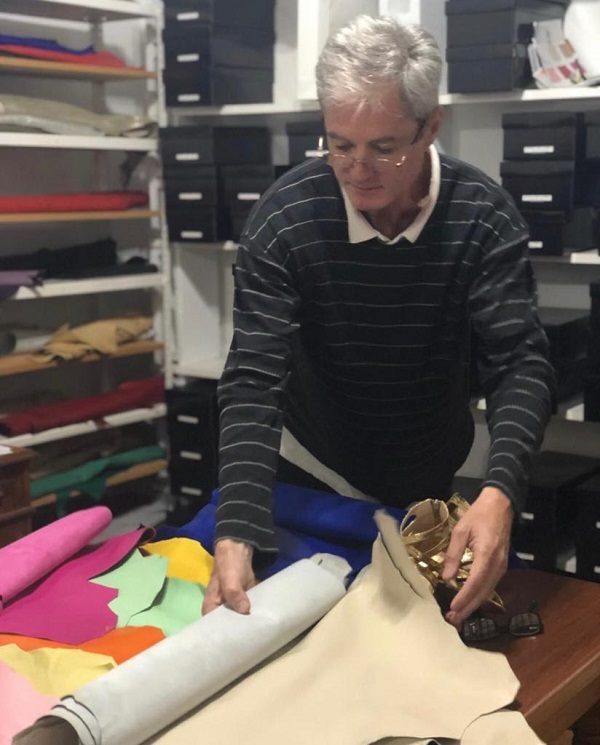
Carlo Farroni checking his materials for shoes

Some of those professionals are shoemakers and shoe modelists, who offer absolute comfort and elegance to artists during their shows, especially when it comes to dancers. Today, we are going to bring the story of Mr. Carlos Farroni, who kindly agreed to talk to us and told us how he began in this interesting and important occupation.

How did you start your career as a shoemaker and shoe designer? (título 3)

Carlos Farroni tells us that he started his apprenticeship at the age of 20, namely more than four decades ago. All this training took place at the shoemaking institute in Buenos Aires, Argentina, Farroni’s native country, but it was not the only place responsible for teaching this man everything he knows today. He also combined his studies with certain tasks in an artisan footwear workshop, something that would be a great support to the knowledge gained within the field of formal education.

Dancing shoes for women made by Carlo Farroni

A few years later, he enbarked on a trip to Italy, where he worked in various areas of the creation of shoes, such as design and subsequent manufacturing, which was also extremely important for the Argentinean to continue learning how to navigate the world that has made him so well known.

Asked why he dedicates himself to the creation of special shoes to dance, he replied that he was carrying out exclusive footwear for theatre plays for many years, during this time his work started to become known in many parts of the world. After the quality of his products made news in many countries, many dancers started contacting Farroni to design exclusive shoes for them. It can be said that this is how he started the famous brand we know today.

More dancing shoes for women made by Carlo Farroni

How is your working methodology? (título3)

Regarding the production process, Mr. Farroni has revealed to us that everything is hand-made, which means that the tailoring, design, choice of materials, cutting, sewing, assembly and finished are handmade. In the same way, he ensures that the materials used for his products (most of the shoes are made of leather) are of excellent quality both in tanning and in thickness. This whole process is what makes the shoes look so professional and, at the same time, so comfortable and light as to allow the wearer to move freely.

It is also important to underline that the shoes handmade by Mr. Farroni’s brand can be used to dance every kind of musical genre without an problem. Obviously, tango dancers are the ones who most often seek out and promote these products, but there is no limit with regard to this detail. Anyone who wants the greatest elegance, sophistication and comfort at the moment of dance anything can contact Carlo Farroni, who will be happy to assist them and offer them the best of his work.

Dancing shoes for men made by Carlo Farroni

Read also: Omar Ledezma Jr talks about his experience at the Tempo Latino Festival

  • « Go to Previous Page
  • Page 1
  • Interim pages omitted …
  • Page 107
  • Page 108
  • Page 109
  • Page 110
  • Page 111
  • Interim pages omitted …
  • Page 165
  • Go to Next Page »

International Salsa Magazine (ISM) is a monthly publication about Salsa activities around the world, that has been publishing since 2007. It is a world network of volunteers coordinated by ISM Magazine. We are working to strengthen all the events by working together.