• Skip to primary navigation
  • Skip to main content

International Salsa Magazine

  • HOME
  • Previous editions
    • 2026
      • ISM / March 2026
      • ISM / February 2026
      • ISM / January 2026
    • 2025
      • ISM / December 2025
      • ISM / November 2025
      • ISM / October 2025
      • ISM / September 2025
      • ISM / August 2025
      • ISM / July 2025
      • ISM / June 2025
      • ISM / May2025
      • ISM / April 2025
      • ISM / March 2025
      • ISM / February 2025
      • ISM / January 2025
    • 2024
      • ISM / December 2024
      • ISM / November 2024
      • ISM / October 2024
      • ISM / September 2024
      • ISM / August 2024
      • ISM / July 2024
      • ISM / June 2024
      • ISM / May 2024
      • ISM / April 2024
      • ISM / March 2024
      • ISM / February 2024
      • ISM / January 2024
    • 2023
      • ISM / December 2023
      • ISM / November 2023
      • ISM / October 2023
      • ISM – September 2023
      • ISM – August 2023
      • ISM July 2023
      • ISM Edition June 2023
      • ISM – May 2023
      • ISM April 2023
      • ISM March 2023
      • ISM February 2023
      • ISM January 2023
    • 2022
      • ISM December 2022
      • ISM November 2022
      • ISM October 2022
      • ISM September 2022
      • ISM August 2022
      • ISM July 2022
      • ISM June 2022
      • ISM May 2022
      • ISM February 2022
      • ISM January 2022
    • 2021
      • ISM December 2021
      • ISM November 2021
      • ISM October – 2021
      • ISM September 2021
      • ISM August 2021
      • ISM July 2021
      • ISM May 2021
      • ISM April 2021
      • ISM June 2021
      • ISM March 2021
      • ISM February 2021
      • ISM January 2021
    • 2020
      • ISM December 2020
      • ISM November 2020
      • ISM October 2020
      • ISM September 2020
      • ISM August 2020
      • ISM July 2020
      • ISM June 2020
      • ISM May 2020
      • ISM April 2020
      • ISM March 2020
      • ISM February 2020
      • ISM January 2020
    • 2019
      • ISM December 2019
      • ISM November 2019
      • ISM October 2019
      • ISM Septembre 2019
      • ISM August 2019
      • ISM July 2019
      • ISM June 2019
  • Download Salsa App
    • Android
    • Apple
  • Spanish

North America

Enriching conversation with Afrocuban music group Okan

Here is the interview

We are here with the Cuban Group Okan whose members, Elizabeth Rodriguez and Magbelis Savigne, are based in Canada. How are you, girls?

All right, thank you very much!

It’s a real pleasure for me to have you here. How’s it going?

We’re doing great and trying to start over after this big break. We are ready to be on tour very soon and do more things.

Elizabeth Rodriguez and Magdelys Savigne, members of the group Okan

Where is the name Okan coming from?

We wanted a name that had something to do with our Afro-Cuban roots, so we were doing some research on the closest thing to what we wanted. So, Okan comes from the Afro-Cuban dialect meaning heart. Elizabeth’s saint’s name is Okantomi which means Heart of Oshún, so we thought that sounded perfect for the kind of music we make that comes from our heart. We wanted to pay homage with that and have a name that Canadians could easily use. There have always been problems with the band’s name because they didn’t know how to say it, so Okan seemed to us the most appropriate.

In your music, the essence of Cuba stands out over everything else, but I imagine that your songs are also a mix of what you have learned since you left your country.

Yes, definitely. We have understood and learned that Cuban music is very good, but there are also many other things in the world. Living in Toronto has helped us to see how diverse music is and how similar it is to Brazilian or Turkish music, so you can say that we are influenced by different cultures and try to make music from the heart, from what we learned and from what surrounds us. In that sense, Toronto has many things to take advantage of

Which foreign rhythms have you been including in your work?

In addition to Cuban rhythms, we have also included Brazilian rhythms. We love Brazilian music and have a great love for Brazil – we include classical music genres as well because the two studied classical music in Cuba, so we are also influenced by that. Our next album is going to have a bit of Afrobeat, so it will be a bit more commercial than what we’ve done at the moment.

Living in Toronto helped Elizabeth and Magdelys to see how diverse music is

What did Jane Bunnet mean to you and other artists of your kind?

For us, she represented the opportunity to be able to go to festivals and learn more about the business. Of course, we learned by ourselves, since she taught us nothing. However, those tours gave us a lot of experience. The most important thing about playing with Jane Bunnet was to have gained experience and participated in important events we would’t have attended on our own. I think the most important thing was being able to achieve so much on our own and to play Afro-Cuban music representing the Afro-Cuban race and culture

Future genres

Are there any rhythms or genres that you don’t like or haven’t tried?

One of the songs on our next album is influenced by the rock of the 60’s because we like it a lot. Right now, there is some kind of Cuban reggaeton that has become very popular, but we haven’t done anything with that urban genre. We don’t really listen to the latest kind of reggaeton, so we prefer Afrobeat. We don’t say we’ll never do it, but we have to find some exponent of the genre who knows more about it to inform us. We have done some collaborations with Lido Pimiento and Bomba Estéreo.

We want to recover old Cuban genres that many people don’t know, which is why we have sung mozambique, pilón, changüI, among others. Cuban music is very broad and we got a long way to go in that regard.

I have noticed that the coloring is very important for you and this can be seen in your album covers and outfits, which are very colorful. What do you want to reflect with that?

What happens here is that clothes are super boring (chuckles) because many people dress in black or gray. In contrast, in Cuba and Latin America in general, people have always worn much more colorful clothes and we took that. Also, we met a Nigerian designer, who is the one who makes our clothes and outfits; besides, our Afro-Cuban roots also come from Nigeria, so we wear those clothes in honor of our ancestors. At first, we were doing this because it looked nice, but then people started asking why we did it, so it’s part of us now.

The coloring is very important for Okan

What reaction does the Canadian public to your outfits and music?

For the most part, the reaction is very positive. Many people say they came back to life when they hear us sing. We met a Cuban woman who had many years without going to Cuba and was very excited to hear us and that made us very happy because that’s the reason why we make music. Even though Canadians don’t understand the language, they like it because they see the chemistry between us and the musicians. People can see that and connect to us, even if they don’t understand the lyrics.

What have been the biggest obstacles you have had to face as immigrant artists?

The first problem is that people in this part of the world don’t respect the music done by professional musicians as much as they should although everyone consumes this product. In fact, payments do not correspond to the work done because people think that having a concert is very simple, but that implies a lot of prior preparation, songs written, sound tests, rehearsals, among other things. After all that, they want to pay 100 pesos for a concert. Music is not appreciated as a career and we consider that to be one of the main challenges we have had to face.

The other issue is that we come from a system in which we are not taught how the music business works. Behind it, there is a huge industry and a huge business, so you have to suffer so much to learn it.

Language is another barrier that closes many doors. Our advice to those who hear us is to know that it is possible make a living from music, but you have to speak the language of the country where you are living. You also have to find a good manager who believes in you and in your music; if it is someone born in the country, so much the better.

These girls have to face some obstacles as immigrant artists, but it was all worth it

How do you see the role of the internet in music?

We believe that excess is bad. It’s not fair what Spotify and other digital platforms pay, but you also have to understand that your music gains access to a larger audience. We’ve heard of people listening to us from Russia, Poland, Brazil, Colombia, Puerto Rico, Australia and many more countries. You have to see the positive part and understand that you can reach audiences from anywhere in the world. We can’t view the internet as an enemy, but as a tool and an advantage; it has its negative aspects, but many positive things.

What will be the name of your new album?

The name of our new album will be Okantomi, Elizabeth’s saint’s name and each track will be very different from the other one in terms of rhythms. We will have many guest artists and a super special song dedicated to Cuba in relation to the current situation, but seen from the point of view of Cubans in exiles. It will be called No volví. 

Occupations when you are away from the stage

We give music, violin, singing and piano lessons.

Incredible conversation with Felipe Martínez about his career in the SF Bay Area

Here is the conversation 

We are here with Felipe Martínez. He is a dance instructor, broadcaster and event organizer. Good afternoon, Mr. Martinez, how are you today?

Very good afternoon. Thank you very much for the invitation.

How did you start your way in the world of music? Did you do it in your native Colombia or there in the United States?

It officially started officially here in the United States, but Colombia also played an important role in this process. In my country, I played soccer and many of my football buddies came from the coast or north of Colombia. I am from the center of the country in Bogotá. When it was our turn to meet in the bus that would take us to our place of practice, each one of them carried a cassette tape to listen to salsa or music from the Colombian Caribbean. That is how I was gradually introduced into the world of music and got interested in salsa and Caribbean music, but I grew up listening to rock and pop.

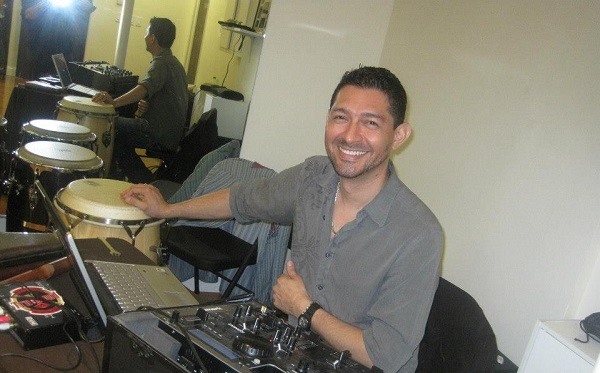
Felipe Martínez in his studio

So, we can say that your taste in music started in Colombia, but you developed professionally in the United States, is that right?

That is correct. When I came to the United States, I started dancing professionally.

You started working as a dance instructor and then as a DJ when you arrived in the United States. Meaning that you had no experience in these things from your country, but you gained it in your new country of residence.

That is right. In the case of locution, I worked as a radio host for about three years in Colombia. I hosted a show with my friends while attending high school, but we were dedicated to rock because it was the genre I listened to the most. When I came to the United States in 1998, I started dancing, working with several dance companies, and studying for a while before I started teaching, so it did not happen immediately. I studied for about four years, and after that, I decided to teach. As for my work as a DJ, that almost happened immediately. In 1999, I started making music in a little club called Café Caracas in Berkley. It was by pure chance because the hired DJ didn’t show up, so the owner of the club asked me to play for a while to cover that space. I replied yes, so I started playing music that night and it all worked out. They proposed me to keep doing it permanently, I accepted and that’s how my career as a DJ began.

Luis Medina told me in his interview that he is sometimes forced to play music he doesn’t really like, but it’s what the public wants. Apart from salsa, what other genres do you play or mix?

Salsa is just a general term for all these rhythms we have. I usually mix salsa with bachata, merengue or cha cha chá. However, I don’t usually include reggaeton in my repertoire despite its popularity.

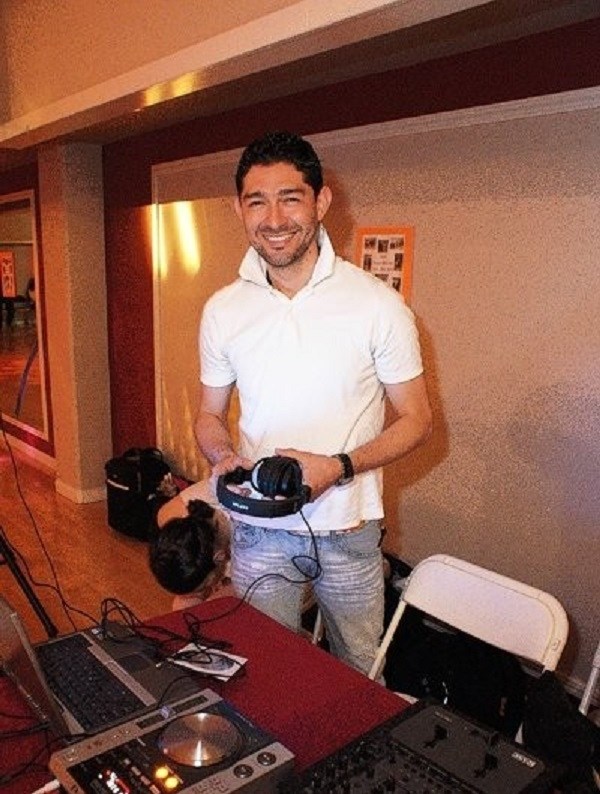
Felipe Martínez in his work as a DJ

How World Salsa Radio started

How did World Salsa Radio start? What drove you to found it?

Worldsalsaradio.com (www.worldsalsaradio.com) started as an adventure alongside a friend at another radio station. The main idea was to educate listeners about the history of records and what they include such as singers, artists, musicians, etcetera. These days, you buy an MP3, but all you can see is the name of the song and the picture, so you lose all the album information such as credits, recording place, among other details.

In my travels around the world, I have known many DJs, whom I contacted when this project started to get them to this station to do shows. Remember that the main objective was to educate the public, then, the guy with whom we started the station took a different path because we had artistic differences, so we decided to separate.

That’s how World Salsa Radio started. During the pandemic in 2020, I was here at home for about three or four months arranging everything. I invited two other friends from the Bay Area, one of them was DJ Orlando Felix, DJ Boricua, and Ivette Fuentes, DJ La Coqui. The three of us started shaping the idea of World Salsa Radio with the same goal of educating as in the beginning. I take care of all the technical part, invite DJs to play, teach them to use the software and tell them what to say. We are already 27 DJs from all over the world and, at the moment, DJ Boricua and I are the ones who run the station.

Indeed, you have DJs from the five continents. How did you manage to unite them all in the same project?

I think the idea that brings us together is the goal of educating the public that listens to us. We want to play great music, but we also want to educate people about what we play. This is something that attracks music collectors because all that information is being lost due to the digital age. I know many who are on World Salsa Radio in person, but I heard the rest of them by other means such as a Facebook Live or YouTube. I contact the ones I like, we exchange ideas and it is explained to them what they should do.

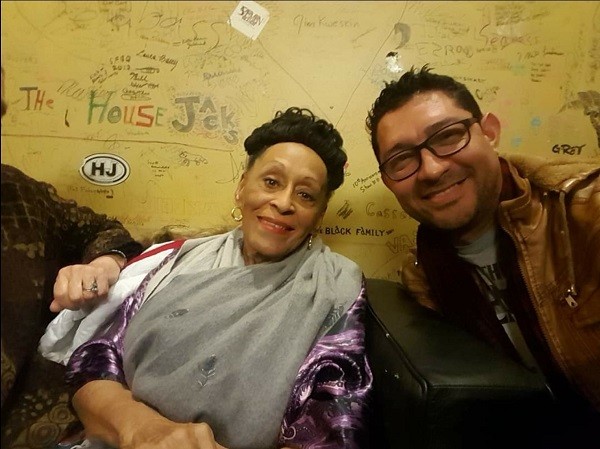
Cuban singer Omara Portuondo and Felipe Martínez

What have been the most noticeable differences in the team?

Each DJ has a different style. We all have a different style even though we are playing Afro-Latin music. Everything played here in California is very different from everything played in Lithuania. Although we all collect the same music, everyone plays it differently.

How dod the public receive World Salsa Radio?

At first, the audicence reception was very small. The first month, we had barely 300 listeners, but we have a very large group of listeners who stay tuned to us despite the time. There are about 100 listeners who are permanently connected with us. We started the project during the pandemic, which was very good for us because everyone was home. So, people who enjoy this music, dancers or musicians listened to our shows on a recurring basis. Two years later, there are already 16,000 people who tune us in every month.

There are many people supporting us without any profit motive because we do this for free. No one is paying us to move the project forward, so we are financed by donations. We also have great support on the advertising side, which has helped us grow.

World Salsa Radio is now ruled by Felipe Martínez

As a dancer and instructor, what do you think people are most passionate about in your classes? What rhythms do they enjoy the most?

As to how I teach, I use percussion much. Since I play the conga, I use this tool to give my classes. I try not to give so much importance to numbers. Many instructors use counting to teach their students, but I try to keep out of it and use percussion. For example, I use the clave and the tumbao.

I think this method works best. If you go to a club with an orchestra playing, the singer is not going to be counting on you to dance, he’s going to be focused on making his music and providing entertainment. For the same reason, you must learn to follow the music without counting.

What have you done to balance all your activities in music?

My activities are linked, but they are separated at the same time. My personal projects have nothing to do with World Salsa Radio. However, when an event invites several DJs from the station, the World Salsa Radio logo joins that production. However, I try to take things apart most of the time.

Your pages, social networks and links to financially support the station.

You can find all the information through worldsalsaeradio.com. In the main part, there is a button that says Donations, which takes you to the station’s PayPal account. People can donate whatever they want to help us, but nothing happens if they can’t. In that case, they can spread the word about the station. In that case, they can show what we do through their social networks and give us publicity.

Felipe Martínez does not combine his activities

Facebook: Eldelaclavesf (https://www.facebook.com/EldelaClaveSF)

Instagram: Eldelaclavesf

NOTICIAS CON SABOR MARCH 2022 by Luis Medina

Live music and other news in the SF Bay Area

I recently interviewed percussion phenom and timbalero for Santana, Karl Perazzo on my KPFA Radio program Con Sabor. He is quite a busy man…I caught up to him while he is in Las Vegas for rehearsals for Santana’s upcoming slew of shows at the House Of Blues. In addition to his busy schedule with Santana, Karl has other projects during his spare time that include the SF based all-star Salsa band Karabali as well as guest appearances with Salsa Caliente that kept him busy during the COVID. He also appears on occasion with fellow bongocero Jake Jacobs band VibraSON. On top of all of that, Perazzo also creates and manages his own line of jewelry.

Perazzo, a self taught musician who was drawn to the drum and Afro-Cuban music as a young child and started his musical studies at the age of 8. Karl is a phenomenal percussionist who plays masterful Timbales, Bongo, Congas, cowbell and an impressive array of percussion instruments. He has been a mainstay in the Santana band for the past 31 years inheriting the Timbales spot from the legendary Orestes Vilato. Perazzo is still going strong keeping the percussive fire burning on Santana’s latest recording Blessings and Miracles. The band will be launching a major tour with Pop legends Earth Wind and Fire later this year. He has his own signature line of Latin Percussion congas and bongos that he designed himself with a distinctive Dia De Los Muertos sugar skull theme to honor the ancestors.

Karl Perazzo and his instruments
Percussionist and timbalero for Santana Karl Perazzo

Perazzo has previously performed with the greats such as Tito Puente who mentored him when he was a young kid along with another fellow kid phenom Gibby Ross. I saw Karl and Gibby playing with Tito on stage-what a sight to see! Karl also played with Sheila E. (as a member of her band in her emergence as a huge star in the 1980’s), Prince, Pete Escovedo, Dizzy Gillespie, Malo, Pacific Mambo Orchestra, Ray Obiedo, Andy Narell, Jorge Santana, Raul Rekow and many others. Perazzo also formed the popular SF based salsa band Avance which had a long run starting in the early 1990’s. The group disbanded in 2020. Karl has kept himself connected to his roots which is Salsa and Afro-Cuban music but has always kept his hear open to all types of music since his childhood. He credits his father who always encouraged Perazzo to push himself to be a complete percussionist, to learn how to sing and be a versatile performer.

Perazzo is now launching his own YouTube show “The Backstage Show” on the TBS Music Channel in the next couple of months which will focus on fellow creatives such as musicians, artists, chefs, writers and other notable individuals involved in arts and culture. Perazzo who is the host of “The Backstage Show‘ told me that the program’s mission is “to turn music into inspiration“. I asked Karl Perazzo what keeps him going. He told me “you have to have passion in whatever you do in life…whether it’s sweeping the floor or playing the drum”. You can feel that burning passion, inspiration and enthusiasm along with those great playing chops whenever you see him play live! You can catch up with Karl Perazzo by following him on Instagram under karlpperc.

Music Notes

Music Notes: Salsa superstar Luis Enrique and Peruvian salsero Josimar Y Su Yambu are the new headliners replacing Victor Manuelle on Saturday, April 9th at the Hyatt Regency Hotel in Burlingame. Promoters JC Coral and Bosco Vega are presenting the show which originally was scheduled for early February but was postponed due to COVID restrictions. The new lineup was announced earlier in February. For tickets, visit eventbrite.com, tickeri.com, ticketsparati.com or call 415-424-8809 or 650-218-0861.

Luis Henrique performing
Luis Henrique on stage

Former El Gran Combo vocalist Charlie Aponte will be singing his original solo material as well as a slew of his great Gran Combo hits on Friday, April 6 at Roccapulco in San Francisco. Pepe Y Su Orquesta will be opening up the show brought to you by Jaffe Events. Roccapulco will also be presenting the red hot Combinacion De La Habana with a high energy six man vocal front line for their SF debut on Saturday, March 5th. CDLH is under the direction of Gerson Valdes, the nephew of iconic pianist Chucho Valdes and performs Timba mixed in with Reggaeton and Salsa Dura. This popular group is embraced by Cuba’s youthful fans and making fans everywhere.

Jaffe Events in association with MGD Productions will be presenting a dream Cuban music double bill featuring Los Van Van and Havana d’Primera with Alexander Abreu on Friday, May 6th at Berkeley’s UC Theatre, 2036 University Avenue. DJ Antonio will also play in-between sets. I have the honor of serving as the Master of Ceremonies of this special event. For Info and tickets visit www.jaffeevents.com.

Former Los Van Van vocalist Yeny Valdes and her band will be visiting the popular Fresquecito monthly party at La Furia Chalaca, 310 Broadway in Oakland on Saturday, March 12 at 10 pm. Yeny will be joined by resident DJ’s Walt Digz and Pepe Timba. For tickets, visit www.eventbrite.com

La Peña Cultural Center, 3105 Shattuck Avenue in Berkeley is featuring a special “Baila” community dance party on Friday, March 18th from 7 pm to 1 am with a multi-room environment featuring the explosive salsa of BrauLio Barrera’s Somos El Son with KPOO/KPFA DJ Jose Ruiz in the main auditorium. DJ Ron will be spinning Bachata in the lounge. Salsa and Bachata dance lessons by In Lak’ech Dance before the show begins at 7:30 pm. Tickets are already going fast. For tickets and information, visit lapena.org.

World Salsa Radio is presenting their second in a series of dance socials on Friday, March 25th at The Beat, 2560 Ninth Street in Berkeley. There will be dance performances by renowned Salsa dance troupes as well as Salsa lessons starting at 9 pm. The DJ music will be provided by WSR CEO Felipe “El De La Clave SF” Martinez and WSR co-founder Orlando DJ Boricua” Felix. Special guest DJ will be yours truly, Luis Medina of “Sabiduria Con Tumbao” starting my set at 10 pm.

Be sure to tune in on your laptop, phone or devices by visiting www.worldsalsaradio.com. It’s on 24 hours a day!

Some of the DJ's
Walt Digz, Felipe “El De La Clave”, Antonio and Luis Medina

The Seahorse in Sausalito continues to showcase a variety of fine bands on Saturday and Sunday evenings starting at 5 pm. This month, the Seahorse features Julio Bravo’s 50+ Birthday Party with Julio and Salsabor 3/6, Rumbache 3/12, Edgardo Cambon and Candela 3/13, Anthony Blea & Friends and DJ Jose Ruiz’ Birthday Party 3/19, Louie Romero & Mazacote 3/20, La Clave Del Blanco 3/26 and Orquesta Taino on 3/27. The featured DJ is KPOO/KPFA’s Jose Ruiz. Great food, Beer and Wine are offered at this popular venue located across the Golden Gate Bridge at 305 Harbor Drive.

The Ramp, 855 Terry Francois Blvd near the water in San Francisco continues their popular Salsa Saturdays with N’Rumba 3/5, Orquesta Borinquen 3/12, Karabali 3/19 and Manny Martinez y Orquesta La Rebeldia 3/26. The shows start at 5 pm and feature DJ Mendy in-between the sets.

San Francisco’s The Cigar Bar on 850 Montgomery Street is continuing their hot Friday and Saturday night live Latin music schedule in March. This month, they are presenting Manteca, 3/4, Pepe Y Su Orquesta 3/5, The Latin Rhythm Boys 3/11, Josh Jones Latin Jazz Ensemble 3/12, Julio Bravo y Salsabor 3/18, La Clave Del Blanco 3/19, Somos El Son 3/25 and Edgardo Cambon y Candela 3/26. Enjoy the classic surroundings, the patio, the fine food, cigars, drinks and the swinging music at the Cigar Bar.

Promoter/DJ Bosco Vega is also opening a new local night spot Gustoso at the Atlas Lounge, 637 San Mateo Avenue, San Bruno on Sat. March 12th featuring Salsa, Bachata and Timba by DJ’s Franklin, Antonio and Bosco himself!!

Remember you can catch my radio programs Con Sabor (in its 25 anniversary year) on KPFA 94.1 FM and kpfa.org Saturday nights 9 to 11 PM PST & Sabiduria Con Tumbao on Wednesday nights 5 to 7 PM PST on WorldSalsaRadio.com.

That’s it for this time! Ciao 4 now!!

This is Julio Bravo
Julio Bravo performing with his orchestra

BY LUIS MEDINA, PRODUCER AND HOST OF CON SABOR ON KPFA 94.1 FM AND SABIDURIA CON TUMBAO ON WORLD SALSA RADIO.COM

Palladium in the New Millenium engalana el “Lehman Center for the Performing Arts”

On March 5, 2022, the heirs to the mambo will reunite once again, this time the concert entitled Palladium in the New Millennium will grace the Lehman Center for the Performing Arts in the heart of New York’s Bronx.

This concert coincides with the coming of age celebration of the establishment of The Big Three Palladium Orchestra.  The initial idea of bringing together the three great Palladium orchestras in this innovative concept came to Mario Grillo, better known in the music world as Machito, Jr. approximately twenty-one years ago.

His counterpart, Tito Rodriguez, Jr. told me about it and, thanks to his complicity, I had a pleasant conversation during which Machito, Jr. shared with me a myriad of details.  Having previously collected and shared the conversations I had with Tito, Jr. and later with Machito, Jr. I must now share the point of view of the youngest of the three mambo heirs -Tito Puente, Jr.- about this trilogy, among other things.  During the beginnings of this historic reunion, Tito Puente, Jr. was barely 30 years old.

As with me, the two oldest members of the trilogy have been very supportive of Tito Puente, Jr.  During an exclusive interview granted for this special assignment, Tito Puente, Jr. expressed his deep appreciation for having been so lovingly guided by Tito Rodriguez, Jr. and Machito, Jr. to the recording of what has become the legacy of the Palladium big three: The Big Three Palladium Orchestra live at the Blue Note (2004).

On March 5, 2022, the heirs to the mambo will reunite once again, this time the concert entitled Palladium in the New Millennium will grace the Lehman Center for the Performing Arts in the heart of New York's Bronx.
Palladium in the New Millenium engalana el “Lehman Center for the Performing Arts” en pleno corazón del Bronx de New York

The youngest of the three heirs of the mambo is doubly celebrating, as he has just released his sixth production, entitled The King and I. It contains nine tracks, as you can hear on the album.  It contains nine tracks, as detailed below:  Picadillo, featuring Humberto Ramírez on trumpet; Salsa na ma, featuring José Alberto “El Canario” on vocals; Pa los rumberos, with a masterful performance by Domingo Quiñones; Oye como va, with a performance by “Mulato Rumbero”, Michael Stuart; Para la niña y pa la señora, with none other than Miguel Angel Barcasnegras, better known as “Meñique” (EPD) on vocals; Hong Kong mambo, instrumental theme that highlights the Puente dynasty, with Ronnie Puente on xylophone; El bribón del aguacero, with Yolanda Duke on vocals; 20 años and El Rey del Timbal.  Let’s be clear that this album is not the big band arrangement to which the eternal King of the Timbal has accustomed us.  It is, however, the best tribute that the youngest of the three heirs of the Palladium pays to his father, keeping the legacy alive and kicking.

As you can see, each of the “Palladium’s Big Three” inherited a timbalero son. Coincidentally, Machito, Jr., Tito Rodríguez, Jr. and Tito Puente, Jr. grew up surrounded by music.  Their family environments, respectively, supported them. Indeed, today, all three are musicians.  These three bandleaders have made it their mission to keep the Palladium legacy alive and well.  Although the mambo heirs have transcended the label of being the sons of the mambo owners, they do not forget that the Patriarchs are still a topic of conversation in musical circles around the world.

As the past is the past and the future is uncertain, here we are already waiting in despair. For this new reunion, first-class musicians have been secured, backing up the three heirs of the mambo.  The musical constellation that will be part of this historic night is formed by: Carmen Laboy on baritone saxophone and musical direction, Jorge Castro on tenor saxophone, Mark Friedman and Al Acosta on alto saxophones; Larry Moses, Seneca Black, Mike Mossman, and John Carlson on trumpets; Gilberto Colón, Jr. on piano, Jerry Madera on bass, John “Dandy” Rodríguez on bongo and Eddie Montalvo on tumbadoras.  On the vocal front, Sammy Gonzalez, Jr. leads with Luisito Rosario and Jeremy Montalvo on backing vocals.

I for one continue to live in salsa, which to put it in more earthly terms is, simply put: magic, fantasy, and illusion.

Article of Interest: Sigo entre amigos de Luis “Perico” Ortiz

By: Bella Martinez “The Irreverent Salsa Writer”

Puerto Rico

Néstor Sánchez “El Albino Divino”. With the Greatest Elegance the Golden Voice of Salsa

Néstor Sánchez “Maestro de Soneros¨.

Born in 1950 in New York, of Puerto Rican origin, he is considered by critics as one of the soneros with the best vocal technique.

Néstor Sánchez “El Albino Divino”.

In 1968 he began his musical career at the age of 19 in New York with the orchestra of Ray Rodriguez, Ray was the brother of the late Bobby Rodriguez, the recording was entitled “Introducing Ray Rodriguez and his Orchestra”, he was also with the Tonny Pabon Orchestra, and the Conjunto Candela.

1976 Nestor Sanchez joined the orchestra of the wonderful Jew, Larry Harlow, replacing Junior Gonzalez as lead vocalist and became a member of the Fania label stars, at that time,

Harlow was recording the album “La Raza Latina” for which Sanchez performed one song and the rest was in charge of the Panamanian Ruben Blades where he musically created the history of Nuestra Raza, from the Amerindians, the Spanish conquest, and the arrival of the black African slave.

The album, “El Albino Divino”, was one of his official presentations with the orchestra, with the Harlow Orchestra he spent almost ten years and recorded seven albums, among these: Rumbambola, Dulce aroma del éxito, Soy Latino.

1979 Harlow disbanded his orchestra, Sanchez also recorded with Tito Puente’s orchestra the song “Bonito y Sabroso” in the LP “Homenaje a Beny Moré” which won a Grammy award for Puente.

In 1984 he recorded the production Julio Castro y La Masacre, in 1990 he was released as a soloist in the romantic wave with the album Como Nunca.

Nestor Sanchez "El Albino Divino". With the Greatest Elegance the Golden Voice of Salsa
Néstor Sánchez “Maestro de Soneros¨

In the year 2000 he was invited by the King of Bass Mr. Bobby Valentin to participate in the album La Gran Reunión, and in all the recordings where he participated as the first voice in the chorus.

This talented man, whom we consider one of the most outstanding voices in our music, and sonero of soneros, never had the recognition he truly deserved. As a tribute and vindication, the February 2017 Salsero of our page is dedicated to him in a heartfelt and sincere way.

As a singer, Néstor Sánchez loved Cuban music and considered himself an admirer of Abelardo Barroso, Beny Moré and Miguelito Cuni, and from La Isla del Encanto his favorites were Tito Rodríguez and Ismael Rivera, in whom he was most likely inspired to create his own style.

His musical career began at the age of 19 in New York in 1968 with Ray Rodríguez’s orchestra. His first recording was the same year and was entitled Introducing Ray Rodriguez and his Orchestra; the second, in 1969 and with this same orchestra, was called Delusion, these two musical works were made for Al Santiago’s label “Alegre Records”.

In 1970, Néstor Sánchez joined Tony Pabón’s orchestra with which he recorded six albums in LP format, these musical productions are: in 1970, Tony Pabon And His All-Stars and La Protesta With Tony Pabón: Free; in 1972, On The Right Track; in 1973, Introducing Néstor Sánchez; in 1974, Tony Pabón & La Protesta Featuring Néstor Sánchez – El Capitán; and in 1976, Tony Pabón Y La Nueva Protesta – Fango – Pura Salsa, Puro Disco.

After his time with La Protesta, El Albino Divino joined Conjunto Candela, with whom he produced an LP entitled Conjunto Candela.

In 1976, he joined the orchestra of “El Judío Maravilloso” Larry Harlow as lead vocalist, replacing the Puerto Rican singer Junior González. With that, he became one of the stars of the Fania label. Between 1977 and 1984 he recorded the albums La Raza Latina – A Salsa Suite, El Albino Divino, Rumbambola; Larry Harlow & Junior González – Our Latin Feeling / Nuestro Sentimiento Latino; El dulce aroma del éxito; Larry Harlow, Canta: Gary Carrión / Así Soy Yo; Larry Harlow – Yo Soy Latino and Larry Harlow / Señor Salsa, featuring the young singer Ray Pérez.

Between 1968 and 1984, Néstor Sánchez was not only part of the orchestras of Ray Rodríguez, Tony Pabón, Conjunto Candela and Larry Harlow. He also recorded with King Nando, Orchestra Colon, Los Hermanos López, Yambú, Andy Harlow, Adalberto Santiago, Charlie Palmieri, Ismael Rivera, Tito Puente, Willie Colón, El Conjunto Libre, Azuquita y Su Melao, Fania All Stars and Louie Ramírez.

Throughout the eighties, Néstor Sánchez’s career had a second stage, in which he participated in musical works as a singer and backing vocalist for other great stars of our musical firmament, such as Héctor Lavoe, Típica 73, Ray Barretto, Julio Castro y La Masacre, Rubén Blades y Seis del Solar, Cheo Feliciano, Ismael Miranda, Oscar D’ León, Celia Cruz and Bobby Valentín.

It is presumed that in his more than three decades of music he participated in some two hundred musical works, about half of which are presented in our “Discography” section, available on our web page. Her voice was also recorded in many musical works of the so-called salsa romántica.

Among the songs that the beautiful voice of our great Albino Divino left us, we highlight numbers such as: “Amor pa’ qué”, “Averigua”, “Bobo tú te quedarás”, “Bonito y sabroso”, “Compay, póngase Duro”, “Con la mayor elegancia”, “El bobito”, “El diablo viene”, “Madre”, “Mentiroso”, “Quasimodo”, “Suena La Quija”, “Va llover”, “Guaguancó para los soneros” and “Vamos a gozar”. Our great sonero also recorded some songs in English.

Finally, we repeat that the present investigative work on the musical life of the great singer, chorister, arranger and composer Néstor Sánchez, “El Albino Divino”, is a tribute to his musical legacy with which the section “El salsero del mes” of our web page www.latinastereo.com wants to remember and keep all his work in force. Néstor Sánchez will remain forever in the hearts of the salseros of the world.

On September 2, 2003, Néstor Sánchez passed away at the age of 54 at his home in Bronx County, New York, after losing a battle with lung cancer.

Born in 1950 in New York, of Puerto Rican origin, he is considered by critics as one of the soneros with the best vocal technique. Nestor Sanchez "El Albino Divino".
Born in 1950 in New York, of Puerto Rican origin, he is considered by critics as one of the soneros with the best vocal technique.
Nestor Sanchez “El Albino Divino”.

Main source:

By: Sergio A. Rendón Ángel

To: www.latinastereo.com

Medellín, Colombia

Article of Interest: Raymundo “Ray” Barretto Pagan was born in Brooklyn, New York on April 29, 1929

  • « Go to Previous Page
  • Page 1
  • Interim pages omitted …
  • Page 101
  • Page 102
  • Page 103
  • Page 104
  • Page 105
  • Interim pages omitted …
  • Page 129
  • Go to Next Page »

International Salsa Magazine (ISM) is a monthly publication about Salsa activities around the world, that has been publishing since 2007. It is a world network of volunteers coordinated by ISM Magazine. We are working to strengthen all the events by working together.