• Skip to primary navigation
  • Skip to main content

International Salsa Magazine

  • HOME
  • Previous editions
    • 2026
      • ISM / May 2026
      • ISM / April 2026
      • ISM / March 2026
      • ISM / February 2026
      • ISM / January 2026
    • 2025
      • ISM / December 2025
      • ISM / November 2025
      • ISM / October 2025
      • ISM / September 2025
      • ISM / August 2025
      • ISM / July 2025
      • ISM / June 2025
      • ISM / May2025
      • ISM / April 2025
      • ISM / March 2025
      • ISM / February 2025
      • ISM / January 2025
    • 2024
      • ISM / December 2024
      • ISM / November 2024
      • ISM / October 2024
      • ISM / September 2024
      • ISM / August 2024
      • ISM / July 2024
      • ISM / June 2024
      • ISM / May 2024
      • ISM / April 2024
      • ISM / March 2024
      • ISM / February 2024
      • ISM / January 2024
    • 2023
      • ISM / December 2023
      • ISM / November 2023
      • ISM / October 2023
      • ISM – September 2023
      • ISM – August 2023
      • ISM July 2023
      • ISM Edition June 2023
      • ISM – May 2023
      • ISM April 2023
      • ISM March 2023
      • ISM February 2023
      • ISM January 2023
    • 2022
      • ISM December 2022
      • ISM November 2022
      • ISM October 2022
      • ISM September 2022
      • ISM August 2022
      • ISM July 2022
      • ISM June 2022
      • ISM May 2022
      • ISM February 2022
      • ISM January 2022
    • 2021
      • ISM December 2021
      • ISM November 2021
      • ISM October – 2021
      • ISM September 2021
      • ISM August 2021
      • ISM July 2021
      • ISM May 2021
      • ISM April 2021
      • ISM June 2021
      • ISM March 2021
      • ISM February 2021
      • ISM January 2021
    • 2020
      • ISM December 2020
      • ISM November 2020
      • ISM October 2020
      • ISM September 2020
      • ISM August 2020
      • ISM July 2020
      • ISM June 2020
      • ISM May 2020
      • ISM April 2020
      • ISM March 2020
      • ISM February 2020
      • ISM January 2020
    • 2019
      • ISM December 2019
      • ISM November 2019
      • ISM October 2019
      • ISM Septembre 2019
      • ISM August 2019
      • ISM July 2019
      • ISM June 2019
    • 2016
      • ISM December 2016
      • ISM November 2016
  • Spanish
  • Download Salsa App
    • Android
    • Apple

November

Carlos “Cano” Estremera was a legendary Puerto Rican salsa singer, widely known as “El Dueño del Soneo” (The Owner of Soneo)

Why “El Dueño del Soneo”?

He earned this nickname due to his extraordinary and almost unbeatable ability for soneo, which is the part of a salsa song where the vocalist has the freedom to improvise lyrics, phrases, and rhymes over the musical base, elevating the track’s energy and the connection with the audience.

El Dueño del Soneo
El Dueño del Soneo

Cano Estremera was famous for his quick wit, rapid rhyming, and extensive vocabulary, qualities that established him as one of the greatest soneros in history, often compared to figures like Ismael Rivera and Héctor Lavoe.

He started in Latin percussion and also with the group Barrio Latino, then he was with Los Pleneros del Quinto Olivo, and later, at the young age of 18, he joined La Orquesta Mulenze, with whom he recorded the track “Mala Lengua” in 1976. The voice that replaced Cano Estremera in Orquesta Mulenze was the great Pedro Brull, who recounts that he had to thoroughly study Cano Estremera’s style to join Edwin Mulenze’s orchestra.

Undoubtedly, one of the greatest successes in Cano Estremera’s career was accepting, in 1978, the invitation to be the lead singer of maestro Bobby Valentín’s orchestra, “El Rey del Bajo” (The King of the Bass).

His first song recorded with Bobby Valentín’s orchestra was the iconic track “La Boda de Ella” (Her Wedding), by the Puerto Rican composer Roberto Angleró, with no suspicion that it would soon become one of the essential elements of Puerto Rican popular culture.

Cano Estremera was famous for his mental agility

Cano Estremera was a unique sonero. He was an artist with an identity and immense talent that was very distinct from the normal or commercial. He established his style from the very first day he became known. There was no style in the genre like “El Cano’s.”

Bobby Valentín was always looking for sound and voices, and Luigi Texidor was leaving the group, and that’s when “Cano” joined with a very different talent.

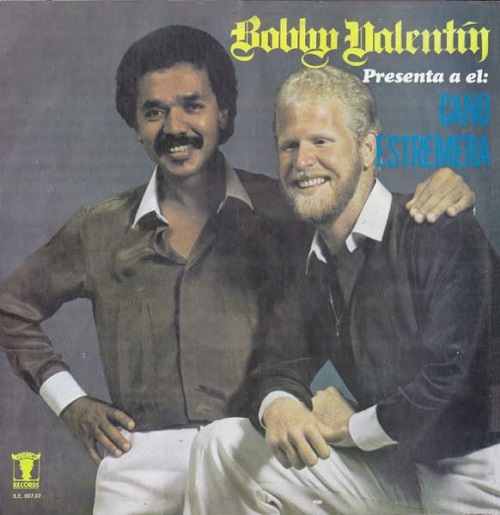
‘Bobby Valentín Presenta al Cano Estremera’ turns 40.

Cano Estremera’s first solo album, accompanied by Valentín’s orchestra. Produced by ‘El Rey del Bajo’ (The King of the Bass) and released by the Bronco Records label (BR-124) on Thursday, October 7, 1982. It includes the hits: Por qué Me Citas, Buen Corazón, El Caimán, Awilda, Casa En El Campo, etc.

'Bobby Valentín Presents Cano Estremera 1984

‘Bobby Valentín Presents Cano Estremera 1984

When he decided to go his own way as a solo singer, Cano Estremera did not have the support of the salsa industry’s machinery at the time. Despite this, with hard work and talent, Cano Estremera decided to fight alone with his music, personally producing everything from his album covers, musical arrangements, tours, and even the distribution of his musical works.

He was always a defender and fiercely protective of the genre. His style and demeanor were always controversial, and that was the magic that captivated his audience throughout his long career—always entertaining, creative, melodious, and above all, prodigious when he stepped onto a stage.

Solo Career: He separated from Bobby Valentín at the end of 1984 to form his own orchestra, further consolidating his career and his title with albums like “Dueño del Soneo”.

Cano Estremera y Dj. Augusto Felibertt

Death: He died on October 28, 2020, at the age of 62, after years of health problems related to pulmonary fibrosis, for which he received a double lung transplant in 2018.

Also Read: The owner of the Soneo’s solo career Cano Estremera

Haitian bandleader and musician Mac Gregore Brunis fulfills his dream in Montreal

We do not often write a lot about Latin music artists in Canada, so we want to remedy that situation and provide coverage to a very talented Haitian based in Montreal. We are talking about bandleader, composer, and musician Mac Gregore Brunis, an artist with whom we have been able to talk about his interesting story and career with the musical group he currently directs, Sabor 19.

Mac posing for the camera
Mac Gregore Brunis posing for the camera at an event

Young Mac’s beginnings in music

In perfect Spanish, Mac thanked International Salsa Magazine for the invitation and started by telling that music had always been more than a simple hobby for him. His first contact with this world was in his native Haiti when he was on his way to school by public transport and there were always musicians playing, so music was always part of his life. 

He also played instruments with some of his classmates who formed musical groups in the classroom.

However, his professional career would not begin until his move to Canada, where he decided to go at age 21 to study electrical engineering and where he remains to this day. Some staff members of the University of Moncton, New Brunswick, where Mac would end up studying, visited some Haitian schools to promote their educational program among young students. The fact that French was spoken in Haiti, as in Canada, also helped Mac make the decision to try his luck in North America, since Haiti did not offer him the opportunities he was looking for.

It was in this country, more specifically in the city of Montreal, that he met other music lovers who introduced him to salsa and other Latin genres. Although he had already heard salsa and bachata in Haiti because of its proximity to the Dominican Republic, some Colombian friends he made in his new place of residence introduced him much more to all this culture, especially the music.

Mac and the rest of Sabor 19
Mac Gregore Brunis and the rest of Sabor 19 at La Salsa Rossa

Sabor 19

When Mac graduated and left the province of New Brunswick to move to Montreal, he began attending salsa and bachata socials to dance on Monday nights, and it was there that he met Eduardo Ramírez. They became friends and played together some of the instruments Eduardo carried, such as maracas, güira, and bongo. When Mac told his new friend that he wanted to learn to play the piano and other instruments, he and Eduardo began meeting to practice and develop the idea of creating a musical group, which they called Sabor 19 in homage to the year it was created, 2019. 

Once they had finally decided to do something more formal in music, they invited other musician friends with whom they met weekly to rehearse. They ended up being a group of about 10 people, including Diego, who would be the band’s lead vocalist. For better or worse, the original members are no longer there, but the current ones from countries such as Haiti, Colombia, Mexico, Canada, Morocco, and Turkey, have kept the ship afloat for the past seven years.

Despite coming from such diverse countries and backgrounds, this has not hindered communication between the musicians in the least. In fact, all of them speak or understand Spanish very well, so they have managed to understand each other almost perfectly. 

Mac playing at the festival
Mac Gregore Brunis and Sabor 19 playing at the Nuits d’Afrique Festival

Original music and genres

Since the foundation of the group, they have focused on covering the most popular hits such as “El Preso,” “Canoa Rancha,” “Un Verano en Nueva York,” and many others. Their repertoire consists of a total of about 70 covers, which are divided depending on the requirements of the concert or show.

However, over the past three years, Mac and the rest of the team have felt the urge to offer something of their own to the public, so they set to work to create their own music in regards to lyrics, arrangements, melodies, and everything else. 

Silly D’Or Festival 

Sabor 19 is well known for having reached the semifinals at the Silly d’Or Festival as part of the Nuits d’Afrique Festival, which is one of Montreal’s most popular music competitions. Although they did not win first place, Mac describes their participation as a very good experience, as this gave them the opportunity to make themselves known to a much wider audience. In addition, being evaluated gave them a good sense of which aspects to improve for the future.

Read also: Alberto Gonzalez talks about his book on Hector Lavoe and his experience with ‘‘El Jibarito de Ponce’’

Gabrielito Y La Verdad giving everything in Los Angeles and beyond

Gabriel González from the group Gabrielito Y La Verdad has been kind enough to speak exclusively with International Salsa Magazine and me, Karina García, about his beginnings, bands, and current career. The composer, actor, and musician gave us some of his time to address the most important issues concerning his successful career and everything that surrounds it, for which we are extremely grateful.

Gabriel performing at the museum
Composer, percussionist, singer, and actor Gabriel Gonzalez playing live at the Los Angeles County Museum of Art

How Gabriel started to become interested in music 

Gabriel was born and raised in Los Angeles, where he took his first steps towards what would become his lifelong vocation. Since his parents were Mexican immigrants, it was not uncommon for him to listen to rancheras, huapango, boleros, son jalisciense, and other genres typical of that country.

He liked music so much that he began participating in contests at “El Mercadito,” a place located east of Los Angeles, where amateur concerts and all kinds of musical events were held. After his father sang there several times, he told him he wanted to do the same, and that is how he began entertaining wider audiences with his voice.

Years later, after his passion for music was being shaped and getting more serious, he contacted his uncle, who was a promoter, and took him with him to Mexico to get some acting work in movies. This means that his artistic career was not just limited to singing but also to acting, but at some point, both areas would end up mixing. 

It should be noted that his work as an actor made him stay in Mexico for several years, so he shared with many great actors of the time who were also singers, such as Yolanda del Río, Federico Villa, David Reynoso, Lucha Villa, and many more. 

Upon returning to California, he experienced a significant culture impact. He realized that he was not Mexican enough for Mexicans nor American enough for Americans. This double identity made it much easier for him to cross cultural and musical boundaries, so from playing ranchera, huapango, and son jalisciense, he was given a chance to play other styles such as son montuno, which for Gabriel is the basis of salsa and much of Latin music. 

Gabrielito at the Vibrato Grill And Jazz
Gabrielito Y La Verdad performing at the Vibrato Grill And Jazz

Gabriel’s professional beginnings in music

Gabriel tells us that, during a huge part of his career, he worked as a solo artist, but he went on to collaborate with several groups and one of them was the Mexican band Quetzal, which specializes in playing Chicano rock and son jarocho. His sister Martha González was the lead singer, so he was able to work with them on and off for about 20 years. He describes his time with Quetzal as a very nice period in which he learned a lot and was even blessed to win a Grammy, but everything has an end, so he went ahead and worked with many other bands in the Los Angeles salsa scene.

In fact, today he is a member of Boogaloo Assassins and has been playing with them since 2015, while also having his own project, which he named Gabrielito Y La Verdad.

Gabrielito Y La Verdad

After all experience gained so far, Gabriel decided to form his own group Gabrielito Y La Verdad, with which he had his first big hit “Oye Muñeca,” released around 2019. Since the project began, the artist has had the same keyboardist and pianist, but the rest of the musicians have come and gone over the years, as it is not easy to maintain a cohesive musical group for a long time.

In fact, he usually has a list of musicians he can call, and their presence at an event depends almost entirely on their availability and ability to read sheet music. Gabriel often works with the same musicians Jimmy Bosch uses, so when the Puerto Rican travels to Los Angeles, Gabriel knows he can count on them if an event comes up. He also often uses some of Jerry Rivera’s musicians and those of many other exponents of the genre.

Gabriel with Oscar Hernandez
Gabriel Gonzalez and bandleader and pianist Oscar Hernandez

Facets additional to singing

In addition to being a singer and film actor, Gabriel has also participated in commercials and done a little musical theater, since the condition of being an artist forces you to learn a little about everything. Being still very young, he participated in the film ”Mojado de Nacimiento” alongside La Sonora Santanera.

One of those memorable experiences was his participation in the second national tour of the musical ”In The Heights” with Lin-Manuel Miranda. It was during this tour that Gabriel learned that he had won a Grammy with the band Quetzal. The news came during a bus trip, making it clear that he experienced several of these facets at the same time without any problems.

More recently, he has served as composer of several of Gabrielito Y La Verdad’s songs in collaboration with pianist Matt Amper, who is also actively involved in the creation of the group’s original songs. 

Collaborations with other artists

Gabriel has shared the stage and collaborated with big names in the industry like Bruno Mars, “El Divo de Juarez” Juan Gabriel, Los Van Van, Silk Sonic, and many others. Similarly, during his acting career, Gabriel also met many great actors of the time with whom he shot scenes during the day, and at night, did voice-overs at the studios, and went out singing.

All this led him to share the stage with Aida Cuevas, Rosenda Bernal, Los Lobos, and Lalo Guerrero. While still with Quetzal, he opened for Aerosmith, Taj Mahal, and others. 

Gabriel Gonzalez and Richie Perez
New York’s singer Hector ”Pichie” Perez and Gabriel Gonzalez

Read also: Creator of Afro-Rican Jazz William Cepeda talks about this subgenre

Colombian dancer and instructor Camila Cepeda takes salsa caleña to Canada

Every day there are more Latinos who, with their talent, are gradually taking over various cities in Canada and the hearts of many of its inhabitants. Colombian instructor and dancer Camila Cepeda shows us that she and several of her compatriots have managed to break into the aforementioned North American country and shares with us a little bit of her interesting story.

Dancer and instructor Camila Cepeda
Colombian dancer and salsa caleña instructor Camila Cepeda

Camila’s interest in dance

Camila has danced through life, and since she was a little kid, dance has been very important to her. One genre in particular that caught her attention was salsa caleña, especially since she saw it for the first time with dance groups on the TV show “Colombia’s Got Talent”. From there, more specifically in 2011, she looked for a dance academy where she could learn to dance and imitate what she saw on the screen.

Almost immediately, she realized that it was a very demanding style that required stunts and movements that were not common in more classic versions of salsa. After training in dancing, she did not want to be just an expert in salsa caleña, but many more people learned how to dance it as well, which led her to create a folk dancing group with which she would take her first steps towards teaching.

In addition to salsa caleña, Camila also danced salsa choka, champeta, bachata, merengue, and Colombian folklore. 

Camila dancing at an event
Camila Cepeda dancing in one of her salsa caleña events

Moving to Canada

Initially, Camila’s plans did not include leaving Colombia, but when she knew Canada, she found it an extremely interesting country where she could start something new with dance due to the lack of salsa caleña there. So, she entered the country with a student visa and studied international business at Seneca College in Toronto, with the intention of forming her own company in her new host country.

While gaining business experience through jobs for other companies, she continued to offer classes in parallel. Finally in 2020, in the middle of the COVID-19 pandemic and when she was still a university student, she decided to register and open her dance academy, “Salsa & Sabor.”

During that time, she also validated her teaching in English so that she could give classes to both locals and people from other cultures who spoke the same language.

Camila, Aleja, and Sonia
Camila with dancers Aleja and Sonia

Salsa & Sabor today

Although the academy was started with only online classes due to the sanitary restrictions of that time, Camila was able to gather together a more or less numerous community that allowed her to stay afloat in such a difficult moment. Therefore, when government controls were relaxed, the young woman had no problem to organize dance classes and activities in parks keeping proper social distancing.

A short time later, she could finally open her dance studio, welcome students in person, and recruit other instructors such as Diana, Victoria, Mateo, and Paula. One thing to mention about these five young Colombians is that they were all Camila’s students in the past and, after all the training she offered, they also became experts in the field. Given the pitifully small number of salsa caleña instructors in Canada, when they were ready, she asked them to join her team, and they gladly accepted the opportunity.

This, in turn, helped them to open up more schedules and workshops for many more people, allowing the academy to grow even more.

Camila with her students
Camila with some of her little students

Division of teaching genres and events

As we said at the beginning of this article, Camila also teaches other genres such as salsa choke, la champeta, bachata, and merengue, but her flagship and main rhythm remains salsa caleña. An important difference between salsa caleña and the rest is that it has a well-defined continuity and academic structure, so it takes much longer to learn. The other genres are relatively simpler, so they do not require as many hours or such an elaborate program.

Differences between salsa caleña and traditional salsa

According to Camila, a very important component of salsa caleña is its speed compared to traditional salsa. The way salsa is danced in Puerto Rico, Cuba, or New York is much better known around the world due to its age, while salsa caleña is a little newer and only began internationalizing a few years ago. In addition, traditional salsa is slower and uses the hips and shoulders a lot, while salsa caleña relies heavily on the rapid movements of the feet.

In fact, an important fact to know is that salsa caleña was created from a mistake. It turns out that a group of young people in Cali were doing private parties with LPs by various artists of the time, but they accidentally raised their speed and made the songs sound faster than they should. This led them to create completely new steps and choreographies based on these fast songs, giving rise to what we now know as salsa caleña. 

These parties were called “aguelulos,” a Colombian term to refer to alcohol-free parties or gatherings for young people. 

Read also: Tito Puente Jr.: perpetuating a legacy with its own rhythm

Fidelis Studio

Latin America / Venezuela / Caracas

The Fidelis studio is located in Caracas Venezuela, Urb. El Cafetal, El Morao street, Qta. Tere, is an excellent recording studio, where national and international artists and groups created their records; An example of this, Maracaibo 15, Billo’s, Los Melodicos, Salserin, Los Adolentes, Oscar D’ León…, the Latin Dimension recorded 8 of its 20 albums.

Fidelis Studio - Photo 1
Fidelis Studio – Photo 1

Currently those in charge of the study are Javier and Francisco González, who succeed their father Antonio José González “Gonzalito” founder of the Study in 1952 with great professionalism; who, despite being a professional photographer, had the inspiration and musical taste that led him and his friend “Toro” to go to the United States where he studied audio, upon arriving in Venezuela he was recognized as the pioneer of Recording Engineering since he did not This race exists to date in Venezuela.

Fidelis Studio - Photo 2
Fidelis Studio – Photo 2

Javier and Francisco González narrate how the recording of music was at that time, where it was recorded on a “Reel” tape where the channels were previously mixed in the matrix and then passed to the “Stamper” which is a metal disc where it was kept. the information to the factory and later this information was transferred to the acetate disc through electromagnetism.

Fidelis Studio - Photo 3 of Reel Tape
Fidelis Studio – Photo 3 of Reel Tape

As the years went by, recording equipment was modernized, going from “vinyl” to analog cassettes, and now it is digitized to CD’s, and digital formats such as FLAC, mp3… to send over the internet through a computer and with this new technology the artist has higher quality and content capacity than the 33 ½ rpm LP disc to record their songs.

Fidelis Studio - Photo 4 sound program
Fidelis Studio – Photo 4 sound program

Now if the artist wishes to transfer an acetate disc or tape that he had, to a current digital format, the studio is able to make the transition without losing the quality of the music recorded on it.

The current recording equipment has 72 channels, usually 24 are used. With each channel the instrument or voice of the artist(s) is recorded, and with the program they are unified, adjusting the appropriate volume levels where the artist or group listens to it and sees if it is to their liking or not, having the ability to modify it.

Fidelis Studio - Photo 5 - instruments and sound program
Fidelis Studio – Photo 5 – instruments and sound program

The studio and especially the room where the singers or members of a band or orchestra are placed has been designed in such a way that the sound that is produced has no alterations such as echo, making the sound that is generated the most pure possible.

They also make recordings both inside and outside the studio, since they have the right equipment (portable studio, headphones, microphones, amplifiers, recorder, among others), so that there would be no difference in the recording either inside the Fidelis Studio or in the outside.

Fidelis Studio - Photo 6
Fidelis Studio – Photo 6
Fidelis Studio - Photo 7
Fidelis Studio – Photo 7

And they tell us that their experiences over the years have been very lively, fun and interesting at the time of making the recordings since each singer or band has their own personality when playing and producing their music, whatever the genre they play, that in the studio all types of music are recorded today.

Fidelis Studio - Photo 8
Fidelis Studio – Photo 8
Fidelis Studio - Photo 9
Fidelis Studio – Photo 9

The most significant artist for the studio and especially for “Gonzalito” according to his children was Alfredo Sadel whose voice ranged from opera to the popular rhythm of Venezuela, later it was Simón Díaz, Mauricio Torrealba… although they are all very important.

Fidelis Studio - Photo 10
Fidelis Studio – Photo 10
Fidelis Studio - Photo 11
Fidelis Studio – Photo 11

The Grammy Awards are a distinction given by the National Academy of Recording Arts and Sciences to recognize an especially outstanding achievement of the music industry to a specific artist, obtaining this award is a great honor since an extensive study is carried out to the CD where sound engineers, producers and other specialists participate to determine the physical and sound quality of the CD created and to participate in this award you must register in the academy to participate.

Fidelis Studio - Photo 12
Fidelis Studio – Photo 12

The Studio currently has 2 Latin Grammy Awards:

1st Recording “Treasures of Venezuelan Music” with Ilan Chester (2010).

2nd Recording “Maria Teresa Chacin Canta Cuentos” with María Teresa Chacín (2012).

Fidelis Studio - Photo 13
Fidelis Studio – Photo 13
Fidelis Studio - Photo 14
Fidelis Studio – Photo 14

Where the team that makes up this renowned recording studio feels proud and happy for the work they are doing.

It should be noted that despite the situation in the country, they continue to provide the best service to singers and musical groups, whether national or international, being a strong competition for other recording studios in other countries, in relation to cost / quality. .

Fidelis Studio - Photo 15
Fidelis Studio – Photo 15

My person who had the opportunity to visit and interview its members, see, know and appreciate the type of study that is Fidelis I can say that the following:

“There are many recording studios in Caracas, Venezuela, but if you want your songs to be recorded with excellent audio quality in a recognized center, don’t think twice and choose them, they are the best”

Fidelis Studio - Photo 16
Fidelis Studio – Photo 16

For more information:

  • WebSite: http://fidelis.com.ve/
  • Teléfono: +58-212-9860722
Fidelis Studio Flyers
  • « Go to Previous Page
  • Page 1
  • Page 2
  • Page 3
  • Page 4
  • Page 5
  • Page 6
  • Interim pages omitted …
  • Page 18
  • Go to Next Page »

International Salsa Magazine (ISM) is a monthly publication about Salsa activities around the world, that has been publishing since 2007. It is a world network of volunteers coordinated by ISM Magazine. We are working to strengthen all the events by working together.