• Skip to primary navigation
  • Skip to main content

International Salsa Magazine

  • HOME
  • Previous editions
    • 2026
      • ISM / August 2026
      • ISM / July 2026
      • ISM / June 2026
      • ISM / May 2026
      • ISM / April 2026
      • ISM / March 2026
      • ISM / February 2026
      • ISM / January 2026
    • 2025
      • ISM / December 2025
      • ISM / November 2025
      • ISM / October 2025
      • ISM / September 2025
      • ISM / August 2025
      • ISM / July 2025
      • ISM / June 2025
      • ISM / May2025
      • ISM / April 2025
      • ISM / March 2025
      • ISM / February 2025
      • ISM / January 2025
    • 2024
      • ISM / December 2024
      • ISM / November 2024
      • ISM / October 2024
      • ISM / September 2024
      • ISM / August 2024
      • ISM / July 2024
      • ISM / June 2024
      • ISM / May 2024
      • ISM / April 2024
      • ISM / March 2024
      • ISM / February 2024
      • ISM / January 2024
    • 2023
      • ISM / December 2023
      • ISM / November 2023
      • ISM / October 2023
      • ISM – September 2023
      • ISM – August 2023
      • ISM July 2023
      • ISM Edition June 2023
      • ISM – May 2023
      • ISM April 2023
      • ISM March 2023
      • ISM February 2023
      • ISM January 2023
    • 2022
      • ISM December 2022
      • ISM November 2022
      • ISM October 2022
      • ISM September 2022
      • ISM August 2022
      • ISM July 2022
      • ISM June 2022
      • ISM May 2022
      • ISM February 2022
      • ISM January 2022
    • 2021
      • ISM December 2021
      • ISM November 2021
      • ISM October – 2021
      • ISM September 2021
      • ISM August 2021
      • ISM July 2021
      • ISM May 2021
      • ISM April 2021
      • ISM June 2021
      • ISM March 2021
      • ISM February 2021
      • ISM January 2021
    • 2020
      • ISM December 2020
      • ISM November 2020
      • ISM October 2020
      • ISM September 2020
      • ISM August 2020
      • ISM July 2020
      • ISM June 2020
      • ISM May 2020
      • ISM April 2020
      • ISM March 2020
      • ISM February 2020
      • ISM January 2020
    • 2019
      • ISM December 2019
      • ISM November 2019
      • ISM October 2019
      • ISM Septembre 2019
      • ISM August 2019
      • ISM July 2019
      • ISM June 2019
      • ISM May 2019
      • ISM April 2019
      • ISM March 2019
      • ISM February 2019
      • ISM January 2019
    • 2018
      • ISM December 2018
      • ISM November 2018
      • ISM October 2018
      • ISM September 2018
      • ISM August 2018
      • ISM July 2018
      • ISM June 2018
      • ISM May 2018
      • ISM April 2018
      • ISM March 2018
      • ISM February 2018
      • ISM January 2018
    • 2017
      • ISM December 2017
      • ISM November 2017
      • ISM October 2017
      • ISM September 2017
      • ISM August 2017
      • ISM July 2017
      • ISM June 2017
      • ISM May 2017
      • ISM April 2017
      • ISM March 2017
      • ISM February 2017
      • ISM January 2017
    • 2016
      • ISM December 2016
      • ISM November 2016
      • ISM October 2016
      • ISM September 2016
  • Spanish
  • Download Salsa App
    • Android
    • Apple

September

Domingo Quiñones The Greatest Singer, Sonero, Poet, and Salsa Warrior

A Talent Born in the Diaspora and Forged in the Neighborhood

Domingo Quiñones was born on August 9, 1963, in Perth Amboy, New Jersey. Born to Puerto Rican parents, he returned to the island with his family at four years old to settle in the municipality of Ceiba.

In 1977, a young Domingo returned to New York, where six years later he formally launched his professional career by joining Conjunto Nativo.

Domingo Quiñones The Greatest Singer, Sonero, Poet, and Salsa Warrior

In that New York scene, the up-and-coming sonero began polishing his talent, collaborating with renowned bands and artists such as Rafael de Jesús, José Alberto “El Canario,” Johnny Rodríguez, and Conjunto Clásico.

By 1985, he joined maestro Luis “Perico” Ortiz’s orchestra, becoming its lead vocalist just eight months later. With the group, he recorded four iconic albums, most notably La vida en broma (1985), In Tradition (1986), and Perico (1987).

Domingo A Talent born in the Diaspora and forged in the Barrio

His performance quickly established him in the industry, leading him to become the first winner of the prestigious “Festival de Soneros: Duelo al Anochecer.”

Solo Breakthrough and Musical Maturity

In 1990, Quiñones signed with the influential label RMM Records and released his debut solo album, Domingo es mi nombre, produced by Charlie Donato. Following a standout feature on the legendary Tito Puente’s 100th album, he released his second project, Pintando lunas. Tracks like the duet “Enséñame” with Tony Vega and his salsa rendition of “Crazy for You” showcased the young performer’s impressive versatility.

Later, following significant personal experiences, he released Se necesita un milagro, one of the most pivotal albums of his career.

In this fifth project under RMM produced by Carlos “Cuto” Soto, with whom he had previously worked on the album Mi meta Domingo tackled spiritual, emotional, and social themes. Following its release in late 1997, the work was honored by the National Foundation for Popular Culture of Puerto Rico as one of the year’s most outstanding productions.

Domingo y Tito el Bambino

Continuing along that same reflective path, he released the album La verdadera Navidad in late 1998. The production highlighted his composition “Si mi papá se quitara,” a poignant song portraying a child’s pain over a father’s addiction, which became one of the season’s biggest hits.

Artistic Versatility: From the Music Stage to Theater and Film

Ever evolving, Domingo Quiñones’ passion for the arts led him to successfully venture into theater and film. In March 1998, he made his debut at Puerto Rico’s Festival Hall as part of the cast for the tropical adaptation of the rock opera Jesus Christ Superstar. Shortly after, he was cast to portray the legendary singer in the stage play Quién mató a Héctor Lavoe, presented by the Puerto Rico Traveling Theater in New York.

Domingo Quiñones y Dj. Augusto Felibertt

Amid talks to adapt the play for the big screen, Domingo earned standing ovations during the historic Fania All-Stars reunion at the Hiram Bithorn Municipal Stadium in Puerto Rico. Following this triumph came the successful release of his album Poeta y guerrero, where he reaffirmed his talent as both a singer and songwriter.

Beyond music and theater, the Puerto Rican salsero made his silver screen debut in the movie Héroes de otra patria. His performance earned him an honorable mention at the Viña del Mar International Film Festival, and the film was chosen as Puerto Rico’s official submission for Best Foreign Language Film at the 1999 Academy Awards.

Today, his legacy as a songwriter, producer, actor, and performer cements him as one of the most complete and respected singers in contemporary salsa.
Also Read: Ralph Mercado: The Visionary Who Turned the Neighborhood Rhythm into a Global Phenomenon The Salsa Giant in New York

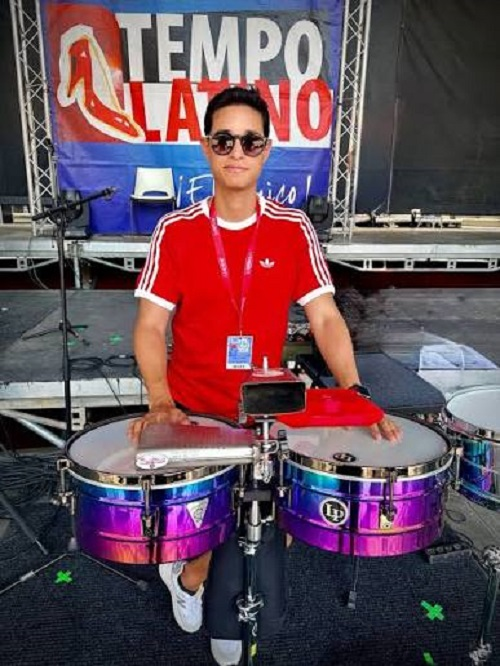
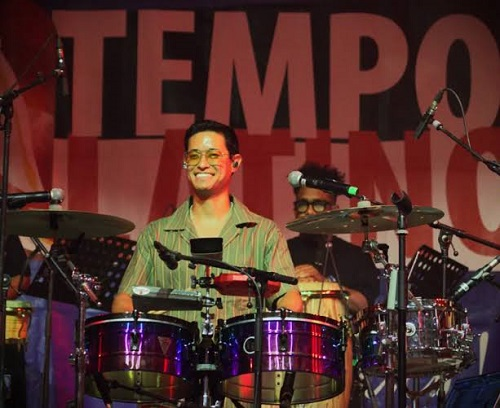
The Rhythm Explosion: Tony Succar Conquers the Legendary Tempo Latino Arena 2026

The Latin Grammy-winning Peruvian percussionist and producer closed the 31st edition of the iconic French festival with a display of dynamism, cutting-edge percussion, and pure clave flavor.

La explosión del ritmo Tony Succar conquista la mítica Arena de Tempo Latino 2026.

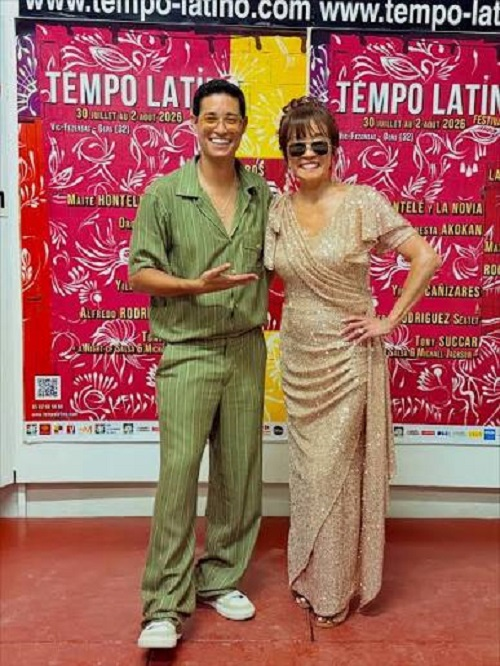
VIC-FEZENSAC (FRANCE) The small town of Vic-Fezensac, in the heart of the Gers department, once again became the European capital of Afro-Cuban music from July 30 to August 2, 2026.

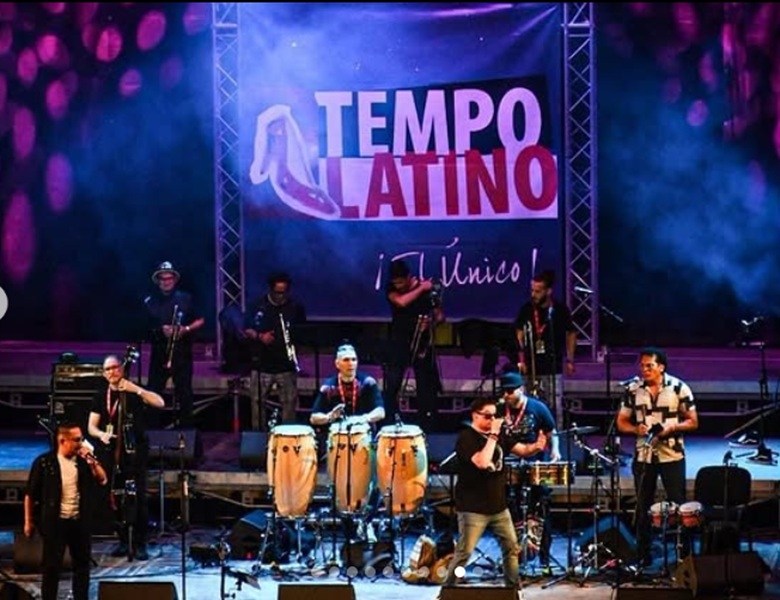
On closing night, the legendary bullring turned Tempo Arena witnessed one of the most thrilling performances in its more than three-decade history: the showcase by Peruvian-American percussionist, arranger, and producer Tony Succar.

The Grand Finale at the Tempo Arena

The Tempo Latino festival celebrates the rich heritage of Caribbean rhythms. On the night of Sunday, August 2, following the jazz virtuosity of Cuban pianist Alfredo Rodríguez, Succar took the main stage backed by an exceptional lineup of musicians.

El percusionista y productor peruano galardonado con el Latin Grammy cerró la 31ª edición.

From the very first hit of the timbales, the two-time Latin Grammy Award-winning producer demonstrated why he is considered one of the most influential creative forces in the evolution of contemporary salsa.

The concert kicked off with an overwhelming energy that brought thousands of ecstatic dancers to their feet. Succar delivered a repertoire that navigated between:

  • Salsa Dura: Classic, high-octane style.
  • Afro-Cuban Jazz: Rich in colors, harmonies, and improvisation.
  • Caribbean Pop: Adding the fresh nuances that define his signature musical style.

The circular acoustics of the arena served as a natural resonator for the percussion’s polyrhythms, where Tony’s own timbale solos reaffirmed his technical mastery and deep-rooted connection to tradition.

Cutting-Edge Sound, Tributes, and a Global Vision

One of the night’s highlights came with the salsa reinterpretations from his renowned project, Unity: The Latin Tribute to Michael Jackson a landmark album that transformed global pop into an authentic tropical showcase.

Tony Succar y Mimy Succar (cuyo nombre real es Miriam Tayrako Sakaguchi).

The European crowd sang along to arrangements where sharp brass lines and salsero syncopation breathed new life into the “King of Pop’s” classics.

Succar also used the Vic-Fezensac platform to showcase tracks from his recent productions, characterized by avant-garde arrangements that never lose their danceable groove.

The tightness of the horn section and the rhythm ensemble kept the festive momentum high throughout the night, proving a rigorous production standard that spares no flavor.

The Enduring Power of Salsa on European Soil

The 31st edition of Tempo Latino brought together top-tier performers from various genres, sharing the lineup with prominent figures:

Featured Artists & Ensembles
Tony Succar
Alfredo Rodríguez
Maïté Hontelé
Orquesta Akokán
La Yegros
Matt Bianco

Note: Corrected the edition number in context to match the 31st edition noted in the header.

However, Tony Succar’s performance on the final night served as a powerful reminder of salsa’s current state: a living, evolving, and truly global genre.

With this concert, Succar not only fulfilled a long-awaited date with European clave enthusiasts, but also solidified his place among the great champions of contemporary tropical sound.

As the lights of the Tempo Arena finally went out, the standing ovation echoed through the streets of Vic-Fezensac, confirming that the new generation of salsa has one of its boldest architects in Tony Succar.

 Tony Succar: “Thank you so much, TEMPO LATINO! It was an honor to return to this incredible festival after 9 years. We had so much fun! And it brings me so much joy to see how much people love salsa on this side of the world.”

By: Titouan Maza & Jean Paul Pourque.

Succar en el Arènes de Vic-Fezensac

Read Also: Antonio “Tony” Succar: Percussionist, Composer, Arranger, Bandleader, and Music Producer


Julian Silva from La Excelencia has overcome the typical difficulties of the music business

American composer, producer, and musician of Colombian descent, Julian Silva, offered us a very pleasant conversation in which we touched all kinds of topics related to his career and the group he currently leads, Orquesta La Excelencia.

The artist has been received by any number of international markets and has been responsible for sold-out tours and performances in more than 16 countries in total, so we are honored to have spent some time with the musician and heard what he has to share with us.

Composer Julian Silva
This is composer, producer, and musician Julian Silva

What inspired Julian to get started in music?

Despite not having any family musicians, Julian emphasizes that his father used to play and sing with his brothers as a hobby, but what they did was not professional at all. It was mere entertainment. Due to this deep love for music, he would always listen to all kinds of artists, especially salseros, with his kids while they were young, which sparked Julian’s desire to learn to play.

That was how the young man born in Cali, Colombia, and nationalized in the United States, began playing guitar at the age of 11 and formed a small group with some friends in trio format. He also wanted to learn to play wind instruments such as the saxophone and trombone, as well as percussion. He also took other music classes in high school, but after that, all he learned by ear and practice. The same thing happened when writing and composing music, for which he did not need any formal training to help him with that.

Music and Psychology

After graduating in psychology from Louisiana State University, Julian moved to New York, as it was in this city that he could truly discover his Latin roots through art. It is worth noting that, thanks to this knowledge acquired during his university education, he has been able to combine the two careers he is passionate about.

After completing his undergraduate studies, he also finished a master’s degree in music therapy, which is why he defines himself as both a professional musician and a music therapist. In other words, he uses music to help people, especially children and older adults, improve their physical and emotional health.

Julian and his band
Julian Silva and his band La Excelencia

One of the things that inspired him most to use music as a form of therapy was his own experience as an immigrant. As a child who had recently arrived in Louisiana and did not speak English, he found it very difficult to connect with others because of the language barrier, so he started using music to achieve this.

First professional opportunities in music

While Julian was still in Louisiana, he noticed that there were not many Latinos in that state, but there was a fairly large group of Hondurans and Dominicans, so merengue was quite popular in that area. That was not what the young man was looking for, and many of these merengue groups, due to lack of experience with the genre, did not want to accept him, so he was always very clear that he wanted to start his own band to avoid such problems.

That was how, at just 17 years old, he had his own band and played at various venues across the United States, until he finally had to go to Austin, Texas, where they opened for Larry Harlow and his Latin Legends Band. It was that day that he had the opportunity to meet Harlow himself and timbalero Chino Núñez. During his talk with these stars, Julian shared his intentions to develop his career and Harlow and Núñez advised him that, if he truly wanted to play salsa and be successful, he had to move to New York, which he finally did after graduating from college.

Orquesta La Excelencia

While it is true that the official founding year of the band La Excelencia was 2005, it was in 2001 that he arrived in New York with a group he already had (Los Calientes del Son) which had previously been signed by a record label and was in the process of releasing its first album. However, the terrible and world-famous events of September 11th caused tourism to plummet dramatically and force New York’s arts to make a temporary stop. It is worth adding that reggaeton and bachata started to gain immense popularity, leaving salsa in oblivion.

La Excelencia at tempo Latino
La Excelencia performing at Tempo Latino in 2023

The facts described above caused the record label to leave off the album until conditions improved. In 2004, seeing that the situation never changed, Julian decided to deviate from his contract, form a new group he named La Excelencia, and create what he himself called “salsa with a social conscience.”

Since he did not know many experienced musicians, he recruited young aspiring musicians, some of whom had not even finished high school. At that point, he started writing more seriously, composed his first song, “La Lucha,” and faced one of the biggest challenges his fledgling orchestra would encounter: anonymity. He nor his bandmates were not at all famous because they had not studied with great musicians nor had any relatives with connections in the industry, which made everything much more difficult for them.

As they were gaining more and more recognition, they released albums such as “Salsa Con Conciencia,” “Mi Tumbao Social,” and “Ecos del Barrio.” In 2012, they took a break because the guys wanted to focus on their own careers, other projects, and starting families, but they were never completely apart. They got back together between 2018 and 2019, when they released their fourth album, “Machete,” which would be released in March 2020. However, fate surprised Julian again with the COVID-19 pandemic.

Although worried, they did not let the circumstances get them down and went ahead with the release so that people could enjoy their music from their homes during quarantine, which worked out pretty well in numbers and popularity.

Today, La Excelencia consists of Julian himself, bassist Luis Orona, pianist Willie Rodríguez, and singer Gilberto Velázquez.

Read also: Hector Rivera ‘‘Riverita’’ tells the story of how he created Riverita Y Su Orquesta Noche Caliente

Uruguay International Salsa Congress 2016

Latin America / Uruguay / Montevideo
Uruguay International Salsa Congress 2016

This September, the International Salsa Congress is coming to Montevideo, Uruguay. Taking place on the 15th, 16th, and 17th, the event will feature workshops, shows, competitions, and parties at the following venues:

“La Bodeguita del Sur”—also known as the “Temple of Salsa”—which is dedicated exclusively to hosting salsa and bachata events (congresses, competitions, and performances) and is an undisputed leader in productions within these genres.

The Hotel Esplendor, specifically the “Roof Garden” and the “Sala Cervantes.”

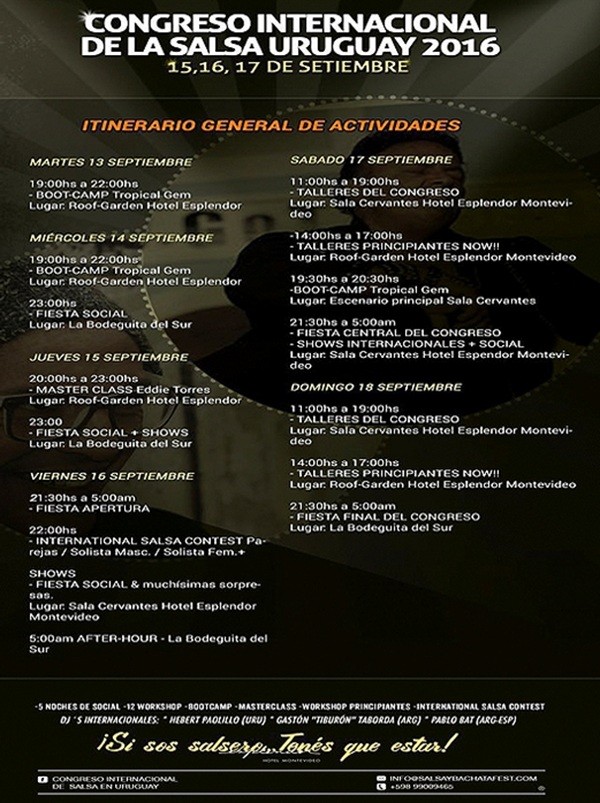
The general schedule of activities for this major event is as follows:

Uruguay International Salsa Congress 2016 – Schedule of Activities


On Thursday the 15th, from 8:00 PM to 11:00 PM, Eddie Torres—known as “The Mambo King”—will appear. An outstanding salsa instructor renowned for both his dancing and his teaching style, he will conduct a session at the Hotel Esplendor Montevideo’s Roof Garden. This offers three hours of intensive classes with limited capacity; the first 30 people to register will pay $75 USD. Afterward, the social party and shows will begin at 11:00 PM at La Bodeguita del Sur.

Uruguay International Salsa Congress 2016 – Artists

On Friday the 16th, from 9:30 PM until 5:00 AM, a grand opening party will take place, featuring the following sponsors:

First, the International Salsa Contest will kick off, featuring couples and soloists across all genres; this will be followed by a showcase promising plenty of surprises. The opening party will take place at the Sala Cervantes in the Hotel Esplendor, Montevideo. After the shows, an after-party at Bodeguita del Sur will wrap up the evening’s festivities. On Saturday the 17th, various workshops will begin and continue through Sunday the 18th; these include six hours of intensive training for beginners, running concurrently with the main congress workshops (for which certificates of completion will be awarded).

Uruguay International Salsa Congress 2016 – Ticket Prices

To purchase tickets for the Tropical Gem Dance Company Boot Camp or the Eddie Torres Master Class, or for any information regarding the Salsa Congress, please contact:

http://salsaybachatafest.com/contacto/

Facebook: CONGRESO INTERNACIONAL DE SALSA EN URUGUAY

Phone numbers:

  • +598 990 99465
  • +598 4523 1975
  • +598 29028649
Uruguay International Salsa Congress 2016 – Flyers

International Salsa Congress in Buenos Aires

Latin America / Argentina / Buenos Aires

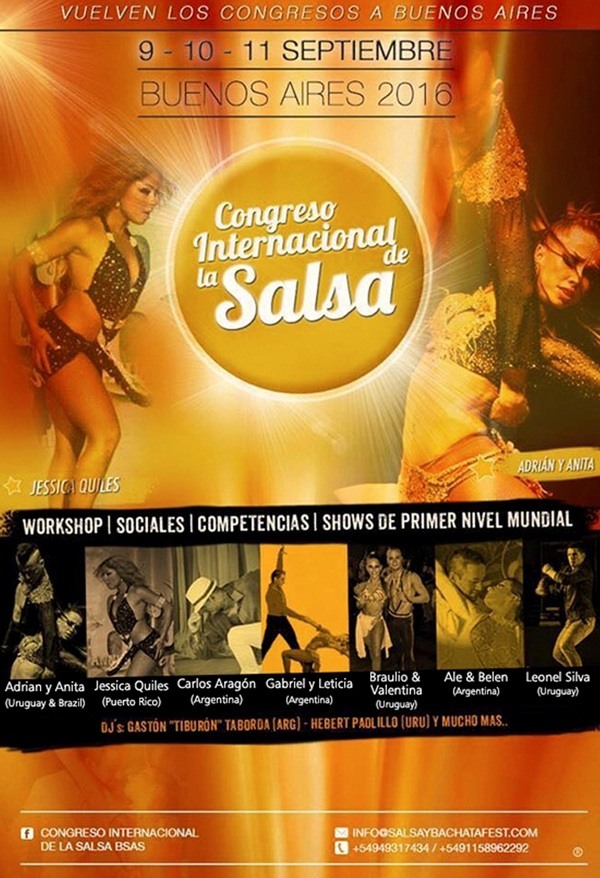
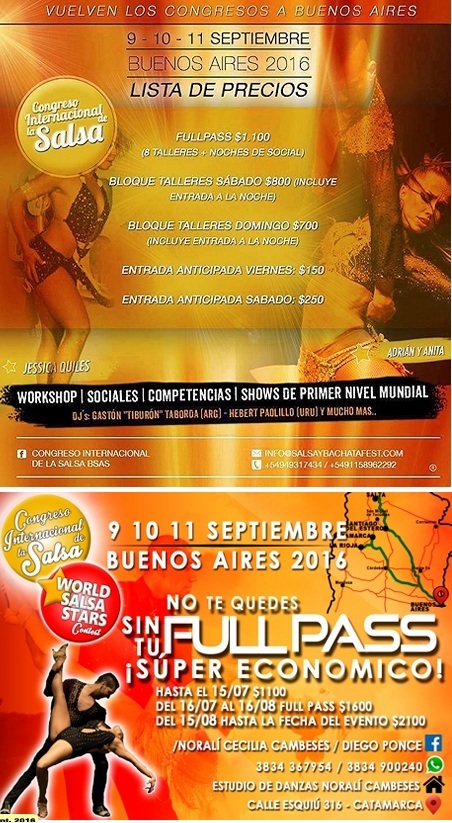
The International Salsa Congress in Buenos Aires, Argentina, runs from September 9th to 11th, featuring three incredible nights and eight workshops—all with high-quality production values ​​designed to make your weekend unforgettable.

International Salsa Congress in Buenos Aires
Congreso Internacional De La Salsa en Buenos Aires - Photo
Congreso Internacional De La Salsa en Buenos Aires – Photo

The participating artists include:

  • Adrián and Anita: five-time world champions (Uruguay and Brazil). Jessica Quiles: world champion in *pasos sueltos* (footwork) (Puerto Rico).
  • Gabriel Salgado and Leticia Beltrán: leading figures in Argentine bachata.
  • Carlos Aragón: Mambo-on-2 director and a key figure in the Argentine dance scene.
  • Braulio Carazo and Valentina Salari: International Bachata Contest (Uruguay) runners-up and leading figures in Uruguayan bachata. Leonel Silva: dancer and leading figure in Uruguayan salsa.
Congreso Internacional De La Salsa en Buenos Aires - Full Pass
Congreso Internacional De La Salsa en Buenos Aires – Full Pass

The event’s choreographers are:

Alumine Oye Chico

Habanna Mix

International Salsa Congress in Buenos Aires - Registration open
International Salsa Congress in Buenos Aires – Registration open

We were also presented with the schedule of activities for the three-day event, as follows:

  • Friday the 9th: Kicking off at 10:30 PM (22:30) with WORLD SALSASTARS (International Group Competition).
  • Saturday the 10th: Four workshops begin at 4:00 PM (16:00). The main congress party starts at 11:00 PM (23:00); guests will enter the VIP area for a surprise opening ceremony, followed by world-class national and international shows and incredible sets by national and international DJs.
  • Sunday the 11th: Four workshops take place starting at 4:00 PM (16:00), followed by the final party opening in the evening, marking the conclusion of the Salsa Congress.
International Salsa Congress in Buenos Aires - Boxes Vip
International Salsa Congress in Buenos Aires – Boxes Vip
International Salsa Congress in Buenos Aires - 2
International Salsa Congress in Buenos Aires – 2
  • « Go to Previous Page
  • Page 1
  • Page 2
  • Page 3
  • Page 4
  • Interim pages omitted …
  • Page 20
  • Go to Next Page »

International Salsa Magazine (ISM) is a monthly publication covering salsa activities around the world and has been publishing since 2007. It is a worldwide network of volunteers coordinated by ISM Magazine. Together, we work to strengthen salsa events around the world.