• Skip to primary navigation
  • Skip to main content

International Salsa Magazine

  • HOME
  • Previous editions
    • 2026
      • ISM / April 2026
      • ISM / March 2026
      • ISM / February 2026
      • ISM / January 2026
    • 2025
      • ISM / December 2025
      • ISM / November 2025
      • ISM / October 2025
      • ISM / September 2025
      • ISM / August 2025
      • ISM / July 2025
      • ISM / June 2025
      • ISM / May2025
      • ISM / April 2025
      • ISM / March 2025
      • ISM / February 2025
      • ISM / January 2025
    • 2024
      • ISM / December 2024
      • ISM / November 2024
      • ISM / October 2024
      • ISM / September 2024
      • ISM / August 2024
      • ISM / July 2024
      • ISM / June 2024
      • ISM / May 2024
      • ISM / April 2024
      • ISM / March 2024
      • ISM / February 2024
      • ISM / January 2024
    • 2023
      • ISM / December 2023
      • ISM / November 2023
      • ISM / October 2023
      • ISM – September 2023
      • ISM – August 2023
      • ISM July 2023
      • ISM Edition June 2023
      • ISM – May 2023
      • ISM April 2023
      • ISM March 2023
      • ISM February 2023
      • ISM January 2023
    • 2022
      • ISM December 2022
      • ISM November 2022
      • ISM October 2022
      • ISM September 2022
      • ISM August 2022
      • ISM July 2022
      • ISM June 2022
      • ISM May 2022
      • ISM February 2022
      • ISM January 2022
    • 2021
      • ISM December 2021
      • ISM November 2021
      • ISM October – 2021
      • ISM September 2021
      • ISM August 2021
      • ISM July 2021
      • ISM May 2021
      • ISM April 2021
      • ISM June 2021
      • ISM March 2021
      • ISM February 2021
      • ISM January 2021
    • 2020
      • ISM December 2020
      • ISM November 2020
      • ISM October 2020
      • ISM September 2020
      • ISM August 2020
      • ISM July 2020
      • ISM June 2020
      • ISM May 2020
      • ISM April 2020
      • ISM March 2020
      • ISM February 2020
      • ISM January 2020
    • 2019
      • ISM December 2019
      • ISM November 2019
      • ISM October 2019
      • ISM Septembre 2019
      • ISM August 2019
      • ISM July 2019
      • ISM June 2019
  • Spanish
  • Download Salsa App
    • Android
    • Apple

Search Results for: Academy

José Mosquera from Barquisimeto for the World “The bodybuilder and elegant”

Barquisimeto, is well known as the musical capital of Venezuela and in this opportunity we will make special mention to the musician José Jesús Mosquera Cañizales, born in our city in the Antonio María Pineda Hospital, on May 23, 1969, son of Rafael Mosquera and Juana Cañizales, married to Yolanda García and from this union were born their children Yolanda José and Luis José.

Mosquera was always inclined to music since he was a child, participating in the musical activities of his school “Ciudad Bolivar”, located on Carrera 13 and 48th Street, in Barquisimeto, singing and playing the cuatro in a self-taught way and with the help of his father who taught him to improve his playing.

At the age of 8 he studied at Pablo Canela’s academy, at the age of 10 he learned to play guitar, also with the support of his father and his cousin Carlos Romero.
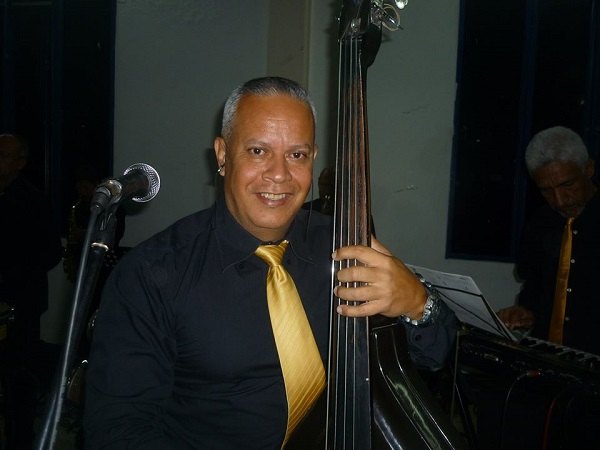
At the age of 11 he participates in the musical groups of the Christian church, standing out as a guitarist, drummer and timbalero. When he turned 15, he became interested in playing the bass guitar and during his high school studies at the Ezequiel Bujanda Combined Cycle, he met Jesús Rincón, also a musician, and joined the ranks of the “Obeligaitas” bagpipe group, where he began his career as a bass player.

When he turned 18 years old, he was part of the staff of the group “Tecnogaitas” of the Tecnológico Antonio José de Sucre and simultaneously he was bassist of the band “La Salle”. Afterwards, he is recommended to Alí Rojas and auditions to be the bassist of the “Sonora de Alí”, where he remains for 3 years.

Alí Rojas gave him the responsibility of being the bassist of the dance orchestra “Sensación”, where he remained for 15 years. In 1992, he began working as a music instructor for the Fundación del Niño until 1996.

Mosquera, besides being an excellent bass player, plays string instruments such as the cuatro, guitar and requinto.
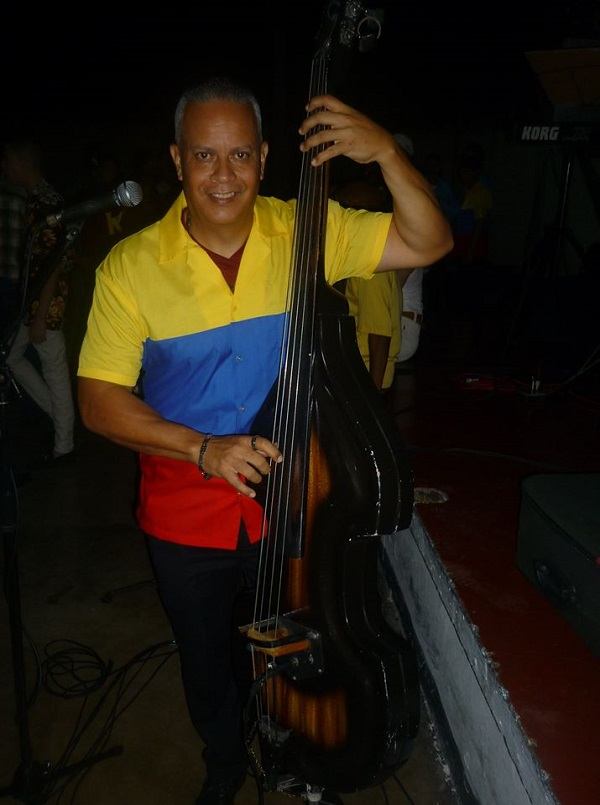
In 1993, Mosquera turned to romantic music and created the duet “Génesis” with his friend and compadre Carlos Enrique Prince, performing in nightclubs and private parties. In 1997, he joined the Poliboys Orchestra of the General Command of the Lara State Police as a bass player, where he currently works. In 2004 he began his musical studies at the Vicente Emilio Sojo Conservatory and graduated as an academic musician in 2009 with excellent grades. José has performed on regional television stations demonstrating his qualities in various prestigious programs and in 2016, he won 3rd place in the Police Voice Festival.

Mosquera, at what date do you become interested in salsa as a musical genre?, Professor Carlos in 2007 I start playing the baby bass and in 2011 I join the K’dencia Latina Orchestra of Carlos Sanchez and also had the privilege of accompanying Benjamin Rausseo “El Conde del Guácharo”, performing with his band and with K’dencia Latina, accompanied the late Willy Rodriguez, and vocalists of national and international renown: Hildemaro, Pibo Márquez, Charlie Guzmán, Alejandro Mayora, Mariana “La Sonera de Venezuela” and the official doubles in Venezuela of Rubén Blades (Jhony Heredia) and Celia Cruz (Ibrahíma Rondón).

Mosquera finally told us that musical excellence is achieved through perseverance and dedication.

Finally we wish the best of success on behalf of International Salsa Magazine, to the excellent musician José Mosquera “The bodybuilder and elegant bass”.

See you next time and let’s keep on salsaing!

José Mosquera “The bodybuilder and elegant”.

Pedro González

Musician, Instructor, And Pioneer Of Salsa Casino In Venezuela

Pedro González dressed in white playing the bass
“I always had the connection to music, and today, I still have two congas. Sometimes I play them during classes.” Pedro González

“If people dedicate themselves to this, it is because we are doing it well.” This nice phrase arose from the pleasant and attractive telephone conversation about the history of the pioneer of Salsa Casino in Venezuela, the charismatic Cuban-Venezuelan musician and instructor Pedro González.

This affable musician and Salsa Casino instructor told us that he carved out his career from a very young age. He was born in Havana (Cuba) in 1966 and began his musical studies at the National School of Arts in the Havana capital at the age of ten, graduating in the specialty of Guitar (Short Course of 8 years) in 1984.

He comes from a musical family, his grandmother was the soprano Rosa “La China” and his mother (teacher and school principal) Zoe Portuondo Suarez, a distant relative of the singer Omara Portuondo.

“…Since I was little I liked to dance, I would dance everywhere. I learned with my cousin… I went to places like Playa… Besides, my mother danced a lot and my grandmother was a singer and she was also linked to the world of art…” Pedro commented.

His first job was as a music teacher in the Pinar del Río city, three hours from Havana. A short time later, he joins the Caranday group, and they play Son Cubano every night at the luxurious Hotel Nacional De Cuba.

After 45 days from his first presentation with the group, they meet the Venezuelan businessman Martín Gutiérrez, who takes them to Venezuela in 1993 to perform at private parties in the Falcón state.

Due to the few opportunities he had in Cuba, he decided to stay in Venezuela and formed the Latino Son band, made up of four Cuban musicians, and in turn began to be members of the Tropicana-style Cuban Fiesta Magazine (Show with a range of musical genres, interaction with guest singers, and dancers) in nightclubs of the Capital.

In Moments of pause with the musical magazine (1997), he undertook a tour with the Latino Son group with whom he traveled for almost all of Venezuela and toured the main stages of large national festivals such as La Feria del Sol (Mérida), Feria de San Sebastián (San Cristóbal), and La Feria de la Chinita (Zulia) among many others.

“We played permanently at La Giralda… At La Giralda we organized a party playing the Cuban Timba, then, there they called us “The Cuban Orchestra” in 1996, 1997, and 1998…”

During the ’90s and already residing in Venezuela, Pedro became the first Salsa Casino instructor in Venezuela without planning it as a life plan, and in 2000 he founded his homonymous academy that has graduated thousands of fans of this style of salsa dance.

Dancing is one thing that keeps you active. That is good for the body. If you have a problem in two hours or an hour and a half dancing you forget it. For my part, I like to teach… And, I like people to have fun.” Pedro González

History And Evolution Of The Academy Dance

Pedro González with burgundy flannel and four women on the sides
Pedro González is the President of the Salsa Casino Organization in Venezuela

One night at the end of the 90s, Pedro along with his friend Milan (Medical and Countryman) began to remember the Dance of the Casino in La Giralda (old venue to listen to live music and enjoy various drinks on the Boulevard de Sábana Grande – Caracas) after his customary presentation with the Latino Son group.

Both began to stand out on the dance floor with the genre of La Timba and for a way of dancing Salsa different from the one practiced in Venezuela. “We began to dance with two Venezuelan girls in the Rueda style (which was not a Rueda because there must be 3 couples)… I began to say Milan “Give me one”, “Plugin”, “The Hat”, and we began to dance the Casino Style”. Pedro “El Cubano” told us between laughs during the interview.

The two ladies were so impressed by that way of dancing that they did not hesitate for a moment to ask Pedro for dance lessons. After so much insistence, “El Cubano” agreed for the first time to give Salsa Casino classes in the capital of Venezuela in an improvised and reduced space with his first five couples. “I am from the Cerro municipality, which is the closest to Old Havana. I used to go to Playa (Municipality of Havana) a lot to dance and I learned many dances and turns…”

And so Salsa Casino began spontaneously in 1999. By the following year (2000), Pedro had 20 couples and a larger room to teach.

The evolution of him in his rise during this year was impressive. Due to the influx of students, he began to teach in the blue auditorium of the Faculty of Economic and Social Sciences (Faces) of the most prestigious University in the country, the Central University of Venezuela (UCV) through Reinaldo Mijares, Director, and choreographer of the contemporary dance “Mudanza” attached to this institution and where González assures that this movement grows.

From there, he gave way to the Casa Monagas club, a place located in the Las Acacias sector (west of Caracas) behind the UCV with the capacity to hold up to 1,000 people. Here, Pedro’s students had more space to rehearse, and Salsa Casino Parties began to be organized monthly.

Pedro González with a blue shirt dancing with two women
Dance academies in Venezuela were teaching Puerto Rican Salsa Style in the year 2000

With this overwhelming success, the creation of the Academia Salsa Casino in Caracas was imminent. It had massive attendance, national impact with graduate students, and attendance at national and international festivals such as Curacao Salsa Tour, Festivals in Cuba, and an amazing show at the Amador Bendayán Theater.

With more than 20 years of teaching Salsa lessons, Pedro has graduated more than 2000 students and changed its name to Academia Pedro González. It currently has five locations: Sábana Grande (main location), Chacaíto, San Antonio de los Altos (Los Teques), Capitolio, and El Cafetal.

The classes are aimed at children and adults. The call is open, so you can sign up without a partner and don’t worry because the essence of the Rueda remains. The estimated graduation time is three years with four basic levels, four intermediate levels, six advanced levels, you will also receive a triple casino level, two dance technique levels, and to complete the process a final choreographic exam is done.

Every dance lesson is fun because of Pedro’s ability to teach. The names of each step such as “Pégale un Cacho” are adapted to the colloquial vocabulary of the Venezuelan so that it is easy and fast to learn.

Due to Covid-19, the Pedro González Academy makes the use of the mask and antibacterial gel an essential requirement for permanence within the institution, as well as reducing the maximum number of couples per level to only ten.

Vanessa Lovera y sus amigas vestidas de negro
Vanessa Lovera (Left) accompanied by two Salsa Casino dancers at the Caracas Carnival party

At the main headquarters, there are four instructors. One of them is Vanessa Lovera, a graduate instructor from the academy. For Pedro, she has been unconditional support in difficult moments of the institution. Vanessa teaches Salsa Casino and Ballroom Dance. You can also find her at the El Cafetal headquarters, but if you prefer the main headquarters, the address is as follows: Sábana Grande Boulevard, Fénix building, 5th floor, next to the Gran Café.

For this 2022 and if there is a return to normality, the Cuban instructor and musician residing in Venezuela hopes to resume the lost spaces in Caracas such as discos, nightclubs, presentations in theaters, once again hold large Salsa Casino parties in large rooms, the return of national competitions, and the continuation of the training of instructors in person (it is only online currently).

Casino Dance Or Salsa Casino?

Club Casino Deportivo in Havana, Cuba
Club Casino Deportivo no longer exists. Nowadays only the sports fields were preserved of this infrastructure.

According to the friendly instructor Pedro González, the origin of Salsa Casino on the island of Cuba has a unique story that begins like this…

Since 1956 numerous Cuban orchestras have been registered that played very popular and contagious musical genres such as Cha Cha Cha, Guaracha, Mambo, and Son. Rhythms that invited the young inhabitants of Cuba of this time to just want to dance and have fun all night with these melodies, but they not only wanted to do it with their partners but also with those of their friends, acquaintances, and strangers. However, for this decade that was not allowed because the rules of the strict and conservative society dictated it.

In this way and with the pursuit of that goal, the gentlemen created this style of dance. A style that did not require constant practice and where partners could be exchanged using keywords such as “Plugin” to perform the movement and for the theory to be carried out perfectly without altering society. The place where this event was recorded was Casino Deportivo, a private summer vacation club located in the Miramar residential area in Havana.

“We (in Venezuela) call it Salsa Casino because it is the commercial name already used in the United States. In Europe they call it Salsa Cubana, but the original name is Baile Del Casino”. Pedro Gonzalez

That is why at the end of 1950 this style of dance began to be generated that people internationally associate with the style of gambling performed in a Casino because it is a dance in Rueda.

The popular expression of most people in Cuba every time they saw this peculiar way of dancing was to say “Ah! But you are dancing like the people of the Casino (Casino Deportivo Club)” that each day was shortening the expression until reaching the Baile Del Casino.

The peculiarity of this dance style is that it does not have a musical genre, that is, no melody that identifies it. For example, a Danzón is danced with the music of the Danzón, the same happens with the Cha Cha Cha, Mambo, Son, and Bolero. There is no rhythm called Casino, therefore this style acclaimed in the world and preferred by Cubans began with the music that existed in this glorious decade of the ’50s.

  • You Can Also Read: Sidney Poitier

What famous trumpeter Luis Gonzalez is doing now

How Luis González began his artistic career

Luis González is one of those artists who really make Puerto Ricans proud of being born in the Island of Enchantment. The fascinating story of this boricua begins in March 1954 when he was born in the town of Arecibo, located on the north coast of Puerto Rico, the country from which he moved to look for new opportunities on U.S. soil, starting in Milwaukee, Wisconsin. It was in this city where he spent most of his childhood and began his artistic career in the Youth Orchestra of this place.   

A few years later, he returned to his native country and was notable for being the trumpet player of the Orquesta Concepto Latino de Arecibo, accompanying a big number of artists such as Celia Cruz, Adalberto Santiago and many others. After completing his studies at the Conservatory of Music in Milwaukee, he moved to New York, where he was part of many famous orchestras and worked with renowned artists such as Ray Barreto (whom many consider him his mentor) and Luis Perico Ortiz. Back in Puerto Rico, he worked with La Mulenze, Bobby Valentín, Willie Rosario, Roberto Roena, among other stars. 

This is Luis González
Renowed trumpeter Luis González

It was not until 2009 when he finally decided to give life to his own orchestra which he called Luis González Y Su Orquesta el Tsunami de La Salsa consisting of a total of 12 musicians with a long international career and an uncanny talent. At this time, it is seen as one of the best salsa orchestras in Puerto Rico in its history. The following year, he released what would be his first musical work with his new orchestra entitled Tributo A Un Gigante, which included the collaboration with Luis Perico Ortiz, Adalberto Santiago, Paquito Guzmán, Toñito Vázquez and others. This record production was recognized as one of the most outstanding of that year. 

Recent years

In 2015, he achieved the same feat with his second production Si te Preguntan…, which allowed him to gain great notoriety in the public and the media dedicated to promoting salsa in various parts of the world. 

Years later, González would be inducted into the Puerto Rico Music Hall of Fame thanks to his more than 45 years of musical career, but that was not all. The artist has also received other important recognition from cultural and musical institutions in his native country. Not to mention that he is a member of the Latin Academy of Recording Arts and Sciences (Latin Grammy), getting to participate in the commissions that choose the nominees in some categories. 

Luis next to to Adalberto
Luis González and Adalberto Santiago

In 2020, under the Carnival of Barranquilla, the trumpet player was selected as a member of the jury at the 2020 Orchestras Festival, a well-deserved honor he received on behalf of the Colombian city due to his talent and experience. 

For the moment, he is working hard on his fourth music production, which he has decided to call 50 años… mi música… mi pasión! and will be released to the public in March of this year. A special peculiarity of this new album is that it will be arranged by a top-line team, including Luis Perico Ortiz (who has worked with González on repeated occasions), Ricky González, Oscar Hernández, Javier Hernández, among other eminences. 

By: Johnny Cruz correspondent of International Salsa Magazine in New York City, New York

Sidney Poitier

The Golden Gentleman Of Hollywood

Face of Sidney Poitier
Sidney Poitier dropped out of school at 12 to help his parents support the home

Sidney Poitier, the Golden Gentleman of Hollywood, died six days after the start of 2022 (January 6th, 2022) at his home in Beverly Hills (Los Angeles – California) as a result of a combination of heart failure, Alzheimer, and cancer prostate (according to the death certificate obtained by the TMZ website). And although he is no longer with us on this earthly plane, at ISM wanted to pay a heartfelt tribute to this famous man on the Big Screen.

We can only start with how a Gentleman is identified. A man with this distinction is characterized by the behavior of absolute courtesy with the people around him, deep nobility regardless of gender, race, or creed, and exuberant distinction in any situation. Qualities that were always present in the behavior of one of the Afro-descendant men in Hollywood with values ​​and principles unalterable over time, we are referring to our Golden Gentleman of Hollywood, Sidney Poitier.

Sidney from his childhood in the Bahamas developed high self-esteem. He was not able to differentiate between skin tones, on the contrary, he only saw people with the same rights, duties, and obligations. That is why he was always ready to give his image and resources to the defense of civil rights on the big screen, as well as stand by the African-American political activist Martin Luther King and in turn, participate in peaceful demonstrations such as the Pilgrimage of Prayer for Freedom (1957) and the March for Jobs and Freedom on Washington (1963).

This actor and director was raised within a family and society where mutual respect, great affection, integrity, and laughter were the premises. These teachings nurtured his life and helped him translate into each of the characters he played in the mecca of cinema.

His multiple characters reflected the kindness, sacrifice, dignity, and greatness of human life, thus leaving an extensive cinematographic legacy with more than 50 films since 1950.

Barack Obama, Sidney Poitier, Michelle Obama
Ex-President Barack Obama presented the Presidential Medal of Freedom (August 12th, 2009) to Sidney during a White House ceremony.

His physical departure has been the center of great posthumous recognition by the industry, such as the cases of Denzel Washington (actor), Oprah Winfrey (writer and television presenter), Lupita Nyong’o (actress), and many more representatives of the Afro-American community living in the United States.

“Through his groundbreaking roles and singular talent, Sidney Poitier epitomized dignity and grace, revealing the power of movies to bring us closer together. He also opened doors for a generation of actors. Michelle and I send our love to his family and legion of fans.” Farewell words from ex-President Barack Obama through his Twitter account.

6 Emblematic Movies Of Poitier

Sidney Poitier never really wanted to be an actor. The truth is that at the age of 15 he didn’t know how to read well either. Words made up of more than three syllables were quite a challenge, and every time he had to read them, he got a feeling of defeat.

So, how did Sidney get into acting? The answer is by accident during his stay in New York City. In his search for a job as a dishwasher, he came across an advertisement that powerfully caught his attention and said “Actor Wanted” and although Sidney did not know what that job was about, he decided to attend the casting with gallantry.

Sidney Poitier in Black and White in NYC
Poitier bought a true confession magazine for ladies and memorized two paragraphs to audition at the American Negro Theater

That day two stories converged. The first was the impetus of creating a fruitful career in acting, while the second story is the narration of the moment when this actor with entrenched convictions felt deeply offended as never before in his life.

Poitier auditioned but due to his poor reading skills, acting, Caribbean accent, and skin color, Sidney was disrespectfully kicked out. He was held by his coat collar and pants belt and thrown into the street. The words of that man were “You can’t read, you can hardly speak, and you have that accent… Why don’t you go find a job as a dishwasher?”

That day was one of intense reflection for the golden gentleman of Hollywood. Walking down Lenox Avenue, he thought about what happened, and his indignation at that situation that he constantly remembered led him to make the best decision of his life, Sidney chose to be an actor! His choice was based on his love for himself. His thought was that he was worth more than the perception that that man had of him, and once he managed to prove it to him, he would leave that profession, and that’s how this magical journey began…

His induction studies in the performing arts began in the American Negro Theater located in Harlem (NYC). Here, he offered his job as a janitor in exchange for his acting training. After not-so-pleasant experiences, he could be the substitute for the main role of the plot of the work. And on the day of the premiere Sidney had to play the leading role because the main actor (Harry Belafonte) could not attend. In that unique moment, the son of tomato farmers from the Bahamas was able to demonstrate the meaning of perseverance, determination, effort, and with his brilliant talent, he was able to captivate all attendees. Since then, job offers in acting for Sidney began to arrive.

Sidney Poitier sitting in a Red Armchair during the filming of a scene
“I can’t represent a scene that I don’t find the texture of humanity in the material.” Sidney Poitier

His first professional job was on Broadway in the classic play Lysistrata (a Greek comedy) in 1946. This was followed by the play Anna Lucasta and later his film debut in No Way Out in 1950.

A narrative that is based on the medical assistance to an intolerant Caucasian criminal by a doctor of color (Dr. Luther Brooks) played by Sidney. Poitier’s first film role broke Hollywood’s established stereotypes for African-American actors, while this film was the first to directly address racism.

“My Values ​​are not disconnected from the values ​​of the black community, so I go in front of the camera with a responsibility to be respectful…” Sidney Poitier

Blackboard Jungle (1955). This film struck the social chord of an educational system and helped revolutionize Rock and Roll music in a soundtrack for a big-budget movie. With this performance, Poitier was full of praise for his participation in the secondary role as Gregory Miller, a troubled student who decides to stay in school.

Three years later comes The Defiant Ones (1958) and with it his first nomination for the Academy Awards. This dramatic film had its center in racial harmony. Two shackled fugitives, John “Joker” Jackson (Tony Curtis) and Noah Cullen (Sidney Poitier), escape from the prison truck. As they try to evade the police, they overcome their racial prejudices.

In 1963 the film would come that changed the life of this actor born at seven months in Miami and raised in Nassau (Bahamas), Lilies of the Field. This cinematic drama dives into Faith and is about an ex-soldier (Homer Smith) played by Sidney, who is persuaded by an order of nuns to do farm work and build a chapel. During the process, Smith earns the respect and admiration of all. This leading role brought Poitier his first Oscar, and he thus became the first black man to receive this award for Best Actor in 1964.

“What the character was doing was exhibiting a vast sense of self and the wonders of being alive. The wonders of being a Human and the responsibilities…” Sidney stated in an interview conducted by the Academy of Achievement in 2014.

Sidney Poitier dressed in a suit with the Oscar in his hand
Oprah Winfrey will make a film about the life of Hollywood’s Golden Gentleman, Sidney Poitier

It was followed in 1967 by In the Heat of the Night. This film also starred the winner of the Honorary Oscar in 2002. The plot deals with the resolution of a crime in a small town in Mississippi. Here, the police chief of the southern place decides to interrogate the only African-American man who was traveling as a foreigner through the city. Sidney played this character, but this outsider was a detective from Philadelphia. This film won the Oscar for Best Picture in 1968.

“When I read the script I told the producer (Walter Mirisch – very close friend) I can’t play this. In the scene, this guy comes up to me and slaps me and I glare at him and walk away… I can’t do that because the human responses that would be natural in those circumstances we’re suppressing serve the values ​​of greed on the part of the acquiescence of Hollywood. You certainly won’t do it with me. Not only will I not, but I will respond as a human being would naturally respond. It blows me up and I’ll blow it back up and you have to put it in writing.” Sydney anecdote. So, it was!

The last milestone that Poitier marks that same year is in the story of Guess Who’s Coming to Dinner? This film is a family drama that involves racial tolerance. The story is based on an African-American doctor who travels to meet his in-laws, unleashing a series of intra-family conflicts associated with racial stigma. The actors who performed the main characters are Katharine Hepburn (Christina Drayton), Spencer Tracy (Matt Drayton), Sidney Poitier (John Prentice), and Katharine Houghton (Joey Drayton). This film breaks the discriminatory social barrier towards people of color, as Sidney becomes the first African-American man to kiss a white woman on the big screen.

Sidney Poitier was also a producer and director from the late 1970s. He was born unusually while his parents were on a business trip from the Bahamas to Miami (FL). His parents were dedicated to the cultivation of tomatoes and later sold them. In one of those trips to sell the agricultural product, Sidney’s mother (Evelyn) broke her waters at seven months of gestation and gave birth to Sidney (her last-child) in the African-American section through a midwife from the North American city, for there were no hospitals for colored people.

Sydney Tamiia (Daughter), Sidney Poitier, Joanna Shimkus (Wife), and Anika (Daughter)

The life of this Golden Gentleman of Hollywood is an example of integrity, values, ​​and effort. He learned to read while working as a dishwasher in a restaurant in Queens (NYC) with lessons from a Jewish waiter every night after work. He opened the doors for new African-American movie stars. He broke down social stigmas that fit with the color barrier where African-Americans could only personify criminals or servitude.

At 94, the movie icon left behind six daughters from two marriages, the last to Canadian actress and model Joanna Shimkus in 1976.

ISM mourns the departure of this stronghold man from the big screen. Rest In Peace, Sidney Poitier (1927–2022).

Some of our information was taken from the American Academy of Achievement interview with Sidney Poitier.

  •  You Can Also Read: News “En Clave”

What Ángel Meléndez has to say about his brilliant musical career

Who Ángel Meléndez is

Ángel Meléndez is a source of pride for Puerto Rico who lives in Chicago, United States, and has a bright musical career that has not gone unnoticed by great well-known people and record labels linked to Latin music. The producer, arranger, composer, music teacher and trombonist studied at VanderCook College of Music, where he gained most of the knowledge that would serve him to become the figure he is today.   

His hard work has allowed him to be nominated for the Best Tropical Music category at the Grammy Awards and the winner of the 2005 Annual Independent Music Awards thanks to the talent he displayed on his album Ángel Meléndez & the 911 Mambo Orchestra.   

Meléndez was great lick to collaborate with some of the greats of music such as Cheo Feliciano, Adalberto Santiago, Tito Puente, Tito Allen, Frankie Ruiz, Ismael Miranda, among many others. 

Trombonist Ángel Melendez
Producer, arranger, composer, music teacher and trombonist Ángel Meléndez

His most recent projects include the one he made with Gia Fu and Ralph Riley. Riley was in charge of the making of Big Band Maquina (album name) and was in charge of organizing the work of all the artists who lent their talent to carry out this ambitious project together with Meléndez and other producers. The album includes 11 tracks and a bonus track, as a result of the serious issue of fathering so many music professionals in a single project in the middle of the pandemic and from so many recording studios. 

We had the opportunity to talk to him to learn a little more about his career and what he is doing now. We hope everyone reading this pleasant talk will enjoy it. 

Interview 

Today we are pleased to welcome composer, arranger, instructor and trombonist Ángel Meléndez. Good afternoon, Mr. Meléndez, how are you today?  

I am doing very well, thank goodness. Although I am very cold here in Chicago, but it is not your fault (laugh). 

You once commented that you always liked the Big Band sound. How important is the number of musicians in an orchestra?  

When I was a kid, my family always organized parties and played the music of Machito, Tito Puente, Tito Rodríguez and many others. So when I went to college, the jazz band director made me his manager. When I had it in front of me, I knew that was what I wanted to. I love it. That is why I say the more the better, but there are also groups like Joe Cuba Sextet that sound great with only six or seven members.   

You have been a music teacher for several decades. Do you think training other artists has influenced your style? Do you think that you have learned from your students? 

I have had many students who have become professional musicians and also learned a lot from them. In college I learned to play many instruments on a very basic level. One of the things I have learned from my students is that you can learn to play two, three or four instruments properly. I love the piano, I bought a Spanish guitar and am learning to play flamenco late in life. 

Ángel playing his instrument
Ángel Meléndez performing and playing the trombone


So you never stop learning and are always looking for new instruments and rhythms to add to your work 

Yes! Right now I am working on a project with Hong Kong producer Gia Fu and she is going to kill me because she does not want anyone to know yet (laugh). It’s called the Borinchino Project and includes Chinese songs in Latin rhythms. The first song is a bolero cha cha chá. 

What was the experience of working together with Gia Fu, Ralph Raley and the rest of the team of musicians with whom you made this album? Are you happy with the result?  

Of course we are! We were all pleased with the record. What happened was that I made a jingle called Lisa La Boricua for a dance academy called Lisa La Boricua in swing dancing about 20 or 25 years ago. In Germany, it was a hit for about 14 weeks. Gia is also a salsa DJ, she was doing some work in Switzerland when she heard that track which was like a jam session. She liked it so much that she thought about collaborating with me. After many months of looking for me, he found me. So my former timbalero is now music director of Victor Manuelle and knows the best musicians in Puerto Rico. When they called me and offered me to collaborate with them, they only wanted to make two songs. I told them if I said yes, we were going to get it right and go to Puerto Rico. Since we are in times of Covid-19, the best musicians are available. We went to Puerto Rico, made two songs and loved the result, so they said to make four more songs. The second time, Gia came from Hong Kong. She is like a painter who knows exactly what she wants. She already bears in mind the idea of how this will all turn out. She can be a bit stubborn, but, at the end of the day, everything always goes as she hopes. If she imagines a song with Tito Allen singing, she got it. 

Something that got our attention at International Salsa Magazine is the way you did this project. We know that you were conceiving everything from different countries and studios thanks to new technologies. How was the process of recording from several places as far apart? How do you feel about what you achieved?   

Most of the recordings were made at Rolo Studios in Puerto Rico. The vocals for the two tracks recorded by Herman Olivera were created at Nino Cegarra’s studio, but vocals by Tito Allen were done in New York because he did not want to travel to Puerto Rico. That is why Ralph, Gia and I went to New York to record them there, but the base, percussion, brass and backing vocals were done at Rolo Studios.   

Album Big Band Máquina
Album cover Big Band Máquina

In addition, the pandemic made everything difficult, especially travel, how much do you think the pandemic has affected your work? Do you feel that things are coming back to normal? Is your work back to normal?  

It has made it impossible to go back to work. I had about three or four bookings, but everything got cancelled when the Covid pandemic was getting worse. As I told you, In part it was a blessing because no one was working. Luis Marín (Gilberto Santa Rosa’s piano player), bassist Pedro Pérez (he has worked in more than 500 recording productions), conguero Sammy García (musical director of Charlie Aponte), Pocorelli (musical director of Víctor Manuelle as I had said), Sammy Vélez (musical director of El Canario), Richie Bastar (El Gran Combo’s congocero) were available to work with us and that it was a blessing. 

Exactly. This whole situation has given you the opportunity to do other activities such as writing music, making new arrangements and many other things.  

That’s it. I put my students on an assignment and most of them paid no attention anyway. I gave them 10 or 15 minutes to practice while I sat at the piano and waited for them to tell me something. During that time, I used to write. As they say, everything happens for a reason. 

What plans do you have for 2022?  

There’s Borinchino, which is the project I am working on with Gia and Ralph wants to repeat what we already did in mambo. Right now I am writing two new musical productions with new songs. In the case of Borinchino, the album will include several Chinese songs with Latin genres such as salsa, bolero, merengue, cha cha chá, among others. In the case of the project with Ralph, it will be almost the same as we did with the previous album. 

This is Gia Fu
Hong Kong producer Gia Fu

This all means this partnership with Ralph and Gia will continue for an indefinite time? 

Of course it will! They are thrilled with me and I am thrilled with them. They are my family in Hong Kong. The two people I love most in Hong Kong. The only people I know there, but I still love them very much. 

What recommendations do you make to young people who want to do the same thing in the future? 

I would advise them to learn about their culture. Our music is incredible and has a very high level. We grew up with children’s songs like Cheki Morena, so a complicated rhythm is very easy for us. In contrast, Americans grow up listening to the A, B, C song. When kids from our Latin countries begin to learn music, it is much simpler for them to play things with complicated rhythms. What I would like to tell those who read this interview is that they have to learn about their culture and music.  

  • « Go to Previous Page
  • Page 1
  • Interim pages omitted …
  • Page 17
  • Page 18
  • Page 19
  • Page 20
  • Page 21
  • Interim pages omitted …
  • Page 28
  • Go to Next Page »

International Salsa Magazine (ISM) is a monthly publication about Salsa activities around the world, that has been publishing since 2007. It is a world network of volunteers coordinated by ISM Magazine. We are working to strengthen all the events by working together.