• Skip to primary navigation
  • Skip to main content

International Salsa Magazine

  • HOME
  • Previous editions
    • 2026
      • ISM / April 2026
      • ISM / March 2026
      • ISM / February 2026
      • ISM / January 2026
    • 2025
      • ISM / December 2025
      • ISM / November 2025
      • ISM / October 2025
      • ISM / September 2025
      • ISM / August 2025
      • ISM / July 2025
      • ISM / June 2025
      • ISM / May2025
      • ISM / April 2025
      • ISM / March 2025
      • ISM / February 2025
      • ISM / January 2025
    • 2024
      • ISM / December 2024
      • ISM / November 2024
      • ISM / October 2024
      • ISM / September 2024
      • ISM / August 2024
      • ISM / July 2024
      • ISM / June 2024
      • ISM / May 2024
      • ISM / April 2024
      • ISM / March 2024
      • ISM / February 2024
      • ISM / January 2024
    • 2023
      • ISM / December 2023
      • ISM / November 2023
      • ISM / October 2023
      • ISM – September 2023
      • ISM – August 2023
      • ISM July 2023
      • ISM Edition June 2023
      • ISM – May 2023
      • ISM April 2023
      • ISM March 2023
      • ISM February 2023
      • ISM January 2023
    • 2022
      • ISM December 2022
      • ISM November 2022
      • ISM October 2022
      • ISM September 2022
      • ISM August 2022
      • ISM July 2022
      • ISM June 2022
      • ISM May 2022
      • ISM February 2022
      • ISM January 2022
    • 2021
      • ISM December 2021
      • ISM November 2021
      • ISM October – 2021
      • ISM September 2021
      • ISM August 2021
      • ISM July 2021
      • ISM May 2021
      • ISM April 2021
      • ISM June 2021
      • ISM March 2021
      • ISM February 2021
      • ISM January 2021
    • 2020
      • ISM December 2020
      • ISM November 2020
      • ISM October 2020
      • ISM September 2020
      • ISM August 2020
      • ISM July 2020
      • ISM June 2020
      • ISM May 2020
      • ISM April 2020
      • ISM March 2020
      • ISM February 2020
      • ISM January 2020
    • 2019
      • ISM December 2019
      • ISM November 2019
      • ISM October 2019
      • ISM Septembre 2019
      • ISM August 2019
      • ISM July 2019
      • ISM June 2019
    • 2016
      • ISM December 2016
  • Spanish
  • Download Salsa App
    • Android
    • Apple

Search Results for: Bar

Anderson Quintero

North America / United State / California

Anderson Quintero. The Multi Percussionist of relief generation in the Quintero Dynasty

Anderson Quintero began his musical career at the age of seven, when he joined Salserin, the only children’s Salsa orchestra visiting more than 10 countries.

Anderson Quintero
Anderson Quintero

Throughout his journey in this group, the young Anderson Quintero demonstrated the talent inherited from his father and the rest of his paternal family, who have been recognized as the greatest percussionists in Venezuela.

While in Salserin, Anderson Quintero became the official timbale player of the group, however he continued his developed on other percussion instruments.

This experience led him to visit about 20 countries, and record 5 musical productions.

Nevertheless, the talent that flowed through Quintero’s veins grew stronger with his studies in the Conservatory José Angel Lamas, along with lessons through which he discovered an interest for drumset.

Well-known musicians such as Vinnie Colaiuta, Tony Williams, Elvin Jones, Paul Wertico, Brian Blade, Robby Ameen, Jack Dejohnettee, and others, have influenced his musical career.

His talent on the drums eventually led him to join several rock bands in the city of Caracas, Venezuela.

During 2004 and 2005, Anderson Quintero was part of the band that accompanied Venezuelan singer/songwriter/Grammy Award Winner Franco de Vita on his tour “Mil y una Historias”, visiting more than 10 countries and garnering 2 Grammy nominations in 2006. That same year Quintero met up with two ex-band members of Salserin, Servando and Florentino, and joined their band “Enamorame”, playing drums and the timbales.

In mid-2006, Anderson Quintero moved to New York City, where he began to gain international recognition. Since then, he has performed with Jerry Rivera, Obie Bermudez, Louie Vega, Don Omar, Servando Y Florentino, Chino Y Nacho, Luisito Quintero Percussion Madness, Paloma San Basilio, Huascar Barradas , Aditus, Vanessa May, Kevin Jones, Tenth worlds, Sheila Charles (Ray Charles’ daughter), Emilly King, Taxi Amarillo, and Willie Colon’s bands, with whom he has traveled internationally.

Anderson worked on a musical about the life of the “Guarachera de América” Celia Cruz, in an Off-Broadway show.

He is a first-call session drummer in Venezuela and has recorded with the most important artist in that country in many different styles of music: pop, rock, folk, ethnic, latin, and jazz.

He’s also on tour with Venezuelan Trombon Ensamble, the best known trombone players in Venezuela. He recently joined the band of Spanish singer Paloma San Basilio, playing drums for their American tour.

In 2011 Quintero won a Grammy for Chino y Nacho’s album “mi nina bonita”.

He recently recorded drums on the album “punto ciego” by Venezuela’s progressive rock band LEXESTET and on “third element” by Luisito Quintero.

Anderson began 2014 touring with Frank Quintero and then joined the salsa orquestra “Los Adolescentes” for a tour around Mexico.

Currently he finds himself in the city of Los Angeles, California where he continues his musical career.


 

Europe – Septembre 2019

La Topa Tolondra & its Salsa with Criterion – Colombia

Latin America / Colombia / Cali

Something magical happens in a unique space in Cali – Colombia: Topa Tolondra

La Topa Tolondra & its Salsa with Criterion ¨ A magical place in a unique space in Santiago de Cali¨

Because what matters is the music and its only and great protagonist “la salsa” a whole universe of happy individuals united by the melody, and all this happens because the salsa is tattooed in the hearts of many caleños and visitors to the area who It becomes evident on the dance floor, where you can find that visiting salsa public from all over the world that dances professionally, there are also those who dance well and those who don’t dance, but who doesn’t give a damn? “nothing”.

Those who are stung or guilla of dancers, those who go in sandals, those who go with tennis, those who go with heels, those who go elegant, those who go relaxed, the dreadlocks with long hair, those with afros, the gentleman and the lady, the chickens, the urban cyclists and even the rockers… and the list is endless because what matters is the music and its only and great protagonist “salsa”

“Lovers of Salsa and Bolero romantics attend weekly without age limits” To the rhythm of the Charanga, the Pachanga, the Boogaloo, the Guajira and the Son Cubano, it is enjoyed every night at the Topa Tolondra. Something unique happens in that magical place and that is that everyone forgets what they will say and they enjoy it from start to finish. In addition, local and international artists such as:

Esteban Copete y su Kintelo Paci co, Habana con Cola, Los Hermanos Lebrón, Clandestina Orquesta, Africali, Ebano y Marl, Bailatino, La Negramenta, Bobby Valentín and among others. For special dates ¬these and events such as Halloween that is approaching are organized. In “La Topa” as it is already known in Cali, sounds resound that arrived in the city between the 50s and 70s, where Salsa shapes the body and bolero its spirit, and going a little deeper we also perceive inclusive energies.

“Having fun is the only requirement to attend” “The Environment” For an unforgettable night you need two halves. The first is a table, chairs, water and drinks. And the second, and perhaps the most important: music and hit.

In Topa Tolondra there is plenty of space for gozadera, to sit down, to toast. Time does not run and there is no decache… “La Música” Here they marry the old guard of Los Hermanos Lebrón, Ángel Canales, La Sonora Ponceña, Frankie Dante and La Flamboyán.

The curatorship of its owner Carlos Ospina, its disc jockey and owner, is to learn it. It is not at all about impressing, it is about knowing how to find the subject at the right time.

¨Variety¨ Mondays are for foreigners. On Tuesdays there is a cinema-forum space and separate classes that are included with the 3 for 1 promotion (for every 3 Salsa songs, one bolero). Wednesdays are the best dancers in the city, Thursdays are dedicated to live salsa.

Finally, Fridays and Saturdays are reserved for these traditional Topa. “To Many Degrees” If your hair is long, bring something to tie it up with. If you are wearing a long-sleeved shirt, roll up the sleeves. If you are one of those people who is not used to consuming water, be prepared to drink what has not been drunk in a year. In La Topa you feel the harsh heat, so it is necessary to establish breaks to go outside to cool off “the heat outside will seem cool to you.”

For a round night, the ideal combination is beer, brandy and water, in dosed sips. Does the temperature exhaust? Yes, but it doesn’t matter if the song that is playing touches your ¬bras and reaches your heart. If you don’t know La Topa Tolondra, be sure to go and if you want to get a clearer idea before visiting, visit their fan page on Facebook www.facebook.com/Latopabar but don’t stay intrigued! Location of La Topa Tolondra. Cl. 5 #13-7, Cali, Valle del Cauca, Colombia Telephone: +57 323 5972646

Where to dance Salsa in London?

Europe/ England/ London

Where to dance Salsa in London?

dance salsa
dance salsa

We present you 5 options to go dance Salsa in London

Every place just promise delicious cocktails and a hearty food menu, also features salsa classes, cocktail masterclasses and fun-time Latin party vibes. In London there are all kinds of events and parties, and Latin music is not far behind. So you will find numerous options to enjoy a night of salsa in the English capital.


1.- Caramelo Latin Dance:

It’s a dance school with Salsa On1 and On2 classes, plus they have the option of doing an intensive salsa in one day, so if you go with your salsa friends to London, this is your chance to learn the basics, and leave to dance with them.

From time to time the school organizes an event for social dancing.

Caramelo Latin Dance

Address: Paddington Academy, 50 Marylands Rd, London W9 2DR.

Metro: Warwick Avenue

Call them:  +44 7572 891570


2.- Hammersmith Salsa & Bachata Club:

6 levels of Bachata and Salsa classes followed by loads of social dancing. Absolute beginners always warmly welcomed. Make new friends, get fit, have fun and dance your night away. Every week DJ Incognito  regularly play the latest Salsa, Bachata, Cha Cha and Latin music. Fun and friendly staff.

Hammersmith Salsa & Bachata Club
Dance in Hammersmith Salsa & Bachata Club

Address: 11 Rutland Grove, Hammersmith, London W6 9DH.

Call them: +44 7831 715368


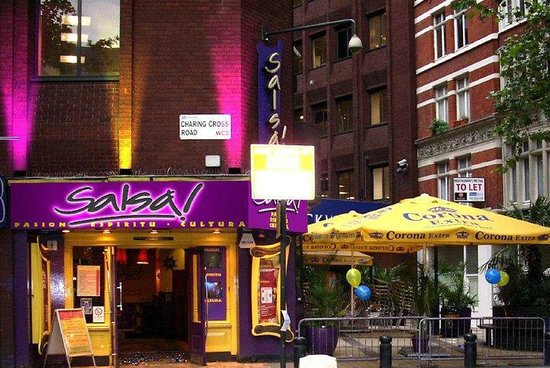
3.- Salsa! Soho:

Partying is what they do, and they do it well! Party with them and you will get a big injection of Latin party vibe to your celebration!

They have menus to suit all occasions. Salsa classes every night of the week, amazing drinks menu with over 50 cocktails and of course non- stop latin music. Enquire about booking and plan your party.

Salsa! Soho
Dance in Salsa! Soho

Address: 96 Charing Cross Rd, London WC2H 0JG

Call them: +44 20 7379 3277


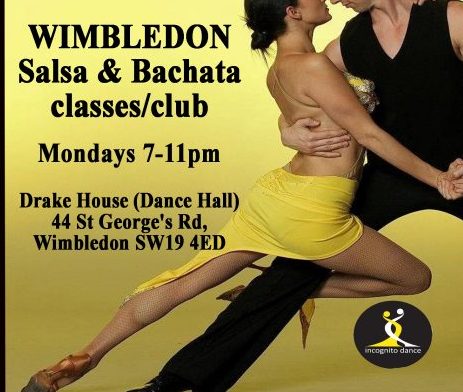
4.- Wimbledon Salsa and Bachata Club and Classes:

Fun & friendly classes for dancers of all levels. Plenty of high quality social dancing to the best and  latest Salsa, Bachata, Cha Cha and Latin grooves. Absolute beginners warmly welcomed. High quality lessons from Beginners to Advanced. No prior bookings needed, just turn up and dance.

Wimbledon Salsa and Bachata Club
Dance in Wimbledon Salsa and Bachata Club

Address: 44 St George’s Rd, Wimbledon, London SW19 4ED

Call them: +44 7831 715368


5.- Revolucion de Cuba:

Rum Bar & Cantina. Unique, expertly made cocktails and Latin-inspired food, with amazing music and live entertainment. Feel-good Cuban vibes all year round! This is not only one bar.

It’s the story of a team of rum lovers, who knew that taking on this spirit meant capturing it. And that doing so would lead to a discovery of food, drink, dance and the culture that makes up one of the world’s most exciting and intriguing places: The island of Cuba.

Revolucion de Cuba
Dance in Revolucion de Cuba

Address: More of 15 locations in England, you can choose anyone!

Call them: +44 1423 226133

We hope this alternatives help you enjoy a great party. Tell us how do you spend the night dancing London.

Soneros Birthdays Party

Soneros Birthdays Party

Omara Portuondo, Ismael Rivera, Jimmy Bosch, and Luisito Carrión celebrate their birthdays this month

October is filled with talent and it’s that in this month a hurricane of brilliant artists of the Salsero genre was born, who have captivated us and have shown their Gift before hundreds of audiences around the world. These Latin Stars have bathed us in SABOR with their lyrics and infected with joy with their melodies. It for that, this month we celebrate their births and dance to the rhythm of the applause towards them. Happy Birthday, Soneros!

Omara Portuondo (October 29, 1930)

Omara was born in La Habana (Cuba). Her first encounter with music was at a very early age. Just as in any other Cuban home, the future singer and her siblings grew up with the songs which her parents, for lack of a gramophone, sang to them. Those melodies, some of which still form part of her repertoire, were young Omara’s informal introduction to the world of music.

She and her sister Haydee sang well-known American group “Los Loquibambla” and their style, a Cubanised version of the Bossa Nova with touches of American jazz, was known as “Feeling”. In their radio debut, Omara was introduced as “Miss Omara Brown, the girlfriend of Feeling”.

“Magia Negra” was her debut record released in 1959. It combined Cuban music with American jazz and included versions of “That Old Black Magic” and “Caravan”, by Duke Ellington. Later she joined one of Cuba’s most important orchestras, La Orchestra Aragón, with which she recorded several albums, such as the one she did with Adalberto Álvarez in 1984 and “Palabras and Desafíos” on which she was accompanied by Chucho Valdés.

Omara Portuondo
Omara Portuondo

However, Omara Portuondo catapulted to her well-earned fame was in the mid-1990s when she collaborated in the recording sessions for Buena Vista Social Club on which she sang “Veinte Años”.

She was the star of the third launching of the Buena Vista Social Club released in 2000 and she toured Europe, traveled to Japan, and performed in the USA and Canada.

Omara went back to the studio to record her second solo album “Flor de Amor” (World Circuit), which was produced by Nick Gold and Alê Siqueira, signals a change in direction in her career: it is an album marked by a more subtle sound and a richness of texture. Portuondo brought in a mixture of Cuban and Brazilian musicians for this album, and it is this factor which influences the particular style of the music.

Omara returned to Europe in 2004 to promote this album, performing at such illustrious venues as the North Sea Jazz Festival, Marble Hill House in London, Olympia in Paris and the Concertgebouw in Amsterdam. “Flor de Amor” was nominated for a Grammy in the Best Traditional Tropical Record category and the 16th edition of the Billboard Latin Music Awards (2005); this album obtained the Tropical Record of the Year award.

Later, Omara released “Gracias”, the record that marks her sixtieth year in the music business and won the Latin Grammy Award for the Best Contemporary Tropical Album. It was a very special night as Omara was there to receive the prize in person and she also presented one of the awards, the first time that a Cuban artist has done this. The album was also later nominated for a Grammy in the Best Tropical Latin Album category.

After touring with the Orquesta Buena Vista Social Club in Europe during 2010, “the girlfriend of Feeling” released the latest recording, Omara & Chucho (Montuno Producciones) in spring 2011. 14 years after their last joint album, they reunite once again to continue unravelling the thread of their first joint project, and show us their talents in the simplest, most unclad manner on a context that enables them to lay emphasis on some of the features that been characteristic of their music at various stages in their careers.

Omara will also tour with the Orquesta Buena Vista Social Club later in Europe and the U.S.

Ismael Rivera (October 5, 1931 – May 13, 1987)

Puerto Rican singer and songwriter contributed to the dissemination of the island’s native rhythms such as the Bomba and Plena, and he was one of the first standard-bearers of the Salsero movement of the decade, the reason for he was called “El Sonero Mayor” and also known for others by the nickname “Maelo”.

In 1952 he was hired as a singer for the Lito Peña’s Orquesta Panamericana with which he became known and reaped his first hits: “La vieja en camisa”, “La sazón de la abuela” and the most popular “El charlatán”, a song in Plena rhythm that was widely heard through the Puerto Rico’s local radio stations.

Two years later he left this group to join the Combo de Cortijo with whom he popularized “El bombón de Elena” by Rafael Cepeda Atiles, and as well as performed on Puerto Rican television in the “El Show del Mediodía”.

At the end of the ‘50s, they were presenting their shows at the prestigious New York club Palladium Ballroom, where they contributed to making popular the tropical rhythms imported from the island with great hits such as “El negro bembón”, “Maquinó Landera”, “Tuntuneco ”, and others.

Ismael Rivera
Ismael Rivera

Ismael Rivera’s triumphant career was interrupted in 1962 for paying four years under the laws of Puerto Rico for possession of narcotics. Then, after recovering his freedom, Ismael formed his musical ensemble “Los Cachimbos” and immersed himself in the nascent Salsero movement to which he contributed two classics such as “Dime por qué” y “Mi negrita me espera”.

In the mid-70s “El Sonero Mayor” became the ambassador of Salsa throughout America, working for the record label of the genre Fania, and triumphing with emblematic songs such as “De todas maneras rosas”.

In his facet as a composer, he wrote very notable pieces such as “Besito de Coco” (famous song by Celiz Cruz), “El incomprendido”, “Arrecotín, arrecotán”, “El que no sufre no vive”, y “Mi libertad eres tú among many others.

In his last years, he suffered a throat cancer that caused him to lose his voice and he died as a result of a heart attack.  R.I.P MASTER!

Jimmy Bosch (October 18, 1959)

Jimmy Bosch was born in 1959 (New Jersey, U.S.). He is a world-renowned Trombonist, composer, singer, and bandleader in the world music genres. He has been performing professionally since age 13. Jimmy’s first two solo CDs, “Soneando Trombón” and “Salsa Dura” established him as the Ambassador of the Salsa Dura movement. He ignited this movement by combining old school quality salsa arrangements with a modern NY aggressive edge and socially conscious lyrics. “El Avión De La Salsa” demonstrates and solidifies his commitment to dancer centered music, while “A Millón” is the title of Jimmy’s 4th solo record released.

Jimmy Bosch
Jimmy Bosch

Appearing in over 100 recordings, Bosch “El Trombón Criollo de La Salsa” has garnered at least 10 Grammys and has toured with his orchestra, his sextet or as a solo artist, as well as with: Eddie Palmieri, Ruben Blades, Celia Cruz, Ray Barretto, Willie Colon, Manny Oquendo y Libre, FANIA Allstars, and the list goes on.

Jimmy has been featured throughout the world in major venues and festivals, including; Carnegie Hall, Lincoln Center (NYC), Celebrate Brooklyn (NYC), Montreal Jazz (Canada), Madison Square Garden (NYC), Sydney Opera House (Australia), Barranquijazz (Colombia), El Poliedro and Teresa Careña (Venezuela), and many other important places.

Luisito Carrión (OCTOBER 26, 1962)

A native of Arecibo in Puerto Rico, Luisito Carrión has been singing since he was 13 years old. He began his career as a Salsa artist with the Orquesta Kafe, Orquesta La Nativa and Grupo Concepto Latino.

In his first performances, he sang along with Celia Cruz, Adalberto Santiago, and Santitos Colón. Later on, he was a member of Salsa Fever together with Julio “Gunda” Merced, were several hits come from: “Renta de Amor” and “Señores ahí va Julián”. Afterward, he joined the Bobby Valentín Orchestra, where he sang songs, such as: “El Señor de las Señoras”, “Ramos de flores”, “El Gigoló”, “Tributo de Cali” and “Como lo hago yo”. In his evolutionary process, Luisito joined the Orquesta Don Perignon where he sang “La Fuga” and later with the Sonora Porceña, where he performed songs, such as “Yaré” and “A Comer Lechón”.

Luisito Carrión
Luisito Carrión

In 1997, he recorded with Roberto Roena y Su Apollo Sound “Mi música 1997”. At the end of the 90s, Carrión began his career as a soloist with the record company MP Records with Julio “Gunda” Mercéd and Rafael Bodo Torres, which led to hits, such as: “Sin tu amor”, “La Chica Más Popular”, “Nadie Como Tú”, “Porque”, “Amiga Mía”, “Muriendo”, “Como Ave Sin Rumbo” and “Para Ser Real”. Nowadays, Luisito Carrión is one of the best Puerto Rico’s Soneros bringing on “Histeriaaaa…” in his fans.

  • « Go to Previous Page
  • Page 1
  • Interim pages omitted …
  • Page 91
  • Page 92
  • Page 93
  • Page 94
  • Page 95
  • Interim pages omitted …
  • Page 168
  • Go to Next Page »

International Salsa Magazine (ISM) is a monthly publication about Salsa activities around the world, that has been publishing since 2007. It is a world network of volunteers coordinated by ISM Magazine. We are working to strengthen all the events by working together.