• Skip to primary navigation
  • Skip to main content

International Salsa Magazine

  • HOME
  • Previous editions
    • 2026
      • ISM / May 2026
      • ISM / April 2026
      • ISM / March 2026
      • ISM / February 2026
      • ISM / January 2026
    • 2025
      • ISM / December 2025
      • ISM / November 2025
      • ISM / October 2025
      • ISM / September 2025
      • ISM / August 2025
      • ISM / July 2025
      • ISM / June 2025
      • ISM / May2025
      • ISM / April 2025
      • ISM / March 2025
      • ISM / February 2025
      • ISM / January 2025
    • 2024
      • ISM / December 2024
      • ISM / November 2024
      • ISM / October 2024
      • ISM / September 2024
      • ISM / August 2024
      • ISM / July 2024
      • ISM / June 2024
      • ISM / May 2024
      • ISM / April 2024
      • ISM / March 2024
      • ISM / February 2024
      • ISM / January 2024
    • 2023
      • ISM / December 2023
      • ISM / November 2023
      • ISM / October 2023
      • ISM – September 2023
      • ISM – August 2023
      • ISM July 2023
      • ISM Edition June 2023
      • ISM – May 2023
      • ISM April 2023
      • ISM March 2023
      • ISM February 2023
      • ISM January 2023
    • 2022
      • ISM December 2022
      • ISM November 2022
      • ISM October 2022
      • ISM September 2022
      • ISM August 2022
      • ISM July 2022
      • ISM June 2022
      • ISM May 2022
      • ISM February 2022
      • ISM January 2022
    • 2021
      • ISM December 2021
      • ISM November 2021
      • ISM October – 2021
      • ISM September 2021
      • ISM August 2021
      • ISM July 2021
      • ISM May 2021
      • ISM April 2021
      • ISM June 2021
      • ISM March 2021
      • ISM February 2021
      • ISM January 2021
    • 2020
      • ISM December 2020
      • ISM November 2020
      • ISM October 2020
      • ISM September 2020
      • ISM August 2020
      • ISM July 2020
      • ISM June 2020
      • ISM May 2020
      • ISM April 2020
      • ISM March 2020
      • ISM February 2020
      • ISM January 2020
    • 2019
      • ISM December 2019
      • ISM November 2019
      • ISM October 2019
      • ISM Septembre 2019
      • ISM August 2019
      • ISM July 2019
      • ISM June 2019
    • 2016
      • ISM December 2016
  • Spanish
  • Download Salsa App
    • Android
    • Apple

Search Results for: Dance Company

John Narváez and Elizabeth Rojas from Salsamania

John and Liz from Salsamania  

Between days 23 and 25 March, 2023, the San Francisco Salsa Festival took place, which brought together some of the cream of The Bay Area Latin music scene. One of those attending this great event was the main editor of International Salsa Magazine, Mr. Eduardo Guilarte.   

On site, he had the opportunity to share with other guests and some of the organizers such as Elizabeth Rojas, affectionately known as Liz, and John Narváez. We had the chance to talk with both dance professionals to know more about their beginnings, festivals and projects. Do not miss it!  

John and Elizabeth
Colombian dancers John Narváez and Elizabeth Rojas

Beginnings   

After several attempts to schedule a meeting with John and Liz, we finally managed to talk with these Colombian dancers and entrepreneurs, who began by thanking us for the contact and the opportunity to promote their passion for salsa and the community they represent.   

This love they have for the aforementioned musical genre has much to do with their roots. Both were born in Colombia and left the country when they were 12 years old (they are the same age) because of the violent situation caused by the guerrilla that existed in those years.   

Although those were hard times, John says these were very nice years from which he has fond memories. He remembers almost all his family members singing or playing an instrument, while he was the only dancer. All this influenced him in such a way that Latin music remains his north after so many years.  

Moving to the United States 

Since the social situation did not allow them to live in their country, they decided to move to the United States and apply for political asylum. At the beginning, it was not easy and the focus was on working hard to get ahead in this new country and to learn English. However, all that changed over time. 

With the arrival of economic and family stability, priorities changed. John comments that his interest in music and dance perked back up due to the family gatherings that his relatives celebrated such as birthdays, quinceañeras, weddings, among others. 

Although at the time dancing was not considered a serious profession, both John and Liz began to practice it at amateur level. Once they turned 21, they started going to the most popular salsa clubs, but it was all for recreational purposes. It was years later before they began to analyze all the technical and historical part of dancing to understand it better and take it more seriously.  

John, Liz, and Barbara
John and Liz with Barbara on Despierta América

Dancing as a profession 

John and Liz started to take dancing seriously in 1999. They both attended a three-day salsa event in Los Angeles, but what they did not know is that this was the first world salsa congress in America.   

This gave them the opportunity to share with the best salsa dancers in the world and they saw such impressive things that they were inspired to return next year with a well-established dance team with which they could participate fully in these activities. 

Being full of motivation, they decided to create Salsamania Dance Company and performed with their team at the festival. They started doing the same thing every year, which helped them gain experience and evolve their styles. 

After earning the trust of the festival organizers thanks to their talent and professionalism, they were given the opportunity to start teaching salsa workshops at the aforementioned congress. This is how little by little John and Liz began to build the reputation and credibility they have today.   

 In 2004, it got to a point where John took the important decision to quit his job to devote himself to dancing and Liz was quick to do the same. His resignation came with the opportunity to take a three-month trip to Hong Kong to teach salsa in a community where people did not dance it. 

They managed to build a community from nothing, since at that time, Hong Kong was not a place where people listened to salsa. However, everything went well and the dancers managed to seamlessly connect with the local audience. As John rightly said, ”salsa is a universal language and you don’t have to speak that language to feel the music”. 

On returning to the Bay Area, they began to practice dancing as a profession in the United States. 

On this point, Liz commented that her parents became very upset with her when she quit her job because of dancing, but today, they admit that it was the right decision and support her totally.  
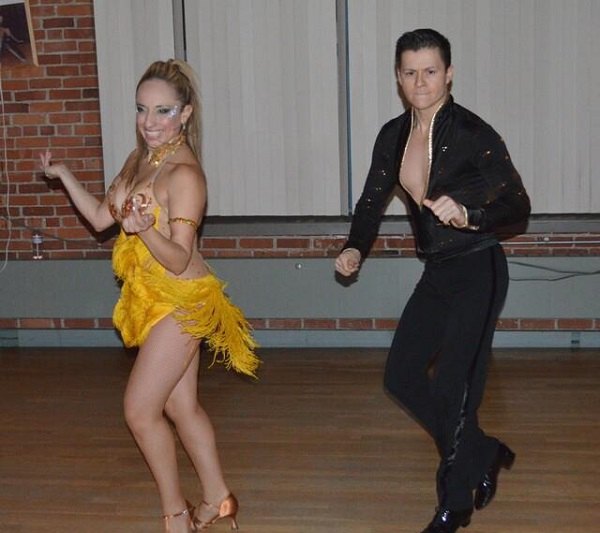
Liz and John dancing
Liz and John during a social dance in Boston

Salsamania Dance Company 

Liz told us that it was difficult to create Salsamania Dance Company because it requires a lot of discipline and healthy coexistance between different types of personalities to create a group like this and keep it together. Fortunately, John is an industrial psychologist, so he helped to prevent these aspects to be a problem. 

Basically, Liz is responsible for the company’s management and John is the one who takes care of the human part of all the staff. 

They started the whole process like any regular company and drew up the contracts for all those who were going to work with them, making Salsamania a much more established, structured and serious project in the eyes of everyone else. Today, it is one of the largest companies in the Bay Area.   

They also took it a step further and built a salsa academic program with a thoroughness and detail that has not been seen in other projects of this kind.   

San Francisco Salsa Festival  

San Francisco Salsa Festival is one of the biggest salsa events in California and the United States in general and we were fortunate to have representation there with our editor Eduardo Guilarte.  

It began to be celebrated in 2008 with the support of international salsa promoter Albert Torres, who was a fundamental piece in the development of the festival and talent recruitment for an event of this size, as there were many things John and Liz had to learn. That is why they are both incredibly grateful for what the congress organizer did for them back then.  

To recruit artists, the dancers only require candidates to be good teachers, to share with the salsa community and to put on a good show for the audience. 

They also often invite colleagues they have known for years and some recommended to whom they give them the opportunity to shine and make themselves known during those days. 

Every year, they look for dancers, dance instructors, DJs and live orchestras. For Liz and John, the thing about live bands is very important, as they are concerned that there are so many clubs and venues that no longer hire these talents. This year, they focused on local bands that play on Thursdays and Fridays in San Francisco and were very happy with the results.  

It is expected that the next San Francisco Salsa Festival is scheduled between days 22 and 24 March, 2024 at the same venue, which is the Marriott Waterfront Hotel.   

The orchestras hired to perform for next year are Cabanijazz, The Latin Rhythm Boys and Orquesta Boyacán. The dancing couples are Alex and Judy from Colombia, Colombians Felipe from Colombia and Kathe and Mauricio and Danny from Mexico.   
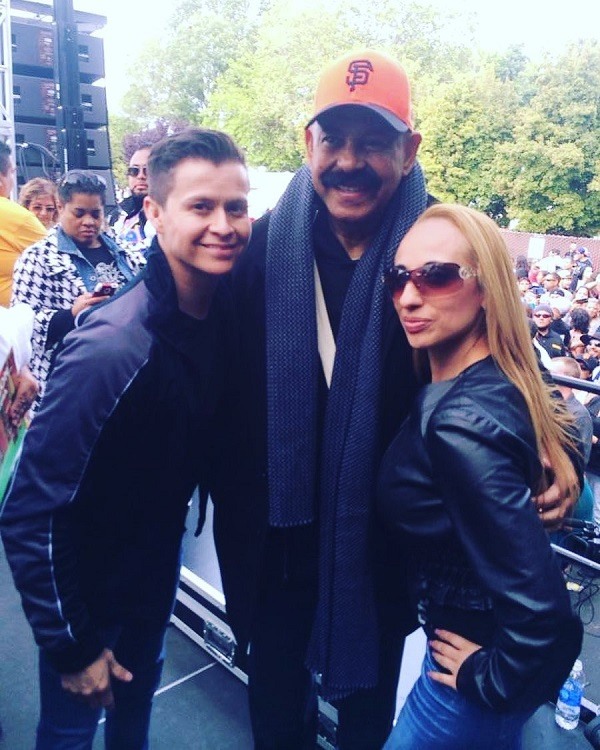
John, Liz, and Oscar D’ León
John and Liz with Venezuelan singer Oscar D’ León

Difficulties in the pandemic 

As dancing is an activity with a lot of physical contact and closeness, we were curious to know how they lived the pandemic and what they did to keep their project afloat in this situation. 

Though they admit that those months were not easy, they have always been very disciplined with their money and had enough to resist as long as possible without working.   

They tried to make up for lost time by teaching classes via Zoom as did most of their colleagues and designing new choreographies to apply when they went back to their usual activities. 

In addition to this, both had not spent time with their respective families in a long time, so they also took advantage of the absence of work to reunite with their loved ones and take up those important contacts that were lost due to stress and routine. 

Read also: Here we have Salseros With Attitude 

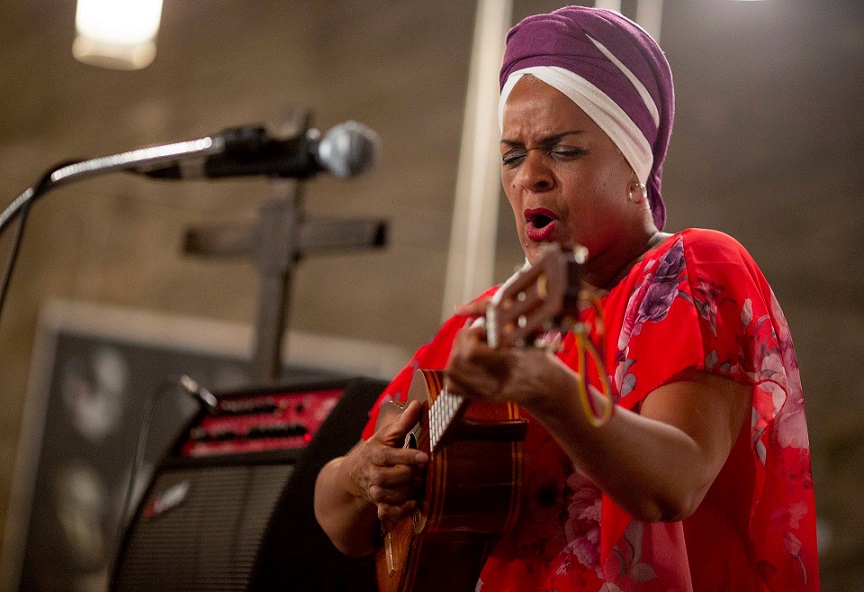
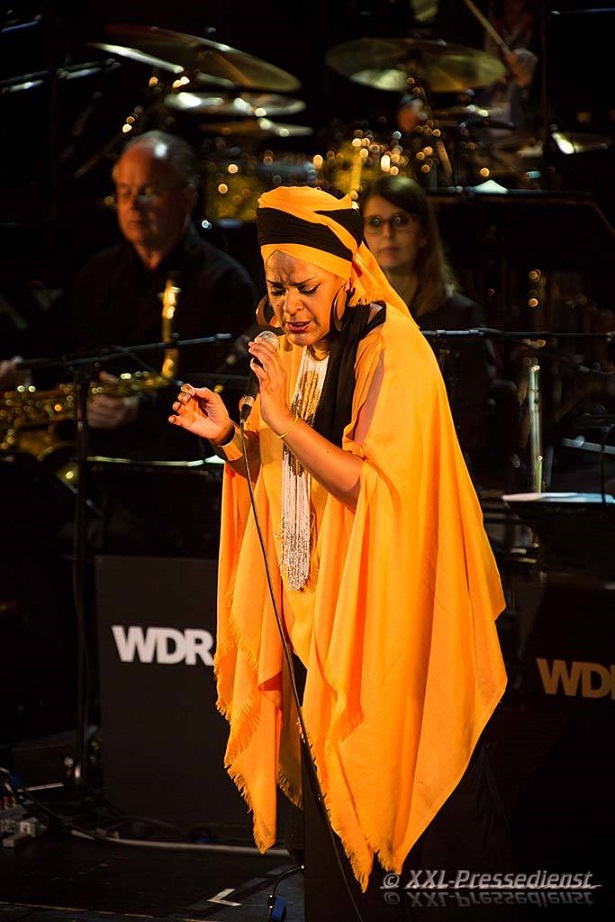
Yma América

Yma América “Every time I go out to play, to sing, I show my training and above all I put the name of Venezuela up and without speaking much.”

Yma América, she reaffirms that; We have done a good job, making our Latin music and culture known.

The trace that many Venezuelan artists, who have decided to settle abroad, are leaving behind is passing through the world, because they distinguish themselves by their achievements and place the name of Venezuela in a big way, making their fellow citizens proud of their successes, such is the case of Yma América Martínez, born in Caracas and based in Germany for almost 30 years.

With a musical vein that he inherited from his parents who points us out, they were the fundamental pillar in his training and career, and why not, for having grown up in one of the most musical parishes in Caracas, the San Agustín del Sur neighborhood, Marín sector, from where great characters have come out including his uncle the choreographer and dancer Carlos Enrique Orta (+), who traveled with his dance company, “Coreoarte” great stages throughout the world.

His musical beginnings were with a group created by his father “Los group created by his father “Los Azulitos Juveniles” where he sang aguinaldos with his sisters and neighbors, and then entered the San Agustín Choir at Don Pedro School “Fe y Alegría”.

(Yma América) She received her academic preparation at the “José Ángel Lamas” School of Music and the “Simón Bolívar” National and Youth Orchestra, to continue her cello studies in Paris at the “Ecole Normale de Musique de Paris” and song and composition at the CODARTS of the World Conservatory of Music in Rotterdam.

Yma América
Yma América

Yma América is a singer, musician, songwriter, arranger, plays the violoncello and the cuatro. It’s clear and powerful voice makes it very popular throughout Europe. He has worked with different groups; Kimbiza, Latin Sampling, Francisco Zumaqué, Connecting Latina, Mirta & The Goalgetters, Duo Ymaya, Cubop City Big Band, among others. He has participated in major jazz and classical music festivals, such as the Ruhr Guitar Festival, the North Sea Jazz Festival, the RuhrTriennale, the MusikTriennale Köln and the Elblandfestspiele. In 2004 his record made her the winner of the international competition “Voice and Guitar” in Saarbrücken – Germany, obtaining the first prize with the Colombian guitarist Andrés Mendoza Villamil.

Another relevant fact in the life of this artist can be seen in the song “Play it”, a song that he composed and sang for the commercial of the Bacardi company, which became a success in the summer of 1998 and 2000. He participated in the musical “King of The Lions” with WDR Big Band in the main role of Lilipuz’s children’s concert “Die schlaue Mama Sambona”; and has performed more than 30 times with the production “Adventure Weltumrundung” of the Fly & Help Foundation.

She has on her shoulders the responsibility of a great project that he has in Germany and wishes to perform in his native country, to make music with percussion for deaf people called “FEEL SOUNDS”, due to this proposal in 2010 he was awarded La Disability Policy of the Cologne Innovation Award (KIB).

He assures us that; “The language of music is the same throughout the planet,” with this phrase we enter to discover the virtues, dreams and desires of the interviewee.

How is Yma América defined?

“It is not easy to answer this, but I think I am a very patient and calm person, I would say too much. I do not give myself a bad life, fortunately I have done what I wanted, thanks to the support of my parents and family in general”. “I am a character who, thanks to the gods, things and opportunities have been offered to me, some have taken advantage of them, some have not, there are some that I have not realized in time that they have been there waiting for me and I have lost.

But I can say that I have lived my life, with the ups, downs, good and bad, without involving anyone and thus I have been leading and learning.”

Part of his training was obtained through the Conservatory of Music “José Ángel Lamas” and the National and Youth Orchestra “Simón Bolívar”

What do you thank and how he gives back his training with them?

“I thank you for part of my training as the musician that I am, because the other part I owe to my family and my people where I come from.” “-Retribute-“, I think that every time I go out to play, to sing, I show my training and above all I put the name of Venezuela up and without speaking much”.

What do you think of the phrase “Nobody is a Prophet in his Land”?

“-Sincerely do not know what you mean-“. “I don’t think I would have started singing professionally if I had stayed in Venezuela. I was quiet there, I played Violoncello in the National and Youth Orchestra of Venezuela, I played and made substitutions for cellists in the Philharmonic Orchestra of Venezuela and in the Municipal Orchestra of Caracas, I sang solo of vacilón in each party and family celebration, and Actually I was very calm in my house. ”

“I don’t think I’m a” prophet “where I am, I always do my best and people value it and often criticize it, of course.”

Why did you choose Germany and not another Latin American country? How many years have you lived in German Colony?

“I left Caracas in 1986 to Paris-France, thanks to my grandmother working in a wealthy family home and they offered to help a family member to study abroad, specifically in France because they had relatives there. First my uncle Carlos Enrique Orta – Choreographer-dancer with a lot of international professional career – left, many years before and then I wanted to “take the floor” after a while ”.

“Actually I wanted to study violoncello for 1 year in Paris and return to Venezuela, but at the end of my 1st year of study at the “Ècolle Normale de Musique de Paris”, they offered me to stay and I did not refuse. The last year of studies in Paris I did not have much money to live and in Köln-Germany lived the musicians of ‘COREOARTE’ (Dance company created by my uncle Carlos Enrique Orta with dancers and musicians of San Agustín), at that time I was leaving every weekend, on Fridays after school, from Paris to Köln and I returned on Monday at 6 am and arrived directly to classes in the afternoon.

I did that because we played; Renis Mendoza, Felipe “Mandingo” Rengifo, Charles Peñalver, Orlando “El Diablo” Blanco and I was in the street to collect some money and brighten the streets and faces of the Germans, and with that I could buy food for the whole week in Paris until the following Friday that I was returning to Köln … and so for many months until after finishing my studies, I decided to move to Köln and the first months I lived at the home of Renis Mendoza who shared his apartment with another ‘Coreoarte’ boy and then I got my room sharing an apartment with a German girl. ”

Yma América
Yma América

“I lived first in Paris from 1986 to 1990, 4 years and from 1990 to the present day in Köln, next year I am 30 years old based in Germany, I say “I have my bed in Köln “, because in reality I am almost never in my home, thanks to the music and the life that has given me so much ”

“I never thought, nor have I imagined living in another country in Latin America, I think that from here, I’m going to my house … Pa ‘Venezuela (to Venezuela)!”

How has been the receptivity of the German public with Latin rhythms, there was no resistance?

“At this moment there is a stagnation in the development of activities with Latin music, but in the same way there is more and more receptivity, I know we have done a good job, making our Latin music and culture known, there are several Salsa bands with German musicians, there are more and more dancers, more dance classes, many have understood the message and others interpret it to its wave but there is a lot of atmosphere and places with Latin music, with Dj of Salsa-Merengue and the crap they call Reggaeton music”.

“I must say that some years ago there were more Salsa orchestras with German musicians and there were more Salsa Festivals that unfortunately has been reduced by the phenomenon” Salsa Dj “I think and I am almost certain, because it is cheaper and people dance the same. That has done a lot of damage to live music. ”

What memories do you have of being under the baton of these great maestro Abreu, Aldermaro Romero, Carlos Riazuelo and Yehudi Menuhin?

“I don’t really remember at this moment any particular experience or directly with them. Although I had more contact with José Antonio Abreu, the experience was the same as with many of the ONJV members. But of all of them, the security with which they could dominate and control the amount of musicians an Orchestra has, and especially that in style and classical pieces, the feeling that is transmitted is that of the conductor and not that of the conductor musician or performer. Of course they were wonderful experiences. ”

How many compositions have you performed?

“Honestly, not many, about 12 but arrangements have been made, played and recorded, only 4.”

Your parents have been promoters of your career, how do you thank them?

-Chacha! –

“My parents are the reason for my profession, from them is that this Yma America that you are interviewing for my work has come out. Thanks to their way of being, their offspring, their education, I thank them for what I am and what I have done … My life. ”

Are you constantly growing anecdotes of your time at the “Normal School of Music in Paris” and the “Conservatory of World Music”?

“In Paris, I think, having to change the mentality of learning everything little by little and without hurry like in Venezuela, to the need to charge the “batteries” because here they do not wait, I have to go for it and comply daily, in addition to that that impelled me to learn the French language faster ”.

“And in Holland, going from being a student to being the singer of the Cubop City Big Band of the Prof. of the conservatory Martin Verdonk (percussion), Leslie López (bassist) and directed by the drummer Prof. Lucas van Merkwijk that was strong, especially at the beginning that it was to understand how they interpreted Latin music that is something other than Latin Jazz, there we started with Mambo of one, and as Leslie López was the bassist of Puerto Rico there was a balance and there we were learning and obtaining experiences all alike. ”

How do you feel about working alongside the Dutch percussionist and producer Lucas Van Merwijk and being the vocalist of the hit band “Cubop City Big Band”?

-Chévere! – assures us

“Working with Lucas and with those wonderful musicians, people with an extraordinary musical level, is very relaxed, zero stress, there we have all learned, failures and successes have gone hand in hand with everyone. Next year (2020), with CUBOP CITY Big Band we will be 25 years old together and surely something good will be done, something wonderful is being cooked, with maestro Edy Martínez – Colombian pianist, composer and arranger -, of course, also thanks to the Lucas’s wife, Roosje who does a great job, is the organizer/ manager of that crowd and all the tours. ”

Have you surrounded yourself and trained with musicians who, due to their quality and career, are considered the best, what do you think you still have to do?

“I have done and learned many things from life, both personally and musically, I believe and I know that I am missing a lot, now I have to do and learn.”

Hasn’t language been an obstacle?

“No, musically speaking, no, the language of music is the same on the entire planet.” “The French language I had to learn quickly because I came from Venezuela directly to the Conservatory of music, in Holland the classes are in English and I did not have to learn Dutch and the German language has been strong in other daily situations or life in general.”

In which festivals have you participated in both Europe and Venezuela?

– Oh! – “How many exactly I cannot tell you, but in these 30 years living in Germany and making music professionally there have been many, in almost all of Europe.”

There is a project with deaf people in Germany, which we hope can also be carried out in Venezuela. Tell us about that musical project and why did you decide that this topic should be precisely?

“TO FEEL (FEEL) – SOUNDS (SOUNDS), but as my name I put” FEEL SOUNDS “in view of the fact that the sense of touch is much more developed in deaf people and my work is based on making music with percussion, so that the vibration of sound is what they feel. ”

“It is a project that I have had in mind for many years, 1980, when I was studying” Hospitality and Tourism Administration “at the University College of Caracas and doing a field job in San José de Río Chico, at the end of my activity and visiting people, they gave me a party, drums and fulías until dawn, there were 5 drummers, dad and 4 children and in the end dad tells me that one of them was deaf. And the young man played very well, I never imagined he could be deaf, he played perfect and we even danced salsa. And from there I had the idea of working and teaching percussion to the deaf. ”

“After all that time, it was that in one of those turns that gives life, I had the courage and I started studying” German Sign Language “and I planned my workshops, I went to the deaf schools in Köln, many percussionist friends helped me Renis lent me his drums and plays with us each presentation at the end of the workshops, other friends lent me his rehearsal room to teach, my Sign Language teacher supported me looking for money to move on … and so…

This year I will be 10 years of having developed it here in Germany and the experience has been wonderful, every day I learn more and more of that world that I cannot imagine, but seeing everyone’s face when they feel the vibration of the sound when they play a drum – event listeners, people without hearing problems – that feeling is uniquely Fascinating! ”.

Yma América
Yma América

Working with children and adults with special conditions is a great challenge. What do you feel when you see that experience come true?

“I feel that I must move on, I have already been invited to several cities in Germany, the Netherlands and Poland and I want to continue doing it, take it to my country and fulfill my desire to develop it there, carry it out, execute it and make it known in my Venezuela.

Although several years ago I attended a conference held by FEVENSOR Federation of the Deaf of Venezuela, with the assistance of several Latin American countries, Spain and Australia, I made an exhibition and presentation of several deaf young people who attended, with the participation and collaboration of Naifer Hernández and Juan Carlos “El Indio”, Betancourt percussionists from San Agustín / Marín, but everything remained there. Of course, I must always be present in order to move forward, it is like that.

I lack the financial support because the program, project, the subjects, the desire, the yearning and the cravings are already there, but I keep moving and insisting, searching and “cursing” until I find the support itself. ”

What new projects are coming?

“We recently started with a new project for the Latin American Music Trio, from Mexico to Argentina, with Prof. Thomas Böttcher, German pianist, Renis Mendoza Venezuelan percussionist, also from San Agustín / Marín and I singing and playing Violoncello, we are in the preparations, making videos, propaganda, looking for program and composing, also in conversations and looking for an agency to sell it and move it forward. The 25th anniversary of Cubop City Big band next year, has finished looking for the musical program for those celebratory concerts. ”

“Continue with my musical project“ FEEL SOUNDS ”, teaching my classes and music workshops to groups of children, youth and deaf adults and from January 1st, start giving talks on this new proposal to students of” Education and Special Pedagogy “to keep moving forward with this and carry it forward until it reaches Venezuela and the entire world. ”

What does the San Agustin parish mean to you?

“It is the neighborhood where I was born, there is all my childhood and adolescence, I love it and I respect its inhabitants very much, besides there is my family whom I love with all my being, there have always been many valuable people, thanks to that work that artists have been doing and all that cultured and fighter generation that lives and has always maintained that training and information contact with the new generations. San Agustín is the good people who live there, the rest is everywhere in the world”.

Yma América
Yma América

Venezuela in one word?

“-MUSIC-” in capital letters.


Eiling Blanco Latin America Correspondent 


Carlos David Suarez

North America - USA - Texas - Houston

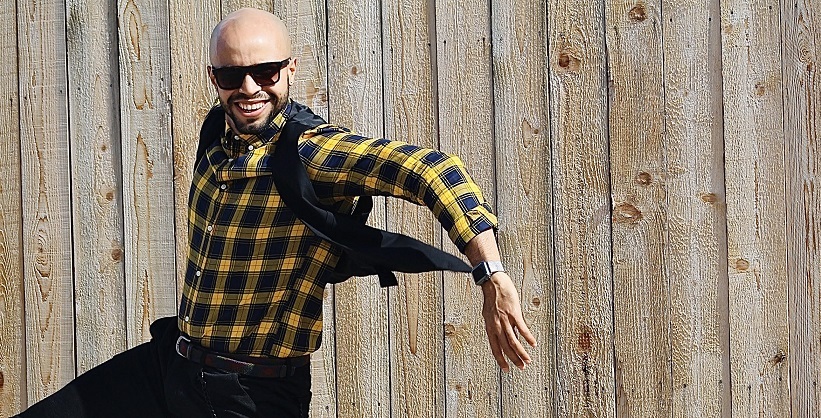
Carlos David Suarez, Professional dancer, choreographer, instructor and musician

Art has been in his veins since he was born, and Carlos David Suarez has cultivated his artistic gift, going far and traveling the world teaching and learning

He was born in Caracas, Venezuela, and grew up in the west of the city in the 23 de Enero, a well-known area to give birth and raise artists, athletes and talented people.

Carlos knew from a very young age that he wanted to be a musician (timbalero) … At 7 or 8 years old, his parents took him to the house of one of the best percussionists in Venezuela and from that moment he began his career in the art world.

Later, his mother could not take him to music classes anymore and unfortunately had to leave them aside, and continue with his primary studies. Although in one way or another, he was always connected with the stage and the dance. At school, he was part of plays, acts, traditional dances and everything related to the arts.

Photo by Carlos David Suarez

Years later, he started playing soccer, and soon realized that he was in love with the sport, and began training hard to thrive within teams.

One of his main strengths is discipline, so he applied it to both: art and sport. He came to play on good teams and was seen himself playing professionally outside of his native country.

“Yes, I always saw myself outside Venezuela, not because of any specific situation, but because as a child I saw myself traveling the world with music, art, or sports.”

Years later, when he was 14, his older brother took him to Imagenes Latinas, an incredible artistic dance school where he trained, and the only one he attended for at least 8 years. There he studied ballet, contemporary dance, jazz, hip hop, funky, Latin genres and above all; Salsa.

“I had great teachers who gave me the opportunity, seeing that desire to be a better artist every day, especially Arelis Guevara, owner and choreographer of the company”

After many efforts, sacrifices, study and, above all, hours after hours of rehearsals, Carlos become the first dancer of the professional company for three consecutive years. He traveled with the company to many national and international events, conferences and TV shows … South America, USA, Europe and Asia.

After his stay in the company, he decided to take other roads, take his own path and do new things. It was part of a ballet where he made musicals and all kinds of varied shows. He learned a lot about other disciplines such as tap, flamenco, nationalist dance, tango; and even a little acting.

He was in the ranks of this ballet for two years and then took his path as a soloist. For the first time, he had the opportunity to travel outside his country; to Miami.

“I was working on famous nightclub shows; then I went to Los Angeles to work with another dance company that I was in for a short time and then I went to Panama. ”

He worked for a short time in Panama; he returned for a short time to Venezuela, and moved to Casablanca, Morocco, where he worked in Salsa and Bachata shows. After two years, and to continue evolving in his artistic career, he decided to go to Europe. He arrived to the city of Amsterdam, Holland, where he was doing shows and workshops at congresses as a soloist.

Soon, he moved to Germany to pursue his dance training … He lived in Germany for two years, worked at various dance schools, and began to expand his horizons, making himself known at Salsa conferences throughout Germany, Europe and Africa. Then after another job offer, and pursuing more dreams and learning, he moved to Milano, Italy, where he lived for a couple of years and the opportunities to go to conferences and festivals were multiplying, giving classes and workshops in Europe, Africa and the United States.

At the time of this interview, Carlos is based in the United States completing art projects with other companies.

Carlos David Suarez pose

“I have had the joy of playing as a musician, and working with excellent companies, dancers, famous awards and great artists such as Juan Luis Guerra, Gilberto Santa Rosa, Pitbull, Chino & Nacho, El Gran Combo de PR, Los Adolescentes, among others. .. ”

Carlos Suárez continues to study, train and learn more and more from this career, which in his opinion is infinite to learn. He continues to work as an instructor, choreographer and dancer, doing shows at many festivals, giving his best at every step, respecting his work, image, integrity and ethics.

Get to know Carlos David Suarez more closely

International Salsa Magazine (ISM): Define in 5 lines, who is Carlos Suarez?

Carlos Suarez (CS):

A person who respects everyone, considering that we are equal, and each one has a different knowledge, talent and strength. A person who aspired, fought and achieved his dream of being an artist, despite all the experiences. Lover to be able to help and teach everyone. Someone who always gives all the support and love to his family and friends. Very disciplined with himself and with his students.

ISM: What do you enjoy most about your profession?

CS: Being able to get to know many countries, cultures, new people, and above all, being able to inspire others to believe in a discipline such as art.

ISM On what platforms and upcoming events (face-to-face and virtual we will see you)?

CS: To see me on platforms or social media, you can go to my Instagram: @casu__ or my Facebook page: CaSu – Dance & Beats. On these two platforms I always leave all my videos of classes, shows, workshops, musicals, etc. Right now due to the pandemic I do not have specific information on where I will be presenting myself, but if you follow me on the social media, you will know just when I know it.

ISM: How do you see yourself in 5 years?

CS: Good question …

I still see myself exercising my career as an artist and dedicating myself much more to music, which is one of the things that I’m most passionate about, and I haven’t had the opportunity to dedicate myself 100%. I see myself as an even more trained person and with much more knowledge, I also see myself dedicating love to a family and above all … I see myself being happy without hurting anyone.

Carlos David Suarez
Carlos David Suarez

ISM: What is your advice for those young people who, like you, are fighting for their dreams in the dance world?

CS: My advice is to never let anyone make fun of your dreams, nor do you make fun of the dreams of others … I believed, I bet on myself, and I won … I am the artist I wanted to be and I still have a long way to go, but all this does not come alone … It is a process that costs a lot, studying, preparing, always staying mentally and physically fit, learning languages ​​so that they can defend themselves in the world and, above all, be people who love and respect their work … Art.

Anya Katsevman: “You have the dream, I have the tools”

USA - New York - New York

When we refer to Anya Katsevman, the first word that comes to mind is: passion! And that is the only way we could explain that a woman has so much strength, dedication and dedication in different facets of her life.

Anya Katsevman is not only a dancer and choreographer, but also a motivational coach and dream builder. In addition, it has its own line of dance dresses and costumes. An unstoppable woman!

Anya Katsevman by Franklin Liranzo
Anya Katsevman Courtesy of Franklin Liranzo

A native of Kiev, Ukraine, Anya and her family immigrated to the United States when she was 8 years old. She is the younger sister of award-winning Latin dancer Eugene Katsevman. She lives in New York.

She also holds numerous titles in salsa. Among them, she is a two-time World Champion as well as the San Francisco International Salsa Congress and New York Salsa Congress Champion.

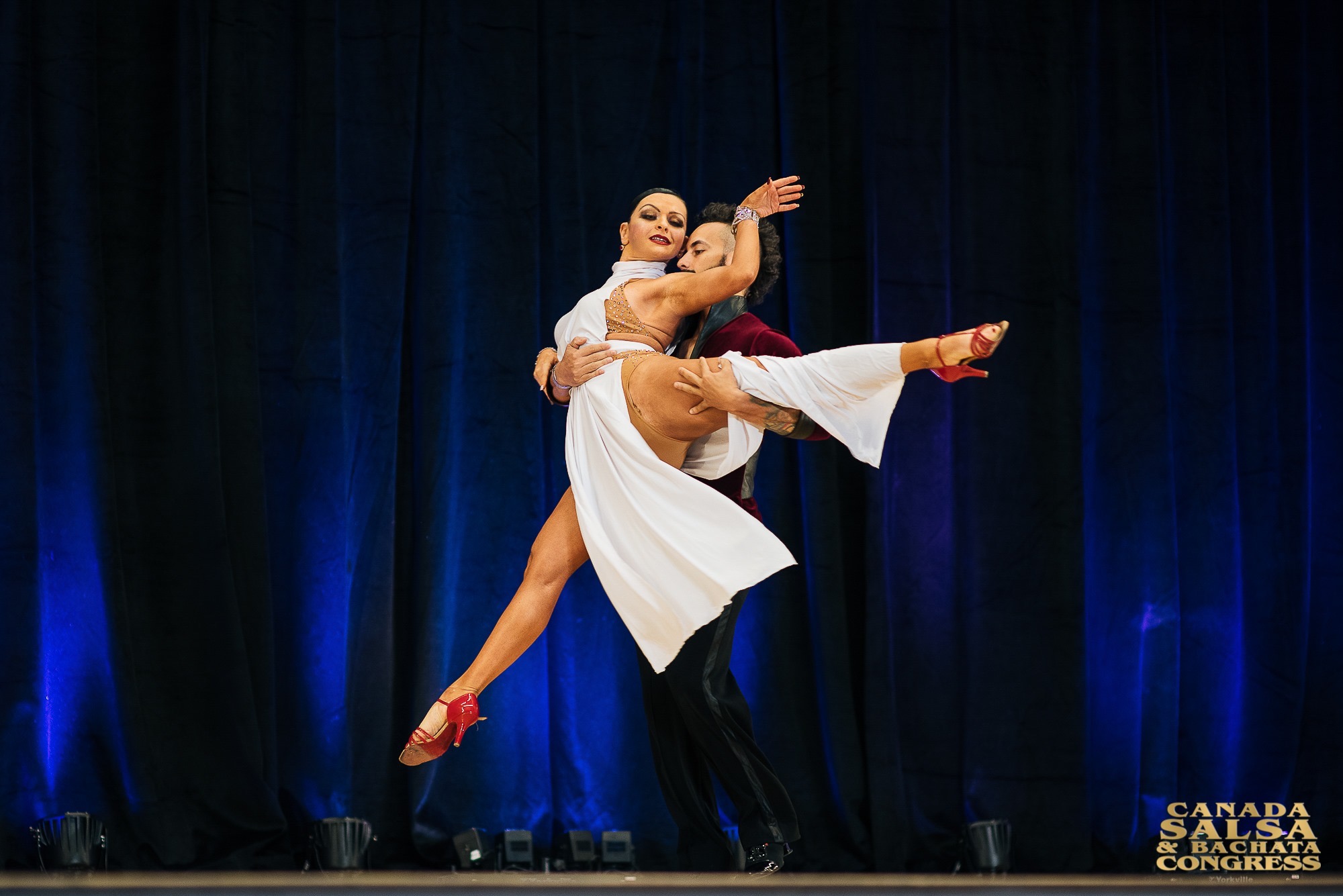
Anya Katsevman dancing

Anya Katsevman is a maker of champions

This is precisely the distinctive mark of Anya Katsevman , that ability to make each dancer, each artist, each dreamer discover in himself his potential to succeed, his style and make the most of his abilities.

She believes that “the art of dance requires much physical ability, exposure and practice. The art of dance is also developing your own voice and getting to know the artist behind the athlete that makes the dancer”

A wonderful career

“Queen of Salsa” Anya Katsevman is a two-time World Salsa Champion, coach and choreographer to more than a dozen world champions, noted costume designer, respected salsa congress circuit judge and advocate for international Latin dance who has transformed the sport during her more than 25-year career.

Anya Katsevman
Anya Katsevman

Renowned for her unique coaching methods, Anya’s style blends multiple cultures and dance forms: her eastern European upbringing and the appreciation for Latin dance culture that she developed in the United States; and her ballroom and salsa backgrounds. She demands rigor, discipline and excellence, and uses her understanding of anatomy, physiology and movement while encouraging freedom of expression to turn her students into the top dancers in the world.

Anya trains and choreographs for “Dancing with the Stars Costa Rica” principal dancer Lucia Jimenez (2020 World Bachata, Chacha and Salsa Champion), “America’s Got Talent” stars Harold Rancano and Regan Hirose (9-time World Bachata Champions), the Huracan Dance Company (2019 World Team Salsa Champions), the stars of Quebec’s 
Revolucion Adriano Leropoli and Samantha Scali (2017 World Salsa Champions), principal dancers in Carmen to Havana and Back Isabelle Freiberger and Hunter Houde and the USA World Games Olympic salsa team.

Always successful and sharing her knowledge

As a competitor and performer, Anya has won more than 20 world titles including the 2009 and 2010 Salsa World Championships. She is also the 2008 North American Salsa Champion, a two-time San Francisco Open Salsa Champion, two-time New York Congress Salsa Champion, Puerto Rico Open Salsa Champion and La Classique Du Quebec Champion. Anya has starred in touring shows “Burn the Floor ” on Broadway and ABC’s “Dancing with the Stars, in addition to numerous other television productions, stage shows, movies, and showcases in the U.S. She has performed with El Gran Combo, Gilberto Santa Rosa and “The Mambo King” Eddie Torres, and for President Barack Obama.

Anya Katsevman - dancers
Anya Katsevman – dancers

Anya is an ambassador for salsa, helping to expand its popularity worldwide. She believes connection is one of the most important aspects of the human experience, and dance is the best medium to explore how we connect with each other and ourselves. Anya has expanded her dance instruction to include GoDeeper, which she co-founded in 2019 to provide monthly movement classes, individual coaching sessions, and group workshops to promote professional growth and self discovery.

Meet this talented woman

International Salsa Magazine had the pleasure of interviewing Anya recently and invites you to learn a little more about this magnificent artist.

International Salsa Magazine (ISM): How did you discover your passion for Latin Dance?

Anya Katsevman (AK): My brother is a professional ballroom dancer

I started to dance ballroom in 1995 following his footsteps  I competed in the international Latin category world wide  in 2007 I was teaching in a dance studio in Manhattan and they did a lot of salsa  that’s where I was introduced to social dancing  I fell in love with the idea that dance is accessible to all people and doesn’t have to be competitive  from there my love for salsa turned in to a career choice  I decided to study Latin social dance and became a two time world salsa champion  for me it was a passion to spread the beauty of dance through teaching as much as performing that did the trick.

ISM: Have you had any obstacle in your professional life? How could you overcome them?

AK: I think when your career is long enough you will probably have many obstacles to overcome  and your passion for your craft and the reason you do it is usually stronger than the obstacle in front of you that gives you the drive to overcome it  it is hard to narrow specifics down because I’ve had so many  my competitive dance partner lived 3000 miles away from me when we won the worlds in 2010 and I just made the commitment to work hard and travel pick up the slack where needed and get the job done regardless I think that was the formula in every struggle.

ISM: What is the achievement that has made you most proud?

AK: I am most proud of all of my students accomplishments  I am of course extremely proud and honored to be a world champion but for me the pleasure of having developed other world champion’s especially those who started learning from me from scratch makes me extremely proud beyond all measures I am also very proud of how individual and independent all of my students are  the variety and diversity of their dancing makes me really happy.

ISM: In the path of entrepreneurship, how did you manage to find the strategy to grow your business? What are the skills you consider an entrepreneur must have to achieve success?

AK: Honestly I believe success comes from genuine passion and desire  it is easy for us to study a successful person after the fact and say which moves appeared strategic but I believe who ever is on their way working toward that goal should do it because they are passionate about each step not because of the end result  my business grows because I am committed to my craft and doing it at my best capacity.

I am genuinely passionate about my dance quality  my students growth and the subjects I am teaching  I study the Industry I watch for what’s missing I ask what contribution would be of most value this doesn’t feel like hard work to me  it is my passion my genuine interest and the rest flows  when I feel I am doing something strategic or because it’s good for my brand or etc it doesn’t flow the same way feels forced and isn’t as successful so I try to only go with my own flow current interest and most passionate desires.

ISM: Could you give us some advice to maintain discipline, even in complex situations?

AK: Absolutely  discipline is hard for anyone when it feels needed and forced so I always try to flip the mindset  if I have to do something I’m bored of or am avoiding because it’s hard or tedious I always find something to be excited about instead whether it is dreaming of what the task will do for me  or adding something Sensory I enjoy to the task like my favorite sounds smells or visuals or including a friend in the process.

If you focus on what you do like about it it’s much easier to do it. Also discipline is really only hard at first pretty quickly it becomes a habit so if you put more disciplined things in to practice it will all feel like a habitual part of your day and you’ll start to enjoy it and feeling accomplished.

ISM: What would you say to all those young dancers who want to achieve a dream?

AK: They do come true!!!!!

Dream more!!!! Everything is possible  want it bad enough to work for it but don’t be afraid to dream those wild dreams if it wasn’t possible you wouldn’t have had the dream in the first place.

News “En Clave”

The Latest News From The Salsero Movement In Germany

We begin the section News “En Clave” that will be dedicated in this edition to Germany. Here, you will see the latest in the Salsa movement in this Western European country during March 2022. Are you ready? Let us begin…

a couple of dancers at Havanna Club in Berlin
Havanna is your Latin getaway in Berlin

We open with the Havanna club located at Hauptstr.30 10827 Berlin. Here you can enjoy Salsa, Merengue, Bachata, and other rhythms on four dance floors with resident DJs. You can also try the mojitos in one of its seven bars and before opening the venue you can participate in Salsa lessons with qualified instructors to advanced and amateur levels.

This club that opened its doors in 1997 and since then has been dedicated to Latin night entertainment in the German capital offers Salsa, Merengue, and Bachata classes (No registration or dance partners required) every Wednesday (7 PM – 8 PM ), Friday (Salsa / Merengue from 9 PM to 10 PM), and Saturday (9 PM to 10 PM) with a cost of € 6 that includes admission and the after-party.

At Havanna, you will find nice people and a great atmosphere on every dance floor. On the first floor (Lower Floor) you will have the purest Salsa every Saturday until dawn, while on the second floor (Upper Floor) on Saturdays there will be a mix between Bachata and urban rhythms. The third dance floor (Basement) is dedicated to the fusion of Anglo-Saxon rhythms, and the fourth dance floor (Big Room) will be available on Wednesday and Friday nights for those who love Salsa, Merengue, and Bachata. And as additional information, I recommend you arrive at 10 PM because at that time and until 11 PM the ladies have free admission.

conexion band dressed in black
Mayelis Guyat (Lead Vocals), Jörg Bücheler (Trombone), Daniel Stawinski (Piano), Sergio Gómez (Bass), Robby Geerken (Congas), and Hardi Barnewold (Timbales, Conductor)

We continue with the second recommendation that I bring you to enjoy Salsa orchestras live in Germany and this time I am talking about La Fiesta de la Salsa with the band Conexión feat. Mayelis, this Saturday, March 12th at 9 PM. This legendary band of six musicians from Cuba, Colombia, and Germany returns to Berlin nights playing live the hottest Salsa, Son Cubano, Cha cha chá, and the most popular singles such as “A Dios Le Pido” included in their most recent record production Felicidad released on February 25th on all digital platforms.

Likewise, La Fiesta de la Salsa will also feature Salsa and Timba sets along with dance classes starting at 8 PM with DJ FISMO brought directly from Cuba.

The event will take place at Casa Pfefferberg 13 at Calle Schoenhauser 176 and the cost of admission ranges from €14 – €18. The permanence in the place will remain under the 2G regulations, that is, you can dance without a mask and without keeping a distance, and consequently you can only attend if you are fully vaccinated or verifiably recovered.

a couple of instructors dancing at euro-dance festival
The Euro Dance Festival will have more than 50 individual workshops and seminars daily

And finally, I recommend the largest festival in Europe, Euro Dance Festival to be held from Tuesday, March 1st to Sunday, March 6th at the Europa-Park facilities located at Straße 2 77977 Rust. During these six days, they will give more than 370 workshops in a wide variety of dance styles, from standard to Salsa, Argentine Tango, and many more. The program of the Euro Dance Festival culminates with four unforgettable evenings of world-class shows.

The ticket cost at the box office is worth €620 and anyone who has not reserved a seat at the table will be assigned a fixed seat (theater seat) on-site (no surcharge). During the show (approx. 60 minutes) an FFP2 mask must be worn in the seat, and no drinks or food can be brought. Masks are mandatory (FFP-2, no cloth or surgical masks) in all areas and at all times. The only exception will be during workshops and when practicing at night, only while actively dancing.

33 actors on stage in the Cuban musical Havana Nights
Cuba’s hit musical, Havana Nights, has been touring in Europe since March 2018

I end this edition by bringing you this Cuban Salsa bonus. The musical Havana Nights will be presented on Sunday, March 20th at 7:30 PM at Europaplatz 12, 26123 Oldenburg, and the cost of admission in category 1 is €72.49.

In this musical, you will listen to live Caribbean rhythms performed by a band of 9 girls accompanied by the Havana Nights Dance Company, with its impressive performance in which Salsa & Merengue, as well as urban dance and hip-hop, merge harmoniously in a fiery choreography.

At their side will also be the technical precision of the artists of the National Circus of Cuba, winner of multiple awards at circus festivals around the world, including Monte Carlo, China, Italy, Spain, and France.

The stage is made with authentic decoration of Cuba and lights with 3D projection. The 33 artists on stage will impress you with their great production and warm Caribbean sounds that will transport you directly to the heart of Cuba.

You Can Continue Reading News “En Clave” of previous editions.

  • « Go to Previous Page
  • Page 1
  • Interim pages omitted …
  • Page 6
  • Page 7
  • Page 8
  • Page 9
  • Page 10
  • Interim pages omitted …
  • Page 40
  • Go to Next Page »

International Salsa Magazine (ISM) is a monthly publication about Salsa activities around the world, that has been publishing since 2007. It is a world network of volunteers coordinated by ISM Magazine. We are working to strengthen all the events by working together.