• Skip to primary navigation
  • Skip to main content

International Salsa Magazine

  • HOME
  • Previous editions
    • 2026
      • ISM / April 2026
      • ISM / March 2026
      • ISM / February 2026
      • ISM / January 2026
    • 2025
      • ISM / December 2025
      • ISM / November 2025
      • ISM / October 2025
      • ISM / September 2025
      • ISM / August 2025
      • ISM / July 2025
      • ISM / June 2025
      • ISM / May2025
      • ISM / April 2025
      • ISM / March 2025
      • ISM / February 2025
      • ISM / January 2025
    • 2024
      • ISM / December 2024
      • ISM / November 2024
      • ISM / October 2024
      • ISM / September 2024
      • ISM / August 2024
      • ISM / July 2024
      • ISM / June 2024
      • ISM / May 2024
      • ISM / April 2024
      • ISM / March 2024
      • ISM / February 2024
      • ISM / January 2024
    • 2023
      • ISM / December 2023
      • ISM / November 2023
      • ISM / October 2023
      • ISM – September 2023
      • ISM – August 2023
      • ISM July 2023
      • ISM Edition June 2023
      • ISM – May 2023
      • ISM April 2023
      • ISM March 2023
      • ISM February 2023
      • ISM January 2023
    • 2022
      • ISM December 2022
      • ISM November 2022
      • ISM October 2022
      • ISM September 2022
      • ISM August 2022
      • ISM July 2022
      • ISM June 2022
      • ISM May 2022
      • ISM February 2022
      • ISM January 2022
    • 2021
      • ISM December 2021
      • ISM November 2021
      • ISM October – 2021
      • ISM September 2021
      • ISM August 2021
      • ISM July 2021
      • ISM May 2021
      • ISM April 2021
      • ISM June 2021
      • ISM March 2021
      • ISM February 2021
      • ISM January 2021
    • 2020
      • ISM December 2020
      • ISM November 2020
      • ISM October 2020
      • ISM September 2020
      • ISM August 2020
      • ISM July 2020
      • ISM June 2020
      • ISM May 2020
      • ISM April 2020
      • ISM March 2020
      • ISM February 2020
      • ISM January 2020
    • 2019
      • ISM December 2019
      • ISM November 2019
      • ISM October 2019
      • ISM Septembre 2019
      • ISM August 2019
      • ISM July 2019
      • ISM June 2019
    • 2016
      • ISM December 2016
  • Spanish
  • Download Salsa App
    • Android
    • Apple

Search Results for: Dancing

Kizomba and the protagonism of the woman in dancing

Women in dancing

A society has a large number of art expressions that reveal how each one of its members is perceived in the cultural field. One of them is the dancing, which permits us to illustrate how men and women are seen by everybody. It is no coincidence that the man has always been the one to set the pace for his female counterpart to follow during any given social dance, so we can say that the woman was nothing more than a passive element who had to await her partner’s instructions. 

After decades of intense struggle for women’s rights, a number of profound cultural changes were taking place that led to the biggest transformation we have ever had as a society. Music and the arts in general certainly could not escape this reality. 

One of those changes came about with a greater role for women in social dances, who are no longer so dependent on their male partner as they used to be in the past. Now, both members of the dance couple are very important for the execution of any choreography. 

What role did kizomba play in this change? 

Role of women in kizomba and dancing in general
Two women dancing kizomba

We all know women are no longer seen in the same way as decades ago, but there is still limited understanding on how this situation changed in dance. Well, one of the events that marked the end of male hegemony at the dance was the emergence of kizomba. This was the first musical genre in which both the man and the woman could be the ones who direct the dance pace. That does not mean men cannot remain the guide of the steps, but it does not have to be this way all the time. Gender roles no longer play an important role during the dance. 

Due to the ease with which kizomba is danced, the roles of the partners of the couple can change at any moment without any problem. In the same way, the two can learn to carry on and be carried away to decide when the best time is to change the role of each of them. The wonderful thing about it is that both the man and the woman have greater freedom to follow or change the performance of the dance. 

Women and its role in dancing
Women dancing kizomba in pairs

After the birth of kizomba, there has been the emergence of many other musical styles that further take into account women and give them a much more active role when dancing. That has enabled them to be more confident and secure in their movements on the dance floor. 

In view of the fact that more and more women are encouraged to take charge during the dance, it is possible that both she and her partner begin to experience new sensations and emotions that none of them knew, which may be extremely beneficial for both of them. Along with exercising certain areas of the brain that we do not even know, we can also explore new personalities and ways of looking at life, which very important in dancing. 

Home

Tips for dancing salsa with style and elegance

Dance tips for salsa

Elegance and good taste are very personal aspects for each of us, since we all perceive the world in a very different way. We can have some rather general ideas of what to be regarded as elegant and what not, but we are never going to agree on everything. This can be applied very well any aspect of life, but today we are going to focus on music. 

For several years, salsa was seen as a low-level and often vulgar musical rhythm, dancing it in certain circles of society was not well received by a number of people. Fortunately, all that has changed radically in the last decades. What is even more, this Latin genre has earned so much prestige that it is now present in those same social circles that rejected it before. However, dancing salsa with a lot of class is not as easy as it is believed. 

If it is true that this type of music is no longer perceived as vulgar, there are certain aspects to take into account when dancing it with great style and subtlety. 

Tips for dancing salsa with style and elegance 

One of the most important details to be in mind is good coordination between the members of the couple and the memory of an elephant that allow those involved to learn all the steps in the best way possible. Additional to that, one has to adapt to certain rules so that everything turns out as planned during the dance. 

Learn the most basic you need to dance salsa 

Dancing salsa with elegance and style
Two young people dancing salsa

First thing that should be taken into account is the learning the most basic things and their execution in the best way possible. One of the best-known characteristics of salsa is that it consists of three basic steps of a short sequence that are danced in a 4/4 beat. After having mastered this structure, dancers are trained to add more complexity to their movements. 

Hear and understand the rhythm and the time 

If you want to dance salsa with style, you have to understand music and rhythms as much as possible. The rhythms, the times and speed are the aspects that help dancers to coordinate their movements in the right way. If there is some ne interested in learning to dance salsa that feels that he is completely lost, he can start listening to salsa a lot more often. This will help him immensely to better understand this music and the rhythms that make it up. 

What you have to do during learning ballroom dances 

Dance tips for salsa
Young couple dancing salsa

If there is something that should never be missing in salsa is the partner dance, which makes this musical genre a much more pleasant experience for the two members of the dance couple. If they both want to dance as well as possible, they must understand each other’s movements to perfection. In the same way, both the man and his partner must perfectly understand each other’s speed and movements in order to anticipate them. In this sense, the members of the dance will be able to achieve a good harmony, which is an essential detail to achieve success in this sensual dance. 

After future dancers have followed these tips, they will be trained to demonstrate their dancing skills on the dance floor. 

Home

David Frankel pursued music and created Avenida B Band to reconnect with the memory of his father

After coupling on our schedules, we were able to speak with bandleader and pianist David Frankel, whose story of how he became interested in music and eventually dedicated himself to it is truly fascinating. It also shows that not only Latinos and their descendants can fall in love with these rhythms, but also people outside our culture. This is because David has Russian and Polish heritage, which did not prevent him from falling in love with Latin music so intensely.

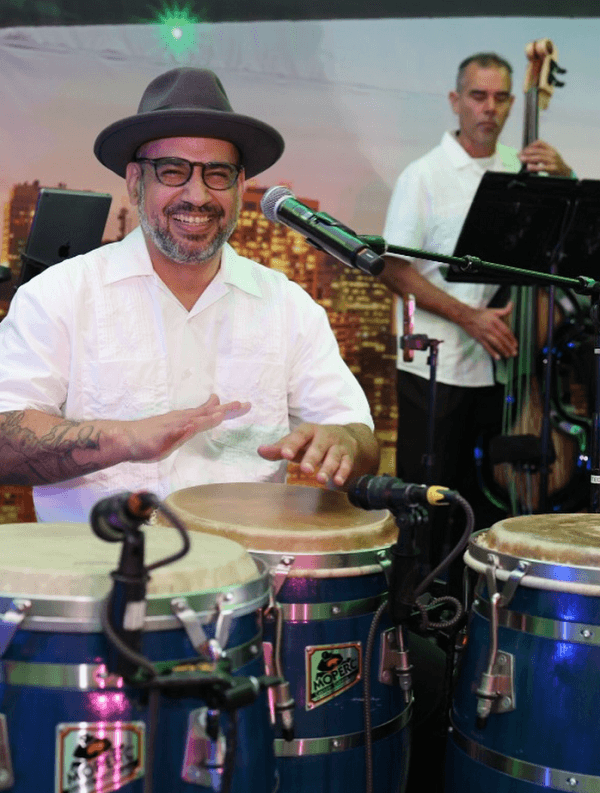
David and Ricky playing
David Frankel and Ricky Rosa playing live some years ago

What inspired David to pursue music

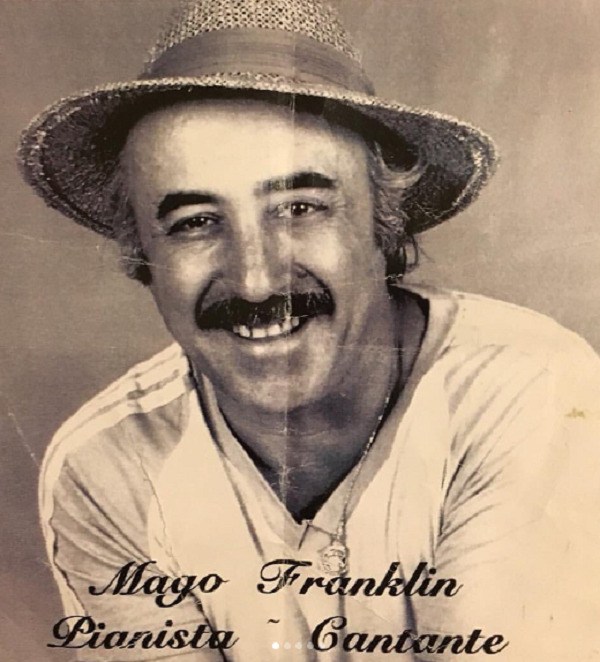
David was born in Lower Manhattan, New York, where there were many Latin families at the time. The neighborhood housed many Puerto Ricans and Dominicans. To this we must add that his father, Daniel “El Mago del Órgano” Franklin, was a musician and moved to that very place where Papote Jiménez, Ismael Miranda, Markolino, Freddy Lugo, Henry Fiol, Luis Ayala, and many others lived. Besides being a neighborhood full of artists, it was much cheaper living there, so he thought it was the ideal place for him.

It is worth noting that Daniel knew how to write music and read scores, but he had never played Latin music before in his life. He began to know it when several musicians he worked with asked for his help to read their scores, which led him to fall in love with Afro-Cuban music and develop an interest in salsa and merengue.

When David was born in 1979, Daniel had already been making music for about 15 years and had earned the nickname “The Organ Wizard” thanks to some band competitions held at a club in the Bronx. From a very young age, the boy watched bands rehearsing on the first floor of his house, so this salsa scene was natural for him. However, David had nothing to do with music until the death of his father in 2003.

David never had any interest in entering the art world, but the void left by Daniel’s death in his life drove him to study music, looking to connect with his father in some way. From there, he began taking piano and percussion classes, but he did not stop there. He also started to go out social dancing in the New York nightclubs and to know a bit more the nightlife of the city. On one occasion, a woman left him alone on the dance floor, and he was so ashamed in that moment that he decided to take classes and learn to dance.

David and the rest of Avenida B
The Avenida B Crew:
Juan Bowers – piano
Alvin Céspedes – bass
Ricky Rosa – congas/coro
Brian Pozo – bongos/coro/stage direction
Jhohan Hernandez – timbales
Demetrios Kehagias – trombone
Dan Lehner – trombone
David Frankel – lead vocals

That was when he realized that all the local bands played almost the same genres and songs, but there was no need for that because there was a world of possibilities in the Latin music he had discovered during his classes. There is a world beyond La Fania, and he learned that thanks to dance schools. All this thinking led him to create his own band with different music, to the old-school style he had always loved. 

His father had always told him salsa is for dancing, and if you are not playing dance music, you are doing it wrong.

Which teachers taught David?

After thanking us for the question, David then proceeded to explain that there was a school in New York called the Harbor Conservatory for the Performing Arts, located at 104th Street and Fifth Avenue in Manhattan. The heads of the education programmes there were Ramón Rodríguez and Louis Bauzó, who were excellent musicians and great people whom he met thanks to his father, who was a piano teacher at that institution. David used to accompany Daniel to the school and met both teachers through him.

Following his father’s death, David returned to that same conservatory to study singing with Ramón, while also studying percussion with Georgie Delgado and piano with Louis. In short, this institution was of vital importance for his career, and the many things he learned there were momentous both personally and professionally. 

As for the dance, he enrolled at the Baila Society school in New York through some friends, but later studied at others such as Santo Rico Dance and Dance On 2.

Jimmy and David
Jimmy Bosch and David Frankel

Avenida B Band

David began his career as a musician by playing boogaloo with a group called Spanglish Fly and a few other small bands. After everything he had studied and learned, already for the year 2011, the idea of creating his own group started percolating in his mind, so he posted an ad online looking for musicians and called some former classmates who might be interested in the proposal. That was how he managed to gather a decent number of people with whom he could finally put the Avenida B project together.

He chose salsa dura as his main genre because it is the kind of music that makes him want to dance, and given his background, this was very important to him.

He is also about to release an album in tribute to his father, which he has named “El Mago,” and it will feature some of his own songs; it is scheduled to be released in July 2026. 

David's father
Daniel ”El Mago del Órgano” Franklin, David’s father

Read also: Puerto Rican bandleader and musician Diana Sosa talks about her many projects in Nashville, Tennessee

John and Liz reveal details of the 16th annual SF Salsa Festival

As is tradition every year, we went back in touch with the organizers of the San Francisco Salsa Festival, John Narváez and Elizabeth Rojas, who treated us with the kindness and affection of always. The dancers and dance instructors once again spoke about the details of the festival’s organization and one or another incident that did not become public, so fans of salsa and such events cannot miss it.

They also talked about how they have done since the 2025 edition and what they will do from now until next year’s edition.

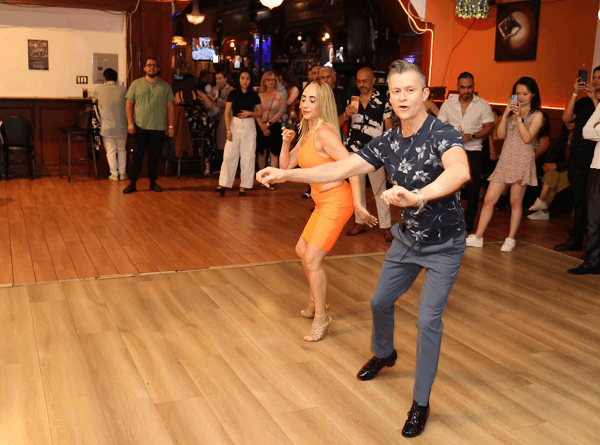
John and Liz dancing
John and Liz dancing at the San Francisco Salsa Festival

What John and Liz have done since the 2025 San Francisco Salsa Festival

After the 2025 edition, John described the rest of the year as sensational because his dance studio has maintained the expected success and his company enjoys the work of of new members who have contributed with their talent to help it grow. In addition to that, their classes are full of people eager to learn to dance, take care of their bodies, keep their minds healthy, and have a more active social life. 

He also recognizes that the Bad Bunny phenomenon helped them a lot, as they’ve welcomed many people who want to learn to dance salsa after the the boom caused by a Super Bowl full of latinidad everywhere. This has also made the celebrated ones at weddings and other family events to celebrate with salsa, so guests do not want to be left behind and seek to dance it as well as possible.

When an event has been organized for 16 years in a row, those involved already have a system by which they are ruled, so there are few surprises that John and Liz could find thanks to so much experience under their belt. However, there may be things that catch them off guard and ,in this case, it was the economy. This time, they found that everything was much more expensive.

After reviewing expenses, they noticed that the flights of the artists and hotel costs were much higher than in previous years, so they were forced to take certain actions, such as hiring fewer dance artists. They were careful to bring only the best they could find to do a tremendous show, which fortunately occurred.

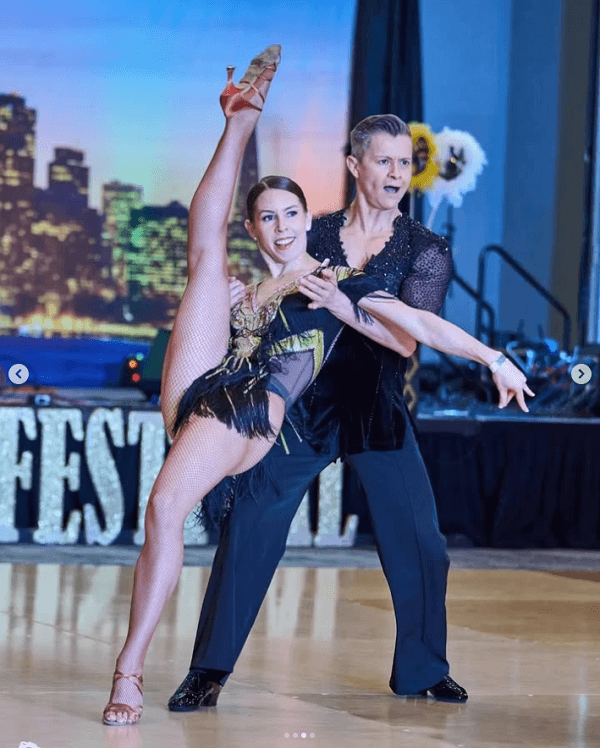
John and Aura dancing
John Narvaez and dancer Aura Moreno dancing at the San Francisco Salsa Festival

They also noticed that many people could not attend the festival, so they offered numerous discounts, press passes, and the opportunity to volunteer for the organization.

Visa problems

The main disadvantage faced by John and Liz last year was the delay in the approval of visas for the members of La Máxima 79, so we wanted to know how it had gone this year. Well, as it turns out, it did happen again and two couples of dancers were unable to attend because their visas were denied, so they had no choice but to invite residents of the United States to prevent that headache. 

Of course, it must be added that bringing people from other places implies additional costs that do not do any good to them right now. For the same reasons, other festival organizers are doing the same thing.

Principal guest artists

The main attractions at this festival were Charlie Aponte, Edgardo Cambón, and Cabanijazz, who of course, did a magnificent job. The big surprise of the festival was definitely Charlie Aponte, with whom they managed to have contact through a well-known Mexican promoter who acted as a link between the dancers and the artist. 

The agreement was made as recently only in January, that is, a couple of months before the event. That is when John contacted Jeannette Santiago, Charlie’s manager and wife, told her who he was, and mentioned the mutual friend they had in common. He then managed to close the deal with her and have the Puerto Rican singer at the event, which came as a very pleasant surprise to those who had been planning to attend for months.

Edgardo Cambón playing
Edgardo Cambón playing at the San Francisco Salsa Festival

Preparations for next year

As every year, after an edition is completed, John and Liz are already thinking about what they will do for the next one. In fact, just the day before this interview, they had a work meeting to start planning everything and thinking about who they will invite for 2027.

They are thinking about inviting La Máxima 79 again. In fact, they have already talked to their lawyer responsible these matters and agreed to carry out the relevant procedures to finally have them at the festival, as they have wanted for a long time. In case the invitation is not given effect, they also have their eyes on Jimmy Bosch and Hermán Olivera. Both have performed in previous editions prior to the pandemic and were sensational, so they are held in good esteem by the organization.

They also mentioned that the venue for the next two editions will continue to be the Marriott Hotel Waterfront, as the location is beautiful and very suitable for an event of this magnitude.

Cabanijazz playing
Cabanijazz Project playing at the San Francisco Salsa Festival

Read also: Uruguayan composer and multiinstrumentalist Sebastián Natal and his band Grupo Sensación

San Clemente 3rd Salsa Congress

Latin America / Argentina / Buenos Aires
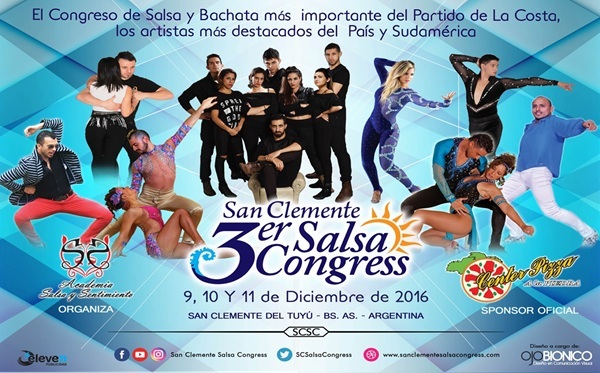
San Clemente 3rd Salsa Congress 2016

San Clemente 3rd Salsa Congress

December 9, 10, and 11, 2016 – San Clemente del Tuyú, Buenos Aires, Argentina

Kicking off this December, we present the 3rd International Congress of Salsa, Bachata, and Caribbean Rhythms. Widely recognized as the most important congress on Argentina’s Atlantic Coast, the event will take place on December 9th, 10th, and 11th in the town of San Clemente del Tuyú, located 185 miles (300 km) from the capital, Buenos Aires. The official sponsor is Center Pizza, with additional support from Tandori Indumentaria SYS.

This international congress will bring together dancers, instructors, and aficionados from across Argentina and South America. The event features world-class workshops (professional training) and countless showcases by headlining artists and dance companies from Argentina and neighboring countries. Attendees can also look forward to sets by top-tier DJs and plenty of social dancing.

Dancers - San Clemente 3rd Salsa Congress 2016
Dancers – San Clemente 3rd Salsa Congress 2016

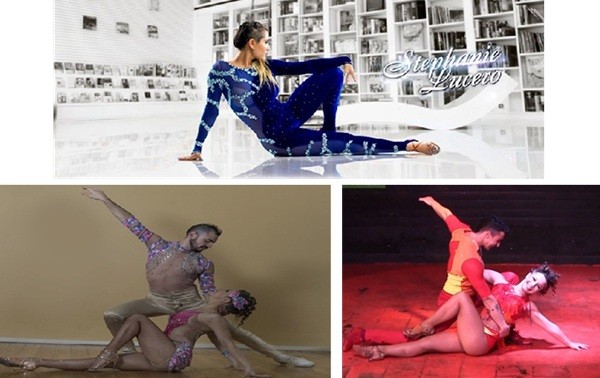
“The following main artists will be performing:”

Stephanie Lucero: Hailing from Buenos Aires, Stephanie is making her first-ever appearance at this Congress. She is widely recognized as one of the most prestigious instructors in the scene, standing out for her ability to dance both lead and follow roles with expertise. Stephanie has refined her skills under world-renowned masters such as Gaston Vidarte, Troy & Jorget, Korke & Judith, Daniel & Desiree, and Ataca & La Alemana. She has also shared the stage with international artists like Daniel Santacruz and Domenic Marte.

Currently, she leads her own all-female choreography group, “Luceros de Fuego.” For this major event, she will be leading two world-class workshops: Partner Bachata and Bachata Ladies’ Styling.

San Clemente 3rd Salsa Congress 2016 Flyers

La Compañía Calambre: Also making their debut at the congress and in the city, Calambre is Argentina’s premier dance company. Widely recognized as 2013 World Champions, they will be hosting three world-class workshops for this massive event. In addition to their incredible showcase, attendees will have the opportunity to enjoy their performances, dance with them, and interact with the team throughout all three days of the congress.

Leandro Erni & Mariela Rondon: Traveling from the city of Mar del Plata, this duo is the reigning Bachata Championship winners. They serve as directors of the Conjunto Clave Academy and are widely recognized as a world-class couple with an extensive international career. Notably, they secured 5th place at the 2015 World Latin Dance Cup in Miami. During the event, they will be hosting two workshops and performing two showcases. You’ll also have the chance to meet them and share the dance floor with them throughout all three days of the congress.

San Clemente 3rd Salsa Congress 2016 Flyers 2
San Clemente 3rd Salsa Congress 2016 - Details
San Clemente 3rd Salsa Congress 2016 – Details

Gustavo Pinat: Originally from Rosario, in the Santa Fe Province, Gustavo has over 19 years of experience in the salsa world. He has trained extensively across Europe and the Americas, including Germany, Switzerland, Spain, Italy, Greece, the U.S., Cuba, and Venezuela. A seasoned professional, he has taught workshops at numerous national and international congresses.

Gustavo is also the organizer of the VIVE CUBA Afro-Caribbean Rhythm Festival held in Rosario. Currently, he serves as the Director of the Bamboleo Salsa Studio in Rosario and leads “RAÍCES,” Argentina’s premier comprehensive training program for Afro-Cuban dance.

Leonel Silva: Hailing from Montevideo, Uruguay, Leonel is ranked among the top seven salsa soloists in the world and is a celebrated figure in his home country. Following his incredible performance at the last event, he returns to the 3rd San Clemente Salsa Congress.

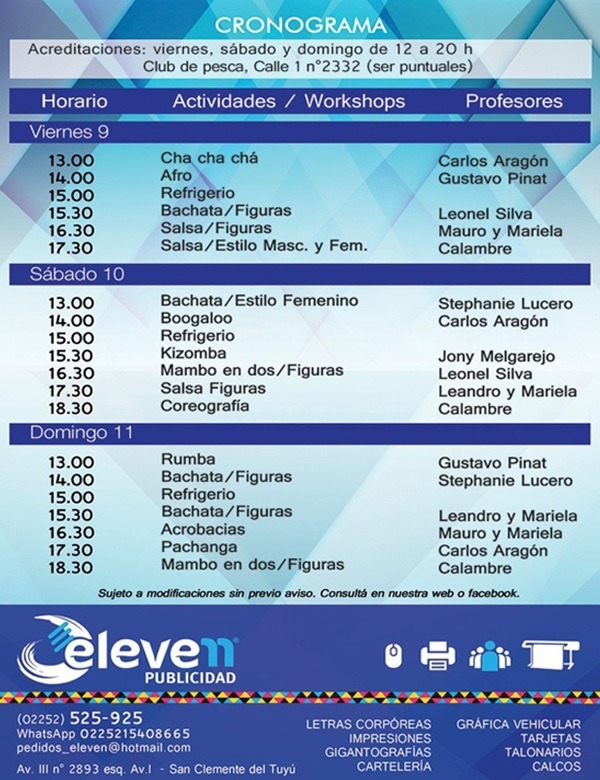
San Clemente 3rd Salsa Congress 2016 - Schedule
San Clemente 3rd Salsa Congress 2016 – Schedule

Carlos Aragon del Carpio: One of South America’s leading figures in the scene, Carlos is a regular at the region’s most prestigious congresses. He is the director of the first South American Mambo “On 2” school in Argentina and has refined his expertise through extensive training in Cuba and the United States.

Our event host will be Silvio González, the director of the Argentina and Puerto Rico Salsa Open. A teacher and dancer with an extensive professional career, he is one of the most prominent figures in our country’s dance scene.

We are also proud to feature our Official DJ: GASTON “TIBURON” TABORDA, a nationally and internationally renowned DJ who headlines the most important congresses and competitions throughout Argentina and South America.

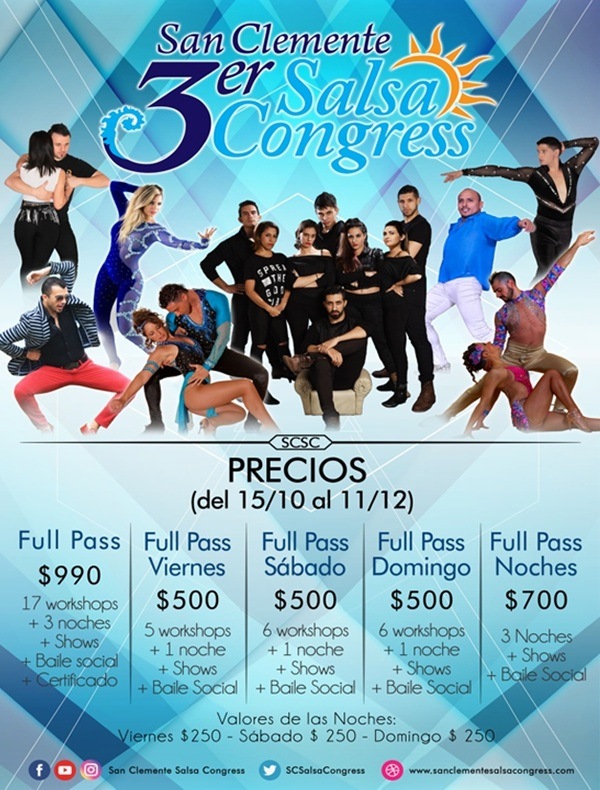
San Clemente 3rd Salsa Congress 2016 - Prices
San Clemente 3rd Salsa Congress 2016 – Prices

You can visit our official website and follow us on social media:

San Clemente 3rd Salsa Congress 2016 - Social Media
San Clemente 3rd Salsa Congress 2016 – Social Media

www.sanclementesalsacongress.com

  • Facebook: San Clemente Salsa Congress
  • Twitter: @scsalsacongress
  • Instagram: San Clemente Salsa Congress
  • YouTube Channel: San Clemente Salsa Congress


  • « Go to Previous Page
  • Page 1
  • Page 2
  • Page 3
  • Page 4
  • Page 5
  • Interim pages omitted …
  • Page 66
  • Go to Next Page »

International Salsa Magazine (ISM) is a monthly publication about Salsa activities around the world, that has been publishing since 2007. It is a world network of volunteers coordinated by ISM Magazine. We are working to strengthen all the events by working together.