• Skip to primary navigation
  • Skip to main content

International Salsa Magazine

  • HOME
  • Previous editions
    • 2026
      • ISM / April 2026
      • ISM / March 2026
      • ISM / February 2026
      • ISM / January 2026
    • 2025
      • ISM / December 2025
      • ISM / November 2025
      • ISM / October 2025
      • ISM / September 2025
      • ISM / August 2025
      • ISM / July 2025
      • ISM / June 2025
      • ISM / May2025
      • ISM / April 2025
      • ISM / March 2025
      • ISM / February 2025
      • ISM / January 2025
    • 2024
      • ISM / December 2024
      • ISM / November 2024
      • ISM / October 2024
      • ISM / September 2024
      • ISM / August 2024
      • ISM / July 2024
      • ISM / June 2024
      • ISM / May 2024
      • ISM / April 2024
      • ISM / March 2024
      • ISM / February 2024
      • ISM / January 2024
    • 2023
      • ISM / December 2023
      • ISM / November 2023
      • ISM / October 2023
      • ISM – September 2023
      • ISM – August 2023
      • ISM July 2023
      • ISM Edition June 2023
      • ISM – May 2023
      • ISM April 2023
      • ISM March 2023
      • ISM February 2023
      • ISM January 2023
    • 2022
      • ISM December 2022
      • ISM November 2022
      • ISM October 2022
      • ISM September 2022
      • ISM August 2022
      • ISM July 2022
      • ISM June 2022
      • ISM May 2022
      • ISM February 2022
      • ISM January 2022
    • 2021
      • ISM December 2021
      • ISM November 2021
      • ISM October – 2021
      • ISM September 2021
      • ISM August 2021
      • ISM July 2021
      • ISM May 2021
      • ISM April 2021
      • ISM June 2021
      • ISM March 2021
      • ISM February 2021
      • ISM January 2021
    • 2020
      • ISM December 2020
      • ISM November 2020
      • ISM October 2020
      • ISM September 2020
      • ISM August 2020
      • ISM July 2020
      • ISM June 2020
      • ISM May 2020
      • ISM April 2020
      • ISM March 2020
      • ISM February 2020
      • ISM January 2020
    • 2019
      • ISM December 2019
      • ISM November 2019
      • ISM October 2019
      • ISM Septembre 2019
      • ISM August 2019
      • ISM July 2019
      • ISM June 2019
  • Spanish
  • Download Salsa App
    • Android
    • Apple

Search Results for: Latin Jazz

Eduardo Tancredi is a renowned Uruguayan pianist and composer specializing in Latin Jazz

Eduardo was a distinguished student at Berklee College of Music in Boston.

Eduardo was an outstanding student at the Berklee College of Music in Boston.

Musical Style: His music fuses a wide variety of Afro-Latin rhythms (such as Uruguayan candombe, Brazilian samba, Cuban son, Peruvian landó, and Venezuelan joropo) with the harmonies and melodies of modern jazz.

Accolades: He has recorded several CDs with his own compositions and has received awards for his outstanding performance in the Latin jazz scene. His album “Ongoing Dreams” was chosen as the best album in its category in 2002 by “The Boston Globe.”

Teaching Experience: During his time in the United States, he was a piano and harmony professor at Berklee College of Music. Since 2003, he has resided in Barcelona and teaches at ESMUC (Escola Superior de Música de Catalunya).

Collaborations: He has collaborated with numerous musical groups as a pianist and is a significant figure in the jazz scene in Spain.

Eduardo Tancredi is a prominent figure in Latin Jazz, known for his ability to integrate diverse Latin American rhythmic influences with the harmonic sophistication of modern jazz.


Latin accents took some time to establish themselves in jazz music. Very few composers ventured into that genre in the early decades of the last century, to the point that their timid attempts were considered exotic and trivial.

Initially, one recalls passages from William C. Handy’s “St. Louis Blues,” some Scott Joplin ragtimes, Jelly Roll Morton’s references to the “Spanish tinge,” or, shortly after, the themes performed by Duke Ellington’s orchestra.

Eduardo Tancredi
Eduardo Tancredi

It was in the 1940s that the Latin touch gained relevance. Cuban Mario Bauzá, who had played trumpet in Chick Webb’s and Cab Calloway’s orchestras, propelled the success of Machito’s band and convinced Dizzy Gillespie to hire conga player Chano Pozo.

Afro-Cuban influence became powerful in the following decades through sones, charangas, rumba, mambo, and salsa. Names like Chico O’Farrill, Tito Puente, Mongo Santamaría, Ray Barretto, and Chucho Valdés became highly regarded, and their works inspired a legion of jazz musicians.

Eduardo Tancredi es un reconocido pianista y compositor uruguayo, especializado en Jazz Latino

Latin jazz today has a strong presence in popular music, and Uruguayan Eduardo “Edú” Tancredi is a brilliant exponent of that style. He was an outstanding student at Berklee College of Music in Boston, where he won awards such as the Quincy Jones Award and the Outstanding Latin Act Award.

After his acclaimed “Ongoing Dreams” from 2002, this CD, “Venimos Tumbando,” recorded in 2007, now arrives with ten formidable compositions and his own arrangements. His background in Latin American folklore plus his jazz studies have achieved a splendid confluence that is enjoyed from beginning to end on this album.

His versatility as a composer is evident in candombes (“La mama vieja” and “Montevideo”), a baião (“Baialona”), a chorinho (“El germen”), a zamba (“Zamba del aire”), and the obvious references to Afro-Caribbean rhythms that unite their exciting cadences with jazz elements. Edú’s works are incisive, stimulating, possess an overflowing swing, and it’s easy to imagine the musicians’ pleasure during their performance.

The arrangements contrast the different orchestral sections, highlighting their diverse sound textures, suggestive harmonizations, and enhancing the dynamics and fiery percussion instruments. Three saxophones, piano, guitar, bass, and drums alternate with ten other guest musicians (vocals, sax, harmonica, two basses, two drum sets, and three percussionists), generating a sonic turbine that captivates the listener from the first note.

This doesn’t mean that all tracks propose an overwhelming rhythm. There are passages of beautiful lyricism, as in the two versions sung by Ana Finger, or the pleasant harmonica of Antonio Serrano, or the director’s piano in “Como un blues.”

The soloists perform at a high level, with special mention of Miguel Zenón’s alto sax, an improviser of fresh ideas, clean musicality, and great inspiration and fervor. The interventions of guitarist Alejandro Luzardo, trumpeter Matthew Simon, tenor saxophonist Eladio Reinón, and baritone saxophonist Xavi Figuerola are also noteworthy.

“Venimos Tumbando” confirms Tancredi’s talent as a composer and pianist and his skill as an orchestra conductor. Abilities he generously demonstrated during his acclaimed performance at the Teatro Solís last December. Thomas Werner

Edu Tancredi & Bandon 33 – Venimos Tumbando (2007)

Tracks:

  1. El Subibaja
  2. Hocus Pocus
  3. Montevideo
  4. El Germen
  5. La Mama Vieja
  6. Baialona
  7. Mapa Del Mundo
  8. Venimos Tumbando
  9. Como Un Blues
  10. Zamba Del Aire

Musicians: Edu Tancredi (Piano) Ana Finger (Vocals) Antonio Serrano (Harmonica) Mathew Simón (Trumpet) Pere Grau (Soprano sax, alto sax) Miguel Zenón (Alto sax) Eladio Reinón (Tenor sax) Juajo Arrom (Trombone) Xavi Figuerola (Baritone sax) Alejandro Luzardo (Guitar) Matías Migues, Paco Weht, Javier Gómez (Double Bass) Santiago Blanco, Salvador Toscano (Drums) Carlos Reyes “Compota”, Alejandro Luzardo, Santiago Blanco, Alexis Liden, Sandro Lustosa, Salvador Toscano (Percussion)

Edu Tancredi & Bandon 33 - Venimos Tumbando (2007)
Edu Tancredi & Bandon 33 – Venimos Tumbando (2007)

Information By:

Ostia Latin Jazz

DJ, Augusto Felibertt

Also Read: Arturo “Chico” O’Farrill. “The Architect of Afro-Cuban Jazz”

Latin jazz and mambo trumpeter Jonathan Powell and his great collaborations

Trumpeter Jonathan Powell is one of the many examples that show how much so many American artists have looked at Latin music over the last few years, so this is a great opportunity to know one of the many stories about what our heritage has achieved in this country.

Jonathan playing
Musician Jonathan Powell playing the trumpet live

Instruments that caught Jonathan’s attention

An important fact to remember is that Jonathan’s parents were musicians. His father played the electric bass and his mother played the cello, so he obviously has a lot of talent to get from. However, his interest in music turned to a slightly different way.

The instrument through which the artist is best known today is the trumpet due to his great skill at handling it, but it is not the only instrument he has learned to play. He also plays the trombone, the tuba and other bass instruments, but does not have the same fascination with them as with the trumpet.

His interest in music began when he was in high school and became part of a few student bands, resulting in more than 30 years of musical career.

Jonathan’s academic training

Most of what Jonathan has got to learn comes from the experience he has gained through his work, although he does not devalue formal music education. In fact, he attended the North Carolina School of the Arts and studied with that institution’s best teachers in the area of classical music.

When he turned 19, he made the decision to move to New York, where he has lived ever since. While there, he did not care as much about further studying music, but gaining as much experience as he could through practice.

Jonathan recording
Jonathan Powell recording music for his album ”Mambo Jazz Party”

Interest in Latin music

Although Jonathan’s interest in music began with the classical genre, his move to Florida made him seek other horizons. In Florida, he and his brother Jeremy began to make contact with radio stations that played Latin genres and this led them to meet the Garcia-Herreros brothers, Juan and Victor, who are two very experienced musicians in Latin jazz, but also in Latin music in general. The boys returned to Florida after studying at Berklee College of Music and started a band with Jonathan and Jeremy until they had to move to New York.

When Jonathan graduated from high school and also moved to New York, he was reunited with Juan and Victor who offered him to join their orchestra La Creación, with which he played every weekend for several years. This would be what the young musician would describe as his first real experience in the world of music, leading him to participate in the orchestra La Excelencia and to play with Arturo O’Farrill and Eddie Palmieri. 

Learning from other great artists

Just as Jonathan has played with O’Farrill and Palmieri, he has also been able to share the stage with Miguel Zenón, Tito Puente Jr, Oscar Hernández from the Spanish Harlem Orchestra, Israel Tanenbaum and many others.

Despite not having received much academic training, the opportunity to have played with the aforementioned music stars and many more really taught him many things that he would not have learnt in any educational institution. He assures that from whom he learned the most was Maestro Palmieri, since the legendary pianist is very generous when it comes to sharing his knowledge with whoever needs it, thanks to his extensive experience in this rich world.

‘‘Palmieri has been around since the fifties and sixties and has played with the most important artists of his generation, so he has a lot to teach. People have no idea how much he knows and how deep his knowledge on music is,” said the trumpeter about one of his great living inspirations.

However, as a trumpet player, another of his great inspirations was Puerto Rican arranger, composer and producer Juancito Torres for the way he played, since he considers it very special and unique compared to many other musicians.

Jonathan and Palmieri
Maestro Eddie Palmieri and Jonathan Powell smiling for the camera

Nu Shanga

Eager to manage his own musical group, Jonathan gives the public a very interesting proposal which he baptized Nu Sangha, inspired by Tibetan language, since these two words together mean ”new community”. With this group, he had much more freedom when choosing how he wanted to address each rhythm and wanted to give a much more modern approach to the type of jazz he had been playing through electronic elements few times used before.

In the case of Nu Sangha, he enjoyed everything he did professionally and was able to experiment with everything he had learned so far in creative ways, leading him to release the albums ”Transcend” and ”Beacons of Light”.

Mambo Jazz Party

In Jonathan’s own words, Mambo Jazz Party, the artist’s most recent musical work, the entire process of recording it took more than 10 years, since that was the time taken to create all the music that appears in the record material. He started the creation in 2014 and it was not until 2022 that Jonathan added the final details such as some missing vocals, but he assures that all the time spent on the album was worth it.

On the album, we can find Jimmy Bosch, guitarist Nir Felder, flutist Itai Kriss, pianist Manuel Valera, vocalist Ariadne Trujillo, singer Anthony Almonte and many other great artists who embellish this creation.

In other interviews, Jonathan has described this album as a mix of traditional salsa and Latin jazz elements, electronic sounds and a lot of spiritualism, which can summarize very well what this musical work represents for Jonathan Powell. 

Mambo Jaszz Party by Jonathan
Cover of the album ”Mambo Jazz Party” by Jonathan Powell

Read also: Great Christmas salsa songs and their stories

Andy Gonzalez started as a musician at the age of 13 in the Latin Jazz Quintet in New York

Andrew “Andy” Gonzalez passed away on April 9, 2020.

Virtuoso bassist, arranger and musical director of Don Manny Oquendo’s “El Conjunto Libre” and Eddie Palmieri’s “La Perfecta”.

Andy has worked throughout his extensive artistic career that spans almost 50 years, with approximately 800 recordings, where he has had the opportunity to be as co-leader, producer, musical director or sideman.

Andy began as a musician at the age of 13 in the Latin Jazz Quintet, a group inspired by the music performed by vibraphonist Cal Tjader and in which he shared with his brother Jerry.

Although long before that, Gerardo Gonzalez, Gonzalez’s father, had already begun his son’s musical

Gerardo was the vocalist of Augie Melendez y Su Combo, an ensemble influenced by the sound of Sexteto La Playa.

Andy Gonzalez virtuoso Bajista, Arreglista y Director musical de “El Conjunto Libre” de Don Manny Oquendo y de “La Perfecta” de Eddie Palmieri

It is worth mentioning that during their time in the Latin Jazz Quintet, the Gonzalez brothers met a person who would change their lives: pianist Llewellyn Matthews, with whom they learned the discipline necessary to “graduate” as professional musicians, both were part of the big band of this decisive leader.

Later came Eddie Palmieri’s La Perfecta, his brother’s Fort Apache Band, the Grupo Folklorico Experimental Nuevayorquino and Manny Oquendo y Libre, 4 groups that changed forever the perception of the music we know today as Salsa.

He collaborated with The Fort Apache Group, Dizzy Gillespie, Tito Puente, Eddie Palmieri, Astor Piazzolla and Ray Barretto.

Andy González is a fundamental reference in the history of Caribbean music and Latin jazz. He has played with almost mythological musicians at times when they left a deep mark on both Latin jazz and dance music.

Andy González se inició como músico a los 13 años en el Latin Jazz Quintet en New York

He has been bassist for Eddie Palmieri, Ray Barreto, Conjunto Libre, Grupo Folklorico Experimental Nuevayorquino, Fort Apache Band, and on some occasions for Ismael Rivera y sus Cachimbos, Cortijo y su Combo and Sonora Matancera.

In this conversation, held in Santiago de Compostela -during the Compostela Millenium Festival in August 2000- he vibrates when talking about his record collection, he declares himself a fan of the study of the roots of the music he makes and reviews his artistic life since when with his band, at the age of 13 and together with his brother Jerry, they imitated the sound of Cal Tjader.

Passion for music      

I’m as much a music fan as I am a musician. Just like any music lover. I’m a fan of the things I appreciate that are important in the history of music. I have studied a lot and that has allowed me to notice the quality and quantity of artists that this music has produced. Great artists, people who have contributed a lot. When you have and study a collection of records like the one I have, you realize that now there are few.

Andrew “Andy” González muere El 9 de abril de 2020ººº
Andrew “Andy” González muere El 9 de abril de 2020

Inspiration

Cal Tjader was my inspiration when I started. Also for Fort Apache Band, because their music had a strong jazz component, but with Cuban rhythms. Good rhythms. We had a great interest in what Cal Tjader was doing.

When we started playing we were copying what Tjader was doing. We were little kids of 13 and 14 years old. We had a very similar repertoire with the same quintet, where Jerry played congas.

Once we even had a dance next to the place where Tjader played, doing the same music. Armando Peraza played congas for Tjader and once he saw us and congratulated us. We always had the support of musicians with more experience, veterans of other generations.

Dj. Augusto Felibertt, Andy Gonzalez, Rafael Muro y Omar Mejias. Centro Cultural La Estancia en Caracas

Main Source: Pablo Larraguibel

Also Read: Roberto Rodríguez fue un trompetista y compositor cubano, autor del éxito de Ray Barreto «Que viva la Música»

Eddie at 80: Eddie Palmieri and his Latin Jazz Septet

North America / USA / Miami

Eddie at 80: Eddie Palmieri and his Latin Jazz Septet. Sábado, 2 de junio de 20:00 a 22:30

Eddie Palmieri
Eddie Palmieri

Entradas: https://tickets.olympiatheater.org/eventperformances.asp?evt=186

NEA Jazz Master Eddie Palmieri is celebrating his 80th birthday this year with a gorgeous album Sabiduría, and a tour of select cities that brings him to the beautiful Olympia Theater in downtown Miami. Tix are available through the theater box office: http://olympiatheater.org/, $37, $47 and $57 + fees.

Born in Spanish Harlem to Puerto Rican parents and raised in the Bronx, Eddie Palmieri learned to play the piano at an early age, and at 13, he joined his uncle’s orchestra, playing timbales. He joined popular New York bands during the 1950s before forming his own band La Perfecta in 1960. Eddie Palmieri’s landmark 1970 release Harlem River Drive was a first to merge what were categorized as “Black” and “Latin” music into a free-form fusion of salsa, funk, soul and jazz. In 1975, he won the first-ever Grammy for Best Latin Recording for The Sun of Latin Music (he’s won ten Grammys altogether to date, including two with Tito Puente).

In addition to the Grammys, Eddie Palmieri has received numerous honors: Eubie Blake Award (1991); BBC (2002); Yale University’s Chubb Fellowship, usually reserved for international heads of state, but given to Palmieri in recognition of his work building communities through music (2002); Harlem Renaissance Award (2005); and more. In 2009, the Library of Congress added Palmieri’s composition Azucar Pa’ Ti to the National Recording Registry, which at the time only included 300 compositions documenting the history of all of recorded music history in the U.S.

In 2013, Eddie Palmieri was awarded the coveted Jazz Master award – the highest honor for a jazz artist – by the National Endowment of the Arts (NEA). That year he was also awarded a Lifetime Achievement Award by the Latin Academy of Recording Arts & Sciences. This June 2nd, MasterEddie Palmieri is celebrating his 80th birthday this year with a gorgeousalbum Sabiduría, and a tour of select cities that brings him to the beautiful Olympia Theater in downtown Miami. Tix are available through the theater box office: http://olympiatheater.org/

Welcome back to Miami, maestro!

Héctor Martignon has been one of the most sought-after pianists on the Latin jazz scene in New York

New York based-, Colombian born Hector Martignon has composed, orchestrated, produced, performed and recorded music in a wide spectrum of genres, from Classical and Crossover, to Jazz and World Music, to Rock and Pop.

His five albums as a leader, two as co-leader (MOZART’s BLUE FANTASIES and BACH’s SECRET FILES) as well as his work on over a hundred albums, scores for five feature films, three Broadway Musicals and multiple other projects, showcase his wide-ranging area of expertise.

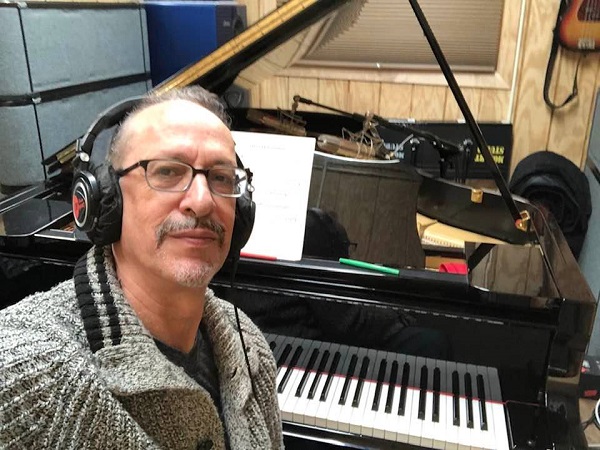
At Mozart Studios recording Carlos Jimenez’ second CD, + Ruben Rodriguez + Vince Cherico. A pleasure!

After several nominations as a sideman, two of his five solo CDs were nominated for a GRAMMY Award (REFUGEE, 2008, and SECOND CHANCE, 2010).

He arranged and performed parts of the score of Ang Lee’s OSCAR-nominated movie EAT, DRINK, MAN, WOMAN.

His first professional recording was at age 18 (Mikis Theodorakis’s “Canto General”) while one of the most recent was on legendary rock band CHICAGO’s latest production, the Latin-tinged “EXITOS”.

He has written symphonic orchestrations, performed and recorded by the Russian Philharmonic Orchestra and compositions like ABRE LOS OJOS, CIERRA LOS OJOS, commissioned and premiered by the MUSICA DE CAMARA STRING ORCHESTRA at St Patrick’s Cathedral in April 2011.

Hector Martignon is currently working on a first CD with his BANDAGRANDE Big Band + String Quartet as well as an album with selections out of a series of  7 solo piano recitals at the Ludwigsburg University of Education (Germany), where he conducts a “compact seminar” on Classic Music-based improvisation every November.

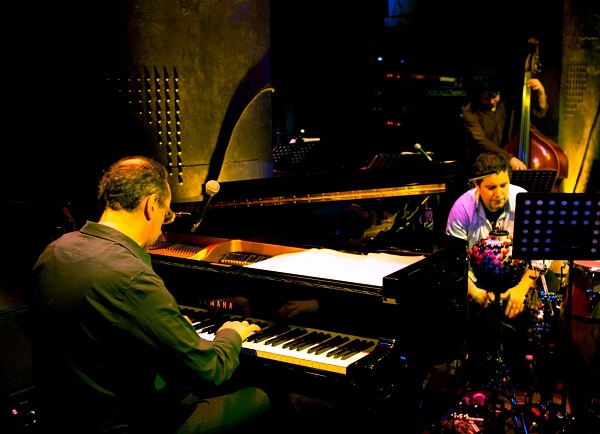
Our trio in Tokyo
Our trio in Tokyo

As a requested sideman he has toured the world with such greats as Paquito D’Rivera, Ray Barretto, Gato Barbieri, Steve Turre, Don Byron, Tito Puente and was featured pianist with Max Roach’s PROJECT AMERICA at the 92 St Y.

His joy of teaching has made him a requested guest-lecturer and performance teacher in music faculties and academies in several countries of Europe, Japan, North- and South America.

Hector wrote an instructional book on Latin piano commissioned and published by Hal Leonard, the SALSA PIANO BOOK.

Martignon’s abilities as a pianist have always been enriched by his interest in varied musical genres.

He paid for his studies of classical piano and composition at the prestigious Freiburger Musikhochschule in Germany by performing with the best Afro-Cuban and Brazilian bands of Europe, backing stars like Celia Cruz and Ismael Quintana on their European tours, and recording with Tata Güiness and Arturo Sandoval.

At the same time he was attending seminars of contemporary composition with masters like Gyorgi Ligetti, Luigi Nono and Karl Heinz Stockhausen.

He also performed classical music in recitals and concerts in Germany, Italy and his native Colombia, specializing in Chopin, Bach and Debussy.

One of his latest endeavors has been a Jazz-Classical crossover  project, co-lead with star virtuoso trumpeter Joe Burgstaller, in which the music of the classics, from Bach to Ellington is re-created in a chamber-jazz setting, to be enjoyed on their two releases, “Mozart’s Blue Fantasies” and “Bach’s Secret Files”.

Living in Brazil for a one-year love affair with that country and its music, Martignon soon became a requested studio musician and worked for star producer Carlinhos Brown.

Luquillo Beach, PR
Luquillo Beach, PR

Since relocating to New York City, Martignon has been one of the most sought-after pianists on the Latin jazz scene.

He’s toured North and South America, Europe, and Asia with the bands of Mongo Santamaría, Gato Barbieri, Steve Turre and Don Byron, who had him record in his latest CD.

He was featured pianist with the bands of Tito Puente, Mario Bauzá, Chico O’Farrill, Paquito D’Rivera, and Max Roach in his “Project America.”
Most notably, Martignon was pianist for the late Ray Barretto’s various ensembles.

During his eight-year association with Barretto, his contributions as pianist, arranger, and composer were fundamental in shaping the sound of the now famous New World Spirit Sextet.

One of his last collaborations with Barretto, “My Summertime,” was a favorite nominee for a Grammy award.
Martignon’s versatility has also made him extremely active in the film and television industries.

Besides playing all piano parts, he arranged and produced many parts of the score for the Oscar-nominated film “Eat, Drink, Man, Woman” by Ang Lee and performed the piano and keyboard parts for many movie scores (i.e., “Gloria”, “Relativity”).

He is composer of the original music of two feature films, one of which, “Septimo Cielo”, won international awards. He also collaborated in the production of many Broadway musicals (“Chronicle of a Death Foretold”, Paul Simon’s “The Capeman”, “Selena Forever”) as conductor, arranger, and co-composer.
In the fall of 2003 Hector visited Slovenia and Russia to collaborate with singer-songwriter Vitaly Osmsçko’s first symphonic CD.

The Russian Philharmonic Orchestra recorded in Moscow the orchestrations written by Hector.

As a composer, producer and arranger of TV and radio music his record is no less impressive. In 2001 he landed two spots for HBO Latino, and one for Coca Cola.

HECTOR” S FOREIGN AFFAIR
In 1998 Martignon performed with his quartet “Foreign Affair”at the Brooklyn Academy of Music’s famed annual festival “The Next Wave” on a triple bill with Tito Puente’s “Top Percussion” and Don Byron’s “Music for six Musicians”.

This proved to be a turning point for him and his ensemble, which evolved from the strictly acoustic trio sound of the first two CDs to a more eclectic and electric quartet sound.

The new configuration that evolved from that memorable concert started a series of concerts and recordings, with guitarist Mark Whitfield, Cameroonian bassist Richard Bona and Cuban drummer Horacio “Negro” Hernández.

This quartet performed and recorded live during a weeklong stint at New York’s famous Birdland.

The group has also performed on BET television festivals, at jazz clubs in Manhattan, and made various appearances in clubs and open-air festivals in his native Colombia and in Europe.

Martignon’s third solo project, to be released in the fall of 2003, is not only a reflection of the group’s new musical direction but also of his interaction with other world class musicians.

Eddie Gomez, Jeff Watts, Mathew Garrison, John Benitez, Dafnis Prieto, Willard Dyson have all made their unique contribution to this, Martignon’s new sound of Jazz.

Hector In Amsterdam with daughter Leticia

Hector Martignon never fails to surprise, challenge and delight us. Stay tuned and get involved in this affair.

Site: Héctor Martignon

Also Read: “El Sol de la Música Latina” el primer premio Grammy para el histórico disco de Salsa Eddie Palmieri

  • « Go to Previous Page
  • Page 1
  • Page 2
  • Page 3
  • Page 4
  • Interim pages omitted …
  • Page 95
  • Go to Next Page »

International Salsa Magazine (ISM) is a monthly publication about Salsa activities around the world, that has been publishing since 2007. It is a world network of volunteers coordinated by ISM Magazine. We are working to strengthen all the events by working together.