• Skip to primary navigation
  • Skip to main content

International Salsa Magazine

  • HOME
  • Previous editions
    • 2026
      • ISM / April 2026
      • ISM / March 2026
      • ISM / February 2026
      • ISM / January 2026
    • 2025
      • ISM / December 2025
      • ISM / November 2025
      • ISM / October 2025
      • ISM / September 2025
      • ISM / August 2025
      • ISM / July 2025
      • ISM / June 2025
      • ISM / May2025
      • ISM / April 2025
      • ISM / March 2025
      • ISM / February 2025
      • ISM / January 2025
    • 2024
      • ISM / December 2024
      • ISM / November 2024
      • ISM / October 2024
      • ISM / September 2024
      • ISM / August 2024
      • ISM / July 2024
      • ISM / June 2024
      • ISM / May 2024
      • ISM / April 2024
      • ISM / March 2024
      • ISM / February 2024
      • ISM / January 2024
    • 2023
      • ISM / December 2023
      • ISM / November 2023
      • ISM / October 2023
      • ISM – September 2023
      • ISM – August 2023
      • ISM July 2023
      • ISM Edition June 2023
      • ISM – May 2023
      • ISM April 2023
      • ISM March 2023
      • ISM February 2023
      • ISM January 2023
    • 2022
      • ISM December 2022
      • ISM November 2022
      • ISM October 2022
      • ISM September 2022
      • ISM August 2022
      • ISM July 2022
      • ISM June 2022
      • ISM May 2022
      • ISM February 2022
      • ISM January 2022
    • 2021
      • ISM December 2021
      • ISM November 2021
      • ISM October – 2021
      • ISM September 2021
      • ISM August 2021
      • ISM July 2021
      • ISM May 2021
      • ISM April 2021
      • ISM June 2021
      • ISM March 2021
      • ISM February 2021
      • ISM January 2021
    • 2020
      • ISM December 2020
      • ISM November 2020
      • ISM October 2020
      • ISM September 2020
      • ISM August 2020
      • ISM July 2020
      • ISM June 2020
      • ISM May 2020
      • ISM April 2020
      • ISM March 2020
      • ISM February 2020
      • ISM January 2020
    • 2019
      • ISM December 2019
      • ISM November 2019
      • ISM October 2019
      • ISM Septembre 2019
      • ISM August 2019
      • ISM July 2019
      • ISM June 2019
    • 2016
      • ISM December 2016
  • Spanish
  • Download Salsa App
    • Android
    • Apple

Search Results for: Latin dance world

Kizomba Conquering the World of Salsa

North America / USA /

These are some of the things I learned about Kizomba when my boss told me to write about it: Its official language is Portuguese; I bet you didn’t know that, either.

See, even when we thought we knew about this music genre, because we hear it at parties, get together or social events; as a Caribbean music, known by its movements that are alike the common Latin rhythms, it actually comes from Angola; a country in Southern Africa, near Namibia; and its official language is Portuguese.

Kizomba Conquering the World of Salsa

That is why the first and most popular Kizomba songs are in Portuguese.

Diogo Cão was that responsible Portuguese explorer to discover Angola and to determine its official language and culture. Who could possibly know that after the colonization era, MUSIC would be that one thing capable of combining cultures and mixing beats taste between humans? Kizomba is a clear example of that. Another fun fact is that its name comes from Kimbudo; which means ‘party’, maybe that’s why it’s so exciting to dance it.

It’s good to know that its characteristic for its slow and sensuous rhythm, came with a mixed touch of African rhythm and Haitian Kompa, until it became the one we know now a day. In the 1990s, when the actual Kizomba got more and more popular, Angolan semba dancers started to adapt their semba steps, according to the tempo and flavour of the Kizomba beats.

Dancers
Dancers

Back in the 60’s, the big parties were referred as: “Kizombadas”; since at that time, Kizomba wasn’t really “Kizomba”. Imagine calling your own parties like that, funning right? Many other dance styles from other continents were also enjoyed, since the rest of Africa received the influence of many other cultures; as a result of African rhythms and European styles.

As Angola did with Portugal. During the years, it has spread ALL AROUND THE WORLD; to countries like: England, France, Spain, Poland, Denmark, Belgium, Sweden, Belarus, Lithuania, Egypt, Switzerland, Serbia, Canada and the United States of America. And now, we hear it in South America, through all these famous artists like: Prince Royce, Romeo Santos and Juan Luis Guerra.

Not always was Kizomba defined, as we know it today. See, through the years, it has been confused with other genres like Cape Verdaen; which turned out to be the first similar rhythm before Kizomba was, what it is today. Many immigrants confused Cape Verdaen rhythm with Kizomba vibes, back in the 80’s. This genre comes from Cape Verde, in Africa; where the official language is Portuguese as well, and their movements are very similar.

Photo 2: Dancers
Photo 2: Dancers

Another interesting fact that I learned about the origin of Kizomba, was its first popular name, “Zouk”. It is good to know that this term represents the origin of Cape Verdaen and Kizomba, because people used to call every type of music by this name. Now with the other name, Kizomba, people can tell them apart. In the history of Kizomba, we will find the popular Brazilian Zouk dance, evolved from a dance called Lambada.

In this following video you could see how to dance Zouk and Lambada https://www.youtube.com/watch?v=BlK5oIjVNfM By HOWCAST

https://www.youtube.com/channel/UCSpV HeDGr9UbREhRca0qwsA

I know what you are thinking; How many dance types come from the same one? That in fact is the magic of Kizomba; it involves so many rhythms and cultures and that’s why it as special and popular, as it is today.

Photo 3: Dancers
Photo 3: Dancers

Lambada, was a dance that took over most night clubs in Brazil; especially, in Rio de Janeiro. In the mid 90’s, Brazilians discovered Zouk from the French Caribbean; which had many similarities with Lambada, because of its Caribbean rhythm influence.

Soon, Lambada started to adapt to Zouk. However; Zouk’s rhythm was slower than the Lambada, so it was necessary to make alterations to the dance, including to its basic steps.

All Zouk professionals then decided to call Lambada style, Brazilian Zouk (Zouk Brasileiro); with the objective to protect their culture and also with the objective, not to interfere with different culture’s interpretations of Zouk.

Ghetto Zouk Dance is one type of Zouk that a couple dances to, very closely with higher dynamics, fun, flow and precision, that follows the ghetto Zouk beat. It combines the basic Kizomba steps and techniques, with faster rhythm in footwork, requiring firm posture and higher level of power, pressure and movement control from both partners.

In the Ghetto Zouk Dance, both partners share the same amount of pressure, tension and impulse which makes, especially the ladies, be more involved in the dance. It also improves the communication between partners and helps them to maintain the flow. Ghetto Zouk Dance uses syncopated rhythm more often to better reflect the beat. In practice, it is demonstrated by faster footwork than the one of Kizomba and higher overall dynamics of the dance.

Unlike very soft movements of Kizomba, Ghetto Zouk Dance applies more energy and extension, while still emphasizing the precision of the movement.

In this link https://www.youtube.com/watch?v=7n9p DcSGwgg you will see how to dance Guetto Zouk step by step. By GHETTO ZOUK DANCE & KIZOMBA PRAGUE https://www.youtube.com/channel/UCA6q QHYwbcfaIQNL23tKk-A

Kaysha dancing
Kaysha dancing

Knowing its steps, in some places of the world, Kizomba is known as African Tango. The body position is very similar to the Argentine Tango, with the upper body leaning forward with head touching at times.

The lower body, particularly the hips, is very fluid using forward, backward and circular movements, in connection with the partner. Like salsa, dancers can break apart and perform ‘solo’ movements.

Everything we learned today about this music genre and its origin leaves us the knowledge that cultures were made to mix up, to blend with others and to spread their believes. Music is that one thing supposed to teach us, how to enjoy life and make dancing as special as it is. The different styles and movements make us feel part of their culture and origin.

Involving all tastes and rhythms, known by its slow, insistent, somewhat harsh, yet sensuous rhythm, as the result of electronic percussion, some of the most popular Kizomba and Zouk artists of all times are:

Kaysha, the Democratic Republic of the Congo (1974 – present):

Kaysha is a French-based musician originally from the Democratic Republic of Congo. His music is a blend of styles such as kizomba, rhumba, zouglou, zouk, zouk love, calypso, R&B, and hip hop. Kaysha is also a successful music producer, having produced songs for some of the bestknown artists on the Afro-Caribbean scene, including Passi, Solaar, Jacob Desvarieux, Soumia, Lynnsha, Elizio, and Ludo.

Kaysha
Kaysha

Elizio, aka Mister ODC (Original Di Cabo Verde):

He is a singer-songwriter, born in Angola in 1979; of Cape Verdean origin. Revealed with the title 10 fois, 100 fois featuring Perle Lama in 2003, Elizio quickly meets his first big solo success with Melodia which leads him to the top of the zouk scene. The artist then connects the tubes and expands his musical universe with more than 70 titles, ranging from general dancefloor with sounds like Bad Man on Kizomba with Angel or Make love on tempo in particular, through the kuduro as Sabi Di Mas.

Elizio - Kizomba
Elizio – Kizomba
  • Anselmo Ralph Andrade Lamb (born 1981 in Luanda, Angola):

Better known as Anselmo Ralph; is a singer of R&B, Soul and Kizomba. In January 2006 he released his first album titled “Love Stories”. That year he was nominated by the Channel O Music Video Awards in the “Best R&B” and “Best Director” categories, and by the MTV Europe Music Awards 2006 in the “Best African Artist” category.

Anselmo Ralph - Kizomba
Anselmo Ralph – Kizomba

In 2012, Coca-Cola announced a promotional campaign featuring Ralph, their first with an Angolan artist. As of January 2013, Ralph was touring the Benguela region of Angola to promote his album “Best of Anselmo Ralph”, which premiered the month before in the #5 position on the Portugal Albums Top 30 chart.

  • Nelson Freitas was born and raised in the Netherlands, with creativity and talent he constantly tries to refresh the world of Zouk music. In 1997 the compilation CD of “MOBASS Presents” was released featuring the track, “Hoje em Dia” (Now a Days), which officially launched Quatro Plus (formerly known as Quatro) in the market. As one of the lead singers of the group, Quatro Plus went on to release three successful albums “4-Voz” (Four Voices) in 1998, “Bem Conche” (Get to Know Us) in 2002 and “Ultima Viagem” (Last Voyage) in 2005.
Nelson Freitas - Kizomba
Nelson Freitas – Kizomba

In almost a decade, Freitas has earned what’s rightfully his as he is of the most admired and respected producers, singers and writers in the Cape Verdean as well as the Zouk music industry. With a blend of Cape Verdean Kriol and English lyrics, a twist of R&B and hip-hop incorporated with Zouk and traditional Cape Verdean music. With all these ingredients Nelson made his solo album called “Magic” In October 2006.The album sold over 25.000 copies worldwide.

  • Don Kikas, born Emílio Camilo de Carvalho, is an Angolan singer from the city of Sumbe in the southern Angolan province of Cuanza Sul. In 1997, Don Kikas released his second album, Pura Sedução which was silver in Portugal. That same year, the album’s Esperança Moribunda song received the “Music of the Year” award granted by the Rádio Nacional de Angola (national radio station). By this time, invitations were extended for Kikas to perform at international level. His third album, Xeque Mate, released in December 1999, produced a totally-renewed Don Kikas as it included songs recorded in three different countries and featured foreign musicians as well.
Don Kibas - Kizomba
Don Kibas – Kizomba
  • Soumia is of Moroccan origin and was born on August 27, 1977 in Saint Mandé in Paris. She made her appearance onto the music scene first in 1998 singing a duet with Talina on the RUBIZOUK compilation album. Since then, she has been featured in numerous compilations including ZOUK R&B VOLUMEs I, II & III; TROPICAL HIT MACHINE and SECTION ZOUK. She released her first album STILL IN LOVE in 2002 and her hits include Mes Sentiments; Trahison; and Avec des si ou Rendez moi.
Soumir - Kizomba
Soumi – Kizomba

Bogotá Dances To The Rhythm Of Son Salome

Latin America / Colombia / Bogota

Son Salome, a name governed by the main genre of Cuban popular music, Son, and the memory of the great Poet/Writer Lou Andreas-Salomé, is defined as a Bar with a dance floor, also defined as a large disco, open to lovers dance, connoisseurs of good Latin music as well as for those who wish to attend to enjoy the right environment for a night of guaranteed enjoyment, with first class attention offers visitors a high level of security, highly trained staff , which seeks to provide a space for enjoyment.

Photo 1: Dances To The Rhythm Of Son Salome

During my visit I was able to enjoy the best options in services, cocktails, drinks and first-class drinks, the reference given by the famous Chepe, owner and personality of the city’s salsa world, was to enjoy the specialty, the Cuban Mojito, a house cocktail that will take you to visit the Island of Cuba without getting up from your seat.

This great bar offers us a varied itinerary during the weekends, starting with Cuban music on Thursdays where you could coincide with large groups, on Fridays with the best DJs in the country closing on Saturdays and Sundays with great salsa, Cuban and even beautiful folklore of the country, singers or musicians of the first gala will make your stay a night class moment.

Photo 2: Dances To The Rhythm Of Son Salome

With 34 years of foundation, Son Salome offers a well-distributed place, with a large space to dance or enjoy a good group, a first-class toilet and, above all, an open space to spend a beautiful evening. We can only recommend you to visit Son Salome located in the center, a few meters from the main means of transport in the city, the Transmilenio at its Aguas station, exactly on Calle 19 # 4-20, in a sector called to be the future of Bogotá, due to the number of constructions that are currently under development, opens continuously from Thursday to Sunday from 6:00 pm, you can learn a lot about this beautiful place through the social networks:

Facebook, Instragam and Google through Son Salome, the Latin reference number 1 in the city.

Photo 3: Dances To The Rhythm Of Son Salome

For more information contact them through:

  • Facebook: https://www.facebook.com/sonsalome / https://www.facebook.com/pages/SonSalom%C3%A9-Caribe/1396835567299952
  • Phones: +57 2432506 / +57 3005707722

Steps Dance Studio Inc.

North America / Canada /  Toronto

Steps Dance Studio

Steps offers a complete curriculum of Salsa, Bachata, Hustle and Latin Dance for all skill levels. Working from a comprehensive dance syllabus designed by Jennifer Aucoin and refined by 20 years of Salsa teaching experience, their professionally trained instructors are patient, dedicated and passionate about their craft. Want you to leave your class and the dancefloor feeling great. The program is designed to allow students to begin anytime! Start any week, even absolute beginners. And come as often as your schedule allows. Steps Dance Studio has classes every night and on weekends, and most levels are offered twice a week or more.

Dancers teachers - Steps Dance Studio Inc.
Dancers teachers – Steps Dance Studio Inc.

Located just a few minutes walk from Bloor & Wellesley subway stations. 819 Yonge St. 3rd floor. Toronto, ON M4W 2G9 SE corner of Yonge St. & Davenport, north of Bloor St.

Meet Jennifer Aucoin, Founder, Executive Director and Instructor.

A full-time salsa instructor, choreographer and event organizer. She is co-artistic director for Steps Dance Company & co-founder of the Women’s Salsa Retreat. As a trained adjudicator, Jennifer has judged competitions in Puerto Rico, Ecuador, New York, Las Vegas, Orlando, Miami, Detroit, Ottawa, Montreal and Toronto. She has also represented Canada on the judging panel for the World Salsa Championships televised on ESPN.

Jennifer Aucoin
Jennifer Aucoin

She is on the judging panel for the prestigious Global Salsa Championships at the World Salsa Summit. Jennifer was also the first instructor in Canada to be certified to teach Latin Hustle by the IHDA. Jennifer is the founder and organizer of the annual Canada Salsa & Bachata Congress, an international salsa festival that takes place in Toronto every October.

This 4-day extravaganza, now in its thirteenth year, is the largest salsa event in Canada and features nightly performances by over 60 dance companies from all over the world and daily salsa workshops given by worldrenowned instructors. The Canadian Salsa Championships, part of the Canada Salsa & Bachata Congress weekend, is the largest and most widely recognized Salsa & Bachata competition in Canada.

Classes offered in Steps Dance Studio

Salsa

  • Salsa Level 1: No previous dance (or salsa) experience required. Start this class at any time. Each class starts with an explanation and review of the basic Salsa step and the timing and rhythm of Salsa music, followed by a new beginner level turn.
  • Salsa Level 2: Geared to those who are comfortable with the basic Salsa step, basic right and left turns and Cross Body Lead. Build on Level 1 material and learn new turns and combinations, add footwork (i.e. Salsa shines) and reinforce your timing and partnering skills. Learn proper posture, frame, weight transfer and connection.
  • Salsa Level 3: Cross body lead patterns, traveling turns, back breaks, checks and different hand hold variations will be linked into fun turn pattern combinations. Start developing a flow of motion between the moves that will make you feel good and look good on the dancefloor.
  • Salsa Level 4: This course will focus on high intermediate level turns and turn pattern combinations, how to maintain balance and connection with your partner while incorporating directional changes & intricate moves, improving musicality, how to remember shines and turn patterns and use them in different combinations, tips on how to be a better leader and follower, adding styling to your dancing – in short, how to be a more complete dancer!
  • Salsa Level 5: This course focuses on taking your dancing to the next level. Advanced level turn patterns, technique and skill development. Execute double spins, multiple turns and variations, intricate choreography, advanced level syncopations and sexy styling. Adapt and combine your moves to suit the level of your partner.

Bachata

  • Bachata Level 1: Bachata is a seductive and flirtatious dance that originated in the Dominican Republic and is played in all Salsa nightclubs. Learn the basic Bachata footwork and how to lead and follow some fun and simple Bachata turns and turn pattern combinations.
  • Bachata Level 2: Learn new turns and turn pattern combinations while focusing on the correct connection, tension and movement of Bachata dancing. Learn body isolation exercises and drills to help make this dance look smooth and sexy.
  • Bachata Level 3: Learn more intricate and complex Bachata turn pattern combinations. Learn how to execute syncopated Dominican style footwork. Learn body isolation exercises and drills to help you to incorporate the sensuous Bachata body movement needed to make this dance look effortless.
  • Bachata Level 4: Learn more intricate and sexy Bachata turn patterns. Add syncopated Dominican style footwork into your partner dancing. Learn how to incorporate the sensuous Bachata body movement needed to make this dance look effortless. Refine your leading & following technique in order to build a connection with each dance partner. And much more… For more information about schedules, classes, lessons, workshops and contacts, visit
Flyer Hustle Foundations

https://www.stepsdance studio.com/

Sizzling Summer Nights dancer April Connella breaks silence on Orlando Delgado and her career

A while ago, we wrote a story about Sizzling Summer Nights, which is a series of outdoor performances by long-established and emerging orchestras at the Autry Museum of the American West, Los Angeles. However, we never had the opportunity to talk to any of those involved in the event, but that has changed in the last few days, as we have had the joy of speaking with professional dancer, dance teacher and choreographer April Connella, who will give us details on her career and professional life. 

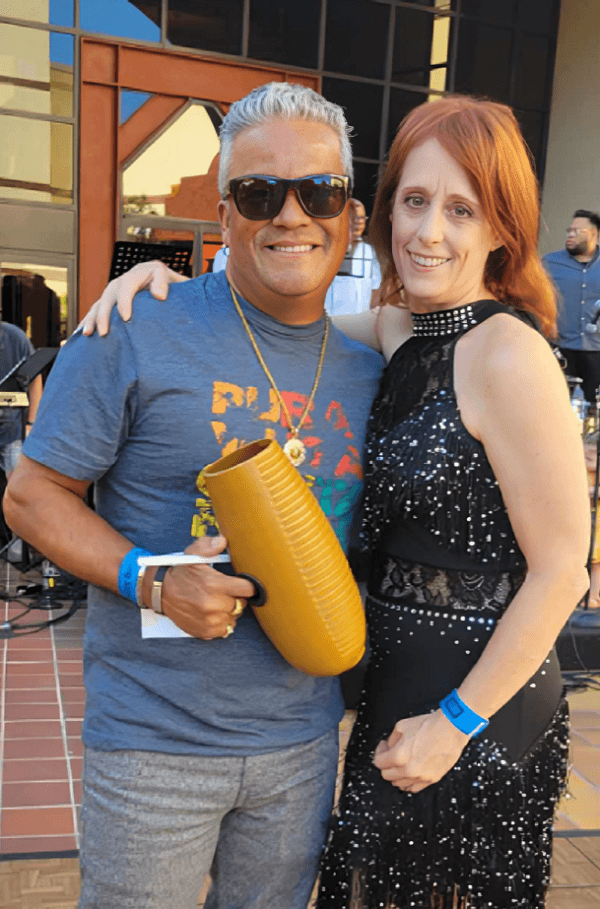
April at an event
April Connella at one of her dance events

How April became interested in dancing

April started to become interested in everything related to dancing from a young age, but the one who really introduced her in this world is Orlando Delgado, who was a salsa instructor and dancer in Los Angeles. It turns out that in this same city, someone close to Orlando saw April dancing in events by chance and told her to go to Orlando’s studio, meet him and take classes with him to reach her full potential. So she did and the connection between the two was instantaneous and, over time, they became friends and Orlando came to be someone very special in her life.

They became a dance couple, taught classes and did many events together until the untimely passing of Orlando in September 2023 due to a long battle with cancer

Sizzling Summer Nights

April was telling us that it was Orlando they really contacted to participate in Sizzling Summer Nights. One of his students in one of his dance classes, who turned out to be one of the organizers, suggested that both he and April attend these events, since the previous instructors had left, so he was looking for new ones.

Since then about eight years have passed and Sizzling Summer Nights has become one of the biggest salsa and Latin music events of the summer, largely due to the effort made by the talented duo.

Orlando and April in Sizzling Summer Nights
Orlando Delgado and April Connella at the Autry’s Sizzling Summer Nights some years ago

How Orlando’s death affected April

The dancer also confessed to us that Orlando’s loss has affected her personally and professionally, to the degree of saying that, together with him, she has lost a part of herself that feels that she will never be able to recover. Many have asked her why she does not get a new dance partner, but she finds it difficult to do that. She recognizes that there are many good dancers who could fill that spot, but finding someone she has the relationship and emotional connection she had with her previous partner is impossible. You do not get that anywhere else.

However, despite this painful loss, April knows she has to move forward in spite of everything and carry out her projects as hard as it is. In fact, one of those challenges is that April herself also happened to be sick with cancer and is in remission.

To this we must add that one of the things keeps her going is the great passion she feels for what she does and she believes that her profession is a part of her soul she cannot let die too. Not to mention that she has felt the support of the entire salsa community that knew Orlando in life and helped her to continue her work.

April and Chino Espinoza
Chino Espinoza from the group Chino Espinoza Y Los Dueños del Son and April Connella

April’s Feel Da Beat

The dance instructor explained that April’s Feel Da Beat is actually a new version of the previous dance company that was only called Feel Da Beat and was directed by Orlando. After the two meet, they not only become dance partners and best friends, but also business partners. 

Then, Orlando was planning to retire at some point due to age, so he wanted his project to be in the hands of someone he could trust and that was April, whom he taught everything he knew so he could delegate what he had built so far to her. When Delgado’s health was already very frail, both he and April discussed the matter of the company and concluded that the best thing to do was to transfer it to her and change its name to April’s Feel Da Beat. After that, it was up to her to handle the project alone and adjust to this new stage without Orlando by her side.

She does not have a big team working for her right now, but she does work with many artists and dancers for the various events in which she performs.

Orlando and his friendship with April
Orlando and April had a strong friendship until the day of his death

Read also: Los Boleros Latin Band Bandleader Rudy Furlan kindly talked to us

Dance. The best of America United in a Single Project

Latin America / Cuba / La Habana

Since the 1950s, a very humorous genre called the casino dance was born in Cuba, a style based on dancing the Cuban music of the moment between couples. This lies in history since the fashion of Mambo and Cha Cha Cha in the most aristocratic clubs and in the fraternal halls of poor blacks of the beautiful island, they danced on Saturdays, Sundays or special parties on specific days, for the moment the rhythms sounded de la Aragon, Chapotin, Orquesta Casino, el Benni, among others, without leaving aside rhythms such as rock and roll, sounds of the time that fought for a space in the fans.

Social Photo
Social Photo

From the mixture and the dance relationship of those attending the clubs is born that change of couples in circular formation called the Rueda de Casino, a name that we will be developing in other editions of the magazine.

In America, especially in the south of this continent, Salsa Casino, as it is called in many places, has managed to lay firm foundations, much more than what is known in Europe or North America, in some countries becoming the reference number 1 of the Salsa dance modality. We have the best example in Venezuela, land of casinos par excellence, where we can add a great hundred dance schools nationwide, without leaving behind how strong it is in Colombia and Peru, among some countries that also use this discipline. as a strong influence on young and old.

It is incredible to see the great differences in styles and forms between the casinos in Europe and those in South America, but always the same concept, joining several couples to enjoy a good timba or a good son.

From the foregoing, the Cubashow Project arises, born with the primary objective of generating a training and development channel for the new generations that venture into the beautiful world of dance, mainly those linked to Cuban Salsa and its roots in popular music or traditional Cuban music, folklore and its Afro tendencies, all in relation to the strong wave of this discipline that is developing in the main capitals of many American countries.

they danced cha cha cha

BAILA QUE BAILA AMERICA a concept of union between southern countries to extend the dissemination of Salsa Casino in the continent brings together some of the best instructors from each country with the sole intention of conducting national and international training tours in all trends of the dances of Cuban culture, in this way we obtain from the best exponents classes, seminars, talks, forums, workshops and shows that can be viewed through the social networks of @BailaQueBailaAmerica the different schools, academies or instructors registered to the project.

Professional dance teams are structured based on their local projections, the work they do within each of their countries. An event of great proportions is expected for the month of June where we will be able to have the best instructors from all over South America together in a high caliber event, we just have to be attentive to social networks and future reports of this great magazine to join us. to this casual wave.

  • « Go to Previous Page
  • Page 1
  • Page 2
  • Page 3
  • Page 4
  • Page 5
  • Page 6
  • Interim pages omitted …
  • Page 85
  • Go to Next Page »

International Salsa Magazine (ISM) is a monthly publication about Salsa activities around the world, that has been publishing since 2007. It is a world network of volunteers coordinated by ISM Magazine. We are working to strengthen all the events by working together.