North America/ USA / Pennsylvania
Celesté Polanco “The Salsera Fair” is a young singer in constant ascent in the National Salsa music movement nowadays. This star from Philadelphia with Dominican and Puerto Rican roots has managed to delve into the acceptation of the tropical music market with her two hits: “Traicionada” and “Mi Salsa te llama” in collaboration with great producers and composers of Latin Music.

This Salsera and humble person began her professional career thanks to the support of Héctor Rosado who believed in her talent and gave her the opportunity to be the lead vocalist of his Hache orchestra and at the same time to start working in the musical field, sharing stage with renowned Salsa figures, such as: Frankie Vázquez, Kevin Ceballo, Frankie Negrón, VITI Ruiz, Herman Olivera, Ricky Luis, and Chino Núñez y su Orchestra.
In 2015 Polanco decided to become a soloist with the 2x Grammy Award and 7x Billboard Award winner, Pablo Chino Núñez, recording her first two singles: “Traicionada”, released in 2015 under the production and arrangement of Pablo Chino Núñez, and composition of her authorship together to Linen Church and a year later her second promotional single “Mi Salsa te llama” whose composition, arrangement and production was in charge of Pablo Chino Núñez and Celesté Polanco.

“La Fiera”, nicknamed by her producer Chino Núñez to see her deliver her emotions during the recording of Traicionada, connects her art with her experiences. “The best way to sing is from my experiences. It’s my art, you know, someone will connect with it because they have encountered it too. I love happy music as well that’s where “Mi Salsa Te Llama” comes in”, said Celesté.
“… I love Salsa I feel that in the Salsa music industry there are not enough females emerging in the Salsa Industry.”

Celesté Polanco currently resides in Philadelphia and is recording her first album in which it will include her third promotional single: “El Tiempo Lo Dirá” which will be presented with an official video and will be available on all digital platforms soon.
This representative of the Salsa has performed at major festivals, such as: NAHREP (National Association of Hispanic Real Estate Professionals), LA LIVE (National Convention, 2016), MUSIKFEST in Bethlehem & LEVITT STAGE in PA and for this 2018 “La Fiera” will continue presenting his shows in Miami, Chicago, LA and also in the tri-state area.

“…The market of salsa, in general, it’s worldwide re-known. It doesn’t pertain to one ethnicity it has become multicultural… It’s a worldwide movement”.
“… My main focus is to reach as many people as I can through my voice and become a positive influence to the younger generation and all those who aspire to do great things but are scared to try”. Celesté Polanco
The Latin Music’s influences of Celeste “La Fiera” Polanco:
-Celia Cruz -Oscar D’ León -Yolanda Rivera -Cano Estremera -Orquesta Mulenze, etc…
For more information about Celesté Polanco, please like her on Facebook: https://www.facebook.com/celeste.polanco.7

North America / USA / New York
Music often requires characters who are always behind the scenes and support the work of singers and performers with their talent, who are ultimately the ones who “put on their face” and become popular. Sometimes, however, these anonymous characters rise to fame in order to perform their own work and even become more popular than any popular singer.
In the case of Pop, this character is called Quincy Jones, of whom it is enough to say that he has been an arranger for Frank Sinatra and a producer for Michael Jackson. A nobody”. In the case of Salsa, these characters have been symbolized by Jones’ emulator, a guy named Louie Ramírez who has done everything with everyone.
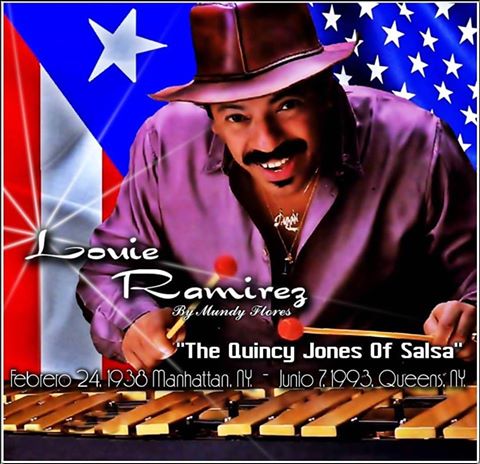
One afternoon in 1994, Ramírez was driving his car down the highway that would take him to Variety Studios in New York. It was going to be a quick session since he only needed one song to complete his 20th album as conductor. Perhaps that was why he was nervous and that filled him with anxiety. Minutes later he couldn’t resist the feeling and had to pull over to the side of the car. He had not finished doing it when a cardiac arrest ended his life.

Louie Ramirez was a genius. The classic man to whom everyone turns for advice and solutions to their problems. It didn’t matter if they were young or old musicians. The fact was, Louie had the answer, and visiting him was like rubbing Aladdin’s lamp. That was a characteristic that always accompanied him, from that first recording “Conozca a Louie Ramírez” in 1963.
He was 20 years old at the time and had already stood out for composing some pachangas and arranging for Pete and Tito Rodríguez’s orchestras. The commentator Dick Sugar then presented it like this: Ramírez breaks the image of the director of a group that uses the talent of other composers and becomes a follower of a rhythm. No, Louie Ramírez is a creator in his genre.

That talent did not go unnoticed by the new Czar of Latin music in New York, Jerry Masucci, who hired him as a star for Fania Records and at the same time, as an arranger for the orchestras and ensembles that belonged to the record company. Ramírez was soon involved in work and was only able to record two albums during the sixties, “Good news” and “Alí Babá”.
On that last album appeared the hit that allowed him to be a famous artist, El Títere, a true Salsa classic. The theme was sung by Rudy Calzado, the third of the soneros that Louie had used without finding the ideal. That was a burden that accompanied him as a director during the seventies, when he used singers of the stature of Pete Bonet, Tito Allen, Jimmy Sabater, “Azuquita” Rodríguez, Adalberto Santiago, and even Rubén Blades.
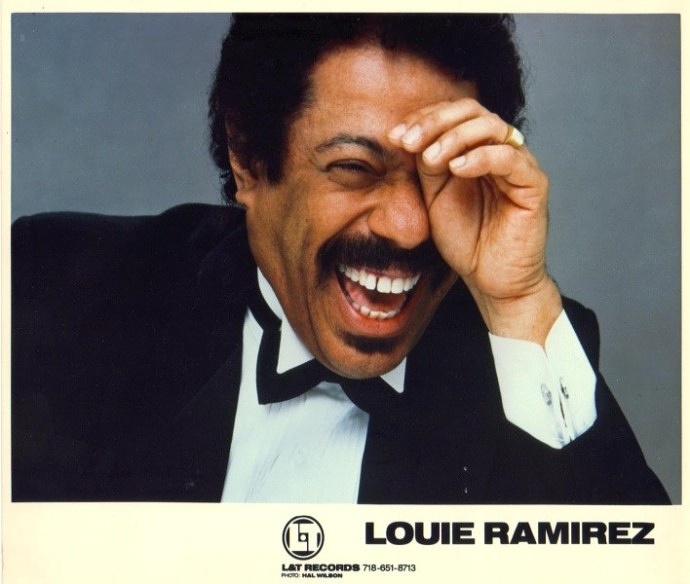
It was with Blades, precisely, that he made an anthological album, “Louie Ramírez and his friends”, in which the song Paula C was included, with an arrangement of those that deserve -hats off-. By then, Ramírez was considered in New York as the most progressive arranger that Salsa had, thanks to the brilliant work done for the Fania All Stars. An excellent job had been the instrumental arrangement of Juan Pachanga, to be sung by Blades, of Canta Canta for a performance by Cheo Feliciano, and of the entire album “Algo nuevo” that Tito Rodríguez sang with Louie’s orchestra.
But the high point of Ramírez’s career came in 1980 when Joni Figueras, representative of the K-Tel International label, hired him to arrange the ballads Todo se derrumbó and Estar Enamorado de Manuel Alejandro. The album, which included these and other tracks, was released two years later under the title “Hot Night” and was recorded by Louie’s own orchestra.

This is how the Salsa-ballad or Salsa-romántica was born in a job that Ramírez continued until his death, making attempts at Latin Jazz from time to time, which he loved. That is why he recorded an album in tribute to Cal Tjader, where Louie was director, producer, composer and arranger, in addition to playing the timpani and his favorite instrument: the vibraphone.
Louie Ramírez was a genius in arranging, in a career where those of Guantanamera and Isadora stand out for Celia Cruz, El Guiro de Macorina for Johnny Pacheco and El Caminante for Roberto Torres. Apart from this, there are his works for the Alegre and the Cesta All Stars. Regarding this profile of Ramírez, the critic Eleazar López defined it very well:

It is not easy to arrange for a dance band, especially when it comes to a group that cultivates the hot tropical genre. Many musicians feel influenced by Jazz and the result of their orchestrations leaves a void in the dancer. Others arrange simple, but so simple that they repeat and copy themselves, and the result is tiresome music, without any degree of creativity: music that says nothing, that leaves nothing. Louie Ramírez has found the perfect balance… that’s why he always stays current.

North America / USA / New York
Andrea Brachfeld (Flutist), Graduated from the High School of Music and Art and Manhattan School of Music. During the last 20 years he has recorded more than a dozen CDs with many artists, including Africando, Noel Pointer, and Timbalaye. Her big break as the flutist for the popular Latin band Charanga 76 catapulted her into Salsa history and fame as the first female flutist to play this music in the United States.

While in high school he received the “Louis Armstrong Award for Outstanding Alumnus” for Jazz Interactions. Study with Hubert Laws, Jimmy Heath, and Mike Longo helped him develop his own style. Downbeat magazine referring to Andrea as “one of the best jazz flautists around”.

She has twice been the winner of the Latino Award in New York, as a flutist. He has performed with Dave Valentín, Néstor Torres, and Ray Barretto, among others. While in Venezuela, he had the honor of opening for Chick Corea and Paco de Lucía. She recently received the Chico O’Farrill Lifetime Achievement Award from Latin Jazz USA. Her first Latin jazz CD, “Remembered Dreams” combines Latin originals with contemporary jazz cuts. His second CD, “Back With Sweet Passion,” is a dynamic salsa recording featuring Grammy winner Oscar Hernández on piano, and Alfredo De La Fey on violin.

Her third CD “Beyond Standards” is a collaborative effort with Chembo Corniel, featuring jazz greats Hilton Ruiz on piano and Steve Turre on trombone.
She has appeared with the Winnepeg Jazz Orchestra as a soloist performing her own compositions as well as those of Mike Longo, Dizzy Gillespie’s longtime musical director. He is currently performing with his own group, including Phoenix Rising, with a new CD out, “Into The World: A Musical Offering” with guest artists Mike Longo, West Paul and Brian Lynch.