• Skip to primary navigation
  • Skip to main content

International Salsa Magazine

  • HOME
  • Previous editions
    • 2026
      • ISM / April 2026
      • ISM / March 2026
      • ISM / February 2026
      • ISM / January 2026
    • 2025
      • ISM / December 2025
      • ISM / November 2025
      • ISM / October 2025
      • ISM / September 2025
      • ISM / August 2025
      • ISM / July 2025
      • ISM / June 2025
      • ISM / May2025
      • ISM / April 2025
      • ISM / March 2025
      • ISM / February 2025
      • ISM / January 2025
    • 2024
      • ISM / December 2024
      • ISM / November 2024
      • ISM / October 2024
      • ISM / September 2024
      • ISM / August 2024
      • ISM / July 2024
      • ISM / June 2024
      • ISM / May 2024
      • ISM / April 2024
      • ISM / March 2024
      • ISM / February 2024
      • ISM / January 2024
    • 2023
      • ISM / December 2023
      • ISM / November 2023
      • ISM / October 2023
      • ISM – September 2023
      • ISM – August 2023
      • ISM July 2023
      • ISM Edition June 2023
      • ISM – May 2023
      • ISM April 2023
      • ISM March 2023
      • ISM February 2023
      • ISM January 2023
    • 2022
      • ISM December 2022
      • ISM November 2022
      • ISM October 2022
      • ISM September 2022
      • ISM August 2022
      • ISM July 2022
      • ISM June 2022
      • ISM May 2022
      • ISM February 2022
      • ISM January 2022
    • 2021
      • ISM December 2021
      • ISM November 2021
      • ISM October – 2021
      • ISM September 2021
      • ISM August 2021
      • ISM July 2021
      • ISM May 2021
      • ISM April 2021
      • ISM June 2021
      • ISM March 2021
      • ISM February 2021
      • ISM January 2021
    • 2020
      • ISM December 2020
      • ISM November 2020
      • ISM October 2020
      • ISM September 2020
      • ISM August 2020
      • ISM July 2020
      • ISM June 2020
      • ISM May 2020
      • ISM April 2020
      • ISM March 2020
      • ISM February 2020
      • ISM January 2020
    • 2019
      • ISM December 2019
      • ISM November 2019
      • ISM October 2019
      • ISM Septembre 2019
      • ISM August 2019
      • ISM July 2019
      • ISM June 2019
    • 2016
      • ISM December 2016
  • Spanish
  • Download Salsa App
    • Android
    • Apple

Search Results for: Latin

Bandleader Edgardo Cambón talks about the teaching of music and his strategies on stage

Here you have our interesting comversation

We are here with Uruguayan bandleader, multi-instrumentalist, and percussionist Edgardo Cambón, who currently lives in Oakland. It’s very nice to meet you, Mr. Cambón. What a pleasure to have you with us today.

Hello, Karina. It’s a pleasure to have you here too despite the distance. I also send my regards to the followers of salsagoogle.com and to salsa fans around the world because this is an international connection. Thank you for the opportunity to connect with so many people.

Uruguayan bandleader and singer Edgardo Cambón next to new MOPERC walnut, 7 & 9 inches drums

On one of your Facebook pages, one can read that the conga is your main instrument, but you also play many others. In that sense, is the conga the instrument you most enjoy playing or are there others?

That’s a very good question. I am a percussion lover in general and, being Uruguayan, I also came into Brazilian percussion. The instrument to which I always gravitated around and returned to very strongly was the tumbadora or conga (commercial name). To study that instrument and the batá (the most religious Afro-Cuban music) I went five times to Cuba from 1989 to 2006. I have a very deep connection with Cuba and with all the countries in which the tumbadora is used. This is also the instrument I play while singing, which makes me have a very special connection with it. Jokingly, I say that I feel naked if I don’t play something while singing. I always try to play a güiro, maracas or another instrument because I always have.

You also teach music and percussion. It is well known that the teacher teaches students, but also that tstudents can also teach the teacher. Could you tell us what you have learned from your students?

That’s a very important and lovely question. I could tell you many things. The first thing you learn is to be patient with yourself and your own progress because the musician never stops progressing. The human being never stops progressing. When I see a student who is very nervous and isn’t patient with himself, I always try to make him understand that performing one instrument well takes a long time.

I learn a lot about what to do and what not to do. I learn to be patient with them, to rewind the cassettetape and to get back to the basics of what I learned in Cuba when I started traveling. My students also teach me to be grateful to my own teachers and connect with the instruments. When you reach a certain level, you become overconfident and it’s harder to connect with the instruments. Classes force you to pick up an instrument without being obliged to do so, which the professional musician tends to leave out after a long career.

My students remind me of what I was doing when I was learning and force me to keep practicing despite the experience. I always learn from them.

Edgardo Cambón in front of El Floridita

You teach both in person and via Zoom. What teaching strategies do you implement at home?

The difference between one mode and the other is huge and it was hard to get used to this situation. I was receiving a lot of proposals to teach via Zoom before the pandemic. I was avoiding at all costs the use of digital platforms even though many people were interested. I have a lot of online videos with great success and positive feedback, thank goodness. This has caused many people to ask me if I can teach them on Zoom.

The pandemic forced me to build that dormant muscle, so I think I achieved a very good system for giving online classes. In person, I use some applications that allow me to play certain songs I can slow down. These apps can work like a metronome, but funnier. Some of them are Percussion Tutor, Salsa Rhythm, Amazing, Slow Downer, among others.

In the case of Zoom, I suggest my students download these apps on devices other than the one they are using to meet with me. The biggest problem with digital teaching platforms is the delay sound between the student and the teacher. Now, amazing things have been done like the fact that a symphony can play in one country, while the conductor is in another conducting them. There have been improvements.

It may also be the case that there are students with excellent quality equipment, but others who have devices with outdated operating system and low download speed. So, we have to find a way for everyone to learn as well as possible. This system consists of doing a demonstration first, getting the student to play the rhythm from his side through the metronome or the application. Many times, we can spend a whole class trying to solve technical issues, but once everything is solved, you can establish a rhythmic relationship between the student and the teacher.

There are situations in which the mismatch between the sound and image prevents errors from being corrected, so we use phone calls to counter these issues effectively. This is how I look at the video image of the student (if there are no delays) and hear the sound at the right time.

The good news is that I can have students from around the world and doors are opened me for an broad international spectrum that I never expected.

Edgardo Cambón with a Pandeiro in a studio

Strategies on stage (título 3)

Radically shifting the issue, according to your website, one of the main defining things about Edgardo & Candela is that you know how to read the crowd very well and what the audience wants at that moment. How do you do that? What techniques do you use?

That’s a very good question. That’s a technique which is a bit instinctive. I must confess that that technique does not belong to the full orchestra, but to me as the lead singer and the orchestra leader. The guys know that I ask for a set list and even send it in advance. Several of them have their iPads and the music there in digital format, but others don’t.

I have over 240 songs in the repertoire, but I don’t get them all with me. On average, you play about seven songs in each set for an hour, which means that you’re thinking of 14 to 16 songs for two hours. It also depends on how long each song lasts.

If you’re playing to an American audience, you’ll probably have to slow down, play one or two songs in English and light beats such as cha cha chá. You have to include digestible things if you’re not playing to a salsa audience.

If I’m playing for the Mexican community, I have to include cumbia and medleys of local bands and artists like Maná, which is a very important Mexican group.

I have four original score albums. The first one was called ilusiones and released on vinyl in 1989. We produced it here in the Bay Area when there were few groups making original music around here. Following a trip to Cuba the same year, I decided to go back and focus more on my melodies, my songs and my lyrics. Another thing I wanted was to keep the Uruguayan essence in salsa and add a bit of candombe, which is the Afro-Uruguayan rhythm par excellence.

Edgardo and Candela at The Seahorse

I’ve had a lot of popular songs on certain digital platforms, but I wouldn’t be honest to say that I had a big hit like Llorarás by Oscar D’ León and Yo no sé mañana by Luis Henrique. I can use these things to push my original music a bit harder in general. You can have your original music, but you also have to play music known by the public to accustom people to your style and make them learn to digest your thing a little bit.

In the 70’s in New York, the bands only played original music, but those times has disappeared. That’s why I mix original music with familiar music, but I focus on making the result digestible and danceable for people. I play at least four times a week and, if I want to maintain that rhythm of work, I need a repertoire that includes Cuban, Colombian, Venezuelan, Mexican, Dominican music, among others.

What made you get involved in Charley’s project?

No self-respecting musician can allow his career to revolve around two or three clubs because these venues can open and break.

What I liked most about Charley’s was its proposal so similar to that of the 80’s, the decade when I arrived here. They were more stable clubs that had organization and the collective participation of artists such as DJ’s, dance instructors, radio folks, among others.

Also, Charley’s is a nice place and has a size that I think appropriate. When clubs get too big, there comes a point when the vibes can get cold, something that doesn’t happen in this place due to its moderate size.

The only downside is that gas is $6.25 and it’s far away for people from San Francisco, but people from closer areas can go.

Your music reaches audiences from all over the world. Have you had the chance to play abroad?

Yes. In 1996, we were at the Benny Moré Festival in Cuba. A few years later, we were on the island of Guam on the occasion of 5 de Mayo sponsored by Budweiser.

On both occasions we were very well received by the audience.

Most recently in May this year, we just played a large concert with over 1500 people at the Fairmont Orchid Hotel in Kona, Island of Hawaii. On that occasion, everything was arranged by the Salesforce company.

This last work was impressive because of the high technical and professional level of the entire production, since in addition to our Latin music, the popular pop singer Kathy Perry closed the show…

International jobs, and simply out your city, give another angle to the career encouraging the musician to present his original music.

After playing in Cuba, Guam and Hawaii, I jokingly say that I only get booked to play on Islands (chuckles).

Traveling on my own (without the orchestra) gave the pleasure of performing in Sweden and Argentina with the support of local musicians from those countries.

Cambón at Brooklyn Basin in Oakland

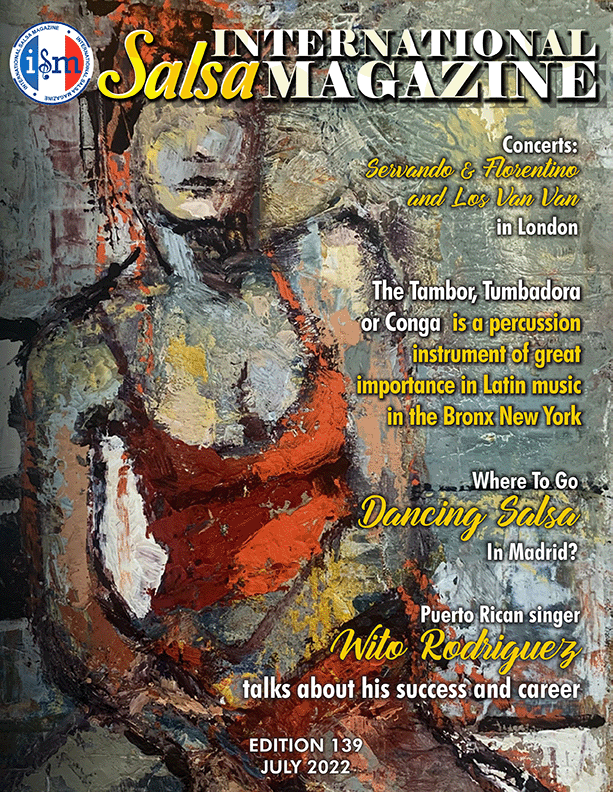
Puerto Rican singer Wito Rodríguez talks about his success and career

How his career starts

We are here with the very talented Irwin Wito Rodriguez (https://www.facebook.com/nmjrecords). Pleased to meet you, Mr. Rodriguez, such a pleasure to have you here. How are you?

Thank you very much, Karina. Thank you for the invitation. Quite well, thanks to God. I am in Florida at the moment, where the temperature is very pleasant.

Talented Puerto Rican singer Wito Rodríguez

Your beginnings in the musical world occured in a rock band, which is very common in many of your colleagues. Many of them start as boleristas and rockers. How did you go from a rock band to singing salsa and other genres like this?

I was born in Chicago and my parents are Puerto Rican, so I was raised American and tended to speak more English than Spanish. I listened only to music in English, but I also listened to Daniel Santos, Los Panchos and Tito Rodriguez at hore since I was a little boy. However, they were my parents’ favorite artists, not mine. As the years went by, my dad bought me my first guitar, so I joined a rock band of four or five kids and we started playing very cool songs. This lasted until I was 14 years old, when my father decided to send us to Puerto Rico and it was a very drastic change for me because now I was going to be in a school where Spanish is spoken and my Spanish was very bad. When I arrived in Puerto Rico, it was very nice to see the island in person because I only knew it from what my dad told me.

Five or six months after I arrived in Puerto Rico, I started singing with another rock band until I turned 16, which was when a very famous percussionist named Chacón (he had a band called Chacón Y Sus Batirítmicos) heard me sing and told me that he would like me to sing with them. He lived near me, so I could go to his place. I started going about twice a week to learn to play the conga and the clave. Around that time, I started learning everything related to salsa and typical Puerto Rican rhythms.

So I started playing in a nightclub, but I wasn’t supposed to do that because I was still 16 years old. So, they got me a jacket, hid me and I started singing there. When I turned 17, I moved to Chicago to finish school and speak English again. Three months later, I started singing salsa with the first orchestra in Chicago whose name was La Orquesta La Justicia from 1971.

So, you didn’t like salsa, but you developed a taste for it.

That’s correct. I didn’t have the joy of attending music school, so I just tried to learn as much as I could from what I saw. If I saw someone playing on a stage, I would approach the musicians, ask questions and clear my doubts. I learned a lot of things on my own.

Image taken from his video clip You’ll Never Find Another Love Like Mine

Military service and his first orchestra

You were part of the German orchestra Conexión Latina while serving in the army. How did the idea of starting a Latin music group in such a country arise?

When I was in the Orquesta La Justicia, I met many salsa stars like La Lupe, Ismael Rivera, Larry Harlow, Ray Barreto, El Gran Combo de Puerto Rico, La Sonora Ponceña and many others. All these artists helped me and taught me many things.

When I joined the U.S. Army, I had the opportunity to sing with an orchestra in Puerto Rico, but I was in Chicago. I accepted and prepared everything to return to the island, but the orchestra had already gone on tour when I arrived and they didn’t take me. It was very sad for me because I left everything in Chicago, since I wasn’t thinking of returning.

From there, I decided to join the U.S. Army and wanted to be sent as far away as possible. A week later, I reveived word that I passed the test and that I would be sent to Germany. That’s when I started a band called Wito Y Su Conjunto Sabor in 1977 along with other Puerto Ricans who also sang or played instruments. We were the only salsa band in Germany at that time. In 1981, I already had an orchestra called La Sonora Antillana and we played for the German audience, which was very tough.

In 1983, I left the army. Then, Luis García, an excellent tres player, and Cano Robles from Conjunto Canayon, Puerto Rico, made my first album called Calorcito. The following year, I released my first album and it was awesome because it led me to release another record production that took me to tour all around Europe.

In 1992, I went back to Tampa, where my dad lived. I came back to be in need because nobody knew who I am there. It was very difficult, so I had to start working until I returned to the Army and was sent to Pennsylvania. In 2007, I finally retired with 30 years of service.

In 2013, I started making my first solo album whose name was Qué Mundo Maravilloso. In 2016, I moved to Orlando, where I finished my other three albums I released later.

Art for the song Qué Mundo Maravilloso

You took opera classes. How did this help you in salsa?

Those classes taught me how to stabilize my voice, know how to modulate, know how to breathe, know how to feel the tone in one part of the body (under your nose), know what tone comes after the previous one and all kinds of things. I also learned some very good exercises to warm up my voice.

Another thing these classes taught me was resistance. Spending an hour singing on stage is not easy.

A lot of singers have a good voice, but they don’t have the necessary training to get to the right tone for them and avoid singing off-key.

I read that you have been nominated for the Hollywood Media Music Awards and the Miami Fox Music Awards for both English and Spanish songs. Which songs are the most successful? English or Spanish?

I try to include even a salsa song in English in all my albums. My last song focuses more on the American audience than the Latin audience. It was a good choice because the video has about 42,000 views on YouTube, which means it attracks more attention than my other work.

One of the things that has done musicians in general most harm has been Covid-19. Many are recovering, but others had to get a job because they could no longer make a living from music.

Many of his songs are related to his Puerto Rican roots

ISM July 2022

Directory of Salsa Clubs in Europe

Diobar

Av. del Marquès de l’Argentera, 27, 08003 +34 656 62 11 45 Barcelona, España

Havanna

Hauptstraße 30, 10827 Berlin, +49 30 78899655 Germany

La Bodeguita del Medio

Kaprova 19, 110 00 Staré Město, +420 224 813 922 Praha, Chequia

La Macumba Music Latino bar

Štefánikova 230, 150 00 Praha 5-Anděl, +420 776 795 166 Czechia

Ronnie Scott’s Jazz Club

47 Frith St, London W1D 4HT, +44 20 7439 0747 United Kingdom

Salsa Carlos

Yegi’a Kapayim St 10, +972 54-573-7173 Tel Aviv-Yafo, Israel

Baby’Oh Elche

Carrer Sabadell, 16, 03203 Elx, +34 633 77 80 90 Alicante, Spain

Havana Music Club

Yigal Alon St 126, +972 3-562-3456 Tel Aviv-Yafo, Israel

Hideaway

2 Empire Mews Stanthorpe Road, Streatham, Londres SW16 2BF +44 20 8835 7070 United Kingdom

Kona Kai

515 Fulham Rd., London SW6 1HD, +44 20 7385 9991 United Kingdom

Mi Barrio

Münzwardeingasse 2, 1060 Wien, +43 1 5876125 Austria

Mojito Club

Carrer del Rosselló, 217, 08008 +34 654 20 10 06 Barcelona, Spain

El Sabor Cubano

Carrer de Marià Cubí, 4, 08006 +34 674 98 88 63 Barcelona, Spain

Salsa! Soho

96 Charing Cross Rd, London WC2H 0JG, +44 20 7379 3277 United Kingdom

Salsa Temple

Victoria Embankment, Temple, London WC2R 2PH, +44 20 7395 3690 United Kingdom


Salsa in Israel

Europe / Israel / Tel AvivSalsa in Israel

Salsa in Israel. This ancient land is as exciting as the many stories it tells. It is the land of Abraham father to Isaac and his half brother Ishmael the patriarchs of the Arabs and the Jewish people. Patriarchs born of Sarah and Hagar. It is the land of Jesus and his many stories. It is the land where all three groups claim Jerusalem as holy.

For the Jewish it is because of King David, King Salomon, the two temples, the tomb of King David and the Western Wall. The Muslims regard it as the place from where the prophet Mohammed ascended to heaven in the birthplace of Christ, the via dolorosa and the cruciction. Each group has a “gate”. Why even the hamburger chain McDonalds seems to have gotten their “golden arcs” from one of the gates.

At 71 years of age, Israel is one of the youngest countries in the world. Needless to say the country is deeply divided, with serious challenges facing its leaders. A majority is required to govern effectively. While 80 % is said to be secular (non-religious ethnic) and 16% ultra-orthodox, the ultra-orthodox control the swing vote. To be Jewish you must be born of a Jewish mother, or converting. Around 500,000 Latinos are Jewish citizens.

This is around 5% in a country of 8.5 million people. The population is very diverse. Listening to people talk, at times I felt that I was in Russia. The migration from the former USSR comprised for over a million immigrants. The Roman Empire could not afford rebellion in Judea as it was the crossroads between Europe, Africa, Asia and the Middle East. Massada is the conformation of the determination to be a free people.

Ultra orthodox 16%

As a new nation the argument that tradition, culture and religion had to be nurtured and recaptured was presented by the ultra-orthodox. As its fi­rst Prime Minister it is said that David Ben-Gurion gave some 50 persons a waiver from obligatory military service. Much to the displeasure of many seculars, the ultra-orthodox have since grown in numbers and receive government assistance so that they are free to do nothing else than to study. However with the control of their swing vote, the ultra-orthodox continue to be exempt from obligations. After fi­nishing mandatory school, all citizens must render military service, two years for the women and three years for the men.

ISRAEL ARCHITECT

Although the official capital is Jerusalem, the modern city is TelAviv, followed by its Port City of Haifa. The Tel Aviv nightlife goes way beyond 2 a.m. The city is very modern, and everything seems to work right on schedule.

The architecture speaks of free growing ideas

ISRAEL FOOD


Diverse migration is accompanied with the cuisine of the immigrants. As a result, Tel Aviv boasts of a wonderful variety of cuisine.

The women walk the streets in the wee hours of the night without a care, which speaks of the public safety. Tel Aviv was voted “friendliest gay city in the world.” It is said that the annual gay pride parade was attended by more than 250,000.

250,000 people attend the LGBT community friendly parade

When visiting Bethlehem, the church of the Nativity, West Wall, and tomb of King David, you have to enter into Palestinian controlled territory. Our Israeli tour guide explained that they had entered into an agreement of cooperation with the Palestinian tour guides

Palestinian tour guides

An Israeli bus took us to the border and we then transferred to a Palestinian tour bus. The Palestinian tour guide took over and gave us our tour, a visit to their gift shop and then returned us to the border where the Israeli bus and guide were awaiting for us.

Man dressed in black dancing with woman in white top

For those of you who are always looking for a place to go dance Salsa, our recommendations are two places only, Salsa Carlos and Havana Club.

Havana Club caters to those new salsa dancers with a large main fl­oor and three or four side rooms for specialties like Bachata, Cumbia, etc. For those of you looking to find a more Latino place, then “El Propio” is Salsa Carlos.

What got you going in Salsa? Carlos says that he grew up hearing Salsa in Cali. It runs in his blood and his heroes were El Gran Combo, Los Hermanos Lebron and Beny More. Even the bell in grammar school to signal recess, played in Salsa. In Israel some Colombian friends asked him to organize a Salsa event and it was successful. To his knowledge, he is the first person to introduce Salsa in Israel. Since then Carlos has been organizing events in Tel Aviv at places like the “Old Port”. Apart from special events, he holds every Friday night at 11:30 pm, Salsa Carlos at Carlbach 3, Tel Aviv. He is accompanied by DJ Manuel.

  • « Go to Previous Page
  • Page 1
  • Interim pages omitted …
  • Page 232
  • Page 233
  • Page 234
  • Page 235
  • Page 236
  • Interim pages omitted …
  • Page 305
  • Go to Next Page »

International Salsa Magazine (ISM) is a monthly publication about Salsa activities around the world, that has been publishing since 2007. It is a world network of volunteers coordinated by ISM Magazine. We are working to strengthen all the events by working together.