• Skip to primary navigation
  • Skip to main content

International Salsa Magazine

  • HOME
  • Previous editions
    • 2026
      • ISM / April 2026
      • ISM / March 2026
      • ISM / February 2026
      • ISM / January 2026
    • 2025
      • ISM / December 2025
      • ISM / November 2025
      • ISM / October 2025
      • ISM / September 2025
      • ISM / August 2025
      • ISM / July 2025
      • ISM / June 2025
      • ISM / May2025
      • ISM / April 2025
      • ISM / March 2025
      • ISM / February 2025
      • ISM / January 2025
    • 2024
      • ISM / December 2024
      • ISM / November 2024
      • ISM / October 2024
      • ISM / September 2024
      • ISM / August 2024
      • ISM / July 2024
      • ISM / June 2024
      • ISM / May 2024
      • ISM / April 2024
      • ISM / March 2024
      • ISM / February 2024
      • ISM / January 2024
    • 2023
      • ISM / December 2023
      • ISM / November 2023
      • ISM / October 2023
      • ISM – September 2023
      • ISM – August 2023
      • ISM July 2023
      • ISM Edition June 2023
      • ISM – May 2023
      • ISM April 2023
      • ISM March 2023
      • ISM February 2023
      • ISM January 2023
    • 2022
      • ISM December 2022
      • ISM November 2022
      • ISM October 2022
      • ISM September 2022
      • ISM August 2022
      • ISM July 2022
      • ISM June 2022
      • ISM May 2022
      • ISM February 2022
      • ISM January 2022
    • 2021
      • ISM December 2021
      • ISM November 2021
      • ISM October – 2021
      • ISM September 2021
      • ISM August 2021
      • ISM July 2021
      • ISM May 2021
      • ISM April 2021
      • ISM June 2021
      • ISM March 2021
      • ISM February 2021
      • ISM January 2021
    • 2020
      • ISM December 2020
      • ISM November 2020
      • ISM October 2020
      • ISM September 2020
      • ISM August 2020
      • ISM July 2020
      • ISM June 2020
      • ISM May 2020
      • ISM April 2020
      • ISM March 2020
      • ISM February 2020
      • ISM January 2020
    • 2019
      • ISM December 2019
      • ISM November 2019
      • ISM October 2019
      • ISM Septembre 2019
      • ISM August 2019
      • ISM July 2019
      • ISM June 2019
    • 2016
      • ISM December 2016
  • Spanish
  • Download Salsa App
    • Android
    • Apple

Search Results for: Merengue

The Soul of Latin American culture – Salsa, Merengue y Lambada

Latin American / Venezuela / Caracas

Did you know that Salsa, Merengue and Lambada are rhythms that have been enjoyed in the last decade? Well, this link that unites them is the energy and passion for life, expressing itself in music, showing itself in the romance of couples dancing in harmony and with dance it unites them even more in a sentimental way as in fellowship.

These rhythms were born from a very urban environment, where each dancer can freely show their personality in the movement, however, following certain rules that each genre has, where one can follow each step and technique or do it spontaneously. For example:

✓ Never use the same foot twice, it must be alternated (right, left, right…).

✓ Dance with your partner as a mirror, that is, if you go to the right, your partner goes to the left.

✓ Transfer of weight from one foot to another as steps are performed.

Salsa is a rhythm that originates from the synthesis of Cuban son and other Caribbean music genres, with jazz and other American rhythms. One of the main contributors comes from the African rumbas along with the cumbia, the guaguancó, the guajira, the Cuban son, the mambo, the montuno son, the cha cha cha, among others.

It can be said that salsa is one of the most important rhythms in the music industry where it has many characteristics of its contributors, for example, “salsa” is close to “mambo” due to the steps executed in counts of eight, its movements and patterns are unique, however, it is a side-by-side dance with different turns.
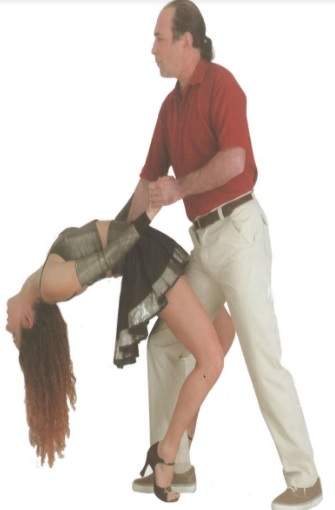
Couple dancing Salsa

The Merengue has its origin in the Dominican Republic and has a huge degree of popularity in the Caribbean area, it is a slow rhythm that increases its speed at the end of the dance, it is similar to the bolero but it is danced more than anything in groups than with a partner.

The secret of the dance is based on the transfer of weight from one foot to another, where each Latin genre has a characteristic that differentiates them, the best example is the similarity that everyone believes that “salsa” has with “merengue”, where Salsa has 4 beats, where the first beat touches the floor lightly with the tip of the foot quickly, which is known as “TAP” and this is repeated in four “4” and eight “8”, instead The merengue does not exist, this “TAP” is only 2 beats, it is a constant rhythm, very simple, whose speed of steps is marked by the musical rhythm.

But both genres have to have in the dance a movement of the hip, shoulders and position of the hands that characterizes them, marking the sensuality of Latin rhythms.

The “Lambada, a Brazilian genre that originated from the small cafes and bars that came from the garrafa dance, is believed to have been the product of rhythms such as the “Carimbo” and the “Merengue” with influences brought from the “Forro” and the “Samba” so it has a lot of Caribbean music influences, but the melody is the combination of Caribbean drums, brass and electric guitars with an added touch of Spanish elements and the flavor of the local indigenous people. It first spread to Bahia, Europe, Japan, the USA and the Middle East. It is currently danced in nightclubs and dance clubs, since its creation its jiv, merengue, rumba, even sevillanas and acrobatic maneuvers have evolved.

It is a 3-beat dance (fast – slow – fast) where the first step is taken with the first beat of the music, the second is the movement of one of the 2 senses and the third is the transfer of the weight back to the center moving the leg more slowly.

This dance is danced with the whole body, women dance pointe, flex the knees and the trunk moves in the opposite direction to the lower part of the body, if the hip rotates in one direction the rib cage rotates in the opposite direction. It can be danced alone or as a couple (they dance very close together giving the impression that it is one person), where the man molds his partner in the dance and the woman can embellish the dance with head movements or a controlled intentional fall producing a wave from the knee to the hips and shoulders.

If you want to know and learn some basic steps of the mentioned rhythms, look for the book in movement Latin Dance Dessi and Orod Ohanian and get passionate with these three “3” hot dances. Or follow us and watch the following videos to learn how to dance merengue, salsa and lambada.

Tips for the Latin dances “Salsa”, “Bachata”, “Merengue” and “Lambada”

To be able to socialize and have fun, many people learn different activities that can attract others either in their daily routine or during a rest time they have; among those activities is music and dance, where the person can interact with their neighbor and / or partner (a) either by practicing it or simply talking about the subject.


Dancing is simply the act of performing a dance, where a person uses his or her body to perform movements to the beat or to the rhythm of a music or melody, in order to express a message, by tradition or with the aim of entertaining oneself; of course, in order to practice it, body communication is very important because the couple or group needs to know certain signals that indicate the “when” or “how”, in order to perform the steps and as a result the success of this performance will test the quality, maturity and growth of the dancers; and to perfect the technique the best thing they could do is to look for an academy where they can orient them and thus achieve their equilibrium either as a couple or as an individual.

However the dance is not something monotonous, it has different musical genres and on this occasion we will talk about La Salsa, La Bachata, El Merengue and a little known but at the same time very interesting rhythm called Lambada.

 The tenses in these 4 musical genres are different, for example:


  • The Lambada is a dance that comes from Brazil although you still have doubts about its exact origin.  Another influence of its development came from Caribbean music adding metal drums, electric guitars making this a unique musical experience.  It has a degree of popularity in Europe because it is exotic and uncommon due to certain characteristics la Lambada that there are traces of flamenco and other ancient Spanish dances.  The Lambada uses a three (3) beats, where the first 2 are fast and the third (3rd) is slow, with simple steps dancing either in the same place or on the side, showing momentum and interest where the dancer is looser, flexible and docile, whereas the woman is full bodily movement and should be guided by her partner, as if the woman were clay in the hands of the potter.
Lambada dance
Photo of a Lambada dance contest
  • La Salsa is an Afro-Caribbean rhythm and dance fused with jazz and other styles.  Its birth has been much debated, but it is known that it comes from a fusion carried out by the inhabitants of the Caribbean when they listened to European music and then mixed it with their drums, it is a rhythm with flavor, joy and the force of life, a very common characteristic when it comes to party, which one can associate through the salsa songs. The Salsa handles a four (4) beat beat beat, either side to side or back and forth, it can also be crossed (as if you draw a “V” with the 2 and 3 in the middle) and the turns in both dancers can be from simple to complex as you progress level in (a dance academy), citing the textual words of Glenis is a rhythm where the woman It’s man-guided, so if you want to blame her for a misstep, you know who to blame.
Salsa Pose
Photo of a couple dancing Salsa
  • The Merengue is a dance from the Dominican Republic, becoming a Caribbean and Latin rhythm, it is one of the easiest rhythms to learn to dance even without experience, since it is not as fast or strict as the “Salsa” is, its movement can be back and forth, or side to side, always adding very noticeable hip movement with the rest of the body although not as exaggerated as bachata or kizomba; giving it a touch of flavor and flavor.  It is required to do this a close dance with your partner that when salsa is danced, facilitating the fluency of the couple at the time of moving and so be more synchronized, of course it is that not all the time is like this, the trick is the synchronization of the couple’s steps; usually it resembles the turns of the salsa with the merengue.
Meringue Competition
Photo of dancers dancing Merengue

There are many types of dances in each country and in its academies and-or dance venues, which have their own rules, tips, names and steps to follow, what matters is that you achieve the ultimate goal which is to “dance” by holding classes regularly, following the advice of your teachers, practicing your technique outside your classes, dedicating time to improve your dance skills specific, improve your postures, exercise without abusing it getting your rest time and above all observe outstanding dancers of different styles, this way you will be able to achieve your goals without staying on the path of learning.

Steel pan percussionist Brad Shores shows us the best of Caribbean music in Florida

Brad Shores is an American musician whose love for tropical music has led him to undertake some truly interesting and successful projects, so we know this article will be of our readers’ liking, so they cannot miss it. 

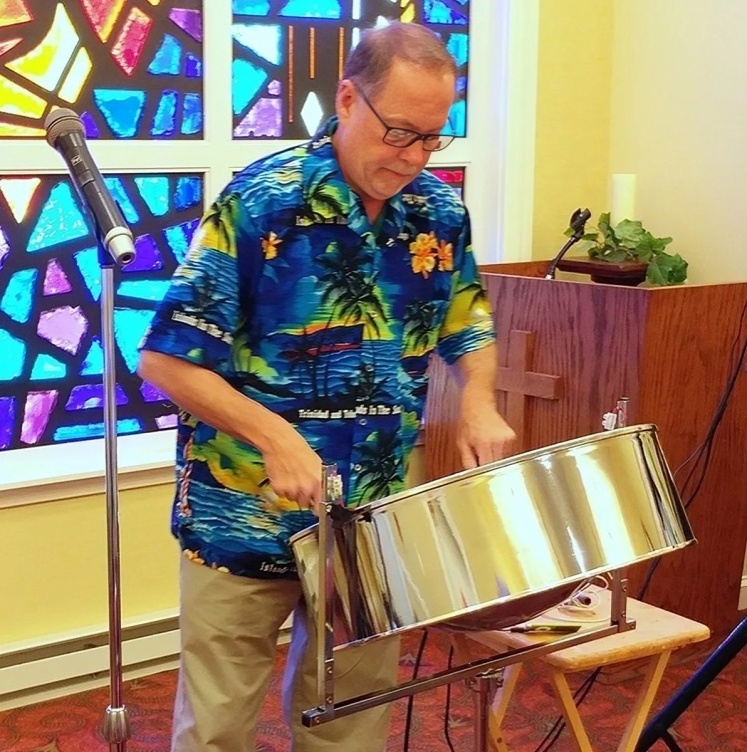
Brad at a church
Percussionist Brad Shores at a church in Newton, KS

How Brad got his start in music

Brad began his story by explaining that his parents were musicians. His mother taught music, while his father loved playing the drums and had been in various bands throughout his life, which caused the boy to be exposed to that world from the earliest age and end up falling in love with it just as his parents did. 

He tells that one day his mother used to lend him the sticks she used to play the drums and teach him to read and understand music when he was just in third grade, so from an early age, it was made easier for him to learn everything regarding music. Around the same time, he understood that music would quite possibly have a very special place in his life, since he had always enjoyed playing and loved it so much.

He was studying music theory in high school, and in college, he earned his degree in music education at Fort Hays State University in Kansas. He focused primarily on drums and percussion, but thanks to all the professional experience he has gained over the years, he plays almost all instruments competently. He also had the opportunity to teach others to play from very early in his own bands and now in a little more formal way, so he had to learn to play everything up to a certain level.

Previous experience to his current group Tropical Shores Steel Drum Band

Before starting his own project, Brad had the opportunity to play with groups in all genres and sizes, so he has a not inconsiderable background.

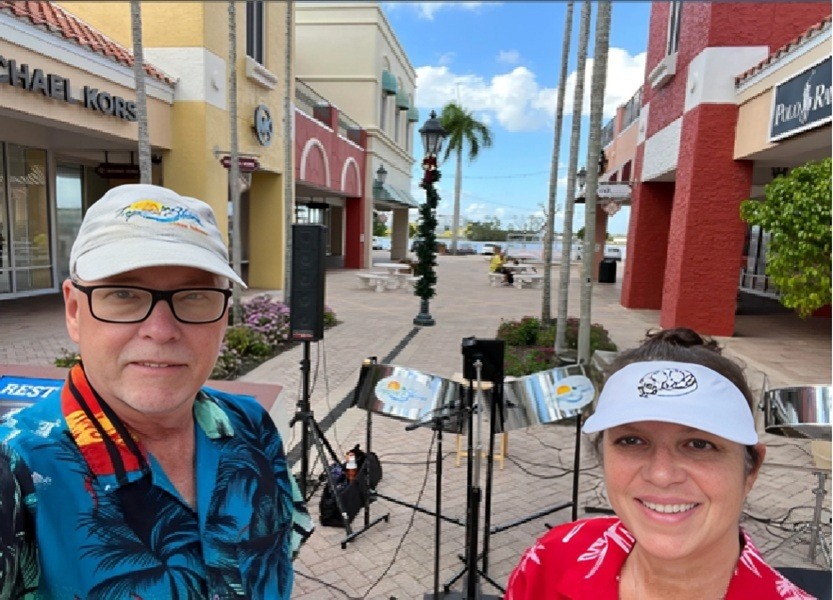
Brad and Erica
Brad and Erica at Moxi Junction

He remembers a jazz trio he was able to be part of in high school, which could be considered one of his first significant professional experiences, but that was just the beginning. He also remembers being part of many projects in college, such as an opportunity in which he played for some Germans and another in which he was in a rock band, showing that the artist was not limited to anything and was perfectly capable of crossing into all genres and adapting to them as it suited him.

Once he moved to Phoenix, he also played with many other bands and continued to experiment until he finally tried steel drums, which is primary instrument to this day and for which he is best known.

Contact with tropical and Latin music 

Being already in Phoenix, Brad told us that he was in a band where there was a steel pan percussionist who played a kind of music Brad had never heard before in his life. It was Caribbean music that had really caught Brad’s attention, and he definitely wanted to learn to play it as skillfully as that guy, so he listened carefully to every note that came from his instrument. With his lack of training in those genres, it was a bit difficult for him, but he finally succeeded and got very good.

In the case of Erica, his current wife, her mother played the organ at a church in Chicago, where she grew up. Before he met Brad, she was a salsa, merengue, and cha-cha-cha dancer, so she had a very different background from her husband’s with regard to rhythms. She also had a master’s degree in music, so her education in this discipline was wide, even if she had not had plenty of practice yet. It is worth mentioning that she is his second wife, since Linda, his first wife and mother of his three children, died from lung cancer in 2014.

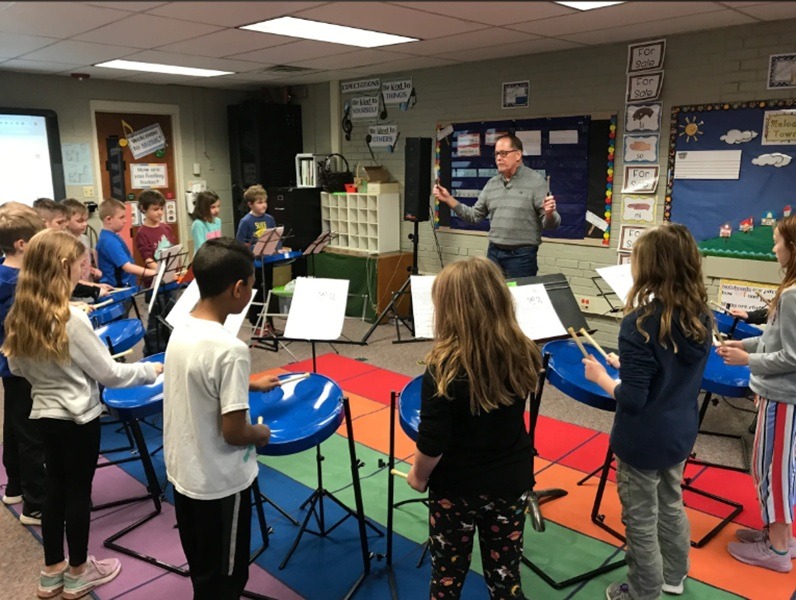
Brad teaching
Brad teaching mini pans to grade school students

Tropical Shores Steel Drum Band 

A handicap Brad and all the musicians of the day had to face was the impossibility of finding and repeating a lot of music, since there was still no internet. Therefore, he could only pay attention to what their peers and colleagues were doing at the time to be able to imitate them and learn how to play the steel drums.

When Brad and Linda moved from Phoenix to Kansas, they had to start looking for local musicians who could suit the project they were making and finding places to play, since many people in Kansas were not used to hearing the type of music they played. For this reason, they would start their sets by playing other genres to which the audience was accustomed to, so that they would be more open to their tropical songs.

Tropical Shores Steel Drums and Teaching

In addition to playing, the Tropical Shores Steel Drums Band has a very important component: teaching. Brad decided it was not enough just to learn to play steel drums and many other instruments, but rather had to share his knowledge with others, especially children. They love music and enjoy the challenge of learning to play an instrument they may never have heard before.

He has also taught at the university level. After having taught for a time at Collier County Schools in Naples, he accepted the assistant band director position at Ave Maria University in Florida, where he currently resides with his family. 

Read also: Ray Rodríguez and The Colao Band promote Latin music in San Antonio, Texas

Gafieira Rio Miami brings the best of Brazilian music to Miami

In this space, we have interviewed artists and groups from different countries of Latin America, but there have been a few times we had the opportunity to connect with talent from Brazil and not only that. They also sing and play typical music of their country, which makes them even more interesting, so we could not fail to speak with Diogo Brown and Isabelle Duarte.

Both have been very kind and shared with us some of their most significant experiences as Brazilian musicians in the United States and how that has shaped their way of making music.

Diogo playing live
Diogo Brown from Gafieira Rio Miami playing live

How Diogo and Isabelle got into music

The first to take the floor was Isabelle, who informed us that she started singing at a church in her home country, Brazil, when she was just six years old. Over time, she also got to sing at weddings, quinceañeras, local festivals, and events of all kinds. 

About 10 years ago, she fell in love and married an American man, with whom she moved to the United States, where she met Diogo, a compatriot of hers who was born and raised in a city far from her own. However, their “Brazilianness” and love for music brought them together in the project they now share with other musicians, Gafieira Rio Miami.

In Diogo’s case, his passion for music awoke at 15, the age at which he knew he wanted to be a professional musician. His mother convinced him to enroll in a music school and an English academy, as she suspected that English would be extremely useful for his future career and this was indeed the case. His arrival to the United States was very similar to Isabelle’s, as he also met an American woman online; they eventually fell in love and moved there together. He attended a screening of a Brazilian film in which he had appeared, where he met her and finally live their relationship in person. That was over 20 years ago.

Since then, Diogo has worked with countless artists and companies such as Sony Music, Univision, and Warner. Among the stars he has collaborated with are Gloria Estefan, Ricky Martin, Lara Pausini, and many others.

Isabelle singing live
Isabelle Duarte singing at the Lincoln Cemter

How was the connection with Spanish and Latin Music

Something interesting that Diogo tells us is that, in his early years as a musician in Brazil, he spent listening to Latin music, and some of his favorite artists were Buena Vista Social Club, Cachao, Jimmy Bosch, and many others of this kind. By his own admission, this is uncommon for a Brazilian resident in Brazil, who usually only listens to music of their own country. Both he and Isabelle agree that, in Brazil, very little music in Spanish is consumed, among other factors, due to the language barrier. 

Isa tells us that her connection to Hispanic music began to form in the United States, and her husband contributed a lot to that, since he is of Hispanic origen. In addition, they settled in Miami, where there is a mix of cultures of each country, so she started to be exposed to genres like salsa, cumbia, merengue, and other rhythms that are not usually heard in Brazil. For her, Gafieira Rio Miami is a golden opportunity to demonstrate that Brazil is not separate from the rest of the Americas.

In addition, he noted that globalization and major musical phenomena in Portuguese and Spanish have managed to break that language barrier over the years.

Gafieira Rio Miami

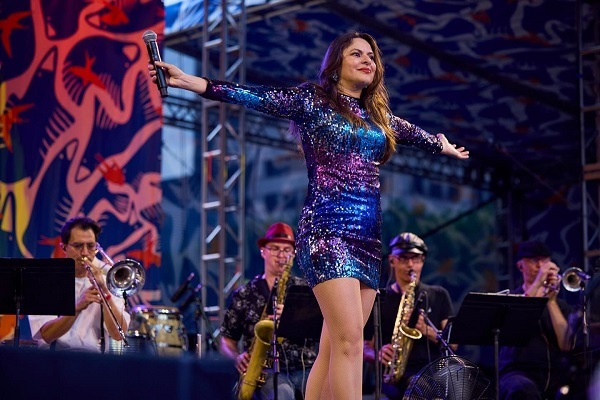
Gafieira Rio Miami was born from a much smaller idea that began with just seven musicians. As the project grew, the group managed to have a total of 11 members, including five brass players, the rhythmic part, and a singer. There are 10 musicians and one vocalist, Isabelle. The members include Brazilians, Venezuelans, and Americans, but they are all united by the passion for Brazilian music.

Diogo and Laura
Diogo Brown and Laura Pausini

In a music scene that pushes bands and orchestras to make themselves smaller, Gafieira Rio Miami has always chosen to remain intact despite the circumstances. Diogo has been perfectly clear that if he’s offered a gig with fewer musicians, he prefers to say no. He says there are 11 members and all are needed for every performance, since otherwise, the impact of the live music would not be the same. 

Read also: Rafaelito and his career between Munich and New York

David Frankel pursued music and created Avenida B Band to reconnect with the memory of his father

After coupling on our schedules, we were able to speak with bandleader and pianist David Frankel, whose story of how he became interested in music and eventually dedicated himself to it is truly fascinating. It also shows that not only Latinos and their descendants can fall in love with these rhythms, but also people outside our culture. This is because David has Russian and Polish heritage, which did not prevent him from falling in love with Latin music so intensely.

David and Ricky playing
David Frankel and Ricky Rosa playing live some years ago

What inspired David to pursue music

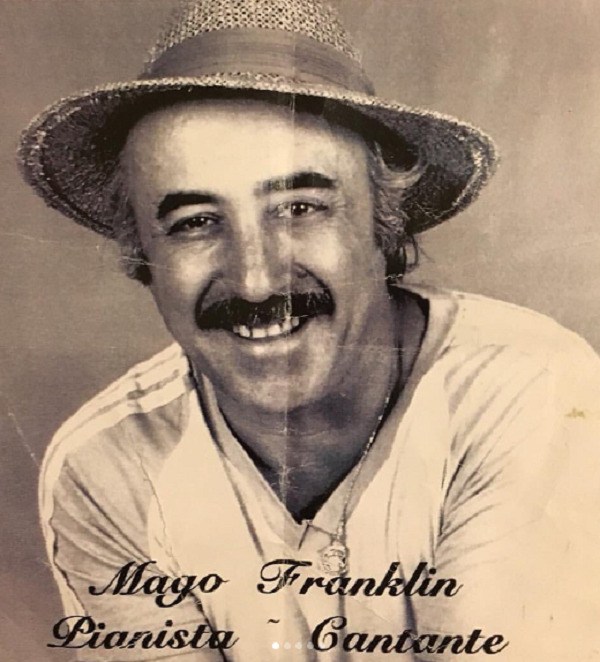
David was born in Lower Manhattan, New York, where there were many Latin families at the time. The neighborhood housed many Puerto Ricans and Dominicans. To this we must add that his father, Daniel “El Mago del Órgano” Franklin, was a musician and moved to that very place where Papote Jiménez, Ismael Miranda, Markolino, Freddy Lugo, Henry Fiol, Luis Ayala, and many others lived. Besides being a neighborhood full of artists, it was much cheaper living there, so he thought it was the ideal place for him.

It is worth noting that Daniel knew how to write music and read scores, but he had never played Latin music before in his life. He began to know it when several musicians he worked with asked for his help to read their scores, which led him to fall in love with Afro-Cuban music and develop an interest in salsa and merengue.

When David was born in 1979, Daniel had already been making music for about 15 years and had earned the nickname “The Organ Wizard” thanks to some band competitions held at a club in the Bronx. From a very young age, the boy watched bands rehearsing on the first floor of his house, so this salsa scene was natural for him. However, David had nothing to do with music until the death of his father in 2003.

David never had any interest in entering the art world, but the void left by Daniel’s death in his life drove him to study music, looking to connect with his father in some way. From there, he began taking piano and percussion classes, but he did not stop there. He also started to go out social dancing in the New York nightclubs and to know a bit more the nightlife of the city. On one occasion, a woman left him alone on the dance floor, and he was so ashamed in that moment that he decided to take classes and learn to dance.

David and the rest of Avenida B
The Avenida B Crew:
Juan Bowers – piano
Alvin Céspedes – bass
Ricky Rosa – congas/coro
Brian Pozo – bongos/coro/stage direction
Jhohan Hernandez – timbales
Demetrios Kehagias – trombone
Dan Lehner – trombone
David Frankel – lead vocals

That was when he realized that all the local bands played almost the same genres and songs, but there was no need for that because there was a world of possibilities in the Latin music he had discovered during his classes. There is a world beyond La Fania, and he learned that thanks to dance schools. All this thinking led him to create his own band with different music, to the old-school style he had always loved. 

His father had always told him salsa is for dancing, and if you are not playing dance music, you are doing it wrong.

Which teachers taught David?

After thanking us for the question, David then proceeded to explain that there was a school in New York called the Harbor Conservatory for the Performing Arts, located at 104th Street and Fifth Avenue in Manhattan. The heads of the education programmes there were Ramón Rodríguez and Louis Bauzó, who were excellent musicians and great people whom he met thanks to his father, who was a piano teacher at that institution. David used to accompany Daniel to the school and met both teachers through him.

Following his father’s death, David returned to that same conservatory to study singing with Ramón, while also studying percussion with Georgie Delgado and piano with Louis. In short, this institution was of vital importance for his career, and the many things he learned there were momentous both personally and professionally. 

As for the dance, he enrolled at the Baila Society school in New York through some friends, but later studied at others such as Santo Rico Dance and Dance On 2.

Jimmy and David
Jimmy Bosch and David Frankel

Avenida B Band

David began his career as a musician by playing boogaloo with a group called Spanglish Fly and a few other small bands. After everything he had studied and learned, already for the year 2011, the idea of creating his own group started percolating in his mind, so he posted an ad online looking for musicians and called some former classmates who might be interested in the proposal. That was how he managed to gather a decent number of people with whom he could finally put the Avenida B project together.

He chose salsa dura as his main genre because it is the kind of music that makes him want to dance, and given his background, this was very important to him.

He is also about to release an album in tribute to his father, which he has named “El Mago,” and it will feature some of his own songs; it is scheduled to be released in July 2026. 

David's father
Daniel ”El Mago del Órgano” Franklin, David’s father

Read also: Puerto Rican bandleader and musician Diana Sosa talks about her many projects in Nashville, Tennessee

  • Page 1
  • Page 2
  • Page 3
  • Interim pages omitted …
  • Page 45
  • Go to Next Page »

International Salsa Magazine (ISM) is a monthly publication about Salsa activities around the world, that has been publishing since 2007. It is a world network of volunteers coordinated by ISM Magazine. We are working to strengthen all the events by working together.