• Skip to primary navigation
  • Skip to main content

International Salsa Magazine

  • HOME
  • Previous editions
    • 2026
      • ISM / March 2026
      • ISM / February 2026
      • ISM / January 2026
    • 2025
      • ISM / December 2025
      • ISM / November 2025
      • ISM / October 2025
      • ISM / September 2025
      • ISM / August 2025
      • ISM / July 2025
      • ISM / June 2025
      • ISM / May2025
      • ISM / April 2025
      • ISM / March 2025
      • ISM / February 2025
      • ISM / January 2025
    • 2024
      • ISM / December 2024
      • ISM / November 2024
      • ISM / October 2024
      • ISM / September 2024
      • ISM / August 2024
      • ISM / July 2024
      • ISM / June 2024
      • ISM / May 2024
      • ISM / April 2024
      • ISM / March 2024
      • ISM / February 2024
      • ISM / January 2024
    • 2023
      • ISM / December 2023
      • ISM / November 2023
      • ISM / October 2023
      • ISM – September 2023
      • ISM – August 2023
      • ISM July 2023
      • ISM Edition June 2023
      • ISM – May 2023
      • ISM April 2023
      • ISM March 2023
      • ISM February 2023
      • ISM January 2023
    • 2022
      • ISM December 2022
      • ISM November 2022
      • ISM October 2022
      • ISM September 2022
      • ISM August 2022
      • ISM July 2022
      • ISM June 2022
      • ISM May 2022
      • ISM February 2022
      • ISM January 2022
    • 2021
      • ISM December 2021
      • ISM November 2021
      • ISM October – 2021
      • ISM September 2021
      • ISM August 2021
      • ISM July 2021
      • ISM May 2021
      • ISM April 2021
      • ISM June 2021
      • ISM March 2021
      • ISM February 2021
      • ISM January 2021
    • 2020
      • ISM December 2020
      • ISM November 2020
      • ISM October 2020
      • ISM September 2020
      • ISM August 2020
      • ISM July 2020
      • ISM June 2020
      • ISM May 2020
      • ISM April 2020
      • ISM March 2020
      • ISM February 2020
      • ISM January 2020
    • 2019
      • ISM December 2019
      • ISM November 2019
      • ISM October 2019
      • ISM Septembre 2019
      • ISM August 2019
      • ISM July 2019
      • ISM June 2019
  • Download Salsa App
    • Android
    • Apple
  • Spanish

Search Results for: Merengue

Where To Go Dancing Salsa In Sydney?

Seductive Afro-Cuban music comes to life in the Australian capital every night of the week

You probably already knew that a lot of Salsa is heard and danced in Australia. But, have you ever wondered, which are the best places to go Salsa dancing in Sydney? Here, we’ve rounded up six of our favorites.

ESTABLISHMENT BAR

At Establishment Bar
At Establishment Bar, you can have your drink in the garden surrounded by abundant latticework and greenery

Salsa Tuesdays are back at the Establishment Bar! This iconic Sydney spot is unique and sophisticated. It has narrow spaces, a 42-meter-long marble bar, and columns lining the walls that recreate the style of ancient Greece.

Establishment Bar with its lush lighting offers its attendees Afro-Caribbean music on Tuesday nights with live bands, dance shows, DJ playing Salsa, Bachata, Merengue, Reggaeton & Bossa Nova until 3 AM, and live percussion. Weekly you will learn basic concepts in the free Salsa class starting at 8 PM, in addition, to enjoying cocktails ($10) and mojitos ($12) all night so you can enter an authentic Latin American Rumba.

This multi-award-winning bar is located on the Ground Floor, 252 George St, Sydney NSW 2000, Australia.

THE ARGYLE

Inside The Argyle you can also find El Camino Cantina

Wednesday nights are from The Argyle! This two-floor club has been powering Sydney nightlife for fifteen years (2007).

This venue located at 18 Argyle St, Las Rocas, Sydney NSW 2000, has six bars, an iconic outdoor patio with spacious mini-environments to enjoy a Salsera night with the lineup of DJ Miro and his friends, as well as live bands in constant rotation.

These fun mid-week nights start at 7:30 PM to 1 AM and are $10 (includes a Salsa lesson). The dress code is casual, and minors are not allowed after 9 PM.

THE COLLAROY
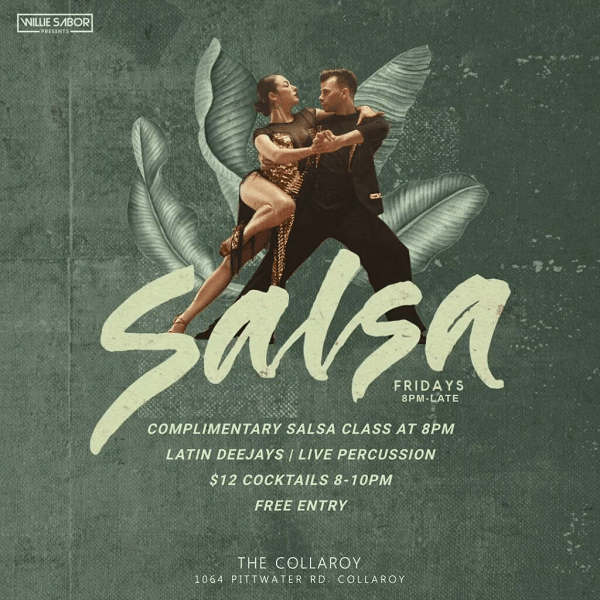
The Collaroy has $14 happy hour cocktails from 8 p.m. to 10 p.m.

Friday nights are Salseras at The Collaroy! Located right on the beachfront at 1064 Pittwater Road, Collaroy, New South Wales, Australia, this restaurant/bar with live entertainment and DJs downstairs on weekends stays open until 3 AM.

On Fridays from 8 PM to 9 PM, they offer Salsa classes (free) and from 10 PM the Latin party starts until 3 AM with live percussion and a DJ playing Afro-Cuban melodies, urban music, and Bossa Nova.

The Collaroy has an open-air terrace with a magnificent panoramic view of the peninsula’s north.

LATIN DANCING UNDER THE SAILS – BROADBEACH

Latin Dancing Under The Sails may change its date due to weather

Salsa takes over Saturdays at The Oasis Shopping Center! Every last Saturday of the month the LatinMania team brings the Latin Social Dance event outdoors at the Oasis shopping center located in Broadbeach Gold Coast, Queensland, Australia with music provided by DJs specialized in Salsa, Timba, Bachata, Merengue, and Salsaton from 7 PM to 10 PM.

The event is free and this month the theme will be Halloween. So don’t miss this opportunity to dance Salsa in Sydney with Colombian-born instructor Alejandro Barriga next Saturday, October 29th.

PLANT 4 BOWDEN

Plant 4 Bowden was born out of a vision for a thriving community and a passion for environmental sustainability

Every first Sunday of the month is Salsero at Plant 4 Bowden! This place is 100% green and adheres to international standards for green building design earning a 5-star rating for its operations.

Plant 4 Bowden, characterized by its environmental sustainability, presents its Salsa nights every first Sunday of the month from 4:30 PM to 10:30 PM with food, drink (local craft beer from barrel), Salsa, Bachata, and Kizomba along with wonderful musical shows on the ground floor. The ticket price is $20 at the box office, and it is located at 5 Third St, Bowden SA 5008, Australia.

The magic of Salsa in this space happens surrounded by greenery with ample indoor seating and outdoor areas.

SALSA IN THE PARK

There is no better time than now. Go out dancing Salsa today in the Park (Sydney – Australia)

The second Sunday of every month is a Salsa immersion in the Park! Salsa in the Park  is a free event that offers 3 hours of Latin music and social dancing outdoors at El Pabellón del Norte, 95 Marine Parade, Broadwater Parklands, Southport next door to the revolving chapel adjacent to North/Smith Street.

The half-hour lesson starts at 3 PM, and then the Social Dance continues until 6 PM with music provided by top DJ’s mixing old and new Salsa, Bachata, Merengue, Cha Cha, and more.

Who can attend? The whole family and their pets. No experience is required. What are the benefits? Meet new friends, you’ll get fit, improve your mental health and coordination, and stay active. When? The next date is Sunday, October 9th.

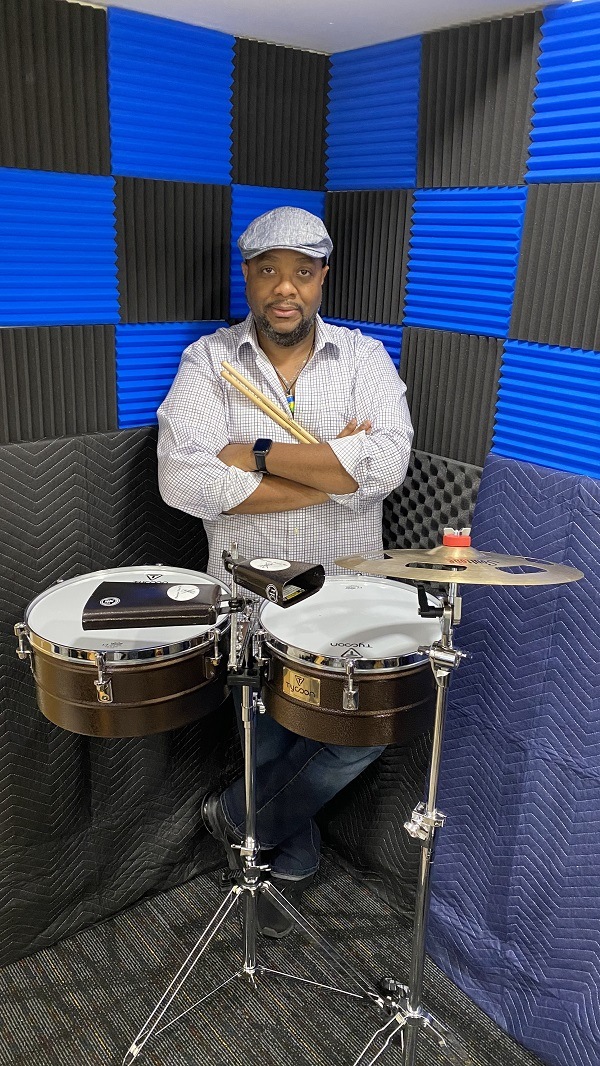
The interesting story of French percussionist Dominique Patrick Noel

How his career started

All right, so we are here with French percussionist, composer and musician Dominique Patrick Noel. How are you doing, Mr. Noel? A pleasure to have you here.

Well, thank you. First of all, I want to thank you for taking the time to interview me and to greet all those who is going to read it. Thank goodness, I am in good health and it is all good.

Dominique Patrick Noel tells us about his story and beginnings

You are a self-taught musician who started playing by age seven. Did you learn everything by yourself or did you receive some kind of training?

Since I come from a family of musicians such as my father and my two grandfathers, I can say that music has always been a part of my life. I started playing the drums by listening to a lot of jazz and fell in love with this genre. That’s how I started to develop the movements and patterns of jazz and the drums.

In school, I started playing and learned solfège, percussion, drumming, among other things. When I turned 15 years old, I started playing music at a pro level because I have always had the pleasure of learning by watching musicians, who had much more experience. Thank goodness, I had my mind fresh to grasp and remember what I had seen, which helped me a lot to continue developing in percussion, different instruments, rhythms, among other things.

When I started playing Latin music, my first instrument was the bongo. I had a mentor named Alfredo Mujica Jr.,m who knew my dad and learned by playing with him. When it was my turn, he was giving the task of helping me understand the patterns and other things. He told me that the best instrument I could choose to start with was the bongo because it would help me understand a little more about how salsa works and that helped me a lot. He showed me the basic pattern and how to imitate the sounds I heard until they were similar.

After that, I also learned to play the conga, the Dominican tambora, the güira, the batá, the cajon and the timbales.

His career started at the age of 15 and his first instrument was the bongo

When you played the bongo for the first time, did you know you wanted to dedicate yourself to the Latin genres permanently?

When I was nine years old, I moved to Martinique and lived there for about four years. There I was fortunate to learn its folklore, its rhythms, its typical instruments and its dances. I also learned to perform all those genres with the drums and tried to absorb all I saw. Concurrently, the zouk era was beginning and I fell in love with the genre since I heard it for the first time.

Sometime later, my dad and I went to the United States to be with my dad, who was living in Washington at the time. It was there where I started to accompany him in several of his activities and shows with his orchestras. Then, I began listening more to salsa, cumbia and merengue, something I liked very much. Then, I told him that I would like to learn what he knew and play with him, to which he replied that it looked good, but that it was a profession that I had to take very seriously. Therefore, he advised me to listen to everything, even if it wasn’t Latin music because all genres nurture the musician in one way or another.

With whom he has worked?

You have worked with Tito Puente Jr, Tito Rojas, Izis La Enfermera de La Salsa, Frankie Vasquez, Lalo Rodriguez, among others. What have you learned from them?

I have had the opportunity to play with maestro Tito Rojas and his musical director, Celso Clemente, gave me some advice. When rehearsing, I approached him to thank him for allowing me to play the bongo with them and ask him for advice for my career, to which he replied that he liked my work very much and that I was very good for someone who was not born in this Latin music environment.

He also advised me that I had to move forward, never play down my goals, accept constructive criticism and always stay humble. I will never forget his words.

Dominique Patrick Noel next to Gloria Estefan and Emilio Estefan

We know that you are a voting member of the National Academy of Recording Arts and Sciences, which is well known for giving the Grammy Awards. What do you base to vote for a nominated candidate for an award?

There are several processes for artists to be nominated. For us the voters, it is a long process because we have the task of listening to much music and analyzing many details such as recording quality, lyrics, musicality and much more. There are many important elements to consider when choosing the person. I want to get to the point of saying that someone really deserves my vote for this or that category.

Voting takes time. It’s not something that you do in an hour or two, it takes a long time. The day of the awards ceremony, we already know who will the winners. At that point, we can say that all of them have managed to win via an arduous selection process.

Tell us about your song Mi Secreto with D’ William.

The skeleton of the song was my idea and I got together D’ William, to whom I offered to join the song. He wanted to collaborate with me in a merengue song for some time and I sent him the skeleton, which he liked and told me that something could be done with it. When he asked me if I already had the lyrics, I said no, but I wanted to base the song on an experience of mine, so I told him what it was about and the lyrics were written about that fact. Later, we made some additional arrangements and that’s how Mi Secreto was born.

Dominique Patrick Noel next to Bobby Cruz

Read also: Earl Miranda and Ric Feliciano talk about the Latin Rhythm Boys and its history

We interviewed IndiviDúo singers Tiffany Joy and Maqui Reyes

How it all started

Today we are going to talk with Tiffany Joy and Maqui Reyes from IndiviDúo, which is a famous and successful musical duo. Great to be with you. How are you?

Tiffany: super! Very well, thank you very much.

Tiffany Joy singing on stage

You two met in 2010 in Buenos Aires while both were recording your respective musical productions separately. How was that first meeting and conversation about music?

Tiffany: you are very well informed, Karina, I love it. We met at a musical party for Colombians living in Buenos Aires. We were introduced by a mutual friend, who is also from the US, but she was living in Buenos Aires at the time. Maqui had invited me to that event through Facebook, so I went with my guitar and a liter of beer. There was a moment when he started singing ohis riginal music and I do the same later. I think that’s where a connection and mutual respect began to be created, which led to us singing together later that night.

He sang Tabaco y Chanel by Bacilos and since I knew it by heart, I started singing the harmonies. The time when our voices found each other was very magical and everyone at the party thought something beautiful was happening there. Really, since that night we haven’t stopped singing and composing music together.

What did you see in each other to form a musical duo?

Tiffany: I think Maqui has a special sensitivity towards lyrics and I admire his role as a poet. In addition, he also has a musicality related to my tastes, so it is very common for us to be on the same page about some melodies with the guitar. Melodically, I feel that we get along very well.

Obviously we don’t agree on everything all the time, but I do think we have very similar taste in music, which makes us be attracted each other musically. Personally, my partner has a very powerful energy in terms of positivity, light, pushing forward and making everyone feel special.

Maqui Reyes singing and playing the guitar on stage

What has been the biggest disagreement that you’ve had musically?

Tiffany: generally speaking, I tend to fall in love with ideas so fast. If I hear a chord, progression, melodic line or lyrics that I like, I don’t want us to change them. On the other hand, Maqui is super thoughtful and likes to try a lot of things before going back to the first thing and even make it better, but I think my anxiety about finishing it and singing it sets us at odds. He is very slow in terms of his process and that makes us different.

Considering that Maqui is Colombian and you are Californian, how did this influenced your musical styles?

Tiffany: Maqui is from Bogota while I am from right here in the Bay Area. I grew up listening to James Taylor, Kenny Loggins and the great singer-songwriters in blues, jazz and other typically American genres. I also did musical theater for many years, which led me to listen to the great Broadway plays. My love for Latin music began much later when I started listening to pop artists like Juanes, Shakira, Rocky Martin, Bacilos, among others. Then, I entered into the world of Latin music and started composing in Spanish. To that I must add that I loved dancing salsa and tango since I was really little.

On the side of Maqui, he comes from a completely different music background where he listened to salsa, bambuco, cumbia, merengue and many other Latin genres. Later, he moved to Argentina where he lived for 13 years and traveled throughout the country to learn to play chamame, samba and other Argentinean rhythms. This made him have a huge range of Latin American music, which we incorporate into our music. That is why our repertoire includes reggae, bolero, pop, salsa, rock, bossa-nova and much more.

Tiffany Joy and Maqui Reyes performing together

How do you connect with your audience?

Your music talks about many positive and reflection messages. It talks a lot about all the important things we humans put aside because we are way too concerned with superficial things. In that sense, what kind of connection are you looking for with the audience?

Maqui: among the responsibilities of a singer-songwriter or a musician, we have to say some important things, so we believe and live the music like that. The subject treated in a song has always been important to us.

I think we have managed to connect with ourselves and people like you who, for some reason, get to listen to one of our songs and identify with it. Songs like Pelea invite you to fight against your own vices, your own demons and your own problems. It is a song that people of any age can identify with, which leads us to have a connection with them beyond music.

What are the age ranges of the people who listen to your music the most?

Tiffany: I would venture to say that those who listen to us the most are people between 25 to 55 years old.

Maqui: However, I must say that we get along very well with children. When we play in theaters or places suitable for minors, there are many families with children. In fact, we don’t rule out recording an album focused exclusively on them. Of course, we know that children don’t like the more traditional genres that we used to listen to and reggaeton is the current trend. Same way, we would include some traditional music so that little ones have the opportunity to listen to it in a fun way.

Tiffany Joy and Maqui Reyes during pregnancy

On that issue, a young salsa singer told me that what he does is a mix of rhythms, while still getting the essence of salsa. Do you plan to add urban genres to your music?

Tiffany: We don’t reject the idea of incorporating urban rhythms to our music because they are good to dance to, easy to defend live and attractive for a generic and large audience. We haven’t yet, but we are open to the possibility.

Maqui: this is a great question because everything has become polarized so much that just listening to the rhythm makes us qualify it as urban, but that’s not necessarily true. What I qualify as urban is attitude and lyrics, things that we know we will never adopt for ourselves.

It’s not our style, although we’ve got nothing against these rhythms. We would like to play them in a more elegant and familiar way.

Tiffany Joy, Maqui Reyes, and their daughter Melody

You have been part of the soundtracks of several soap operas such as La Ley del Corazón and Si Dejo de Creer. How did this help you advance your careers?

Tiffany: It helped us get a little more exposure on Spotify, YouTube and other music platforms. It also gave us the opportunity to be much better known, as many people started to see what else we’ve done and listen to other pieces of ours.

What did you do during the pandemic?

Tiffany: because all the shows being cancelled, we dedicated ourselves to hosting a Facebook Live every Friday afternoon. At the beginning, it was very difficult because we didn’t know how to connect, but when we finally learned how to do it, we had a lot of people listening to us. We played original music, did a lot of covers, had a drinkie and toasted people from time to time.

During this time, we also found out we were pregnant, which was a surprise for us because we never thought about having children. We were composing at the time, so we ended up including a song for the baby on our album. Right when Melody (our daughter’s name) was born we did the official album release.

Read also: Story of achievement and dedication of Yoshie Akiba

Salsa Invades Belgium In September

We tell you about 5 Salsa events that you cannot miss

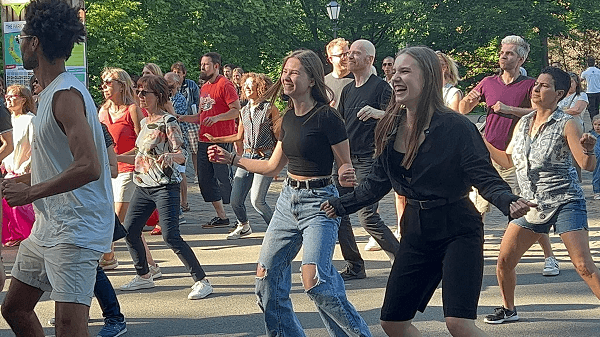
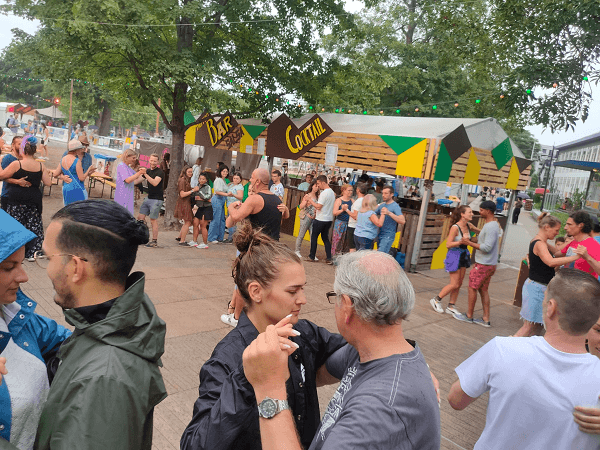
Salsa Park

Caption: Food & Latin Music at Josaphat Park in Belgium

We started with the dance school specializing in Cuban Salsa, Cuban Style, and Rueda de Casino in the capital of Belgium (Brussels), Danza Mania. This academy with more than a decade of experience teaches Salsa classes for all levels with an emphasis on mastering combinations, movements, and figures in a fun and relaxed environment.

The Danza Mania’s motto https://danzamania.be/ is Dancing with Feeling, which is the motive to offer the last free workshop for all Salsa lovers on Friday, September 2nd.

At 7 PM the lessons will begin for those salseros who want to start in Cuban Salsa but don’t worry, they will also teach classes for intermediate and advanced levels. An hour after Salsa Party will begin with DJ Felito, and at 8:45 PM, there will be entertainment with the Danza Mania team. The workshop will end with the last Salsa Party with DJ Felito from 9 PM until dawn. Where? At La Laiterie in the heart of Josaphat Park, 1030, Schaerbeek, Belgium. Dare to participate and have a pleasant recreation at no cost in a warm and welcoming environment.

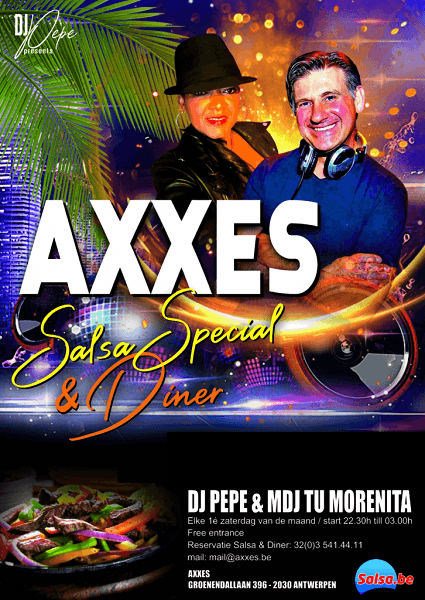
Axxes Café

Caption: A pleasant evening with dinner and lots of Salsa

We continue with the second recommendation in this edition and it is Axxes Café https://www.axxes.be/. In this venue, you can taste delicious Mexican dishes and tasty cocktails.  Additionally you can dance to Latin rhythms such as Southern Salsa, Bachata, Merengue, and Kizomba every first Saturday of the month from 11:30 PM to 3 AM. Admission is free.

DJ Pepe is in charge of making this Salsa night a reality since last Saturday, July 22nd (2022). This resident DJ of Latin night in Belgium for almost two decades traveled for the first time to Old Havana (Cuba) in 1997, where he fell in love with this musical genre. Since then, he has been a faithful lover of Salsa, and is currently the organizer of the Salsa evening at the Salsa Axxes restaurant and café in the Kinepolis complex. Address: Groenendaallaan 396, 2030 Merksem. Enjoy the most southern atmosphere in Belgium!

Mambo Surge Weekend 

Caption: Daily workshops from 1 PM to 6 PM

The second weekend of this month Mambo Surge Weekend www.mambosurge.com event will be held in its first edition with workshops (7 PM – 8 PM), shows (11 PM), and social events in three different rooms of the Theater of Dramatic Art OC Djoelen, Steenweg op Mol 3/Bus 2, Oud-Turnhout, Belgium from 9 PM.

Mambo Surge Weekend is a cooperation of experienced Salsa event organizers whose goal is to create quality events that spread love and passion for this Afro-Caribbean rhythm.

Mambo Surge Weekend is from September 9th to 10th and will feature the following local DJs team: DJ CyCy, DJ Asmadi, DJ Cisko, DJ Louis, and DJ Lukas “El Taz” mixing the best Caribbean music. The cost to attend this event is €80.

10 Dance Delirium Salsa Festival Gante

Caption: Tickets for the daily Salsa parties range from 10 EUR to 15 EUR

This seventh edition of the festival will take place from Friday, September 2nd to Sunday, September 4th and will be packed with three days and three nights of parties in two areas (Salsa/ Bachata), around 20 hours of varied workshops, shows from at 11:30 PM, meet & greet with national and international artists, and three DJs: DJ Willy VIP, DJ Cisko and DJ Alfons doing their best mixes.

The location for this edition of the 10 Dance Delirium Salsa Festival Ghent www.10dancefestival.be will be the modern dance complex, Doxtudio, located at Dok-Noord 7/107, Gent. The cost of the Full Pass is 85 EUR, and street parking will be free from 11 PM to 9 AM each day.

But, if you want to continue the fun with the team of the young and dynamic dance school in Ghent, Lékip Dance, Dox Summer Sundays 2022 will take place on Sunday, September 11th, with two hours of lessons. From 8 PM to 9 PM the Afro Body Movement class will be held, and an hour later, you will be able to do the Rueda Cuban Style lesson by the pair of instructors Osbanis & Anneta from Poland.


Michiel Braam: The Virtuous Pianist from Nijmegen

Two years after the creation of the Latin Jazz album XYZ with Son Bent Braam

Michiel Braam presented XYZ at the Music Meeting Festival. “The festival takes place in Nijmegen, where I was born (1964), grew up, and still live”. Foto: Marjan Smeijsters

Virtuous pianist, masterful producer, and surprising composer. Winner of the Podium award (1998) and Boy Edgar (1996/1997). Musician trained by conviction and at the ArtEZ Music Academy in Arnhem. His lifestyle is synchrony between freedom, creativity, teaching, and love. It is how he presents us his life and his works in Nijmegen, Michiel Braam.

This friendly artist with a protective childhood where love prevailed always had the support and freedom to develop and create everything he considered necessary to him. Michiel is the only one in his family who turned to music professionally, but the rhythm of melodies runs through his veins. His parents played the piano self-taught. His mother wrote notes while his father just improvised.

During high school, he participated in a band for which he wrote and arranged all the music. He studied at the conservatory and founded his more minor quartet Bentje Braam (“Little Band Braam”) in 1985. In the same year, he traveled with his band to Sweden to be the first Dutch group to open the EBU Jazz Festival and wrote his first composition for the Dutch radio “Cows and Beasts”. A year later, he created the band Bik Bent Braam.

“Music is, as long as I know, everything to me. I feel better with music. I dance when I’m happy, and music comforts me when I’m not doing so well… It seemed like a logical step to pursue what I enjoyed most.” Michiel Braam https://www.michielbraam.com/

By 1988 Braam had had no contact with Latin music until percussionist André Groen asked him to be the pianist for his Orquesta Europea de Danzón. In this regard, this wonderful pianist told us: “He wanted a pianist who had a wild free Jazz attitude and who didn’t only play the well-known Latin patterns because he thought that fitted better with the authentic Cuban music. That music immediately appealed to me, especially because of its rhythmic impact, but also because as a pianist, you have a lot of freedom to go in all directions during improvisations. I have touched on those Latin patterns to some extent and in the course of the 10 years that I played in that orchestra I managed to master them better, but it was mainly the combination of freedom and rhythm. That orchestra lasted ten years and we celebrated the thirtieth anniversary in 2018 with a couple of concerts. Great to do that again and I felt again exactly why I found it so appealing back then”.

In 1988 Michiel won the Podium Prize, an encouragement prize for Dutch Jazz music and in 1996/1997 he won the Boy Edgar, the highest prize for Dutch Jazz.

This pianist, the architect of great projects, built a party based on the Latin alphabet of Western culture on the album XYZ released in 2020, creating a danceable mix that includes Mambo, Rumba, Son, Danzón, Boogaloo, Calypso, Rumba, Bembé, Mozambique, Samba, Afro, Bolero, Cha-cha, Merengue, Bembé, and Samba. Michiel is also the Director of the Jazz and Pop department of the ArtEZ conservatory and founded a Danzón orchestra. Now, I leave you with the rest of this wonderful interview that I had the opportunity to do with the great Maestro Michiel Braam. Enjoy!

They have played on the ZomerJazzFiets tour, North Sea Jazz, and Bimhuis. Likewise, some of the members of the orchestra are fluent in Spanish.

– How did the idea of the Latin jazz album XYZ come about?

In 1995 I wrote “The XYZ of Bik Bent Braam” for my big orchestra at the time, Bik Bent Braam (phonetic Dutch for “Big Band Braam”). I thought it would be fun to make a festive version of it to celebrate the 25th anniversary. The XYZ was (and is) a 26-part suite, with a piece for each letter of the alphabet, starting with Aardedonker (English title Atramentous, Spanish Apagado, both not exact translations…) and ending with Zwoerdspek (Zaftig, Zafio). I revisited all the pieces in 2020 and paired various styles with the original material. In the 1995 original, they were mostly jazz-like styles (bebop, free improv, swing, jazz ballad, etc), but Chachachtig was a rumba even then. It is the only piece that has not changed its mood substantially.

– What happened to the previous members and how did the new members take hold?

The original orchestra Bik Bent Braam was composed of top musicians from the Dutch improvised music scene. The orchestra existed from 1986 to 2013 and had a number of lineup changes. In the final version of Bik Bent Braam there were only a few members left from the very beginning. That the musicians of Bik Bent Braam could read well was not really a requirement, the core was affinity with swing and great improvisational skills. For this new version, it was important not only that the musicians were excellent improvisers, but also that they had to have a feel for Latin music and also that they were outstanding readers, because I did not foresee that there would be very much rehearsal time and the notes are quite challenging. Bik Bent Braam was subsidized with government funding and I could then easily occupy a longer period with many rehearsals. Son Bent Braam, the current line-up, does not have its own subsidy, so we have to look at each concert and hope that everyone can make it. There have been quite a few subs, and they too have to be able to improvise and read well.

– Tell us about your Danzón orchestra.

André (André Groen – Percussionist) wanted to immerse himself in traditional Cuban music. There is so much richness in the danzón with its fixed forms that pass by in each piece with the most beautiful melodies and the wildest spaces for improvising on highly danceable rhythms. We found the instrumentation with violins, cello, flute, percussion, double bass, and piano attractive. After ten years I got too busy with my jazz ensembles, by then I was touring all over the world with Bik Bent Braam and other groups and especially with my Trio BraamDeJoodeVatcher. I could hardly combine it anymore with the Danzón Orchestra and the great pianist Peter van Marle took my place, which made me feel very humble. The European Danzón Orchestra then existed for another year or so. I honestly don’t know why it stopped then. In 2018 we did a couple of reunion concerts, great fun to do.

– How many years have you been in charge of the Jazz and Pop department of the ArtEZ conservatory and what do you teach the new generations based on your experience?

I have been head of the program since 1992. It is part of a broad arts university and is located in a building that also houses dance, theater, fine art, applied art, fashion, and creative writing. As a head, I don’t teach very much… only when students very specifically ask for it a few hours of individual lessons per year and a few group lessons, and I also regularly give master students some lessons. My message is usually quite short and clear: there are millions of people who play an instrument excellently, and you can probably teach an orangutan to play Keith Jarrett better than Keith does himself, but – apart from the fact that that would be a fun YouTube hit – there is no point; in our music, it is almost all about an authentic voice, including all the shortcomings that are in everyone, which also make you a unique musician. Obviously, you must have many skills as a musician, but my life motto is that one’s deficiencies are far more important for one’s personality than one’s skills, and that attitude underlies my whole vision of art education.

“With Nos Otrobanda have started to concentrate on the music of Noro Morales and have his composition Maria Cervantes (single) firmly in our program. His music will probably be the subject of our new album”. Foto: Marjan Smeijsters

– What are your next projects?

Everything is starting up again post-covid. I want to record a solo album on my grand piano, a so-called “Alurip”. That’s an aluminum grand piano made in the fifties with a specific sound. And the album of our trio Nos Otrobanda, which specializes in Antillean music, is almost sold out. That doesn’t matter obviously, if there are no more physical copies then you can always hear the music through iTunes, Spotify, etc, but it’s a great opportunity to make new recordings again and the intention is to go to Curacao and record music in the Fortkerk in Willemstad, the place where we did a couple of concerts in 2018. That was a great experience, what a nice place and sweet audience!

– How was the process to make a living from music?

I stuck pretty firmly to the rule that you have to do what you like and not let yourself be distracted too much from that. And I look for what it takes to make it happen. From 1996 to 2012 I received an annual government subsidy to realize my projects. I am also a real musician in the sense that I have a mixed professional practice (playing, writing, teaching, producing, almost every musician has roughly that mix) which means that it is always possible to make a living out of it and we never had to worry about bread and a place to live.

Michiel Braam & Son Bent Braam Orchestra.  Foto: Marjan Smeijsters

I make music mainly because I can’t do otherwise. Music is a way to communicate; it makes you a little better… Leitmotiv in everything is that in music, I am free to do anything I want. For example, I did play Purcell’s Dido and Aeneas with the exquisite reed quintet Calefax, also improvising on the various songs from that opera.” Michiel Braam

Home

  • « Go to Previous Page
  • Page 1
  • Interim pages omitted …
  • Page 25
  • Page 26
  • Page 27
  • Page 28
  • Page 29
  • Interim pages omitted …
  • Page 44
  • Go to Next Page »

International Salsa Magazine (ISM) is a monthly publication about Salsa activities around the world, that has been publishing since 2007. It is a world network of volunteers coordinated by ISM Magazine. We are working to strengthen all the events by working together.