• Skip to primary navigation
  • Skip to main content

International Salsa Magazine

  • Home
  • Previous editions
    • 2025
      • ISM / November 2025
      • ISM / October 2025
      • ISM / September 2025
      • ISM / August 2025
      • ISM / July 2025
      • ISM / June 2025
      • ISM / May2025
      • ISM / April 2025
      • ISM / March 2025
      • ISM / February 2025
      • ISM / January 2025
    • 2024
      • ISM / December 2024
      • ISM / November 2024
      • ISM / October 2024
      • ISM / September 2024
      • ISM / August 2024
      • ISM / July 2024
      • ISM / June 2024
      • ISM / May 2024
      • ISM / April 2024
      • ISM / March 2024
      • ISM / February 2024
      • ISM / January 2024
    • 2023
      • ISM / December 2023
      • ISM / November 2023
      • ISM / October 2023
      • ISM – September 2023
      • ISM – August 2023
      • ISM July 2023
      • ISM Edition June 2023
      • ISM – May 2023
      • ISM April 2023
      • ISM March 2023
      • ISM February 2023
      • ISM January 2023
    • 2022
      • ISM December 2022
      • ISM November 2022
      • ISM October 2022
      • ISM September 2022
      • ISM August 2022
      • ISM July 2022
      • ISM June 2022
      • ISM May 2022
      • ISM February 2022
      • ISM January 2022
    • 2021
      • ISM December 2021
      • ISM November 2021
      • ISM October – 2021
      • ISM September 2021
      • ISM August 2021
      • ISM July 2021
      • ISM May 2021
      • ISM April 2021
      • ISM June 2021
      • ISM March 2021
      • ISM February 2021
      • ISM January 2021
    • 2020
      • ISM December 2020
      • ISM November 2020
      • ISM October 2020
      • ISM September 2020
      • ISM August 2020
      • ISM July 2020
      • ISM June 2020
      • ISM May 2020
      • ISM April 2020
      • ISM March 2020
      • ISM February 2020
      • ISM January 2020
    • 2019
      • ISM December 2019
      • ISM November 2019
      • ISM October 2019
      • ISM Septembre 2019
      • ISM August 2019
      • ISM July 2019
      • ISM June 2019
      • ISM May 2019
      • ISM April 2019
      • ISM March 2019
      • ISM February 2019
      • ISM January 2019
    • 2018
      • ISM December 2018
      • ISM November 2018
      • ISM October 2018
      • ISM September 2018
      • ISM August 2018
      • ISM July 2018
      • ISM June 2018
      • ISM May 2018
      • ISM April 2018
      • ISM March 2018
      • ISM February 2018
      • ISM January 2018
    • 2017
      • ISM December 2017
      • ISM November 2017
      • ISM October 2017
      • ISM September 2017
      • ISM August 2017
      • ISM July 2017
      • ISM June 2017
      • ISM May 2017
      • ISM April 2017
  • Download Salsa App
    • Android
    • Apple
  • Spanish

Search Results for: Oscar D'Leon

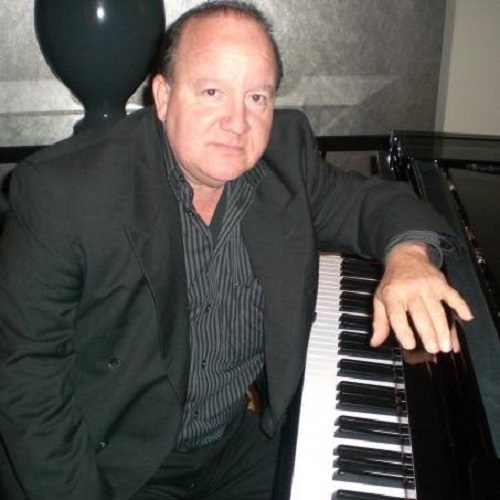
Samuel del Real was an excellent pianist, orchestra conductor, arranger and educator

Born on August 22, 1953 in Barranquilla, Colombia, he was a well-known pianist, orchestra conductor, arranger and educator.

Samuel del Real was an excellent pianist, conductor, arranger and educator.Samuel del Real was an excellent pianist, conductor, arranger and educator.
Samuel del Real was an excellent pianist, conductor, arranger and educator.

He was part of renowned orchestras such as Pacho Galán, La Dimensión Latina and El Trabuco Venezolano and participated in a series of record productions in Caracas, Venezuela.

In 1983 he recorded his first album with his own band. His first hit “Ella No Baila Sola” became the theme song in every night club in Colombia, Venezuela, Peru, Panama, USA among other countries.

In 1985, Samuel moved to Chicago, USA, where he quickly formed his orchestra with members of different nationalities resulting in a mixed sound for his music.

Since then Samuel del Real and his orchestra participated in many festivals, concerts, private events in cities such as Chicago, London, New York, Minneapolis, St. Paul, Detroit, Indianapolis, Miami and more. “Piano Caliente”, ‘Piano Jamboree’ and ‘Piano Navideño’ are the most recent albums that include selections from his extensive Latin jazz repertoire, as well as new interpretations of Afro-Cuban classics from his album entitled Piano Caliente.

Samuel In 1985, Samuel moved to Chicago, U.S.A.

Samuel has ventured not only into the salsa genre, but also into Latin jazz that surprises even those who don’t know him.

It doesn’t take much to realize that Samuel was “El Maestro del Buen Ritmo” and that his music is here to stay.

Samuel del Real: the artist from Barranquilla who triumphed in the United States.

He trained musically and academically, open to the idea of expanding his artistic horizons.

“I began my musical studies in Fine Arts, among my teachers I remember Günther Renz.

In Venezuela I attended the Juan José Landaeta Conservatory and the Caracas Philharmonic Conservatory with the pianist Paul Rosenbloo.

I studied harmony and counterpoint. With maestro Antonio Lauro, composer and guitarist, I completed my academic training”.

At the age of 15 he began his professional career as a pianist in the Pacho Galán Orchestra. There he learned the tricks of popular dance music of the Colombian Caribbean, and the possibilities of sharing with national musicians opened up for him.

DiegoDel Real, my first piano teacher, my advisor, my partner in producing, arranging and recording music.

With him I learned the routine of Caribbean music, he had a very positive attitude towards me. He would summon me before rehearsals to teach me how to play, he would take the score and sit with me at the piano: ‘Play like this’, he would tell me, and ‘play the acor-des this way, this is the tumbao, this is the phrasing’, all with a lot of patience”, he recounted.

“There was Pi¬chirilo on bass, Jorge Pérez on timbales and drums; and Joaquín Pérez on congas. Chicho Sarmiento, Clí¬maco Sarmiento’s son, played the alto saxophone; Pacho Aragón played the tenor saxophone. On trumpets Armando Galán, Raúl Lastra and Chino Acosta.

Rosendo on trombone. Maestro Pacho Galán would arrive to conduct the first set and then he would leave, Armando would be in charge of the orchestra. That’s when my interest in Caribbean folklore began.

I did not record with Pacho’s orchestra because he did not record in that period, but I played a lot of his music and I still play it in Latin jazz.

“For me it was a great school,” he said.

Although he has lived outside the country for many years, when he returns to Barranquilla it is as if he had never left.

It shows in his confidence to walk the streets, to visit places, to call friends, to exchange anecdotes with people he barely knows.

He is a man who lives for music, to which he has dedicated a contagious enthusiasm. That is why when he comes, it is a pleasure to review his career.

“I come to take a little hot temperature and to bring my latest albums for the local public to get to know them,” he said.

In 1975 he formed an orchestra in Venezuela with which he worked at the Hotel Tamana¬co Internacional, while at the same time he was a pianist, administrator and producer of various musical projects in the recording industry of that country.

In 1979 he joined Dimensión Latina, an aggregation with which he recorded Di¬mensión desconocida (1979), el número uno con la núme¬ro uno (1980), Para siempre (1980), Combinación latina Nº 4 (1980), and Cuerda para rato (1981).

“In Dimensión Latina I spent three years with Andy Montañez, Argenis Carruyo and Gustavo Carmona, then I started the orchestra project with my name.

I also recorded with Andy Montañez as a soloist, and made arrangements in recordings for Velvet de Venezuela”.

Samuel also participated in the extraordinary Trabuco Venezolano, led by drummer Alberto Naranjo.

“With Trabuco Venezolano I participated in many concerts in Venezuela.

With them I recorded Irakere and Trabuco, in a live performance at the Poliedro de Caracas. I also recorded Imágenes Latinas.

The Flor y Nata, themes: No me engañes, Rosa de la Noche, Brujería, Almas Blues, Desilusión, (there I do a piano solo that has been highly praised), a pesar de Usted, Orquesta de moda, No quiero Confusión. Retrospectiva del Trabuco Venezolano Vol. 2 (1977- 1984)”.

El Trabuco Venezolano – La Flor y Nata 1984

In 1983 he recorded his first album with his orchestra, the hit was the song Ella no baila sola, which became his letter of introduction.

In 1984 he recorded his second album, repeating his success with the song Cara de Domingo, by the niuyorrican flautist Lou Perez.

The third album with his orchestra was produced in 1987, when he was already living in Chicago.

“When I left Dimensión Latina, Gustavo Cardona, Oscar D’León’s bass player, encouraged me to start my own orchestra.

One of the numbers was Ella no baila so¬la, and when it was played, people stopped to dance. That is why we decided to record that song.

I brought Frankie Paz, a boy from Maracaibo who had auditioned with Dimensión Latina as a replacement for Argenis Carruyo, but César Monje didn’t like it.

I told the boy, I’m going to have my orchestra soon and I’m going to bring you with me”.

Referring to his piano influences, Samuel recalls Noro Morales, Eddie and Charlie Palmieri, Richie Ray and Lino Frias.

Others such as Bud Powell, Thelonious Monk and Oscar Peterson, shaped his vision.

“I liked Noro Morales a lot, I had only one record of his, ‘Maria Cervantes’, which caught my attention since I was a child. One day I decided to arrange it a little differently. I still play it in my Latin concerts.

Del Real took up residence in Chicago in 1985. There he has continued his work moving between Latin dance music and Latin jazz.

I’ve been living there for 32 years, I have my orchestra, I give Latin jazz concerts, and I’ve also worked for other organizations in other cities like Minneapolis and Cleveland.

We do salsa and different Latin American rhythms. The music business has changed, it’s a big investment to make a record, and you have to project it to the singer, limiting the possibility of moving.

That’s why I decided to make Caribbean Latin jazz instrumentals; with that I expose my music without the need to write ten arrangements for a singer with whom you run the risk of him leaving”.

His recent recordings include the Pianos del Caribe series, which includes the discs Piano caliente, Piano jamboree and Piano navideño.

“The first disc of the series, Piano Caliente, brings songs from the 50’s such as Mata Siguaraya, El que siembre su maíz, Besitos de coco…. I made the themes a little more progressive with jazz, but preserving their essence.

I subtly changed the harmonic structures, without distorting them. There the singer is the piano.

Then came Pia¬no Jamboree, with some of my own themes. I do more complex things, trying to penetrate Latin jazz, looking for a space for my musical identity.

It is an interesting work that I would like music lovers from Barranquilla to listen to.

The third album also in the same series is entitled Piano Navideño,

“The first album in the series, Piano Caliente, brings songs from the 50’s like Mata Siguaraya, El que siembre su maíz, Besitos de coco…. I made the themes a little more progressive with jazz, but preserving their essence.

I subtly changed the harmonic structures, without distorting them. There the singer is the piano.

Then came Pia¬no Jamboree, with some of my own themes. I do more complex things, trying to penetrate Latin jazz, looking for a space for my musical identity.

It is an interesting work that I would like music lovers from Barranquilla to listen to.

The third album also in the same series is entitled Piano Navideño, I took as a reference the themes of Christmas. Christmas is very important to me. I am a lover of that celebration.

I took several themes from the international Christmas repertoire and put them in Latin jazz”.

No one doubts that Barranqui jazz or the International Carnival of the Arts would be the perfect setting for his work. Plus, it would be a homecoming in style.

“I think it would be a great opportunity to showcase my music in my city. I am glad that in Barranquilla they are creating spaces like the Carnival of the Arts and the Caribbean Cultural Park, so that people have access to that part of the culture that is music”.

He passed away at the age of 67 on December 10, 2020.

Samuel del Real, who suffered from diabetes, died in Chicago, United States, where he had settled 35 years ago.

Also Read: Thank you Rafael for all you have done for Salsa. Without you many of us would not be salseros

Source and Collaboration By: Marino de Jesus (15889 of Historia Salsera
Republica Dominicana

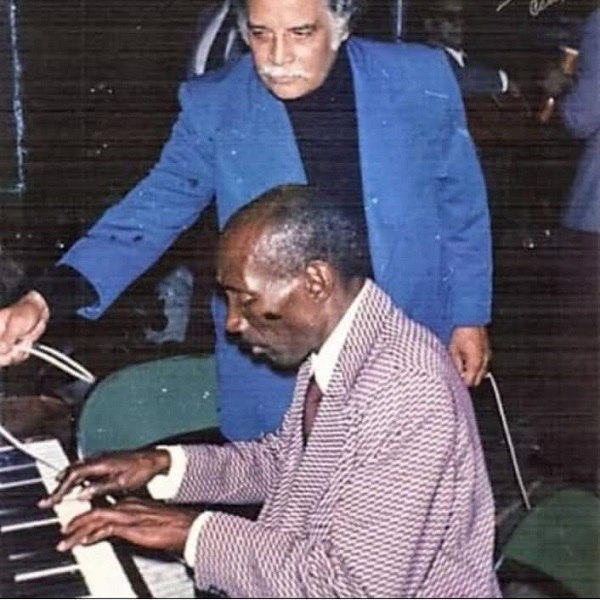
Ezequiel Lino Frías Gómez was an excellent musician, pianist, arranger and composer.

Ezequiel Lino Frías Gómez was born on April 10, 1915 in Havana, Cuba.

Lino Frías y Daniel Santos

Musician, Pianist, Arranger, Composer. He began his artistic career in the early 30’s, working with singer and composer Joseito Fernandez, in the orchestra of Raimundo Pla.

Later he became part of the Fantasía Orchestra.

At the end of the decade he worked with the Septeto Carabina de Ases.

Some time later he joined Arsenio Rodríguez’s Conjunto Todos Estrellas in September 1940, remaining in it until November 1943, leaving his place to Adolfo Oreilly Panacea, to join the Sonora Matancera in 1944, until 1976, where he contributed in an important way both in the composition and musical arrangements, imposing his particular piano solos.

In 1974 he helped found with Armando Sánchez the Conjunto Son de la Loma.

Upon his retirement from La Sonora Matancera, the Puerto Rican producer René López invited Lino, together with Israel “Cachao” López, to revive the descargas he had already recorded in the fifties, assembling a Típica together with “Cachao”.

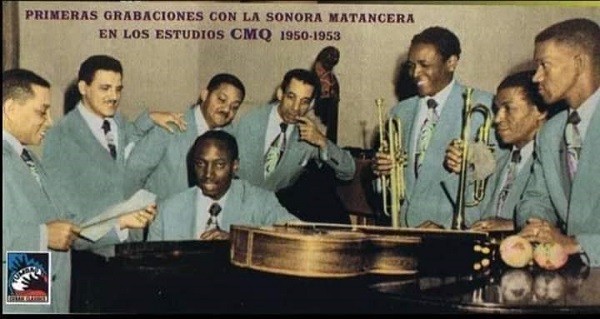
Sonora Matancea
Sonora Matancea

In his independent years Lino worked with Johnny Pacheco and Carlos “Caito” Diaz.

He accompanied great artists in recordings, in that period in New York, such as La Lupe, Olga Guillot, Daniel Santos, Carmen Delia Dipini, Bobby Capo, among others.

He died on May 22, 1983 in New York, USA.

Lino Frías, who for twenty-two years was the pianist of the Sonora Matancera, composed the very popular Mata Siguaraya in 1951.

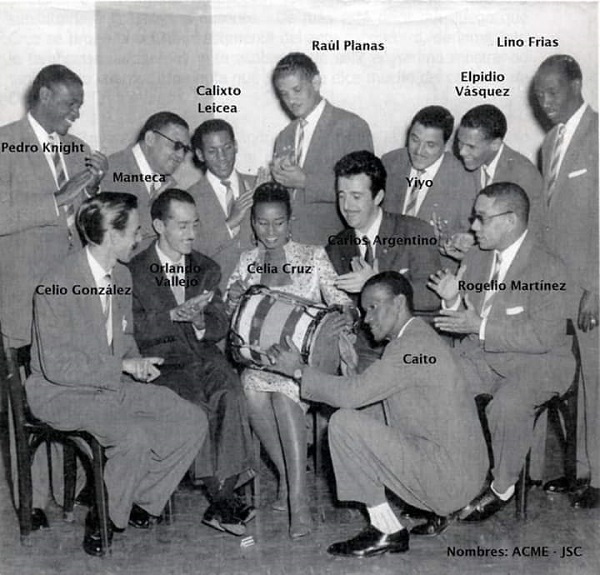
One of the most popular photos of the Sonora Matancera.

In it we can see Lino Frías from his piano looking at Celia Cruz, great interpreter of Mata Siguaraya, together with Benny Moré and Oscar D’León.

Ezequiel Lino Frías Gómez was born in Havana and died in New York in 1983.

Lino studied piano at the Havana Conservatory. For a time, in the 1930s, he played in the Raimundo Pia y Rivero Orchestra, whose singer was Joseito Fernandez. He would later play in the Orquesta Fantasía.

In 1939 he joined the Septeto Carabina de Ases, led by Mariano Oxamendi, guitarist and second voice, and with Bienvenido Grande, singer and harpsichord player, Nilo Alfonso, double bass, José Bergerey, maracas and third voice, Ramón Liviano Cisneros, tres player, Florencio Coco Morejón, bongos player, and Félix Chappotín, trumpet player.

In 1944, Lino joined the Sonora Matancera as a pianist, where he remained until 1976.

In the 1960s, Frías joined the movement that created the so-called salsa music, alongside Fania All Stars, Johny Pacheco, Bobby Rodríguez, Carlos Patato Valdés y Caíto, Carlos Manuel Díaz (Matanzas 1905-New York 1990), among others.

Don Adolfo, a Puerto Rican timbalero, worked with Lino Frías in a group that included some of the most renowned musicians and singers of the 1950s and 60s: Olga Guillot, Daniel Santos, Lucecita Benítez, Bobby Capó, Marco Antonio Múñiz, Carmen Delia Depiní, Chucho Avellaneda, Sergio González Siaba and La Lupe, among others.

In 1974, parallel to his work as a pianist in the Sonora Matancera, Lino Frías created the ensemble Son de la Loma, with the participation of Cuban-Niuyorquinos such as Marcelino Guerra, Rapindey (Cienfuegos 1914-Spain 1996), author of Convergencia, and Pedro Rudy Calzado (Santiago de Cuba 1929-New York 2002).

Celia Cruz y La Sonora Matancera

Due to arthritis, in 1976 Lino left the Sonora. His place is taken by Javier Vázquez, (Matanzas 1936), son of the double bass player Pablo Vázquez.

It is said that the death of Lino Frías, in 1983, was a hard blow for his great and faithful friend Celia Cruz (Havana 1925-New Jersey 2003).

In addition to Mata Siguaraya, Lino Frías composed Pan de piquito, Óyela, gózala, Vamos todos de panchanga, Cañonazo, Vive la vida hoy, Suena mi bajo, Convencida, Afecto y cariño, Has vuelto a mí, Baila Yemayá.

Also Read: Israel “Cachao” López Sobrado en fama y respeto en los años setenta se dedicó a mantener la tradición a nivel supremo

Wilmer Lozano from a very young age his mother saw in him the desire to be a musician

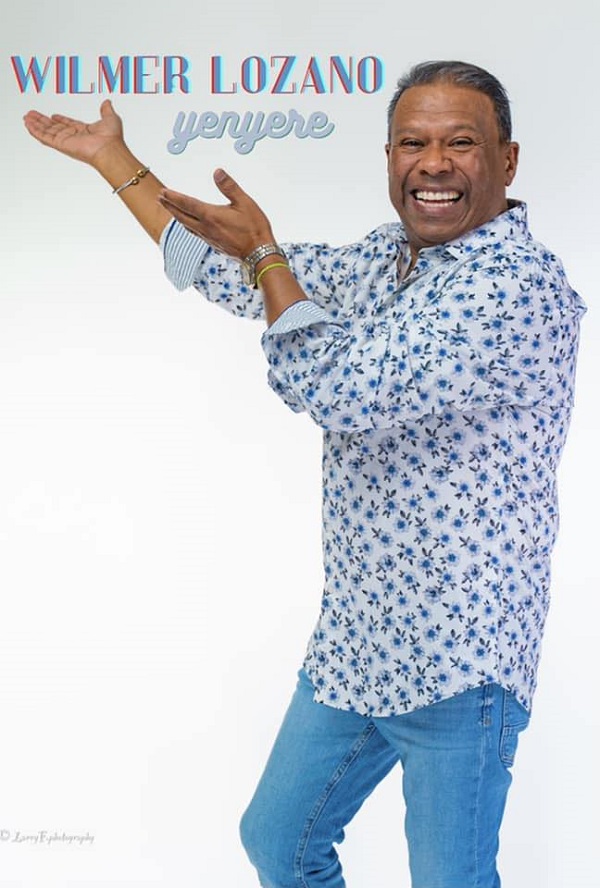
Wilmer Lozano is a Venezuelan singer and composer. He was born in Caracas, Venezuela, on October 7.

Wilmer Lozano Yenyere

When talking about successful Latin singers and good salsa, one has to talk about Wilmer Lozano, one of the greatest exponents of Latin music in the world, who has made millions of people around the world dance.

Among his musical hits are: “Me marcharé”, “Aún estoy de pie”, “Si acaba bien”, “Descarga pa ti”, “Se me pasó la mano” and “Igual que yo”.

Childhood, Youth and Family Life.

Wilmar Lozano’s mother saw in him the desire to be a musician since he was a child.

Every night before going to sleep and saying his prayers, he would dedicate himself with his grandfather Lino Lozano to practicing décimas, which would be very useful in his career as a sonero.

Wilmer Lozano’s Beginnings in Music.

Wilmer Lozano’s career began when he was in school, participating in all the events that took place there.

He got his first singing lessons at the Casa de la Cultura Germán Lira and that’s how he arrived at a very popular radio program for the time, rumbos, coplas y canciones directed by the great Venezuelan Simón Díaz.

Jose Hidalgo y Wilmer Lozano

Wilmer Lozano and his union with different groups.

Soon after, he belonged to an orchestra in the block where he lived and shared his studies with music. Little by little he belonged to orchestras based in Caracas, such as: Grupo Autana, Grupo Rayta, La Quinta Galaxia, Quinteto Visa, Conjunto Sensación, Sonora Habanera, Hildemaro y su Orquesta, Orquesta Selecto, Marianela y su Orquesta, Orquesta Vía de Escape and Orquesta La Júnior.

He later joined the ranks of the Dimensión Latina Orchestra. With this orchestra he has the privilege of sharing with the excellent bolerista Wladimir Lozano and the sonero Rodrigo Mendoza, both recognized nationally and internationally, with whom he further nurtured his knowledge as an interpreter and sonero.

He also formed part of the youth orchestra called Los Adolescentes, where he is a key piece of it, standing out as a leading artist.

With this project he recorded two productions where he performed several hits, with which he became known worldwide.

Musical genre.

Wilmer Lozano is a performer who is considered one of the best salsa singers due to his graceful voice register.

Career and Legacy

Wilmer Lozano has managed to place eleven songs in the first place of the Hit Parade. According to information provided by the company Record Report, besides being the only Venezuelan singer, who in two opportunities being in the first place, is incorporated again to the same place of honor with the same interpretations.

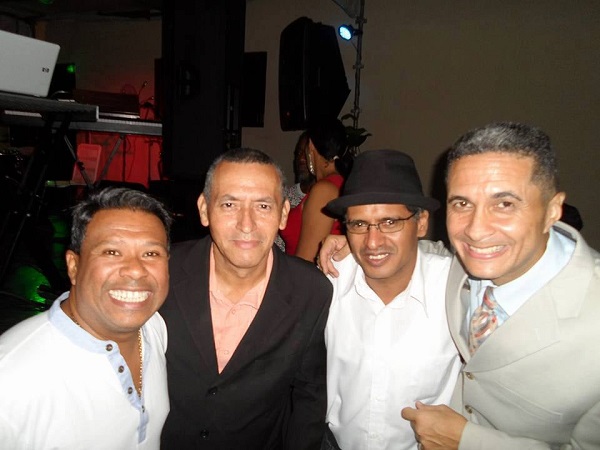
Wilmer Lozano, Tuky Torres, Dj. Augusto Felibertt y Rey Torcatt

Then his artistic life assumes another challenge, which he achieves with great professionalism, since his talent exceeds many expectations. Proof of this was his record production “Wilmer Lozano Original”, where he took the opportunity to launch himself as a soloist.

In this work he shows all the experience he has acquired during his artistic career, with the help of producer Thomas Bernal.

He achieves an excellent production, with very varied Latin rhythms and social themes. This album has the participation of the composers: Thomas Bernal, Ruby Pérez, José Luis Perales, Amaury Gutiérrez, Ángel Flores and Pedro Vargas, among others.

Among the hits of his debut are: “Me han contando que existe un paraíso”, “Me marcharé”, “Se me pasó la mano”, “Completamente” and “Sueño guaireño”, this last one was dedicated to the people who had something to do with the tragedy of La Guaira, Vargas, Venezuela.

In many of his songs he also talks about the social content, as well as the concern of many people to move forward beyond their borders.

He has also collaborated with renowned interpreters of the salsa genre, such as: Tito Puente, Tito Rojas, Rey Ruiz, Victor Manuel, Cheo Feliciano, Gilberto Santa Rosa, Tony Vega, Celia Cruz and Oscar D’León.

Wilmer Lozano is a salsa performer who has achieved musical success. His career has excelled nationally and internationally, with his arduous talent that has characterized him.

His tours have taken him to Latin America, the United States, Asia and Europe.

Theme: Se me paso la mano

Album: Wilmer Lozano “Original”.

Composition and Arrangement: Tomas “Monchy” Bernal (RIP)

Year: 2001

Label: Plátano Record

“I don’t know what I’m going to do with me, today I’m destroying myself little by little, I was wrong I lost my way because of her my destiny is transformed, because I don’t know what to do with this love that makes me run amok, she makes me see everything differently”.

Sources: Buena Música

Also Read: If you want to listen to Tasty Salsa tune in to Ritmo Sabor y Salsa with Nesmary J. Gómez

Julio Vilchez and his orchestra conquer Miami

Peru continues to give us something to talk about thanks to all the salsa talent coming out that country in recent years and today we had the opportunity to talk with one of them, which is the producer, composer and singer Julio Vilchez. 

After we communicated with Vilchez via email and WhatsApp to schedule an interview, we have managed to have a great conversation in which we knew a little more about the artist’s beginnings in this fascinating world that is music.   

singer Julio Vilchez
This is Peruvian producer, composer and singer Julio Vilchez

Childhood and musical roots in the Vilchez family 

It is not surprising that Vilchez took that parth of life considering that his father, Juan José Vilchez Sanchez, was a talented actor, comedian and professional dancer who carried music in the blood and ran some of the most famous salsa clubs in the city of Lima, which served as a stage for important national and international groups and singers of all genres.   

Having referred with admiration to his father because of all that he achieved in life thanks to music, he assured that music definitely ran through the veins of his family and had always been a very important part of his childhood and youth. 

Seeing all this, the years were not many when Vilchez became interested in musical instruments such as maracas, the bongo bell and the güiro, which led him to participate in groups such as Raíces, La Fragua and Soy Calidad.   

Salsa and other genres 

A large majority of Peruvian artists whom we had the honor to interview have typically ventured in Peruvian Creole music before getting involved in salsa, but not Vilchez. In fact, he pointed out to us that his country was heavily influenced by Cuba musically speaking and there used to be a time when groups from the island visited Peru such as La Sonora Matancera and Los Compadres. Peru also received influence from Colombia, Venezuela and Puerto Rico, although to a lesser extent. 

The artist also remembers that, at home, he and his family always used to listen to Venezuelan singers and orchestras such as La Dimensión Latina, Oscar D’ León, Luisito Quintero, Nati Y Su Orquesta, among others. In the case of Puerto Rico, of course Vilchez and his family used to listen to La Fania All Stars.  

Vilchez was part of Raíces, La Fragua and Soy Calidad
Julio Vilchez was part of groups such as Raíces, La Fragua and Soy Calidad

Formal beginnings of Julio Vilchez in music 

In the neighborhood Vilchez and his family lived in, the singer made friends with other local boys and met up with them to sing in a completely amateur way. In addition to that, he liked to participate in school talent shows, in which he delighted the crowd performing songs from Oscar D’León, Rubén Blades and Willie Colón. 

After attaining the age of 17, he began working alongside his father in the business of running clubs, which gave him the opportunity to spend time with the members of the orchestra La Progresiva del Callao, who performed on Tuesdays, Wednesdays and Thursdays in one of those places.   

Since Vilchez loved to dance and the orchestra focused a lot on its choreographies, the young man identified himself a lot with the group and began to learn the steps the singers performed on stage. One day, the boys saw him dancing and invited him to sing with them in one of their shows, in which he danced very well, but he did not sing in the best way. For this reason, he got the opportunity to stay permanently in the orchestra, but only as a dancer for the moment.   

Over time, he was grabbing experience on stage and getting over stage fright until he managed to keep up with the rest of his orchestra fellows with the passing of days.  

Julio Vilchez with Cano Estremera
Julio Vilchez with Puerto Rican salsa singer Cano Estremera

Vilchez’s time in Venezuela 

Vilchez made friends with a group of Venezuelan musicians who accompanied Oscar D’ León in one of his concerts and invited him to travel with them to Venezuela because they wanted him to be part of the sextet they were going to create, which was meant to perform at a tavern in Caracas. 

Seeing that things were going well in Venezuela at that time, Vílchez decided to accept the invitation and immigrate to the South American country to try his luck. Once there, he spent a lot of time alone because the boys from the sextet traveled a lot, something which took advantage to get to know other groups, one of them being La Selecta de Cúa. One day, Vilchez was walking down the street and heard this orchestra rehearsing, but it needed a singer. That is when Vilchez proposed himself as an option, was admitted and worked for about two years in this orchestra. 

Although he did well in Venezuela, he ended up returning to his native country because he missed his homeland and his father could not get used to having him away, so he packed suitcases and decided to return.   

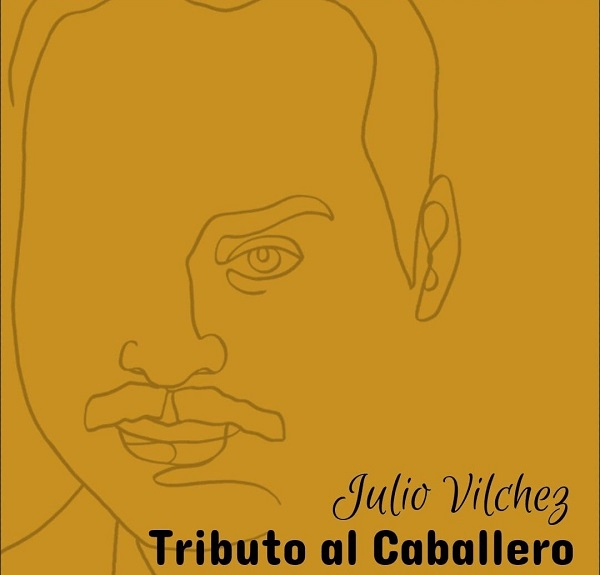
Tributo al Caballero by Julio Vilchez
Cover of the album Tributo al Caballero by Julio Vilchez

Life in the United States 

One of the songs he released in 1995 led him to make a video clip, which started to become very popular on music channels and shows, giving him the recognition Vilchez aimed for so long.  

Since things were not going as he expected on his solo career, he joined the Orquesta La Novel to continue working on music for the next two years. Although his name was not as well known as Vilchez needed it to be, his song was still sounding loud internationally for quite some time, which led him to receive a proposal to perform eight shows with his orchestra in the United States in 2000. 

When Vilchez and the rest of the musicians traveled to Miami, about nine members of the orchestra received proposals to stay in the country and decided to accept. It was there where the artist gathered his courage and says to himself ”I’m staying too”. That was over 24 years ago now.   

At that point, the Peruvian had to look for other musicians to replace the others in order to finish the concert tour they had scheduled. It was then when he contacted José Alberto ”El Canario” through a Peruvian colleague of his to use his band for the remainder of the tour and so he did. Vilchez did two or three shows with this band and stayed in Miami from 2001 to 2004.   

Given the lack of musical proposals, he spent a few years in New York, but returned to Miami some time later to work both with music and with a business sector linked to gastronomy, since living only from music is complicated. In addition to that, his children live in Miami and he wanted to spend more time with them, so this was also a powerful reason to return.   

Read also: Argentine-American composer and guitarrist Alejandro Meola kindly talked to us 

José Alberto “El Canario” and his orchestra enjoy a great international reputation in the Latin music scene.

His start in music was as a drummer, then as a bongo player, with some 48 years in Latin music and as a sonero, today in International Salsa Magazine through www.salsagoogle.com, José Alberto Justiniano Andújar, better known artistically as José Alberto El Canario, was born on December 22, 1958 in Villa Consuelo in Santo Domingo Dominican Republic.

José Alberto El Canario

El Canario began to have a passion for music from a very young age, first playing drums, bongo and timbales, at the age of 7 his mother Adalgisa, recognized dancer of the golden age of “Radio-Televisión Dominicana”, took him to live on the island of Puerto Rico, as a professional dancer she had to perform in important international theaters.

El Canario began to study in a military school in Las Antillas, then in 1970 he moved with his father to New York, where he began to sing with several orchestras, receiving international attention as the leader of the Típica 73 in October 1977, where he earned 25 dollars for each presentation and recognized it as his university in the life of art.

José Alberto credits his compadre Roberto Geronimo for his successful artistic career. Geronimo discovered him as an artist and managed him for many years. El Canario also sang merengue at the onset of his musical journey.

In 1983, José Alberto established his own band and gained fame as a major Latin star after his debut album Noches Calientes released in 1984.

Jose Alberto is a renowned singer who has recorded numerous chart-topping hits, including “Sueño Contigo”, “Hoy Quiero Confesar”, “Te Voy a Saciar de Mi”, “A Gozar”, “Es Tu Amor”, and “Quieres Ser Mi Amante”, among others, for his 1988 album Sueño Contigo and several others.

His inimitable voice and unmatched improvisational skills have earned him international acclaim. Jose Alberto has collaborated with several contemporary artists such as Johnny Rodriguez, Mario Rivera, Nicky Marrero, Oscar D’Leon, and Celia Cruz.

El Canario began to have a passion for music at a very young age, first playing drums, bongo drums and timbales.

José Alberto “El Canario” has earned multiple gold and platinum records due to his high number of album sales.

He has achieved success not only in the United States and Europe but also throughout Latin America, including his native Dominican Republic, Puerto Rico, Peru, Venezuela, Panama, Colombia, Ecuador, and Costa Rica.

The nickname “El Canario” was bestowed upon him by a New York disc jockey who christened him so in a disco due to his improvisational skills; “Canta canario” was the catchphrase he would belt out through the control microphone.

José Alberto ‘El Canario’ and his Orchestra have gained immense international recognition in the Latin music industry.

His musical prowess and captivating voice make his live shows some of the most thrilling performances.

El Canario, winner of the “Congo de oro” in 2005 – an award given to the best musical groups presented at the Festival de Orquestas del Carnaval de Barranquilla – and of three Latin Grammys in 2013, 2015 and 2018, is one of the undisputed artists of Latin music with a career spanning some 48 years.

Arturo Sandoval, Oscar D' Leon y El Canario
Arturo Sandoval, Oscar D’ Leon y El Canario

Throughout his career, José Alberto El Canario has gained international recognition for his unique voice and style, but also, according to his biographies, for his improvisations on stage.

José Alberto El Canario y su Orquesta enjoys great international renown in the Latin music scene.

Also Read: Jimmie Morales a conguero for the history of Afro-Caribbean music

  • « Go to Previous Page
  • Page 1
  • Page 2
  • Page 3
  • Page 4
  • Page 5
  • Page 6
  • Interim pages omitted …
  • Page 10
  • Go to Next Page »

International Salsa Magazine (ISM) is a monthly publication about Salsa activities around the world, that has been publishing since 2007. It is a world network of volunteers coordinated by ISM Magazine. We are working to strengthen all the events by working together.