• Skip to primary navigation
  • Skip to main content

International Salsa Magazine

  • Home
  • Previous editions
    • 2026
      • ISM / January 2026
      • ISM / February 2026
    • 2025
      • ISM / December 2025
      • ISM / November 2025
      • ISM / October 2025
      • ISM / September 2025
      • ISM / August 2025
      • ISM / July 2025
      • ISM / June 2025
      • ISM / May2025
      • ISM / April 2025
      • ISM / March 2025
      • ISM / February 2025
      • ISM / January 2025
    • 2024
      • ISM / December 2024
      • ISM / November 2024
      • ISM / October 2024
      • ISM / September 2024
      • ISM / August 2024
      • ISM / July 2024
      • ISM / June 2024
      • ISM / May 2024
      • ISM / April 2024
      • ISM / March 2024
      • ISM / February 2024
      • ISM / January 2024
    • 2023
      • ISM / December 2023
      • ISM / November 2023
      • ISM / October 2023
      • ISM – September 2023
      • ISM – August 2023
      • ISM July 2023
      • ISM Edition June 2023
      • ISM – May 2023
      • ISM April 2023
      • ISM March 2023
      • ISM February 2023
      • ISM January 2023
    • 2022
      • ISM December 2022
      • ISM November 2022
      • ISM October 2022
      • ISM September 2022
      • ISM August 2022
      • ISM July 2022
      • ISM June 2022
      • ISM May 2022
      • ISM February 2022
      • ISM January 2022
    • 2021
      • ISM December 2021
      • ISM November 2021
      • ISM October – 2021
      • ISM September 2021
      • ISM August 2021
      • ISM July 2021
      • ISM May 2021
      • ISM April 2021
      • ISM June 2021
      • ISM March 2021
      • ISM February 2021
      • ISM January 2021
    • 2020
      • ISM December 2020
      • ISM November 2020
      • ISM October 2020
      • ISM September 2020
      • ISM August 2020
      • ISM July 2020
      • ISM June 2020
      • ISM May 2020
      • ISM April 2020
      • ISM March 2020
      • ISM February 2020
      • ISM January 2020
    • 2019
      • ISM December 2019
      • ISM November 2019
      • ISM October 2019
      • ISM Septembre 2019
      • ISM August 2019
      • ISM July 2019
      • ISM June 2019
      • ISM May 2019
      • ISM April 2019
      • ISM March 2019
      • ISM February 2019
      • ISM January 2019
    • 2018
      • ISM December 2018
      • ISM November 2018
      • ISM October 2018
      • ISM September 2018
      • ISM August 2018
      • ISM July 2018
      • ISM June 2018
      • ISM May 2018
      • ISM April 2018
      • ISM March 2018
      • ISM February 2018
      • ISM January 2018
    • 2017
      • ISM December 2017
      • ISM November 2017
      • ISM October 2017
      • ISM September 2017
      • ISM August 2017
      • ISM July 2017
      • ISM June 2017
      • ISM May 2017
      • ISM April 2017
      • ISM March 2017
      • ISM February 2017
  • Download Salsa App
    • Android
    • Apple
  • Spanish

Search Results for: Salsa Orchestra

Musician and entrepreneur of Latin origin Jorge Torres talks about his band and his company

American multi-instrumentalist and entrepreneur of Puerto Rican descent Jorge Torres had a conversation recently with us about his musical origins, his company Jimmy Jorge Entertainment, his band, and his work with music today. In International Salsa Magazine, we are more than happy to interview him and learn what he has to tell us.
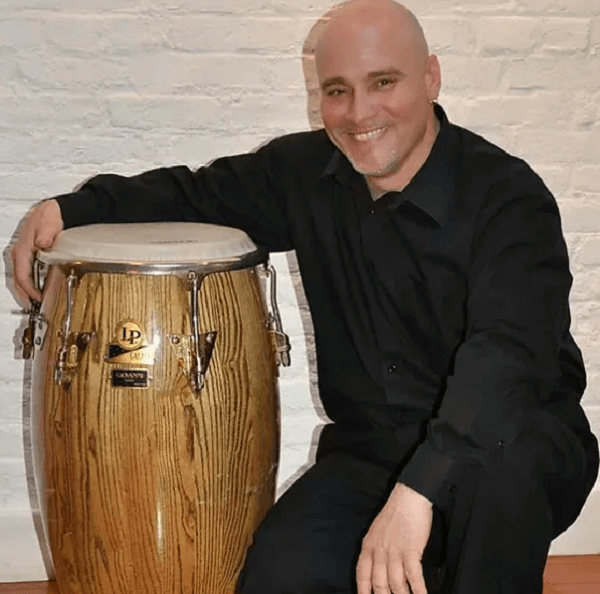
Jorge Torres and his conga
Musician and entrepreneur Jorge Torres next to his conga

Jorge’s beginnings in music in his native Chicago

Jorge said that when he was very young, his mother got a large stereo system that included a record player and radio where she listened to all kinds of music. His brother had a copy album “Che Che Cole” by Willie Colon and a cowbell he used to play constantly, making it the first instrument he heard in his childhood.

In the fifth grade in Philadelphia, he became interested in learning to play the guitar, but at that time his school did not offer guitar programs, but violin. So he decided to try the violin, but only played it during that year. In the eighth grade, he returned to Chicago to live with his father following the death of his mother, and his interest turned to steel drums, which he also referred to as Caribbean drums. 

He spent another year playing this instrument until he reached high school and moved back to Philadelphia to live with his brother, which is when he changed his mind again and started loving the trumpet and the conga. He was so passionate about the latter that he bought his own conga, which he still has to this day. Then, other musician friends taught him how to play it, and the rest is history.

Jorge Torres playing
Jorge Torres playing the conga live

Early professional career

His learning to play the conga was the beginning of his life as a professional musician, and he played for various groups such as La Orquesta Cupey, Orquesta La Precaución, and Orquesta La Opinión, among others. During this time, Jorge learned to play many other instruments such as bongos and timbales. His teacher was Mikie Rivera, renowned Puerto Rican singer-songwriter and trova and jazz guitarist, who met with the young man and other musicians in the cellar of a friend’s house to mentor them and work with them.

These meetings aroused in him the idea of creating his own band in the future because of all that Rivera taught him about the music biz, and he wanted to put that knowledge into practice as soon as possible.

Jimmy Jorge and The Latin Jazz Expenses

Jorge’s band started as a small jazz group, but he did not want to settle for that. At some point, he was interested in having an orchestra with four wind instruments, three singers, piano, bass, bongos, timbales, and congas. That is how Jimmy Jorge and The Latin Jazz Express project arose.

This project started as a six-member Latin jazz band in 1995, but has managed to grow to the point that it has about 12 members and plays many other musical genres, although salsa is still very present in its repertoire.

Jorge Torres and the band
Jorge Torres and the rest of Jimmy Jorge and The Latin Express

Through hard work, Jimmy Jorge and The Latin Jazz Express have managed to position itself in the industry until they became the house band on the radio station called “La Mega 1310 AM” for some time and have played at all kinds of events such as The Puerto Rican Parade, La Feria del Barrio, Penn’s Landing’s Hispanic Fest, among others. 

Some of the current members of the band are Peruvian singer Joseito Rivera, Puerto Rican singer Lia Montalvo, Dominican singer Hugo Tavares, conguero Edwin “Papo Buda,” percussionist Orlando Santana, and trombonist Edgar Salias.

Jimmy Jorge Entertainment

When Jorge began performing with American orchestras, he noticed that some of them, in addition to their musicians, also had dancers and DJs who were part of the orchestra and the show. The inclusion of these professionals in concerts seemed like a phenomenal idea to him and wanted to put it into practice for his own project, so he took advantage of the contact he had made with singers, DJs, photographers, dancers, and dance teachers to recruit them for his own shows in the future.

So, he began asking for phone numbers in order to build a network of artists he could count on in case he needed their services. Today, he has a large catalog of options for every type of show, making Jimmy Jorge Entertainment one of the most important Latin entertainment companies in Philadelphia today.

Read also: Raúl Eliza: from the army barracks to the stage and recording studios
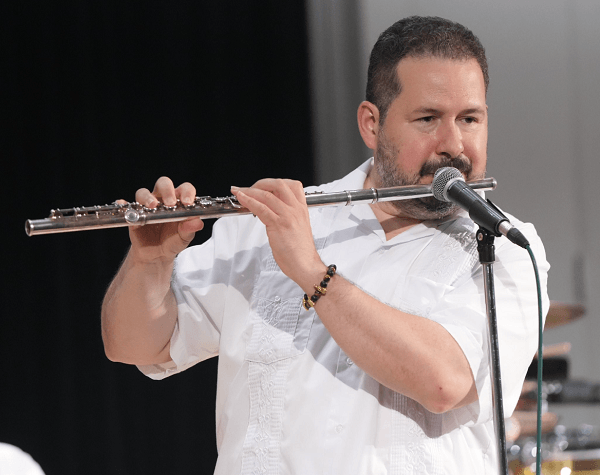
Carlos Jimenez offers his talent and passion to charm the audience in universities, hotels, and restaurants all over New York

We are very happy because this beginning of the year has brought us a very friendly conversation with brilliant bandleader, composer, vocalist, and flutist Carlos Jiménez, who kindly answered the questions we had for him. 

The New Yorker has many interesting things to tell, so we hope that everyone will enjoy the material below.

Carlos Jimenez playing
Carlos Jimenez playing the flute live

Carlos’ beginnings in music

Carlos was born in New York City, but moved to Puerto Rico with his family when he was six years old. It was on the Island of Enchantment that he discovered his inclination toward music thanks to his trumpeter father William, and his cuatrista grandfather Cruz, who encouraged him to take music lessons. Therefore, he also began to receive musical training and built competence for playing percussion instruments such as the timbales, bongos, and congas. 

His first lyrical instrument was the trumpet, which he learned to play under the tutelage of Professor Pablo León at Francisco Zayas Santana High School. However, inspired by Mongo Santamaría and his musical arrangements for his song “Song For You,” he decided to switch instruments and start playing the flute, which he has continued to do.

Carlos’ return to New York

As a young man, he decided to return to his hometown highly motivated by the vibrant Latin music scene there, which he describes as “the city where all our dreams come true.” While there, he enrolled at the Music Conservatory of Westchester to study classical flute, but his training have not been completed. 

He also studied jazz harmony and voicing with piano teacher Michael Longo, who he describes as a good friend and teacher to the point of making a recording together. Unfortunately, Longo was one of the many victims of the COVID-19 pandemic, which was an immense sadness for Carlos and those who had the privilege of knowing him. 

Orlando Marín and Carlos Jimenez
Orlando Marín ”El último Rey del Timbal” and Carlos Jimenez

Results of his prolific career

After more than 20 years of successful career, Carlos has built a great reputation in the industry at the point of passion and hard work. He himself says that his good name comes as a result of his responsibility, reliability, and, most importantly, his ability to play good music.

His great skills as a professional and musician have led him to play at corporate events for companies such as Victoria’s Secret, Nike, ScotiaBank, Regeneron, and many others. In addition to that, he has also been able to play and lead orchestras in performances for universities and cultural institutions such as Lehman College, Sarah Lawrence College, New York Botanical Garden, Columbia University, and many more. 

Likewise, Carlos’ band has performed in so many festivals such as West Harlem Jazz Festival, Harbour Jazz Festival, Fall Harvest Fishkill Farm Festival, Lake George Festival, Summer Sound Festival, and many others. 

Altruistic side

In addition to the above, Carlos has also earned the respect of his colleagues thanks to the numerous galas, charity events, and community activities the artist has been involved in recent years, which has made him worthy of numerous awards for his community service. This shows that the flutist is not only passionate about his craft, which is music, but also uses it to do good to those in need. We can also add that he has headlined numerous shows at well-known restaurants and hotels such as Casa Cipriani Hotel, The Marriott, Ritz Carlton, The Lexington Hotel, among others.

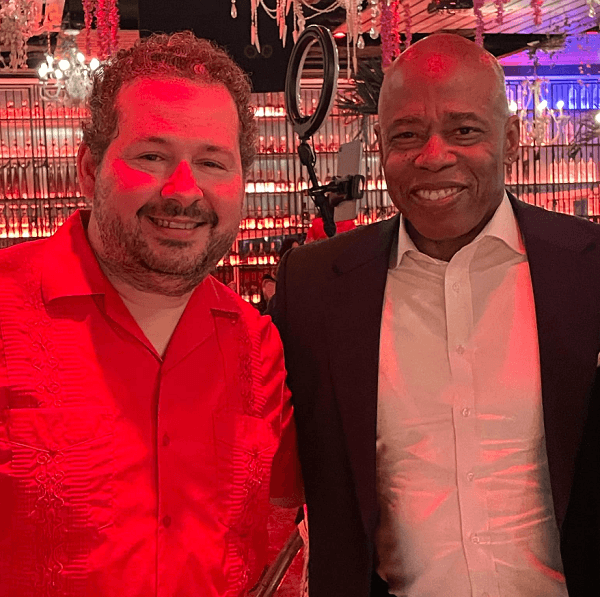
Carlos Jimenez and Eric Adams
Carlos Jimenez and former New York Mayor Eric Adams

The Carlos Mambo Dulcet

Together with his orchestra, Carlos has released several albums, including “Red Tailed Hawk Vol. 1,” “Red Tailed Hawk Vol. 2,” and “Despierta Boricua,” among others. The artist closed the conversation by saying that his group continues to be formed and has more than 100 musicians and all are are wonderful.

Read also: La Nota Band showcases the best of Venezuelan talent

Oscar D’ León confessions of Oswaldo Ponte by William Briceño

Latinoamerica / Venezuela / Caracas
Oscar D' León
Oscar D’ León

Part 1

This book narrates the story of the famous singer Oscar D’ León from his birth and his life’s progress to who he is today; it also mentions how the era evolved, not only at a musical level but also regarding the situation of the country, both in Venezuela and other nations.

Before beginning to comment on the biography written by his manager, Oswaldo Ponte: biographies do not only try to remember great men who extend beyond their era. In this way, through this biography, the goal is to spread an idea about the work of the well-known artist “Oscar D’ León,” who has brought greatness to the country, crossing the line of his horizon and extending it toward other latitudes. One could say it is like a novel that not only speaks of successes or already known events, but also tells us about the reality of his life and not just what acquaintances or representatives of the artist think.

Photo1: Oscar D' León
Photo1: Oscar D’ León

The biography begins with the birth of Oscar Emilio León Simosa on July 11, 1943, in Caracas, Venezuela; where not only his family but other friends were present, one of whom ironically mentioned that in the future “he would be a great singer” since his crying was like a symphony. According to his mother, “Carmen Dionisia,” the midwife told her that he was born “enmantillado” (born with a caul), which meant the baby could have a multitude of gifts that he could take advantage of in the future.

It is worth mentioning that at an early age, he had more passion for music than for his studies, and he came to the conclusion that studies were not the best thing for his future; therefore, he dedicated himself to helping at his parents’ business to contribute to the household.

Since he was very young, he enjoyed listening to “Sonora Matancera” in a corner at night, which was the musical group of the era, and he would follow the percussion with his throat. He also listened to jazz orchestras, which led him to the conclusion that music would be his vocation; he was fascinated by listening to his mother hum the hits of 1953 by the Orquesta Aragón and Dámaso Pérez Prado.

Oscar D' León - Photo 1
Oscar D’ León – Photo 1

Fortunately for the future singer, his family was passionate about music and had close relationships with musicians, singers, and players of all types of instruments even if they were not professionals. This warm, joyful, and above all, musical atmosphere embraced Oscar from the moment he was born. It was even shown that at an early age he had a certain interest in any object that emitted a musical sound, and he longed to learn how to use musical instruments. Despite having a humble family, Oscar himself managed to use various objects to create something that generated a musical sound and to discover his own rhythm, which he enjoyed at that time.

Oscar D' León - Photo 2
Oscar D’ León – Photo 2

Simosa, which was on July 11, 1943, in Caracas, Venezuela; where not only his family but other friends were present, and ironically one of them mentioned that in the future “he would be a great singer” because his crying was like a symphony. According to his mother, “Carmen Dionisia,” the midwife told her that at birth he was “born with a veil” (enmantillado), which meant the baby could have a multitude of gifts that he could take advantage of in the future.

During his adolescence in Venezuela, many significant political changes were occurring for the population; however, they did not stop celebrating festive seasons with his family even in difficult times. Many “parrandas” (parties) were held, something that Oscar enjoyed very much.

In 1958, he mentions that a phenomenon was occurring with the musical style of “Dámaso Pérez Prado’s Mambo”; also, at the Club Las Fuentes, the Sonora Matancera resonated with “Celia Cruz” alternating with the “Caracas Swing Boys”. A movement of orchestras influenced by foreign rhythms that thrilled Venezuelans began to be observed on a national level, such as Billo’s, which won the precious title of the most popular orchestra in Venezuela. Oscar was not interested in societal events, except for events in Cuba, since Cuban music was what fascinated him.

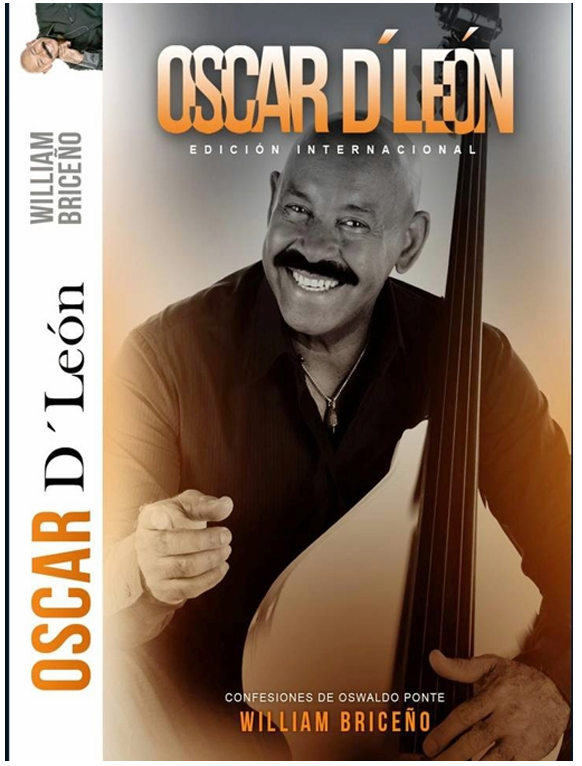
Photo: Oscar D' León confessions of Oswaldo Ponte by William Briceño
Photo: Oscar D’ León confessions of Oswaldo Ponte by William Briceño

Starting in 1962, he became a father, and marveled by his new life and his firstborn, he dedicated himself to his role as a father, keeping his family supported by working; this caused him to step away from music, and his maturity can be witnessed despite his age.

By the age of 23, he already knew how to sing and play the bass; over time, he met friends who would influence great changes in his future life. In 1966, he met Kiko Pacheco, who invited him to the group “Los Junior,” where he would begin his professional career. During that same year, salsa was taking off in Venezuela, as it was heard on all the country’s radio stations.

During that era, life was expensive, so he worked hard both in clubs and discotheques or as a taxi driver. On one occasion, Kiko Pacheco asked Oscar to sing in the “Quinteto Los Junior” because their vocalist had to leave; this allowed Oscar to demonstrate his talent, and from that moment on, everyone was enchanted upon hearing him, and his musical profession began. Later, “La Dimensión Latina” was created, which at that time was known as “Dimensión Seis,” founded by Oscar D’ León and Cesar Monge.

The members who formed “La Dimensión Latina” were Oscar de León, Cesar Monge “Albóndiga,” and José Rojas “Rojita” on trombones; José Rodríguez “Joseíto” and Elio Pacheco on percussion; and Enrique “Culebra” Iriarte on piano. A significant event for Oscar was that, during their first rehearsals, he had a premonition of his success when they found the rhythm he wanted to hear and share with the rest of the musical world. This was proven during their first performance, which was a total success, leaving everyone who heard them stunned.

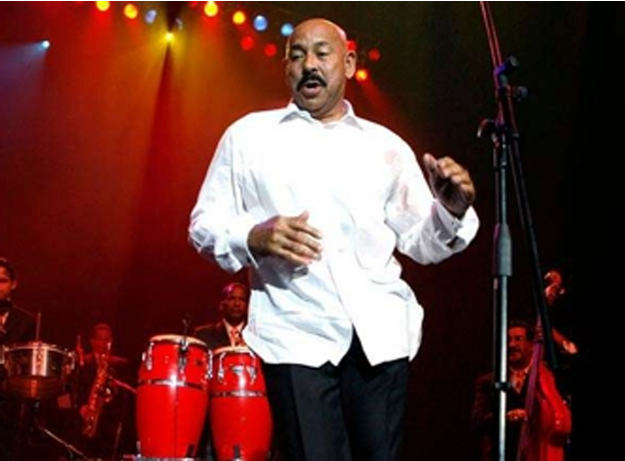
Oscar D' León singing
Oscar D’ León singing

From that moment on, with the debut of La Dimensión Latina, a new concept emerged that would change the landscape of popular Venezuelan music and make history both nationally and internationally with the rise of the legend Oscar D’ León. They began playing for five months at “La Distinción” from Friday to Saturday. On Sundays, after finishing there, they would go to El Junquito to continue the party, gaining so much popularity that some felt they should launch an international career. During that time, singer-songwriter Mireya Delgado hired them after being impressed by seeing them perform on stage.

They played on a cruise ship during a one-week tour through different Caribbean islands and achieved great success despite the inconveniences they faced. They paid these no mind, as they dedicated themselves wholeheartedly to playing for their audience. This caused venues to become packed, captivating their fans who idolized them. From that point forward, many people began wanting to hire them for various events.

Here is the translation of the text into American English:

In that same year, 1972, a dizzying and unstoppable recording career began. This was based on the fact that executive representatives from the TH label heard two tracks: one was “Oye mi canto,” which was a hit for Gran Combo de Puerto Rico, and the other was “Te voy a cortar las patas” by Oscar D’ León. Because this made a great impact and created absolute conviction among the executives that they were witnessing a success, the promoter Mesone, upon hearing them, agreed to carry out a recording. This recording was shared with the Víctor Mendoza Orchestra, one of the TH producers in Venezuela: El Clan de Víctor.

2- Oscar D' León
2- Oscar D’ León

The album featured three tracks by Oscar; he recorded two of them with Dimensión Latina and the other with El Clan de Víctor. However, he does not appear as the author in the credits. The same thing happened with an album in 1991 when recording the album Auténtico. Among the 80 tracks that Oscar wrote, two of them are his immortal classics and of his authorship: “Llorarás” and “Detalles”.

For the first time in Venezuela, Salsa festivals were held that moved everyone. From that moment on, a true proliferation of salsa was witnessed in the country, all thanks to “Pensando en ti,” which had a major impact on the history of Venezuelan popular music.

After the success of his new discography—which contains “La comprita,” “Barranquilla,” and “Barranquilla y Quiéreme,” among others—three important international contracts were signed. Oscar and Dimensión Latina would go to Curaçao, Aruba, and Bonaire; that same year, they would also go to Colombia and Santo Domingo. However, it is worth noting that the period from “Pensando en ti” to “Que bailen to’s” covered the stage that catapulted him internationally.

Here is the translation of the text into American English:

The production of Dimensión Latina’s 1975 discography was the one that left an eternal mark, whose immortality was glimpsed from the very moment of its appearance. Its tracks focused on themes of romantic heartbreak. However, the rhythmic conception of “Llorarás” was the most important conception and structure of Oscar D’ León and Dimensión Latina; in fact, the song “Llorarás” marked the rupture of the old dance empire represented by Billo’s, and Dimensión came to be considered the “Billo’s of Salsa”.

An important subject in the world of music tells us in this book that: “salsa singers used phrases worn out by the use of previous generations who popularized them; in contrast, Oscar projected original modifications created by him”.

Oscar D' León in concert
Oscar D’ León in concert

When they traveled to New York, Oscar was very excited by the different stories he had experienced in the music world, and they were even happier to perform for the first time in the impressive metropolis. It was there where that musical genre that transformed them into idols, “Salsa,” was projected.

As time passes, Oscar manages to establish his own style and never changed it while climbing the steps of popularity and fame; the same happened with Dimensión Latina, though without achieving the countless triumphs Oscar D’ León obtained until his departure.

If you wish to know more about the history of Oscar D’ León, we recommend reading “Oscar D’ León: Confessions of Oswaldo Ponte by William Briceño, Editorial Fundación Simón Bolívar” to learn about the continuation, as it is a very broad topic to describe in this first part; likewise, in our next edition, we will conclude our final thoughts on this interesting and extensive biography.

Oscar D' León confessions of Oswaldo Ponte by William Briceño
Oscar D’ León confessions of Oswaldo Ponte by William Briceño


What Adalberto Santiago represents for Latin music

Our great friend Adalberto Santiago is one of the biggest references of Latin music despite his long career, so it is always appropriate to remember the greatest moments of his career. Today, he is experiencing some health difficulties, so we hope he enjoys this article and it makes him feel better.

This is Adalberto Santiago
This is Puerto Rican composer and singer Adalberto Santiago many years ago

Adalberto Santiago’s beginnings in music

Adalberto Santiago Berríos was always possessor of an extremely powerful and deep voice, making him a lyric tenor and one of the best performers of Afro-Cuban music in the United States. Some of his most important influences from an early young age were Miguelito Cuní and Benny Moré, who served as a source of inspiration for what was to come in his future career.

The artist began in music by lending his voice to trios and playing the guitar and bass, although he often accompanied these activities with some dance steps. In the eyes of many, this makes him one of the first singers to play, dance, and sing in the same concert. In addition, in this early stage of his career, he was nicknamed “The Latin Elvis Presley” due to his tall stature, thick hair, blue eyes, and elegant demeanor. 

Turning point in his career

After having had the opportunity to play with great orchestras at the time, what really made his career take off was his joining Ray Barretto’s Orchestra, prompting him to go international with albums such as “Acid” and “Rican Struction.” These albums continue to be a reference for salsa and Latin music fans in general.

Johnny and Adalberto at the museum
Johnny Cruz and Adalberto Santiago at the Spaha Salsa Museum in New York

Some time later, Santiago and other members of the aforementioned orchestra created La Típica 73, but unfortunately time did not pass much when the artist and some of his colleagues split up again over religious differences with the rest of the members and founded Los Kimbos on their own. Along with this group, of which he was the lead singer, he recorded ”Los Kimbos” and ”This Big Kimbos With Adalberto Santiago” in 1977, the year in which he dared to release his first solo album called ”Adalberto”. 

One interesting thing about that album is that it was produced by Ray Barretto, who contributed two of his compositions to his old pupil.

Solo career 

From 1977 onwards, everything that came for Alberto was nothing more than success and recognition. One of those great successes was his famous participation in “Hommy, A Latin Opera,” a work produced and directed by Larry Harlow, which was an assured stamp of excellence. Soon after, he was asked to be one of the lead singers for “Louie Ramírez y sus Amigos.” He co-produced the song “Adalberto Featuring Popeye El Marino” with Ramírez and joined Barretto on “Rican/Struction.”

In the 1980s, Adalberto and Roberto Roena came together to release ”Super Apolo 47:50”, which included songs such as ”Yo Tenía Una Mujer” and ”Vigilándote”. Around the same time, he also co-produced the album ”Calidad” with Papo Lucca, who was also very involved in the musical direction. 

Adalberto and Johnny en un homenaje
Adalberto Santiago and Johnny Cruz during a tribute to the Puerto Rican singer

Another international explosion of popularity

Another milestone in his career was his salsa version of the classic “Sex Symbol,” which has since become a cult album for fans from many countries, including Colombia, Peru, and Venezuela. It turned out to be one of the most successful albums of his entire career and practically established a new style known as “salsa monga.”

The composer has also written songs for albums in which he himself has been involved as both a bandleader and singer, and his success has in no way prevented him from staying true to his Latin roots.

Adalberto Santiago’s current situation

We have learned that Adalberto Santiago was about to participate in a tour which aimed to pay tribute to him and other participants, but due to some complications with his health, this concert series will not be able to take place for the time being.

From International Salsa Magazine, we are very sorry for this situation, and the entire team hopes that this living legend of music will be able to get out of this situation and continue to give us joy with his talent.

Johnny Cru ISM corresponde in New York City


Read also: Cache Live Music puts Miami to dance to traditional Latin music

Latin America / January 2026

Dámaso Pérez Prado 01 2026

Compay Segundo 01 2026A Bayamo 01 2026Toña La Negra 01 2026Bella MartinezCalibrated maracas

DIRECTORY OF NIGHTCLUBS

Argentina flag
ARGENTINA

Aruba circular flag
ARUBA

Belize circular flag
BELIZE

Bolivia circular flag
BOLIVIA

Brazil flag
BRAZIL

Chile circular flag
CHILE

Colombia
COLOMBIA

Costa Rica circular flag
COSTA RICA

Cuba circular flag
CUBA

Dominican Republic
DOMINICAN REPUBLIC

Ecuador circular flag
ECUADOR

Guatenala circular flag
GUATEMALA

Mexico Circular flag
MEXICO

Panama circular flag
PANAMA

Peru circular flag
PERU

Puerto Rico circular flag
PUERTO RICO

Venezuela circular flag
VENEZUELA


  • « Go to Previous Page
  • Page 1
  • Interim pages omitted …
  • Page 49
  • Page 50
  • Page 51
  • Page 52
  • Page 53
  • Interim pages omitted …
  • Page 154
  • Go to Next Page »

International Salsa Magazine (ISM) is a monthly publication about Salsa activities around the world, that has been publishing since 2007. It is a world network of volunteers coordinated by ISM Magazine. We are working to strengthen all the events by working together.