• Skip to primary navigation
  • Skip to main content

International Salsa Magazine

  • HOME
  • Previous editions
    • 2026
      • ISM / April 2026
      • ISM / March 2026
      • ISM / February 2026
      • ISM / January 2026
    • 2025
      • ISM / December 2025
      • ISM / November 2025
      • ISM / October 2025
      • ISM / September 2025
      • ISM / August 2025
      • ISM / July 2025
      • ISM / June 2025
      • ISM / May2025
      • ISM / April 2025
      • ISM / March 2025
      • ISM / February 2025
      • ISM / January 2025
    • 2024
      • ISM / December 2024
      • ISM / November 2024
      • ISM / October 2024
      • ISM / September 2024
      • ISM / August 2024
      • ISM / July 2024
      • ISM / June 2024
      • ISM / May 2024
      • ISM / April 2024
      • ISM / March 2024
      • ISM / February 2024
      • ISM / January 2024
    • 2023
      • ISM / December 2023
      • ISM / November 2023
      • ISM / October 2023
      • ISM – September 2023
      • ISM – August 2023
      • ISM July 2023
      • ISM Edition June 2023
      • ISM – May 2023
      • ISM April 2023
      • ISM March 2023
      • ISM February 2023
      • ISM January 2023
    • 2022
      • ISM December 2022
      • ISM November 2022
      • ISM October 2022
      • ISM September 2022
      • ISM August 2022
      • ISM July 2022
      • ISM June 2022
      • ISM May 2022
      • ISM February 2022
      • ISM January 2022
    • 2021
      • ISM December 2021
      • ISM November 2021
      • ISM October – 2021
      • ISM September 2021
      • ISM August 2021
      • ISM July 2021
      • ISM May 2021
      • ISM April 2021
      • ISM June 2021
      • ISM March 2021
      • ISM February 2021
      • ISM January 2021
    • 2020
      • ISM December 2020
      • ISM November 2020
      • ISM October 2020
      • ISM September 2020
      • ISM August 2020
      • ISM July 2020
      • ISM June 2020
      • ISM May 2020
      • ISM April 2020
      • ISM March 2020
      • ISM February 2020
      • ISM January 2020
    • 2019
      • ISM December 2019
      • ISM November 2019
      • ISM October 2019
      • ISM Septembre 2019
      • ISM August 2019
      • ISM July 2019
      • ISM June 2019
    • 2016
      • ISM December 2016
  • Spanish
  • Download Salsa App
    • Android
    • Apple

Search Results for: Salsa music

The Jeque and his Band present: “Ultimatum”, a musical gem with Hermán Olivera

A masterful fusion that redefines Guaguancó and Cha-Cha, celebrating the group’s tenth anniversary.

El Jeque y su Banda is a salsa ensemble based in Venezuela.

Under the direction of its founder and general manager, Lic. Ángel Martínez “El Jeque,” and with the impeccable musical direction, arrangements, and piano work of the renowned William “Willie” Melo, the band has established itself as a benchmark in the genre.

El Jeque y su Banda presenta “Ultimátum”, una joya musical junto a Hermán Olivera

Approaching ten years of professional trajectory, maintaining their momentum through persistence, passion, and dedication to their craft, the group celebrates this anniversary with the release of their fourth studio production: Evolución…El Jeque y sus Estrellas.

The Launch: “Ultimátum”

The purpose of this release is to announce the launch of their second promotional single, a piece crafted for the true music connoisseur: “Ultimátum.”

This musical gem features a collaboration with a legend of the genre, a world-renowned sonero and vocalist: Hermenegildo Olivera Suárez, globally known as “Hermán Olivera, El Sonero del Siglo XXI.”

Herman Olivera El Sonero del Siglo XII y Dj. Augusto Felibert

History and Evolution

This romantic-style track was originally recorded in 1981 by the great Puerto Rican interpreter Felipe “La Voz” Rodríguez.

The song was written by the legendary Puerto Rican composer Luz Celenia Tirado, who was the first woman recognized in the island’s challenging guild of troubadours and also performed on that original production.

On this occasion, El Jeque y su Banda takes the work in a new direction, transforming it into an aggressive Guaguancó fused with an elegant Cha-Cha.

The concept for this version was a creative endeavor led by Hermán Olivera, who defined the essence and intent of the track.

Ángel Martínez “El Jeque” y Dj. Augusto Felibertt

Subsequently, Luis Alberto and Willie Melo shaped the project, solidifying the final musical structure under the pen and direction of William “Willie” Melo, with the co-production of Luis Alberto “Redlouis” (Manager, Producer & Booking for Hermán Olivera).

Musical Virtuosity

It is remarkable how these music aficionados manage to mesh Guaguancó and Cha-Cha originally fused with a bolero with a versatility that preserves the essence, cadence, and appeal of the piece.

Herman Olivera Soneando Luis Rojas y Augusto Felibertt prueba de Sonido en el marco del evento Salsa Bajo la Cúpula Poliedro de Caracas.

Willie Melo masterfully integrates Hermán Olivera’s characteristic sound, marked by the influences of Manny Oquendo’s Conjunto Libre and the maestro Eddie Palmieri.

The arrangement, loaded with dissonant notes and power, softens its impact with the magic of the Cha-Cha, allowing Hermán to display his artistry in the soneo.

This interplay between the irreverent, the melodic, and the elegant makes “Ultimátum” a mandatory addition to any quality music lover’s playlist.

Production Credits

The excellence of this single is made possible by the participation of these great Venezuelan musicians:

  • Musicians: Yomar “Caballo” Méndez, Julito Antillano, Luis Ruíz, Joel “Pajarraco” Rivas, Frank Haslam, and Willie Melo.

  • Backing Vocals (Cha-Cha): Maestro Nino Segarra, accompanied by Rodrigo Mendoza and Wilmer Lozano.

  • Recording (Lead and Backing Vocals): Nino Segarra Studios (Puerto Rico).

  • Musical Recording, Mixing, and Mastering: Dale Cerebro Estudio, led by engineer Emmanuel “Cerebro” Romero.

Everything stated above summarizes a work with all the necessary elements to become a radio hit and, above all, an essential piece in your music library.

El Jeque y su Banda
El Jeque y su Banda

Sincerely,

Lic. Ángel Martínez “El Jeque”

Collaborations:

Luis Alberto “Redlouis” (Manager, Producer & Booking for Hermán Olivera)

Dj. Augusto Felibertt

Also Read: Hermán Olivera “El Sonero del Siglo XXI”

John and Liz reveal details of the 16th annual SF Salsa Festival

As is tradition every year, we went back in touch with the organizers of the San Francisco Salsa Festival, John Narváez and Elizabeth Rojas, who treated us with the kindness and affection of always. The dancers and dance instructors once again spoke about the details of the festival’s organization and one or another incident that did not become public, so fans of salsa and such events cannot miss it.

They also talked about how they have done since the 2025 edition and what they will do from now until next year’s edition.

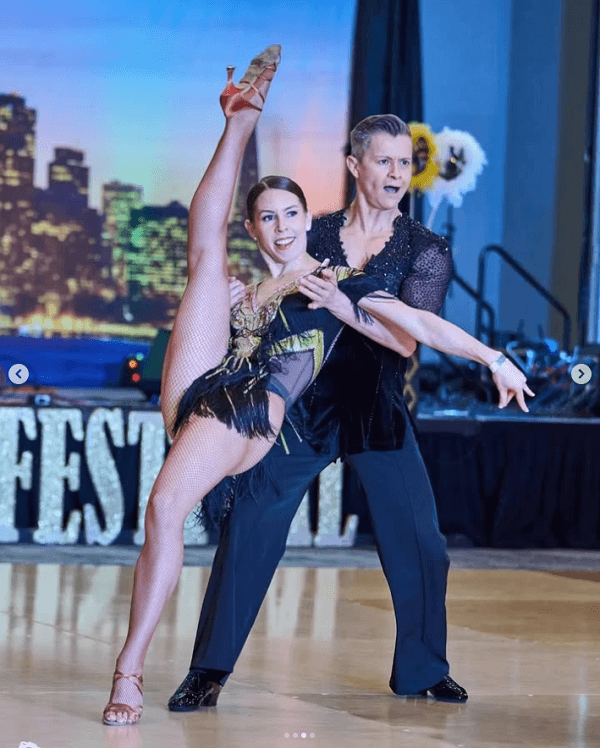
John and Liz dancing
John and Liz dancing at the San Francisco Salsa Festival

What John and Liz have done since the 2025 San Francisco Salsa Festival

After the 2025 edition, John described the rest of the year as sensational because his dance studio has maintained the expected success and his company enjoys the work of of new members who have contributed with their talent to help it grow. In addition to that, their classes are full of people eager to learn to dance, take care of their bodies, keep their minds healthy, and have a more active social life. 

He also recognizes that the Bad Bunny phenomenon helped them a lot, as they’ve welcomed many people who want to learn to dance salsa after the the boom caused by a Super Bowl full of latinidad everywhere. This has also made the celebrated ones at weddings and other family events to celebrate with salsa, so guests do not want to be left behind and seek to dance it as well as possible.

When an event has been organized for 16 years in a row, those involved already have a system by which they are ruled, so there are few surprises that John and Liz could find thanks to so much experience under their belt. However, there may be things that catch them off guard and ,in this case, it was the economy. This time, they found that everything was much more expensive.

After reviewing expenses, they noticed that the flights of the artists and hotel costs were much higher than in previous years, so they were forced to take certain actions, such as hiring fewer dance artists. They were careful to bring only the best they could find to do a tremendous show, which fortunately occurred.

John and Aura dancing
John Narvaez and dancer Aura Moreno dancing at the San Francisco Salsa Festival

They also noticed that many people could not attend the festival, so they offered numerous discounts, press passes, and the opportunity to volunteer for the organization.

Visa problems

The main disadvantage faced by John and Liz last year was the delay in the approval of visas for the members of La Máxima 79, so we wanted to know how it had gone this year. Well, as it turns out, it did happen again and two couples of dancers were unable to attend because their visas were denied, so they had no choice but to invite residents of the United States to prevent that headache. 

Of course, it must be added that bringing people from other places implies additional costs that do not do any good to them right now. For the same reasons, other festival organizers are doing the same thing.

Principal guest artists

The main attractions at this festival were Charlie Aponte, Edgardo Cambón, and Cabanijazz, who of course, did a magnificent job. The big surprise of the festival was definitely Charlie Aponte, with whom they managed to have contact through a well-known Mexican promoter who acted as a link between the dancers and the artist. 

The agreement was made as recently only in January, that is, a couple of months before the event. That is when John contacted Jeannette Santiago, Charlie’s manager and wife, told her who he was, and mentioned the mutual friend they had in common. He then managed to close the deal with her and have the Puerto Rican singer at the event, which came as a very pleasant surprise to those who had been planning to attend for months.

Edgardo Cambón playing
Edgardo Cambón playing at the San Francisco Salsa Festival

Preparations for next year

As every year, after an edition is completed, John and Liz are already thinking about what they will do for the next one. In fact, just the day before this interview, they had a work meeting to start planning everything and thinking about who they will invite for 2027.

They are thinking about inviting La Máxima 79 again. In fact, they have already talked to their lawyer responsible these matters and agreed to carry out the relevant procedures to finally have them at the festival, as they have wanted for a long time. In case the invitation is not given effect, they also have their eyes on Jimmy Bosch and Hermán Olivera. Both have performed in previous editions prior to the pandemic and were sensational, so they are held in good esteem by the organization.

They also mentioned that the venue for the next two editions will continue to be the Marriott Hotel Waterfront, as the location is beautiful and very suitable for an event of this magnitude.

Cabanijazz playing
Cabanijazz Project playing at the San Francisco Salsa Festival

Read also: Uruguayan composer and multiinstrumentalist Sebastián Natal and his band Grupo Sensación

10 The Cuban Salsa Festival

Europe / Germany / Munich

10 The Cuban Salsa Festival, Munich 27 Jan 2017 – 29 Jan 2017

10 The Cuban Salsa Festival Germany, Munich 27 Jan 2017 – 29 Jan 2017

In January 2017, Munich will be able to experience a high class weekend full of dance and music, again. Inspired by “Baila en Cuba”, the annual dance and music event in Havanna (Cuba), we brought this festival to life. And moreover we want to import a part of the wonderful atmosphere of its big Cuban counterpart to Munich.

With the 10th “El Festival Salsa Cubana” We will continue our legendary winter festival series. Salsa Cubana is more than a dance – it’s an attitude towards life! Who does not inevitably associate typical Cuban music, Cuban ambience and Son Cubano (the most traditional of all Cuban dances) with these words?

Festival Salsa Cubana stands for this very diversity. No matter if dancer, music lover or just fancier of the Caribbean atmosphere – you will get your money’s worth!

Cuban atmosphere and total joy of life!

  • Top event for all dancers in and around Munich!
  • Salsa, Afro, Reggaeton and a lot more!
  • Great party with show acts!
  • Taster’s session Salsa Cubana
  • Rueda de Casino: Dancing Salsa with other couples in a circle. Nice combinations with the exchange of the dance partners provide pure fun!
  • Up to 50 workshops with best in class instructors
  • For all dancers and future dancers a “must do”: authentic teaching with guest instructors! From beginner to master class!
  • Awesome and high class parties and show acts!
Photo 1: The Cuban Salsa Festival

Location

The festival is located in the rooms of the CIRCULO. CIRCULO is the biggest dance school for Salsa Cubana in Munich. Additionally, as a salsateca, with legendary salsa parties and a lot of Salsa live concerts, CIRCULO is an integral part of Munich’s salsa scene.

CIRCULO’s address is Rosenheimerstrasse 139, in Munich. With its seven, highly equipped rooms, it is predestined for the realization of all classes and parties that are part of the Festival Salsa Cubana.

The studio in the back has two dance rooms with a bar area. Since the expansion in January 2007, we have 3 additional classrooms with an inviting bar area. And NEW since October 2014, with the latest extension we have another 2 additional rooms with a bar area, which connects the two studios.

Mobile walls separate the single rooms from each other, but can be removed to form one big room for party and dancing. Premises with a very classy interior, a flexible stage excellent quality of light and sound prevent parties and training in greatest atmosphere.

Photo 2: The Cuban Salsa Festival

‘‘El Griego Rumbero’’ visited the Salsa Museum and donated some objects

The artist we will talk about today is a very particular case, since he comes from a country which is not usually related to salsa or Latin music in general. However, the passion for these rhythms has captivated people from all over the world, so it is not surprising that our guest has experienced the same thing.

We’re talking about the Greek-born trombonist and composer Demetrios Kastaris, whom El Rubio Boris and I were fortunate to welcome at the Salsa Museum. Here’s a little of his fascinating story.

Demetrios Kastaris playing
Demetrios Kastaris playing the trombone

Demetrios’ early years

Demetrios was born in Thessaloniki, Greece, but moved with his family to the United States when he was just two years old. After living in Ohio for a few years, the family moved again, but this time to St. Louis, Missouri, a place that would be critical to the training of the Young man in the times to come.

The first contact of the boy with music was in elementary school during a live performance by a classical music quintet, but what really captivated him was a demonstration of a slide trombone by a member of the St. Louis Symphony Orchestra. It was at that instant the aforementioned instrument inspired Demetrios to take trombone lessons and join the school concert band.

More importantly, as Demetrios grew older, he spent countless hours practicing the trombone, especially in summer when he was free from school work. Finally, On reaching the age of 17, his perseverance began to bear fruit, and he got the opportunity to rehearse with the Stan Keaton Jazz Orchestra, which was the first great experience for the teenager. Just one year later, he sang as a soloist at the Classical Rimsky-Korsakov Concerto. 

Other than that, Demetrios received the John Philip Sousa Band Award just before graduating from high school. He then studied music education at the University of Missouri-St. Louis, when he played in the jazz band and won several awards with the group.

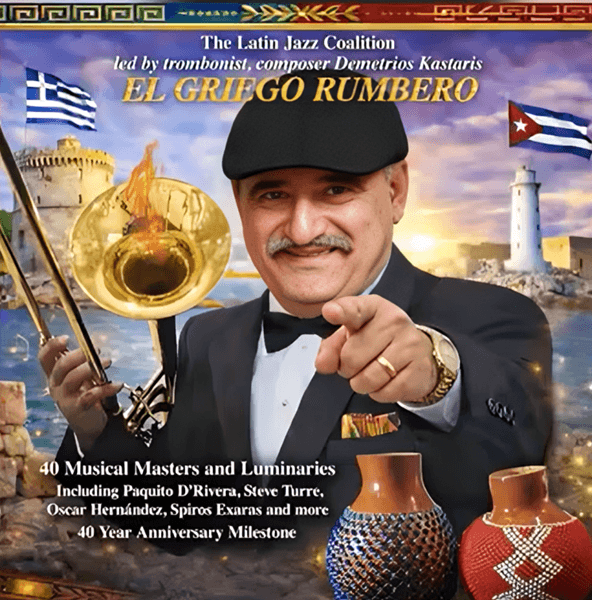
Cover of the album ''El Griego Rumbero''
Cover of the album ”El Griego Rumbero” by demetrios Kastaris

Moving to New York

Two years after having studied in Missouri, Demetrios moved to New York, where he received a scholarship that allowed him to attend New York University and take more steps in his musical career. While completing his studies, he met a bandleader on the subway and was invited to a rehearsal where he was given the opportunity to arrange Afro-Cuban jazz pieces for the first time in his life.

Latin music and its rhythmic features made such an impression on Demetrios that he began attending concerts by many of its great exponents, such as Willie Colón, Eddie Palmieri, Ray Barretto, Tito Puente, Mongo Santamaría, and many others. This led him to transcribe and conscientiously analyze these artists’ songs to satisfy his curiosity and learn more about these rhythms.

After graduating with honors, he earned a masters degree in jazz from the Manhattan School of Music. Soon after, he was already teaching in public schools while performing with one of the bands of the Concord Resort Hotel.

Other important details of his career

For over 50 years of artistic career, Demetrios has had the opportunity to perform with big Latin stars such as Tito Puente, Luisito Quintero, Alfredo De La Fé, Ray Barretto, Charlie Palmieri, Herencia Latina, Oscar Hernández from The Spanish Harlem Orchestra, and many others. 

Already in the decade of 1980, the artist founded the Latin-Jazz Coalition and recorded several of his original compositions in genres such as Brazilian and Afro-Cuban jazz. In certain Circles, his work has earned him the nickname of “El Griego Rumbero”, a moniker by which he is still known today.

Johnny Cruz, Demetrios Kastaris and El Rubio Boris

Much more recently, Demetrios was invited to play with Los Leales de Cuba at the Buena Vista Curry Club and also to rehearse with Los Muñequitos de Matanza, which was a very learning afternoon and a memorable experience for him. Thereafter, he traveled to Cuba on several occasions to learn much more about this music.

Visit to the Salsa Museum

Just two years ago, Demetrios visited the Spanish Harlem Salsa Museum directed by yours truly and spent an enjoyable time with our entire team but he did not come alone. He brought us his photograph and a poster of the Latin Jazz Coalition, which were mounted on a wall alongside many other photographs of stars such as The Fania All Stars, Hector Lavoe, Tito Puente, Celia Cruz, El Gran Combo de Puerto Rico, Larry Harlow, and many others. 

His childhood trombone was also added to our extensive display of objects donated by artists and their families. This took place on March 20, 2024, and the instrument remains at our institution to this day as a reminder of a Greek man’s love for our music and a thank you to his dedication over the years.

Johnny Cruz ISM

Read also: Rey Ruíz visits the Salsa Museum and talks about his prolific career

Jairo Varela Music, Identity, and Social Narrative

The BE MORE publishing house is proud to announce the release of the new book by journalist and music researcher Robert Téllez M.

The work offers a deep dive into the social and narrative dimensions of the compositions of Jairo Varela, founder of the world-renowned Grupo Niche. It illustrates how his lyrics transcend music to become chronicles that interpret Latin American reality.

More than just a repertoire of songs, Jairo Varela’s legacy serves as a testament to memory and identity, born from his profound Afro-descendant roots. From this perspective, the book develops a discourse analysis that explores the symbols and meanings structuring his lyrics within a historical and social context.

Categorized within the field of ethnomusicology, the literary work proposes a rare perspective in Salsa studies: understanding Jairo Varela as a narrator of social reality.

“Through his lyrics, Jairo Varela challenged indifference, exposing what many preferred to keep silent,” states author Robert Téllez M.

To develop this research, the author brought together an interdisciplinary team of specialists in anthropology, communication, law, education, history, linguistics, music, journalism, and poetry from across Latin America. This diversity shapes a study organized into seven chapters, where symbols, metaphors, and narrative structures within Varela’s songwriting are analyzed and deconstructed.

“With an honesty that never yielded to artifice, Jairo Varela mapped the social landscape of everyday life; he narrated the intimate without betraying the collective, all in an effort to better understand the world,” Téllez notes.

As an innovative feature, the book Jairo Varela: Music, Identity, and Social Narrative incorporates QR codes that lead directly to Maestro Varela’s compositions. Each code allows the reader to use their mobile device to access the songs analyzed via Grupo Niche’s profile on Spotify, enhancing the connection between the written word and musical creation.

The publication also includes a prologue by writer Bella Martínez, illustrations by Frank Rosado, and photographs from the Varela family archive—elements that provide essential context to the composer’s creative universe.

Jairo Varela: Music, Identity, and Social Narrative is now available to the public on Amazon, with worldwide shipping.

The Book: Jairo Varela. Music, Identity, and Social Narrative

Jairo Varela (1949–2012)

Varela was the creator and founder of the iconic Grupo Niche and one of the most influential figures in Colombian Salsa. It was Jairo Varela who built the prestige of this orchestra through his artistic vision and his talent as a composer and director. With those five letters Niche Varela changed the course of Salsa made in Colombia, elevating it to a level of international respect.

Jairo Varela. Música, Identidad y Narrativa Social

Throughout his musical career, Jairo Varela wrote hundreds of songs and produced dozens of albums for his group. His compositions including “Cali Pachanguero” (recognized by Billboard magazine as one of the 50 most important songs in the history of Latin music), “Buenaventura y Caney,” “Mi pueblo natal,” “Ana Milé,” “Un caso social,” and “Han cogido la cosa” have traveled the world and become classics. In his lyrics, Varela portrayed everyday Latin American stories and the identity of Afro-descendant communities.

When Grupo Niche’s music plays, there is something for every listener. Behind that diversity lies the creative intuition of Jairo Varela, a composer who knew how to turn local stories into universal emotions. For this reason, from its beginnings in the late seventies to its international acclaim, the group has brought the rhythmic power, joy, and character of its culture to stages worldwide.

About the Author

Robert Téllez M. is a social communicator, radio and TV broadcaster, and producer with over 20 years of experience. He is an accomplished interviewer, journalist, and music researcher.

His analyses and reflections have been published in outlets such as Revista Semana, El Espectador, El Tiempo, El País, La República, and Agencia EFE, among others. He has also contributed to the scientific journal Nómadas of the Universidad Central de Colombia.

Robert Téllez is also the author of Ray Barretto: Giant Force (2016), whose English translation won a silver medal for Best Translation (Spanish to English) at the 2021 International Latino Book Awards.

In 2019, he presented the authorized biography Willie Rosario: The King of Rhythm, with a second edition released in 2024. He served as a judge for the annual international minimalist poetry contest for the anthology titled Siglema 575: Say What You Want to Say (2024).

As a result of his extensive research, Robert Téllez serves as a consultant and lecturer on topics related to the appreciation of Salsa music.

Press Contact: [email protected]


Roberto Tellez

Also Read: Willie Rosario, El Rey del ritmo by journalist and music researcher Robert Téllez M.

  • « Go to Previous Page
  • Page 1
  • Interim pages omitted …
  • Page 4
  • Page 5
  • Page 6
  • Page 7
  • Page 8
  • Interim pages omitted …
  • Page 300
  • Go to Next Page »

International Salsa Magazine (ISM) is a monthly publication about Salsa activities around the world, that has been publishing since 2007. It is a world network of volunteers coordinated by ISM Magazine. We are working to strengthen all the events by working together.