• Skip to primary navigation
  • Skip to main content

International Salsa Magazine

  • HOME
  • Previous editions
    • 2026
      • ISM / March 2026
      • ISM / February 2026
      • ISM / January 2026
    • 2025
      • ISM / December 2025
      • ISM / November 2025
      • ISM / October 2025
      • ISM / September 2025
      • ISM / August 2025
      • ISM / July 2025
      • ISM / June 2025
      • ISM / May2025
      • ISM / April 2025
      • ISM / March 2025
      • ISM / February 2025
      • ISM / January 2025
    • 2024
      • ISM / December 2024
      • ISM / November 2024
      • ISM / October 2024
      • ISM / September 2024
      • ISM / August 2024
      • ISM / July 2024
      • ISM / June 2024
      • ISM / May 2024
      • ISM / April 2024
      • ISM / March 2024
      • ISM / February 2024
      • ISM / January 2024
    • 2023
      • ISM / December 2023
      • ISM / November 2023
      • ISM / October 2023
      • ISM – September 2023
      • ISM – August 2023
      • ISM July 2023
      • ISM Edition June 2023
      • ISM – May 2023
      • ISM April 2023
      • ISM March 2023
      • ISM February 2023
      • ISM January 2023
    • 2022
      • ISM December 2022
      • ISM November 2022
      • ISM October 2022
      • ISM September 2022
      • ISM August 2022
      • ISM July 2022
      • ISM June 2022
      • ISM May 2022
      • ISM February 2022
      • ISM January 2022
    • 2021
      • ISM December 2021
      • ISM November 2021
      • ISM October – 2021
      • ISM September 2021
      • ISM August 2021
      • ISM July 2021
      • ISM May 2021
      • ISM April 2021
      • ISM June 2021
      • ISM March 2021
      • ISM February 2021
      • ISM January 2021
    • 2020
      • ISM December 2020
      • ISM November 2020
      • ISM October 2020
      • ISM September 2020
      • ISM August 2020
      • ISM July 2020
      • ISM June 2020
      • ISM May 2020
      • ISM April 2020
      • ISM March 2020
      • ISM February 2020
      • ISM January 2020
    • 2019
      • ISM December 2019
      • ISM November 2019
      • ISM October 2019
      • ISM Septembre 2019
      • ISM August 2019
      • ISM July 2019
      • ISM June 2019
  • Spanish
  • Download Salsa App
    • Android
    • Apple

Search Results for: Salsa

The interesting story of French percussionist Dominique Patrick Noel

How his career started

All right, so we are here with French percussionist, composer and musician Dominique Patrick Noel. How are you doing, Mr. Noel? A pleasure to have you here.

Well, thank you. First of all, I want to thank you for taking the time to interview me and to greet all those who is going to read it. Thank goodness, I am in good health and it is all good.

Dominique Patrick Noel tells us about his story and beginnings

You are a self-taught musician who started playing by age seven. Did you learn everything by yourself or did you receive some kind of training?

Since I come from a family of musicians such as my father and my two grandfathers, I can say that music has always been a part of my life. I started playing the drums by listening to a lot of jazz and fell in love with this genre. That’s how I started to develop the movements and patterns of jazz and the drums.

In school, I started playing and learned solfège, percussion, drumming, among other things. When I turned 15 years old, I started playing music at a pro level because I have always had the pleasure of learning by watching musicians, who had much more experience. Thank goodness, I had my mind fresh to grasp and remember what I had seen, which helped me a lot to continue developing in percussion, different instruments, rhythms, among other things.

When I started playing Latin music, my first instrument was the bongo. I had a mentor named Alfredo Mujica Jr.,m who knew my dad and learned by playing with him. When it was my turn, he was giving the task of helping me understand the patterns and other things. He told me that the best instrument I could choose to start with was the bongo because it would help me understand a little more about how salsa works and that helped me a lot. He showed me the basic pattern and how to imitate the sounds I heard until they were similar.

After that, I also learned to play the conga, the Dominican tambora, the güira, the batá, the cajon and the timbales.
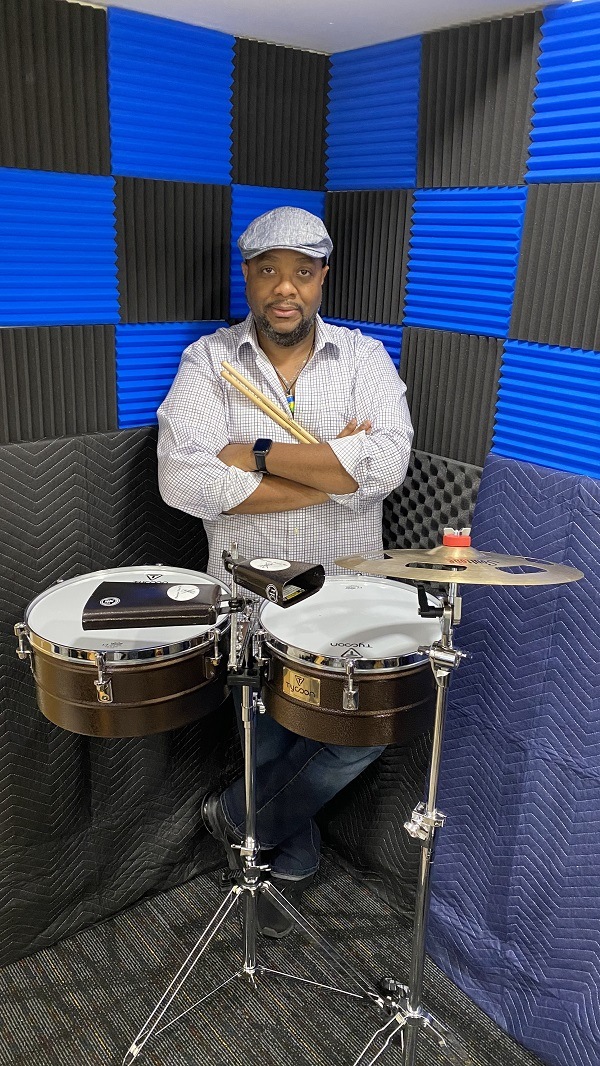
His career started at the age of 15 and his first instrument was the bongo

When you played the bongo for the first time, did you know you wanted to dedicate yourself to the Latin genres permanently?

When I was nine years old, I moved to Martinique and lived there for about four years. There I was fortunate to learn its folklore, its rhythms, its typical instruments and its dances. I also learned to perform all those genres with the drums and tried to absorb all I saw. Concurrently, the zouk era was beginning and I fell in love with the genre since I heard it for the first time.

Sometime later, my dad and I went to the United States to be with my dad, who was living in Washington at the time. It was there where I started to accompany him in several of his activities and shows with his orchestras. Then, I began listening more to salsa, cumbia and merengue, something I liked very much. Then, I told him that I would like to learn what he knew and play with him, to which he replied that it looked good, but that it was a profession that I had to take very seriously. Therefore, he advised me to listen to everything, even if it wasn’t Latin music because all genres nurture the musician in one way or another.

With whom he has worked?

You have worked with Tito Puente Jr, Tito Rojas, Izis La Enfermera de La Salsa, Frankie Vasquez, Lalo Rodriguez, among others. What have you learned from them?

I have had the opportunity to play with maestro Tito Rojas and his musical director, Celso Clemente, gave me some advice. When rehearsing, I approached him to thank him for allowing me to play the bongo with them and ask him for advice for my career, to which he replied that he liked my work very much and that I was very good for someone who was not born in this Latin music environment.

He also advised me that I had to move forward, never play down my goals, accept constructive criticism and always stay humble. I will never forget his words.

Dominique Patrick Noel next to Gloria Estefan and Emilio Estefan

We know that you are a voting member of the National Academy of Recording Arts and Sciences, which is well known for giving the Grammy Awards. What do you base to vote for a nominated candidate for an award?

There are several processes for artists to be nominated. For us the voters, it is a long process because we have the task of listening to much music and analyzing many details such as recording quality, lyrics, musicality and much more. There are many important elements to consider when choosing the person. I want to get to the point of saying that someone really deserves my vote for this or that category.

Voting takes time. It’s not something that you do in an hour or two, it takes a long time. The day of the awards ceremony, we already know who will the winners. At that point, we can say that all of them have managed to win via an arduous selection process.

Tell us about your song Mi Secreto with D’ William.

The skeleton of the song was my idea and I got together D’ William, to whom I offered to join the song. He wanted to collaborate with me in a merengue song for some time and I sent him the skeleton, which he liked and told me that something could be done with it. When he asked me if I already had the lyrics, I said no, but I wanted to base the song on an experience of mine, so I told him what it was about and the lyrics were written about that fact. Later, we made some additional arrangements and that’s how Mi Secreto was born.
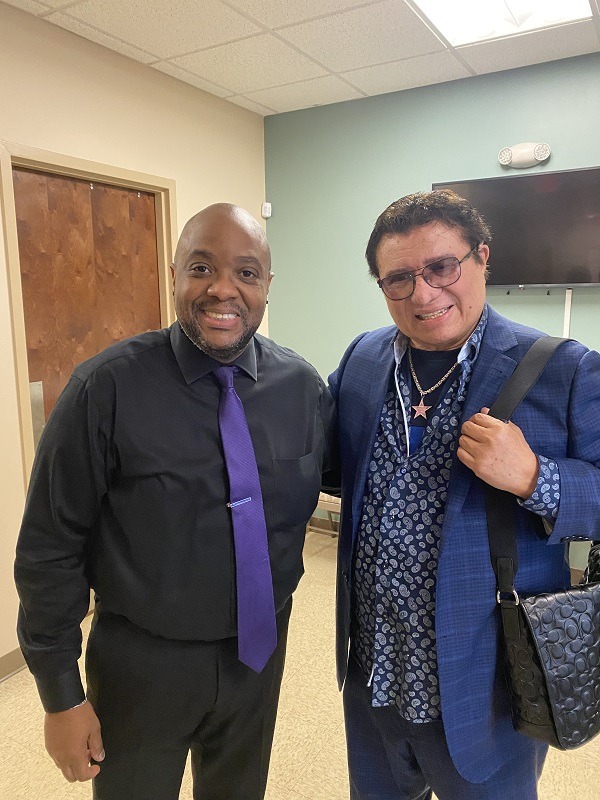
Dominique Patrick Noel next to Bobby Cruz

Read also: Earl Miranda and Ric Feliciano talk about the Latin Rhythm Boys and its history

We interviewed IndiviDúo singers Tiffany Joy and Maqui Reyes

How it all started

Today we are going to talk with Tiffany Joy and Maqui Reyes from IndiviDúo, which is a famous and successful musical duo. Great to be with you. How are you?

Tiffany: super! Very well, thank you very much.

Tiffany Joy singing on stage

You two met in 2010 in Buenos Aires while both were recording your respective musical productions separately. How was that first meeting and conversation about music?

Tiffany: you are very well informed, Karina, I love it. We met at a musical party for Colombians living in Buenos Aires. We were introduced by a mutual friend, who is also from the US, but she was living in Buenos Aires at the time. Maqui had invited me to that event through Facebook, so I went with my guitar and a liter of beer. There was a moment when he started singing ohis riginal music and I do the same later. I think that’s where a connection and mutual respect began to be created, which led to us singing together later that night.

He sang Tabaco y Chanel by Bacilos and since I knew it by heart, I started singing the harmonies. The time when our voices found each other was very magical and everyone at the party thought something beautiful was happening there. Really, since that night we haven’t stopped singing and composing music together.

What did you see in each other to form a musical duo?

Tiffany: I think Maqui has a special sensitivity towards lyrics and I admire his role as a poet. In addition, he also has a musicality related to my tastes, so it is very common for us to be on the same page about some melodies with the guitar. Melodically, I feel that we get along very well.

Obviously we don’t agree on everything all the time, but I do think we have very similar taste in music, which makes us be attracted each other musically. Personally, my partner has a very powerful energy in terms of positivity, light, pushing forward and making everyone feel special.

Maqui Reyes singing and playing the guitar on stage

What has been the biggest disagreement that you’ve had musically?

Tiffany: generally speaking, I tend to fall in love with ideas so fast. If I hear a chord, progression, melodic line or lyrics that I like, I don’t want us to change them. On the other hand, Maqui is super thoughtful and likes to try a lot of things before going back to the first thing and even make it better, but I think my anxiety about finishing it and singing it sets us at odds. He is very slow in terms of his process and that makes us different.

Considering that Maqui is Colombian and you are Californian, how did this influenced your musical styles?

Tiffany: Maqui is from Bogota while I am from right here in the Bay Area. I grew up listening to James Taylor, Kenny Loggins and the great singer-songwriters in blues, jazz and other typically American genres. I also did musical theater for many years, which led me to listen to the great Broadway plays. My love for Latin music began much later when I started listening to pop artists like Juanes, Shakira, Rocky Martin, Bacilos, among others. Then, I entered into the world of Latin music and started composing in Spanish. To that I must add that I loved dancing salsa and tango since I was really little.

On the side of Maqui, he comes from a completely different music background where he listened to salsa, bambuco, cumbia, merengue and many other Latin genres. Later, he moved to Argentina where he lived for 13 years and traveled throughout the country to learn to play chamame, samba and other Argentinean rhythms. This made him have a huge range of Latin American music, which we incorporate into our music. That is why our repertoire includes reggae, bolero, pop, salsa, rock, bossa-nova and much more.

Tiffany Joy and Maqui Reyes performing together

How do you connect with your audience?

Your music talks about many positive and reflection messages. It talks a lot about all the important things we humans put aside because we are way too concerned with superficial things. In that sense, what kind of connection are you looking for with the audience?

Maqui: among the responsibilities of a singer-songwriter or a musician, we have to say some important things, so we believe and live the music like that. The subject treated in a song has always been important to us.

I think we have managed to connect with ourselves and people like you who, for some reason, get to listen to one of our songs and identify with it. Songs like Pelea invite you to fight against your own vices, your own demons and your own problems. It is a song that people of any age can identify with, which leads us to have a connection with them beyond music.

What are the age ranges of the people who listen to your music the most?

Tiffany: I would venture to say that those who listen to us the most are people between 25 to 55 years old.

Maqui: However, I must say that we get along very well with children. When we play in theaters or places suitable for minors, there are many families with children. In fact, we don’t rule out recording an album focused exclusively on them. Of course, we know that children don’t like the more traditional genres that we used to listen to and reggaeton is the current trend. Same way, we would include some traditional music so that little ones have the opportunity to listen to it in a fun way.

Tiffany Joy and Maqui Reyes during pregnancy

On that issue, a young salsa singer told me that what he does is a mix of rhythms, while still getting the essence of salsa. Do you plan to add urban genres to your music?

Tiffany: We don’t reject the idea of incorporating urban rhythms to our music because they are good to dance to, easy to defend live and attractive for a generic and large audience. We haven’t yet, but we are open to the possibility.

Maqui: this is a great question because everything has become polarized so much that just listening to the rhythm makes us qualify it as urban, but that’s not necessarily true. What I qualify as urban is attitude and lyrics, things that we know we will never adopt for ourselves.

It’s not our style, although we’ve got nothing against these rhythms. We would like to play them in a more elegant and familiar way.

Tiffany Joy, Maqui Reyes, and their daughter Melody

You have been part of the soundtracks of several soap operas such as La Ley del Corazón and Si Dejo de Creer. How did this help you advance your careers?

Tiffany: It helped us get a little more exposure on Spotify, YouTube and other music platforms. It also gave us the opportunity to be much better known, as many people started to see what else we’ve done and listen to other pieces of ours.

What did you do during the pandemic?

Tiffany: because all the shows being cancelled, we dedicated ourselves to hosting a Facebook Live every Friday afternoon. At the beginning, it was very difficult because we didn’t know how to connect, but when we finally learned how to do it, we had a lot of people listening to us. We played original music, did a lot of covers, had a drinkie and toasted people from time to time.

During this time, we also found out we were pregnant, which was a surprise for us because we never thought about having children. We were composing at the time, so we ended up including a song for the baby on our album. Right when Melody (our daughter’s name) was born we did the official album release.

Read also: Story of achievement and dedication of Yoshie Akiba

Tickets

This is where you can purchase tickets for International Salsa Magazine’s events at Charley´s Los Gatos.

MyTicket Listing

Johnny Cruz Present – September 2022

Home

Tribute to Larry Harlow about a year after his departure

Tribute to my friend Larry

It is now a year since the unfortunate departure of one of the greatest icons of Latin music, who is none other than the one and only producer, composer and pianist Larry Harlow. Let’s remember that he passed away on August 20, 2021 in a health center located in the Bronx at the age of 82. His death was caused by heart failure due to a kidney condition from which he had been suffering from for some time.

“El Judio Maravilloso” passed away on August 20, 2021

A little of his history

The also known as “El Judio Maravilloso” has a great success story behind him in the field of music, which began with the occupations of his parents. Recall that his mother was an opera singer and his father was a musician in the orchestras of Barrio Latino, which could explain his interest in the industry when he was very little. From a very young age, little Harry already handled certain instruments in a skilled way, showing what he could dedicate himself to in the future.

His great interest in Cuban music and culture led him to travel to Cuba, where he began his musical studies related to Afro-Cuban music. Unfortunately, the arrival of the Cuban Revolution prevented him from fulfilling his task and he had to leave the island prematurely due to the political crisis that started to develop.

Since then, the Harlow Orchestra became one of the first groups to be formed with the label of Fania Records. At the same time, Harlow was producing an tremendous amount of albums, both his and other musical stars’, catapulting him to becoming one of the most respected producers of that time. Reportedly, there were approximately 270 records in total, which gave us a lot of hits that continue to be heard to this day.

One of his greatest achievements was to have brought the world famous Cuban singer Celia Cruz to New York, thus becoming the first artist of Latin origin to perform at the Carnegie Hall, a famous concert hall located in Manhattan that had only had room for Anglo-Saxon artists until that time. It was “El Judio Maravilloso” who managed to bring Latin America to the Carnegie Hall for the first time from the hand of “La Guarachera de Cuba”, something unthinkable in those years.

Larry Harlow and Johnny Cruz in the 80’s

He also had an important role in the film “Our Latin Thing”, along with several transcendental figures of the Fania All Stars.

Relationship with the Spanish Harlem Salsa Gallery Museum

It is of common knwoledge that Larry and this server had a close relationship, since we knew each other for many years and lived many incredible experiences related to this wonderful genre called salsa. That is why the famous pianist sent me some of his most precious costumes to be exhibited in our gallery so that all his fans could be as close as possible to their idol.  After his departure, seeing all those things donated by him leaves a deep emptiness in those who see them, but at the same time this reaffirms our commitment to offer our public the best salsa exhibittions they have ever seen.

Larry has left an indelible mark in the hearts of all of us who got to know him during his lifetime, but our duty is to move on with our heads held high.

Harlow and Cruz in 2018


By Johnny Cruz, ISM Correspondents, New York, New York City

  • « Go to Previous Page
  • Page 1
  • Interim pages omitted …
  • Page 300
  • Page 301
  • Page 302
  • Page 303
  • Page 304
  • Interim pages omitted …
  • Page 397
  • Go to Next Page »

International Salsa Magazine (ISM) is a monthly publication about Salsa activities around the world, that has been publishing since 2007. It is a world network of volunteers coordinated by ISM Magazine. We are working to strengthen all the events by working together.